
Home Blog Page 830

Delhi Metro | CMRS starts inspection of Botanical Garden-Kalkaji Mandir section of Line-8

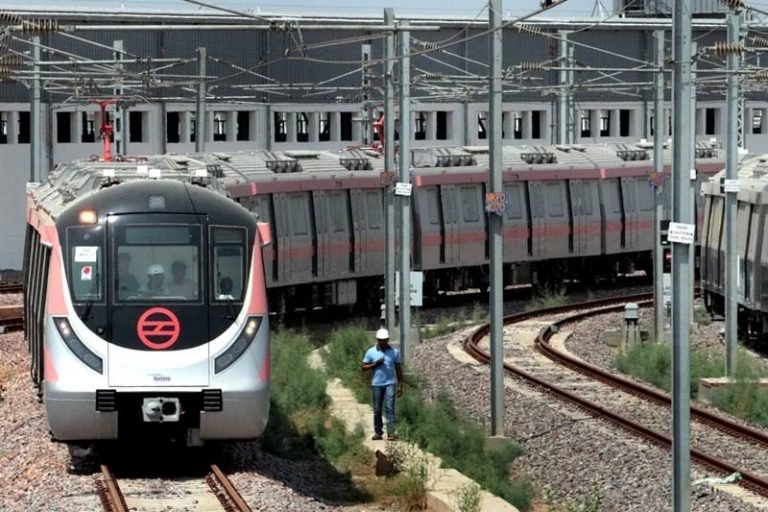
New Delhi: The Commissioner of Metro Railway Safety (CMRS) has started statuary inspection of 12.64 km long stretch between Botanical Garden and Kalkaji Mandir of Line-8 (Magenta Line) of Delhi Metro Rail Corporation (DMRC) from today at 9.45 am. The inspection will be carried out in three days from 13th November to 15th November according to the programme. This is 6th round inspection being carried out by the CMRS and his team. After getting final and satisfactory inspection report from CMRS, the section will be opened for public.

The team of CMRS inspection is comprised with Sh. Rakmal Khoiwal (Dy.CRS/S&T/NDLS), Sh. Shalabh Tyagi (Dy.CRS/ET/LKO), Sh. Rajeev Kumar (Dy.CRS/G/LKO), Sh. Uttam Prakash (Dy.CRS/Mech/LKO) and Smt. Indu Dubey (Dy.CRS/Optg./LKO).

This section of the line-8 includes 9 stations at Kalkaji Mandir, Okhla NSIC, Sukhdev Vihar, Jamia Milia Islamia, Okhla Vihar, Jasola Vihar Shaheen Bagh, Kalindi Kunj, Okhla Bird Sanctuary and Botanical Garden. While Kalkaji Mandir is underground, all other stations are elevated. The UTO metro train will be run in this section and will originate from Kalindi Kunj Metro depot.

This first trial test run in this corridor has been started in October 2016.

If CMRS team find the section fit in all aspects then this corridor will be opened to public in last week of this month subject to availability of local ministers and schedule of Ministry of Housing and Urban Affairs.

Delhi Metro | DMRC to sale IITF 2017 tickets at metro stations from Nov. 14

New Delhi: Like previous years, the Delhi Metro Rail Corporation (DMRC) will start selling India International Trade Fair (IITF) entry tickets for business as well as general public from 14th November 2017 to 27th November 2017. The IITF entry tickets for general public days (18th Nov to 27th Nov 2017) will be available at all the Metro stations including Airport Express Line except Pragati Maidan.

According to press release issued by DMRC, trade fair tickets for Business Days (14th Nov to 17th Nov 2017) will be available only from 42 Metro stations.

pressimage11007
List of stations where trade fair tickets will be available for sale for business days only 

Lucknow Metro | LMRC starts track laying work in the underground section

Lucknow: The Lucknow Metro Rail Corporation (LMRC) today started the work of track laying in the underground Metro section between Sachivalaya & Hazratganj. The track laying commenced after performing ceremonial ‘puja’ at the Sachivalaya underground Metro station site by Shri Kumar Keshav, Managing Director, Lucknow Metro.

LMRC UG
Pooja ceremony by LMRC Chief Kumar Keshav before begining the work

The first track will be laid from Sachivalaya to Hazratganj inside the tunnel. LMRC is using the Mass Spring System (an Elastomer pad of 25mm thickness) below the track bed for construction of track. Mass Spring System, procured from Austria, eliminates the problem of vibration and sound in adjoining structures of the underground portion.

For the construction of track, first of all Elastomer Mass Spring System sheet is laid, then reinforcement mesh is laid over this and then it is filled with concrete up to the rail bottom. Rails are wielded continuously to avoid any joint in the rails.

Lucknow Metro has started the track work one month earlier than the scheduled planning keeping in view the overall project completion. Track laying between Sachivalaya and Hazratganj will be completed by next month.

The rails have been are procured from Japan and its fittings are procured from Germany. The track laying work is being done by M/s Kalindee Rail Nirman which was also doing the track laying work on the viaduct portion of the North – South corridor.

Mumbai Metro | MMRC begins tunnelling work for Metro 3 project at Naya Nagar

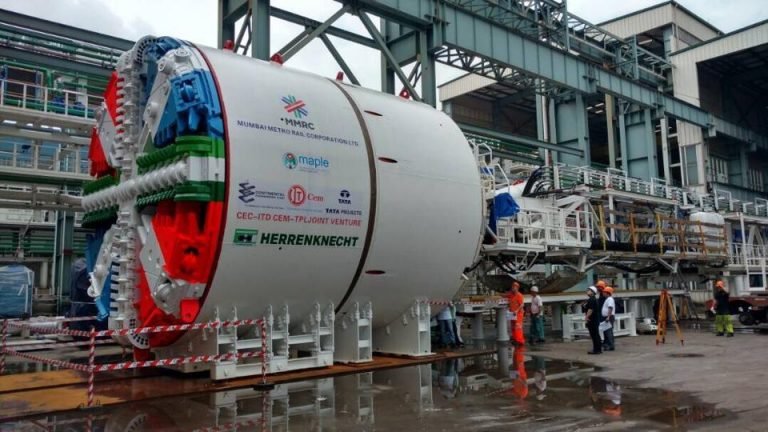
Mumbai: Work on constructing the first-ever tunnel in Mumbai for the fully underground Metro 3 line began at the Naya Nagar site in Mahim on Friday, with two more tunnel boring machines (TBMs) lowered to dig towards Dadar.

Naya Nagar is one of the seven ‘launching shafts’ from where tunnelling operations will be conducted. The others are at Cuffe Parade, Azad Maidan, Worli, Kalina, Sahar Road and Marol Naka. Azad Maidan is the next site where tunnelling work will start, said Ashwini Bhide, Managing Director, Mumbai Metro Rail Corporation (MMRC).

“This phase of tunnelling will be completed by 2019,” said Ms. Bhide.

In all, 17 TBMs will be deployed to construct the two 33.5-km long tunnels. Five TBMs have arrived in the city, one of which is still at the Mumbai port. Of the rest, three have been lowered into the launching shaft and one has started tunnelling. “By November-end, all five machines will be operational,” Ms. Bhide said. The first boring machine was lowered in September, and needed around 45 days to be assembled.

Seven machines, whose factory acceptance test has been completed, are in various stages of transit. The factory acceptance for the remaining five will be done in the next two months. “By March 2018, every site will have at least one machine at work,” she said.

Tunnelling operations will be carried out 25-30 metres underground using an Earth Pressure Balance (EPB) device. “Mumbai sits on hard basalt rock, which is not mixed with soil. While this provides a certain degree of safety while tunnelling, it also increases the time required for the work,” Ms. Bhide said. Each machine’s speed will be between eight and 14 metres per day. “One can expect a daily average of approximately 11 metres of tunnelling,” she said.

Ms. Bhide said that Mumbai’s linear design left them with no option but to work on the main thoroughfares, which makes it more challenging to build a Metro in Mumbai as compared to other cities. The Metro stretch from Aarey Colony to Bandra Kurla Complex (BKC) will be commissioned by June 2021, while the entire route is expected to be completed by December 2021.

Chennai Metro | Land survey begins for 2nd phase of metro rail project

Chennai: Though the second phase of the city metro rail project is still awaiting Centre’s approval, Chennai Metro Rail has begun field surveys and has initiated talks with the revenue officials in Chennai, Kancheepuram and Tiruvallur district to acquire lands for building the metro lines. The 108.4 km phase-2 project will connect several parts of the city suburban areas including Madhavaram and the IT corridor along Old Mahabalipuram Road.

The Rs 44,000 crore project will have three corridors running across the length and breadth of the city connected by 104 stations. Survey along the corridors to map land and buildings on the alignment route have begun, a metro rail official said. Land that may be temporarily required for construction of lines are also being considered. “This will make it easy when the notices are issued to the land and building owners for acquisition,” the official said.

The  Rs 44,000 crore phase-2 project will have three corridors running across the length and breadth of the city connected by 104 stations.

While the project, which will cover more than double the distance covered by the two corridors of phase-1 corridors, is awaiting approval from the Centre, CMRL has also appraised a team of officials of Japan International Cooperation Agency for funding of the project. “We are expecting to sign an agreement with JICA by March or April 2018. By that time, procurement process will also start,” said S Krishnan, principal secretary , planning, development and special initiatives, recently .

CMRL has kick started work for the second phase even as the construction of the 45km phase-1of the project is nearing completion. They began preliminary work for acquiring lands before they received approval for the phase-1 extension project that is being built to North Chennai with the rest of the city .

CMRL officials are also simultaneously holding meetings with the district revenue officials of Chennai, Kanchipuram and Thiruvallur , where the metro corridors are planned for the phase, to oversee the survey and eventual acquisition of land which will include issuance of notices to land and building owners and handling documents for the actual acquisition. “We are waiting for the detailed project report to be approved to start land acquisition process,” said an official with the district administration.

An official said a proposal has also been sent to the state to recruit more people capable of handling the land acquisition process as they would be dealing with the acquisition of more area of land than in phase-1 before they begin the actual construction.

Haryana Metro | State asks for report on Gurugram-Faridabad Metro link

Gurgaon: The Haryana Mass Rapid Transport Corporation (HMRTC) has been asked to prepare a feasibility report on a proposed Metro route between Sector 45 in Gurgaon and Bata Chowk in Faridabad via Gwalpahari.

The instruction was passed on during a high-level meeting chaired by chief secretary DS Dhesi in Chandigarh on Tuesday, in keeping with chief minister Manohar Lal Khattar’s announcement earlier.

During the meeting, another proposed route to connect Rapid Metro’s Section 55-56 station with Dwarka Expressway via SPR also came up for talks.

Talking about the proposed Gurgaon-Faridabad route, officials, privy to the minutes of the meeting, said the proposed route would start at Sector 45 in Gurgaon, run along Gurgaon-Faridabad road via Gwalpahari and culminate at Bata Chowk in Faridabad.

“Initially, we had thought of connecting the two cities via Tughlakabad. Accordingly, last June, we had asked the Delhi Metro Rail Corporation (DMRC) to conduct a feasibility test. But, in its report, DMRC had claimed that the existing Violet line (line 6) was running almost parallel to the one being planned and therefore, there was no point constructing one more route. Now, we are considering an alternative route via Gwalpahari and HMRTC has been asked to look into its feasibility,” said a senior official.

“However, the exorbitant cost that would be required to connect the two cities of Haryana remains a matter of huge concern. Besides, there may not be enough commuters as major parts along the proposed route have very less population. So, we want to get a feasibility study done before finalising the route,” he said.

Hyderabad Metro | PM Modi expected to flag off metro services on Nov 28

Hyderabad: Municipal Administration and Urban Development Minister KT Rama Rao on Monday informed that Prime Minister Narendra Modi is expected to launch the Hyderabad Metro Rail on November 28.

The final confirmation is awaited from the Prime Minister’s Office. However, with the Prime Minister’s confirmed visit to the city on November 28 for the Global Entrepreneurship Summit, the Metro Rail could also be inaugurated on the same day.

Previously, KTR said that feeder services connecting residential colonies to the Metro Rail stations will include both electric vehicles and conventional buses that will be operated to cover a distance of three to four kilometres from the stations.

The Minister at the valedictory session of the 10th Urban Mobility Conference in Hyderabad stated that bicycles also will be available at the stations to promote cycling and encourage eco-friendly transportation mode.

Bangalore Metro | BMRC to sign a € 300-m loan deal with AIIB

Bangalore: The Bangalore Metro Rail Corporation (BMRCL) is expected to finalise a 300-million loan (Rs 2,275 crore) from the Asian Infrastructure Investment Bank (AIIB) in the next two days. The loan will have a 15-year tenure and comes with a 2.2% rate of interest.

The Beijing-headquartered bank is owned by several Asian countries and India is its second largest stakeholder. The BMRCL’s response follows AIIB’s offer of loan to fund Phase II of the Namma Metro project on reasonable terms.

The AIIB team has already had four rounds of discussions with BMRCL officials in Bengaluru. A BMRCL delegation led by managing director Pradeep Singh Kharola is in Beijing to close the deal. The final round of negotiations is scheduled for Nov 8-9.Once the terms are finalised, the Department of Economic Affairs (DEA) of the Union government is expected to sign the finance contract in about two months paving way for the flow of funds.

The Luxembourg-based European Investment Bank (EIB), which is cofinancing the project along with AIIB, has committed a loan of 500-million (Rs 3,770 crore).

The DEA and EIB signed the contract for the first tranche of 300 million last month for reach six (R6) of Metro Phase II. This apart, BMRCL has also borrowed 200 million (1,508 crore) from AfD, France. All these loans have flowed in through the DEA channel.

Phase II is being financed jointly by EIB (500 million) and AIIB (300 million). The project envisages extension of east-west and north-south lines covering a length of 72 km, including the underground length of 13.8 km. The project will have 61 stations with 12 underground. The project is implemented over a five-year period from the date of launch.

The BMRCL has estimated Phase II to cost Rs 26,000 crore. Of the project cost, 60% will come from loans, while the Union and the state governments will chip in the rest by equally sharing the project equity . Work under Phase II is progressing in full swing, Kharola said. The BMRCL, he added, will complete the first reach next year and has targeted to complete Phase II in 2020.

The work on both Kanakapura Road and Mysuru Road extensions are according to schedule and will be completed next year.

The spinoffs of the project, a DEA press release last month said, would include job opportunities, a drop in the number of vehicles on road, reduction in air pollution, faster travel and improvement in the aesthetic value of the city, among others.

Vice President M Venkaiah Naidu, at a conference on Saturday, mentioned how Bangalore Metro is pursuing innovative ways to finance its project by trying to capture the land value that are going to be benefited by the project.

Mumbai Monorail halts services due to fire in a monorail, no casualties

Mumbai: A monorail train caught fire at Mysore Colony station in Chembur on Thursday morning. Services have been stopped immediately after the incident took place, and are likely to resume only in the afternoon.

Sources said that the fire broke out at 5.20 am and was brought under control in around 40 minutes. Three fire brigade vehicles were rushed to the spot to put it out.

Mono Rail fire

As it was early morning, there was no rush at the station when the fire broke out. No commuters were injured.

On condition of anonymity a fire brigade official said, “Prima facie, it looks like the fire was caused by a short circuit.”

Currently, the Mumbai has one monorail line which runs along a 9 km route, covering seven stations, from Chembur to Wadala. The trains run from 5am to midnight daily.

MEGA Metro | Hyundai Rotem bags contact for supply of 96 metro cars

The METRO-Link Express for Gandhinagar and Ahmadabad (MEGA) has awarded Hyundai Rotem a US 159 m contract to supply 96 metro cars for Ahmadabad Metro Line 1.

The metro cars will be assembled at Hyundai Rotem’s plant in Changwon, Korea. Delivery of the ordered cars excepted between April 2019 and July 2020.

The first phase of the metro network in Gujarat’s largest city comprises the 20.7km Line 1 from Vastral Gaam in the east to Thaltej Gaam in the west, and the 18.5km north-south Line 2 from Motera to APMC. Construction began in 2015 and Phase 1 is due to be completed by 2023.