



ഈ വാർത്ത കേൾക്കുക
0:00
NEW DELHI (Metro Rail News): Railways has made significant investments in improving and expanding its network in recent years. This technique has aided railways in meeting rising transportation demands. Railways have demonstrated operational excellence while benefiting from high GDP growth. Railways' capex increased from Rs 53,989 cr in FY14 to Rs 1,90,267 cr in FY22, with a provision of Rs 2,45,800 cr made for FY23. The current year's expenditure trend has been positive, and the budgeted capex target is expected to be met.Higher capital investments, frequent monitoring, and timely settlement of inter-ministerial issues will aid in linking the hinterland with the completion of important projects in J&K, Uttarakhand, and the North East States. The commissioning of Dedicated Freight Corridors (DFCs) and other key throughput augmentation projects will result in increased capacity. These initiatives, together with the acceleration of the Bullet Train project, will benefit the construction industry by creating jobs. Railway capital investments have a massive multiplier effect on the economy as a whole.The downward trend in modal share has been reversed, and Railway has loaded an additional 184 MT in FY22 and 75 MT in FY23 till the end of November 2022. Railway receipts have entirely recovered from the negative impact of the pandemic experienced in the previous three years in the current fiscal, and until the end of November'2022, they have grown at a CAGR of 10.3% over the equivalent period of 2019-20. (i.e. pre-covid phase). In the post-covid context, the recovery is primarily supported by buoyancy in loading and a growing share of PRS passengers in total passengers.Passenger Convenience
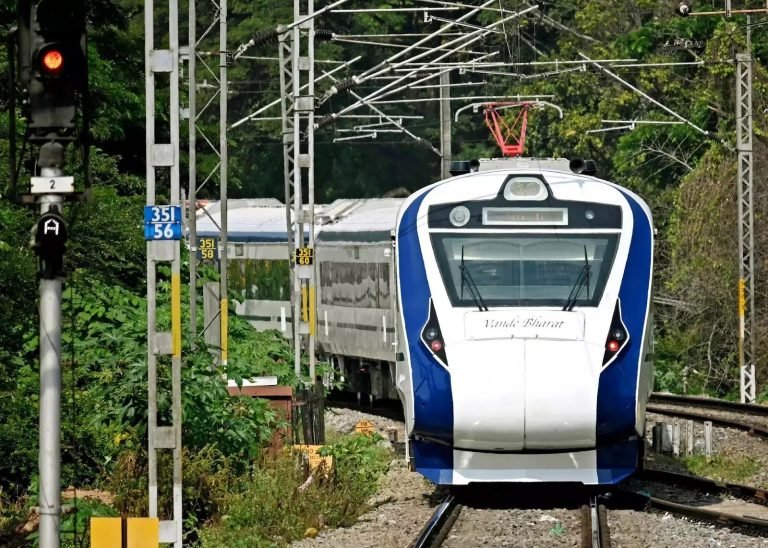
- Induction of Semi-High Speed Vande Bharat Trains : Integral Coach Factory/Chennai produced semi-high speed self-propelled trains with indigenous efforts, which is known as the Vande Bharat Express. These trains have ultramodern features such as quick acceleration, significant reduction in travel time, a top speed of 160 kmph, on-board infotainment and GPS-based passenger information system, automatic sliding doors, retractable footsteps and Zero discharge vacuum bio toilets, CCTV cameras, and other modern features in accordance with global standards.
- Six Vande Bharat trains are now in service on Indian Railways. Since 2019, two Vande Bharat trains have been travelling between New Delhi and Varanasi, and New Delhi and Shri Mata Vaishno Devi Katra. Three new and improved Vande Bharat trains with better safety measures and passenger amenities have recently been introduced between Mumbai Central and Gandhi Nagar Capital, New Delhi and Amb Andaura, Chennai and Mysore, and Nagpur and Bilaspur.
- Introduction of Vistadome coaches : Vistadome coaches give panoramic views through bigger body side windows and transparent areas in the top, allowing passengers to experience the visual beauty of the locations they travel through.
- Introduction of Tejas Rajdhani trains : Indian Railways has launched ultramodern Tejas trains with sleeper cars on the LHB platform. These ultramodern trains include the following notable features: Passenger Announcement / Passenger Information System, Fire and Smoke detection system, CCTV cameras, Improved lavatory - vacuum aided flushing with bio-toilets, and so on.
- AC Economy Coaches : A new model of the LHB AC three-tier coach, the AC Economy coach, has also been introduced into service, with improved facilities and higher passenger capacity. IR intends to introduce AC Economy coaches to meet the demands of the general public and to meet their expectations of travelling in AC class. These coaches are planned to replace general sleeper class coaches. One prototype coach was produced in 2020-21, and 519 similar coaches were produced until 30.11.22.
- Proliferation of LHB coaches : IR has opted to mass produce Linke Hofmann Busch (LHB) coaches, which are technologically superior with characteristics such as anti-climbing arrangement, secondary air suspension with failure notification system, and less corrosive shell. When compared to traditional Integral Coach Factory (ICF) coaches, these coaches ride and look better. To that purpose, IR Production Units have ceased production of ICF coaches beginning in 2018-19. Trains running with traditional ICF carriages are gradually being replaced with LHB coaches.
- Record Freight Loading : On mission mode, Indian Railways' freight loading for the first eight months of fiscal year 2022-23 surpassed the loading and earnings for the same period last year. On a cumulative basis from April to November 22, freight loading of 978.72 MT was accomplished, an improvement of 8% above previous year's loading of 903.16 MT over the same period. Railways generated Rs 105905 crore as opposed to Rs 91127 crore last year, representing a 16% increase over the same period last year. Following the mantra 'Hungry For Cargo,' IR has made ongoing efforts to increase the convenience of doing business as well as service delivery at reasonable pricing, resulting in new traffic flowing to railways from both conventional and non-conventional commodity streams. The customer-centric strategy and activities of Business Development Units, backed up by agile policies, aided Railways in reaching this historic milestone.
- Provision of Electronic Interlocking (EI) to increase Safety and Flexibility - Electronic interlocking are being used to reap the benefits of digital technologies in railway operation and to improve safety. 480 stations have been provided electronic interlocking systems during 2022. Up to 30th Nov, 2022, 2837 stations have received Electronic Interlocking, covering 44% of IR. The largest electronic interlocking in Indian Railways, with 1002 routes, was commissioned on May 30, 2022, in Bandel yard of the Eastern Railway's Howrah division.
- Automatic Signalling (ABS) - Automatic Block Signaling is a cost-effective approach for increasing line capacity so that more trains may run on Indian Railways' existing High Density Routes. ABS was deployed on 305 Rkm in 2022. Till 30th Nov 22, ABS has been deployed on IR's 3643 kilometres route. The rollout is planned to carry out in mission mode. Increased capacity is expected from the introduction of Automatic Signaling, allowing for more train services.
- Kavach – Kavach has been adopted as the National Automatic Train Protection system in the spirit of the vision Atam Nirbhar Bharat. Indian Railways has begun the deployment of Kavach on the Delhi-Mumbai and Delhi-Howrah circuits (about 3000Rkm), for which tenders were awarded in 2022.
- Interlocking of Level Crossing Gates - Level crossing gate safety has been a big concern. To improve safety at level crossings, Indian Railways installed interlocking with signals at 317 Level Crossing Gates during 2022. Till Nov 30, 10986 LC gates have been provided with gate signals for interlocking.
- Sliding Boom at LC Gate - When Level Crossing Gates are broken by road vehicles, especially in suburban areas, the use of Interlocked Sliding Booms has proven to be quite efficient in minimising disruption to train services. With installation of Sliding Boom Interlocking, the Signalling System can continue to operate regularly with minimal disruption to train operations. Enhancing Safety at Level Crossing Gates with Sliding Booms (in case of gate breakage) has been completed at 488 level crossing gates during 2022.
- Intermediate Block Signalling - The usage of Intermediate Block Signaling (IBS) has been particularly effective in increasing line capacity without incurring additional recurring revenue expenditures in the form of running labour and amenities necessary when establishing and operating a block station. Indian Railways has installed intermediate block signalling in 67 block sections during 2022, for a total of 700 block sections as of 30.11.2022.
- Signal Design Automation Tool for Electronic Interlocking (SigDATE) - To expedite infrastructure work, improve efficiency, and enable safe railway operations, an indigenously built automatic Route Control Chart generating system has been adopted. The standing committee approved standard typical circuits for Electronic Interlocking Version 2.0 on March 29, 22 for use in all future installations up to 100 routes to improve efficiency in signal design and circuit approvals.
- Centre of Excellence for Modern Signalling - On May 24, 2022, the 'Centre of Excellence' for Modern Signalling was established in Secunderabad with the primary goal of providing knowledge and technical inputs through competence building, research, design, and standardisation.
- Reduction/rationalisation of single journey fare structure of AC local services and first class over suburban section.
- Provision have been made for issue of Quarterly, Half Yearly and Yearly season tickets for AC ordinary local train services.
- The second class unreserved coaches, in long distance Mail/Express trains, which were withdrawn due to Covid -19 have been restored.
- Military/Defence Forces book special trains/coaches on Full Tariff Rates (FTR) for transit from one area to another. There had been a number of situations of pending reimbursements due to late submission of required papers, such as original receipts/folders, or loss of original receipts/folders, for which no refund/part refund was permitted under Tariff rules. In light of this, General Managers of Zonal Railways have been assigned authority to decide all such refund situations, even those that go beyond tariff guidelines, for booking of special trains on Full Tariff Rates (FTR) by Para Military Forces/Defense Forces beginning in January 2022.
- On a trial basis, the Station Ticket Booking Agent (STBA) method for issuing unreserved tickets at NSG-5 and NSG-6 category stations has been expanded to NSG-4 and SG-3 stations (pilot for one year).
- DRMs have been authorised to accept the suggestions of the JAG level screening committee for YTSK engagement, to provide approval for YTSK location change, to reduce YTSK office facilities, and to extend the duration of YTSK licensee. These powers were previously available to CCM(PM)/CCM(PS) of Zonal Railways.
- An application has been developed for digitalising the procedure for issue of photo ID cards to persons with disabilities. The application has been rolled out at Secunderabad (SCR), Chennai (SR) and Mumbai (CR) Divisions w.e.f. 01.10.2022.
- CRIS has developed a utility for data-driven quota optimization for reserved classes of the train known as 'Ideal Train Profile' to assist zonal Railways in finalising distribution of reservation quota, which should result in optimal utilisation of available accommodation, maximise revenue, and meet public demand. The utility enables the customer to evaluate demand, choose the best remote sites, and divide current berth/seat capacity into an ideal quota mix. It is expected to assist zonal railways in undertaking periodic reviews of train quotas to reflect changing demand mix due to holidays, festivals, seasons, and so on.
- Vande Bharat Express train : Prime Minister Narendra Modi inaugurated the sixth Vande Bharat Express between Nagpur in Maharashtra and Bilaspur in Chhattisgarh on December 11, 2022. The Vande Bharat Express, the Government of India's 'Make in India' programme, has been a major accomplishment so far. The elite and premium train, formerly known as Train 18, is the country's first of a new generation of trains. It is a semi-high-speed train that travels from one location to another in a shorter time. Despite the fact that the trains are moving, passengers have the impression that they are flying. '400 new generation Vande Bharat trains with improved efficiency to be brought in over the next three years,' said Finance Minister Nirmala Sitharaman while presenting the Union Budget 2022-23. There are now seven Vande Bharat Express trains operating in the country.
- Train coach with a baby berth : On Mother's Day this year, the Lucknow division of the Northern Railway zone made a special arrangement and added a lower berth, especially for the children in the lower berth, on May 8, 2022. The Indian Railways has introduced new 'baby berths' on the side of the lower main berth in the Lucknow Mail. This service has been introduced for the convenience of passengers (particularly mothers) travelling with their babies. To help mothers travelling with their babies, a baby berth has been introduced in Coach no 194129/ B4, berth no 12 & 60 in Lucknow Mail.
- Azadi Ki Rail Gadi Aur Stations week : The Indian Railways observed 'Azadi Ki Rail Gadi Aur Stations' week (from July 18, 2022 to July 23, 2022) as part of the Azadi Ka Amrit Mahotsav celebrations, during which 75 stations were designated as 'Freedom Stations' around the country. Apart from that, 27 trains were identified for showcasing and flagged off by freedom fighters or family members. Some were associated with Mahatma Gandhi, such as the Ahimsa Express, which runs between Ahmedabad and Pune, and the Ashram Express (Ahmadabad-Delhi); others with famous poet Rabindranath Tagore, who wrote songs hailing the Indian independence movement and raising the spirits of freedom fighters, such as the Shantiniketan Express (Howrah-Bolpur), Gitanjali Express (Mumbai CST-Howrah), Gurudev Express (Nagercoil-Shalimar) and others like Netaji Express (Howrah-Kalka) and Azad Hind Express (Pune-Howrah) linked to Netaji Subhash Chandra Bose.
- 'Kavach' : Kavach, an indigenously developed Automatic Train Protection (ATP) system, shall be installed across the entire rail network, starting with 2,000 kilometres in 2022-23. Every year, it will be extended by 4,000 to 5,000 kilometres. 'Kavach,' the world's cheapest automatic train collision protection system, has been developed with the objective of 'zero accidents' in view. It is built to automatically stop a train when it detects another train on the same line within a specified distance. In a situation where Loco Pilot fails to manage the train's speed, it applies automatic application brakes.
- Bharat Gaurav Tourist train : Under the new policy of the Ministry of Railways, the Indian Railway Catering and Tourism Corporation, abbreviated as IRCTC, ran its first Bharat Gaurav Tourist train. On June 21, 2022, the train commenced its 18-day journey. It followed the Ramayana Circuit identified under the Swadesh Darshan system, visiting significant locations linked with Lord Rama's life, including the Ram Janaki temple in Janakpur, Nepal. The Bharat Gaurav Tourist train made its first stop in Ayodhya, Lord Rama's birthplace, where travellers viewed Shri Ram Janmabhumi temple and Hanuman temple, as well as Bharat Mandir in Nandigram, dedicated to Lord Rama's younger brother Bharat. The Bharat Gaurav Tourist train, consisted of ten three-tier AC coaches, accommodating 600 tourists at a time. The 18-day tour cost was Rs 62,370 per person.