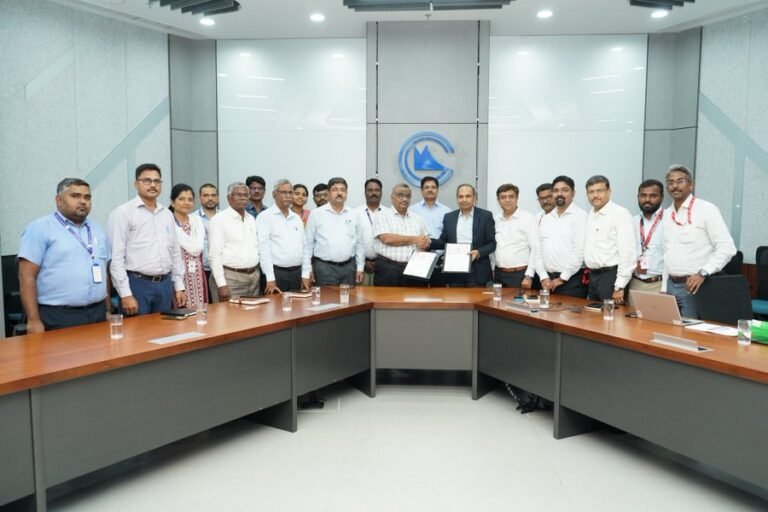
Delhi (Metro Rail News): Delhi Metro Rail Corporation ( DMRC) has issued a Letter of Acceptance ( LoA) to Nuvision Commercial and Escort Services (NCES) for the Ticket Vending Services contract at various stations of Delhi Metro.
Bidding Process
DMRC issued tender for this contract with a 1440 days deadline. On 18 March 2025, technical bids were opened, revealing that 5 firms had submitted bids for the contract.
Technical Evaluation of the submitted bids took place on 24 April 2025. During the technical evaluation, 3 firms’ bids were rejected.
Financial bids were opened on 24 April 2025, and the financial evaluation of the remaining bids took place on 3 June 2025, revealing Nuvision Commercial and Escort Services (NCES) as the lowest bidder for the contract.
On 3 June 2025, Nuvision Commercial and Escort Services (NCES) received LoA for the contract.
Contract Details
Contract Value: ₹ 172.8 Cr
Contract Period: 1440 Days
DMRC Brief Scope: Provision Of Ticket Vending Services At Various Metro Stations Of Line- 2, 3, 4, 5, 9, Ael And Other Locations.
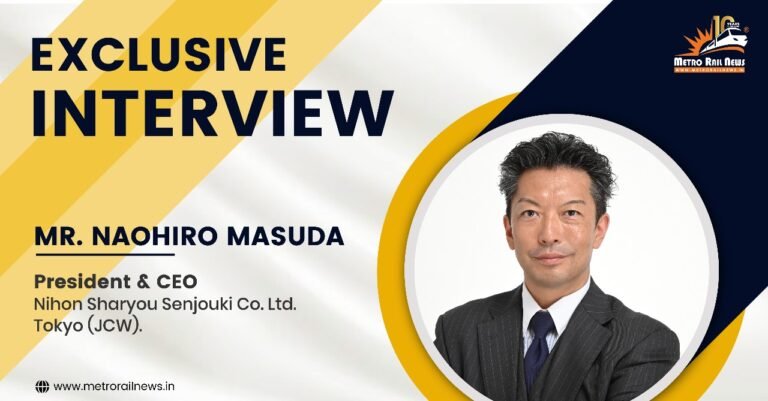
Metro Rail News conducted an exclusive interview with Mr Naohiro Masuda, President & CEO, Nihon Sharyou Sejouki Co., Ltd., Tokyo (JCW). During the interview, Mr. Masuda discusses the company’s focus on providing effective cleaning solutions for railway systems across the world. He explains how JCW customises solutions based on different climatic and operational conditions. Mr. Masuda also shares JCW’s involvement in several international projects, including those in Asia. Furthermore, he emphasises JCW’s interest in expanding in India to support its growing rail transport sector. Here are the edited excerpts.
Question 1. Mr. Naohiro Masuda, could you elaborate on your two-decade journey as the President & CEO of Nihon Sharyou Sejouki Co., Ltd. (JCW) and how your leadership has influenced the company’s growth over the years?
We are, at our core, a cleaning company and our focus is on delivering effective cleaning solutions. I have attributed the origins and the goal of bringing up the company. So, our primary goal is to exist for the customers. And we are just aiming to be the best in our sector. And we would like to be the world’s best manufacturer one day.
Question 2. Could you provide insights into the primary products and services JCW offers for the railway industry?
We have a lot of products at hand. There are just too many to explain. A few examples would be car body washing equipment, boggy washing equipment, bearing washing, parts washing, etc. We also have wastewater treatment, recycling equipment, reverse osmosis water production equipment, and many others. To sum it up, we design and manufacture all the equipment that does the cleaning.
Question 3. How has JCW evolved over the years to meet the dynamic demands of modern rail transportation?
We have always challenged ourselves to meet our customers’ needs and demands. We have never said that we cannot do what our customers request. We have also never received a complaint after we have delivered what has been requested of us. We put all the knowledge that we have into our products. We invite specialists to produce something that is lacking in our products. That is why our product today is much better than what it was years ago. We always strive to be better than what we were yesterday.
Question 4. What distinguishes JCW’s railcar cleaning and maintenance systems from others in the global market?
The main thing would be that all of our equipment has a very low failure rate. According to our annual operating hours, it is down to less than 0.3%. We have also experienced very low stoppage rates, and we have been producing cleaning equipment for 70 years. Therefore, 70 years of experience is infused in our products and our machines. In the event of an unexpected breakdown, after receiving information, we have trained our maintenance system to respond to it within 24 hours. It is done for the convenience of our customers.
Question 5. How do your solutions cater to both high-speed and urban rail systems, including metros and commuter trains?
We cater to numerous customers from all over the world, such as Japan Railways, trains and mass rapid transport in Singapore, Hong Kong Subway, and many other Southeast Asian railways. It is a long, long list. We also cater to customers from different fields, such as the military, mining, food manufacturing companies, and many, many others. Different fields require different cleaning equipment. With all the knowledge and experience gained from our experience, it has made us more attuned to solving different systems of transportation and machinery.
Question 6. JCW has been involved in various international railway projects. Could you share a few key collaborations or projects outside Japan?
Recently, almost all major railway projects in Asia have incorporated our products, including the Hong Kong Airport Railway, Jakarta MRT (a mass rapid transit system), Manila Metro, and the Manila North–South Commuter Line.
Question 7. JCW is known for its railcar washing systems. What recent innovations or technologies have you introduced in this domain?
Currently, we are developing unmanned cleaning equipment for the front and rear cars of high-speed trains. This system is being developed and produced in collaboration with one of the most renowned railroad companies in the world; however, we cannot disclose the name due to a non-disclosure agreement (NDA). This is the world’s first unmanned washing system specifically designed for the front and rear sections of high-speed trains. This cleaning equipment will be something that is beyond our imagination, so after extensive testing, including the creation of a one-by-one scale mock-up model vehicle, it will be finished by December 2025 this year.
Question 8. Automation is emerging as a core element in driving smooth operations. How does JCW integrate automation systems to improve efficiency and reduce operational downtime?
Yes, automation is indeed one of our most important systems. Our current machines can operate unattended, but actions are performed for safety checks and operational purposes. However, with our current technology, we can build machines and systems that might not require human intervention one day. In the event of a breakdown in such a machine, the system can automatically inform the engineer, who can then sort it out.
Question 9. Sustainability is a growing concern globally. How is JCW incorporating eco-friendly practices into its manufacturing and service processes?
All of our products are designed and manufactured with sustainability in mind. For our cleaning equipment, we source components from world-renowned brands that also prioritise sustainability, such as Mitsubishi, SMC, Panasonic, Omron, and Sumitomo. These Japanese companies integrate sustainable development goals into their core brand values.
Furthermore, we develop and produce a large number of products in-house. By doing so, we contribute to sustainability as well.
Question 10. Could you shed light upon any specific water-saving or energy-efficient features in your railcar washing systems?
Our cleaning equipment uses water and recycles 100% of it during the cleaning process. Complete cleaning requires a large amount of water, which can be harmful to the environment and result in high operating costs. That is why all of our cleaning equipment uses recycled water only.
Question 11. How do you customise your systems to suit the specific climatic and operational conditions of different countries?
Of course, we customise our systems according to the country and the place. It varies from country to country. The dirt & stains can also vary from country to country even within same country. For instance, the dirt and stains found on train cars in Delhi can be very different from those in Mumbai. These differences are influenced by factors such as humidity, temperature, air pollution, vehicle mileage, and more. Therefore, the cleaning method is adapted based on the location where the equipment is installed, and we tailor our systems accordingly.
Question 12. India’s rail transport sector is expanding with projects in metro rail, RRTS, and high-speed corridors. How does JCW intend to explore potential opportunities in the Indian market?
In India, we aim to incorporate the knowledge and expertise we have gained over the past 70 years in Japan, as well as from our global operations. Thereafter, as an Indian manufacturer of cleaning equipment, we would like to expand further and align our efforts with India’s Make in India policy too.
We already have a subsidiary company in India, and we are currently in the process of inquiring about various cleaning equipment throughout the country. As per our findings, the Indian equipment is not up to the mark by the Japanese standard. They might fit into the look of cleaning equipment, but their functionality and efficiency can be considered a little bit below the standard as per Japanese standards.
For instance, if we install an air conditioner and then if it doesn’t work properly, then it is a problem, right? Rather than seeing this as a business opportunity, we would genuinely love if India makes use of our cleaning devices. So being the oldest manufacturer of cleaning equipment in the world, I feel that India would greatly benefit from our company and our devices. And we also intend to follow the Swachh Bharat policy and respect that.
Question 13. What message would you like to convey to the readers of Metro Rail News?
As we know that India is a developing country and Indian railroads are under development and redevelopment. However, it will soon become the world’s largest railroad powerhouse. The number of lines, the length of distance covered by the tracks, and the number of coaches would soon be the number one in the world. This is only possible with the right number of people and funding, of course. We are looking into having the best skills and experiences in order to make the Indian railway system the best railroad network in the world. We want to be a company that grows with the growth of the nation as well as the Indian railway system. To do so, we need many teachings of India and the Indian people. We also want to be a company that is loved by India, loved by Indian people and respected by everyone.
Hyderabad (Metro Rail News): Hyderabad Metro Phase 2B has received clearance from the state cabinet on 5 June 2025. The project will be implemented at the cost of ₹19,579 crore jointly by the State and Central Governments.
About Phase 2B of the Hyderabad Metro Project
The project will cover about an 86.1 km route. The proposed expansion under Phase 2B of the Hyderabad Metro includes three key corridors:
Corridor 1:
Type: Elevated & Underground
Route – Shamshabad Airport to Future City
Length – 39.6 km (21km Elevated + 1.5km Underground + 17 km At grade)
Corridor 2:
Type: Elevated
Route – Jubilee Bus Station to Medchal
Length – 24.5 km
Stations – 18
Corridor 3:
Stations – 14
Type: Elevated & Underground
Route – Jubilee Bus Station to Shamirpet
Length – 22 km (20.35 Elevated + 1.65km Underground
The project proposals will be submitted to the Central Government for joint implementation.
Completion of DPR for Phase 2B
Recently, Hyderabad Airport Metro Limited (HAML) announced the completion of Detailed Project Reports (DPRs) for the proposed Phase 2B of the Hyderabad Metro Rail project. These reports provide comprehensive insights into the planned expansion, including route alignments, cost estimates, and implementation strategies.
Hyderabad Metro: Operational Overview
The Hyderabad Metro is managed by Hyderabad Metro Rail Limited (HMRL). Currently, it’s operational across three corridors and covers a total distance of 69 kilometres. It stands out as the largest metro project globally developed through a public-private partnership (PPP) framework
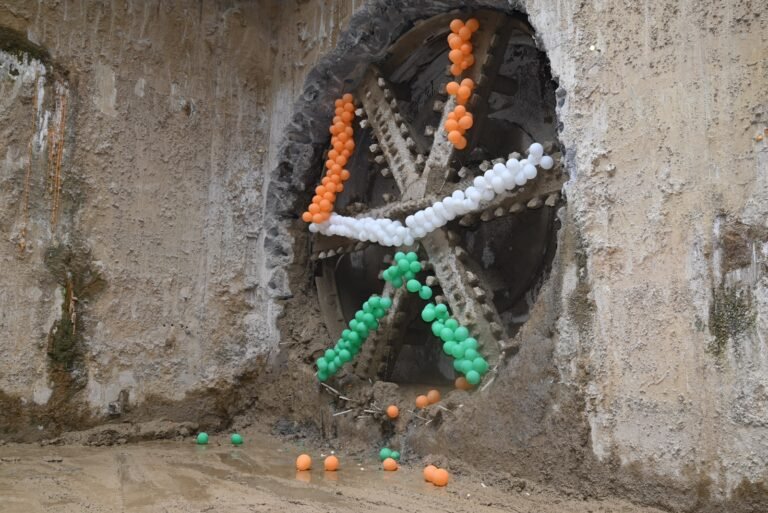
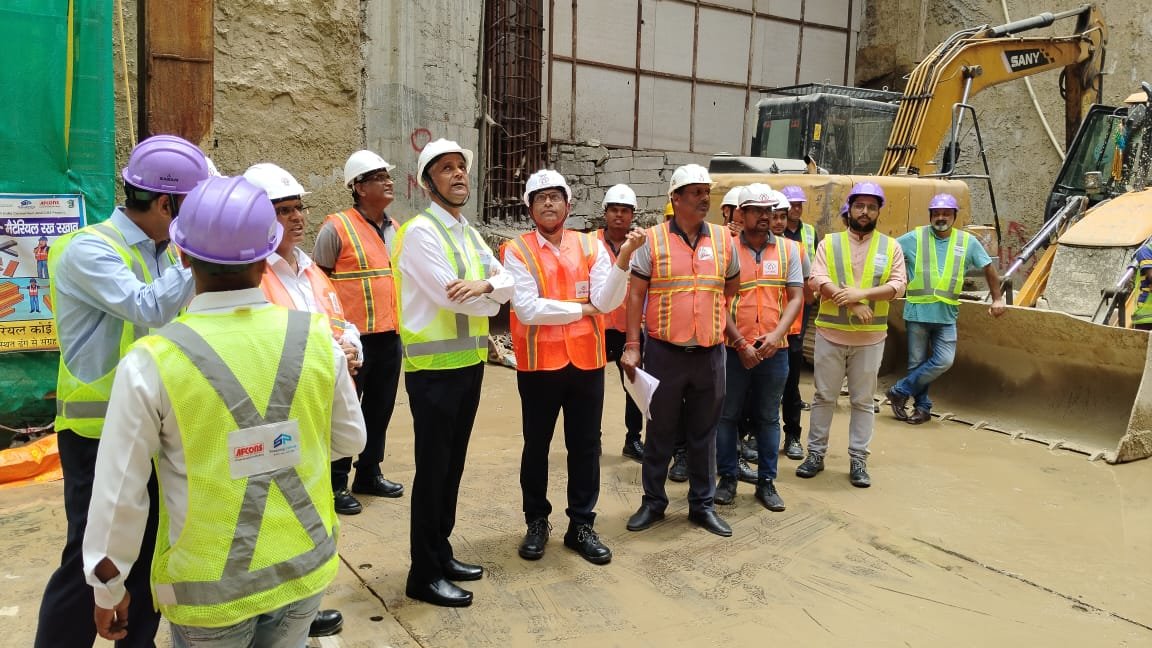
Agra (Metro Rail News): The Agra Metro Rail Project has achieved a major milestone with the successful TBM Breakthrough at Mankameshwar Metro Station of Line 1. Line 1 of the Agra Metro spans 14.25 km between Sikandra and Taj East Gate.
This breakthrough marks the completion of all the underground tunnelling work for Line 1 of the Agra Metro Rail Project.
This TBM Breakthrough has been recorded for the Package AGCC-02 of Agra Metro.
Package AGCC-02
In March 2022, Uttar Pradesh Metro Rail Corporation awarded Afcons – Sam India Consortium Package AGCC-02 at Rs. 1819.79 crore with a 48-month deadline.
Scope of Work
The scope of work under this 7.93 km underground package includes the construction of twin tunnels and 7 stations at Agra Metro Line 1.
Stations
Taj Mahal
Agra Fort
Mankameshwar (Jama Masjid)
S.N. Medical College
Agra college
Raja ki Mandi
RBS college
Brief Scope of Work: Design and Construction of Tunnel from start of underground ramp (near Fatehabad Road Metro station) to end of ramp after RBS college Metro station, including seven underground metro stations (viz. Taj Mahal, Agra Fort, Jama Masjid, S.N. Medical college, Agra college, Raja ki Mandi and RBS college), including Architectural finishes, E&M, TVS, ECS, etc. on Corridor-1 of Agra MRTS Project at Agra, Uttar Pradesh, India.
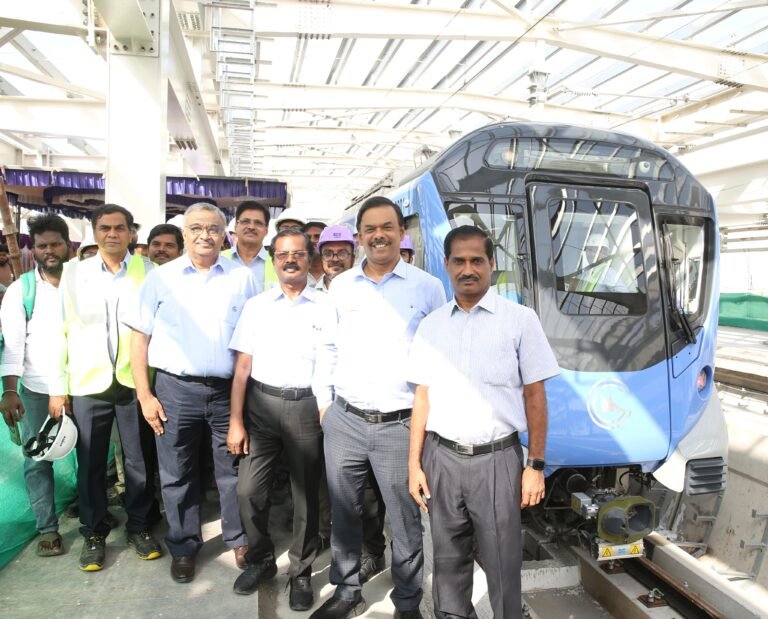
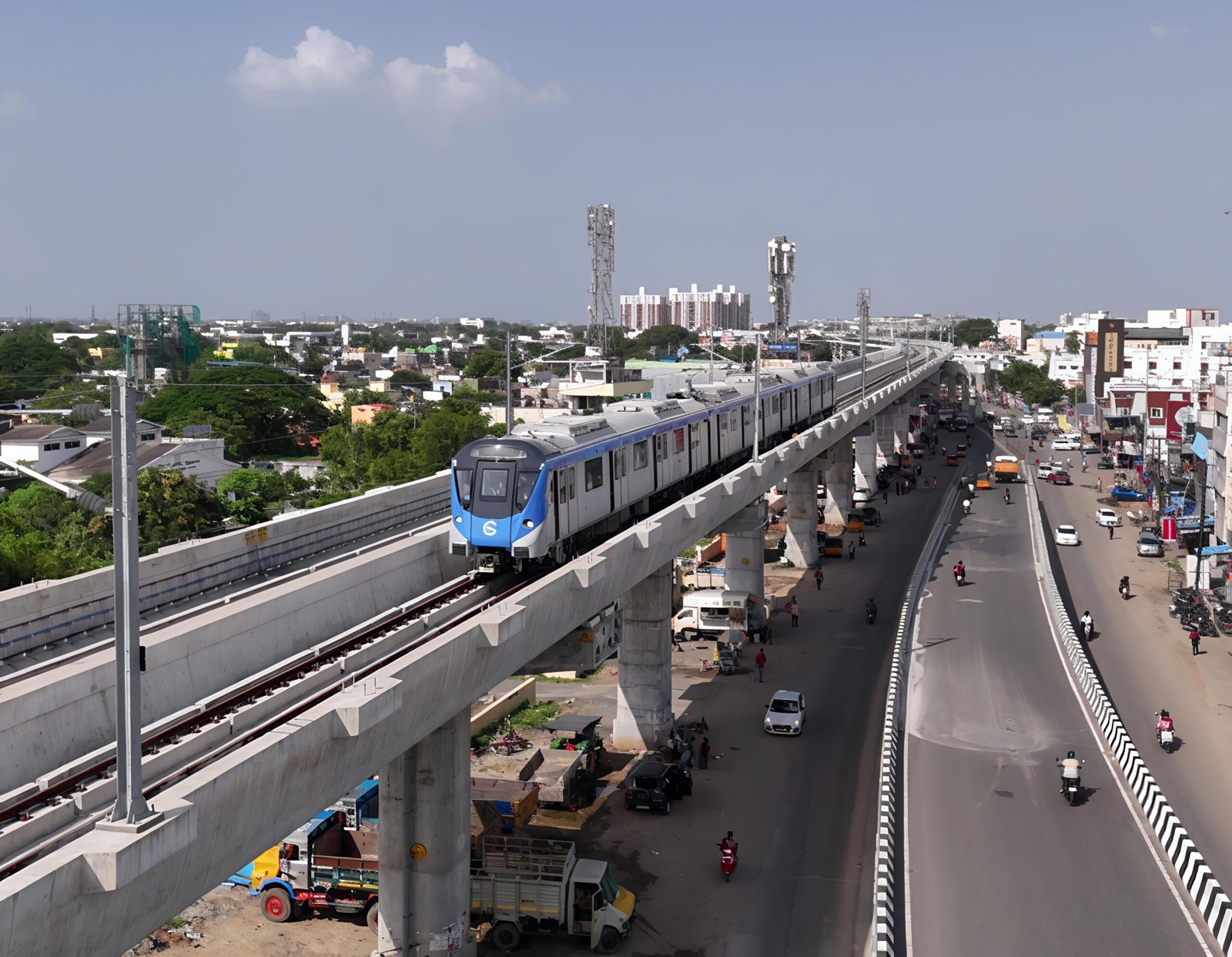
Chennai (Metro Rail News): Chennai Metro Rail Corporation (CMRL) has initiated testing and trial runs on Line 4 of Phase 2. The trials were conducted for the 10 km Downline stretch of Line 4. Originally, Line 4 of Chennai Metro Phase 2 spans 26.1 km between Light House and Poonamallee Bypass through 28 stations.
Earlier, CMRL initiated trials on the Up-Line section. In March 2025, CMRL conducted trials on a 3 km stretch of Line 4 connecting Poonamallee Depot and Mullaithottam. Subsequently, in April 2025, CMRL extended the trials (Upline) on the 9.1 km stretch connecting Mullai Thottam Metro Station and Porur Junction Metro Station.
About the Trial Run
CMRL has commenced trial runs on the 10 km stretch of Corridor 4, which connects Porur Junction Metro Station to Poonamalle Bypass Metro Station through 10 stations. Poonamalle Metro Depot will be the nerve centre to coordinate the testing & trials of the section.
Stations
Porur Junction
Chennai Bypass Crossing
Ramachandra Hospital
Iyyapanthangal Bus Depot
Kattupakkam
Kumananchavadi
Karayanchavadi
Mullai Thottam
Poonamalle bus terminus
Poonamallee Bypass
Further Updates
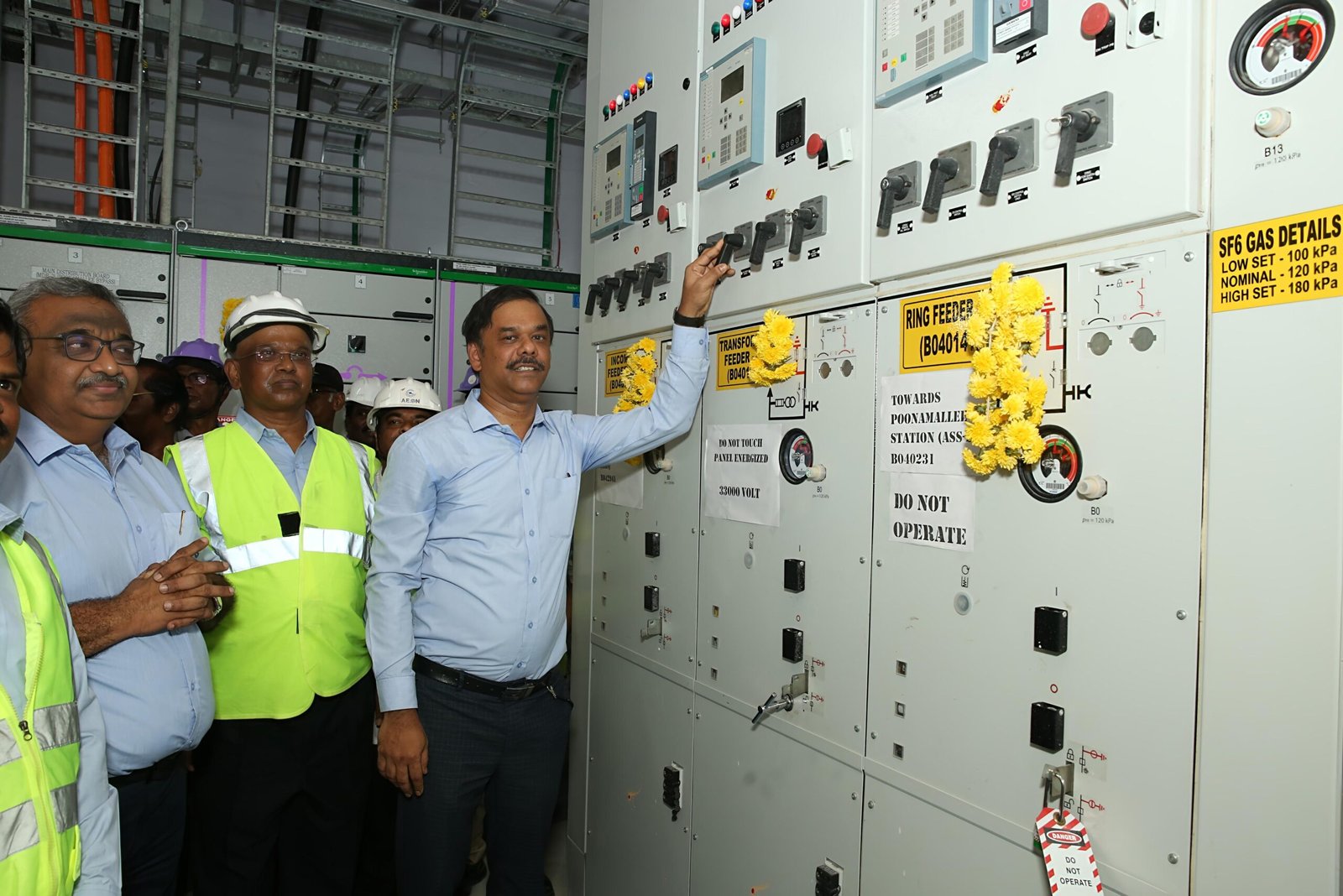
Additionally, the Poonamaallee Bypass station ASS (Auxiliary Substation) was also inaugurated and successfully charged through 33kV power supply cable from Poonamallee Receiving substation at Poonamallee Depot.
Mumbai, formerly referred to as Bombay, serves as the capital of the state of Maharashtra. It is situated along the Konkan coast, adjacent to the Arabian Sea. In addition to its geographical significance, Mumbai functions as the central hub of the Mumbai Metropolitan Region. The city is characterised by its vibrant culture and diverse attributes and is recognised as India’s principal financial and commercial centre, often referred to as the “Economic Capital of India.”
Mumbai is the second-fastest-growing city in India and is among the most densely populated cities worldwide. The estimated population of Mumbai is approximately 12.5 million, which makes it one of the most densely populated cities in India. The increased population has started putting strain on the city’s infrastructure, particularly the transport infrastructure struggles to cope with the growing number of commuters. Due to this, the vehicular traffic overflows the roads of Mumbai. In addition, the buses & Mumbai Suburban Rail Network are also inadequate to meet the transportation needs of the city’s residents.
Establishing a metro network that traverses through the densely populated areas of the city and connects with existing modes of transportation was the only solution to address the increasing demand for a more convenient transport mode. The Mumbai Metro Project is a strategic approach to support the existing transport infrastructure in the city and reduce vehicular traffic on the roads. This initiative will help the city to become more accessible for its residents while reducing environmental impact. This study highlights the positive impact of the Mumbai Metro on the city while examining the critical components that can have implications on the viability of the project.
Historical Background of Mumbai Metro
The rapid urbanisation of Mumbai resulted in road and rail infrastructure development that has struggled to keep pace with the increasing demand over the past several decades. Consequently, the Mumbai Metropolitan Region Development Authority (MMRDA) aimed at establishing mass rapid transit services.
In May 2003, the Mumbai Metropolitan Region Development Authority (MMRDA) engaged the services of Delhi Metro Rail Corporation (DMRC), with assistance from Tata Consultancy Services (TCS) and the Indian Institute of Technology (IIT), Mumbai, to develop the Master Plan for the Mumbai Metro and to prepare a Detailed Project Report (DPR) for the priority corridors.
The Mumbai Metropolitan Region Development Authority (MMRDA) sanctioned the Master Plan for the Mumbai Metro, which encompasses a phased implementation strategy, during its assembly on 28May 2004.
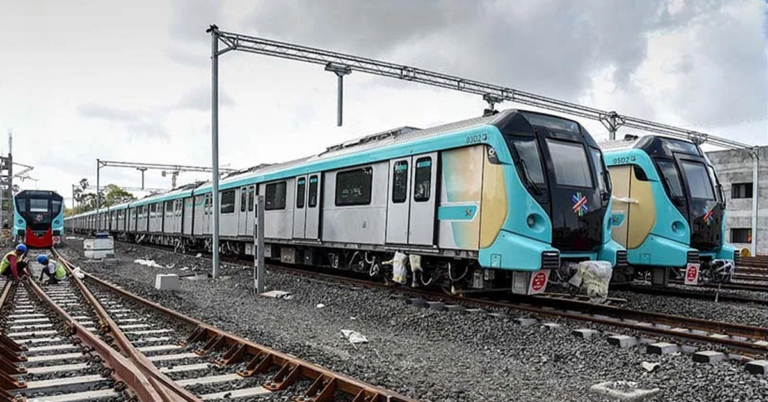
Mumbai metro line 3 (Representational image)
The Master Plan encompasses nine corridors that collectively span a length of 146.5 kilometres, with 32.5 kilometres designated as underground and the remaining sections elevated.
A public hearing was held on 22 January 2004 to gather opinions, suggestions, and comments regarding the Master Plan.
In 2004, the Mumbai Metropolitan Region Development Authority (MMRDA) presented a comprehensive master plan that spans 146.5kilometreskilometers and includes multiple lines.. However, due to a variety of challenges, including policy paralysis regarding the selection between Engineering, Procurement, and Construction (EPC) versus Public-Private Partnerships (PPP), as well as debates over metro rail versus monorail options, the MMRDA was able to commission only one metro line in the suburbs that connects Versova, Andheri East, and Ghatkopar.
In 2015, an updated master plan of 118 kilometres was approved, with the then-incumbent government providing essential momentum for the development of two lines:
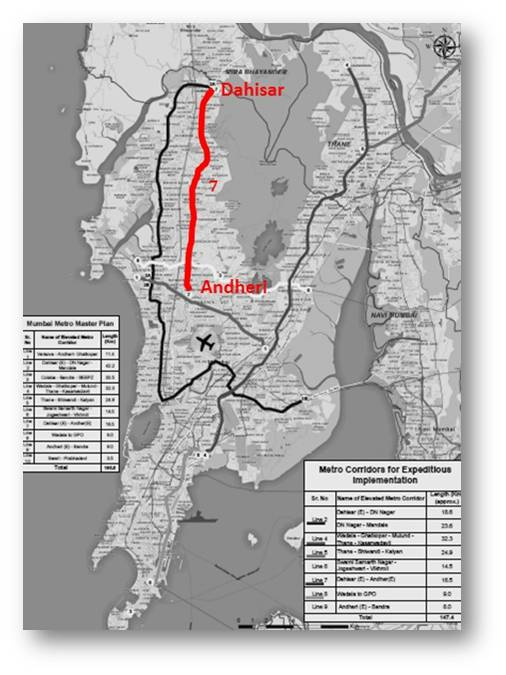
Dahisar East to Andheri East (Red Line)
Dahisar East to D.N. Nagar (Yellow Line),
Additional Route: Cuffe Parade to BKC to Aarey Colony (Aqua Line)
In June 2019, a new nodal agency, the Maha Mumbai Metro Operations Corporation Limited (MMMOCL), was established to oversee the operation and maintenance of all Mumbai Metro services on lines owned by the MMRDA.
In September 2019, the MMRDA revised the master plan for the Maha Mumbai Metro, encompassing a network of 337 kilometres and consisting of ten lines across a total of seventeen sections.
The list of Revised Master Plan corridors proposed for implementation is as below:
Sr.
Corridor
Length ( km )
Line 1
Versova-Andheri-Ghatkopar
11.40
Line 2A
Dahisar-D.N. Nagar
18.6
Line 2B
D. N. Nagar-Mandale
23.6
Line 3
Colaba-Bandra-SEEPZ (Andheri)
33.5
Line 4
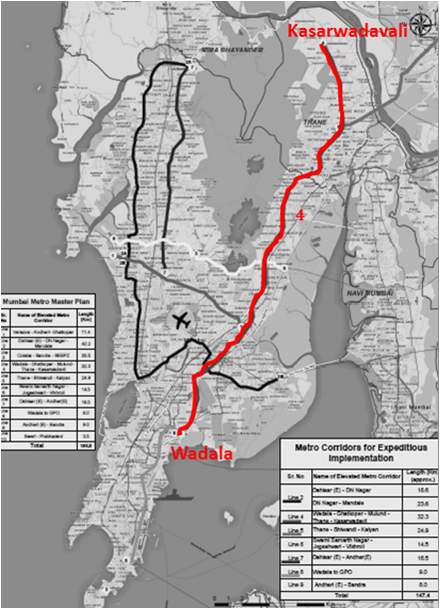
Wadala-Ghatkopar-Mulund-Thane-Kasarwadavali
32.3
Line 4A
Kasarwadavali-Gaimukh
2.7
Line 5
Thane-Bhiwandi-Kalyan
24.9
Line 6
Swami Samarthnagar-Vikhroli
14.5
Line 7
Andheri (East)-Dahisar (East)
16.5
Line 8
Airport Metro(Chhatrapati Shivaji Maharaj International Airport -Navi Mumbai International Airport)
35
Line 9 & 7A
Dahisar(E)-Mira-Bhayander & Andheri(E)-Chhatrapati Shivaji Maharaj International Airport
13.5
Line 10
Gaimukh-Shivaji Chowk (Mira Road)
9.2
Line 11
Wadala-Chhatrapati Shivaji Maharaj Terminus(CSMT)
12.7
Line 12
Kalyan-Taloja
20.7
Line 13
Shivaji Chowk (Mira Road) – Virar
23
Line 14
Kanjurmarg-Badalapur
45
Total
337.1
The total length of Metro Corridors will be 337 km, and the aim is to complete most of these corridors by 2024-26.
Mumbai Metro: Driving the City’s Transport Evolution
Overview
The Mumbai Metro is an urban Mass Rapid Transit System (MRTS) being built to serve Mumbai, Maharashtra’s capital and largest city. In June 2006, Prime Minister Manmohan Singh laid the foundation for the Mumbai Metro Rail Project.
Mumbai Metro Coach/Representational image only
Navigating through the Network of the Mumbai Metro system
The Mumbai Metro spans 337 kms and consists of 10 Lines. Currently, 59.19 km of the total route is operational, while 143.65 km of the route is under construction.
Here’s a Breakdown of the Mumbai Metro Network
Line 1 ( Blue Line )
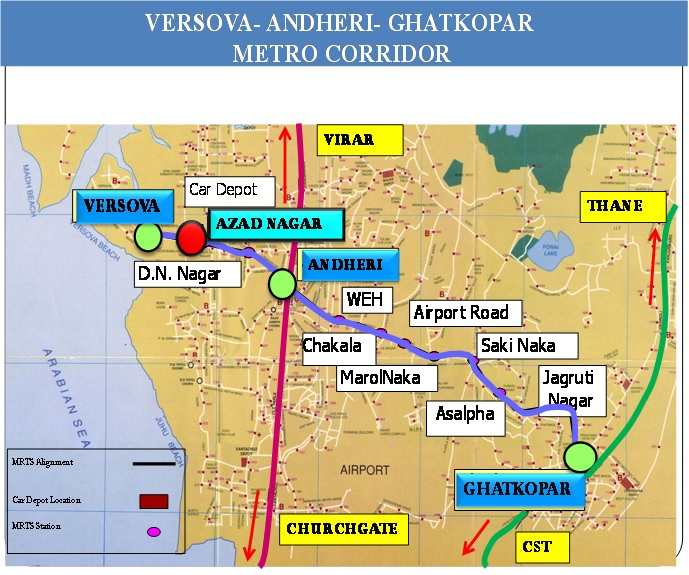
Line 1 of the Mumbai Metro is an operational elevated corridor which spans 11.40 km, connecting Versova-Andheri-Ghatkopar through 12 stations.
The Line 1 of Mumbai Metro has been built at Rs. 2,356 Cr through a PPP Model ( Public Private Partnership)
The Line became operational and opened for passengers on 8th June 2014.
Features of Line 1
Route length
11.40 km (Elevated)
Number of Total Stations
12
Speed
Max Speed: 80 kmph
Average Speed: 35 kmph
Estimate Ridership
2031- 8.83 lakhs per day
Project Implementing Agency
Mumbai Metro One Private Limited
Total project completion cost
Rs. 2,356 Cr
VGF
Rs. 650 Cr
Implementation Period
2007-2012 (As per Concession Agreement)
Interchange Facilities
Metro Line 2: D. N. Nagar
Western Railway: Andheri
Metro Line 3 : Marol Naka
Central Railway: Ghatkopar
Line 2A ( Yellow Line )
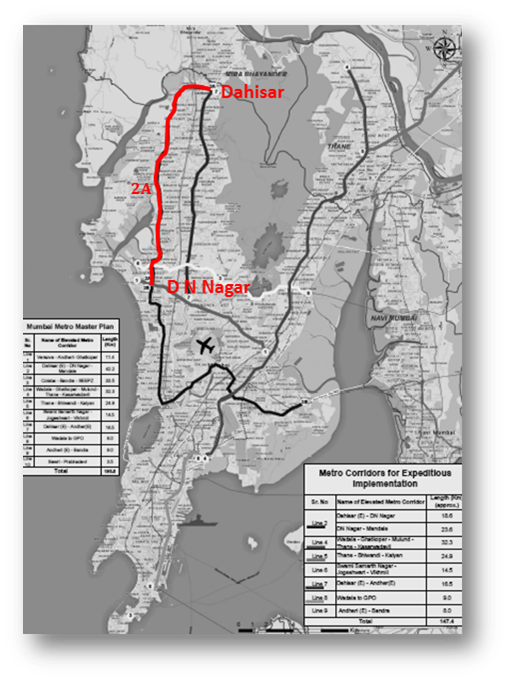
The Line 2A of Mumbai Metro is an operational 18.6 km long elevated corridor which connects Dahisar to D N Nagar. This Line features 17 stations in total. The Project was implemented in 2 Phases.
Phase 1: The Phase 1 of Mumbai Metro Line 2A spanned 9.8 km and covered 9 stations between Dahisar and Dahanukarwadi.
Phase 2: Phase 2 of Mumbai Metro Line 2A spanned 8.8 km and covered 8 stations between Dahanukarwadi and D N Nagar.
Phase 1 became operational on 2nd April, 2022, while Phase 2 of Mumbai Metro Line 2A became operational from 19th January, 2023.
The Line 2A of Mumbai Metro was completed at Rs. 6,410 Cr (including state taxes and 7.5% p.a escalation & IDC).
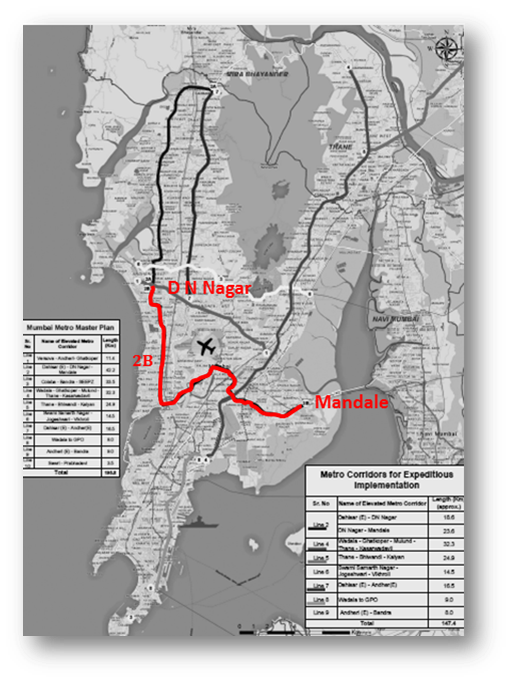
Mumbai Metro Line 2B is under construction elevated metro corridor which spans 23.643 km from D N Nagar to Mandale through 20 stations.
The Line 2B of the Mumbai Metro will be completed for Rs. 10,986 Cr.
Features of Line 2B
Route length
23.643 km
Number of Total Stations
20
Estimate Ridership
2031- 10.5 Lakhs (PHPD 38509)
Total project completion cost
Rs. 10,986 Cr.
Depot
Mandale
Interchange Facilities
D. N. Nagar (Line 1)
Bandra (Suburban)
ITO junction (Line 3)
Kurla East (Suburban & Line 4)
Chembur (Monorail)
Mankhurd Suburban, CST-Panvel fast corridor
Mumbai-Navi Mumbai Airport fast corridor
Line Status as of 23 February 2025
Sr. No
Name of Work
Status
Pile Cap
97.00% Completed
Pier Work
91.00% Completed
Pier Cap / Portal Beam
Erection – 84.00% Completed
U / I Girder Works
Erection – 75.00% Completed
Mandale Depot Works
97.21% Completed
Recent Development on Mumbai Metro Line 2B In April 2025,theMumbai Metropolitan Region Development Authority (MMRDA) initiated the trial runs on the Mandale-Mankhurd stretch of Mumbai Metro Line 2B. This section features 5 stations.
Line 3 ( Aqua Line )
The Line 3 of Mumbai Metro is a partly operational metro corridor which spans 33.5 km connectingCuffe Parade – BKC – Aarey JVLR through 27 stations.
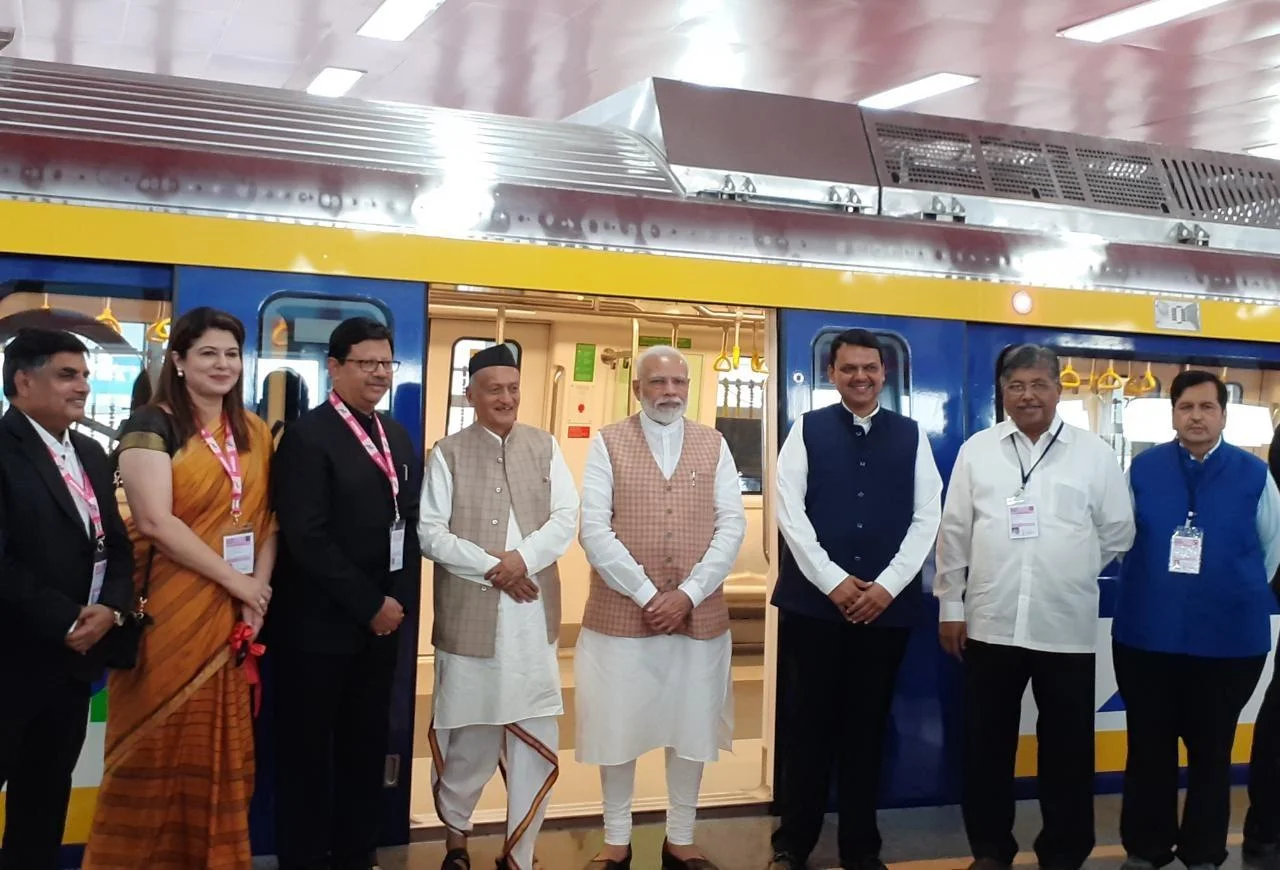
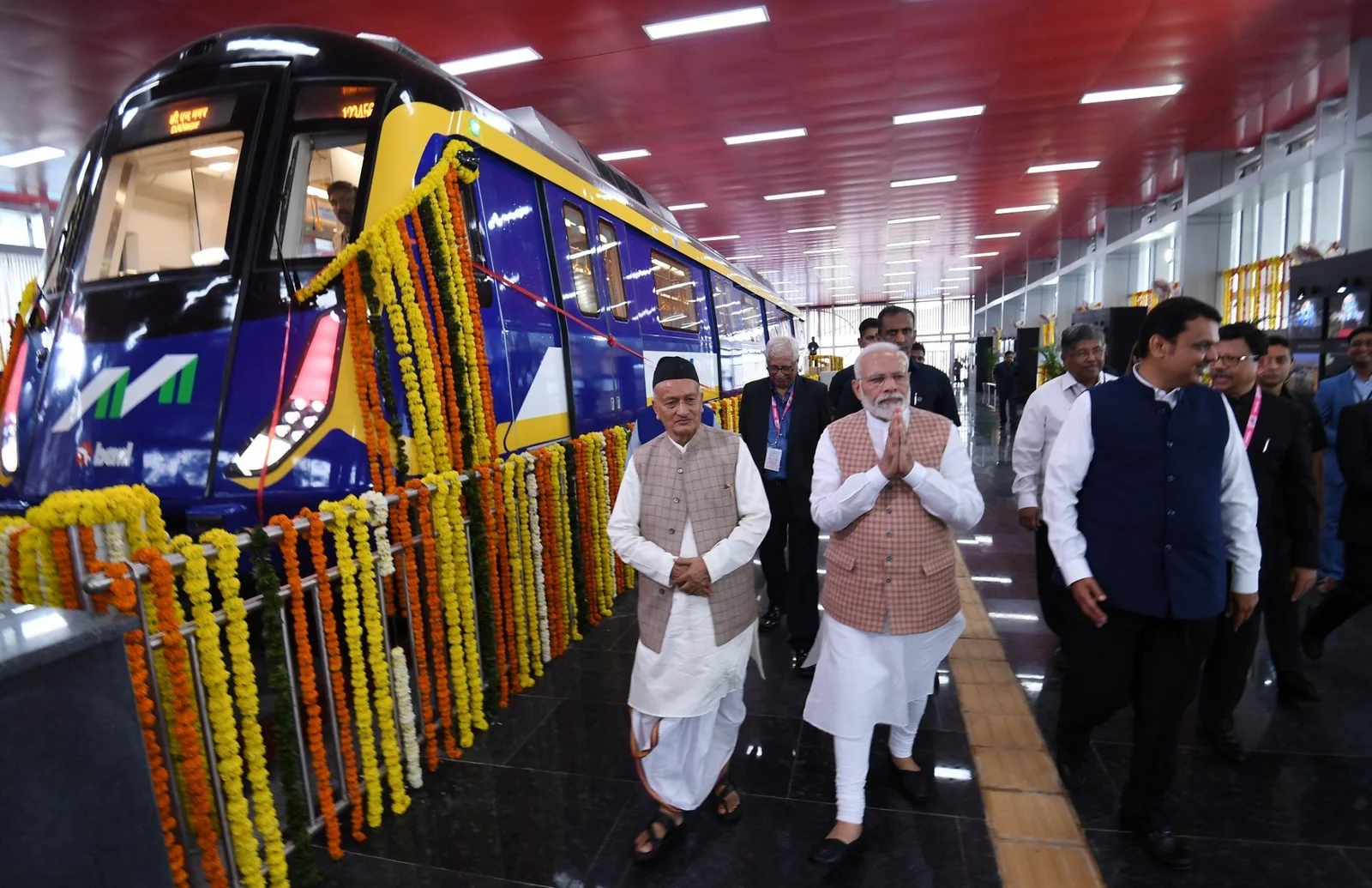
Currently, Phase 1 of Line 3, spanning 12.69 km between Bandra Kurla Complex ( BKC) and Aarey JVLR, is operational. Prime Minister Narendra Modi inaugurated this section on 5 October 2024.
Features of Line 3
Route length
33.5 km
Number of Total Stations
27
Speed
Max Speed: 90 kmph
Average Speed: 34 kmph
Estimated Cost
Rs. 23,136 crore
Rolling Stock
248 coaches (31 x 8) by Alstom
Line 4 ( Green Line )
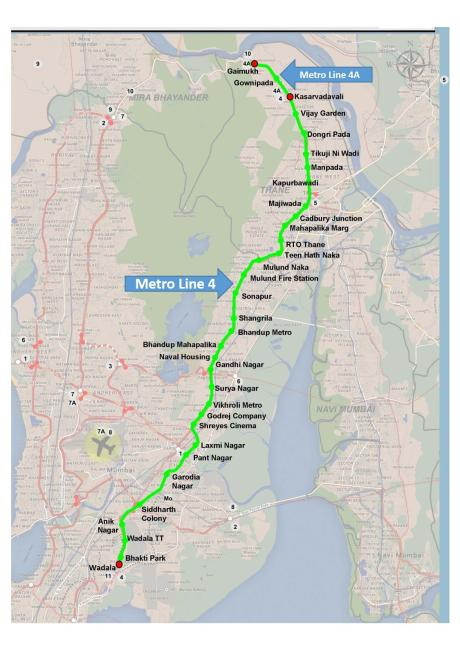
The Line 4 of Mumbai Metro is an under-construction elevated line which spans 32.32 km between Wadala and Kasarvadavali, featuring 30 stations. Mumbai Line 4 Project will be executed at Rs. 14,549 Cr.
Features of Line 4
Route length
32. 32 km
Number of Total Stations
30
Total project completion cost
Rs. 14,549 Cr. (Incl. Taxes and Duties)
Estimated Ridership
2031: 12.13 Lakhs (PHPDT- 33417)
Elevated / Underground
Fully Elevated
Line Status As of 10 February 2025
Sr. No.
Activity
Status
1
Pier (Viaduct+Station up to PL)
94% Completed
2
Piercap Erection
93% Completed
3
U Girder Erection
88% Completed
4
I Girder Erection
65% Completed
5
Deck Slab
59% Completed
6
L Gird Erection
61% Completed
7
T Gird Erection
68% Completed
8
RCC Beam Erection
38% Completed
9
Portal Beam Erection
16% Completed
10
PI Girder Erection
0% Completed
Line 4A ( Green Line )
Line 4A of the Mumbai Metro is the under-construction extension of Line 4. Line 4A spans 2.7 km from Kasarvadavali to Gaimukh through 2 stations. The Project will be completed at a cost of ₹ 949 Cr.
Features of Line 4A
Route length
2.7 km
Number of Total Stations
2
Total project completion cost
₹ 949 Cr.
Estimated Ridership
2031: 1.31 Lakhs (PHPDT – 30,708)
Proposed Depot
Mogharpada (Provision made in Metro Line 4 Depot)
Interchange Stations
At Kasarvadavali (Metro Line 4)
At Gaimukh (Metro Line 10
Line Status As of 10 February 2025
Sr. No.
Activity
Status
1
Pier (Viaduct+Station up to PL)
100% Completed
2
Piercap Erection
94% Completed
3
U Girder Erection
87% Completed
4
I Girder Erection
64% Completed
5
Deck Slab
60% Completed
6
Portal Beam Erection
90% Completed
7
PI Girder Erection
100% Completed
Line 5 (Orange Line )
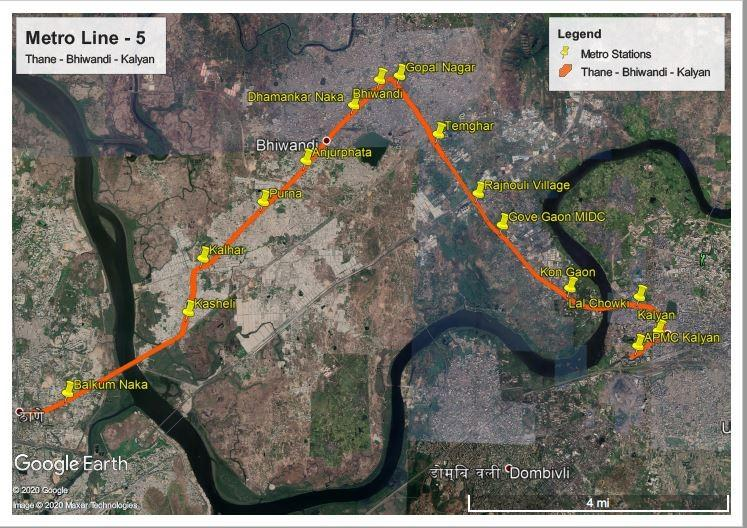
The Line 5 of Mumbai Metro is a partly under-construction elevated metro corridor which spans 24.90 km from Thane to Bhiwandi to Kalyan through 15 stations.
Currently, Phase 1 of Line 5, which connects Thane to Bhiwand, is under construction.
The project is being executed at a base cost of Rs. 8416.51 Cr.
Features of Line 5
Route length
24.90 km
Number of Total Stations
15
Total project completion cost
Rs. 8416.51 Cr.
Elevated / Underground
Fully Elevated
Estimated Ridership
2031: 3.025 Lakhs (PHPDT- 26143)
Line Status As of 15 February 2025
Sr. No.
Activity
Status
1
Piling works(Viaduct+Station)
100% Completed
2
Pile cap works(Viaduct+Station)
99% Completed
3
Pier works (Viaduct+Station)
99% Completed
4
CIS Pier cap
76% Completed
5
Pier cap Viaduct erection
96% Completed
6
U-Girder Viaduct erection
98% Completed
7
Spine Station Erection
100% Completed
8.
Wings erection
100% Completed
Line 6 ( Pink Line )
The Line 6 of the Mumbai Metro is currently under construction and spans 15.31 km, connecting Swami Samarth Nagar and Vikhroli(EEH) through 13 stations.
The Line 6 of the Mumbai Metro will be constructed at a cost of ₹ 6,716 Cr.
Features of Line 6
Route length
15.31 km
Number of Total Stations
13
Total project completion cost
Rs 6,716 Cr.
Elevated / Underground
Fully Elevated
Estimated Ridership
2031: 7.69 Lakhs/ day (PHPDT – 29,658)
Interchange stations
Metro Line 2A at Infinity Mall
Metro Line 7 at JVLR
Metro Line 3 at Arey Colony Area
Metro Line 4 at Kanjurmarg West
Suburban Railways (Western) at Jogeshwari & (CentralRailway) at Kanjurmarg.
Line Status As of 18 February 2025
Sr. No.
Activity
Status
1
Pile Cap Works
93.00% Completed
2
Pier Works
89.00% Completed
3
Pier Cap Works
91.00 % Erection Completed
4
Flyover Pier Cap
93.00 % Erection Completed
5
U Girder Works
86.00 % Erection Completed
6
Stations Works
73.60% Completed
7
Station Entry-Exit Works
29.50 % Completed
Line 7 ( Red )
The Line 7 of Mumbai Metro is an operational 16.5 km long elevated corridor which connects Andheri (E) and Dahisar (E). This Line features 13 stations in total. The Project was implemented in 2 Phases.
Phase 1: The Phase 1 of Mumbai Metro Line 7 spanned 10.7 km and covered 9 stations between Dahisar (E) and Aarey.
Phase 2: Phase 2 of Mumbai Metro Line 7 spanned 5.8 km and covered 4 stations between Aarey and Andheri (E).
Phase 1 became operational on 2nd April, 2022, while Phase 2 of Mumbai Metro Line 2A became operational from 19th January, 2023.
Line 7 of the Mumbai Metro was completed at a cost of Rs. 6,208 Cr.
Features of Line 7
Route length
16.5 km
Number of Total Stations
13
Total project completion cost
Rs 6,208 Cr.
Elevated / Underground
Elevated along Western Express Highway
Estimated Ridership
2031: 6.68 Lakhs (PHPDT- 18,584)
Interchange stations
At Andheri (Line 1: WEH Station of Ghatkopar – Versova)
At Dahisar (Line 2A: Dahisar – D N Nagar)
At JVLR Jn. (Line 6: Swami Samarth Nagar – Kanjurmarg)
Line 7A ( Red )
The under-construction Line 7A is the extension of Line 7 (Red Line ). The Line 7A spans 3.17 km betweenAndheri and CSIA Terminal through 2 stations. Out of 3.17 km the 2.915 km is underground while the remaining route is elevated.
Line Status As of 31 January 2025
Sr. No.
Name of Work
Status in % Against Total Scope
Elevated Viaduct
1
U-Girder Erection
100% Completed
2
I-Girder Erection
100% Completed
3
Deck Slab Casting
100% Completed
Elevated Station
1
Portal Pier (Up to PL)
100% Completed
2
Pier Cap Erection
100% Completed
3
Portal Beam Casting at PL (Cast in Situ)
100% Completed
4
Tie Beam
100% Completed
5
U-Girder Erection
100% Completed
6
Casting of Extended Pier
100% Completed
7
Pi-Girder Casting
23% Completed
8
Precast Portal Beam Casting @CL
17% Completed
Elevated Ramp
1
Elevated Ramp
80% Completed
Tunnel
1
Tunnel Ring Segment Casting
99% Completed
2
Main Tunnel
3
TBM-1 (Down Line)
92% Completed
4
TBM-2 (Up Line)
87% Completed
UG CSMIA Station
1
Base Slab (Sqm)
54% Completed
2
BS to CS wall (Sqm)
33% Completed
3
Column 1st Lift (BS to CS)
39% Completed
4
Column 2nd Lift (BS to CS)
33% Completed
5
Concourse Slab
20% Completed
6
CS to RS Wall
15% Completed
7
Column (CS to RS)
19% Completed
8
Roof slab
7% Completed
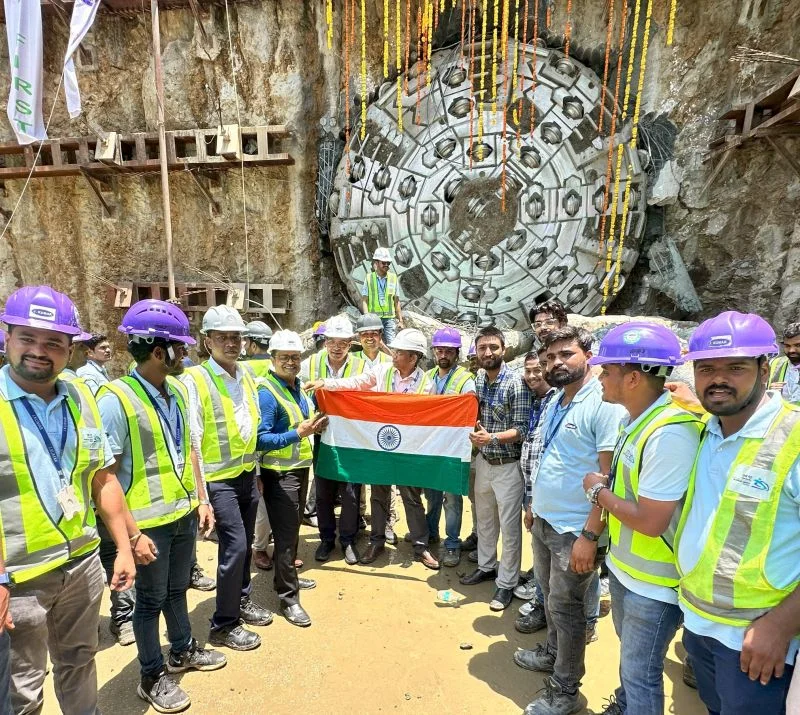
Latest Development on Mumbai Metro Line 7A In April 2025, J Kumar Infraprojects (JKIL)’s TBM Disha achieved a tunnel breakthrough at Airport Colony Station of Line 7A under package CA-48. In 2019, J Kumar Infraprojects secured Package CA-48 at Rs. 1,998 crore from the Mumbai Metropolitan Region Development Authority (MMRDA).
Line 8 ( Gold Line )
Line 8 of the Mumbai Metro is currently under implementation. The Line 8 has been proposed between Chhatrapati Shivaji Maharaj International Airport (CSMIA) and Navi Mumbai International Airport (NMIA) through a 35 km long metro corridor.
The Mumbai Metro Line 8 Project will be implemented under the public-private partnership (PPP) model, and is estimated to cost Rs 15,000 crore.
Recent Update
In January 2025, the Maharashtra Government approved the construction of Mumbai Metro Line 8. CIDCO, along with the agency developing the NMIA, has been assigned the task of preparing a Detailed Project Report (DPR) for Mumbai Metro Line 8.
Line 9 ( Red Line )
The under-construction Line 9 is the extension of Line 7 (Red Line ). The Line 9 spans 11.38 km between Dahisar East and Mira Bhayandar through 7 stations.
Line Status As of 31 January 2025
Elevated Viaduct
Sr. No.
Name of Work
Status in %
1
Pier Cap Erection
98% Completed
2
U-Girder Erection
93% Completed
3
Portal Beam Erection
97% Completed
4
I-Girder Erection
100% Completed
5
Deck Slab Casting
93% Completed
6
Deck Slab Casting
93% Completed
8
Parapet Erection
85% Completed
Elevated Station
1
Concourse Pier Arm Erection
96% Completed
2
Platform Pier Arm Casting
100% Completed
3
Platform Pier Arm Erection
95% Completed
4
Portal Beam Erection (Dahisar Station)
100% Completed
5
U-Girder Erection
96% Completed
6
PI-Girder Erection
90% Completed
7
L-Girder Erection
97% Completed
8
T-Girder Erection
93% Completed
Flyover
1
Hammer Head
100% Completed
2
Abutment Pile
100% Completed
3
Abutment Pile Cap
100% Completed
4
Abutment Pier Cap
83% Completed
5
Dirt Wall
83% Completed
6
Flyover Pier Cap Casting
90% Completed
7
Flyover Pier Cap Erection
88% Completed
8
I-Girder Casting
92% Completed
9
I-Girder Erection
86% Completed
10
Deck Slab Casting
73% Completed
Line 10 ( Green Line )
Line 10 of the Mumbai Metro is currently under implementation. The Line 10 spans 9.209 km between Gaimukh and Shivaji Chowk (Mira Road) through 4 stations.
The Detailed Project Report (DPR) of Mumbai Metro Line 10 was prepared by Delhi Metro Rail Corporation (DMRC) in March 2019.
The Prime Minister, Shri Narendra Modi, laid the foundation stone for the Mumbai Metro Line 10 Project on 7 September 2019.
Features of Line 10
Route length
9.209 km
Number of Total Stations
4
Estimated Cost
Rs. 4,476 cr
Elevated / Underground
Fully Elevated
Estimated Ridership
2031: 4.66 lakh/day
Line 11 ( Green Line )
Line 11 of the Mumbai Metro is currently under implementation. The Line 11 spans 12.7 km between Wadala – Chhatrapati Shivaji Maharaj Terminus.
The Detailed Project Report (DPR) of Mumbai Metro Line 11 was prepared by Delhi Metro Rail Corporation (DMRC) in September 2018.
The Prime Minister, Shri Narendra Modi, laid the foundation stone for the Mumbai Metro Line 11 Project on 7 September 2019.
Features of Line 10
Route length
12.7 km
Depot
Wadala
Estimated cost
Rs. 16,000 crore (old estimate: Rs. 8739 cr)
Estimated Ridership
2031: 16.95 lakh/day
Line 12 ( Orange Line )
Line 12 of the Mumbai Metro is currently under implementation. The Line 12 spans 22.17 km between Kalyan and Taloja through 19 stations.
The Prime Minister, Shri Narendra Modi, laid the foundation stone for the Mumbai Metro Line 11 Project on 7 September 2019.
Features of Line 12
Route length
22.17 km
Total Number of Stations
19
Estimated Cost
Rs. 8,416 crore
Type
Elevated
Line 13 ( Purple Line )
Line 13 of the Mumbai Metro is currently under the planning stage.
The Line 13 of Mumbai Metro will span 23 km connecting Shivaji Chowk (Mira Road) – Virar through 20 stations.
Line 14 ( Purple Line )
Line 14 of the Mumbai Metro is currently under the planning stage. The Line 14 of the Mumbai Metro will span 45 km, connecting Kanjurmarg – Badlapur through 40 stations.
Latest Update on Line 14 The Detailed Project Report (DPR) for Metro Line 14 has been prepared by Milan Metro, a consulting firm and has received approval from IIT Bombay.
Impacts of Mumbai Metro
1. Enhanced Connectivity: The Mumbai Metro has substantially improved connectivity throughout the city by offering a fast, reliable and efficient transportation option that complements the existing suburban railway and road networks. The metro infrastructure has effectively addressed significant gaps between the eastern and western suburbs, which were previously challenging to navigate due to heavy traffic and a lack of direct routes.
For example, Metro Line 1, which connects Versova in the west to Ghatkopar in the east, has reduced travel times from over 90 minutes by road to approximately 20 minutes, providing a fast and dependable alternative.
The metro system has streamlined daily commutes for countless residents, linking residential neighbourhoods with commercial centres, educational institutions, and business districts, thereby enhancing convenience and time efficiency.
2. Economic Growth: The Mumbai Metro Project has majorly contributed to the city’s economic development. The establishment of this metro system has led to a surge in real estate development by increasing property values and attracting investments in both residential and commercial sectors. Moreover, the Mumbai Metro connects key business districts, residential zones, and commercial areas, which has resulted in increased employment opportunities within the city. Job creation has occurred not only through direct employment associated with construction, operation, and maintenance but also in the retail, hospitality, and service sectors in areas connected by the metro.
3. Reduction in Traffic Congestion: The Mumbai Metro has played a crucial role in alleviating the severe traffic congestion faced by the city, providing a much-needed resolution to one of the most pressing urban challenges. As Mumbai contends with overcrowded roads and constrained infrastructure, the metro serves as a modern and efficient alternative to traditional modes of transport. The metro system has reduced the number of private vehicles on the roads, particularly during peak hours, which has resulted in a reduction in traffic congestion on the roads of Mumbai.
4. Multi-Modal Integration: Mumbai Metro is pioneering the concept of multimodal integration to enhance urban mobility by seamlessly connecting various modes of transport. The metro network is being strategically designed to interface with Mumbai’s extensive suburban railway system, facilitating easy transfers between trains and metro lines for passengers. Furthermore, metro stations are being integrated with the city’s bus network, ensuring smooth connectivity with local buses as well as with planned feeder services to expand the metro’s reach.
Conclusion
The Mumbai Metro represents a pivotal initiative aimed at mitigating the city’s persistent traffic challenges while offering a faster and more reliable transportation option for millions of residents. Supported by strategic planning from the MMRDA and technical expertise from organisations such as the DMRC, Tata Consultancy Services (TCS), and IIT Bombay, the metro project has evolved from an initial proposal of 146.5 kilometres in 2004 to an expanded network of 337 kilometres by 2019. The Mumbai Metro serves as a key element in addressing the urban transport challenges faced by the city. With its extensive network, it is designed to alleviate traffic congestion, shorten travel times, and offer a more efficient means of transportation. Currently, multiple lines are operational, with additional lines under construction, enhancing connectivity between crucial areas across the city and its suburbs. As Mumbai continues to develop, the Metro will play a vital role in the city’s vision of a smart, sustainable, and well-connected urban future.
Indian Railways stands as one of the largest railway networks in the world. Over the years, Indian Railways has evolved to cater to the various needs of the country, and today it serves as the backbone of India’s transportation Infrastructure. It is a key component of the country’s economy and overall infrastructure.
As of 2024, the Indian Railways is recognised as the fourth largest railway network globally in terms of size, encompassing a total network length of 68,584kilometres.
Indian Railways’ historic journey began with the commencement of its first passenger train service, which covered a 34-kilometre route between Bombay and Thane. The train was moved by a steam locomotive.
For more than a century, steam engines dominated the network, relying heavily on coal and water. However, the steam locomotives were highly inefficient and contributed to pollution and maintenance challenges. To address these challenges and increase the capacity of rolling stock, Indian Railways deployed electric trains. The introduction of electric trains was not only more efficient than steam locomotives but also helped reduce pollution in major cities. On 3 February 1925, the first electric train operated between Bombay and Kurla.
To further strengthen rail transportation, Indian Railways incorporated diesel-powered trains into its operations. In 1957, Indian Railways imported its first mainline diesel locomotive from the American Locomotive Company (ALCO) in New York and named it as WDM1. However, Diesel locomotives were highly dependent on petroleum products, which raised concerns over fuel dependency and environmental impact.
Recognising these challenges, Indian Railways explored more sustainable and energy-efficient alternatives. One of the most promising recent innovations of Indian Railways is the introduction of hydrogen-powered trains. Unlike other trains, hydrogen-powered trains do not require electrified tracks. This eliminates the substantial costs associated with establishing electrified infrastructure, rendering hydrogen trains a preferable alternative for non-electrified routes, particularly in rural and underdeveloped regions.
The transition of Indian Railways to hydrogen trains is in line with India’s overall vision of lowering carbon emissions, enhancing energy independence, and shifting towards green mobility solutions in the transport sector.
Hydrogen-Powered Trains: The Future of Sustainable Rail Mobility
Overview
The introduction of hydrogen trains is part of Indian Railways’ comprehensive strategy to modernise its infrastructure and reduce its environmental impact, aligning with the national goal of achieving net-zero emissions by 2030.
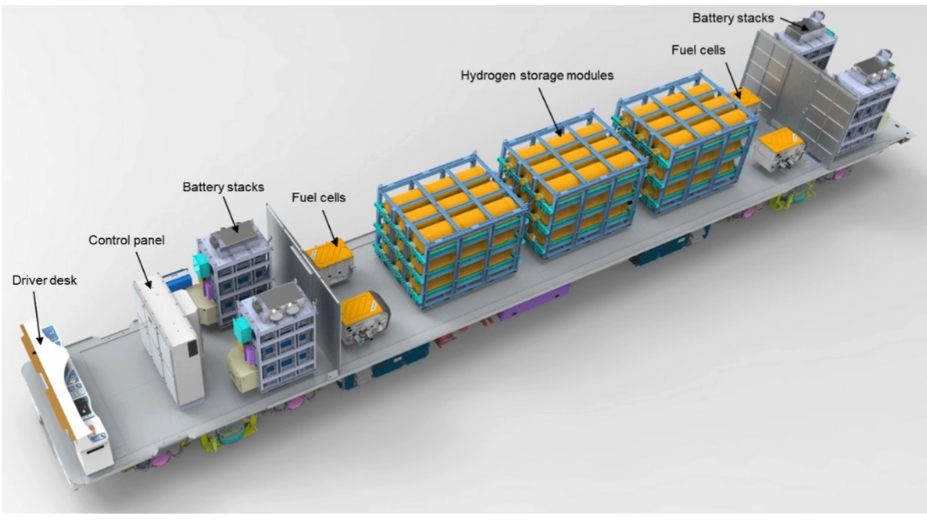
Hydrogen trains serve as an innovative and eco-friendly alternative to conventional rail transport by utilising hydrogen fuel cells rather than traditional diesel or electricity supplied by overhead lines. These trains generate zero direct emissions, producing only water vapour and heat as byproducts, which makes them a better solution in the advancement of sustainable transportation.
India’s Engineering Pride: First Indigenous Hydrogen Train
The journey of the first hydrogen train in India began with the Research Designs and Standards Organisation (RDSO) finalising the design specifications for the hydrogen fuel cell-based train in December 2021, ensuring the technology would be “Made in India.”
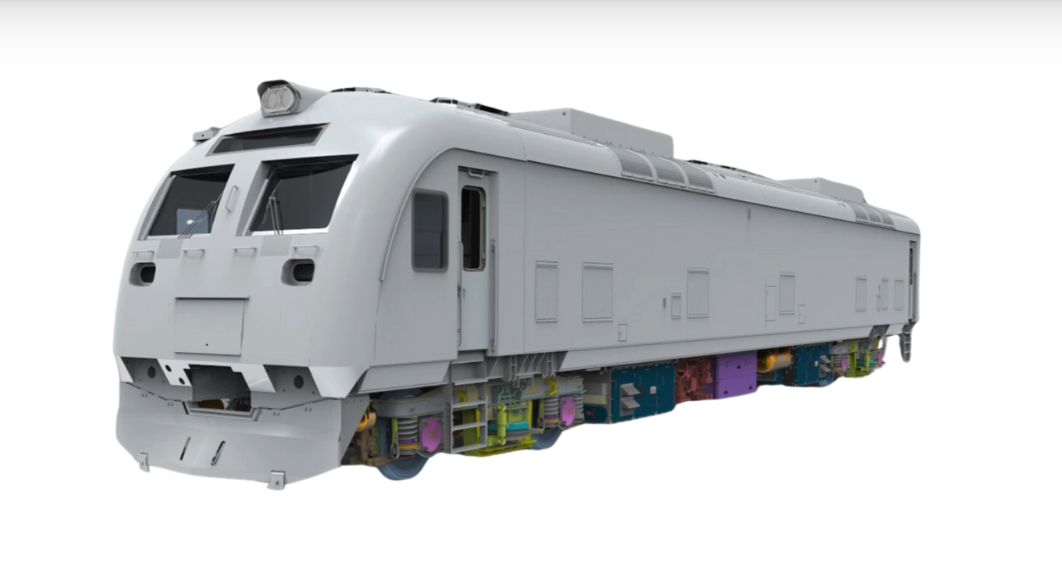
The Integral Coach Factory (ICF) in Chennai was entrusted with the critical task of manufacturing the hydrogen-powered trains. This involved designing and producing coaches that could not only carry passengers but also house essential components such as hydrogen cylinders, fuel cell converters, batteries, and air reservoirs.
India’s hydrogen-powered engine, engineered with indigenous technology, possesses the capability to deliver an impressive 1200 horsepower, exceeding the performance levels of global counterparts that typically operate within the range of 500 to 600 horsepower
The train is engineered to feature eight coaches, with a capacity to transport up to 2,638 passengers and achieve speeds of 110 km/h, thereby ensuring efficient and timely travel.
Indian Railways’ Hydrogen for Heritage Initiative
In February 2023, the Indian Railways unveiled its initiative to operate 35 Hydrogen Trains as part of the ‘Hydrogen for Heritage‘ initiative, aimed at mitigating carbon emissions and promoting environmentally sustainable practices. This development was confirmed by the Union Minister of Railways, Ashwini Vaishnaw, during a written response to an inquiry in the Rajya Sabha in 2023.
Indian Railways Pilot Project for Hydrogen Trains
October 2021: Indian Railways issued the tender for a pilot project for converting a Diesel Electric Multiple Unit (DEMU) rake into a hydrogen-powered train. This pilot initiative is scheduled to be operational on the Jind-Sonipat section of theNorthern Railway.
September 2022: Medha Servo Drives, which is undertaking the pilot project for the retrofitment of a hydrogen fuel cell onto an existing Diesel Electric Multiple Unit (DEMU), placed an order for hydrogen fuel cell modules from Ballard Power Systems. The order was for eight units of 100 kW FCmove™-HD+ fuel cells.
In 2023, Union Railway Minister Ashwini Vaishnaw announced that Indian Railways has entrusted the pilot project worth Rs 111.83 crores for the retrofitment of a hydrogen fuel cell onto a running Diesel Electric Multiple Unit (DEMU) rake along with the corresponding ground infrastructure.
Furthermore, the Ministry of Railways earmarked ₹2,800 crore in the 2023-24 budget for the development of hydrogen-powered trains.
The projected cost for each hydrogen train is approximately ₹80 crore, with an additional ₹70 crore per route to cover the ground infrastructure.
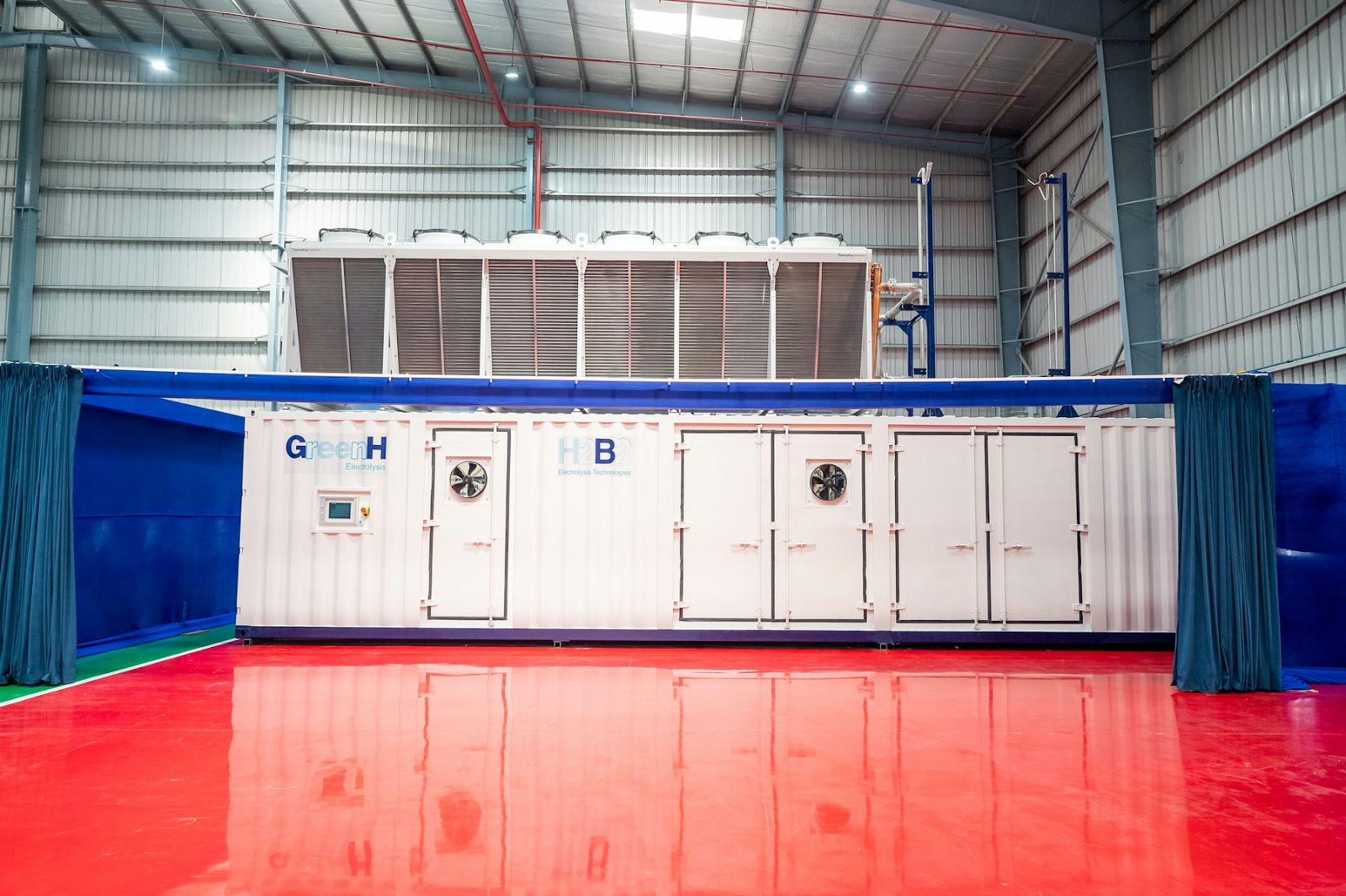
October 2023: GreenH Electrolysis, a joint venture between H2B2 Electrolysis Technologies and GR Promoter Group, entered into a contract with Medha Servo Drives to establish a hydrogen production and refuelling station in Jind, Haryana. GreenH is responsible for the Engineering, Procurement, and Construction (EPC) of the station.
In October 2024, GreenH Electrolysis unveiled its 1 MW PEM electrolyser at its manufacturing unit in Jhajjar, Haryana. This electrolyser is planned for installation at the hydrogen production and refuelling station in Jind, Haryana.
Key Features:
The electrolyser is designed to generate approximately 430 kilograms of hydrogen daily at a pressure of 40 bar (g), adhering to the ISO 14687 purity standard, which is suitable for fuel cell applications.
The refuelling station will also include the following:
3,000 kg hydrogen storage system,
A compressor and two hydrogen dispensers with pre-coolers,
These essential components will ensure quick and efficient refuelling of hydrogen-powered trains.
From Vision to Reality: First Hydrogen Train Trials
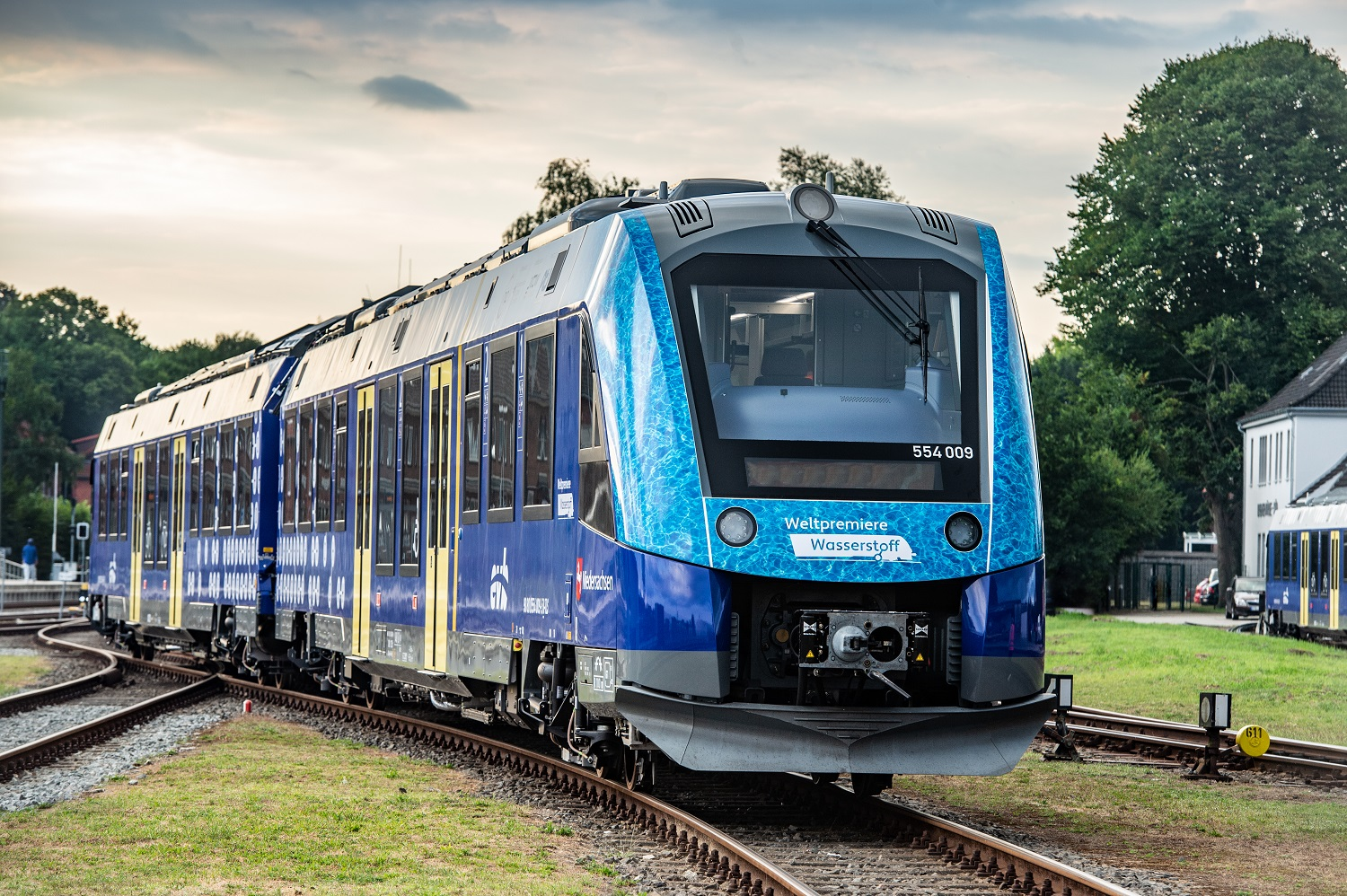
In April 2025, Indian Railways began trial runs of its first hydrogen-powered train on the 89-kilometre route, which spans between Jind and Sonipat.
A senior official at Indian Railways has stated that the preliminary trial runs have been primarily successful. However, during the testing of the train, it was identified that the capacity of its hydrogen fuel cell must be increased to enable optimal performance under maximum load-carrying conditions.
An estimated additional timeframe of 2 to 3 months is required for technical adjustments and testing. This delay has already pushed back the original launch timeline of December 2024. The railway now aims to introduce the train on the iconic Kalka–Shimla route by mid-2025.
The Global Shift Toward Hydrogen-Powered Trains: A New Era in Clean Rail Transportation
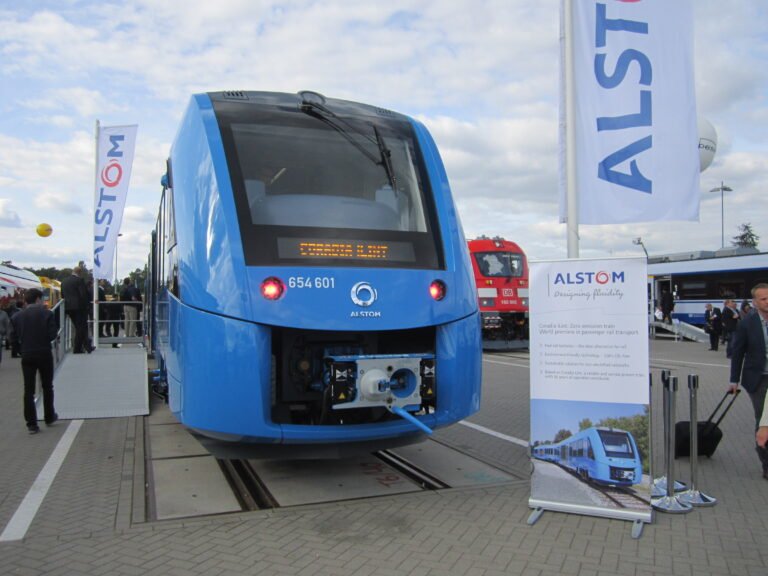
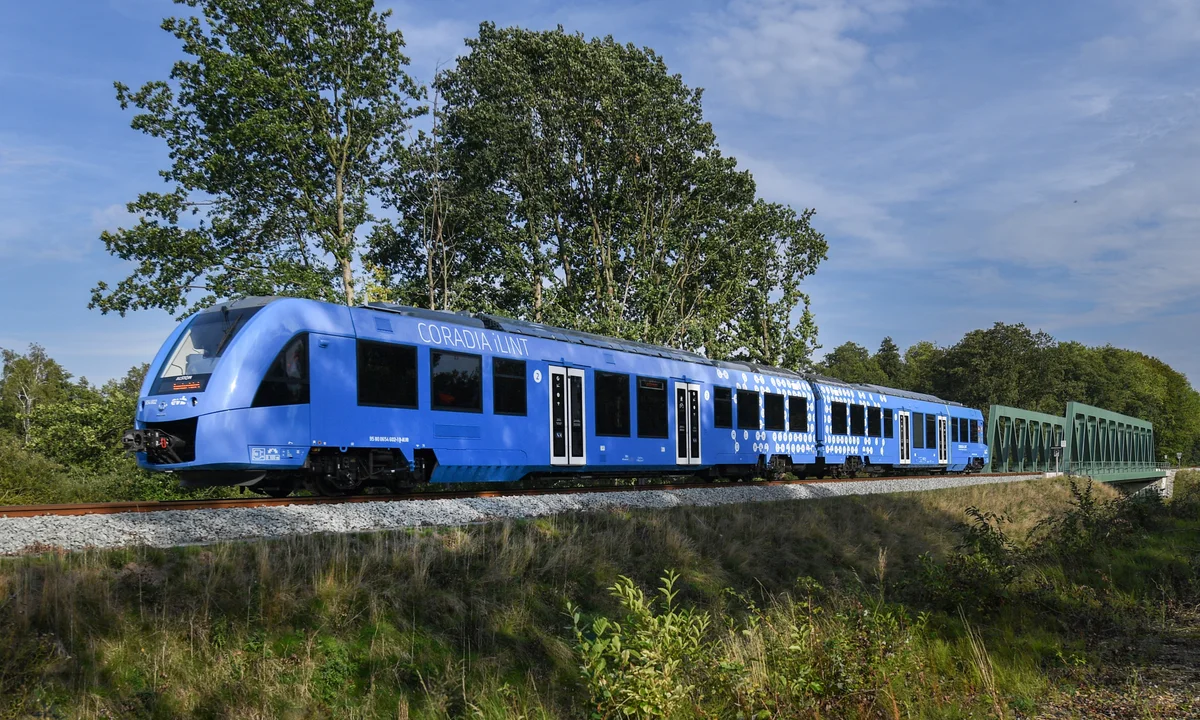
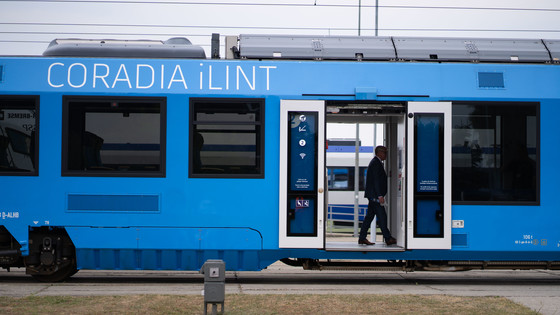
1. Germany: Alstom Coradia iLint
Coradia iLint stands as the world’s first train that runs on hydrogen-based fuel. The train was developed by Alstom at its Salzgitter facility in Germany.
The train was first introduced at the InnoTrans event in Berlin in 2016 and began commercial operations in Germany by 2018.
The Coradia iLint represents the inaugural passenger train that employs a hydrogen fuel cell to produce electrical power for traction purposes.. This train operates without emitting carbon dioxide (CO2) and produces only water as a byproduct.
On Thursday, September 15, 2022, the Alstom Coradia iLint achieved a noteworthy milestone by successfully travelling 1,175 kilometres without requiring refuelling of its hydrogen tank.
2. UK’s: HydroFLEX
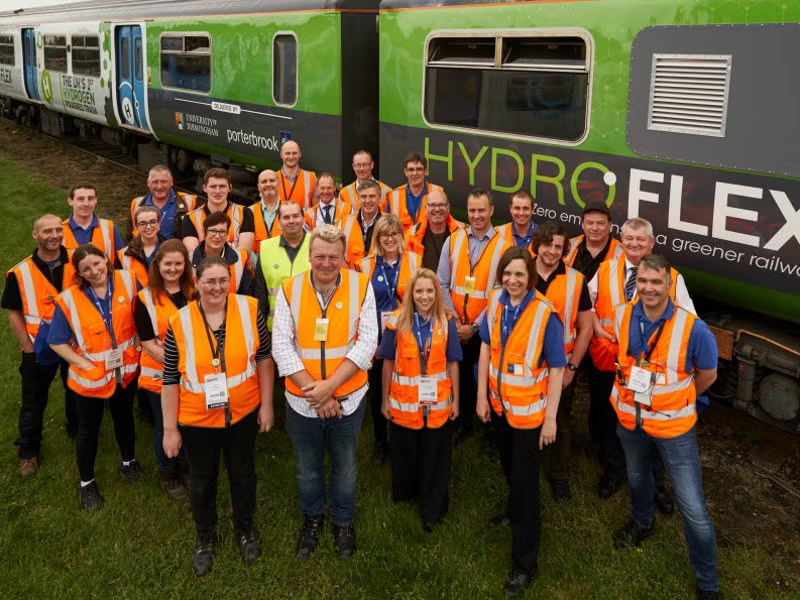
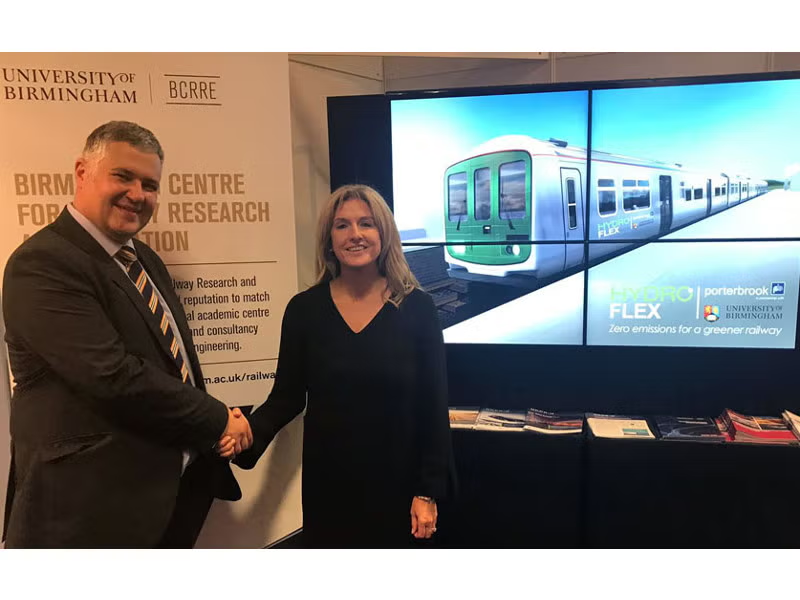
HydroFLEX is the UK’s first hydrogen-powered train, developed by fitting a hydrogen fuel system onto an existing Class 319 train.
The Hydroflex initiative is a joint project between the University of Birmingham’s Centre for Railway Research and Education (BCRRE) and Porterbrook.
The idea for HydroFLEX was first introduced at the Rail Live event in June 2018. A working version of the train was later showcased at the same event in June 2019, held at the Quinton Rail Technology Centre.
The goal of the project is to help reduce carbon emissions on the UK rail network by replacing diesel-only trains with hydrogen-powered ones by 2040. It supports the UK Government’s goal of reducing carbon emissions by 80% by 2050
3. Swiss: Stadler FLIRT H2
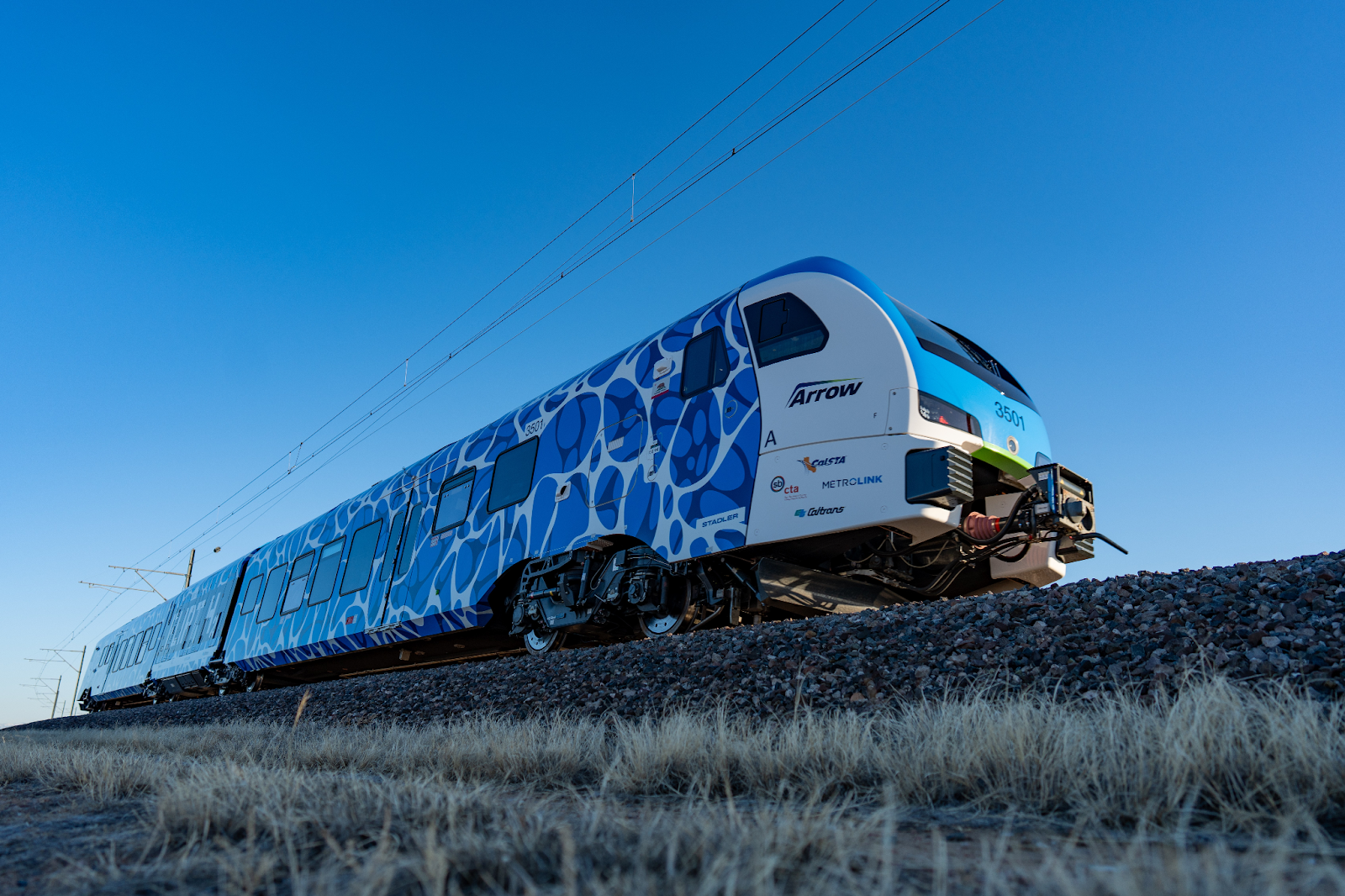
The FLIRT H₂ train is an electric multiple unit incorporating hydrogen fuel cell technology, developed by the Swiss manufacturer Stadler Rail. Stadler unveiled the FLIRT H₂ to the public at InnoTrans 2022 in Berlin.
In March 2024, Stadler’s hydrogen-powered train set a Guinness World Record for covering the longest distance without needing to refuel or recharge.
This remarkable feat involved the FLIRT H₂ covering a distance of 1,741.7 miles (2,803 kilometres), which signifies a pivotal advancement in the implementation of clean energy solutions within the railway sector.
4. China: CINOVA H2
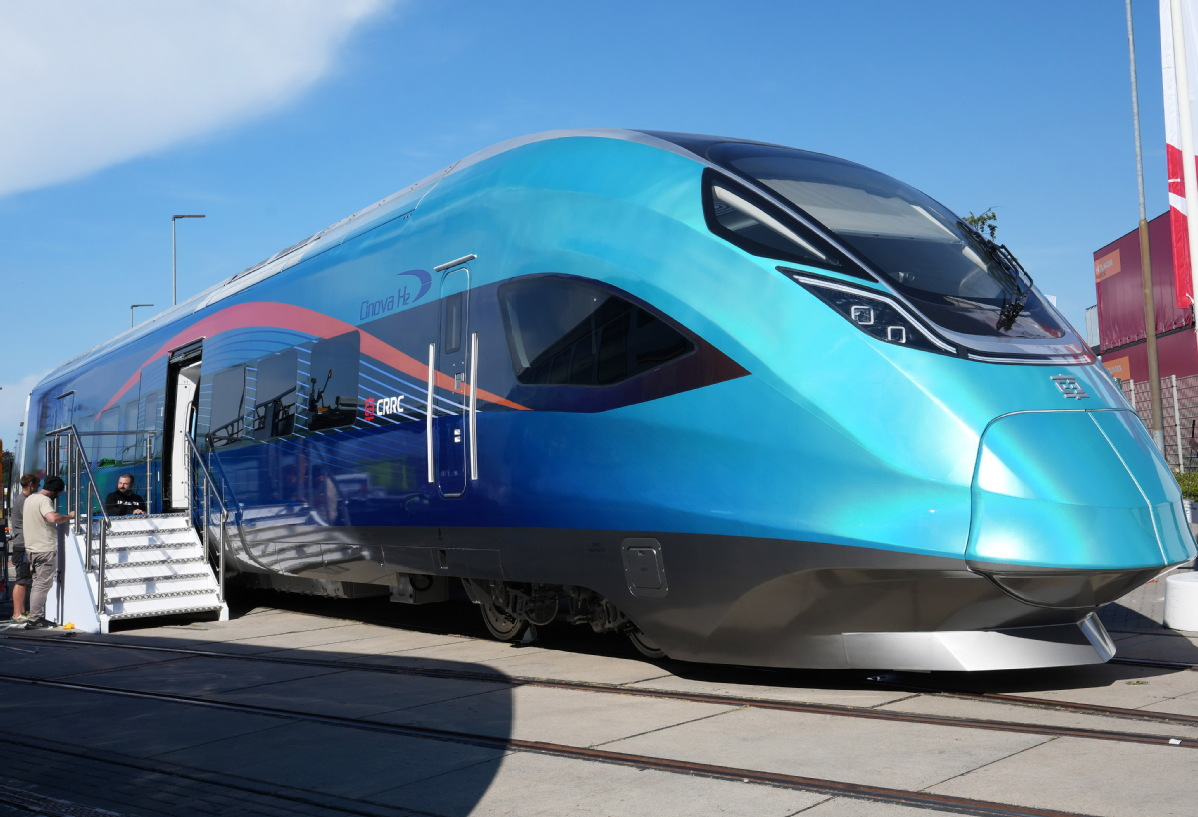
The CRRC CINOVA H2 is a hydrogen-powered intercity train manufactured by CRRC QingdaoSifang Co. Ltd,. It was introduced at InnoTrans 2024 as China’s first smart intercity train running on hydrogen.
The CINOVA H2 runs on a powerful and efficient hydrogen fuel cell that produces electricity by combining hydrogen and oxygen. The only byproduct is water, which is purified and reused onboard to serve passengers’ water needs.
Assessing the Viability of Hydrogen Trains in India
The viability of hydrogen-powered trains in India is contingent upon a comprehensive evaluation of economic, infrastructural, environmental, and technological factors. While hydrogen trains signify a progressive advancement toward the decarbonization of the rail sector, their successful deployment is reliant upon overcoming a range of systemic challenges.
1. Infrastructure Limitations:
India possesses an extensive railway infrastructure that is primarily designed for diesel and electric locomotives. The implementation of hydrogen trains within the Indian railway system requires a robust and adaptable infrastructure strategy.
Unlike conventional diesel or electric trains, hydrogen trains necessitate the establishment of a specialised ecosystem, which includes systems for hydrogen production, storage, distribution, and refuelling. Each hour, the train will necessitate approximately 40,000 litres of water to facilitate the required chemical processes. The authorities will need to construct dedicated water storage facilities for the efficient operation of these trains.
Furthermore, the integration of hydrogen technologies into the digital infrastructure of Indian Railways is a major challenge. Advanced monitoring systems, fuel management frameworks, and predictive maintenance technologies are essential to ensure operational efficiency and safety.
2. Economic Feasibility:
The implementation of hydrogen trains necessitates a substantial initial investment in technology, infrastructure, and fuel production; however, they present considerable long-term economic advantages for Indian Railways.
Currently, India incurs substantial expenses in diesel imports, and the adoption of hydrogen trains has the potential to diminish this reliance while enhancing energy security. As the production of green hydrogen increases and the costs of renewable energy decline, the price of hydrogen fuel is anticipated to decrease, thereby becoming more competitive over time.
Additionally, hydrogen trains exhibit lower maintenance costs compared to their diesel counterparts, attributed to the reduced number of moving parts in fuel cell systems.
3. Environmental Impact
Hydrogen trains present a clean alternative to diesel locomotives, emitting only water vapour as exhaust and generating no harmful emissions, such as carbon dioxide (CO₂) or nitrogen oxides (NOx). This transition contributes to the improvement of air quality, particularly in urban areas and regions sensitive to environmental changes.
Conclusion
The deployment of hydrogen-powered trains in India is a major move towards the modernisation of the Indian railway system and its environmental reduction. Although the transition to hydrogen fuel has definite benefits, including reduced emissions and less reliance on fossil fuels, it also comes with challenges. These are the requirements for dedicated infrastructure for the production, storage, and refuelling of hydrogen, as well as the high upfront cost of implementation. Moreover, technological refinement and trials are vital to guarantee the dependability and efficiency of these trains. Through ongoing development and trials, hydrogen trains may become a significant component of India’s strategy to decrease carbon emissions in rail transport, providing a cleaner and more environmentally friendly option compared to conventional diesel-fueled trains. Nonetheless, their success relies on surmounting these technical and financial barriers.
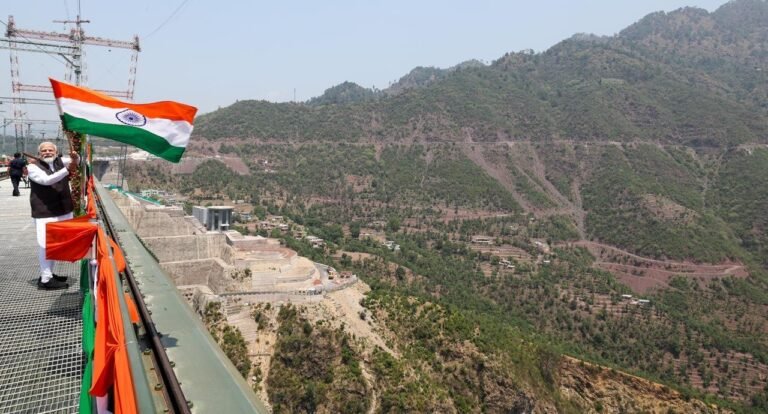
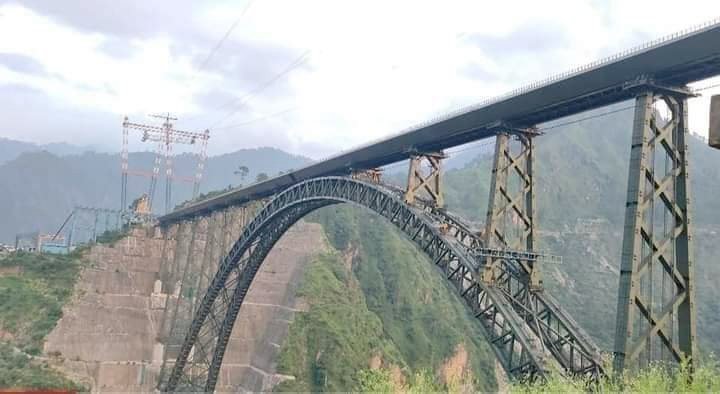
Kashmir ( Metro Rail News): On 6th June 2025, Prime Minister Narendra Modi inaugurated the Chenab Rail Bridge, recognised as the world’s highest railway bridge, along with India’s first cable-stayed rail bridge, the Anji Khad Bridge. These developments signal the completion of the Udhampur-Srinagar-Baramulla Railway Link (USBRL) Project.
The Chenab Bridge is recognised as the world’s highest railway arch bridge, standing at an elevation of 359 meters (1,178 feet) above the Chenab River.
This remarkable structure surpasses the Eiffel Tower in Paris by 35 meters in height. The Chenab Bridge is a part of the Udhampur-Srinagar-Baramulla Railway Link (USBRL).
About Anji Khad Bridge
The Anji Khad Bridge is recognised as India’s inaugural cable-stayed railway bridge, spanning the Anji River and also part of the ambitious USBRL project.
This bridge is designed to ensure continuous rail connectivity to the Kashmir Valley, specifically along the Katra-Banihal section of the Udhampur-Srinagar-Baramulla Rail Line.
The Anji Khad Bridge attains a height of 331 meters above the riverbed and extends 725 meters in length, relying on 96 high-tensile cables for support. The total length of cable strands utilised in the construction of this bridge amounts to an impressive 653 kilometres.
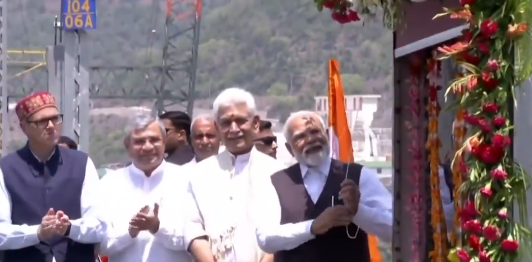
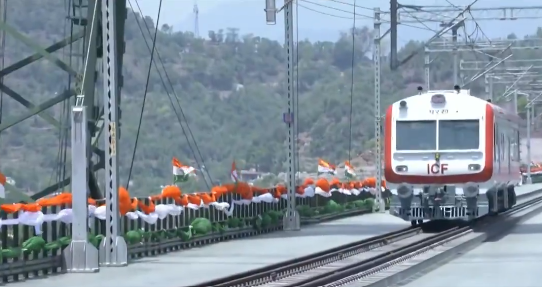
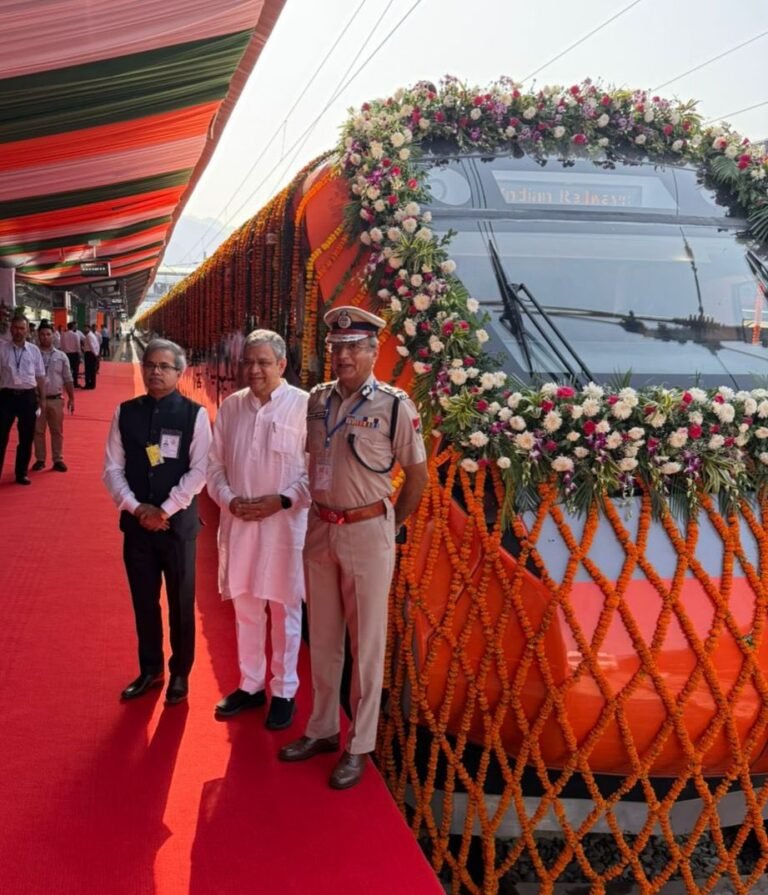
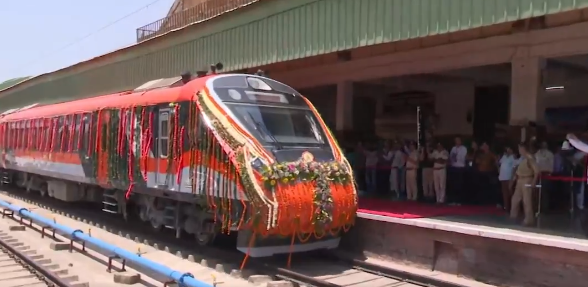
Kashmir (Metro Rail News): Prime Minister Narendra Modi launched the Vande Bharat Train Services on the Katra-Srinagar route on 6 June 2025. This development will connect the Kashmir Valley with the rest of the country.
Prime Minister, Narendra Modi, has launched the 2 Vande Bharat Trains with one operating between Katra and Srinagar and the other servicing the route from Srinagar to Katra.
Vande Bharat Trains to Traverse Engineering Marvel
The Vande Bharat trains operating on this newly established route will navigate through the Chenab Bridge, recognised as the world’s highest railway bridge, which rises to an elevation of 359 meters above sea level. This bridge is a significant component of the Udhampur-Srinagar-Baramulla Rail Link (USBRL) project, a substantial investment valued at ₹40,000 crores.
Additionally, the Vande Bharat trains will cross the Anji Khad Bridge, which is notable for being India’s inaugural cable-stayed bridge. This remarkable structure, supported by 96 cables, extends 725 meters in length and achieves a height of 331 meters above mean sea level.
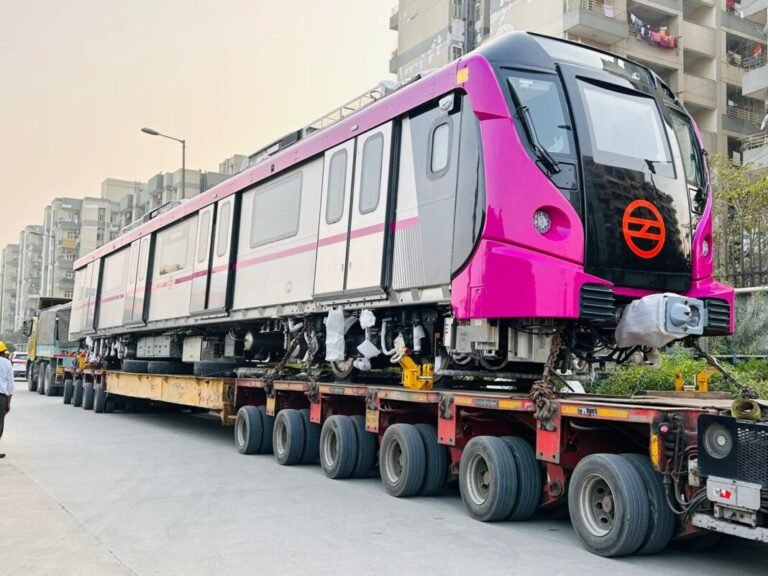
Chennai (Metro Rail News): Chennai Metro Rail Limited and Alstom Transport India Limited have signed a Contract Agreement for the procurement of 32 driverless 3-car (UTO) trains consisting of 96 cars for Phase 2 of Chennai Metro.
The contract agreement was signed by Thiru. Manoj Goyal, Director (Systems & Operations) on behalf of CMRL and Thiru. Parag Nandlal Gohel, Customer Director (South) on behalf of M/s. ALSTOM Transport India Limited.
Thiru. A. R. Rajendran, CGM (RS & S&T)-CMRL, Thiru. P. Thiagarajan JGM (RS)-CMRL, and other senior officials from CMRL, General Consultant AEON and ALSTOM were present during the occasion.
About the Rolling Stock of Chennai Metro Phase 2
On 28 April 2025, Alstom Transport India received a Letter of Acceptance (LoA) for the rolling stock Contract ARE04A of Chennai Metro Phase 2.
Under this contract, the first train is scheduled to be delivered to CMRL by February 2027 at the CMRL Phase 2 Depot. The subsequent trains will be delivered between September 2027 and May 2028 and tested at the CMRL site.
Scope of Work
The scope of work under this contract includes the “Design, Manufacture, Supply, Testing, Commissioning, Training of Personnel and Comprehensive Maintenance Contract for Fifteen (15) years of Standard Gauge Metro Rolling Stock (Electrical Multiple units)” of 96 cars to form 32 UTO trains.
National High Speed Rail Corporation Limited ( NHSRCL) has floated a tender for the selection of a Consultant for the Independent Safety Assessment (ISA) of the complete Mumbai-Ahmedabad High Speed Rail (MAHSR) Project.
Tender Details
Opening Date
2 Jun 2025
Closing Date
12 Aug 2025
Tender Id
2025_NHSRC_237274_1
Tender No
NHSRCL/CO/OS/ISA/2025/09
EMD Amount
1,38,50,000
Bid Submission Start Date
23-Jul-2025
Bid Opening Date
13-Aug-2025
Bid Submission End Date
12-Aug-2025
Contract Details
Contract Duration: 2558 Days
Contracts Scope of Work: Selection of Consultant for Independent Safety Assessment (isa) of Mumbai-ahmedabad High Speed Rail ( MAHSR) Project
Recent Developments on the Mumbai-Ahmedabad Bullet Train Project
Recently, the Mumbai-Ahmedabad Bullet Train Project progressed with the commencement of casting the first slab at the Virar Bullet Train station.
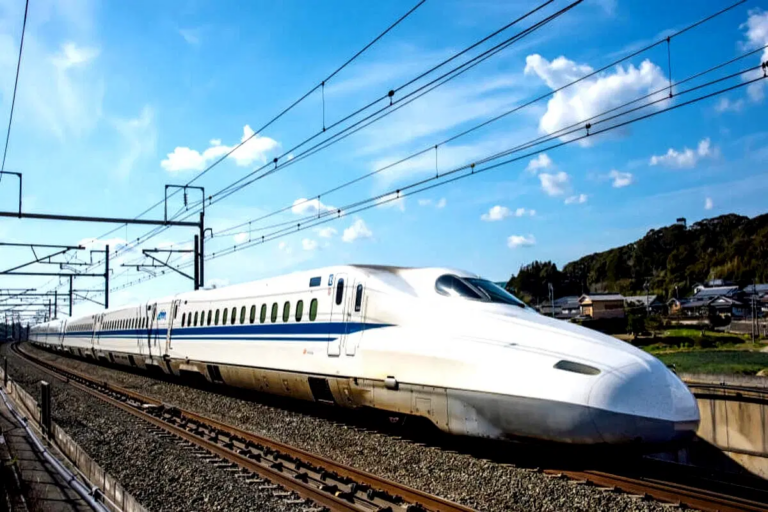
Additionally, the first Shinkansen bullet train of the Mumbai-Ahmedabad Bullet Train Project entered the trial phase in Japan.
About the Mumbai-Ahmedabad Bullet Train Project
The Mumbai Ahmedabad Bullet Train Project is an under-construction high-speed rail line that spans 508 km from Mumbai to Ahmedabad, covering 12 stations.
Out of 12 stations planned for the Mumbai-Ahmedabad Bullet Train Project, 8 stations are located in Gujarat, while the remaining 4 stations are located in Maharashtra.
On June 6, 2025, during his visit to Jammu and Kashmir, Prime Minister Narendra Modi will inaugurate the Chenab Rail Bridge, recognised as the world’s highest railway bridge, along with India’s first cable-stayed rail bridge, the Anji Khad Bridge.
About Chenab Rail Bridge
The Chenab Bridge represents a major infrastructure advancement undertaken by Indian Railways.
It is distinguished as the world’s highest railway arch bridge, standing at an elevation of 359 meters (1,178 feet) above the Chenab River.
This impressive structure exceeds the height of the Eiffel Tower in Paris by 35 meters.
The Chenab Bridge is an integral part of the Udhampur-Srinagar-Baramulla Railway Link (USBRL).
About Anji Khad Bridge
The Anji Khad Bridge, India’s first cable-stayed railway bridge, spans the Anji River and is also part of the ambitious USBRL project.
This bridge aims to provide uninterrupted rail connectivity to the Kashmir Valley, specifically within the Katra-Banihal section of the Udhampur-Srinagar-Baramulla Rail Line.
The bridge reaches a height of 331 meters above the riverbed and extends 725 meters in length, supported by 96 high-tensile cables.
The total length of cable strand utilised in the construction of this bridge amounts to an impressive 653 kilometres.
PM Modi to Launch First Vande Bharat Train for Kashmir
On June 6, 2025, Prime Minister Narendra Modi will also launch the Vande Bharat Train Services on the Katra-Srinagar route during his visit to Jammu and Kashmir.
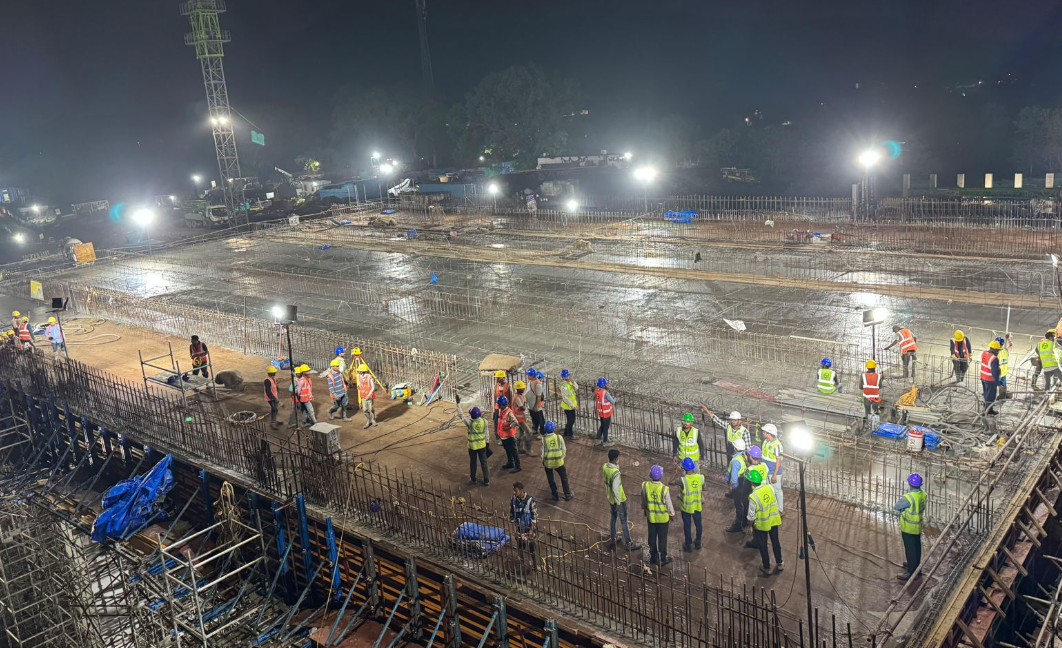
The Mumbai-Ahmedabad Bullet Train Project progressed as the Casting of the first slab started at the Virar Bullet Train station. There will be 9 such slabs at this level, which will form the base for track laying works at the station.
The Virar Bullet Train station will have two levels with a total length of 425 meters.
Concourse level
Rail level
The first slab cast at the Virar Bullet Train station is 50 meters in length and 35.32 meters in width. The slab has a thickness of approximately. 300 mm, utilising 1555 cubic meters of concrete.
Recent Train Trials for Mumbai-Ahmedabad Bullet Train Project
Recently, the first Shinkansen bullet train of the Mumbai-Ahmedabad Bullet Train Project entered the trial phase in Japan. As part of the Indo-Japanese collaboration, Japan will provide two Shinkansen train sets—one from the E5 series and one from the E3 series—for initial inspection and performance testing.
About the Mumbai-Ahmedabad Bullet Train Project
The Mumbai Ahmedabad Bullet Train Project is an under-construction high-speed rail line that spans 508 km between Mumbai and Ahmedabad through 12 stations.
Out of 12 stations planned for MAHSR, 4 stations are located in Maharashtra, while the remaining 8 stations are located in Gujarat.
Kolkata ( Metro Rail News): Metro Railway Kolkata has issued a tender for the electrification contract of the North-South Corridor of Kolkata Metro ( Phase 3).
Brief Scope of Work: Provision of High Conductivity Aluminium Third Rail in the Elevated Section of North-South Corridor of Metro Railway, Kolkata (Phase III).
Further Updates
Recently, Metro Railway Kolkata also issued a tender for the Deployment of the KAVACH system on the Kolkata Metro Yellow Line’s 7.03 km stretch between Noapara and Jai Hind metro stations.