Satyanarayansinh Rathore appointed as GMRC Managing Director

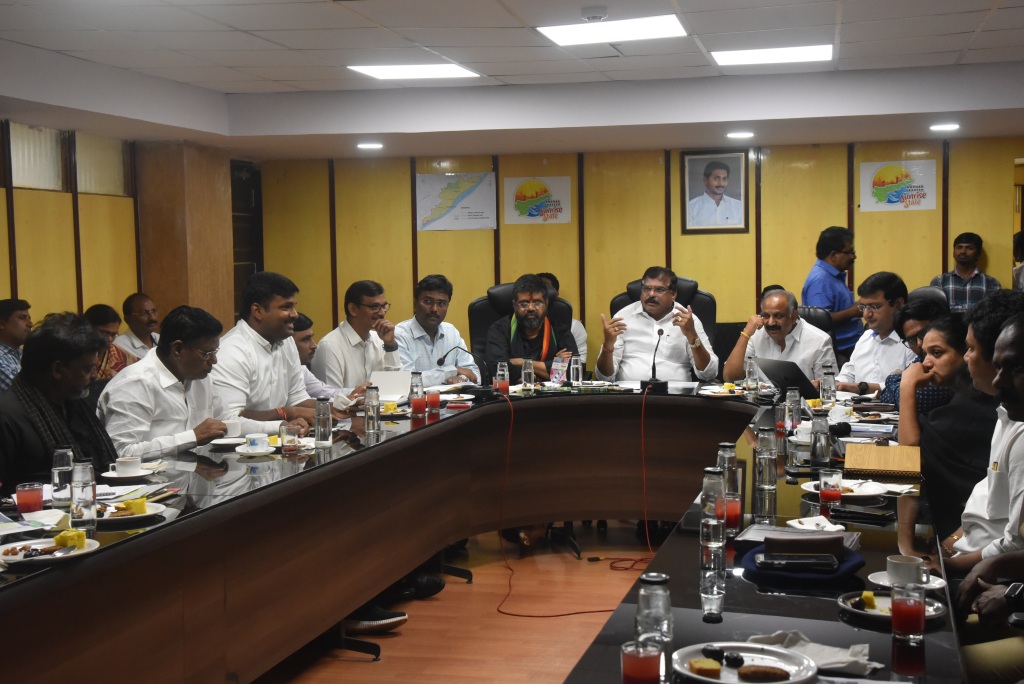
GUJARAT (Metro Rail News): Satyanarayansinh Rathore, Chairman, Sardar Sarovar Narmada Nigam Ltd (SSNNL), has been appointed as Managing Director of the Gujarat Metro Rail Corporation (GMRC).

He would be taking over the post from I P Gautam, who had resigned from the post following his appointment as a member of the Lokpal body.

Earlier, Rathore was acting as nominated Director of GMRC after he retired as Additional Chief Secretary, Roads and Building Department, Government of Gujarat.

Rathore started his career as a Civil Engineer with Gujarat Service of Engineers (GSE) cadre. He belongs to the royal family of Valasna State. He is popularly known as the ‘Highway and canal man of Gujarat’.

As CMD of Sardar Sarovar Narmada Nigam Limited (SSNNL), Rathore completed the Sardar Sarovar dam project which enabled the supply of irrigation and drinking water from the Narmada river, established various canal networks. He also leads the team for the Statue of Unity project.

Rathore introduced the Build, Operate and Transfer (BOT) road development model, the first of its kind in India. He is credited for developing major highways in Gujarat. He also served as the former President of the Institute of Engineers, India, Indian Road Congress, and the Vice-President of the World Federation of Engineering Organization.

He also served as the Principal Secretary of the Government of Gujarat. Rathore was honored with the fourth highest civilian honor Padma Shree in 2018 for his contribution towards infrastructure development in India.

Cabinet note finalized on a free bus ride for women in Delhi

NEW DELHI (Metro Rail News): The cabinet note pertaining to free rides for women on public buses in Delhi has been finalized and it is likely to be “approved” by the Delhi cabinet by the end of the week, Delhi transport minister Kailash Gahlot said Monday.

Senior officials in Delhi government had earlier said while its plan to offer free rides to women on the Delhi Metro is set to take longer, with the involvement of the fare fixation committee, they were planning to implement the scheme first on buses.

While the Centre is a stakeholder when it comes to Metro services, city buses come under the jurisdiction of the Delhi government.

The Delhi government currently has 5,521 buses that ply across Delhi-NCR. The city’s state-run buses have a daily ridership of over four million of which nearly 31% are women, senior government officials said.

“All modalities for the cabinet note have been taken into account. It has been finalized. It is likely to be approved by the Delhi cabinet by the end of the week,” Gahlot said.

The Delhi Transport Corporation and the Delhi Integrated Multi-Modal Transit System Ltd (which operates the cluster buses in Delhi) together had given an estimate of Rs 300 crore for the first year, including capital cost. Both agencies had also suggested introducing special passes and cards to beneficiaries of the scheme.

While announcing the scheme on June 3, chief minister Arvind Kejriwal had asked the DMRC (Delhi Metro Rail Corporation) and Delhi Transport Corporation (DTC) to submit proposals of rolling out the schemes in their respective networks.

In its proposal, the DMRC had stated it would take at least six months to implement the scheme. It had offered two stop-gap arrangements to the government, out of which the Cabinet preferred the one which involved giving single ticket journey tokens in pink color to the interested female commuters. But this alternative, the DMRC has said would take them at least eight months to roll out.
buy cialis strips online https://lasernailtherapy.com/wp-content/themes/twentytwentytwo/inc/patterns/en/cialis-strips.html no prescription

In its report to the government submitted on June 10, on implementing Delhi government’s proposal to allow free travel for women in the Metro and buses, the DTC said it would require an annual subsidy amount of about Rs200 crore to roll out the scheme in its buses, apart from another Rs100 crore that would be incurred on the cluster (orange-colored) buses, which are operated by the Delhi Integrated Multi-modal Transit System Ltd.

DTC officials had cited legal provisions in the Motor Vehicles Act to explain that no passenger can be allowed to travel without a ticket in state-run buses.

While announcing a proposal to offer free bus and Metro rides to women in Delhi, chief minister Arvind Kejriwal had, on June 3, said that the government is open to suggestions from the public and experts on improving the scheme.

While implementing the scheme is easier in public buses, the government has chalked out an initial plan for rolling it out in the Metro. As a short-term measure, the Metro plans to give pink tokens to women commuters. The suggested long-term measures include creating new entry-exit AFC gates, holding a registration drive for women passengers and handing out pink smartcards to them.

A 17-km segment of country’s first rail rapid corridor likely to be operational March 2023

NEW DELHI (Metro Rail News): Commuters will be able to travel on the country’s first rail rapid transit corridor in over three years from now as its 17-km-long Duhai-Sahibabad section in Uttar Pradesh’s Ghaziabad is expected to be operational by early 2023, an official said on Wednesday.

According to the National Capital Region Transport Corporation (NCRTC), the executing agency of the Rail Rapid Transit System (RRTS), the entire Delhi-Ghaziabad-Meerut RRTS corridor, spanning 82 km, will be operational by 2025.

The corridor would cut down the travel time between Delhi and Meerut to around 55 minutes from the current three-four hours by road, the official said.

The NCRTC has already commenced the civil construction work on the 17-km-long Duhai-Sahibabad section of the corridor. This next-generation regional transit system will not only reduce the travel time but will also help people get rid of long traffic jams and air pollution, the official said. The Duhai-Sahibabad section of the corridor will have four stations Duhai, Guldhar, Ghaziabad, and Sahibabad besides a depot at Duhai.

“This priority section is expected to become operational by March 2023, while people can avail the benefit of fast and safe commute on the 82-km-long full corridor by 2025,” the official said.

The opening of the Duhai-Sahibabad section will connect the Ghaziabad RRTS station to Delhi Metro’s Ghaziabad New Bus Adda station, while the Sahibabad RRTS station will integrate with the proposed Vasundhara Sector 2 metro station and bus terminal.

The Delhi-Ghaziabad-Meerut RRTS corridor will have a total of 24 stations, including two depot-cumstations at Duhai and Modipuram. “The RRTS trains will have a design speed of 180 kmph, the operational speed of 160 kmph and the average speed would be 100 kmph.

“The trains will be three times faster than the Delhi Metro trains in terms of operational speed,” the official added. The distance between the stations will vary from 5 to 10 km. Prime Minister Narendra Modi had laid the foundation stone of the Delhi-Ghaziabad-Meerut RRTS corridor in March.

Maharashtra govt declares Hyperloop Project as Public Infrastructure Project

MUMBAI (Metro Rail News): As the assembly elections approach, the Maharashtra cabinet has taken up the approval of various projects.

 On Tuesday, the cabinet approved a proposal to declare the Mumbai-Pune Hyperloop Transport project a public infrastructure project. The Hyperloop is an ultra-high-speed ground transportation system comprising a system of tubes through which a pod may travel free of air resistance or friction conveying people or objects at high speed from one point to another.

The Hyperloop is proposed from Bandra Kurla Complex to Wakad in Pune, a distance of 117.50 km and when commissioned it will cover the distance in 23 minutes.
buy veklury online gaetzpharmacy.com/veklury.html no prescription

It is estimated to cost Rs 70,000 crore which will be through foreign investments in installments. It will be executed by the Pune Metropolitan Region Development Authority (PMRDA). In a press release, chief minister Devendra Fadnavis said the project will be completed in two phases. Phase I is from Gahunje to Usse village in the PMRDA region, a distance of 11.8 km.

This will be completed in 2.5 years and is estimated to cost Rs 5,000 crore, he said. If successful then Phase II will cover the entire distance from BKC to Wakad and will be executed in 6-8 years.

“The stretch for phase I has been selected as a test track because all the technical challenges that can be experienced along the entire expressway can be found on this patch. The company will get a sense of the challenges along this stretch,” said a senior official.

The cabinet approved the tag of a ‘public infrastructure project as it would help streamline permissions for the project and also the government has approved the consortium of Hyperloop Technologies INC and DP world FZE as the project proponents.

The contractor for the project will be approved by the Swiss Challenge Method. The consortium will prepare the Detailed Project Report.

Under the Swiss Challenge Method, the design is put out for bids. Anyone can offer an alternative. If the alternative is better than the original proposal then it is accepted. “If there is no better proposal then the consortium will execute the project,” said a senior official.

Buldi-Lokmanya Nagpur stretch’s train run before August 15

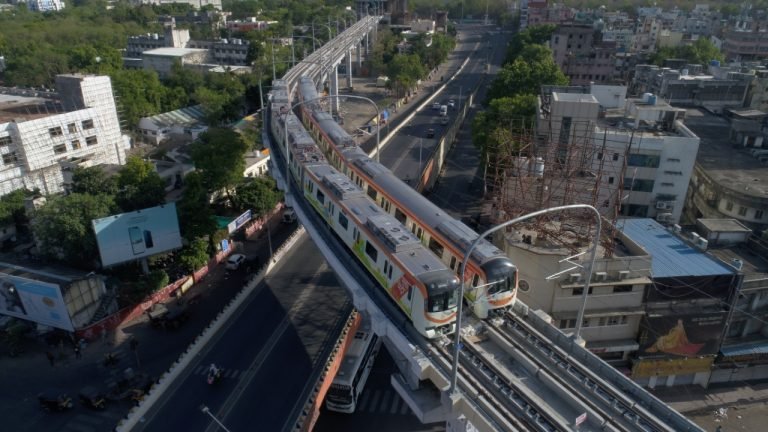
NAGPUR (Metro Rail News): MahaMetro has set a target of holding a trial run on Sitabuldi-Lokmanya Nagar stretch (Reach-III) before August 15. The civil work of viaduct is over while that of erecting overhead electrical (OHE) equipment and track laying is in the final stages. The 25KV power cable for this section will be charged on August 1. Fifteen coaches will reach the city on August 5.

Currently, three stations on this reach – Lokmanya Nagar, Subhash Nagar, and Institution of Engineers – are almost complete while the top level of Sitabuldi Interchange will be ready by August end.

Commissioner of Metro Rail Safety (CMRS) will be invited for inspection after this. A Metro official said that the agency would do it best to start Rani Jhansi Square station too.

MahaMetro has set a target of starting commercial operations on this stretch by mid-September. If it wants to get the train flagged off by politicians, then it will have to hurry up a bit. In 2014, assembly elections were declared on September 12. Unlike Reach-I (Sitabuldi-Khapri), Metro officials plan to start both up and down lines together.

Similar to Reach-I, the initial speed will be 25 kilometers per hour. The speed will increase after the communication-based train control (CBTC) system is fully operational.

Metro officials expect a better ridership on this reach than Sitabuldi-Khapri stretch as many people work in Hingna MIDC and there are a lot of educational institutions on Hingna Road. A Metro official said that work of construction of Reach-III viaduct was done very fast. “The work had begun in December 2016. We completed the 11-kilometer section in July 2019, which is 32 months.

It has 393 piers (columns) and 3,564 viaduct segments. All the segments were cast in Hingna yard,” he added. “A challenging task on this reach was launching segments above Gowari Flyover at Rani Jhansi Square. This was done successfully without any hassles,” said the official.

This reach will later have some attractions for Nagpurians. Metro has created a mini-forest Little Wood near Vasudeo Nagar Metro station while Ambazari Lake View station will have a viewing gallery from where you will get a very good view of Ambazari lake.

Peak-hour Metro rush set to ease for Hyderabad commuters

HYDERABAD (Metro Rail News): In a relief to Metro passengers, the long-awaited train reversal system at the Hitec City Metro station has been completed. This will increase the frequency of trains on the Nagole-Ameerpet-Hitec City corridor, reducing the rush at peak hours at stations such as Hitec City, Madhapur, and Durgan Cheruvu.

The Hyderabad Metro receives 2.6-to-2.8 lakh passengers on a daily basis, with Hitec City station attracting the second-highest footfall. The number of passengers rises during heavy rains.“The reversal facility at Hitec City has been completed and we expect clearance from the commissioner of Metro Rail Safety soon. After that, normal train operations will be introduced at the Jubilee Hills Checkpost and Hitec City stations.

Following this, the frequency and number of trains will be increased on all sections as per the need,” NVS Reddy, managing director of Hyderabad Metro Rail Limited, said. Passengers complain of the poor frequency of trains and lack of crowd management on this route during peak hours and have requested the Hyderabad Metro Rail Limited, to increase the number or frequency of trains.

Previously, NVS Reddy told that the Hitech City train reversal will be carried out only if the completion of Mindspace station is delayed beyond August. “After setting up the Mindspace station, train reversal facility will be made available there too”, he said.

Kochi Metro covers more ground, conducts a successful trial run

KOCHI (Metro Rail News): Adding another feather to its cap, Kochi Metro Rail Ltd (KMRL) is getting ready to extend its operations further up to Thykoodam.

Presently the metro runs between Aluva and Maharaja’s College covering about 19 km. The experts are carrying out an inspection of the cantilever bridge built over the railway lines in Ernakulam Junction.
buy vigora online https://www.ecladent.co.uk/wp-content/themes/twentyseventeen/inc/en/vigora.html no prescription

This is the most difficult and crucial section in the new reach where construction of the bridge took about three years at a cost of Rs 58 crore.

During the trial run, the train moved at a speed of 5 km per hour. Two trains carrying sand-filled bags were stationed midway on the cantilever bridge as part of testing its load-bearing capacity.

Though Metros in other cities have balanced cantilever bridges, they are straight whereas the one in Kochi is curvy.

The trial run would continue too and fro from Maharaja’s College to Thykoodam in the coming days.

The next crucial section is an inspection at the Vytilla road overbridge were the girders are built at a very high level.

The inspection is being conducted by officials of Kochi Metro Rail Ltd (KMRL) and Delhi Metro Rail Corporation (DMRC).

Construction of 25.6 km metro work from Aluva to Pettah began in 2013. The first reach of 13.4 km up to Palarivattom was completed in 2017 and second of 5 km up to Maharaja’s College later in the same year. Work on Thykoodam to Pettah is under progress and might take a few months to complete.

There are 22 stations proposed between Aluva and Pettah.

The metro has many special features like its management is completely handled by women. Transgenders and women’s self-help groups are involved in its operations. It uses solar power to a great extent to become first in the world to do so.

It has the facility to operate without a driver.

A senior official of DMRC told The Covai Post that the actual plan was to begin service in the Maharaja’s College – Thykoodam section before Onam in August.

The Thykoodam-Pettah reach would be commissioned by December. The State Government has granted sanction for starting work from Pettah to Sree Narayana Junction in suburban Tripunithura and would take some time, he added.

Loopholes found on Delhi-Katra trial run with new Train 18

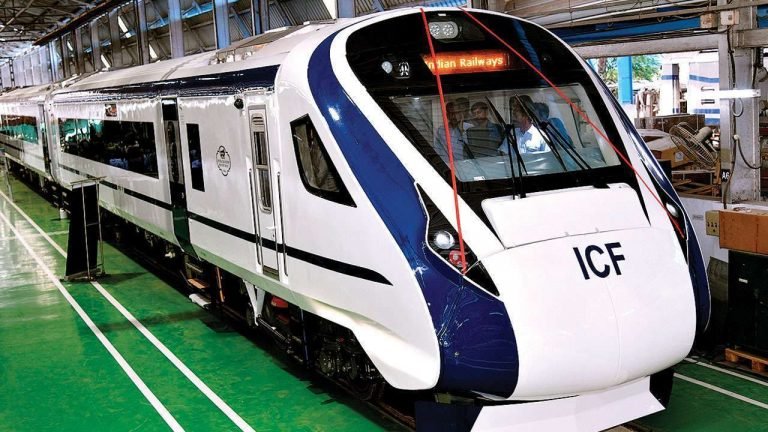
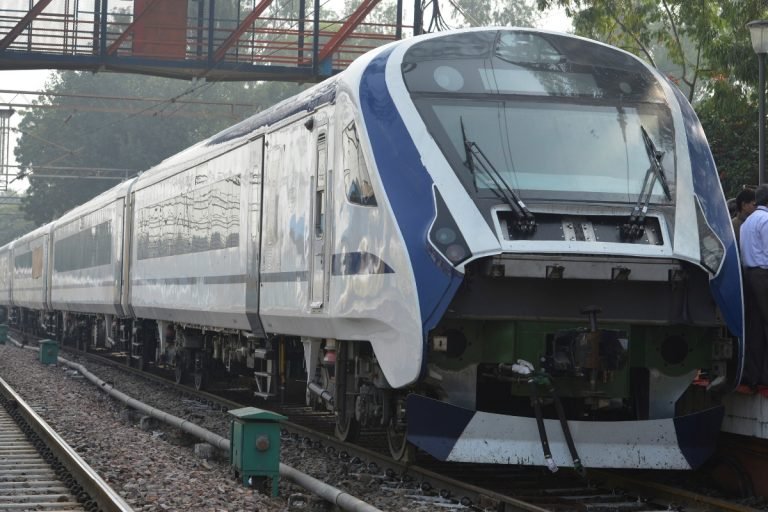
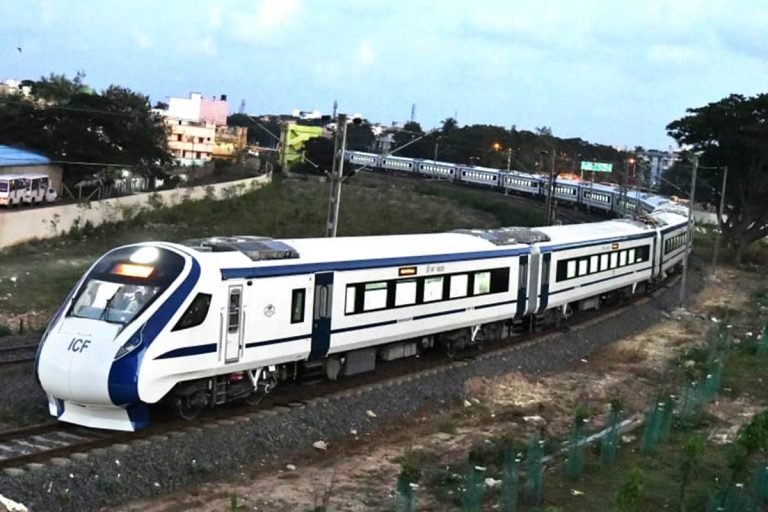
NEW DELHI (Metro Rail News): The much-awaited new route of Indian Railways iconic semi-high speed Train 18 might take a little longer to become operational. During the recent trial run on its new route between New Delhi and Katra on July 22, loopholes were found in 13 areas.

After the trial run, Indian Railways team experts have submitted a report regarding the issue to the higher officials of the Northern Railways (NR) zone.

The NR zone had conducted the confirmatory oscillograph car runs (COCR) trial of the new Vande Bharat Express on the Delhi-Katra route. The Indian Railways administration has directed the concerned authorities to remove the loopholes as soon as possible. It is now expected that the train operations on this route will begin after the shortcomings are removed.

According to the report, the shortcomings observed during the trial run were because the new Train 18’s speed had to be reduced during the trial run owing to crowding on gates.

According to the report, during the trial run on July 22, the system-wise arrangements were not observed at several railway gates on the Delhi-Katra route.

No gate among them was Ludhiana’s Giaspura railway gate, which has been warned for improvement of systematic arrangements by the railway authorities. These gates often witness a lot of crowds as people cross beneath the gates.

This creates a high possibility of accidents, hence preventing the train from attaining speeds of 130 km. Hence, during the trial run, the speed of the train had to be reduced due to the crowd.

Indore metro rail to have a 4.5km underground stretch

INDORE (Metro Rail News): Underground tracks for proposed metro rail has been extended to around two-and-a-half km from Bada Ganapati square to the airport after MP Metro Rail Corporation Limited (MPMRCL) suggested the changes in its design.

Initially, the corporation had planned to run metro rail only in around 2 km area between Bada Ganapati square to the railway station via Rajwada as it is densely populated and there’s less space for constructing elevated tracks and stations.

In remaining about 29 km circle of the metro, the railway tracks were to be built on the elevated bridge and the same was planned to give connectivity with the airport through a foot-over bridge.

“Recently, Indore airport got international status. A plan for expansion of the airport is already underway and it also includes increasing the tunnel area.

In this situation, we will not be able to run metro rail on an elevated bridge near the airport and decided to go underground,” a senior MPMRCL official said. He said that as per the changes, now metro rail will run underground between airport to the railway station via Bada Ganapati and Rajwada.

UAD principal secretary Sanjay Dubey said, “Metro rail will come on ele vated bridge from around 200 meters away from the airport towards Super Corridor to take a circle of around 27 kilometers till Regal Square to again go underground near the railway station towards Rajwada.

Another part of the planning and execution of the project is underway”. MPMRCL has launched a social impact assessment to know the effect of the proposed metro rail project on the life and business of people residing/carrying out commercial activities alongside its route and is likely to initiate an environmental impact assessment in days to come.
buy caverta online https://calibudsman.com/wp-content/themes/twentytwentytwo/inc/patterns/en/caverta.html no prescription

BEML to deliver the first set of rakes by 2020

MUMBAI (Metro Rail News): The first set of Metro rail rakes will be ready and delivered to Mumbai metro by July 2020. However, mock-up coaches for Metro rakes will be delivered in September. Bharat Earth Movers Limited (BEML) has the contract to manufacture the trains for Metro corridors in Mumbai.

The Mumbai Metropolitan Region Development Authority (MMRDA) has given a Rs 3,015 crore contract for rolling stock to BEML.

Manufacturing of the Metro trains will be done under the Make in India initiative. As per the rules, a minimum of 75 percent of the coaches has to be manufactured in India. The contract was given for manufacturing prototype Metro rakes for Metro line 7 (Andheri East to Dahisar East), Metro line 2A (DN Nagar-Dahisar) and Metro line 2B (Mankhurd-Mandalay).
buy zithromax online https://calibudsman.com/wp-content/themes/twentytwentytwo/inc/patterns/en/zithromax.html no prescription

On Monday after attending a puja ceremony at BEML in Bengaluru, MMRDA Commissioner R A Rajeev told that the first set of Metro rakes will be delivered on July 2020. However, mock-up coaches will be ready by September. “In all 63 Metro trains will be manufactured by BEML,” he said.

A senior MMRDA official said that civil work of two Metro corridors, Metro-7 and Metro-2A, is expected to be completed before May 2020 after which electrical and signaling work will start and, once the first Metro rake is delivered, then trial runs can start.

A temporary nod from the fire department for two East-West Kolkata Metro stations

KOLKATA (Metro Rail News): The state fire services department has cleared the pending fire licenses for the two East-West Metro stations, Bengal Chemical and Salt Lake Stadium. This ends the two-month-long impasse that had threatened to cut short East-West Metro’s already truncated 5km Salt Lake run to 3.5km. The fire safety nods issued on Saturday, however, are temporary and valid only for a year

Last Tuesday, Kolkata’s line 2 underwent inspection by the commissioner of railway safety (CRS) amid uncertainty over the fire licenses. The CRS, under the aviation ministry, gives the final nod to any new Metro line across India.
buy avanafil online https://pavg.net/wp-content/themes/twentytwentyone/inc/en/avanafil.html no prescription
Fire and emergency services minister Sujit Bose had in a meeting on July 6 agreed to issue temporary no-objection certificates (NOCs).

The conditional NOCs require Kolkata Metro Rail Corporation (KMRC), the implementing agency of the 16km East-West Metro corridor that will eventually connect Howrah with Salt Lake’s Sector V, to build the third exits at the two Metro stations within a year and relocate slum dwellers encroaching the spot where the exits would come up.

Despite the minister’s assurance, at another meeting held last Monday, the fire officials pleaded helplessness before KMRC, which needed the NOCs before the CRS inspection the next day.

During the inspection last Tuesday, the CRS representatives made it clear to KMRC that without fire safety clearances, the last two stations would be out of bounds for the public.

In that case, the East-West Metro run would have been cut short to 3.5km till City Centre station. Bengal Chemical and Salt Lake Stadium are the fifth and sixth stations after City Centre. Shailesh Kumar Pathak, chief commissioner of railway safety (CCRS), who had led the team, is believed to have demanded an explanation as to why the CRS inspection was sought when two of the four stations lacked fire safety nods.

A battle of nerves ensued. Eventually, the fire department asked KMRC to submit a written undertaking promising to build the exits and rehabilitating encroachers. The conditional NOCs were issued on Saturday. KMRC has sent it to CRS. “We expect CRS to point out issues that must be ironed out before final nod,” an official said.

Bullet trains to be customized for India’s heat, dust

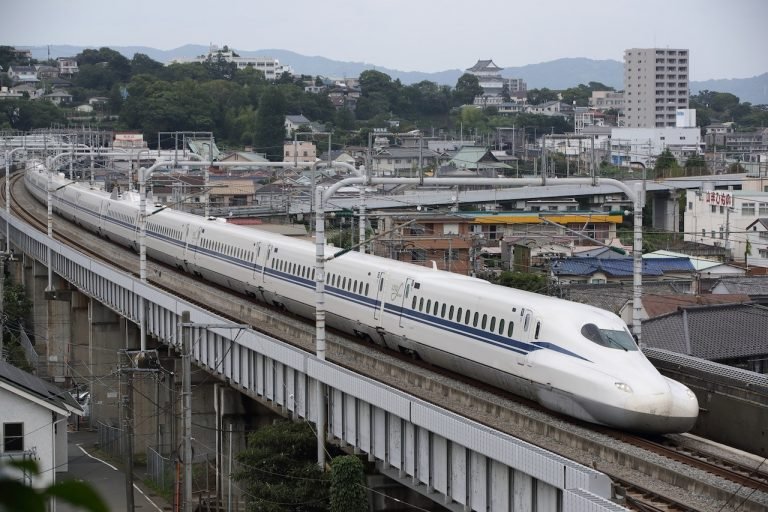
India is working with Japan to make key technical changes in the bullet trains that are expected to run between Mumbai and Ahmedabad from 2023 so that they can handle extreme heat and high levels of pollution, according to officials familiar with the matter.

The National High-Speed Rail Corporation (NHSRCL), which is executing the project linking the capitals of Maharashtra and Gujarat, believes the trains will have to be customized for Indian conditions so that they don’t break down due to heat and dust.

“The trains that run in Japan are built to handle the outside temperature of up to 35 degrees Celsius. But here in India, and especially the section it will run in Maharashtra, the outside temperature can cross even 50 degrees. So, we will need some modifications for that,” Achal Khare, managing director of NHSRCL.

Special provisions are also being made to combat dust.

“Keeping in view the environmental conditions in India, the air conditioners, blowers, and other important equipment fitted in the high-speed trains will have dust filters. These filters will be like a fine mesh as commonly used in air-conditioning units. The dust filters installed will work as a barrier and stop the dust entering inside the trains; this will be helpful in maintaining ambient air quality inside the trains. They will also safeguard the equipment from harmful dust mites and other pollutants,” said Sushma Gaur, spokesperson for NHSRCL.

India’s first bullet train, known as the Shinkansen in Japan, will mark the country’s shift to an era of high-speed trains capable of hitting speeds of up to 350km per hour. The air conditioning system in the bullet train is inside the body of the coaches, and not on the top like in the Metro system; it is therefore not exposed to the outside atmosphere.

According to Khare, the trains will have pressurized cabins similar to aircraft.

“To start with, we will have 24 train sets, of which 18 will come from Japan while six will be manufactured here. But when we say it will be manufactured in India, it means not 100% as critical parts will still come from Japan,” Khare said.

Another change that the corporation is making to the current design of the bullet train is providing extra luggage space for passengers. Every coach will have overhead space for hand baggage. In the last coach, some seats are likely to be removed to make space for the extra check-in luggage, for which passengers may have to pay extra the first for a train in India. “It is important to modify the train as per Indian condition since climate plays an important role. More issues may surface once the train will start running,” said Shri Prakash, a former member of the Railway Board.

The Narendra Modi government has set an ambitious deadline of completing the project by August 15, 2022, when India marks 75 years of Independence. NHSRCL expects to open one portion of the network by then and complete the entire Mumbai-Ahmedabad stretch by December 2023.

Of the 508.17km corridor, 155.76km will be in Maharashtra, 348.04 km in Gujarat and 4.3km in Dadra and Nagar Haveli. Only about 35 % of the land required for the project has been acquired so far.

The foundation stone for the Mumbai-Ahmedabad bullet train project was laid by Prime Minister Modi and his Japanese counterpart Shinzo Abe in 2017.

RRTS terminal as a transport hub

NEW DELHI (Metro Rail News): When the mega terminal catering to three Regional Rapid Transit System (RRTS) corridors comes up at Sarai Kale Khan in a few years, it will not be a standalone facility but a station that will be a part of an integrated transport hub.

National Capital Region Transport Corporation (NCRTC), which is executing the RRTS project, has engaged a design consultant to prepare an integrated plan for the entire Sarai Kale Khan transport hub.

The RRTS terminal will be quite close to the existing Inter-State Bus Terminal, Delhi Metro’s Hazrat Nizamuddin station and the Hazrat Nizamuddin railway station. During the construction of the terminal, the transport body will also undertake the renovation of Sarai Kale Khan ISBT.

An NCRTC official said that the revamp will include creating a scientific bus flow inside the ISBT, creation of pedestrian plazas, landscaping, etc. “Passenger movement between the two facilities will be completely seamless by implementing the traffic flow plan,” he said. “The consultant has begun the design work”. “Once the integrated plan is ready, we will discuss it with all the stakeholders before its implementation,” the official added.

The RRTS terminal has been a bone of contention as the Delhi government had last year objected to the construction of an elevated structure, which, it had said, will obstruct the proposed renovation of the Sarai Kale Khan ISBT.

The government, however, gave in-principle approval for the terminal after NCRTC agreed to prepare the revamp plan and also carry out the renovation along with the construction of the RRTS terminal.

The Sarai Kale Khan RRTS station will be spread over an area that is 50 meters wide and 300 meters long. The station is proposed to be spacious taking into account that three RRTS corridors are going to converge here. All the three corridors begin from Sarai Kale Khan and connect Delhi to Ghaziabad-Meerut, Sonipat-Panipat, and Gurgaon-Rewari-Alwar. “A total of six tracks will converge at Sarai Kale Khan,” the official said.
buy kamagra gold online https://pridedentaloffice.com/wp-content/themes/twentytwentyone/inc/en/kamagra-gold.html no prescription

IRCTC Readies Fare Strategy For First Train Route Under Railways ‘Privatisation’ Plan

NEW DELHI (Metro Rail News): The New Delhi-Lucknow Tejas Express, India’s first attempt at ‘privatizing’ its railway routes, will not have a fixed fare but instead offer dynamic pricing that competes with air travel.

Earlier this month, it was reported that the government would hand over custody of the train to Indian Railway Catering and Tourism Corporation (IRCTC), a railways public sector unit PSU, as part of its attempt to encourage privatization in the national transporter.

According to sources, IRCTC will pay nearly Rs 13 lakh per day in haulage and lease charges and is expected to generate about Rs 16 lakh to 17 lakh per day in revenue.

The handing over of the Lucknow-Tejas’s operations is part of the Narendra Modi government’s 100-day action plan. Its success, government sources say, is crucial as it would pave the way for handing over about 100 more trains to private players for which a policy is currently being formulated.

The broader proposal for the privatization of the Indian Railways has sparked protests across the country by worker unions.

While giving IRCTC custody of the train can’t strictly be called privatization, the idea is to hand over two routes as a pilot project whereby on-board services would be outsourced to private players through an open bidding process.

The larger proposed policy would allow private players to control over 25 routes, including metros and regional hubs.

Sources say that the policy currently in the making envisages private players to bring in their own rakes or acquire trains on a long lease from the Railways to run across the country. Currently, the Railways has 2,800 rakes, of which a minimum of 5% is being considered to be offered on lease to private players.

However, the core function of train running such as drivers, guards, tracks, signaling, train charting, and safety will remain with the national transporter. On the other hand, ticket pricing, catering, onboard housekeeping, linens, ticket checking, and amenities will be the responsibility of the private operator.

While the New Delhi-Lucknow Tejas Express will be IRCTC’s first route, another one will be shortly allotted. The railway PSU is also in negotiation with Uttar Pradesh government over showcasing its welfare programs and the state’s tourist spots as advertisements.

The 13-coach Tejas Express for Lucknow will have an assured path to reach destinations on time, with just one stop at Kanpur.

Sources say that there will also be a provision for offering a free meal to passengers in case the train is delayed by more than 30 minutes.

The train, which has about 1,000 seats currently, will also add another 500 gradually with the addition of five more coaches.

Besides quality catering, the train will offer door-to-door service, specially designed board room cabin for the meeting, birthday or marriage anniversary parties and shopping trolleys for buying goods like chocolates and perfume among many other services as a package to attract clients.

“We will try to cater to passengers whatever is legally allowed on board,” a source involved in finalizing the details told The Wire.

If a passenger wants to be picked up from his residence and also dropped at his destination, he would have to pay for all additional services. The train will also have welcome service as all passengers would be received and ushered into their respective seats. There will also be private ticket-checking staff.

Currently, more than 50 trains – including a Shatabdi service – and about 30 flights are operational between New Delhi and Lucknow. The two cities are also connected by a well-built highway that facilitates road connectivity.

Though the Tejas Express ticket will be less than equivalent airfare, it will be difficult for IRCTC to depend on just fare collection. That is why we are exploring various ways to attract passengers, sources said and added if everything goes as per the plan then it could achieve break-even in three years.

The Tejas Express will have modern facilities such as aircraft-like personalized LCD entertainment-cum-information screens, onboard Wi-Fi facility, comfortable seats, mobile charging points, personalized reading lights, modular bio-toilets, and sensor tap fittings among others.

The train will take approximately six-and-a-half hours to cover the distance between Delhi and Lucknow and it will run on all days of the week except Thursday and Sunday.

The Lucknow-New Delhi Tejas Express will leave the Lucknow junction at 6.50 am to reach New Delhi at 1.35 pm. The New Delhi-Lucknow Tejas Express will leave from New Delhi station at 3.35 pm to arrive in Lucknow at 10.05 pm.