ArcelorMittal bags Head Hardened Rails Supply Contract of Delhi-Meerut RRTS

NEW DELHI (Metro Rail News): The National Capital Region Transport Corporation (NCRTC) opened financial bids July 28 2020, of tender invited for the supply of 22,000 MT of Head Hardened Rails for the Delhi-Meerut RRTS project.

According to the financial bid decision, Spanish firm ArcelorMittal España S.A. has emerged as the lowest bidder (L1) amongst 4 bidders.

As per the data shown by the NCRTC, the financial position of each bidder is as under:

  1. ArcelorMittal España S.A.: Rs 144.79 cr (L1)
  2. Mitsui & Co. Ltd.: Rs 148.15 cr (L2)
  3. East Metals AG: Rs 150.62 cr (L3)
  4. Voestalpine Schienen GmbH: Rs 155.01 cr (L4)

Although, Indian steel manufacturing company Jindal Steel & Power Limited (JSPL) had also participated in this contract but not found technically qualified according to the provisions laid down in the tender notice (No. DM/TW/COR-OF/087), so their financial bid was not opened.

Tender notice for manufacture, supply, transportation, and delivery of 22,000 MT of 60E-1, 1080 Grade Head Hardened Rails Class-A, undrilled Rails conforming to IRS T-12-2009 for Delhi-Meerut Regional Rapid Transit System (RRTS) Corridor of NCRTC was invited in December 2019. Technical bids were opened on February 24, 2020.

NCRTC will issue the Letter of Acceptance (LoA) to ArcelorMittal España S.A. after evaluating the technical and financial bids. The firm has to complete the delivery of 22,000 MT Head Hardened Rails in 24 months from the date of issuance of LOA.

Headquartered at Asturias in Spain, ArcelorMittal is the world’s leading steel and mining company. 

Renowned Indian industrialist Lakshmi N Mittal leads the company. It has steel manufacturing units in a total of 18 countries and has a customer base in 160 countries. The company is likely to manufacture the required material in its Gijón Rail Mill in Asturias, Spain to supply the rails to India.

DMRC suffer Loss of Rs 1000 Cr in four months During Covid-19

DELHI (Metro Rail News): Delhi Metro Rail Corporation (DMRC), which has remained non-operational from the past 4 months due to the Covid-19 lockdown has incurred a revenue loss of nearly Rs 1,000 crore.

The DMRC earns Rs 10 crore every day. The total revenue loss so far has been over Rs 1000 crore since the time the lockdown. On March 25, The nation went into lockdown to halt the spread of the coronavirus. Still, more than 14.8 lakh individuals infected. 

DMRC has 300 trains running on eight lines that make 5,000 trips daily, transporting around 1.8 million commuters, hasn’t earned a penny from last four months. Its income ended from different sources; for example, business and retail rents have additionally evaporated during the pandemic.

“DMRC’s occupants’ organizations, including retail and business properties, as well, have been affected seriously. They have kept in touch with us requesting that we allow rental instalments. We are taking a gander at government rules on this”, Said Anuj Dayal, CPRO & Executive Director, Corporate Communications, DMRC,

The Government has been hastening limitations since Last week of May and opening up the economy in a staggered way. Unlock 3.0, or Phase 3 of relaxing up restrictions, starts August 1 however it is clear if the Metro will be not permitted to continue activities however Delhi has seen a drop in coronavirus infections.

Opening and Reviving

 “The choice to revive the system lies with the administration. When they conclude, we are on backup. We ought to be in a situation to open the metro inside a few days when the administration takes the choice. Rules are set up for social separating and sanitization methods,” Dayal said.

In Unlock 3.0, FICCI has suggested that the Government should permit multiplexes, films, and metro rail, and worldwide flights, among others, while holding fast to security safety measures.

Trains ought not to stop at stations that fall in contentment zones and security staff ought to guarantee adherence to wellbeing rules, it said.

Metro administrations may begin with under 50 per cent limit at first that can be expanded steadily, alongside contactless tagging beyond what many would consider possible.

In Mumbai, local train administrations continued from June 15 yet just for labourers offering fundamental types of assistance.

Infrastructure specialists said it is hard to keep up social removing in the metro. Although metro systems had revived in a few nations, there were hardly any takers for the open vehicles.

Ajay Sharma, Managing Director, Valuation Services at Colliers International India, said: Most of the worldwide metro services have revived with 60 to 100 per cent of running limit, yet commuters support has been a grim 20 to 25 per cent. The explanation is that individuals are as yet careful about utilizing open vehicles.

How can DMRC recover losses?

Metro projects have two sources of regular income – farebox, which accounts for almost 80 to 90 per cent of the revenue- ticketing, passes, sales. And the other source is non-fare box revenue, which accounts for 10 to 20 per cent and includes commercial and retail leases on DMRC land.

“Though trains have not been running there are fixed costs– maintaining the network and salaries,” Ajay Sharma, Managing Director, Valuation Services at Colliers International India.

It can at best offset a certain percentage of the loss by increasing ridership, enhancing frequency and speed up construction work on new corridors, Sharma added.

Other ways to recover losses are- Value Capture Finance mechanism, wherein additional taxes can be levied on properties located around new metro lines and through Transit-Oriented Development, wherein additional floor space index can be provided for land parcels close to the station.

However, both these methods are for the long term and new lines, Sharma said. In order to recover losses in the short term, DMRC could shore up revenue by improving density, increasing the frequency of trains and higher ridership.

Reportedly, DMRC may not be able to pay this year’s instalment of the Rs 35,198-crore soft loan it has taken from Japan International Cooperation Agency(JICA).


CM Yediyurappa launches Tunnel operation for the second phase of Bangaluru metro

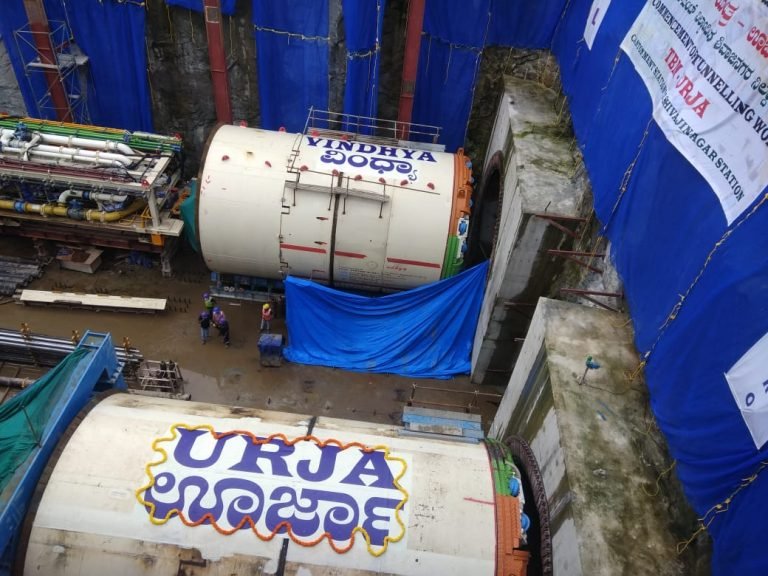
BENGALURU (Metro Rail News): Chief Minister BS Yeddiyurappa on Thursday launched tunnelling operations for Namma Metro Phase-II from the grounds of Abdul Bari’s High School near the proposed Cantonment Metro Station here at Bangaluru. With the launch,  Tunnel Boring Machine ‘Urja’  began the tunnel operation for  2.88 km stretch ranging from Cantonment station to  Shivaji Nagar Metro stations.

This stretch is a part of the 13.9 km underground corridor from South Ramp near Jayanagar Fire station to North Ramp near Nagawara underground Metro Stations with 12 underground stations and twin tunnels covering a distance of 10.37 km.

According to the official data, the expected geology of  the  tunnel stretch is about 250m in hard rock, 350m in mixed ground conditions and 255m in soil thus making the work a little bit difficult.

Few of the machines have  been procured along with two others from China Railway Construction Heavy Industry Corporation (CRCHI) with Larsen & Turbo Ltd  having the contract for completing the Reach-3 package. Although a boycott of Chinese goods is underway but the use of its materials in metros continues.

Completion timeline of phase-2 extension lines:

  • R4 from Yelachenahalli to Anjanapura is likely to be commissioned in November.
  • Extension line R2 from Mysore Road to Kengeri in February 2021.
  • Extension line R1 from Baiyappanahalli to Whitefield in June 2022.
  • Extension line R3 from Nagasandra to BIEC in January 2022.
  • New line R5 from RV Road to Bommasandra in March 2022.
  • New line R6 from Kalena Agrahara to Nanawere in June 2024.

Indian Railways plans to expedite production of 44 Vande Bharat train

NEW DELHI (Metro Rail News): The Railways had earlier decided to get it manufactured through three different manufacturing units.

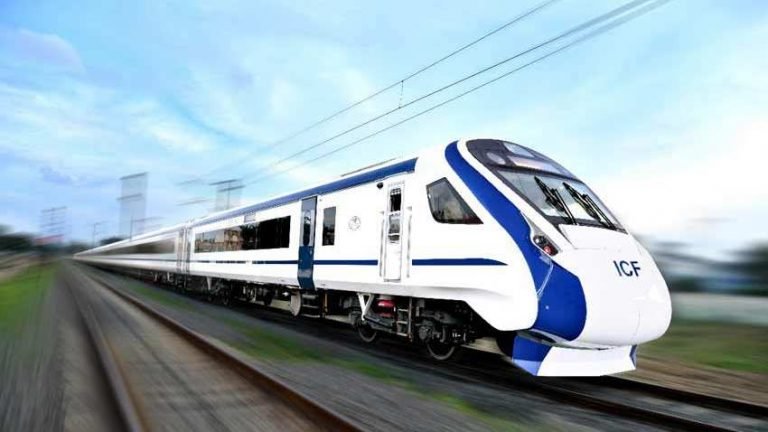
As Indian Railways moves to speed up the production of 44 Vande Bharat Express trains, Railway Board Chairman VK Yadav has said that the ‘Make in India’ train sets will now be manufactured by not one but three units of Indian Railways – Integral Coach Factory in Chennai, Railway Coach Factory in Kapurthala and Modern Coach Factory in Rae Bareilly. As per reports, 44 Vande Bharat trains are going to be added to the Indian Railways network within the next three years. The decision to involve three manufacturing units will help in reducing the time duration in making the trains.

It is possible that the 44 Train 18 services start operating in a year or two depending upon the progress of the work. A definite time, however, has not been decided yet, the sources familiar with the matter told. The railway manufacturing unit in Chennai had earlier manufactured the first two Vande Bharat Express trains now on the fleet of the Indian Railways.
buy ventolin online https://myhst.com/wp-content/themes/twentytwentytwo/inc/patterns/en/ventolin.html no prescription
It would take long time ranging from 6 – 7 years if a single unit was to manufacture all the trains. This was the reason behind involving two more units to boost up the production process. However, Vande Bharat trains have always been in controversy since the first Train 18 was rolled out in a time frame of 18 months by ICF.

Recently, for Indian Railways’ global tender for its ambitious semi-high speed Vande Bharat Express project, CRRC Corporation, a Chinese state-owned rolling stock major, emerged as the only foreign player to bid. However, the bid from CRRC is likely to be scrapped. The company under the name CRRC Pioneer Electric (India) Private Limited, had entered into a joint venture with a Gurugram-based company to place its bid. For the tender for procuring propulsion systems or electric traction kits for 44 Vande Bharat trains, CRRC is one of the six contenders.

As per the official data, only Rs100 crore was spent to manufacture the first Train 18, of which Rs 35 crore was alone spent on the propulsion system. The bid for 44 such kits will worth over Rs 1,500 crore as per the officials concerned with the matter. As the Vande Bharat trains get a boost up, the people may hope for a faster railway journeys in the coming years.

NMRC to invites fresh bids for the construction of Aqua Line extension

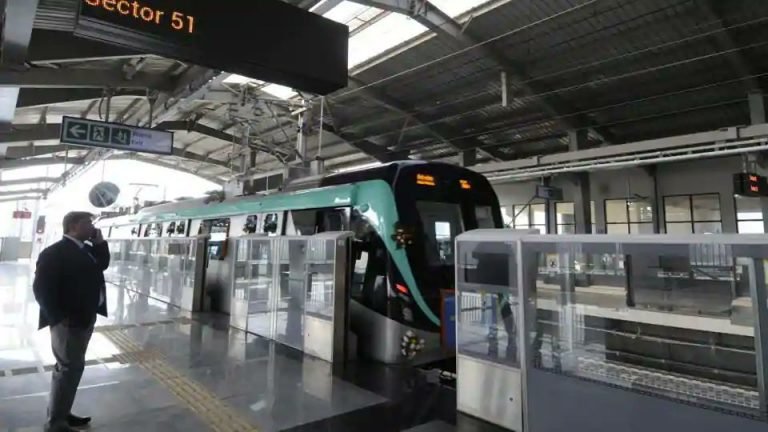
NOIDA, UP, India (Metro Rail News): Noida Metro Rail Corporation (NMRC) will invite fresh bids for the construction of the 1st phase of Aqua line extension (Noida Sector 51 metro station to Greater Noida Knowledge Park V.) soon. As one of the three previous bidders disqualified due to lack of expertise, officials said.
buy caverta online https://www.facebeautyscience.com/wp-content/themes/twentyseventeen/inc/en/caverta.html no prescription

According to officials, The three contractor, i.e. Sam India Builtwell Ltd, NCC Ltd and Shrisay Infotech, replied to the tender in June 2020 for the first phase of the 15 km long Noida Sector 51 -Gr. Noida Knowledge Park V corridor. Were Shrisay Infotech was rejected due to not being a construction company, leaving the two others in the fray.

Smt. Ritu Maheshwari, Managing director, NMRC Said that we would float the tender again as only two respondents surfaced.

The proposed 15 km long Noida Sector 51 -Gr. Noida Knowledge Park V corridor that will branch out from the existing Sector 51 metro station of Aqua Line and end at Greater Noida’s Knowledge Park V would ultimately benefit lakhs of commuters travelling to and from Noida, Greater Noida and Delhi daily.

Aqua Line extension
Noida Metro Extension

According to the plan, the project will be constructed in two phases, i.e. the first one will be 9.6km from Sector 51 metro station to Greater Noida Sector 2. The second one will be a 5.3km-long corridor that will terminate at Knowledge Park 5. The tender was for the construction of an elevated viaduct and five elevated stations at Sector 122, 123, Greater Noida Sector 2, 4 and Ecotech 12 in the first phase, at an estimated cost of Rs 430 crore.


The first phase of the corridor will have five stations and is likely to be completed by 2022. This will be followed by the 2nd phase with four metro stations — Greater Noida sectors 3, 10 and 12, and Knowledge Park 5. “We are also awaiting the Union government’s permission on this extension,” Maheshwari said.

Alstom to get EU antitrust approval to buy Bombardier Inc’s rail business

BRUSSELS (Metro Rail News): Alstom is all set to get European Union (EU) antitrust approval to buy Bombardier Inc’s rail business, people familiar with the matter said on Monday, a deal which will make the French rail manufactures the world’s second-largest after Chinese state-owned CRRC Corp.

Earlier this month Alstom offered to sell a French rail factory, its regional train unit Coradia Polyvalent, and a Bombardier commuter trains division and the related production facilities at its Hennigsdorf site in Germany.

The French TGV high-speed train maker also proposed providing access to some products within Bombardier’s train control systems and signalling units to competitors.
buy tadora online https://www.adentalcare.com/wp-content/themes/medicare/editor-buttons/images/en/tadora.html no prescription

The permissions came after the European Commission voiced concerns about Alstom’s more enormous market clout after the deal.
Alstom finally improved the concession on access to the Canadian company’s train control systems and signalling units but did not have to sell more assets following feedback to the Commission from rivals and customers, the people said.

The European Union Commission, which is scheduled to decide on the deal by July 31, declined to comment. Alstom and Bombardier also declined to comment.
Last year, EU regulators blocked Alstom’s attempt to merge rail assets with Siemens AG after they refused to offer more permissions.

Mumbai-Ahmedabad Bullet train Project not in the priority list of Maharashtra Govt: CM Uddhav Thackeray

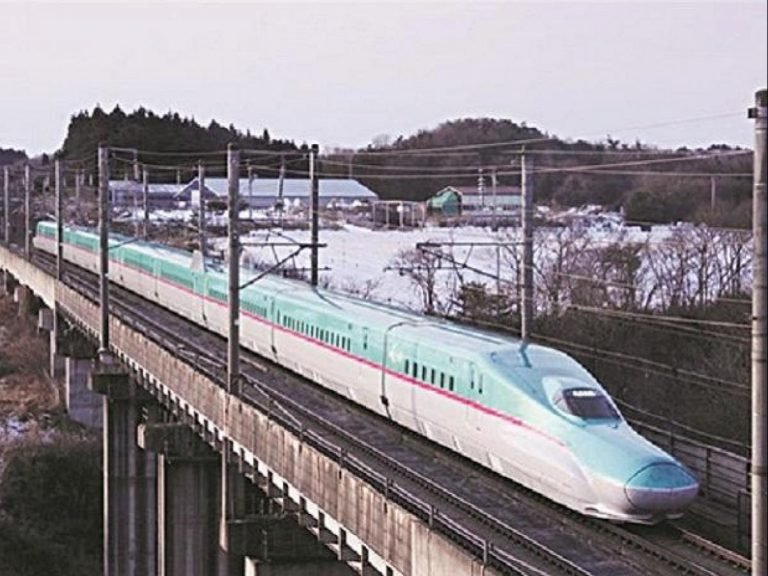
MUMBAI (Metro Rail News): Prime Minister Narendra Modi’s ambitious Mumbai-Ahmedabad Bullet Train Project is not in his priority list of major infrastructure projects in Maharashtra said Maharashtra Chief Minister Uddhav Thackeray. He also clarified that the bullet train project has now taken a ‘backseat’. Although, he prefers a bullet train to connect Mumbai to Nagpur rather than Ahmedabad.

“Since the inception of our government no one asked about this project and we have also not discussed it. We will take people-oriented issues that will benefit our Maharashtra. The government is with people of the state,” Chief Minister CM Uddhav Thackeray said.

Chief Minister said that he would like to connect the capital of Maharashtra, Mumbai, to the state’s sub-capital Nagpur.

“There are some people who intentionally make a difference between people of Vidarbha and the rest of Maharashtra. This Mumbai to Nagpur bullet train will help to bridge the gap. Like Samruddhi Mahamarg, the bullet train will compete if the central government revises its plan,” said the Chief Minister.

Chief Minister said that Shiv Sena as a party has always supported the farmers who opposed the bullet train.

Now, we are in power; we will do whatever it takes to support the farmers. In Nanar refinery case, the central government had approved the plan, and some people even offered their land, and the transaction also happened. But the majority of people were against the Nanar, so what happened? We cancelled it, and the same thing will happen with Mumbai to Ahmedabad bullet train.

CM further said that his government is like ‘a three-wheeler auto rickshaw- it is a poor man’s vehicle.’

We don’t need bullet trains, but I will prefer the auto-rickshaw. There were some differences of opinion and communication gap among the ministers due to the COVID-19 situation. But we are back to normal. We are now maintaining regular communication. I also spoke with Congress president Sonia Gandhi and NCP chief Sharad Pawar.

WRMS opposes bullet train project

In Gujarat, The Western Railway Mazdoor Sangh (WRMS) working committee has decided to request the chairman of Railway Board to drop the Ahmedabad-Mumbai bullet train project and save Rs 1 lakh crore so that economic health of railways can be recovered.

In the virtual working committee meeting held on Friday, 57 member attendees paid homage to all the railway employees who have died in the Covid-19 pandemic and also denounced the recent move of Western Railway (WR) asking nearly 400 railway families to vacate 21 buildings of suburban section between Churchgate and Virar in Mumbai.

The committee has passed resolutions demanding ex-gratia payment to railway employees who died in Covid-19 pandemic. WRMS general secretary J G Mahurkar highlighted that outsourcing and privatization being done in railway would weaken the railways

Not even 25% of land acquired in Maharashtra

The National High Speed Rail Corporation (NHRCL), The executing agency for the Inida’s first bullet train project, has been acquired only 23% of the total land required in Maharashtra. The land needed is 431 hectares and 100 hectares has been acquired.

“In Maharashtra, Only 23% of the land has been acquired while in Gujarat and Dadar Nagar Haveli 70% and 80% of the land required has been acquired,” the spokesperson said.

Out of 508 km-long Mumbai-Ahmedabad High-Speed Rail, 155 km will pass through Mumbai, Thane and Palghar districts in the state. Of this, 66 hectares (ha) is government land, 267. 55 ha private land, 97 ha forest land and the rest belongs to the railways. This land is spread across 2,344 plots.

The spokesperson said that a joint measurement survey of land required is almost about to be completed.
Of 100 hectares acquired so far in Maharashtra, 40 per cent of the land is in Thane and 13 per cent in Palghar and 19 per cent in Mumbai.

NHSRCL has floated tenders for civil work for 345 km of 508 km. It includes six stations, including one underground station in Mumbai, 345 km of viaduct construction and 21km-long underground/undersea tunnel. A separate tender for the fabrication of 28 steel bridges has also been floated.

The government had set a deadline for December 2019 to clear land acquisition roadblock but there has been opposition, especially in Maharashtra from tribals and farmers.

Germany to build World’s first hydrogen station for passenger trains

BREMERVORDE, GERMANY (Metro Rail News): With the coming of the hydrogen fuel-based trains, the travel is going to be cheaper, convenient and more eco friendly. Germany’s model can be applied to the developing nations to cut carbon emissions.

Germany is set to have the “world’s first” hydrogen station for passenger trains. The foundation stone started with a groundbreaking ceremony held in Bremervörde, Germany on Tuesday. The construction works will start in September which follows a successful 18-month trial of the world’s first two hydrogen trains in the region. Linde will build and operate the station on behalf of the Lower Saxony Regional Transport Company (LNVG).

The station is expected to get operational by early 2022 and it will be able to fuel 14 of Alstom’s hydrogen-powered Coradia iLint’s, which will be supplied to the regional rail traffic provider LNVG, and will use the network of regional railway company EVB, as per media reports.  The station having a capacity of around 1,600kg of hydrogen per day will be one of the largest made under a nameplate.

The German transportation system is the start of a fuel system which will become need of the hour in the near future across the globe as it will be less polluting and best in terms of protecting environment. Alstom will be playing a crucial role in its development, sources said. 

The trains will be less noisy and more eco friendly which will further attract passengers. Germany’s model can help the Asian countries to plan likewise.

KEC-VNC JV bags civil contract of Kochi Metro Phase 1 Extension

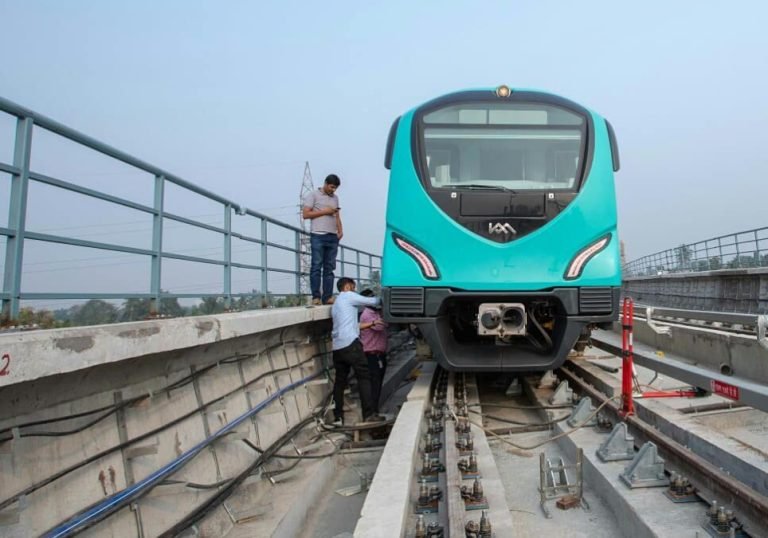
KOCHI (Metro Rail News): The Kochi Metro Rail Limited (KMRL) opened the financial bids received from the civil contractors against package KAC-4 invited for the construction of 1.163 km long elevated corridor from S.N. Junction to Thrippunithura on July 24, 2020.

KEC International Ltd. – Vijay Nirman Company Pvt. Ltd. (KEC – VNC JV) emerged as the lowest bidder (L1) among the other two who are technically qualified civil contractors who participated in the bidding process. Below are the financial position posion of the each bidder:

  1. KEC International Ltd – Vijay Nirman Company (KEC – VNC JV): Rs 162.98 crore
  2. URC Construction Private Limited: Rs 179.56 crore
  3. Cherian Varkey Construction Company (CVCC): Rs 181.60 crore

Although, the rest of the two bidders Marymatha Infrastructure Private Limited and Crescent – EKK Infrastructure JV found technically disqualified as per the results of technical bids evaluation which was opened on July 14, 2020. Hence, their financial bids were not opened.

On May 13, 2020, The KMRL had called the bids from the civil contractors and the estimated cost of work Rs 166 crore.

KMRL would issue the Letter of Acceptance (LoA) to KEC – VNC JV after assessing the technical as well as financial bids. Once the LoA issued, the bidder will have to complete the work within 20 months.

The scope of work includes the construction of viaduct from S.N. Junction to Thrippunithura (from Ch. 26+962 to 28+125) including one Elevated Station i.e Thrippunithura Terminal (at Ch. 27+781.90) for Phase 1 Extension of Kochi Metro Rail Project excluding Architectural and Building Services Works of Stations.

It is relevant to mention here that KEC International Limited was earlier awarded the contract package KAC-2 for the construction of 1.78 km viaduct including two metro stations from Petta to S.N. Junction (Petta – Vadakkekotta – S.N. Junction). 

This 1.163 km elevated extension from S.N. Junction to Thrippunithura with one new station is a part of the under-construction Petta – Thrippunithura section of the 2.95 km Kochi Metro Rail project, Phase 1B.

Alstom starts manufacturing 100 Avelia Horizon trains for SNCF

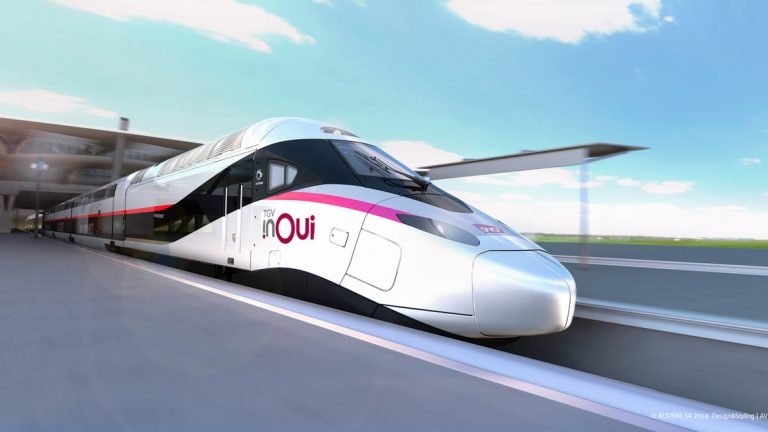
FRANCE (Metro Rail News): Avelia Horizon, which will be called TGV M by SNCF, is a joint initiative of the two companies to design a new generation of TGVs. The collaboration which started in May 2016 and culminated in SNCF awarding a €2.7bn contract for 100 trains to Alstom on July 26 2018. Alstom, the leading French train maker firm has started the production according to media reports. 

The firm is manufacturing the trailer coaches at La Rochelle and the power cars in Belfort and expects to complete the first power car in September followed by the first trailer coach in November.

Static testing of the first vehicles will begin in summer 2021. Fitting out of the coaches will start in autumn 2021. Dynamic testing should begin in May 2022 with delivery of the first trains scheduled for 2023. SNCF says it expects TGV M trains to enter service in June 2024.

Energy efficient

SNCF says the trains will consume 20% less energy than existing double-deck TGVs thanks to regenerative braking, eco-driving and their aerodynamic shape. The trains will be manufactured from more environmentally friendly materials and will be 97% recyclable.

“The design results in an improved carbon footprint of 32% compared with current trains,” SNCF says. “The acquisition cost is 20% lower than that of conventional trains and maintenance costs will drop by more than 30%.”

Avelia Horizon is modular and can have between seven and nine cars per train, rather than the standard eight on existing TGVs. The interior can be reconfigured in a day between first and second class. The power cars are shorter than on existing TGV Duplex trains and the new trains can seat up to 740 passengers, 20% more than today, within the same 200m length.

SNCF says Avelia Horizon will be the first 100% connected TGV with an optimised onboard internet network capable of integrating future innovations. Real-time transmission of information from various onboard components should increase reliability and make predictive maintenance possible.

The new trains will have 10% more glazing, a modular lighting system and a redesigned air-conditioning system. SNCF says it will be the first TGV entirely designed in collaboration with the wheelchair user’s association UFR. As a result, wheelchair passengers will be able to move around the train independently with access to seats on both levels as well as to the toilets.

Quality Buildcon bags New ISBT Depot Construction Contract of Patna Metro Rail

PATNA (Metro Rail News): Delhi Based Quality Buildcon Private Limited is emerged as the lowest bidder (L1) among the seven other bidders for the construction of New ISBT Depot of Patna Metro Rail project in financial bids opened today by Delhi Metro Rail Corporation (DMRC). 

Contract package PC-02: The scope of work of involves the development of New ISBT Rail Depot including earth filling, boundary wall, depot buildings, workshop, inspection shed, plumbing, drainage, external development, architectural finishes, road works, design and construction of PEB works etc.

The DMRC floats the tender of the above work on 16th April 2020. Quality Buildcon Private Limited has quoted Rs 143.35 crore against the estimated cost of Rs 172.18 crore and emerged as the lowest bidder. As per data disclosed by DMRC, The financial positions of all bidders are below: 

1. Quality Buildcon: Rs 143.35 crore (L1)

 2. Lisha Engineers: Rs 149.82 crore (L2)

 3. Dinesh Chandra R. Agrawal Infracon: Rs 184.38 crore (L3)

 4. Sam (India) Builtwell: Rs 188.89 crore (L4)

 5. YFC Projects: Rs 189.94 crore (L5)

 6. URC Construction: Rs 224.39 crore (L6)

 7. Pinax Steel Industries: Not qualified

The letter of acceptance (LoA) will be issued soon after the evaluation of the financial bids. The contractor will have to complete the construction and other activities for New ISBT Depot in 30 months.

As per the tender notice, the New ISBT Depot (Metro Carshed) will consist of 2 workshop bays with provision for 2 in the future, two inspection bay lines (IBLs) with provision for 2 in the future, 8 stabling bay lines (SBLs) which can accommodate a total of 32 (3-coach) trains along with an auto coach washing plant. Apart from this, buildings for other support activities like auditorium, training school, canteen, and operational control centre (OCC) will also be constructed under this contract.

UPMRC creates history with first double T-Girder erection at IIT Metro Station of Kanpur Metro

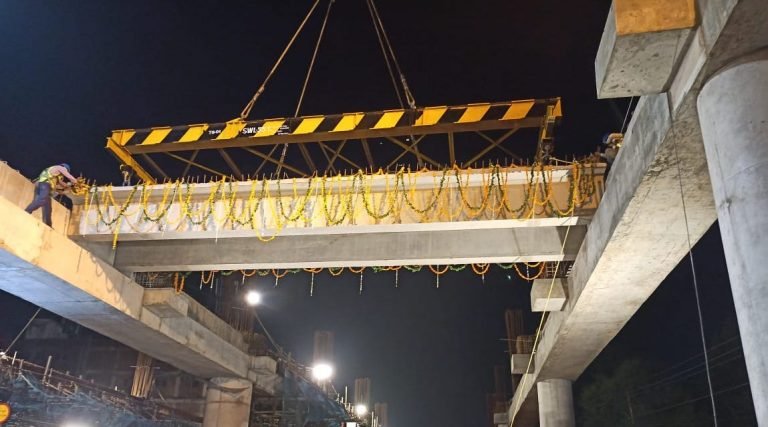
KANPUR (Metro Rail News): The Uttar Pradesh Metro Rail Corporation (UPMRC) has made another historic achievement on Friday midnight by the erection of the first pre-casted double T-girder of the metro corridor under the Kanpur Metro project and by doing this UPMRC added another new feat to its achievements. In fact, before this, double T-girder was never used for preparing slab of the concourse level of a Metro station under any Metro project in India. The strategy of Metro engineers behind the use of double T-girders in the civil construction of Kanpur Metro is that it will beneficial for saving time and for good finishing too.

On this proud moment, Shri. Kumar Keshav, Managing Director, UPMRC said, “It is our endeavor to always strive for an innovation that will not only speed up construction work but also enhance the structural beauty of the project. It is the result of these continuous efforts that for the first time in India, we have achieved an unprecedented achievement using this kind of experiment. This experiment will prove to be very effective in the direction of completing the Kanpur metro project within the stipulated time frame. I congratulate the whole team of Metro engineers, our Design Consultants and Contractor for evolving the concept and successfully implementing it at site. ”

What is a T-girder?

There are many types of girder used in the structure of metro, whose main task is to incorporate precast construction to enhance the speed in delivering the project. Double T-girder is now being used for construction of concourse slab above the road for elevated stations in Kanpur Metro construction. The girder is named after its shape resembling like the letter ‘T’ in English.

Why is the use of double T-girder special?

Generally, a group of single girders is used to form the base of the concourse of the elevated Metro stations, but in Kanpur Metro, double T-girder is used to form the base of the station’s concourse. It is being used to save time in construction and also, to enhance the finishing of the structure.

Agra Metro project gets clearance from the Hon’ble Supreme Court of India

AGRA (Metro Rail News): UPMRC’s Agra Metro Rail project got the green signal from the Hon’ble Supreme Court of India. It is a Mass Rapid Transit System (MRTS) project of Agra which is the 3rd largest city of Uttar Pradesh. It is expected that around 20 lakh population will be benefitted through this vast network of Metro expansion by Uttar Pradesh Metro Rail Corporation. UPMRC has already successfully completed, executed & implemented the Lucknow Metro project in a record time of less than 4 years 6 months.

Detailed Project Report for the Agra Metro Project was approved by Union Cabinet on 28th February, 2019. On 8th March 2019, Shri Narendra Modi, Hon’ble Prime Minister of India laid down the foundation stone of the project via video conferencing. It was an auspicious occasion not only for the Agra Metro project but also for Lucknow Metro which commenced the commercial operations on the entire North-South corridor (from CCS Airport to Munshipulia) on the same day.

Hon’ble Supreme Court had appointed Central Empowered Committee (CEC) to undertake the impact of the Agra Metro Project from environmental consideration. Chairman and Members of CEC visited Agra Metro Project on 15th – 16th January 2020 and conducted a very detailed inspection of the total alignment of the project.

CEC in his report dated 10th February, 2020 to Hon’ble Supreme Court was satisfied with the implementation strategy and measures being taken by UPMRC in implementing the Agra Metro Project and recommended the same very positively for necessary consideration and approval of Hon’ble Supreme Court.

Hon’ble Supreme Court in his decision after hearing the petition filed by UPMRC (formerly known as Lucknow Metro Rail Corporation) on 14th July, 2020 and after considering the Report of CEC has permitted UPMRC to proceed with the implementation of Agra Metro Rail Project in the city of Agra as the approved project by Govt. of India and Govt. of Uttar Pradesh.

Agra Metro Map
Agra Metro Map

The Agra Metro project is worth Rs 8,379.62 crores having 2 Corridors – ‘Sikandra to Taj East Gate’ of 14km route length & ‘Agra Cantt to Kalindi Vihar’ of 15.4km. The Corridor 1- ‘Sikandra to Taj East Gate’ will comprise 13 Metro stations with 6 Elevated & 7 Underground.

Shri Kumar Keshav, Managing Director, UPMRC stated that entire UPMRC team will not leave any stone unturned in delivering this world-class transport project for the city of Agra in the shortest possible time and will fully comply with the recommendations of CEC while implementing this prestigious project as per the directions of Hon’ble Supreme Court. 

UPMRC has been preparing and planning design works for the project which is now in an advanced stage. UPMRC, with its outstanding track the record will now take up the physical works at the site at a fast pace and complete the project in time which will provide environment friendly and hassle-free access to major residential & commercial areas of the city as well as easy connectivity to major historical sites like the Taj Mahal and The Agra Fort.

UPMRC to get Rs 5,661 cr from EIB for Kanpur Metro Project

KANPUR (Metro Rail News): Uttar Pradesh Metro Rail Corporation Limited (UPMRC) to get approx. Rs 5,661 crore (Euro 650 million) for procurement of Rolling Stock and other development for Kanpur Metro Rail project. The European Investment Bank (EIB) approved the loan amount in its recent board meeting held on 15th July 2020. 

In an official statement, European Investment Bank (EIB) said that the project investments is the construction and operation of an urban metro rail transit system in Kanpur, One of the largest industrial city of Uttar Pradesh (UP). EIB will finance the procurement of rolling stock and the development of two metro rail corridors with elevated sections, totalling to 32.4 km with 31 stations (of which 19.4 km with 19 stations and 13 km with 12 underground stations).

The Kanpur Metro Rail enables safer Kanpur city and business-friendly. By facilitating access to amenities and jobs, this low carbon and climate-resilient urban infrastructure will enhance the conditions for private sector development, while reducing environmental impact.

The project contributes to the two main goals of the EIB External Mandate:

(i) climate change mitigation by promoting the modal shift from road to the rail while reducing greenhouse gas emissions.

(ii) social and economic infrastructure development by contributing to urban development. The project is in line with the EU Country Strategy Paper for India, which highlights the infrastructure gap and needs to address rising greenhouse gas emissions.

In India, metro projects do not fall within the range of the relevant Environmental Impact Assessment (EIA) legislation except the built-up area is beyond a defined threshold, in which case the project is subject to screening by the State level Competent Authority. The status of testing, if any, is to be determined during the appraisal. The project has, in any case, been subject to an environmental and social impact assessment. The further steps in assessing and managing environmental risks are to be reviewed during the appraisal. Compliance with relevant EIB Social Standards is to be reviewed.

The Bank will require the promoter to ensure that the implementation of the project will be done in accordance with the Bank’s Guide to Procurement.

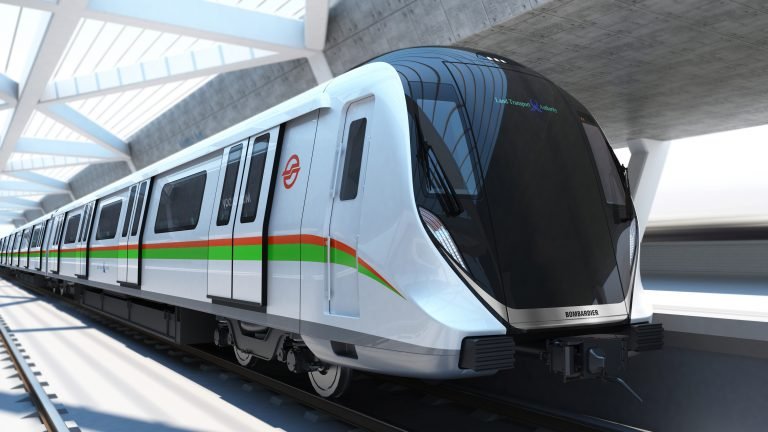
Recently, the implementing agency UPMRC had awarded a contract worth Rs 2,051 crore to Bombardier Transportation India for the supply of 201 metro coaches and provide signalling solutions for the Kanpur and Agra Metro Rail projects.