Hyderabad: SCR keeps MMTS rakes ready, awaits Centre’s nod

HYDERABAD (Metro Rail News): It’s been six months since MMTS, which is the suburban rail system in the city, stopped its services due to the Covid-19 induced lockdown. Hyderabad Metro Rail (HMR) and TSRTC resumed operations recently but MMTS remains the only public transportation that is still unavailable for commuters in the city. SCR conducted a trial run on the Secunderabad-Malkajgiri and Medchal-Moula-Ali routes as part of the phase-II project recently.

SCR, which is waiting for an official order from the Ministry of Home Affairs and Ministry of Railways, is making sure they are ready to resume operations as soon they get a go-ahead by ensuring all the MMTS rakes are fit and well-maintained. “By regularly checking the rakes and conducting other maintenance activities, we are taking all necessary steps to start operations at any moment. The batteries, brakes, wheel alignment and functioning of the engine and other motors are being checked regularly at the Electrical Multiple Unit (EMU) car shed at Moula Ali,” said a senior official.

SCR operates 12 rakes on Secunderabad-Lingampally, Hyderabad-Lingampally and Secunderabad-Faluknuma sections. After lockdown restrictions were lifted partially, SCR operated Shramik special trains to transport migrant workers and is currently operating special passenger trains.
buy xifaxan online https://gilbertroaddental.com/wp-content/themes/twentyseventeen/inc/en/xifaxan.html no prescription
With 25 local stations, apart from three major divisions of Secunderabad Kacheguda and Hyderabad, the MMTS runs 40 kms and handles 1.60 lakh passengers every day, while generating a revenue of nearly Rs 10 lakh per day.

UPMRC to conduct a series of events to celebrate 151st Birth Anniversary of Mahatma Gandhi

LUCKNOW (Metro Rail News): Uttar Pradesh Metro Rail Corporation (UPMRC) will be organizing a host of events to celebrate the 151st birth anniversary of Gandhi Ji. Beginning with 1st October 2020, a Swatchhta Pledge (oath for cleanliness) will be taken by UPMRC officials in the esteemed presence of Shri Kumar Keshav, MD, UPMRC at Administrative Office, Gomti Nagar, Lucknow. An elocution competition will be conducted at Hussainganj Metro station portraying the teachings & philosophies of Mahatma Gandhi.

In the evening of the same day, MD will felicitate the participants of the elocution event. Shri Kumar Keshav will also address the Directors, senior officials & other staff of UPMRC at the Hussainganj Metro station after the prize distribution ceremony. On the following day, ie 2nd October 2020, a cleanliness drive will be conducted beginning with Badshah Nagar Metro station where Shri. Kumar Keshav himself will start the Swatchhta Abhiyaan (cleanliness drive) and then at all other Metro stations.

On Gandhi Jayanti, a special fashion show will be organized at Hazratganj Metro station for children dressed in the attire of freedom fighters & other nationalist leaders of India. A train ride has also been planned for children from Hazratganj to Sachivalaya Metro station. In the evening Managing Director, UPMRC will give away awards to winners of the fashion show and other housekeeping staff for participating in various events specially organized for them.

Every year UPMRC conducts several special events & activities before Gandhi Jayanti to pay tribute to the ‘Father of the Nation’ & to propagate his message of ‘Swachta Hi Sewa’ among the public. Shri Kumar Keshav, MD, UPMRC while addressing the senior officials & other Metro staff remarked,” On this special day of Gandhi Jayanti all of us should take a pledge to keep our surrounding clean & to maintain cleanliness both at our homes & workplace. We should follow the ideals of Bapu- ‘Father of the Nation’ & imbibe his values in us for the betterment of society. ‘Cleanliness is next to Godliness’ should motivate us to practice & adopt his teachings & philosophies in our daily life. Keeping the surroundings clean & tidy is the best service an individual can for his country & society.”

Kolkata police nod to shut Sealdah flyover for East-West Metro tunnelling

KOLKATA (Metro Rail News): Kolkata City police on Tuesday issued a letter to the Kolkata Metro Rail Corporation (KMRC), implementing agency of the East-West Metro, giving its nod to keep the Sealdah flyover closed for 72 hours to facilitate construction of underground tunnelling for the corridor. The flyover will remain closed from 6 am on Friday till 6 am on Monday. Tunnel boring machine (TBM) Urvi, digging the east-bound tunnel, will reach the flyover sometime on Friday morning and cross the structure on Sunday night to reach its destination, Sealdah station.

A detailed guideline was issued for the traffic rejig that will come into effect for the flyover’s closure. This is the last-leg of 2.45km of the East-West Metro tunnelling, between Esplanade and Sealdah station. Till the TBM covers the 25m distance below the flyover to reach Sealdah station, around 40 engineers and workers of construction agency ITD ITD-Cementation will be camping below and above the flyover round-the-clock. The TBM is currently 50m away from the 40-year-old Sealdah flyover, which is in a fairly good condition, engineers of KMDA.

The elaborate exercise will be repeated three months later when the flyover is closed again as Urvi takes a U-turn to build the unfinished west-bound tunnel till Bowbazar’s Durga Pituri Lane.Kolkata Police is cordinating with various stakeholders, the traders below the flyover, the bus owners and workers.

“We have met a few bus owners and another meeting is being planned in the next 48 hours. We also held a meeting with the concerned traffic guards. Three roads — MG Road, CR Avenue and SN Banerjee Road — will require augmented force besides the Moulali Crossing,” said an officer.“A configuration will be sent to KMRCL and Kolkata Police by Thursday as to the precautionary and safety measures to look after to see that no damage occurs on the base of the flyover structure while the tunnel is made,” said a KMDA official.

Kolkata traffic police has decided to use CR Avenue, Surya Sen Street, SN Banerjee Road and the Canal Road East to try and keep central Kolkata moving. “No parking will be allowed on SN Banerjee Road and Vivekananda Road. We are also removing all encroachments along BB Ganguly Street that might impede free movement of vehicles,” said an officer.

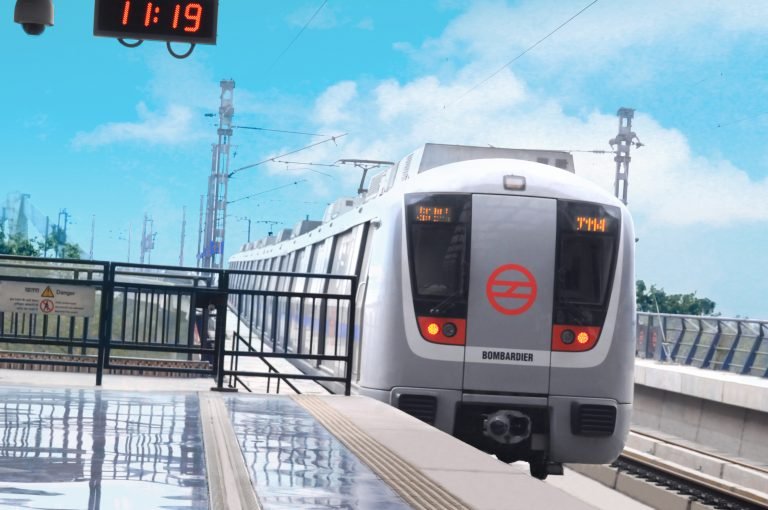
Delhi-Meerut rapid rail: All you need to know about Bombardier’s semi-high speed rail

NEW DELHI (Metro Rail News): Delhi-Meerut RRTS corridor construction is in full swing that will reduce and give a world-class travel facility for people commuting between the two cities. Being the first semi-high speed Rapid Rail system, the Centre has unveiled the first look of the Regional Rapid Transit System (RRTS) train whose design is inspired by Delhi’s iconic Lotus Temple and can attain a top speed of 180 kilometres per hour on the Delhi-Ghaziabad-Meerut corridor.

Union Housing and Urban Affairs Ministry said with a radiating stainless steel outer body, the aerodynamic RRTS trains will be lightweight and fully air-conditioned. They have been designed in such a way that natural sources of light and energy will flow into the trains, the ministry said. Each car will have 6 automatic plug-in type wide doors, three on each side for ease of access and exit. The business class will have four such doors, two on each side.

An official of the National Capital Region Transport Corporation (NCRTC) claimed that the RRTS trains will travel at a speed three times faster than the Delhi Metro. RRTS trains will also have business class (1 coach per train) with spacious, comfortable and reclining seats which will be accessible through a special lounge at the platform-level, an official said.

The official claimed that people travelling on RRTS trains can have an ‘airplane-like’ experience as the coaches will have all modern facilities which are available inside a passenger aircraft.The 82-km-long Delhi-Ghaziabad-Meerut corridor is the first RRTS corridor being implemented in India.The commute time from Delhi to Meerut will be reduced to less than an hour from the current 3-4 hours by road, the official said.

The prototype is scheduled to roll off the production line in 2022 and will be put into public use after extensive trials.The 17-km priority corridor of Delhi-Merrut RRTS from Sahibabad to Duhai will be operational in 2023 and the entire corridor will be operational in 2025, the official said.”Delhi’s iconic Lotus Temple is an epitome of sustainability as its design allows flow of natural sources of light and air circulation.

On similar lines, RRTS rolling stock will have lighting and temperature control systems to enhance passenger experience with less energy consumption,” a statement stated.The NCRTC, which is executing India’s first RRTS, will procure 30 train sets of 6 cars each for operating regional rail services on the entire corridor and ten train sets of three cars each for operating local transit services in Meerut.The entire rolling stock for Delhi-Ghaziabad-Meerut RRTS corridor will be manufactured at Bombardier’s Savli plant in Gujarat, it said.

The trains have been designed while keeping in mind the high-acceleration and deceleration that they will need to undergo given the maximum operational speed of 160 kmph and stations at every 5-10 km. The RRTS trains will have transverse 2×2 seating with adequate legroom, optimised aisle width with grab handles and grab poles for a comfortable journey for standing passengers, overhead luggage rack, mobile and laptop charging sockets and onboard WiFi among other computer-centric features. Unveiling the train’s first look, HUA Secretary Durga Shanker Mishra said that infrastructure is one of the 5 pillars of ‘Atma Nirbhar Bharat’ envisioned by Prime Minister Narendra Modi. Mishra said that it is a matter of great pride that these high-speed, high-frequency commuter trains for RRTS are entirely being manufactured under the government’s ‘Make in India’ policy.

“The environment friendly, energy efficient trains will improve the quality of life in and around NCR by accelerating economic growth, creating economic opportunities and at the same time reducing air pollution, carbon footprint, congestion, and accidents,” he said.

NCRTC’s managing director Vinay Kumar said that the rolling stock of India’s first RRTS has been designed with a vision to fulfil the aspirations of New India. The rolling stock will be energy-efficient with about 30 per cent regeneration during braking, Kumar said. The other two Phase-I RRTS corridors are Delhi-Gurugram-SNB and Delhi-Panipat. According to the NCRTC, pre-construction activities are in full swing for Delhi-Gurugram-SNB corridor and its detailed project report (DPR) is under active consideration of the government of India for sanction. The DPR of the Delhi to Panipat RRTS corridor is also under active consideration of the respective state governments for approval, it added.

Kolkata Metro services disrupted due to technical snag

KOLKATA (Metro Rail News): Kolkata Metro Railway services were disrupted for over an hour on Tuesday after a Dum Dum-bound A/C train experienced technical snag at Netaji station. According to sources, the incident took place at 2 pm when the AC rake going in the UP direction was stopped at Netaji UP platform after a cable hanging from the coach touched the third rail resulting in the emission of a burning smell. “Metro engineers and staff went to the spot and passengers were immediately evacuated,” said an official.


Truncated services were run from Mahanayak Uttam Kumar station to Noapara station (both in the UP and DN direction).
On September 28, Kolkata Metro Railway started running three pairs of additional trains (110 to 116 trains) and extended operation hours (the last service extended from 8 pm to 8.30 pm). However, the footfall in the North- South Metro line was 55,228 and in the East-West Metro line passenger was 163.

On the first day of opening, the footfall in the North-South Metro line was 27,000. The East-West Metro line passenger was 99. Since then the number of commuters are increasing. On average, there is an increase of at least 2,000 passengers on a daily basis.

NMRC to build 5 Metro stations on Aqua Line extension

NOIDA (Metro Rail News): The Noida Metro Rail Corporation (NMRC) has issued a tender to develop five Metro stations on the extension line of the Aqua Line to Greater Noida West in the first phase. The proposed route will connect Noida’s Sector 51 station with Greater Noida’s Sector 2, and help make commuting easier of scores of residents living in high-rises and villages en route. On December 3, 2019, the Uttar Pradesh cabinet had approved the 14.95km Aqua-Line extension corridor comprising nine stations from Noida’s Sector 51 to Knowledge Park 5 in Greater Noida.

Praveen Mishra, an executive director, NMRC, confirmed that the tender has been issued. The 9.15km route in the first phase will have five Metro stations — Sector 122 and Sector 123 in Noida; and Sector 4, Ecotech 12 and Sector 2 in Greater Noida. In the second phase of 5.8km, there will be four Metro stations; in Greater Noida’s Sector 3, Sector 10, Greater Sector 12 and Knowledge Park 5.

Sandhya Sharma, deputy general manager, NMRC, said the Greater Noida West extension line is significant given the number of residential colonies in that area. “The NMRC has issued a tender on September 29 and the last date for submission of bids is October 31. The project will be completed in 24 months from the award of contract.
buy vardenafil online https://www.facebeautyscience.com/wp-content/themes/twentyseventeen/inc/en/vardenafil.html no prescription
Soil testing and geotechnical survey of the route have been completed,” she said.

The NMRC commenced operations of the Aqua Line, comprising 21 stations from Sector 51 in Noida to Depot station in Greater Noida, on January 25, 2019. This existing corridor has 15 stations in Noida and six in Greater Noida. This 29.71km Aqua Line was developed at a cost of ₹5,503 crores. The average daily ridership in February 2020, stood at 25,907. After the lockdown, it resumed services on September 7 and has an average daily ridership of 4,200.

Passengers to pay an additional amount of Rs 10 to Rs 35 for using redeveloped stations

NEW DELHI (Metro Rail News): Railway passengers may have to pay an additional amount of Rs 10-Rs 35 for their ticket fares as user charges for availing redeveloped stations with state of the art amenities and to help the national transporter in raising funds for redeveloping more stations, sources indicated. This is part of a proposal being finalised by the Railways which will soon be sent for Cabinet nod, the sources said. The user fee will vary according to the class — it would range between Rs 10 and Rs 35 with the higher price for AC first-class passengers according to sources.

The Railways had earlier clarified that user fee would be levied only across stations which will be redeveloped and those that have high footfalls.
buy finasteride online https://myhst.com/wp-content/themes/twentytwentytwo/inc/patterns/en/finasteride.html no prescription
Of the 7,000 total railway stations in the country, around 700-1,000 fall in this category according to the officials.

“This is the first time that such a fee, which is levied on air passengers, will be charged from rail users. UDF is charged at various airports and the rate varies from city to city. User charges are essentially a small token amount which when collected, will be ploughed back into the improvement of conveniences and facilities for all passengers at the railway station,” a railway ministry spokesperson said.

“The amount of this fee is expected to be very reasonable and minimalistic so that there is no burden on anyone, especially common people. This little sum will only be levied at the stations where the footfall is high. It will only be collected by the facility management when the development of the station is complete”, he added.

Kochi Metro: Removal of more than a hundred girders expected to take four months

KOCHI (Metro Rail News): With demolition work on the Palarivattom flyover set in motion, the process of removing and demolishing its 102 girders is expected to take four months. As many as 60 workers will be employed at peak hours to break the girders, casting work, removing remnants and other activities.

“Though cutting of the girders is likely to start on Wednesday or Thursday, the two agencies, Delhi Metro Rail Corporation and Uralungal Labour Contract Cooperative Society Ltd. refused to divulge where the generated waste will be disposed of. Work on removing the asphalt started on Monday after puja.
buy levitra oral jelly online https://www.facebeautyscience.com/wp-content/themes/twentyseventeen/inc/en/levitra-oral-jelly.html no prescription
The girders will be cut using wire cutters”, said one official.

Each girder will be broken into three pieces making it easier for cranes to move them. When work starts, the pillars will be safeguarded by reinforcing them with nets. Barricades will be placed on the stretch of roads flanking the flyover when girders are removed. The broken girders will be ground into powder before being transported for disposal.

“We will dispose of the waste at a convenient spot. If anyone comes forward to buy the waste, we will give it on condition that it is not dumped in a wetland. We want the waste removed at the earliest,” an official said.

“Girders on 17 of the 19 spans will be removed. There are six girders in each span”, he added. The city police in meanwhile has submitted a proposal on traffic diversion to the DMRC which will be implemented once girder removal starts according to sources.

DMRC may opt for outdoor advertising to recover the loss

NEW DELHI (Metro Rail News): As Delhi Metro Rail Corporation (DMRC) has resumed its services, the biggest metro network of the country is working balance its losses incurred due to the lockdown. The DMRC has suffered a loss of Rs 1,609 crores and it is trying to boost the revenue through other sources than that of fare revenue. The Metro Corporation which earns around 40% of its total no-fare revenues through advertisement is planning to adopt a few new measures to boost its economy.
The corporation has rolled out four tenders to give out advertising license over the course of two weeks after resuming operations. The latest tender is to allot exclusive advertising rights through digital media inside ITO metro station on line-6 of DMRC network for nine-year-duration. It is single-stage two-packet system e-tender through which a minimum of 50 square meters digital advertisement space is proposed to be licensed out. The closing date to submit bids is October 12, 2020.

Prior to this, DMRC opened bids for licensing of exclusive outdoor advertising rights on selected DMRC civil structures i.e. from Mayur Vihar Pocket-I to Gokulpuri metro stations of Line-7 (Pink Line) in DMRC network. The tender includes a few important stations located at popular places in Delhi such as Mayur Vihar, Anand Vihar, Karkardooma Court and Welcome which offers an area of 245.35 square meters. The bids will open on October 1, 2020.
DMRC also offers to license of exclusive outdoor advertising rights on selected DMRC civil structures i.e. from Yamuna Bank to Anand Vihar (excluding Yamuna Bank and Laxmi Nagar) metro stations of Line-4 (Blue Line) in DMRC network. In this, DMRC allows branding on civil structures- cantilever panels and double-sided pillar panels with a total area of 250.88 square meters. It also includes the branding space on bridge panel on three stations. The tender is slated to open on September 30, 2020

The fourth tender is for exclusive outdoor advertising rights on DMRC’s selected civil structures under East Delhi Municipal Corporation i.e. from Dilshad Garden to Shastri Park metro station of Line-1 (Red Line) in DMRC network. The bid will open soon for this.

JSPL produced rails approved by Indian Railways for main track usage

RDSO approved today the supply of JSPL’s rails to Indian Railways. RDSO certified UIC 60 kg, 880 Grade prime (Class- A) rails of JSPL in this move which enables JSPL to supply regularly to Indian Railways for usage in passenger track as well.

NEW DELHI (Metro Rail News): Jindal Steel & power limited (JSPL) becomes India’s first private company to get approval from Indian Railways for regular rail supplier status for its upcoming and ongoing projects. Research Designs & Standards Organisation (RDSO), which works under the ambit of the Railway Board, has approved field performance of UIC 60 kg, 880 Grade prime (Class- A) rails made by JSPL at its Raigarh Plant. Railway Board has accepted the field performance test report of RDSO and considered UIC 60 kg, 880 Grade prime (Class- A) rails are suitable for use in Indian Railways.

“The approval by RDSO itself is an illustrious qualification for JSPL’s Rail Mill, as their evaluation quality and safety parameters are very stringent, and not many rail producers in the world can meet ou quality norms laid by RDSO”, said JSPL in a statement.

“It’s a landmark development towards India’s quest for AtmaNirbhar Bharat and it is a momentous occasion for our rail business. We are thankful to the Ministry of Railways and the Ministry of Steel for encouraging domestic manufacturing of Rails. We are thankful to the RDSO for field performance approval of UIC 60 kg, 880 Grade prime (Class-A) rails of JSPL” Said Mr. V R Sharma, Managing Director, JSPL.

Apart from 880 Grade main track rails, JSPL has also started supplying 1080 grade Head Hardened rails to several metro Rails projects in India which includes Rail Vikas Nigam Limited for the construction of the Kolkata Metro Rail Project and Pune Metro. Earlier RDSO had approved the 1080 grade HH rails, and JSPL has developed Special rails, Asymmetric Rails, R260, and 1175HT grades for heavy load carrying wagon units of 75 tones /wagon.

JSPL supplies special grade rail blooms to France Rail, Hayange in Europe. Rail produced from JSPL supplied Blooms by France Rail are found successful in meeting the quality & safety parameters of different European railways. JSPL also exported 2.5 Lac Tonnes of rails through Indian PSUs (IRCON & STC) to customers in Bangladesh, Sri Lanka, & Africa. About JSPL: JSPL is a leading Indian Infrastructure Conglomerate with a presence in the steel, power, and mining sectors.

With an investment of approximately 12 billion USD (90,000 Crore Rupees, the Company is continuously scaling its capacity utilization and efficiencies to contribute towards building a self-reliant India.

Bombardier gets Singapore Metro’s fleet services contract

SINGAPORE (Metro Rail News): According to sources, operator SMRT has signed an integrated fleet services contract for Bombardier Transportation to provide 10-years of long-term support for the 636 Movia metro cars which it will be supplying for the North-South and East-West lines of Singapore Metro from 2021 onwards. There is a clause in the deal that the agreement can be extended for a further 20 years.
In July 2018 Land Transport Authority awarded Bombardier Transportation an initial base contract to supply 66 six-car trainsets for the lines, and this was followed an order for 240 more cars.
“We are proud to continue playing such a major role, contributing to Singapore’s public transport network and supporting our customer’s ambitious expansion plan to grow its rail network to 360 km by the 2030s”, said Jayaram Naidu, President of Bombardier Transportation’s Southeast Asia Region, on this occasion.

‘‘This order demonstrates the confidence Land Transport Authority and SMRT have in our industry-leading services capabilities. We will maintain their assets to the highest levels of reliability and availability throughout their lifecycle”, said one official.

Paras Railtech emerges as the lowest bidder for Delhi Metro Airport Express Line’s Track Contract

NEW DELHI (Metro Rail News): Paras Railtech Pvt. Ltd has emerged as the lowest bidder for the supply and installation of tracks inside the 1.878 km underground extension of the Delhi Metro’s 22.9 km Airport Express Line from the Dwarka Sector 21 Station to the upcoming Exhibition-cum-Convention Centre (ECC) in Dwarka’s Sector 25.

The Delhi Metro Rail Corporation (DMRC) had invited tenders (bids) for ballastless tracks from firms on March 5 and then opened technical bids on July 6 to reveal two bidders – Paras Railtech and Vijay Nirman Company. Financial bids were opened last week to reveal Paras Railtech had quoted the lowest amount. DMRC’s estimate was Rs. 25.86 crore.

Contract: CT-36
The work includes Supply, Installation, Testing And Commissioning Of Ballastless Track In Underground Section Of Airport Express Line From Dwarka Sec-21 To ECC Dwarka Sec-25 Standard Gauge Corridor Of Delhi MRTS Project Of Phase-III. A Letter of Award in the coming weeks to complete all track-work, from supply to installation to testing to commissioning, in 15 months within the cut and cover tunnels and ECC station.

This small extension, being built entirely by the cut and cover method, has been under construction by YFC – MBZ JV through the 162 km Phase 3 project’s Package CC-127 since January 2018 with a completion deadline of 30 months. The line’s targeted opening was later revised to match the exhibition & conference centre’s completion.

Pune Metro achieves Breakthrough in a historic way

PUNE (Metro Rail News): The Maharashtra Metro Rail Corporation is executing Pune Metro Rail Project, which has two corridors. One from Vanaz to Ramwadi which is an elevated line and the other from PCMC to Swargate which is elevated from PCMC to Agriculture college and thereafter underground up to Swargate. The underground section is about 6 km. 43% of the overall civil work has been completed till date.

“In another significant milestone achievement today in the ongoing Pune Metro Project, tunnel breakthrough was achieved in the underground section at the North end of Civil Court interchange station. This signifies the completion of tunnelling of the Range Hill- Shivaji Nagar- Civil Court stretch. The breakthrough happened 150 metres inside the NATM section of Civil Court underground Station”, the Maha Metro said in a statement.

A breakthrough is when a Tunnel Boring Machine (TBMs) completes its Schedule UG stretch & comes out to the bottom of the shaft. The 1.6 km stretch of the underground section up to this breakthrough was completed in 10 Months.

“This TBM is one of the two machines (TBM) being used for tunnelling the UP line and Down line in the underground section and as completed tunnelling, up to 1.6 km whereas the other TBM has completed 1.5 km from its beginning i.e. Agriculture College. The second TBM will also achieve a breakthrough soon. When breakthrough happened the centre of TBM cutter is just 10 mm offset than the designated location”, it added.

“The permissible deviation in the tunnelling is 100 mm. This signifies the accuracy in tunnelling. This was successfully achieved on schedule due to deliberate planning and execution in spite of the challenges of the pandemic COVID 19. Utmost care and precautions were taken while following the COVID protocol”, said one official.

“MAHA Metro is doing the tunnelling work of Pune Metro with astute planning and utmost precision. MAHA Metro is committed to complete the work in time”, said Dr Brijesh Dixit, Managing Director of MAHA Metro.

Study for exploring possibilities of hyperloop corridor in Bangalore

BANGALORE (Metro Rail News): According to different reports, The Bangalore International Airport Ltd (BIAL) and the US-based hyperloop technology leader Virgin Hyperloop are planning to conduct a feasibility study to build a hyperloop corridor for high-speed transport between the airport and the city centre.

“An agreement has been signed by the airport operator (BIAL) and Virgin to study a viable hyperloop corridor between Kempegowda international airport and the tech city, covering 40 km distance in about 10 minutes,” a statement said.
“The agreement was signed by Karnataka Chief Secretary T.M. Vijay Bhaskar as BIAL consortium chairman and Virgin chairman Sultan bin Sulayem from its Dubai office and exchanged through the virtual mode”, a source added.

Hyperloop is a new transport mode under development to enable high-speed movement of hundreds of people and goods at a time in floating pods through tubes or tunnels above or below the ground. The move will ease up travel in the city and help to enhance the last mile connectivity.

“We are partnering with BIAL to explore a hyperloop between the airport and the city to address the congestion and support the economic growth of Bengaluru,” said one official.

The operator plans to make the airport a transportation hub, connecting people and places through multi-transport modes. Besides a road network, suburban train service and metro rail connectivity are under execution in the third busiest city of India.
The study will focus on technical, economic and route feasibility of the ambitious project in two phases of 6 months each. As technological innovation is key to building and sustaining transportation hub, Marar said the study was a step towards a new mode of transportation with economic potential, connecting passengers at high speeds with zero-emission.