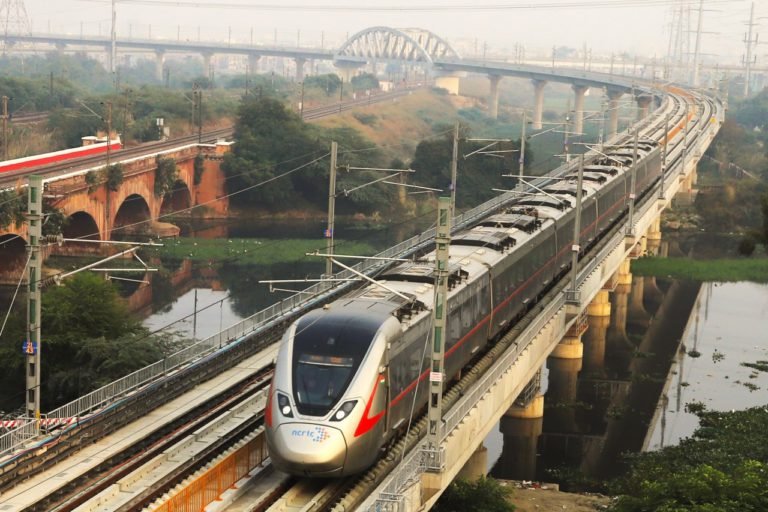
DELHI (Metro Rail News): 2023 was a year of achievements for the National Capital Region Transport Corporation (NCRTC). This year, NCRCTC achieved a significant milestone in its journey to provide the country with an advanced and transformative transit service through the Delhi-Ghaziabad-Meerut RRTS corridor. On October 20, 2023, the Honorable Prime Minister inaugurated India’s first RRTS and flagged off the Namo Bharat train. With this, the 17-kilometer-long Priority Section between Sahibabad and Duhai Depot was operationalised for the public.
The construction of the RRTS corridor began in 2019, and commencing the operation of the Priority Section within just 4 years is a significant accomplishment. It is especially remarkable considering that it is an entirely new system with all the sub-systems and trains of the RRTS corridor having been developed in an entirely new manner.
Along with this, with the relentless efforts of Team NCRCTC, the construction of the corridor continued to expand in the direction of Delhi and Meerut, progressing consistently. As the countdown of this year has begun, NCRCTC has reached a stage in the journey where trial runs have commenced in the sections beyond the Priority Section.
Here is a glimpse of some significant achievements attained by NCRCTC in the year 2023-
1. Operations Commenced on Priority Section: A Journey-
For NCRCTC, 2023 began with the commencement of trial runs on the Priority Section. These trial runs began in the first week of January 2023. During these trial runs, various sub-systems of the RRTS, such as the rolling stock, ETCS-2 signalling on the LTE network, ballastless track, and overhead equipment, were tested independently and later in synergy with each other to ensure their safe and compliant implementation and compatibility.
Stepping ahead in this direction, in June 2023, the Commissioner of Metro Rail Safety (CMRS) approved the operation of Namo Bharat train services on the Priority Section between Sahibabad and Duhai Depot. With the approval from CMRS, the Priority Section of the RRTS became the first railway system in the country to be opened for operation on the entire section with a maximum operational speed of 160 kilometres per hour.
Subsequently, in the last quarter of the year, finally, the moment arrived which was awaited not only by NCRCTC and the people of Ghaziabad but by the entire nation. On October 20, 2023, in the presence of the Honorable Chief Minister of Uttar Pradesh, Yogi Adityanath, the Governor of Uttar Pradesh, Anandiben Patel, and the Union Minister of Petroleum and Natural Gas, Housing and Urban Affairs, Shri Hardeep Singh Puri, the Honorable Prime Minister inaugurated India’s first RRTS and flagged off the Namo Bharat Train. With this, from October 21, 2023, this section became operational for the public.
2. Tunneling Work Completed in Underground Section-
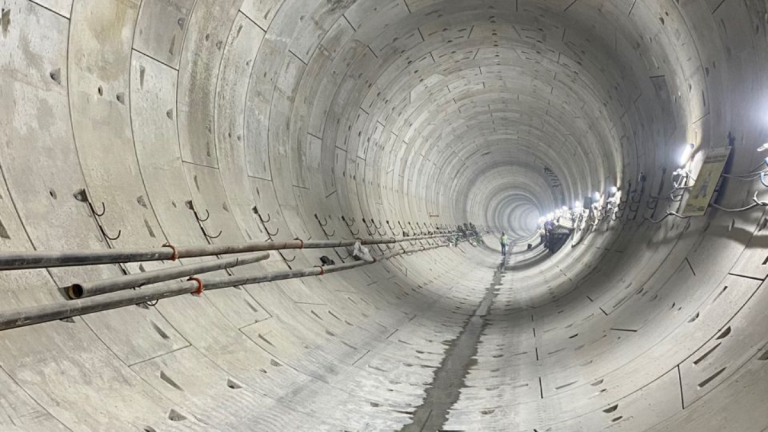
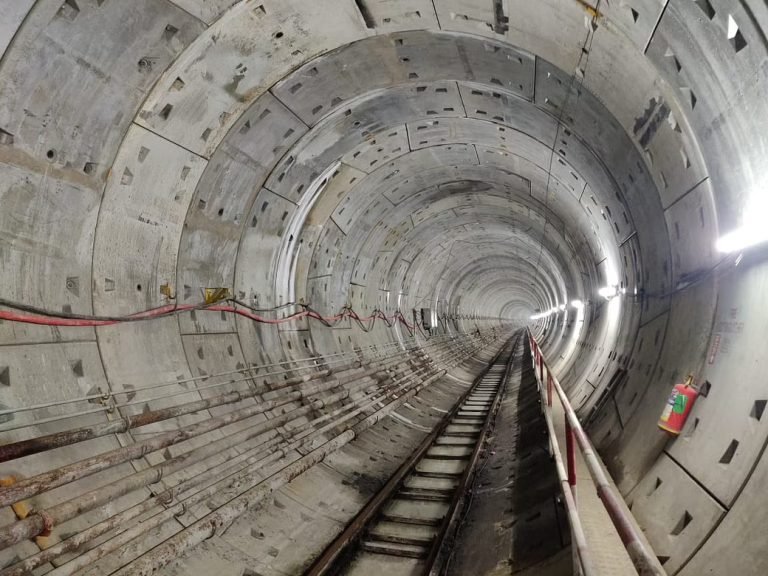
In the journey of providing rapid regional connectivity in the NCR, another crucial milestone was achieved when the tunnelling work for the entire Delhi-Ghaziabad-Meerut RRTS corridor was completed successfully. This corridor has a total of four underground stations: Anand Vihar in Delhi, and Meerut Central, Bhainsali, and Begumpul in Meerut.
The tunnelling journey of NCRTC commenced in February 2022, when Sudarshan 4.1 (Tunnel Boring Machine) was lowered into the launching shaft built at Anand Vihar, New Delhi to bore the tunnel between Anand Vihar towards New Ashok Nagar. On August 29, 2023, with the completion of boring the 2-kilometer-long tunnel between Anand Vihar and Sahibabad, the entire tunnelling work for the RRTS corridor was completed. It is a remarkable feat to construct parallel tunnels in the entire 12-kilometer-long underground section in less than 18 months, achieved by using seven state-of-the-art Sudarshan (TBM),
To construct these tunnels, more than 80,000 pre-cast segments have been used. These high-precision pre-cast tunnel segments were cast at the state-of-the-art casting yards established at Karkardooma, New Delhi, and Shatabdi Nagar, Meerut. The diameter of the RRTS tunnels is 6.5 m which is highly optimised as compared to global benchmarks of tunnels for a similar design speed of 180 Kmph with wider and higher rolling stock.
3. Stepping Towards Sustainability, NCRTC Established Solar Power Plants at Depots and Stations
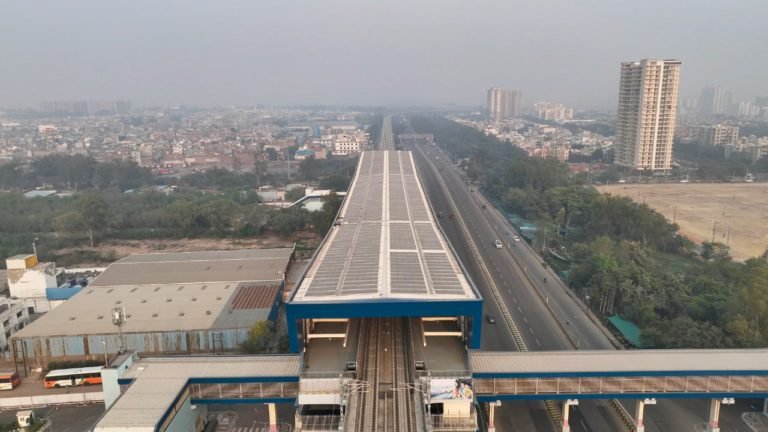
In step with its commitment to adopt renewable energy and sustainable practices, NCRTC established a state-of-the-art Solar Power Plant at RRTS Depot at Duhai and Sahibabad RRTS Station and Duhai Depot RRTS Station.
With a total capacity of 729 kW, the Solar Power Plant established at Sahibabad station is equipped with 1620 high-efficiency solar panels. The plant will generate about 10 lakh units of electricity per annum as against the annual consumption of about 7.3 lakhs per annum for the auxiliary load of the station, thus making the Sahibabad Station a ‘Green Station with the distinction of being Carbon Negative’.
The solar plant at the Duhai Depot Station is equipped with 320 solar panels with an installed capacity of 108 kW.
Earlier in July, a solar power plant was established at RRTS Depot in Duhai with an installed capacity of 585kWp, making this Depot a Green Depot.
This initiative represents a major stride towards sustainability, as together, these solar power plants are expected to reduce approximately 1600 tonnes of carbon dioxide (CO2) emissions per year. The reduction is achieved by substituting conventional fossil fuel-based power sources with clean and green solar energy. This transition to solar energy aligns with NCRTC’s commitment to reducing its carbon footprint while optimizing operational costs. The solar energy produced through this Solar Plant will be monitored and optimized by a cutting-edge cloud-based application which will track the output regularly. This advanced technology ensures transparency, efficiency, and seamless management of the solar energy infrastructure.
4. RRTS Project Won Several Awards-
In the year 2023, what was noteworthy for NCRCTC was not only the revolutionary changes being made in the urban landscape through the RRTS project but also the recognition garnered for the innovative technologies, novel approaches, and strategic decisions implemented in it. The project not only received appreciation but also won several awards.
In the prestigious TAI Tunneling Awards 2023 organized by the Tunneling Association of India, the project was honoured in the ‘Environmental Initiatives of Tunneling’ category. Additionally, in the CNBC-AWAAZ Real Estate Awards 2023, the project received the ‘Special Commendation for Innovation and Excellence in Urban Transportation.’ Furthermore, NCRCTC was recognized with the highest ‘Project Award’ rating, a Platinum rating, for the Ghaziabad Receiving Substation (RSS) and Sahibabad RRTS Station. This Platinum rating was conferred at the Green Building Congress 2023 held in Chennai by the Indian Green Building Council (IGBC), representing the highest rating in the ratings provided by IGBC.
5. NCRTC Organized Various Skill Development Training Programs-
This year, NCRCTC organized various skill development training programs in the villages of Ghaziabad and Meerut districts. In this series, farmers were trained in modern agricultural techniques, and women were provided self-defence training.
NCRCTC understood the changing needs of farmers in evolving landscapes and, as a result, organized more than 100 training sessions for over 1500 farmers residing in 52 villages around the Delhi-Ghaziabad-Meerut RRTS corridor. These sessions provided them with training in modern urban agriculture techniques that can offer high returns per unit of land.
Polyhouse farming, drip irrigation farming, retractable greenhouse farming, hydroponics, and similar modern agricultural techniques were introduced to farmers by a team of agricultural specialists. These new methods of farming are environmentally and socially sustainable. The increasing demand in the market for nutrient-rich and organic produce will create opportunities for farmers to enhance their income by selling high-quality crops.
In addition, NCRCTC is making efforts not only to ensure the safe travel of women but also to empower them. In this direction, NCRCTC organized a self-defence training program for students at D.N. Degree College in Meerut. The program provided training by specialized instructors from the Central Industrial Security Force (CISF), and more than 200 female students from various colleges in Meerut took part in the training.
In addition to these, initiatives such as training taxi drivers, gender sensitization for drivers and conductors, and skill development for employment continue to be implemented. These efforts highlight the inclusivity of the RRTS project and its positive impact on gender equality and other social aspects project. In the coming days, a large number of rural women will also be provided training in sewing and modern tailoring work.
6. Trial Run Commences in Section Beyond Priority Section, Namo Bharat Train Travels Up to Modi Nagar South-
After the commencement of operation of the Priority Section on the Delhi-Meerut-Ghaziabad RRTS corridor, the trial run has now begun in the section ahead of it. Trials run of the Namo Bharat trains are being conducted from Duhai to Modi Nagar South Station. In this process, the electric OHE (Over Head Equipment) has been charged with a capacity of 25 KV from Murad Nagar Receiving Sub Station to Modi Nagar South and following this, the trial runs of the Namo Bharat train are being carried out in this section. Currently, the trains are running from Duhai Station to Murad Nagar Station and then further to Modi Nagar South, covering a distance of approximately 12 kilometres.
The 25 km stretch between Duhai and Meerut South RRTS station is the next section of the RRTS corridor to be operationalized for the public after the Priority Section. This section has a total of 4 stations, namely Murad Nagar, Modi Nagar North, Modi Nagar South, and Meerut South.
In June, the construction of the viaduct up to Meerut South was completed with the installation of the last span. Since then, various construction works like track laying, OHE installation, signalling and telecom, and electrical have been progressing at pace in this section. At present, track laying work is almost complete, and other works are in their final stages. Additionally, Muradnagar RSS is ready to supply electricity from Murad Nagar to Meerut South. Soon, OHE will be charged between Modi Nagar North and Meerut South stations, and trial runs will be conducted in this section by running trains up to Meerut South station.
7. Construction Progressing at Pace, Stations and Viaduct Taking Shape in Delhi and Meerut-
The construction of the RRTS corridor gained momentum in Delhi and Meerut. With the construction work progressing at pace, the outline of the RRTS viaduct from Delhi to Meerut became visible and most of the stations took shape.
In the elevated section of the Delhi segment, approximately 7 kilometres of the nearly 9-kilometer-long viaduct has been completed. As part of this, the construction of a bridge over the Yamuna River has been successfully completed, which was a complex process. Additionally, in the congested area of Kondli, a total of 360 meters of special steel spans were installed to cross the Gazipur Drain. Furthermore, the RRTS viaduct in New Ashok Nagar crossed over the Delhi Metro’s Blue Line. Currently, construction work is progressing to cross the Barapula viaduct.
Along with this, the track laying activities have been completed in about 1.5 track kilometres and the installation of OHE masts over about 2 kilometres have been completed on the constructed viaduct. The construction of two stations in the elevated section, Sarai Kale Khan and New Ashok Nagar RRTS stations is also progressing. The majority of civil construction work at Sarai Kale Khan RRTS station has been completed, and currently, finishing, electrical, and maintenance work is underway. Similarly, civil construction work is being carried out for the concourse and platform level at the New Ashok Nagar station.
The tunnelling work in the underground section of Delhi is complete, and, the concourse and platform levels at the Anand Vihar station have been constructed and are now undergoing flooring work. Similarly, construction work in Meerut is progressing rapidly. The RRTS corridor has successfully crossed over the Delhi-Meerut Expressway. Additionally, to cross the railway line at Partapur, a 90-meter-long special steel span, including eight large girders, has been installed. Furthermore, the construction of Meerut Metro stations, including Partapur, Rithani, Shatabdi Nagar, Bramhapuri, Meerut Central, and Bhaisali, is in its advanced stages. The construction of the Begumpul RRTS station is also being expedited.
In addition to these achievements, NCRTC has organized various community awareness programs to educate the public about the RRTS project. As part of this initiative, art competitions have been conducted in schools, and knowledge-sharing sessions have been organized in colleges. During these sessions, students were educated about various modern technologies and innovative methods being implemented in the RRTS. Additionally, street plays were organized to entertain the public and familiarize them with the project in an engaging manner. The purpose of this event is to encourage people to use public transportation instead of private vehicles, reducing dependence on private vehicles and promoting sustainable urban mobility.
NCRTC aims to operationalize the entire Delhi-Ghaziabad-Meerut RRTS corridor by June 2025, and witnessing the pace at which construction work is progressing, this destination is now within reach.