




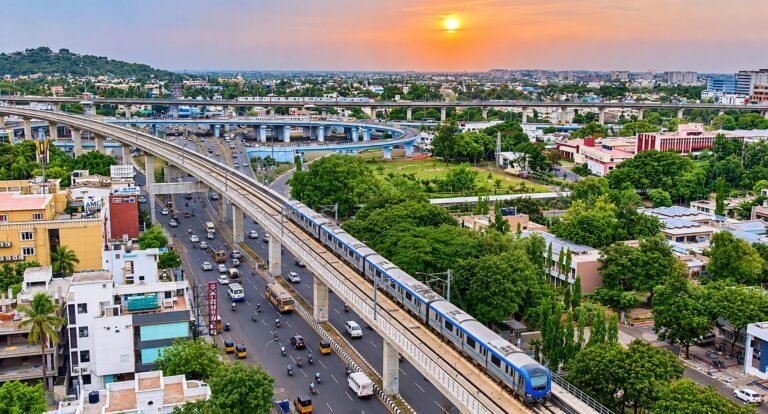
CHENNAI (Metro Rail News): It is expected that by March 2027, six trains will operate simultaneously at Kathipara Junction across three Chennai Metro corridors. Two corridors belong to the Phase I network, while the third is part of Phase II.
Chennai Metro Rail Limited (CMRL) has completed the construction of balanced cantilever viaduct over Kathipara Junction for Phase II (Corridor 5: Madhavaram to Sholinganallur via Alandur). The track work is underway with the target to finish it within 45 days. Train trials are expected to be scheduled for January 2027.
The viaduct stretches across a total length of 413 metre and it is a circular span that incorporates some of the tallest pillars of the metro network. It passes from Paul Wells Road to Alandur and is located over the cloverleaf-shaped flyover and the two existing Chennai Metro Phase I corridors.
2 more trains are expected to be introduced across the 14.5-km Koyambedu-Alandur stretch which is a part of Phase II’s corridor 5 (Madhavaram to Sholinganallur via Alandur). As mentioned by The Hindu, the trains will cross through the tallest pillar (108 feet) of the 118.9-km Phase II network and will run through the sharpest curve of radius 125 m before reaching Alandur.
Get the Daily Metro & Rail Brief
Join 125,000+ metro and rail professionals. Project updates, new tenders and contract awards from across India, in your inbox every day.
Viaduct Construction Scheduled for Feb 2026 Faced Constant Delays
In-Situ Construction of Each Segment: Stressing of the concrete segmental spans proved difficult as there was lack of friction, therefore in-situ construction was followed for each segment of the viaduct.
Electric Induction Issues: Construction equipment and materials were located near a high-voltage line, while the existing overhead electrical equipment of the Phase I network posed additional challenges. The proximity to electrical equipment slowed down the work, as the overhead equipment of the Phase I network had to be switched off to ensure safe construction activities. Workers had to carry out the construction work within a restricted four-hour window, from midnight to 4 AM every day
 Read nextChennai Metro Yellow Line Services to Start at 7 AM Instead of 6 AM From 24 November for Testing Work23 Nov 2026
Get alerts for big metro and rail stories Openings, trials, fares and approvals. Two or three a day at most; turn them off any time.