




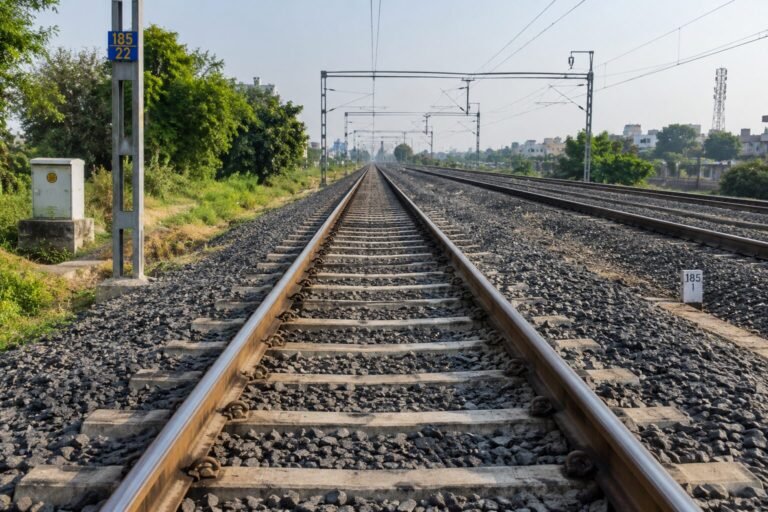
DELHI (Metro Rail News): South Coast Railway (SCoR) has commissioned automatic block signalling on the 28.112-km Adoni-Kosgi double-line section, completing the signalling upgrade across the Guntakal-Raichur corridor. The ₹500 crore project is expected to reduce train waiting times and create scope for handling more passenger and freight services on the busy interstate route.
Commissioned on October 17, 2026, the latest section falls under the Guntakal Division and covers three stretches: Adoni-Isivi, Isivi-Kuppagal and Kuppagal-Kosgi. The upgrade adds 56.224 track kilometres of automated signalling infrastructure and takes South Coast Railway’s cumulative automatic block signalling (ABS) coverage to 105 route kilometres.
The completion means the entire Guntakal-Raichur corridor now operates under automatic block signalling, replacing the conventional system across the route.
How automatic block signaling in railway improves capacity
Under conventional absolute block signalling, a train generally requires confirmation that the section ahead is clear before it can proceed. Automatic block signalling divides the line into shorter sections monitored by trackside equipment, allowing successive trains to operate at controlled intervals when the relevant sections are clear.
Get the Daily Metro & Rail Brief
Join 125,000+ metro and rail professionals. Project updates, new tenders and contract awards from across India, in your inbox every day.
This can reduce the minimum time gap between trains and improve the use of existing tracks without requiring additional railway lines. The system also provides continuous monitoring of train movements through fail-safe signalling equipment.
For the Guntakal–Raichur corridor, the upgrade is intended to ease operational constraints on a route carrying both passenger and freight traffic between Andhra Pradesh and Karnataka.

Signalling infrastructure installed
The newly commissioned section includes a range of signalling, train-detection and power-backup systems designed to support safe and reliable operations. Key installations include:
- 38 new mainline signals and 24 station semi-automatic signals.
- Five automatic block signalling huts across the three sections.
- 178 train-detection points equipped with Frauscher Dual Multi-Section Digital Axle Counters (Dual MSDAC).
- 16 Universal Fail-Safe Block Interface (UFSBI) sets, supported by non-vital multiplexers.
- Five Integrated Power Supply (IPS) units for backup power.
- Five data loggers for monitoring equipment performance and supporting fault diagnosis.
The combination of train detection equipment, fail-safe interfaces and backup power is intended to maintain signalling integrity and help staff identify faults.
₹500 cr project targets higher line capacity
The wider signalling programme has been undertaken to improve the handling of growing traffic on the Guntakal-Raichur route. By reducing headway between trains, the system can help railway operations make better use of the existing double-line infrastructure. South Coast Railway General Manager Sandeep Mathur said the corridor-wide upgrade would support capacity expansion and operational safety. He also credited the Signal and Telecommunication and Projects teams with completing the commissioning without disrupting scheduled train movements.
The railway has not specified a number of additional trains that could be operated following the upgrade. The actual capacity gains will depend on traffic patterns, operating schedules and other constraints across the corridor.
Also Read: Indian Railways Develops ₹307 Cr. Sabarmati Hub for 24 Coach Vande Bharat Trains