




CHENNAI (Metro Rail News): Tamil Nadu Chief Minister Mr. C. Joseph Vijay visited the under-construction Chennai Metro Phase 2 site at Kathipara Junction on July 29, 2026. He even climbed all the way up to inspect the elevated viaduct standing 101 feet tall being built over the busy clover-leaf interchange. The Kathipara Metro Junction in Guindy will also feature the tallest pillar on the entire Chennai Metro network, standing at about 108 m.
Chennai Metro Phase 2 is a big leap towards true multi-modal connectivity, once operational.The project will link up with other public transport systems, including Suburban Rail, MRTS, and City Bus services, at 21 different locations, making commuting across the city far smoother and more convenient.
Key Features of Chennai Metro Phase 2
The Double-Decker Corridor: Road and Metro, together
The weekly brief metro & rail professionals read.
A standout feature of Phase II is a double-decker line and station design, where both levels stand on a single pillar for a stretch of about 4 km. This double-decker stretch includes four stations Alwarthirunagar, Valasaravakkam, Karambakkam, and Alapakkam.
Rather than constructing entirely separate structures, the metro corridor shares space directly with State Highway flyovers. This smart integration shows up at several key locations Kattupakkam, MIOT, Thoraipakkam, and Sholinganallur where the metro line runs above or alongside the highway instead of needing its own dedicated corridor.
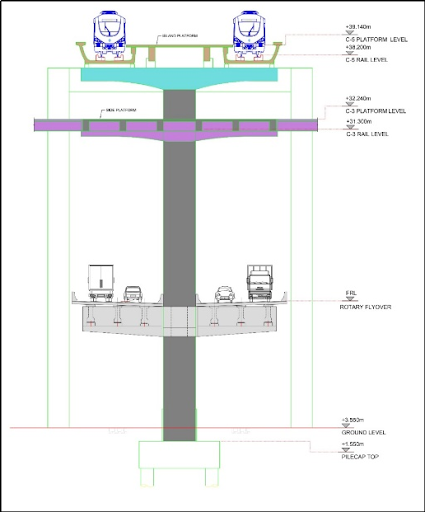
This design helps save precious space and cuts down on the need for extra land in already congested urban stretches.
Going Underground: Tunnels, Tight Spaces, and a River Crossing
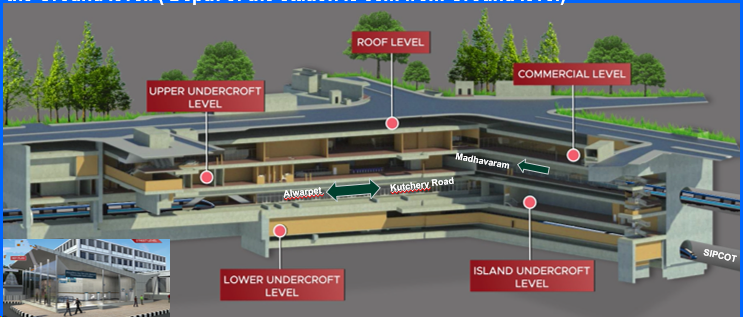
Underground sections were planned because in some locations the width of the roads is as narrow as 10m.
Underground sections will be featured in Pattalam, Thirumayilai, Kutchery, Alwarpet,Kilpauk, Thousand Lights, and Nandanam and Bharathidasan Road .
Among these, the Thirumayilai interchange station stands out as the deepest, plunging nearly 39 m below street level.
At Kilpauk, Thousand Lights, and Nandanam, the new Phase II tunnels have to pass right below the older Phase I tunnels that are already running trains with just a safety gap separating the two.
Diving 15 m below the riverbed level beneath the Adyar River
Near Adyar Junction, Corridor 3 crosses the Adyar River underground. The crown of the tunnel here sits 15 m below the riverbed level .
With its double-decker corridors, deep underground tunnels, and river-crossing engineering, Chennai Metro Phase 2 stands out as one of India’s most ambitious and technically advanced urban transit projects.
Also Read: India’s First Vande Bharat Freight Train Hits 145 km/h: RDSO initiates Speed & Safety Trials in Kota
Project Overview