Kanpur (Metro Rail News): Kanpur Metro progressed as CMRS Inspection was conducted on the Kanpur Metro Line 1 stretch from Moti Jheel to Kanpur Central Station to start the passenger services operations. Corridor 1 of the Kanpur Metro spans 23.785 km from IIT Kanpur to Naubasta covering 22 stations.
About CMRS Inspection
The CMRS inspection was conducted on the Line 1 section between the Moti Jheel and Kanpur Central Station. This section features 6 stations.
Stations
Moti Jheel
Chunniganj
Naveen Market
Bada Chauraha
Nayaganj
Kanpur Central
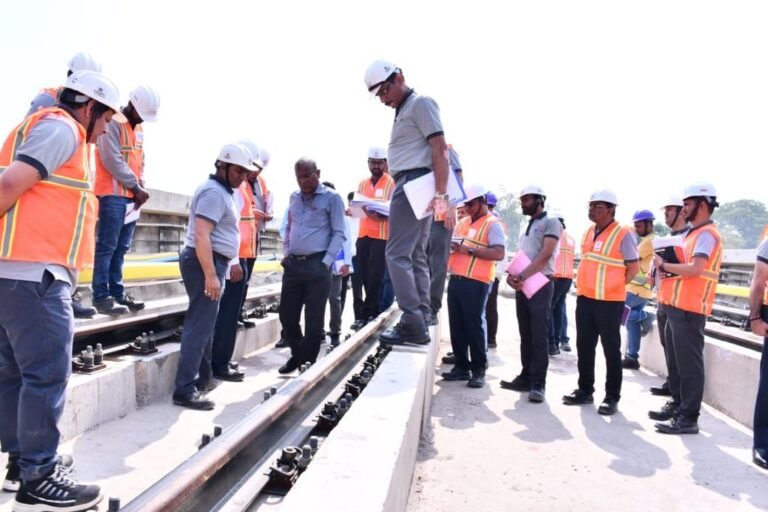
The Commissioner of Metro Rail Safety (CMRS) Mr Janak Kumar Garg inspected the metro stations from Moti Jheel to Kanpur Central Station in the presence of senior officials of UPMRC.
Delhi (Metro Rail News): Delhi Metro Rail Corporation (DMRC) has announced SS.SS Construction Pvt. Ltd. as the lowest bidder for the architectural finishing contract of 4 stations of Delhi Metro Phase 4’s Golden Line which spans 23.622 km from Aerocity to Tuglakabad.
DMRC Brief Scope of Work: Comprehensive Architectural Finishing Works at Four Underground stations namely Aerocity, Mahipalpur, Vasant Kunj and Kishangarh station on Aerocity-Tughlakabad corridor of Phase-IV of Delhi MRTS.
Contract Details
Contract Amount: INR 67.73 Cr
Contract Date: 20 Mar 2025
Contract Duration: 730 days
Bidding Process
DMRC floated a tender for this contract and 9 firms submitted bids for this work of which the bids of Ghaziabad Mechfab Pvt. Ltd. and Premco Rail Engineers Limited were disqualified in the technical evaluation due to non-compliance with the tender’s terms and conditions.
Technical bids were opened on 11 February 2025. On 20 March 2025, financial bids were opened to reveal that SS.SS Construction was the lowest bidder for the contract.
Financial Bid Value
Bidder Name
Bid Value
SS.SS Constructions Pvt. Ltd
₹ 67.7 Cr
Quality Buildcon Private Limited
₹ 72.5 Cr
M/S B. Rai Construction Company
₹ 72.8 Cr
Godrej and Boyce Manufacturing Company Limited
₹ 75.2 Cr
M/S Garg Builders
₹ 75.9 Cr
NS Associates Pvt Ltd
₹ 76.2 Cr
MIA Construction Pvt Ltd
₹ 76.5 Cr
Contracts Scope of Work
The contract’s scope of work includes the architectural finishing work of 4 stations of Delhi Metro Phase 4’s Golden Line
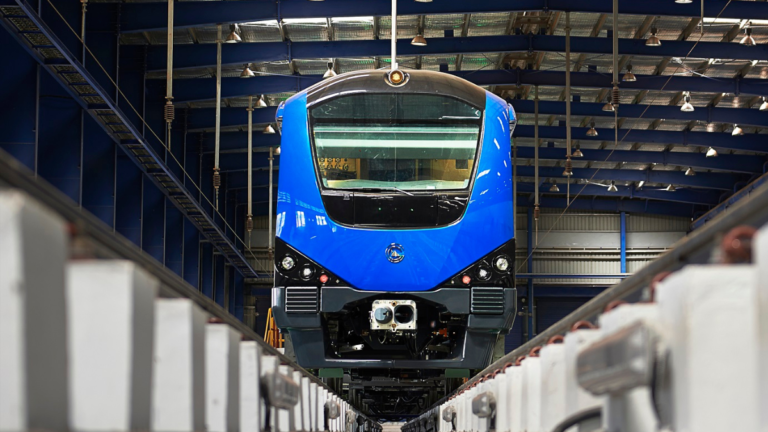
Chennai (Metro Rail News): The Chennai Metro Rail Project has achieved a major milestone with a successful trial run of the driverless train on Line 4 of Phase II.
The initial trial run of Chennai Metro Rail’s first driverless train for the Phase II network encountered several technical issues. Originally scheduled to commence at approximately 5 p.m. from the Poonamallee Depot, the trial was delayed and ultimately took place around 11:30 p.m.
Chennai Metro Rail Limited (CMRL) has commenced the TESTING AND TRIAL of its first Phase 2 section along with train , between Poonamallee Depot Metro Station and Mullai Thottam Metro Station in the Corridor 4 of the Phase-2 project.
The train successfully departed from Poonamallee Depot and covered a distance of 3 kilometres, reaching Mullaithottam at approximately 11:45 p.m.
“On the viaduct, about a kilometre from the depot, a cable of the overhead equipment snapped, and there were sparks for a couple of seconds. We then carried out the repair work. Hence, the trial run was delayed by a couple of hours,” an official said.
“Though it was a driverless train, it was operated by a driver because it was a trial run. The train was operated at a speed of around 15 kmph,” an official said. These trials are likely to continue on a daily basis, the official added, as reported by The Hindu.
The Poonamallee Bypass to Mullaithottam section is part of Corridor 4 of the Phase II network, spanning a total length of 26.1 km from Poonamallee Bypass to Light House. Currently, various construction and system installation works are in progress along a 9-km stretch between Poonamallee Bypass and Porur Junction.
Delhi (Metro Rail News): Delhi Metro Phase 4 progressed as Paras Railtech emerged as the lowest bidder for Package DT-10R which includes the installation of Ballastless tracks on the Golden Line which spans 23.622 km from Aerocity to Tuglakabad.
Delhi Metro’s Golden Line
Delhi’s Golden Line, a key corridor in the 112.32 km Delhi Metro Phase 4 project, will span from Aerocity to Tughlakabad, covering 16 stations.
The line’s civil construction is currently underway through four contract packages.
Package
Type
Contractor
DC-07
Underground
Afcons Infrastructure
DC-08
Underground
J Kumar Infraprojects
DC-09
Underground
Larsen & Toubro
DC-04
Elevated
YFC Projects
DMRC has been planning to operate 13 train sets of 6 coaches which will be supplied by Alstom Transport on Golden Line.
Bidding Process
DMRC initially invited bids for track work under Package DC-10 in July 2023 but unexpectedly cancelled the process in August. The bids were reissued in September 2024 under Package DT-10R, with a completion deadline of 1,080 days (2.95 years)
In December 2024, Technical bids were opened to reveal that 4 firms have submitted bids for the contract.
In February financial bids were open to reveal Paras as the lowest bidder.
Financial Bid Values
Firm
Bid (crore)
Paras Railtech Pvt. Ltd.
125.37
Texmaco Rail and Engineering Ltd.
135.72
Rahee Infratech Ltd.
140.19
Contract Details
Funding: The Package will be financed by the Japan International Cooperation Agency (JICA).
DMRC’s Brief Scope: Installation, testing and commissioning of ballastless track including supply of MSS and Buffer Stop for Line-10 (Aerocity to Tughlakabad) (ch. -760m to ch. 23286m).
Other Track-related contracts for the Golden Line
Package
Scope of Work
Contractor
DT-07
UIC-60 turnouts and scissor cross-overs
Voestalpine VAE VKN India
DT-09
Track fastening
Patil Rail Infrastructure (PRIPL)
DT-10R
Ballastless track work
Paras Railtech (Lowest Bidder)
DT-16
Ballastless/Ballasted track in Sarita Vihar Depot for augmentation of additional maintenance facilities
Bangalore (Metro Rail News): Cyclosystem India Pvt Ltd has emerged as the sole bidder for the contract to supply automatic train wash plant for three depots under Bangalore Metro Phase 2, with a bid of ₹10.03 crore.
The Automatic Train plant will be set up at the following depots:
1. Kothanur Depot
2. Baiyyappanahalli Depot
3. Airport Depot
Scope of work
The appointed contractor for this contract will be responsible for the design, manufacturing, supply, installation, testing, and commissioning of a fully automatic train washing plant. The contract also includes the supply of tools, supply of software, supply of manuals, and training personnel along with the supply of spares, and consumables during 3 three-year Defect Liability Period (DLP) for Kothanur, Airport & Baiyappanahalli Depot of Bangalore Metro Rail Corporation Limited (BMRCL) – 5RSDM project.
Bidding Process
A total of four firms submitted bids for this contract by BEML; however, three firms were disqualified during the technical evaluation. The firms are as follows:
Bidders
Bid Status
1. Cyclosystem India Pvt Ltd New Delhi
Qualified
2. Gourika India Ltd Kolkata
Disqualified
3. Skylark Pune
Disqualified
4. Swastik Overseas New Delhi
Disqualified
Bangalore Metro Phase 2
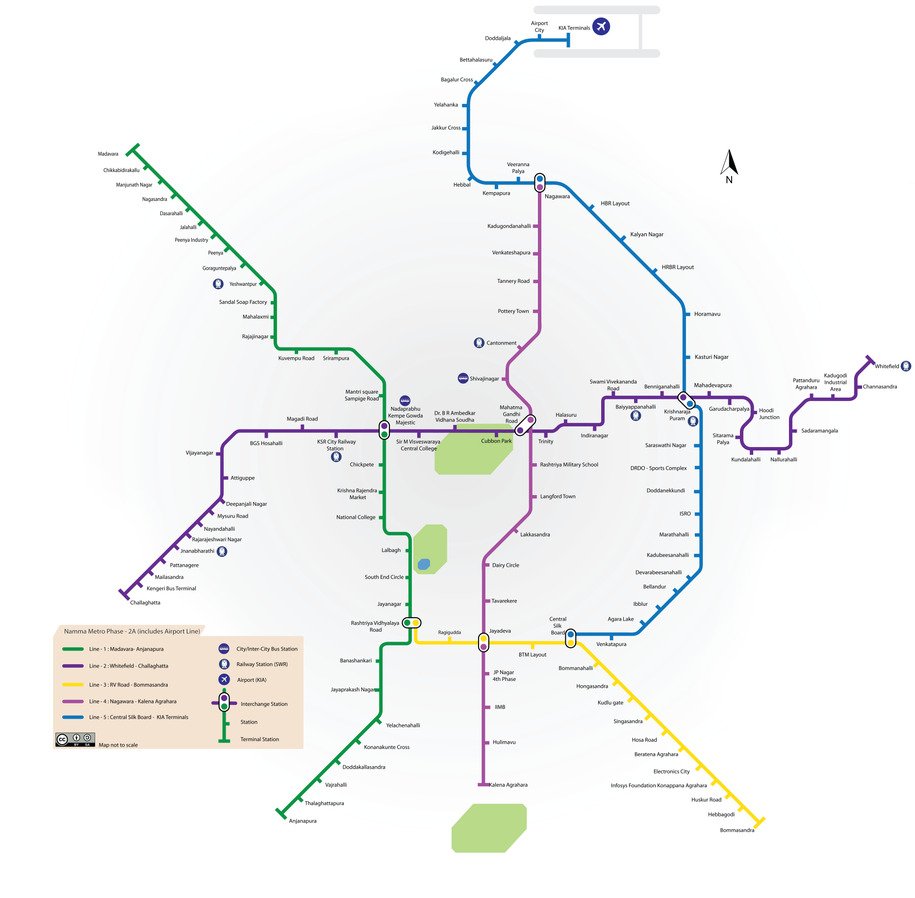
The Bangalore (Namma) Metro Phase 2 project, spans 73.921 km of new routes. It received approval from the Karnataka state government in 2011 and the Central Government in 2014. This phase includes the construction of two new corridors, the Yellow Line and Pink Line, along with extensions of the existing Green Line and Purple Line.
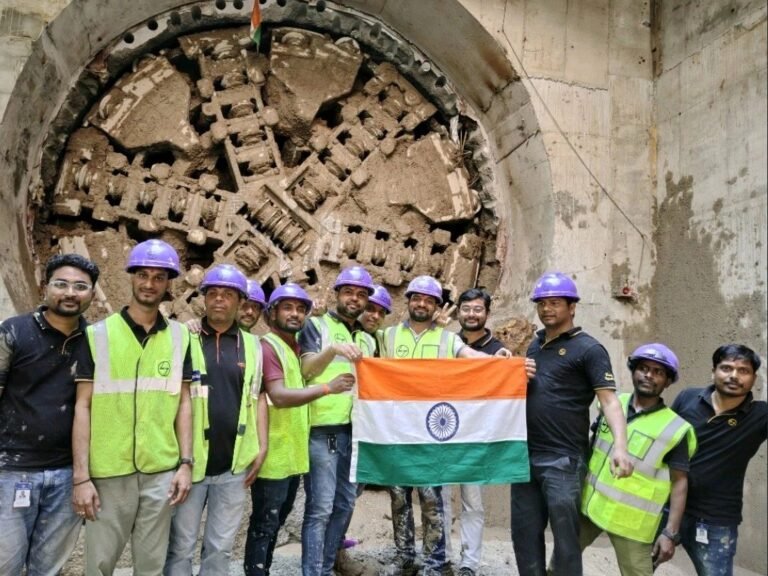
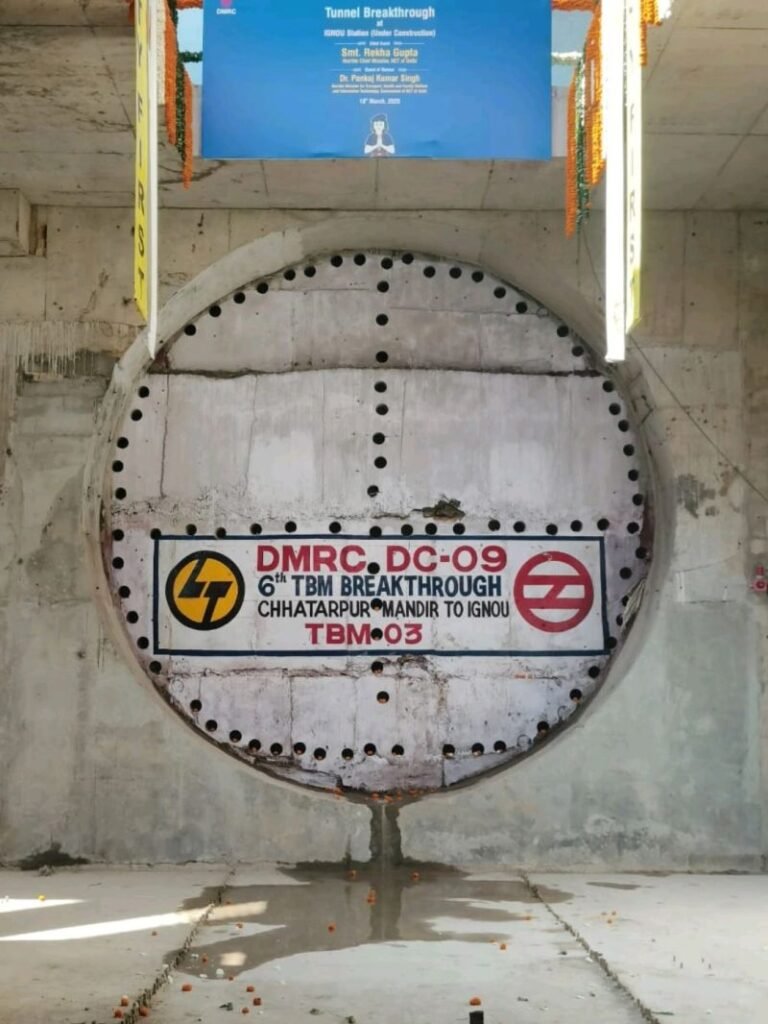
Delhi (Metro Rail News): Following the successful breakthrough of TBM-4 (DZ1124) in the Down-Line tunnel at IGNOU Station, TBM-3 has now completed its drive on the UP-Line and achieved a breakthrough at IGNOU Station which is a part of the Delhi Metro’s Golden Line. The Golden Line covers a distance of 23.622 km and connects Aerocity and Tughalakabad via 15 stations.
Image Credit: Sandip Mandal
TBM 3’s Drive in Delhi Metro Phase 4
In November 2023, TBM 3 was deployed from Chhattarpur Mandir Station by L&T for its first assignment. On 18 March 2025, the TBM reached IGNOU station after constructing a 1470m up-line tunnel.
Image Credit: Sandip Mandal
6th Tunnel Breakthrough in Package DC-09
This was the 1st tunnel breakthrough of TBM-3 (DZ1125). However, it was the 6th overall breakthrough within Package DC-09, which was awarded to Larsen & Toubro. This package covers a 6.51 km stretch from Kishangarh to Saket G Block and includes four stations: Chhattarpur (interchanging with the Yellow Line), Chhattarpur Mandir, IGNOU, and Neb Sarai.
The Progress Ahead
TBM-3 and TBM-4 will now be moved through the IGNOU Station box and deployed to construct approximately 1.2 km of twin tunnels toward Neb Sarai.
RITES Limited has bagged a contract worth Rs. 27.96 crores from South Central Railways which includes conducting a Final Location Survey of high-speed elevated rail corridors between Hyderabad-Bengaluru and Hyderabad-Chennai.
To ensure both accuracy and efficiency, RITES will utilise advanced surveying techniques, specifically Airborne and Terrestrial LIDAR (Light Detection and Ranging).
These technologies offer high-resolution topographical mapping, which is essential for optimizing alignment and planning for infrastructure development.
Contract’s Details
Contract Value: Rs. 27.96 crores
Contract Duration: 8-month
Contract’s Scope of Work
According to a statement from RITES, the contract encompasses various key tasks related to the proposed High-Speed Elevated Rail Corridor between Hyderabad–Bengaluru and Hyderabad–Chennai.
The scope of work includes conducting the Final Location Survey, preparing a Detailed Project Report (DPR), designing the final alignment, and carrying out a traffic survey. Additionally, it involves Right of Revenue (ROR) calculations, preparing a detailed cost estimate, and drafting EPC (Engineering, Procurement, and Construction) documents.
Modern survey techniques, such as Airborne and Terrestrial LiDAR, will be utilized for accurate data collection. The contract has been awarded by South Central Railway, and a formal agreement is expected to be executed in due course.
Additionally, a detailed estimate and EPC documentation are compiled, which include cost projections and contract documents essential for the engineering, procurement, and construction phases.
Aim Behind the Contract
The survey represents a critical step in enhancing high-speed rail connectivity in South India. The corridors connecting Hyderabad to Bengaluru and Hyderabad to Chennai aim to reduce travel times, improve regional mobility, and stimulate economic growth.
This initiative is consistent with India’s long-term objective of expanding its high-speed rail network
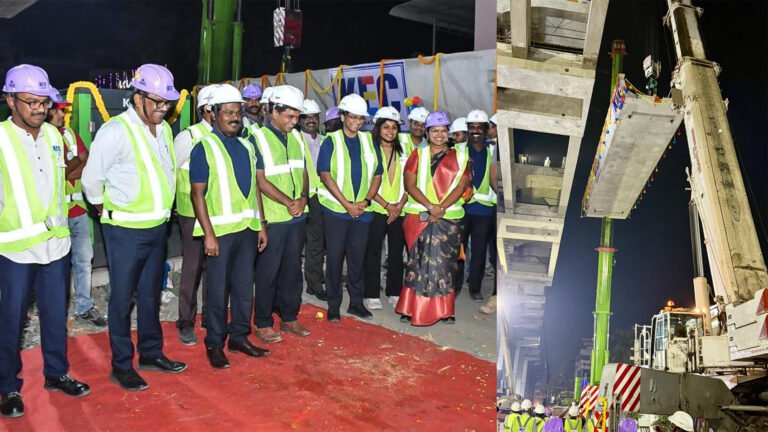
Chennai (Metro Rail News): Chennai Metro progressed as Hindustan Construction Company – KEC International (HCC – KEC JV) launched all the 624 U-girders under Package C4-ECV-02 of Chennai Metro Line 4. This corridor connects Light House to Poonamallee Bypass.
The work was carried out at piers SP-04 and SP-05 of the upcoming Kumananchavadi Metro Station. With this development, all 3,202 precast elements planned for this section, including U-girders, pier arms, portal beams, and pier caps, have been installed.
The package also involved launching two Open Web Girders (OWGs) over the Tambaram – Maduravoyal Bypass.
The joint venture between HCC and KEC completed the casting of all components in June 2024 at their facility located in Kolappancheri.
Package C4-ECV-02
In May 2021, HCC – KEC JV bagged Package ECV-02 from Chennai Metro Rail Ltd. (CMRL) at Rs.1007.95 crore with a 36-month construction deadline.
The Package spans 7.945 km, connecting Poonamallee Bypass and Porur through 9 stations. The package includes the construction of a 7.945 km viaduct for the main-line primarily consisting of U-girders and a viaduct to Poonamallee Depot.
Stations
Chennai Bypass Crossing
Ramachandra Hospital
Iyyapanthangal Bus Depot
Katupakkam
Kumananchavadi
Karayanchavadi
Mullai Thottam
Poonamallee Bus Terminus
Poonamallee Bypass
Further Information
Chennai Metro Rail Limited (CMRL) has received two Alstom train sets for Line 4, which were delivered to the Poonamallee Depot from Sri City. Additionally, the track work for the downline has been completed over a brief 2-kilometer section between Mullaithottam and the Poonamallee Depot. Testing, including trial runs with Alstom’s trains, is anticipated to commence within the next two months. Recently, CMRL conducted a test run involving a trolley along the tracks with its management team on board.
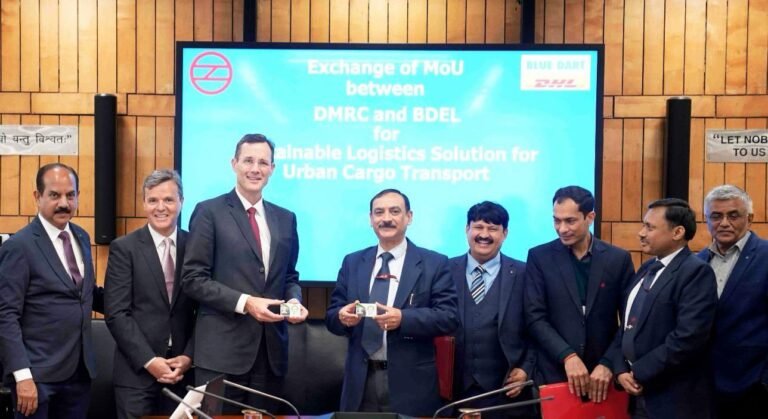
Delhi Metro Rail Corporation (DMRC) and Blue Dart, a leading express logistics service provider in India, have entered into a Memorandum of Understanding (MoU) for urban logistics service.
This service is part of a strategic collaboration between DMRC and Blue Dart, India’s premier express logistics service provider. This innovative initiative, the first of its kind in the entire South Asia Pacific region, reinforces both DMRC and Blue Dart’s commitment to environmental stewardship and to fostering more sustainable logistics solutions.
Under this collaboration, Blue Dart will transport cargo via metro trains during non-peak hours, utilizing available capacity to ensure faster and more reliable movement of time-sensitive shipments. This innovative solution reduces dependency on road transport, thereby easing congestion and curbing vehicular emissions. At the same time, DMRC will optimize its resources while reinforcing its commitment to environmentally friendly transport solutions. Globally, metro systems are increasingly exploring ways to utilize spare capacity to generate revenue while promoting sustainability.
For instance, Madrid Metro has initiated a pilot project in collaboration with logistic partners to transport parcels via metro trains, thereby reducing road traffic and pollution. DMRC is actively engaging with Madrid Metro to exchange insights and best practices in urban freight transportation. By integrating first-mile and last-mile connectivity through metro-enabled logistics solutions and Micro Parcel Hubs, the project enhances supply chain efficiency while alleviating road congestion and urban pollution. Under this initiative, DMRC is leveraging its stations and tracks to establish a sustainable urban freight network across Delhi-NCR.
The collaboration highlights the importance of overcoming operational challenges and adopting global best practices to strengthen urban cargo movement. The exchange of expertise and benchmarking will be key in scaling the project’s impact. It also aims to boost operational efficiency, shorten delivery timelines, and support urban freight systems with lower carbon emissions by repurposing metro premises into logistics hubs. As part of its long-term vision, DMRC plans to expand this cargo network to additional metro stations, setting new benchmarks in sustainable and seamless freight transportation. With this pioneering model, DMRC and Blue Dart will be redefining urban logistics by integrating sustainability with innovation, ensuring a greener and more efficient future for cargo movement in metropolitan areas.
Chennai ( Metro Rail News): Chennai Metro Rail Limited (CMRL) declared Alstom Transport India Limited as the lowest bidder for the rolling stock contract at Rs. 1538.3 Cr for Chennai Metro Phase 2 within package ARE04A.
Chennai Metro Rail Ltd. (CMRL) will operate 96 coaches procured under this rolling stock contract. These will be deployed as 32 train sets, each consisting of three cars in the following configuration: DMC+TC+DMC. These train sets are not assigned to any specific corridor but will be maintained at one of the following depots:
Madhavaram Depot (Lines 3 & 5)
Semmancheri Depot (Line 3)
Poonamallee Depot (Line 4)
Bids submitted by Firms
Firm
Bid Value
Alstom Transport India Limited
₹ 1538.3 Cr
BEML limited
₹ 1551.9 Cr
Titagarh Rail Systems Limited
₹ 1634.2 Cr
Bidding Process
The Chennai Metro Rail Limited (CMRL) floated a tender for this contract. Alstom, BEML and Titagarh submitted bids for the contract.
Technical bids were opened on 23 Jan 2025. The technical evaluation of the technically qualified bids took place on 12 March 2025.
The financial bid opened on 12 March 2025, revealing that Alstom is the lowest bidder for the rolling stock contract of Chennai Metro Phase 2.
Contract Details
Contract Period: 7505 Days
Scope of Work: Design. Manufacture, supply, testing, commissioning, Training of personnel and comprehensive maintenance contract for 15 years of Standard Gauge Metro Rolling Stock ( Electrical Multiple Units).
About Chennai Metro Phase 2
The under-construction Chennai Metro Phase 2 received the Central Government Cabinet’s approval in October 2024. The Chennai Metro Phase 2 comprises 3 new corridors.
Chennai ( Metro Rail News): Delhi Metro Rail Corporation Ltd. (DMRC) has secured the operations & maintenance (O&M) contract at Rs. 5870 crores for Chennai Metro Phase 2.
Bids submitted by Firms
Firm
Bid Value
Delhi Metro Rail Corporation (DMRC)
₹ 5870 Cr
Deutsche Bahn International Operational gmbh (DB IO)
₹ 7654.6 Cr
Bidding Process
The Chennai Metro Rail Limited (CMRL) invited bids for this contract in August 2024. Deutsche Bahn International Operations GmbH (DB IO) and Delhi Metro Rail Corporation Ltd. (DMRC) submitted bids for the contract.
Technical bids were opened on 7 Mar 2025. The technical evaluation of the technically qualified bids took place on 10 March 2025.
The financial bid opened on 11 March, revealing that DMRC is the lowest bidder for the operation & maintenance (O&M) contract of Chennai Metro Phase 2.
Contract Details
Contract Period: 4380 Days ( 12 Years approx)
Scope of Work: Selection of the “Operation and Maintenance (O&M) Contractor for Chennai Metro Rail Phase II -Corridor-3 ((Madhavaram Milk Colony to Siruseri SIPCOT-II Metro), Corridor- 4 (Lighthouse to Poonamallee Bypass) and Corridor-5 (Madhavaram Milk Colony to Sholinganallur), including Maintenance Depots at Madhavaram, Poonamallee & Semmancheri”
Note: The contract is for 12 years, commencing with the initiation of the final section or stage of Phase 2. However, there exists a provision for extending the contract by an additional three years, depending upon the performance review.
About Chennai Metro Phase 2
In October 2024, the Central Government’s Cabinet approved the under-construction Chennai Metro Phase 2 in October 2024. The Chennai Metro Phase 2 consist of 3 new corridors.
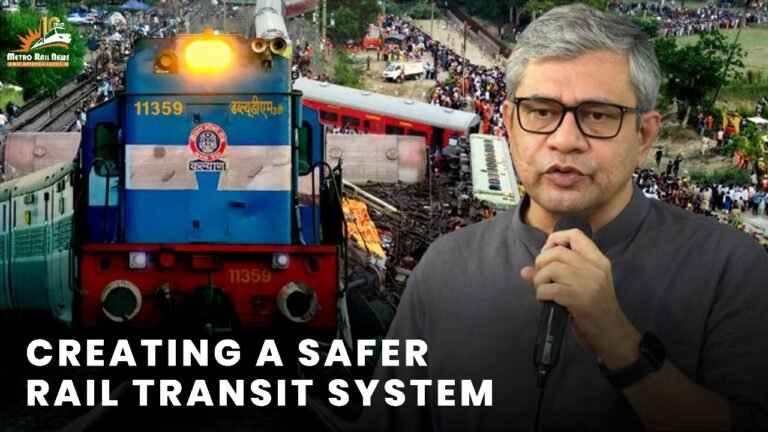
New Delhi (Metro Rail News): During a recent address to the Rajya Sabha concerning the debate on the Railways (Amendment) Bill, Railway Minister Shri Ashwini Vaishnaw emphasized that safety remains the paramount concern for Indian Railways.
He provided an overview of the advancements made in the indigenous Kavach safety system, which has been developed under the leadership of Prime Minister Narendra Modi. The system has achieved Safety Integrity Level 4 (SIL-4), which is the highest global safety standard—following thorough certification processes conducted from 2016 to 2019.
Despite facing challenges presented by the COVID-19 pandemic, comprehensive trials were executed across India’s varied terrains, ensuring the Kavach system performs effectively in diverse conditions.
The Research Designs and Standards Organization (RDSO) approved Kavach Version 4.0 in July 2024. Shri Vaishnaw also mentioned that an order for 10,000 locomotives has been placed, and deployment is actively progressing on 15,000 Route Kilometers (RKm).
Minister Vaishnaw dismissed critiques regarding the current deployment rate of 2%, asserting that India is striving to accomplish in five years what developed nations have taken two decades to achieve. This illustrates an unprecedented commitment to enhancing railway safety standards within the country.
Progress and Deployment Timeline
The deployment of Kavach is steadily advancing across key railway zones and corridors. As of October 2024, the following progress has been recorded:
South Central Railway (SCR) and North Central Railway (NCR):
The Kavach system has been successfully implemented across a total distance of 1,548 Route Kilometers (RKm) within these specific regions.
Work is in progress on the Delhi-Mumbai and Delhi-Howrah corridors, covering approximately 3,000 RKm. Track-side works have been completed over 1,081 RKm—705 RKm on the Delhi-Mumbai section and 376 RKm on the Delhi-Howrah section. Regular trials are being conducted to ensure the system is fully operational.
Key Deployment Milestones (As of October 2024):
Optical Fibre Cable Laid: 4,960 Km
Telecom Towers Installed: 378 Towers
Kavach Provisioned at Stations: 381 Stations
Locomotives Equipped with Kavach: 482 Locomotives
Track-Side Equipment Installed: 1,948 RKm
These milestones highlight the scale of Kavach’s deployment and the ongoing efforts of Indian Railways to strengthen railway safety and efficiency.
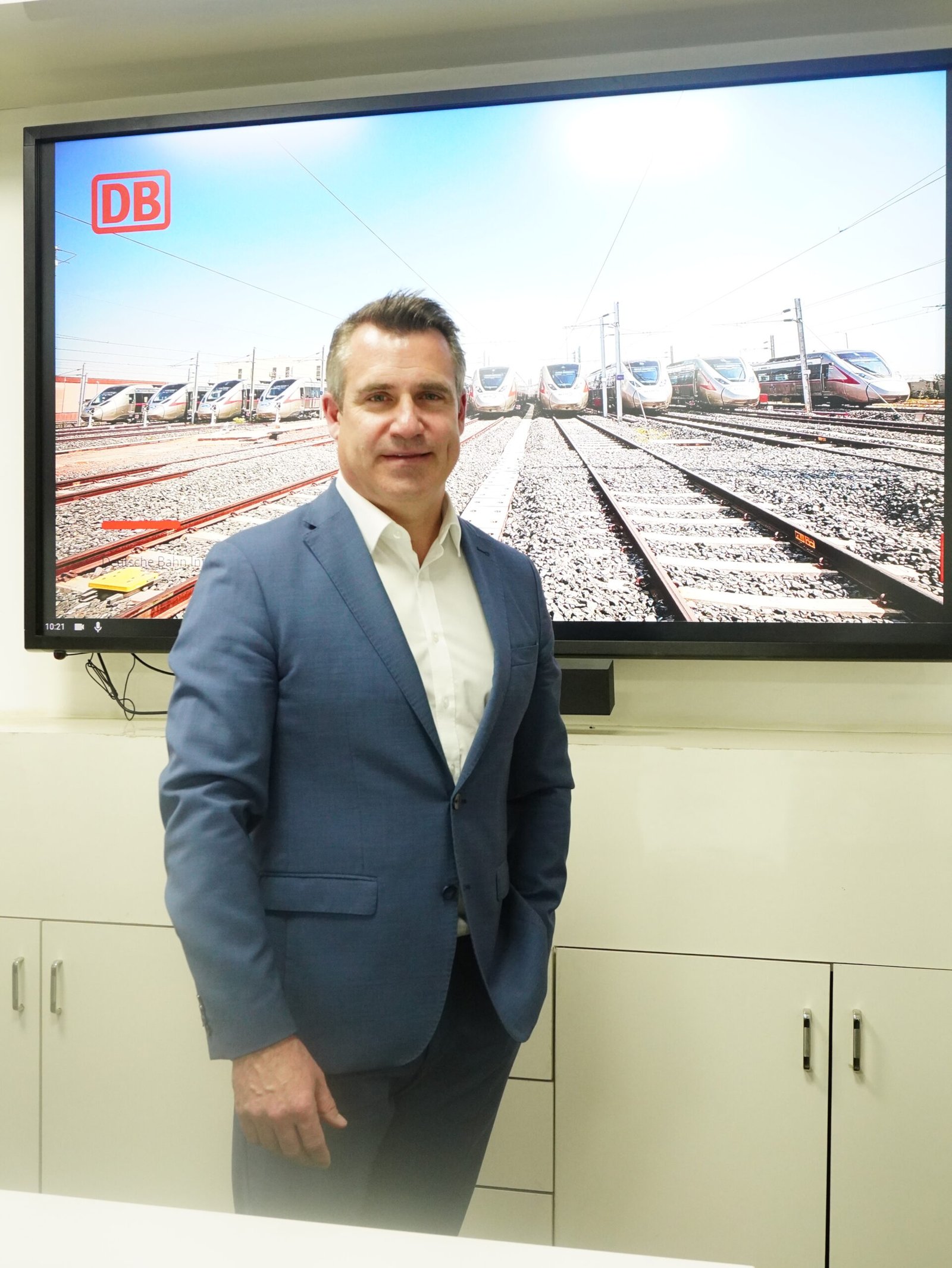
Metro Rail News Conducted an exclusive interview with Mr Niko Warbanoff, CEO of DB International Operations & DB E.C.O. Group. During the interview, Mr Warbanoff highlighted the significance of DB’s role in Delhi-Meerut RRTS. In Addition to this, Mr. Warbanoff emphasised the potential for growth in India’s rail transportation sector. Here are the edited excerpts.
You have a long-standing career in rail transportation. How has your role as CEO of DB International Operations (DB IO) and DB E.C.O. Group influenced your leadership approach in the railway industry?
For the last 15 years, I have worked in the railway industry. During this time, I learned about different railway systems around the world. As CEO of DB International Operations and DB E.C.O. Group, I gained important insights into best practices and regional differences in rail transportation. These experiences have helped me contribute to the success of each project.
DB IO has a global footprint in managing rail transport operations. What potential do you foresee in the Indian market?
The Indian rail transportation sector has great potential for growth. For the past 15 years, DB has been involved in India by working on engineering projects. We have served as a general consultant for various railway systems, including the Dedicated Freight Corridor. These projects have built a strong foundation for our work in the region.
In 2022, DB took an important step by entering the Operations & Maintenance (O&M) market in India. Our first project is operating and maintaining India’s first RRTS Corridor (Delhi-Meerut). We are eager to further expand our footprint in India by putting our global expertise into action to contribute to the growth and success of its rail transportation sector.
Could you share the key highlights of DB IO’s involvement in the Delhi-Meerut RRTS project? What were the major challenges encountered during the preparation phase?
Every project has its own challenges, and the Delhi-Meerut RRTS project is no exception. I remember signing the contract on July 1, 2022, and within just two weeks, we had onboarded our first 150 employees at DB RRTS. Establishing a railway operations company from scratch is quite challenging, but I am immensely proud of the exceptional work our team has accomplished.
Now, we have over 700 people working with us and we are achieving great results every day. We maintain a 99% punctuality rate and excellent customer satisfaction. These figures show the solid foundation we have built. A major breakthrough was the inauguration of Stage 3A on January 5, which extended the operational RRTS network to 55km spanning from New Ashok Nagar to Meerut South. We look forward to opening the entire corridor later this year.
The RRTS features ETCS Level 2/Hybrid Level 3 and LTE-based communication. How will these technologies impact rail operations in India and globally?
The Delhi-Meerut RRTS uses advanced technology like ETCS Level 2/Hybrid Level 3 and LTE-based communication. These technologies represent the future of railway operations. ETCS is a worldwide standard that improves safety, efficiency, and connectivity in rail systems. This progress will set a high standard for future rail projects, both in India and around the world. We are proud to be part of this important change.
You’ve mentioned that the technology used in the RRTS will also be implemented in Germany. What specific lessons or innovations from this project can benefit German rail modernisation efforts?
A great example of the advanced technologies integrated into the RRTS is the infrastructure for automatic train operations, such as platform screen doors at stations. Interestingly, this is something we don’t commonly encounter in Germany. At the Duhai Depot, we have set up a lab specifically for training staff on how to operate these doors and handle emergencies. This facility not only supports operations but also provides us with valuable learning opportunities. In fact, the only platform screen door lab within the Deutsche Bahn network is located here in Delhi.
In addition to operations and maintenance, we also focus on training train operators. We equip them with skills such as proficiency in the German language. This creates opportunities for those interested in working with Deutsche Bahn’s regional operations in Germany. This shows that our cooperation goes beyond regular operations, promoting a deeper exchange of knowledge and expertise.
How does DB IO plan to facilitate continuous knowledge exchange between Indian and German rail systems to streamline technological advancements and sustainable practices?
DB IO is in continuous exchange between Indian and German rail systems. When we started our business, we combined a German team with a local Indian team to develop and improve our standard operating procedures. These procedures were thoroughly practised before implementation and are now an integral part of daily operations.
Technology exchange is also important. For example, we learned a lot from introducing platform screen doors, and sharing knowledge is key to our collaboration. In addition, Germany currently has a shortage of skilled workers, and we need that expertise. Starting with train operators could help, but we also need technicians for railway maintenance and other roles that we can bring into our business in Germany. This partnership shows the benefits of combining expertise from both countries.
India’s capital region is expected to become the world’s most populous metropolitan area by 2030. How does DB IO envision expanding its presence in India? Are there plans to participate in other rail or metro projects in the country?
Rail and metro projects, including RRTS, are highly strategic for India’s mobility infrastructure. The capital region, as you mentioned, is set to become the world’s most populous metropolitan area by 2030. Having visited the area many times, I am always amazed by its size. Developing just one RRTS corridor is not enough the region will require second and third corridors in the capital region alone to effectively address the traffic situation and significantly enhance mobility for its residents.
Beyond the capital region, other cities with multimillion populations also present opportunities for RRTS projects. These systems could be pivotal in addressing congestion challenges in such metropolitan areas. DB IO is open to exploring options in these areas to support India’s expanding rail and metro network.
How do you define success for a project like the RRTS, and what milestones are you particularly looking forward to achieving?
Enhanced Accessibility: Success for a project like the RRTS means achieving key goals such as reducing travel time, reducing CO2 emissions, promoting easy connections between different transport options, and making sure all passengers can access the system. The project is already meeting these goals and providing great benefits to commuters.
Ridership Goal: An important milestone is increasing ridership, which is steadily picking up. To ensure long-term success, it will be important to promote the system and attract more daily passengers.
Operational Excellence: Operational excellence is also crucial. This means keeping services on time, maintaining clean stations, and ensuring a safe and welcoming environment for all passengers, including women and disabled individuals. With these qualities, the RRTS is one of the most modern and innovative transit systems in the world, and I believe it will continue to meet high standards as it expands.
What message would you like to convey to the readers of Metro Rail News?
I am passionate about the work we are doing in India, particularly the RRTS project. Our DB RRTS team focuses on meeting performance goals and ensuring passenger satisfaction through our hard work. We are dedicated to upholding high standards in our operations and are ready to help with other RRTS or metro projects in the future. We look forward to contributing to India’s development in modern rail transportation.
Chennai ( Metro Rail News): The 2 prominent firms, Deutsche Bahn International Operations GmbH (DB IO) and Delhi Metro Rail Corporation Ltd. ( DMRC), have submitted bids for the operations & maintenance (O&M) contract for 116.1 km Chennai Metro Phase 2.
The Chennai Metro Rail Limited (CMRL) invited bids for this contract in August 2024. The contract spans a duration of twelve years, commencing upon the initiation of the final section or stage of Phase 2. Additionally, there is a provision to extend the contract by three years, contingent upon satisfactory performance.
Contract’s Scope of Work
Brief Scope: Selection of the “Operation and Maintenance (O&M) Contractor for Chennai Metro Rail Phase II -Corridor-3 ((Madhavaram Milk Colony to Siruseri SIPCOT-II Metro), Corridor- 4 (Lighthouse to Poonamallee Bypass) and Corridor-5 (Madhavaram Milk Colony to Sholinganallur), including Maintenance Depots at Madhavaram, Poonamallee & Semmancheri”
About Chennai Metro Phase 2
In October 2024, the Central Government’s Cabinet approved the under-construction Chennai Metro Phase 2, which is managed by Chennai Metro Rail Ltd. (CMRL). The Chennai Metro Phase 2 comprises 3 new corridors.