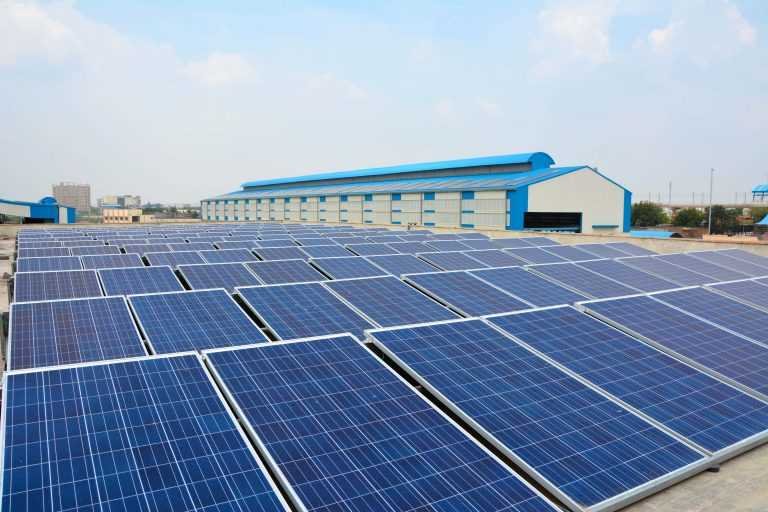
KOCHI (Metro Rail News): Shri Loknath Behera, managing director of Kochi Metro Rail Limited, inaugurated an 824.1 KWP ground-mounted solar plant for testing on Friday at Kochi metro’s Muttom depot (KMRL).
KMRL will be able to generate around 3,000 units of power per day as a result of this, allowing the agency to cover 42 per cent of its overall power needs on its own.
solar plant was inaugurated at Kochi metro muttom depot
By 2022, the metro agency plans to install solar panels in the Muttom track region and the surrounding land area, generating an additional 2 MW of power. Because metro operations are dependent on electrical power, “KMRL plans to develop the use of solar energy in an inclusive manner to ensure maximum usage from the existing solar potential in this region”, stated Mr Behera.
They believe that the green energy measures will reduce carbon dioxide emissions by 3,53,625 tonnes per year, comparable to planting 5,65,800 teak trees over the project’s lifetime.
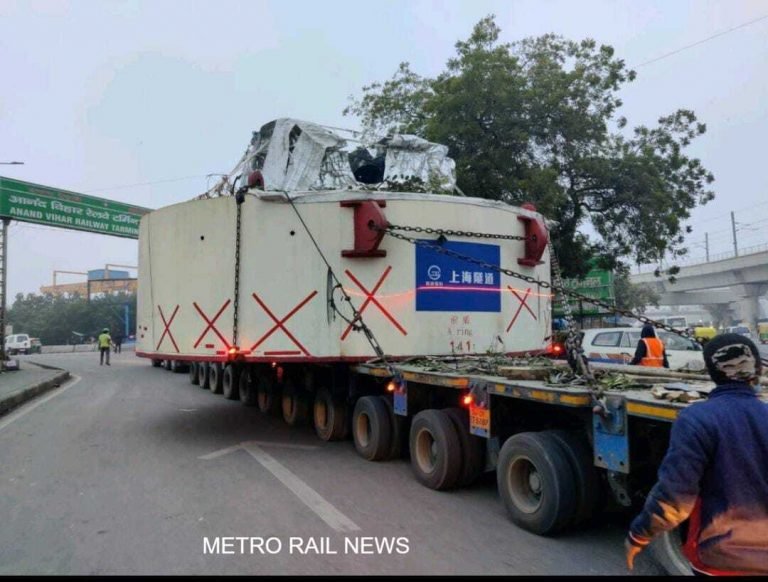
DELHI (Metro Rail News): Shanghai Tunnel Engineering Co. Ltd. (STEC) received the first of four tunnel boring machines for the 82.15 km Delhi – Meerut RRTS project’s twin tunnels on Friday morning at Anand Vihar Station.
STEC’s first TBM reached at Anand Vihar on Dec 7, 2022 and It will be deployed on Package 4 (New Ashok Vihar – Sahibabad) to construct 5.6 km underground stretch of 82.15km Delhi-Meerut RRTS Corridor.
In December 2020, STEC was awarded a disputed contract to build four tunnels between New Ashok Nagar DN Ramp – Anand Vihar – Sahibabad UP Ramp for the project’s 5.6-kilometre Package 4.
In September 2021, the team completed factory acceptance testing (FAT) for this 7.5m diameter earth pressure balance machine, called Sudarshan 4.1, at their Shanghai site.
STEC’s first TBM reached at Anand Vihar on Dec 7, 2022 and It will be deployed on Package 4 (New Ashok Vihar – Sahibabad) to construct 5.6 km underground stretch of 82.15km Delhi-Meerut RRTS Corridor.
Terratec completed FAT for 3 TBMs that Afcons Infrastructure would deploy to build Package 8’s tunnels between Brahampuri and Begumpul in Meerut in Q4 2021.
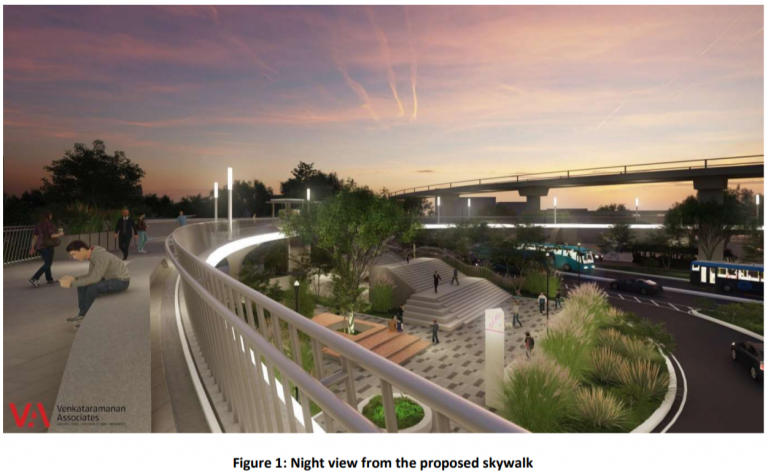
Aerial View: skywalk to connect metro and the BMTC terminal at Banashankari
BANGALORE (Metro Rail News): The BMRCL has proposed a skywalk linking the Banashankari Metro Station with the BMTC terminal, which will provide safe space for street sellers and a pedestrian route.
A report published in September 2019 titled ‘Traffic chaos reigns over Banashankari Signal, a no-man’s-land,’ Bangalore South MP Tejasvi Surya and Revenue Minister R Ashoka visited the area in November of that year and suggested officials propose a skywalk connecting the metro and the BMTC terminal.
The idea is to restructure the present intersection, improve traffic flow, and add a traffic island where trees can be planted. In addition, a circular skywalk with loops will connect the bus terminal and metro station at the intersection. “This Skywalk will be a lively public place packed with flora and resting pods, setting it unique from the usual foot over bridges we see in the city.
On the ground and in the air, it will connect and enhance the pedestrian experience at the intersection, “According to a brief that accompanied the project design. The current junction design is simply the leftover space from the numerous renovations that have taken place at this location throughout the years.
View of Pedestrian: skywalk to connect metro and the BMTC terminal at Banashankari
As a result, the intersection is a nightmare for pedestrians who must manoeuvre through heavy traffic, with weirdly formed traffic islands and pedestrian crossings that leads nowhere. Venkataramanan Associates, a city-based architecture firm, created the skywalk’s design
DELHI (Metro Rail News): On December 24, Datamatics Global Services – AEP Ticketing Solutions (DM-AEP-26A JV) was issued an Rs. 227 crore contract for the EMV-based open loop Automated Fare Collection (AFC) system for the 82.15 km Delhi – Meerut RRTS Line (Package 26A).
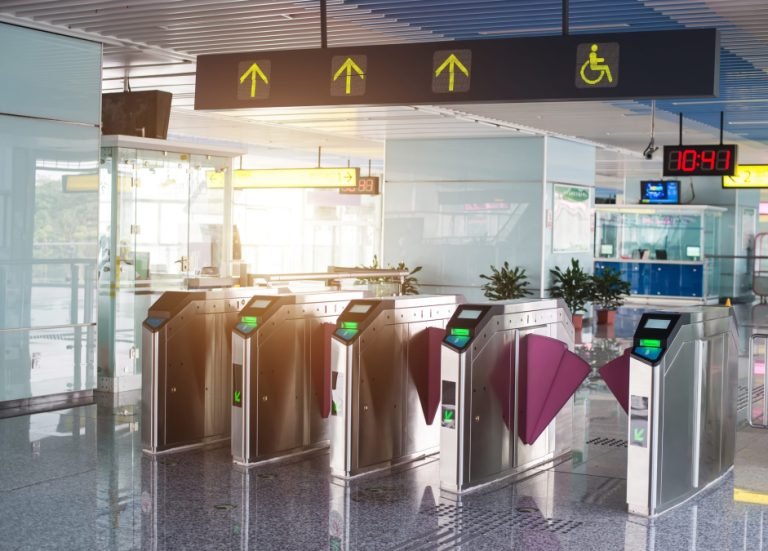
This new semi-high-speed line will support QR Code ticketing (both digital and paper QR) as well as EMV (Europay, Mastercard, Visa) open-loop contactless card ticketing based on NCMC (National Common Mobility Card) standards using a contactless bank card, phone, or smartcard.
Riders will be able to utilise QR code tickets purchased at ticket vending machines, ticketing booths, or produced digitally on the NCRTC’s mobile app or website. For entrance to the executive lounge and boarding the Alstom trains’ Business Class coach, Business Class passengers must validate twice on the concourse level and again on the platform level.
The Hybrid Annuity Model (HAM), the first of its type for AFCs in India, invited tenders for this package in May 2021. NCRTC would hire a system integrator (Package 26A) and a financial institution (Package 26B) to issue and acquire services.
In September, technical bids for 26A were opened, revealing five bidders, three of whom were disqualified.
DM – AEP – 26A JV – Qualified
Aurionpro – SC Soft JV – Qualified
Asis – Paycraft JV – Disqualified
Revenue Collection Systems France SAS – Disqualified
Shellinfosg Global Digital Technologies – Analogics Tech India JV – Disqualified
Contract Value: Rs. 227 Cr
Design, Supply, Installation, Testing & Commissioning, and Comprehensive Annual Maintenance Contract of EMV based Open Loop Automatic Fare Collection (AFC) System for Delhi-Ghaziabad-Meerut RRTS Corridor of NCRTC are some of the scopes for the project.
Package 16 (2 lots): 2000 MT of 1080 Grade Head-Hardened and 4000 MT of regular 880 Grade rails within Duhai Depot, Modipuram Depot and Jangpura Stabling Yard – 2 bids were received for Lot-1 and one bid for Lot-2 (bidder names are unknown)
Datamatics had previously won AFC contracts for the Mumbai Metro’s Line-2A, 2B, and Line-7, as well as the Lucknow Metro’s Line-1. Technical bids for RRTS’ Package 26B, which involves selecting a financial institution, are set to begin on January 11.
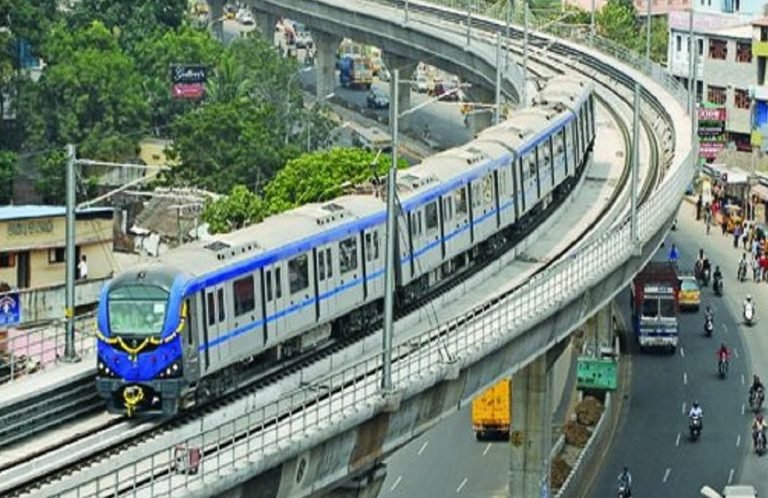
CHENNAI (Metro Rail News): Residents of Ernavur may soon have access to a Metro station, according to a decision by the Chennai Metro Rail Ltd., one more station to be added to the 3,770-crore phase I extension project.
This section currently contains nine stations, the last of which is located in Wimco Nagar. CMRL is building a depot about half a kilometre from the station, which was supposed to be ready by February last year. CMRL has chosen to build a station at this depot, known as Wimco Nagar Depot, with two platforms and a concourse. It will open along with the Tiruvottiyur Theradi station in a few weeks.
“Like the Tiruvottiyur Theradi station, work on this station is currently ongoing. It will most likely be completed in two weeks. The Commissioner of Metro Rail Safety will inspect both stations simultaneously. While the Tiruvottiyur Theradi will open, it is unclear whether the Wimco Nagar Depot station would open at the same time or a later date,” an official added.
According to sources, security had to be tight because this station was on the depot grounds. “There was a proposal to build a multi-story building over the depot for commercial development. As a result, we decided to convert the platform into a station by combining two platforms. However, it is unclear whether or not this initiative will take off. As a result, we don’t know how many passengers will use it or whether it will be useful. “Only time will tell,” another source added. Meanwhile, the Wimco Nagar Depot may take a little longer to finish.
Chennai Metro Rail has changed train schedules in view of night curfew and Sunday lockdown
Due to the complete lockdown, train services will be suspended on January 9 (Sunday). Starting Thursday, metro trains in Chennai will run from 5.30 a.m. to 9 p.m., rather than 11 p.m., as part of new restrictions, including a night curfew, to curb Covid-19. CMRL said in a statement that the service hours will be from 5.30 a.m. to 9 p.m. Monday through Saturday. However, peak hour train schedules will remain unchanged, with trains running every five minutes during peak hours and every ten minutes during non-peak hours. The last train will leave at 9 p.m. and arrive at the terminal at 10 p.m.
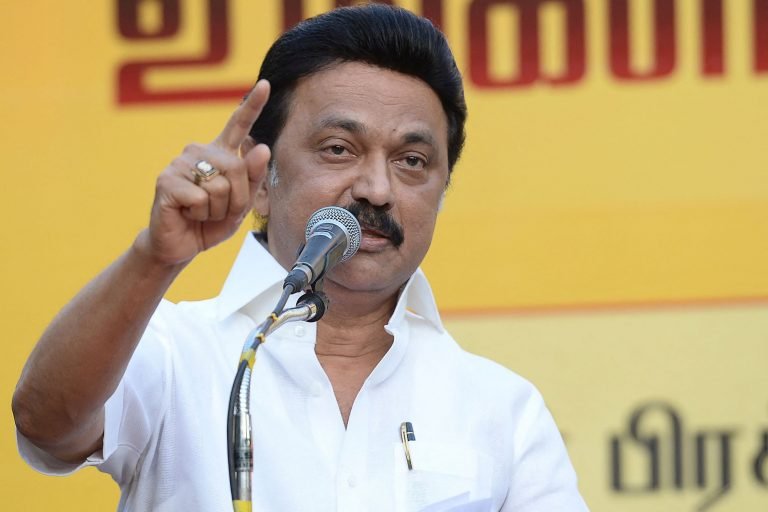
Chennai (Metro Rail News): Metro Rail services would be stretched out up to Kilambakkam, and the undertaking report had as of now been finished, said M.K. Stalin, Chief Minister – Tamil Nadu, on Thursday.
“A global organisation has put together the task report, and it was under the study of the State Government. The government has also taken the initiative to implement the project,” he said, replying to DMK member E.
Karunanidhi in the Legislative Assembly.
The Chief Minister said that since another new terminal was being built in Kilambakkam, there was a need to expand the Metro Rail services up to the area from Meenambakkam Airport.
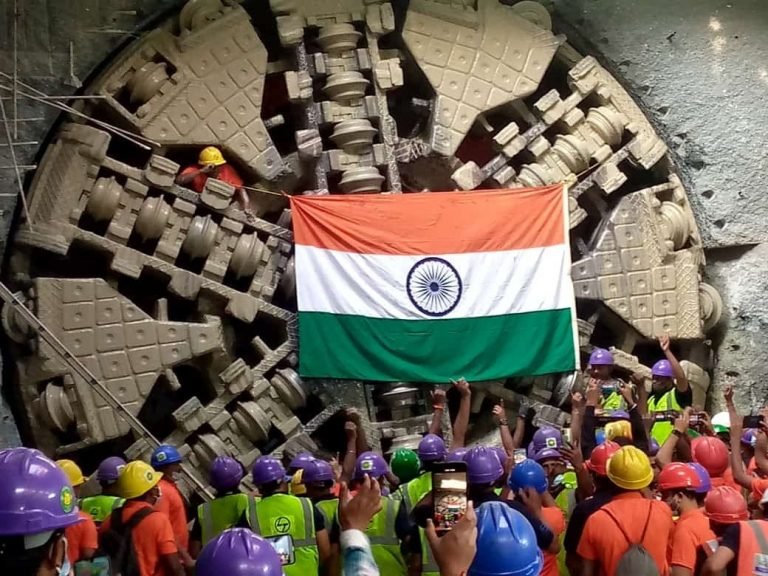
CHENNAI (Metro Rail News): On the underground metro line from Dairy Circle to Nagavara two tunnel-boring machines (TBMs) have been deployed which have achieved a breakthrough four days apart.
TBM Vamika completed the tunnelling of 614 metres from the south ramp (near the Jayanagar Fire Station) to Dairy Circle on January 3 and TBM Avni accomplished the forward leap on the 1,086-metre section from Shivajinagar to MG Road on January 6 (Thursday).
Tamika will proceed with its forward excursion to the proposed Lakkasandra station while Avni will continue to tunneling onwards to Rashtriya Military School on Hosur Road. Vamika will be following TBM Rudra, which finished the tunneling of the equal 614-meter line between the south ramp (close to the Jayanagar Fire Station) and Dairy Circle on November 11 and is presently headed towards the Lakkasandra station.
TBM Avni experienced hard stones for a length of around 280 meters, wherein tunneling was incredibly difficult and required exceptionally incessant intercessions.
This TBM will pass through the (MG Road) station region for additional tunneling to Rashtriya Military School,” the Bangalore Metro Rail Corporation Limited (BMRCL) said in an assertion.
Avni’s pair, TBM Lavi, is tunneling the equal (north-bound) segment and is probably going to accomplish a breakthrough not long after confronting comparative difficulties. The TBM that finishes one method of the passage will be redeployed on another part. The machine will be dismantled and taken to the launching shaft of another part where the whole TBM will be reassembled with the goal of tunneling once again. TBM Urja, which finished the Cantonment-Shivajinagar area in September, has been redeployed to tunnel from Cantonment to Pottery Town station.
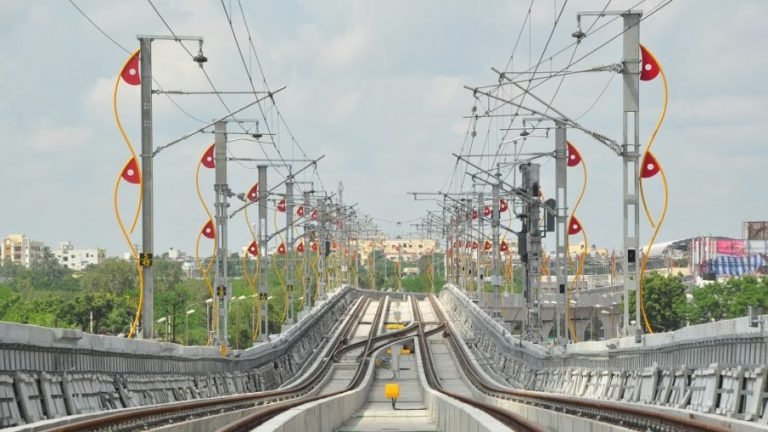
DELHI (Metro Rail News): KEC International on Wednesday arose as the lowest bidder for the 25KV Overhead Equipment (OHE) charge arrangement of Patna Metro’s Phase 1 venture. In this 30.91 km network Package, PE-03 is the third charge related bundle which highlight two, for the most part, raised lines with 24 stations including 2 exchanges at Khemni Chak and Patna Junction Railway Station.
Other than the OHE system, the scope incorporates setting up a 33 KV ring main unit, Auxilliary substation (ASS) and SCADA for both elevated & underground sections including the New ISBT Depot, which is under development by Quality Buildcon. DMRC invited bids for package PE-03 in July 2021 with an estimate of Rs. 144.65 crore and a completion period of 36 months (3 years). Technical bids were opened in November to reveal 4 bidders. During the evaluation, Salasar – STS’ bid was found technically non-compliant.
Bids by the companies were as follows:
KEC International – 131.89 Cr.
Kalpataru Power Transmission – 135.07 Cr.
Siemens – 179.48 Cr.
SITC of 25KV Overhead Equipment (OHE) System, Switching Posts, 33KV Ring mains, Auxiliary Substations for Elevated Sections and SCADA System for Underground and Elevated sections for Corridor 1 and 2 and ISBT Depot of Patna Metro Rail Project are some of the scopes for the project.
KEC’s offer was well below DMRC’s estimate and ought to receive an LOA in the coming weeks. When awarded, this will be KEC’s second win in Patna.
The list of contractors for the other 2 electrification-related packages are as follows:
FIRM
CONTRACT
KEC International
PE-01: Design & Commissioning of Receiving cum Traction (RSS + TSS) and Auxiliary Main Substation (ASS) including High Voltage Cabling from Grid Substation
Tuaman Engineering
PE-02: Design & commissioning of Electrical and Mechanical (E&M) systems, Fire detection, Fire suppression system and DG sets of Corridor-1 and Corridor-2 Elevated stations and Depot.
NEW DELHI (Metro Rail News): Indian Railways aims to add four new bullet train circuits to the high-speed rail network as part of the National Rail Plan. There is a 618-kilometre corridor between Hyderabad and Bangalore, an 855-kilometre route between Nagpur and Varanasi, and an 850-kilometre route between Patna and Guwahati a 190-kilometre corridor connecting Amritsar, Pathankot, and Jammu are among the corridors planned.
The new routes would be presented and the eight that the railway ministry has already been working on under the NRP. The railway government is also looking towards connecting all of India’s main cities to the high-speed train network.
According to the TNIE research, the approved and proposed bullet train corridors will travel alongside national highways and expressways, enhancing passengers’ views with magnificent greenery.
According to Railway Minister, the first high-speed rail corridor in India, which would run between Mumbai and Ahmedabad and cover a distance of 508 kilometres, is now under construction and might be completed by 2026-27 Ashwini Vaishnaw.
The project’s estimated cost is Rs. 1.1 lakh crore. The National High-Speed Rail Corporation Limited has prepared a complete project report for the Mumbai – Ahmedabad project, responsible for financing, constructing, and managing India’s bullet train projects. The DPRs for other approved corridors, on the other hand, are still in work.
The eight already approved high-speed rail corridors include Mumbai – Ahmedabad, a 958-kilometre corridor connecting Delhi and Varanasi with a 123-kilometre spur connecting Lucknow and Ayodhya, a 736-kilometre corridor connecting Nagpur and Mumbai, an 886-kilometre corridor connecting Delhi and Ahmedabad, a 480-kilometre corridor connecting Delhi and Amritsar, a 711-kilometre corridor connecting Mumbai and Hyderabad, a 760-kilometre corridor connecting Varanasi and Howrah. The railway ministry may propose these four lines this year if everything goes according to plan.
Indian Railways has hired a consultant to examine the feasibility of running trains at a maximum speed of 200 kmph on the ground rather than on an elevated structure, which would be a low-cost alternative for a semi-high-speed track.
Aside from recommending low-cost semi-high-speed railway technology suitable for Indian conditions, the consultant will also look into the possibility of using Vande Bharat trainsets and the TCAS (train collision avoidance system) on the broad-gauge network, which is expected to give the Atmanirbhar Bharat initiative a big boost.
Viaducts are currently being built for the Mumbai-Ahmedabad high-speed line, and the Delhi-Meerut RRTS and Metro service is available on either an elevated or underground construction. While constructing a kilometre of elevated structure costs around Rs 300 crore, at-grade construction for high-speed or semi-high-speed trains costs only Rs 30 crore.
Semi-high speed trains travel on standard gauges worldwide, just like RRTS and Airport Metro. In addition, the consultant will look into the possibility of running semi-high-speed trains on broad gauge rails. The national transporter would benefit from using the BG line because the whole Indian Rail network is on broad gauge (BG).
For Indian Railways, the BG network, indigenously developed TCAS, and Vande Bharat trainsets are the best solutions. However, it would save much money if semi-high-speed trains could run on the ground instead of elevated structures. A senior Railway Ministry official explained that the goal is to put up an at-grade level and avoid elevated structures/viaducts to save money.
The consultant has been tasked with examining several technical solutions and recommending to Indian Railways the best-optimized semi-high-speed technology for running trains at a maximum speed of 200 kmph on wide-gauge routes.
The consultant would also connect with road networks such as the National Highway, state highways, and existing rail tracks for the planned semi-high-speed corridors. According to the authority, aligning with rail or road networks will alleviate land acquisition and forest clearance issues for the trains. There are roughly eight potential semi-high-speed train lines that would connect all of the country’s major cities.
BENGALURU (Metro Rail News): Bangalore Metro Rail Corporation (BMRCL) has stated that civil works for the long-delayed Bengaluru suburban rail project shall begin this year and it stated that it should start where Namma Metro’s network ends. “Namma Metro should concentrate its efforts within the boundaries of the BBMP or BDA, and suburban rail should be extended to surrounding districts and satellite towns.” This will avoid unnecessarily competing for ridership between the two agencies.
“This will also benefit suburban users in neighbouring towns,” an official added. “For example, the Namma Metro currently runs all the way to Kempegowda International Airport” (KIA). As a result, suburban rail might begin there and run all the way to Devanahalli. Similarly, the suburban rail may run from BIEC to Tumakuru, Kengeri to Ramanagara, Whitefield to Kolar, Bommasandra to Attibele, and Yelahanka to Doddaballpur, he said. He explained that the 148-kilometre suburban rail project is mostly focused within the BBMP boundaries, where Metro is expanding.
Because it does not connect satellite towns, the planned project cannot be dubbed a suburban rail like those in Mumbai and Chennai. However, people in peripheral locations will gain if they start from Metro’s terminal stations since they will be able to switch to Metro to reach the city with improved multi-modal integration,” he said.
The civil work tender for the Byappanahalli-Chikkabanavara (Mallige) line was floated in November 2021 by Karnataka Rail Infrastructure Development Enterprises (K-RIDE), which is undertaking the suburban rail project (four corridors). Next, a tender for civil work in Heelalige-Rajankunte (Kanaka) will be issued.
However, the other two corridors KSR Bengaluru City-Devanahalli (Sampige) and Kengeri—Whitefield (Parijaata) which run parallel to Metro will be taken up only later. The Centre had indicated that the entire project would be finished in six years (2026) and the airport corridor (KSR Bengaluru City-Devanahalli) in three years when it was sanctioned in October 2020. (2023). Officials of K-RIDE have stated that their network will need to be expanded from the city limits to the periphery.
“This 148-kilometer network is just the beginning. We’ll need another 160-kilometre network to connect satellite towns in the following phase. Suburban rail will have air-conditioned carriages and stops, similar to Metro, but at a lower cost. “All four corridors will be finished in six years,” a government official stated.
By 2024, BMRCL intends to expand the network from 56 kilometres to 170-kilometres. “Suburban rail is a large public transportation system, so it cannot be considered a feeder service to Metro,” said Sanjeev Dyamannavar, a rail campaigner. While the Metro will have a station every 1km, suburban rail will only have a few. A Metro travels at 30 kilometres per hour, while a suburban travels at 60 to 80 kilometres per hour.
Suburban rail, unlike Metro, may use existing rail infrastructure to expand and can also operate non-AC trains.” “Bengaluru is not a monopoly of Namma Metro, and there should be different options for passengers,” said Rajkumar Dugar, founder and convener of Citizens for Citizens, an NGO. It all depends on who offers the cheapest and fastest solutions. The suburban rail’s airport corridor gained Centre approval nine months before the Metro’s KR Puram-KIA line, but it is not being prioritised owing to BMRCL pressure.”
NEW DELHI (Metro Rail News): Aligned to the government’s vision of modernizing the country’s infrastructure, the Hon’ble Prime Minister recently inaugurated a 9-km long completed stretch of Uttar Pradesh Metro Rail Corporation’s (UPMRC) Kanpur Metro Project. This metro network sports modern coaches manufactured with stainless steel supplied by Jindal Stainless. Rolled out by UPMRC in a record time of two years, the inaugural event was also attended by Chief Minister, Uttar Pradesh, Shri Yogi Adityanath and Union Minister of Petroleum and Natural Gas, Shri Hardeep Singh Puri.
In the Metro segment, Jindal Stainless’ products have been approved by major metro coach manufacturers like Alstom, Bombardier and BEML. For the Kanpur project, Jindal Stainless supplied high-quality stainless steel in various tempers (strength levels) to Alstom. The first trainset was handed over to Uttar Pradesh Metro Rail Corporation (UPMRC) by Alstom on September 18, 2021. The scope of the metro project includes the design and development of 201 coaches, with each coach consuming approximately 9-10 metric tonnes of stainless steel supplied by Jindal Stainless.
Jindal Stainless is currently supplying high strength level, cold worked Austenitic products like SS 301LN and 304L in LT, MT & HT configurations. It is noteworthy that Jindal Stainless is among the top few companies in the world that can supply 2J and No. 4 special finishes required for metro coaches. The Company has already supplied stainless steel to metro projects in Sydney and Queensland, apart from Delhi, Kolkata, Bangalore and Chennai metro.
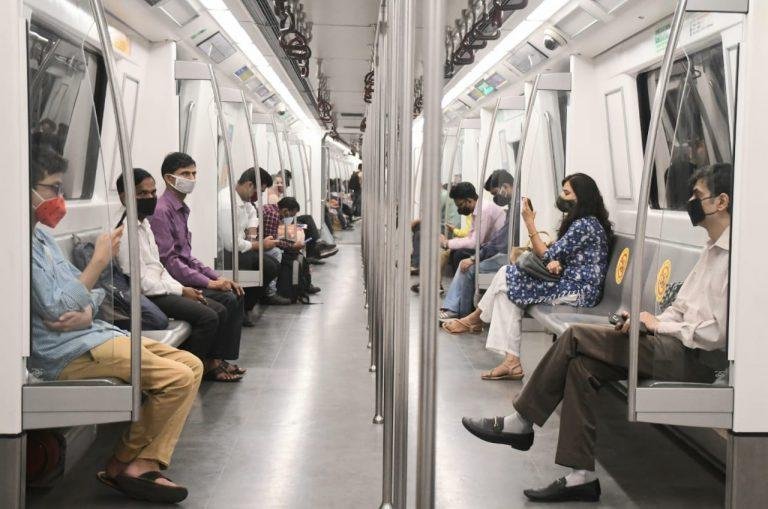
DELHI (Metro Rail News): The Delhi Metro Rail Corporation (DMRC) has announced that no standing passengers to be allowed inside the train until further notice. A day after, Deputy Chief Minister Manish Sisodia said that the metro would run 100% sitting capacity. DMRC tweeted this morning, “in light of the current instructions given by DDMA, Delhi Metro operating at 100% seating capacity, and no standing passengers would be permitted until further notice.”
The Delhi government has decided to run metros and buses at total capacity to reduce crowding at stations. On the other hand, Commuters must wear masks and maintain adequate social distance while travelling. In addition, the Delhi government issued a weekend curfew and work-from-home policy for its offices earlier on Tuesday, after the city recorded 5,481 new COVID-19 cases, the highest number since May 16, with an 8.37 per cent positive rate and three fatalities.
However, the national capital is not under lockdown, according to Health Minister Satyendar Jain’. The municipal administration also urged all private hospitals and nursing homes with 50 beds or more to set aside at least 40% of their total bed capacity for coronavirus patients, citing the surge in positive rates.
All essential services are permitted in the national capital during the weekend curfew, which will begin at 10 p.m. on Friday and last until 5 a.m. on Monday, to combat a rise in COVID-19 caused by Omicron. On Tuesday, the city registered 382 omicron cases, up from 351 the day before. Along with the weekend curfew, a night curfew will be enforced during the week.
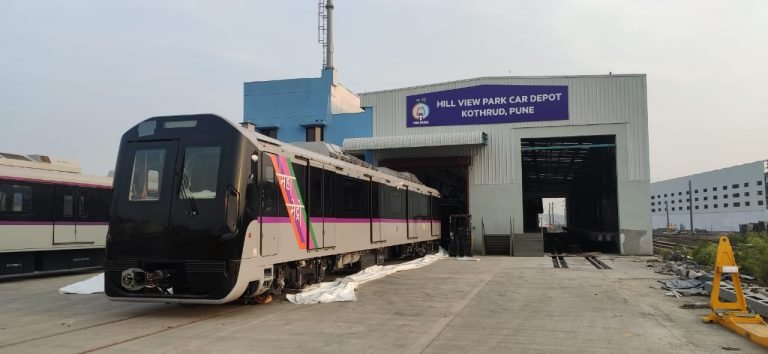
PUNE (Metro Rail News): The Maharashtra Metro Rail Corporation (Maha Metro), a joint venture between the Maharashtra and central governments, was given charge of implementing the Pune Metro project.
Maha Metro has already begun surveying and planning for Phase 2 of the project. In addition, it is drafting a DPR to extend the existing Metro lines, which are 33.1 kilometres long (Phase 1).
Maha-Metro has begun a door-to-door public transportation survey as part of the preparation of a Detailed Project Report (DPR) for the Pune metro’s 82.5 km Phase II project.
Pune Metro has begun planning for the second phase of the metro as the first phase of work nears completion and operations on priority parts are set to begin soon.
Pune Metro Planning Phase 2 Corridor for which it is conducting Survey door-to-door, Maha Metro Conducts Survey For Extension of Metro Lines in Pune
“Maha-Metro had contracted agencies to do the DRP on an 82.5-kilometer route,” said Brijesh Dixit, managing director of Maha-Metro. Officials will go to housing societies, commercial complexes, and various small and large businesses to learn about and listen to Pune residents’ expectations from the public transportation system.”
Maha-Metro is conducting the survey through its subsidiary companies, UMTC Limited and Data Corp Traffic Private Limited. “Questionnaire for residents” includes “frequency and modalities of travel by people, as well as overall attitude of public transportation,” according to officials.
Maha-Metro has urged people to take part in the survey and contribute information, as doing so will allow citizens’ voices to be heard once the DPR is finalised. The DPR will be prepared by Maha-Metro and submitted to the Pune Municipal Corporation (PMC), after which it will be presented to the state and federal governments.
Because the metro construction is progressing at a rapid pace, there is a demand to complete the project in different regions of the city. The PMC and Pimpri Chinchwad Municipal Corporation (PCMC) general bodies adopted several routes proposed by elected members.
The PMC has already approved the metro route’s extension between Swargate and Katraj. Swargate to Katraj would be the first phase’s extension, as it is the first phase’s extension.
Phase 2 corridors would be 82.5 kilometres long, connecting Vanaz to Chandani Chowk (1.5 kilometres), Ramwadi to Wagholi (12 kilometres), Hadapsar to Kharadi (5 kilometres), Swargate to Swargate (7 kilometres), Khadakwasla to Swargate (13 kilometres), and SNDT to Warje (8 km).
The Pune Metro’s Phase 1 is approaching completion, and a few portions will soon be open to the public. The new lines will connect Pune from east to west and north to south, according to Maha Metro.
Through UMTC & Data Corp Traffic, the company conducts Pune and Pimpri Chinchwad surveys to estimate ridership.