




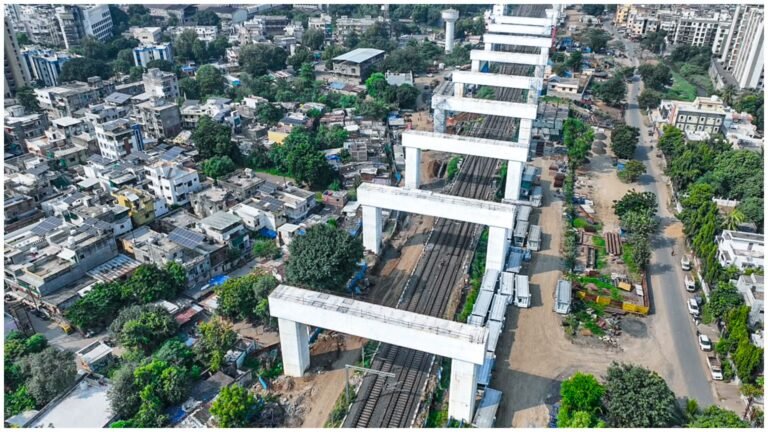
VADODARA (Metro Rail News): The Mumbai-Ahmedabad bullet train project has completed installation of all 14 portal beams over the Delhi-Mumbai Rajdhani railway line in Vadodara, clearing a major structural hurdle for the next stage of viaduct construction. The milestone will allow work to progress towards launching 40-metre composite girders across one of the busiest railway routes in the country.
The achievement comes on the 8.3-km Vadodara stretch, where the high-speed rail alignment passes through a densely built-up area and crosses five existing Indian Railways lines, including two main lines.
Bullet Train viaduct takes shape
The portal beams will support the elevated bullet train structure at locations where the alignment crosses existing railway infrastructure. The next stage involves launching composite girders spanning approximately 40 metres across the Rajdhani route. The construction method will vary by location:
- Rajdhani main line crossing: Composite girders will be launched across the 14 portal beams.
- Other portal beam locations: Engineers will use the Span-by-Span (SBS) launching method to construct the viaduct.
The alignment crosses the Delhi-Mumbai Rajdhani line diagonally, making the work more complex. Engineers must maintain the required clearances while allowing existing railway services to continue operating safely.
Get the Daily Metro & Rail Brief
Join 125,000+ metro and rail professionals. Project updates, new tenders and contract awards from across India, in your inbox every day.
Why the portal beams required specialised construction for this Bullet train
The portal beams were built using the cast-in-situ method because of limited working space and the constraints of constructing above operational railway tracks. Their size and weight also made conventional precast launching impractical. Each completed beam has the following specifications:
| Length | Approximately 37 metres |
| Height and width | Around 4 metres each |
| Weight | Approximately 1,500 tonnes |
| Concrete requirement | About 590 cubic metres |
| Reinforcement cage weight | Around 55 tonnes |
Construction required high-capacity cranes, hydraulic jacks, long-boom concrete pumps and precision surveying equipment. Teams also had to coordinate closely with Indian Railways, monitor structural work continuously and schedule railway blocks where necessary.

Portal beams distributed across the Vadodara corridor
The 14 structures are located on either side of Vadodara’s railway infrastructure, along the bullet train alignment:
- 10 portal beams lie between Vadodara Bullet Train station and Vishwamitri Railway station, towards Surat.
- Four portal beams lie between Vadodara Railway station and Chhayapuri Railway station, towards Ahmedabad.
This section presents a major engineering challenge because the elevated corridor must pass across several operational railway lines within a restricted urban area.
Next phase focuses on viaduct integration
With all 14 portal beams completed, the project can move towards composite girder launching over the Rajdhani main line. The remaining work will require careful coordination with Indian Railways to manage construction activity above live tracks.
Also Read: Mumbai-Ahmedabad Bullet Train: 480-metre Sabarmati River Bridge Completed in Ahmedabad
Project Overview