




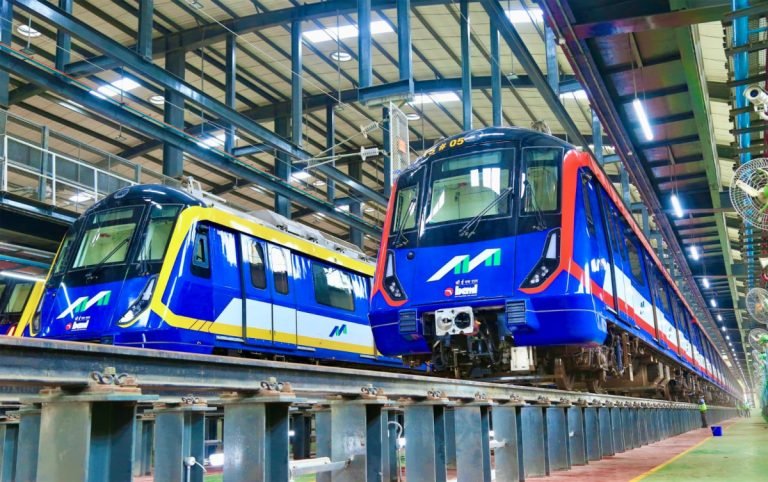
MUMBAI (Metro Rail News): The Maharashtra government has approved a revised plan for Mumbai Metro Line 5 and its extension. The combined 34.2 km network will improve connectivity across Thane, Bhinwandi, Kalyan, and Ulhasnagar. The project cost has now increased to Rs 18,131 crore.
Project Overview
The project was first approved in 2017 as a 24.9 km fully elevated corridor with 17 stations. It aimed to connect Thane, Bhiwandi and Kalyan at a cost of Rs 8,416.51 crore. But land and rehabilitation issues, especially in Bhiwandi and Kalyan, forced multiple changes. In 2023, officials decided to shift a key stretch between Dugadi and Kalyan underground, increasing the cost by Rs 1,427crore. In 2025, a review meeting led by the Chief Minister led to another revision. The plan added an underground stretch between Dhamankar Naka and Temghar to reduce disruption. After these changes, the cost of this phase rose to Rs 7,326.13 crore.
Current progress and changes
- Phase 1 (Thane to Bhiwadi, 11.9 km): It is about to be completed, and there are going to be 6 stations in this phase
- Phase 2 (Bhiwadi to Durgadi, 10.475 km): With 6 stations, this phase is under planning with mixed alignment. Also, a part of this phase between Dhamankar Naka and Temghar will go underground to avoid congestion.
- A double-decker structure is planned between Ranjoli Junction and Durgadi (metro and flyover).
Metro Line 5A extension plan
Get the Daily Metro & Rail Brief
Join 125,000+ metro and rail professionals. Project updates, new tenders and contract awards from across India, in your inbox every day.
The earlier proposal to extend the line to Kalyan APMC has been dropped. It has been replaced with a new extension, which will come up as a Mumbai Metro Line 5A. The new route will start from Durgadi. It will act as a key interchange point. From here, it will move through growing residential areas such as Asdharwadi and Khadakpada, before reaching Kalyan. The corridor will then extend further towards Ulhasnagar.
Project Snapshot
The change is expected to improve access to fast-growing residential areas.
Local representatives said the project will offer a better travel option for daily commuters who currently depend on congested roads and indirect rail routes. The double-decker flyover design has also been welcomed, as it is expected to ease traffic while making better use of space. Once completed, the corridor is expected to improve connectivity in the region and offer a faster, more reliable alternative to road travel.
Discover how AI is bringing the next phase of sustainable urban rail mobility for Viksit Bharat at InnoMetro 2026, India’s prime exhibition and conference for metro & railways, which is going to be held on 21-22 May 2026 at Bharat Mandapam, New Delhi.
Register Now: https://zma.page/ek9
Project Overview