Home Blog

Chennai Metro: Panasonic-Pioneer JV Bags PSD Contract of Line 3 & 5

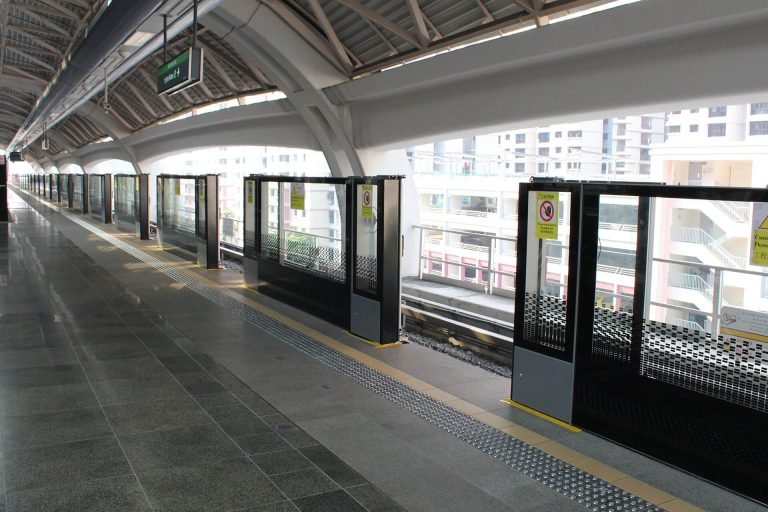
Chennai (Metro Rail News): The joint venture between Panasonic Manufacturing (Beijing) Co. Ltd. and  Pioneer Fil-Med  Pvt. Ltd. has secured a 146.95 crore contract from Chennai Metro. The contract involves supplying and installing Platform Screen Doors for Chennai Metro’s Line 3 and Line 5.

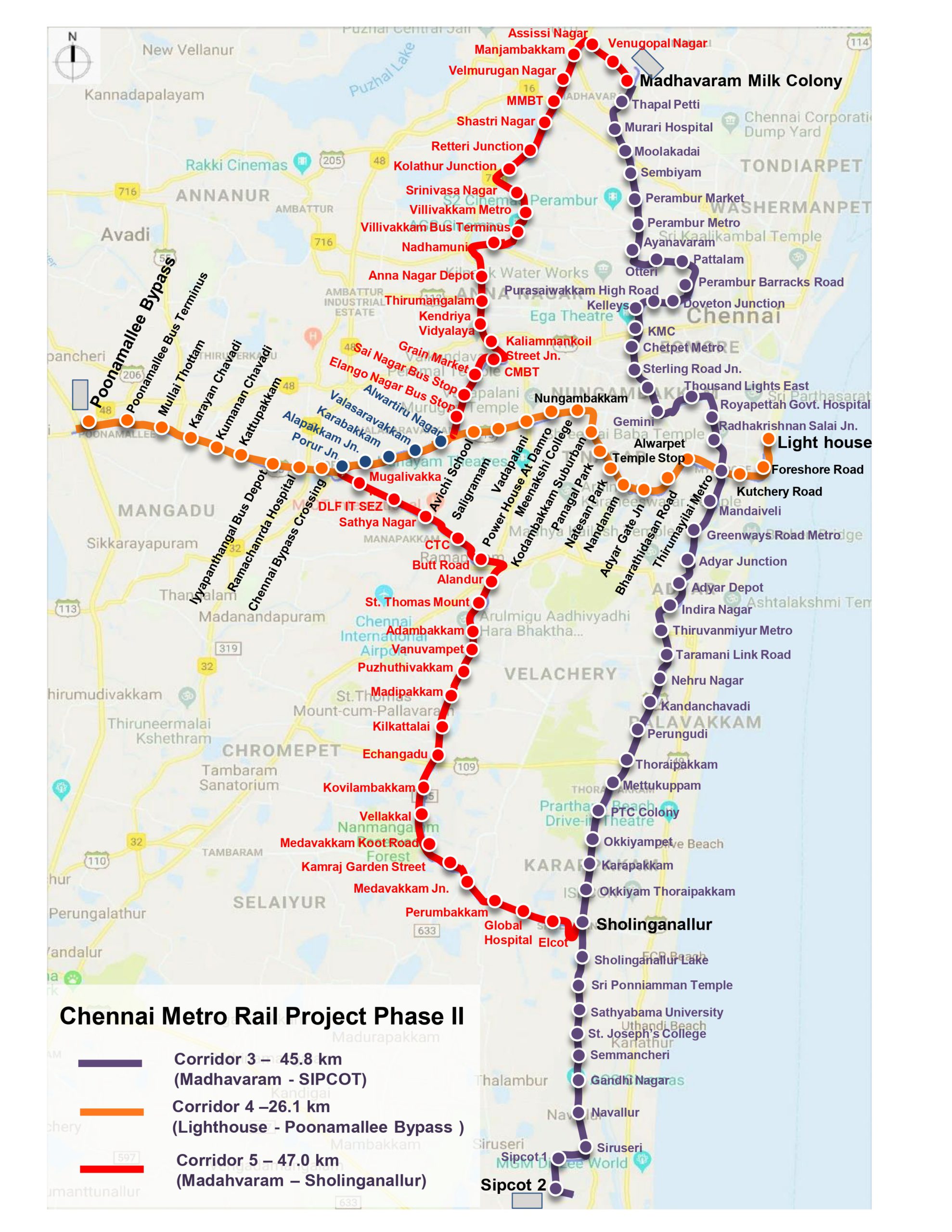
Chennai Metro Phase 2 Map

Line -3 and Line-5 of Chennai Metro will operate in a North-South orientation to link Madhavaram – SIPCOT (45.4 km Line-3) and Madhavaram – Sholinganallur (44.6 km Line-5), Respectively, through both elevated and underground stations. 

The contract’s scope includes the design, manufacture, supply, installation, testing, and commissioning of Platform Screen Doors. 

In Corridor-3, the contractor will install PSDs at 29 underground stations between Madhavaram Depot Station and Tharamani Station.

In Corridor 5, PSDs will be installed at 5 underground stations falling between Kolathur Junction Station and Nathamuni Station.

Final Contract Value: INR 85,36,03,003 + USD 7,392,013 (approx. INR 146,95,66,140.67 or 146.95 crore)

Deadline for the contract: 1465 Days ( approximately four years )

Other contracts for Platform Screen Doors

Another 2 packages by CMRL for installing platform screen doors:

Package ASA12A: In November 2023,  ST Engineering Urban Solutions Ltd. secured this package. Under this contract, ST Engineering is responsible for installing Platform Screen Doors at 10 elevated stations of Line 3 (Sholinganallur Lake – SIPCOT 2). Additionally, they will install PSDs at 29 stations of Line 5 (Grain Market – Elcot).

Package ASA09: The work under this package includes the PSDs at 10 elevated stations of Line-3 (Nehru Nagar – Sholinganallur) and 10 elevated stations of Line-5 (Assissi Nagar – Koyambedu). Currently, the bids are under technical evaluation for this package.

Ongoing development On Line 3 & 5 of Chennai Metro

Line-3’s 29 stations are under construction by DRA – Soma JV Tata Projects Ltd. and Rail Vikas Nigam Ltd. 

Line-5’s five underground stations are under construction by Tata Projects Ltd. 

Exclusive interview of Sophie Moochhala on the occasion of International Women’s Day

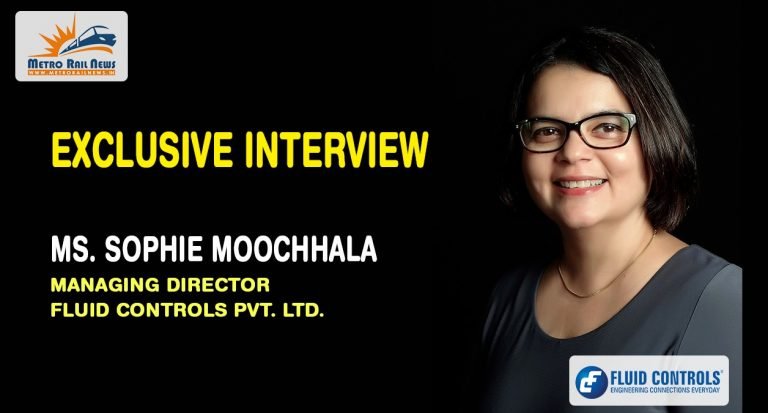
To celebrate International Women’s Day, our Managing Editor Mr. Narendra Shah had a conversation with Ms Sophie Moochhala – Managing Director – Fluid Controls Private Limited. In which she speaks about the Company business strategy, Atmanirbhar Bharat Policy and Growth in a Post-COVID Situation.

Tell our readers about various innovative products recently developed for Metro & Railway Industries?
Fluid Controls Private Limited was established in 1974 by Dr. Y.E. Moochhala, a Ph.D. from Northwestern University, the USA with a vision to deliver high quality & high-performance products which delight customers. Fluid Controls offers customers comprehensive end-to-end “Make in India” solutions for Rail & Metro brake piping arrangements – from design & engineering services to supply of high-performance products and installation services. From its inception in 1974, Fluid Controls has engaged in original R&D and also has had an ethos of developing indigenous replacements for imported products. Our founder, Dr. Y E Moochhala, after a successful career in the USA decided to return to India because he was a strong believer in a self-reliant India. His idea was to develop high quality, high-performance products to suit local prototype climatic and performance expectations. Today, Fluid Controls is approved as an “In-House R&D unit” by the Department of Scientific & Industrial Research (DSIR), Government of India. Since 2011, we have developed more than 25 new products, which is very much in line with the Fluid Controls vision statement. Adding to our strength in innovating, Fluid Controls has filed its first Global Patent and
is in the process of filing two more patents. Particularly for the Rail & Metro Industry Fluid Controls has developed Across Frame Connectors for connection of pipelines between the shell and bogie for high-speed electric locomotives. These connectors eliminate welding processes and allow for seamless connection of pipes between the shell and bogie. Across Frame connectors also, reduce component parts required to be purchased as they are integrated fitting assemblies. Fluid Controls has also developed an entire range of FlexiGripTM connectors to provide zero-leakage and vibration resistant connections Here are the excerpts from the
interview:- “Success is a multi-faceted word! Professionally, for me, success is to build a brand which is trusted by customers
and which delights customers.” Sophie Moochhala Managing Director Fluid Controls Pvt. Ltd. between misaligned pipes or between pipes of different materials. The triple sealing action of the split ring, washer and O ring provides for a completely leak-proof connection. The split ring also provides superior vibration resistance by ensuring the joint remains in a springing condition. As an ongoing part of product development, Fluid Controls also customizes standard products to suit specific customer requirements.

How do you see the Govt of India’s Atmanirbhar Bharat policy?
Fluid Controls is a “Vocal for Local” MSME organization and we whole-heartedly support the Atmanirbhar Bharat initiative. Domestic manufacturers have the capability – be it in manufacturing, quality, or R&D – to cater to domestic requirements across sectors. In the past, legacy international vendors and lack of firm procurement policies constrained the effective implementation of “Make in India”. Atmanirbhar Bharat, which clearly outlines procurement policies, will go a long way to boost domestic manufacturers, especially in the MSME sector. With our manufacturing and R&D capabilities, Fluid Controls can contribute immensely to provide high quality, high-performance products to all sectors in the move to localize supplies.

Please share some of your value-added, problem-solving product and services offered by Fluid Controls?
A good example of a product we developed is the Fluid Controls Hydraulic Swaging Unit (HSU), which is a tool to ensure that twin ferrule connectors are installed correctly at the site. The unique feature of our HSU is that there is no need for manual intervention in the process. We also offer design and engineering services and have completed conversion projects (from one connector system to another) for several customers.

How Covid-19 outburst the Fluid Control’ business and the step you have taken to overcome it?
During the onset of the Pandemic COVID-19, our primary focus was to ensure the health and safety of our employees, their families, our customers and our business partners. And we had changed the way we approach every task and every activity. We had to adapt our model of operation since face-to-face meetings and interaction were not possible for some months (and we are still work-from-home at our Mumbai office!). We have invested in ERP and Microsoft Teams software to ensure the ease of teamwork and connectivity. To ensure seamless day-to-day operation, each department head would hold a daily telephonic meeting to discuss tasks and the way ahead. We also had to change the way we conducted our external business. During the lockdown period, Fluid Controls engaged with customers via video conferencing and calls. And, to ensure the least disruption in schedules, we have provided regular updates on our business status and order status to them. As many of our customers still do not allow business visits, we continue to have a virtual engagement with them. Once our plant became operational in May 2020, we provided our employees with a safe working environment. Whilst a major part of our staff is still working from home, “Operational Safety” being the primary parameter for the health and safety of people at work in the plant, we have planned our manufacturing with a system and process-focused approach. At Fluid Controls, we “Engineer Connections every day”. And in the time of the COVID-19 pandemic, we learnt how to “Adapt Everyday”!

What is your view on Business Growth in a Post COVID Situation?
I am very optimistic about the post-COVID growth situation and increased Union Budget allocations this year for railways will definitely lead to more business for companies such as ours. In addition, we are very positive that the focus on freight, Metros and RRTS/LRTS networks will result in an increasing demand
for rolling stock.


What are the Metro Projects in which Fluid Controls currently associated?
We are currently associated with projects for Mumbai Metro, Pune Metro, Delhi Metro and Chennai Metro. BEML suppled the First Driverless Metro Train developed in India form Mumbai Metro Line 2A.

What is the role of fluid Controls in the development of this true Atma Nirbhar product?
We are very happy to have been associated with BEML for Mumbai Metro. The Metro cars supplied by BEML have Fluid Controls DIN Single Ferrule connectors installed in the brake piping system. This is a very big achievement for Fluid Controls and we are very proud to have been approved by BEML for this project. Coming from a non-technical background,

how do you manage the most senior management position of an innovative product engineering company?
“Success” is a multi-faceted word! Professionally, for me, success is to build a brand that is trusted by customers and delights customers. At an organizational level, it is to build a team that is motivated, innovative and performs to high expectations. In this context, my having or not having an engineering background doesn’t really matter as I am supported by a team that has stellar engineering credentials.

What are the company’s business strategy and future expansion plan concerning the Metro & Railway market?
Over the years, Fluid Controls has developed comprehensive expertise for manufacturing, by identifying the right materials and ensuring “fit and forget” assembly. For Rail & Metro applications, we offer complete fitment of brake piping components, engineering and site installation services, pre-piped assemblies for easy site fitment, double ferrule fittings, DIN single ferrule fittings, threaded adaptors, Across Frame connectors, FlexiGripTM connectors, quick release connectors, isolation valves and clamps. A key part of our future plans is to tap into the brake piping business for the emerging high-speed train operations and to offer integrated solutions and hose assemblies to our current customer base. We are also focusing on global supplies to Europe, North America and SE Asia


Building the Pillars of Viksit Bharat: Alstom’s Role in Strengthening Urban Rail Mobility and Socio-Economic Development in India

Abstract

Over the last decade, India’s urban transport landscape has undergone a clear structural shift. What began as a limited number of metro rail projects in a few large cities has expanded into a nationwide urban rail programme that is now influencing how Indian cities plan growth, manage congestion, and address environmental pressures. Metro systems are no longer treated as supplementary infrastructure; they are increasingly forming the backbone of urban transport planning.

This transition has been driven by rapid urbanisation and a sharp rise in daily travel demand. As cities expanded, road-based transport systems struggled to manage congestion, rising commute times, and higher emissions. Metro rail emerged as a high-capacity, energy-efficient solution capable of moving large passenger volumes with predictable travel times and lower environmental impact. Over time, metros evolved from city-specific interventions into a standardised model that could be replicated across regions.

India today operates the world’s 3rd largest metro network. Operational length has increased from approximately 250 km in 2014 to over 1,000 km across more than 20 cities. Daily ridership has grown proportionately, reflecting a sustained shift in commuter preference towards mass rapid transit. This growth indicates that metro rail has moved beyond pilot adoption to becoming an accepted and dependable mode of urban transport.

However, the expansion has required more than civil construction and rolling stock procurement. Delivering metro systems at this pace has demanded integrated capabilities across rolling stock, signalling, traction, and power supply, depot infrastructure, operations, and long-term maintenance. As networks expanded into Tier-2 and emerging cities, standardisation, localisation, and system-level integration became critical to maintaining safety, reliability, and performance.

At this scale of expansion, Alstom has emerged as one of the key system partners supporting metro development in India. Over nearly 100 years of engagement in the country, the company’s role has expanded beyond the supply of standalone components to encompass integrated sustainable metro solutions. Its present-day involvement extends across rolling stock, modern signalling technologies, and the development of maintenance frameworks necessary to support high-frequency urban rail operations. 

Alstom’s participation across multiple metro projects has supported the deployment of globally benchmarked solutions while progressively building manufacturing and engineering capabilities in India under the ‘Make in India’ &Atmanirbhar Bharat programmes.

The growth of metro systems in India is heavily influenced by its capabilities to deliver the global standard sustainable solutions for the sector. Against this backdrop, Alstom is well-equipped to support the next phase of India’s urban mobility through its integrated capabilities in rolling stock, signalling technologies, and lifecycle support. This cover story examines how Alstom’s presence in India has evolved alongside the country’s metro programme, and how its technologies, manufacturing base, and project experience are contributing to the continued development of metro systems, aligning with India’s broader urban and sustainability objectives. 

Realising the Vision of Green Mobility for Viksit Bharat through Modern Rolling Stock

One of the reasons to deploy metro systems in urban centres is to lower the carbon emission which is primarily caused by road-based transport. The Alstom-built trains are taking India closer to the goal of low-carbon mobility. Alstom’s trainsets are today running in major metro systems, including Delhi, Kochi, Kanpur, Indore, Bhopal, and Agra, among others. These trainsets demonstrate lower carbon emissions when compared with conventional road-based modes of transport.

Closing Operational Gaps with Advanced Signalling Solutions

One of the growing operational challenges faced by metro systems in India is overcrowding, particularly on high-density corridors. While physical capacity expansion is possible, it is capital-intensive and requires long planning cycles. In this context, advanced signalling technologies offer a more immediate pathway to increasing operational throughput. Alstom’s latest-generation signalling solutions, including Communications-Based Train Control (CBTC) and ETCS, support higher service frequencies and improved operational flexibility across Indian metro corridors & RRTS corridor.

Ensuring Reliability Through Lifecycle Support

As metro networks mature, asset availability and long-term reliability become critical to system performance. Alstom’s lifecycle-oriented approach to maintenance, robust reliability growth culture and 24×7 fleet support goes beyond initial delivery, which is helping metro authorities sustain high operational efficiency and deliver a reliable travel experience for passengers.

Industrial Base as a Catalyst for India’s Metro Expansion

key figures

The rapid expansion of metro systems across India has required an industrial ecosystem capable of supporting multiple projects simultaneously, across different geographies, while maintaining consistent quality and delivery timelines. To respond to this requirement, Alstom has developed a strong industrial and engineering presence in India, comprising 6 facilities and 5 engineering centres, aligned directly with the needs of India’s growing metro programme.
Today, over 33% of Alstom’s global engineering activities are executed from India, which underlines the country’s strategic role in both domestic delivery and international metro projects.

The Backbone of Rolling Stock Manufacturing in India

Alstom Metropolis carbody shell

A central pillar of India’s metro manufacturing capability is the Sri City facility in Andhra Pradesh, operational since 2012. The site has a production capacity of up to 480 rail cars per annum and achieves localisation levels of approximately 85%. It has supplied metro trainsets for Indian cities including Chennai, Kochi, Lucknow, and Mumbai, while also supporting international projects in Sydney and Montreal. The facility houses India’s longest dynamic test track, enabling end-to-end validation and performance testing prior to commissioning.

Complementing this capability is the Savli facility in Gujarat, which further strengthens India’s metro and rail manufacturing base. In addition to producing metro and commuter rolling stock for domestic projects, the site has delivered 450 metro cars for the Queensland Metro project in Australia. It has also exported over 4000 bogies and supplied more than 4,500 flatpacks and modules to global rail programmes, which reinforces India’s role as a manufacturing and supply hub for metro rolling stock and critical assemblies.

Localisation of High-Value Components and Propulsion Systems

At the component level, Alstom’s Coimbatore facility in Tamil Nadu anchors the localisation of propulsion and electrical systems. Established in 1978 and expanded across three sites, it is today Alstom’s largest components manufacturing facility globally. The site supplies traction motors, converters, and electrical equipment to over 80 projects across five continents, with approximately 50% of output exported, which strengthens both supply resilience and lifecycle performance of metro fleets.

 Leading the Charter of Rail Technology Innovation

As metro systems progress towards higher service frequencies and tighter operational margins, signalling and digital systems have become central to network performance and safety. These requirements have elevated the importance of proven engineering, testing, and validation capabilities within the country.

Bengaluru, which anchors Alstom’s India operations, has emerged as a key centre for these activities. The city hosts a signalling laboratory infrastructure spread across approximately 60,000 sq. ft., including a 5,000 sq. ft. Digital Experience Centre. This facility supports the full lifecycle of signalling systems from design and development to integration, testing, and validation across both urban and mainline rail applications.” The infrastructure supports over 40% of the company’s global signalling R&D requirements.

Engineering teams based in Bengaluru contribute to more than 120 projects worldwide. Their work spans Communications-Based Train Control (CBTC), European Train Control System (ETCS), and cybersecurity solutions, which reflects the increasing convergence of safety-critical systems and digital resilience in modern metro operations. These capabilities enable Indian engineering teams to support domestic metro networks while also contributing to complex international deployments. The comprehensive framework strengthens India’s position within the global rail engineering value chain.

Delivering Sustainable Mobility Solutions Across Indian Cities

India today operates the 3rd largest metro rail network, which spans over 1,000 km across more than 20 cities. Delivering systems at this scale requires consistent performance across varied operating environments, timelines, and institutional frameworks.

Across this expanding landscape, Alstom has been involved in a wide cross-section of Indian metro projects. The company has come up with solutions tailored to local operating requirements while aligned with international standards. Its participation covers mature networks in large metropolitan regions as well as newer systems in emerging cities in India, which offer a practical view of how metro technologies are adapted and deployed across different stages of network development.

The following section reviews select metro projects to illustrate how these capabilities have been applied in practice, with due consideration to city-specific operational and design requirements.

Mumbai: India’s First Metro with 75% Motorised Trainsets

Mumbai metro 1

Mumbai Metro Line 3 represents one of the most technically advanced metro projects undertaken in India. The fully underground corridor operates in a dense urban environment, requiring precise system coordination and high operational reliability. Alstom supplied lightweight rolling stock designed with 75% motorisation, a configuration introduced for the first time in the Indian metro context. This enables improved acceleration and braking performance, supporting efficient operations under closely spaced station layouts.

The trains are designed with sustainability considerations integrated into their lifecycle, with 96% recyclability and 99% recoverability of materials. The project also incorporates Urbalis 400 CBTC signalling, which enables high-frequency operations with enhanced safety margins. 

Delhi: Scaling India’s Largest Metro Network

Magenta line delhi metro

Delhi Metro’s growth mirrors the broader trajectory of urban rail development in India. What began as a limited set of corridors has evolved into a dense, multi-line network that now carries millions of passengers daily and operates under increasingly complex service conditions.

As the network expanded, requirements also changed. New corridors needed to integrate with existing lines, operate at higher frequencies, and maintain reliability under heavy passenger loads. Alstom’s involvement in the Delhi Metro reflects this transition from initial capacity creation to system optimisation at scale. More than 800 metro cars supplied by the company are currently in service across the network, forming a crucial part of the operational fleet. Reinforcing this commitment to long-term operational excellence, Alstom recently secured a 10-year maintenance contract worth €42.1 million from Delhi Metro to ensure the sustained performance and reliability of the network’s assets in Line 1 & 2.

Under Phase IV of the project, the focus has shifted towards enhancing throughput and operational efficiency rather than only adding length. Alstom is supplying 312 standard-gauge metro cars and implementing Communications-Based Train Control (CBTC) signalling on key corridors, including Mukundpur-Maujpur,  and Aerocity-Tughlakabad. The signalling architecture integrates Automatic Train Supervision (ATS), allowing operators to regulate train movement more precisely and optimise energy usage across the network. 

Chennai: Advancing Automation in Urban Rail Operations

Chennai Metro

Alstom has a long-standing association with Chennai Metro, marking its first rolling stock contract in India. In 2010, Alstom secured a key contract to supply rolling stock for Phase 1 of the project, delivering reliable trains that have powered the network’s growth. This enduring partnership highlights Alstom’s important role in shaping Chennai’s urban mobility landscape since its inception.

Since the early era of India’s urban mobility journey, automation in metro rail operations is steadily moving from aspiration to necessity, as metro operators across India seek solutions to bridge gaps in service frequency, punctuality, and overall reliability. Growing ridership, denser networks, and the demand for consistent service levels are pushing cities to adopt higher grades of automation not merely as a technological upgrade, but as a strategic operational choice.

Chennai Metro’s Phase II reflects this transition clearly. The project places automation at the core of its operational philosophy. It is within this context that Alstom’s role assumes significance. The company is contributing to Chennai Metro’s move towards driverless operations, aligning technology with the city’s long-term mobility requirements.

Supporting Metro Systems in Emerging Cities: Indore, Bhopal, Agra, and Kanpur

As India’s metro journey moves beyond megacities, the focus is increasingly shifting towards emerging urban centres where systems must be scalable and locally adapted. Cities such as Indore, Bhopal, Agra, and Kanpur represent this next phase of metro expansion networks designed not for extreme density alone, but for long-term urban transformation. In these contexts, adaptability and localisation are no longer optional; they are central to project success.

Bhopal 46 1

The Indore and Bhopal metro projects illustrate how new-generation metro systems are being shaped with this mindset. For these cities, Alstom is supplying 25 and 27 metro trainsets, respectively, all manufactured in India under the ‘Make in India’ initiative. Beyond localisation of manufacturing, the projects integrate advanced CBTC signalling, train control, and telecommunication systems, to ensure reliable and efficient operations suited to the evolving demands of emerging urban networks. The emphasis is on building systems that can grow with the city, both operationally and technologically.

A similar approach underpins the Agra and Kanpur metro projects. Here, Alstom is executing a combined order for 201 metro cars. These trains are expected to serve a combined population of nearly 5 million residents. 

Together, these projects signal a broader shift in India’s metro development strategy. As metro rail becomes a tool for balanced urban growth rather than a megacity-exclusive solution, the ability to deliver reliable, standardised, and locally manufactured systems will define the next chapter of urban mobility in the country.

Meerut: Rolling Out One of the Fastest Metro Trains in India

Video thumbnail first trainset M

Meerut Metro reflects a distinct shift in how urban rail systems are being conceptualised in India, introducing a model where metro services operate alongside regional rapid transit on shared infrastructure. This integration with the Namo Bharat (RRTS) corridor adds a new operational dimension, one that demands higher speeds, precise system coordination, and uncompromising safety standards.

Given the intricacy of the Meerut Metro project, Alstom has developed rolling stock tailored specifically for higher-speed urban operations, departing from the conventional design philosophy of Indian metro systems. These trains are among the fastest metro rolling stock in the country as they feature a design speed of 135 kmph. The notable thing is that these rolling stocks are completely designed & manufactured under the ‘Make in India’ initiative.

The Meerut Metro trains serve as a clear proof point of India’s growing rail engineering expertise, which demonstrates the ability to deliver rolling stock that is no longer confined to traditional operational limits, but is instead engineered to support faster, more flexible rail operations.

India’s First Semi-High-Speed Regional Train: A Make in India Manufacturing Milestone

Screenshot 2026 07 11 175314

As India transitioned towards a modern era of mobility where speed and safety are paramount, Alstom developed ultra-modern rolling stock that is 100% indigenously designed and engineered for a maximum operating speed of 180 kmph. This development supports India’s first Regional Rapid Transit System (RRTS) project connecting Delhi and Meerut, a key economic corridor within the National Capital Region.

Under a €436 million mega order, Alstom is supplying 210 train cars, which are expected to reduce travel time between Delhi and Meerut by nearly 40%. For this corridor, Alstom has developed a hybrid European Train Control System Level 3 ETCS signalling solution, which is the first deployment of this technology in the world.

This contract also represents a world premiere for the integration of the latest ETCS standard with digital interlocking and Automatic Train Operation (ATO) over Long Term Evolution (LTE) radio. The project sets a new reference for Semi high-speed, safe, and reliable regional rail operations in the country.

Building Capability for India’s Metro Ecosystem: Skills, Workforce, and Inclusion

The rapid expansion of metro rail systems across India has brought with it a parallel challenge: building and sustaining the human capability required to design, deliver, operate, and maintain increasingly complex networks. As metro systems scale up and adopt advanced technologies such as CBTC, automation, and digital asset management, the availability of a skilled workforce is emerging as a critical determinant of long-term system performance. Within this landscape, Alstom’s engagement in India’s metro programme extends beyond project execution to strengthening the broader capability framework that underpins the sector. Recognising that technology alone cannot ensure operational excellence, the company has focused on nurturing talent in India.

Nurturing Young Engineering Talent

Alstom has invested in structured training and knowledge development programmes to support the growing technical requirements of modern urban mobility systems. Engineers, technicians, and operational staff are trained across domains including rolling stock systems, signalling, traction, and digital applications. These programmes combine classroom instruction, on-the-job exposure, and digital learning tools.

YEGP 2024 Copyright Alstom

A key component of this effort is the Young Engineering Graduates Programme (YEGP), launched in 2015. The programme recruits engineering graduates from across India and provides structured onboarding, mentoring, and hands-on project exposure. Over the past decade, the diversity profile within the programme has increased from 23% to over 66%, which reflects a broader effort to build an inclusive technical workforce capable of supporting India’s expanding metro ecosystem.

Strengthening Engineering Skills

To support continuous skill upgradation, Alstom encourages higher education through initiatives such as the Work Integrated Learning Programme (WILP), which enables engineers to pursue specialised M.Tech programmes from BITS Pilani in areas including artificial intelligence, machine learning, and data science. These programmes are complemented by regular e-learning modules and in-person technical workshops, strengthening engineers’ ability to manage complex systems and lead cross-functional teams.

Such investments are particularly relevant as metro projects move towards higher levels of automation, data-driven maintenance, and integrated system management. Building in-house expertise in these areas supports both project execution and long-term asset reliability.

Employment Generation and Local Ecosystem Development

Employment creation and local ecosystem development are emerging as integral outcomes of large-scale urban rail projects. Alstom’s manufacturing, engineering, and service operations in India contribute to employment generation across multiple levels, which encompass both direct and indirect jobs spread across various project locations.

With a skilled workforce of over 12500 employees, the company is able to manage complex project requirements across the lifecycle of metro systems from design and manufacturing to operations and maintenance. Beyond direct employment, these activities stimulate regional economic activity by creating sustained demand for ancillary services, logistics, and technical support.

In parallel, Alstom’s operations have supported the steady development of a domestic supplier and service ecosystem. A reliable network of local suppliers has taken shape around key facilities such as Savli, where companies including Integra, Anovi, Hind Rectifier, Hitachi Energy, and ABB are engaged in areas such as fabrication, interiors, and electrical systems.

This engagement has helped suppliers build capability, improve process standards, and meet the technical demands of metro projects. Over time, it has strengthened local value chains and contributed to a more resilient industrial base, supporting India’s broader objective of Aatmanirbhar Bharat through practical capability development rather than short-term sourcing.

Promoting Inclusion and Workforce Participation

Dignitaries from WRI Alstom BM

Inclusive workforce participation is increasingly being recognised as an essential component of sustainable urban mobility. In line with this approach, and to promote inclusivity and women’s participation, Alstom introduced the Low Emission Access to Public Transport programme in February 2024. 

The initiative deploys electric autorickshaws to provide last-mile connectivity from Namma Metro stations such as Yelachenahalli and Indiranagar to address a practical gap in metro access. At the same time, it supports greater participation of women in the transport workforce. Under the pilot phase, around 25 women drivers were trained and employed, creating new livelihood opportunities while improving connectivity for metro users.

By linking cleaner transport solutions with workforce inclusion, the LEAP programme demonstrates how urban mobility initiatives can deliver social outcomes alongside operational benefits.

Investing in Future Talent and Community Development

WhatsApp Image 2024 12 03 at 11

Beyond creating employment, Alstom has also invested in long-term talent development through education-focused initiatives. In regions such as Madhepura, the company has established STEAM laboratories in schools to promote experiential learning in science and engineering. 

Complementing this is the Alstom India Scholarship for STEM Education, which provides financial support of ₹75,000 to meritorious students from economically disadvantaged backgrounds pursuing undergraduate or postgraduate studies in STEM disciplines. The programme is implemented in regions surrounding Alstom’s operational hubs, including Coimbatore, Madhepura, Sri City, and Vadodara, reinforcing local capability development aligned with industrial presence.

Conclusion

As the nation charts its path toward Viksit Bharat 2047, the story of its urban mobility is one of transformation and ambition. Today, metro systems are no longer just a mode of transport; they are the backbone of growing cities. In this evolving landscape, Alstom stands out not merely as a supplier of trains and technology but as a key sustainable mobility partner in building the very ecosystem that is well positioned to support India’s metro networks for decades to come.

Be it high-density megacities or emerging urban centres, Alstom’s approach combines technology, sustainability, and local capability. Its leadership is evident not only in the scale and speed of delivery, but in creating systems that are reliable, inclusive, and ready to accommodate future demands of mobility

India’s metro journey is far from complete, but with stakeholders like Alstom that bring innovation, the foundations are being laid for a resilient urban transport ecosystem. In this story of progress, true leadership is measured not merely by the infrastructure delivered, but by the lives it connects, the opportunities it creates, and the cities it enables to flourish for generations to come.

Guwahati Metro project moves close to reality: State announced feasibility study in 2026-27 budget 

GUWAHATI (Metro Rail News): The Assam government announced a feasibility study for a metro rail system along the upcoming Guwahati Ring Road during the presentation of the 2026–2027 State Budget on July 10, 2026. Chief Minister Himanta Biswa Sarma explicitly confirmed that the Assam government plans to officially engage the DMRC to prepare the Detailed Project Report (DPR) and structural feasibility framework for the new 121-km Guwahati Ring Road Metro. This project marks a significant shift toward regional connectivity rather than a conventional intra-city network. 

These infrastructure initiatives were officially announced by Assam Finance Minister Shri Jayanta Malla Baruah on the floor of the Assam Legislative Assembly. Following the announcement, Assam Chief Minister Himanta Biswa Sarma stated that Prime Minister Narendra Modi had advised the state government to plan a metro network across the four corners of the proposed Guwahati Ring Road. 

The Chief Minister further emphasized that the primary purpose of this study is regional connectivity linking surrounding satellite towns (such as Nalbari, Baihata Chariali, and Sipajhar) and peripheral regions to reduce traffic gridlock on core city roads and central downtown areas. Consequently, this will not be a conventional metro system within Guwahati city lines.

The proposed metro system will run over or alongside the planned 121-km Guwahati Ring Road. Ultimately, the project will focus on allowing commuters to travel quickly from outlying areas like Baihata Chariali, Sipajhar, and the Guwahati Airport to different parts of the city. This will be the first metro rail project in Northeast India.

Also Read: Insolvency ends for MMOPL as NARCL reconstructs Mumbai Metro Line 1 debt

Insolvency ends for MMOPL as NARCL reconstructs Mumbai Metro Line 1 debt

MUMBAI (Metro Rail News): Mumbai Metro One Private Limited (MMOPL) entered a debt reconstruction agreement with National Asset Reconstruction Company Limited (NARCL). This agreement reduced the company’s debt by ₹1,100 Crore and provided relief to the company on the insolvency proceeding that is looming over the company for the last few years.

The company’s outstanding debt of ₹2,771.32 Crore has been reconstructed under this agreement. After the reconstruction, this amount has been revised to approximately ₹1,600 Crore that the company will repay to NARCL. 

Now, NARCL will take over the debt from all the lenders including SBI, IDBI Bank, Indian Bank and Canara Bank, and MMOPL will have to repay the said amount to NARCL. Further, the NARCL will appoint a director to the board of MMOPL. A monitoring committee, with members from both parties, has been formed to oversee the reconstruction.

MMOPL is a collaborative venture of Reliance Infrastructure and Mumbai Metropolitan Region Development Authority (MMRDA). It operates the Line 1 (Blue Line) of the Mumbai Metro. The line has a daily ridership of around five lakh commuters.

Company’s long loan repayment defaults

MMOPL has been defaulting the repayments of loans from 2018, after which it was declared as a Non-Performing Assets (NPA). During the construction stage of Line 1, the estimated budget of ₹2,356 Crore increased to over ₹4,000 Crore. 

SBI and IDBI Bank, who were among the lending institutes for the project, proceeded to the National Company Law Tribunal (NCLT) for insolvency. However, the Maharashtra government offered to settle the dispute and buy Reliance’s stakes in the project. But, the settlement offer could not go through. 

Also Read: Mumbai to get world’s largest water metro network 

Mumbai to get world’s largest water metro network 

MUMBAI (Metro Rail News): Progressing towards making water transport an important part of Mumbai’s transport system, Maharashtra CM Shri Devendra Fadnavis said, “Mumbai Water Metro will be the largest water transport network of any city in the world.”  

The estimated cost of the project is Rs. 6,066 Crore which will include 44 terminals and 33 water routes, covering a total length of 340 km. The government plans to obtain 203 environment-friendly electric and hybrid vessels for this project. 

The Maharashtra Maritime Board and M. Zoya Marine Services Pvt. Ltd have signed a Memorandum of Understanding (MoU) for the development of a shipbuilding facility in Sindhudurg and supply of water metro vessels for the Mumbai Water Metro Project.

image 8

According to the MoU, M. Zoya Marine Services Pvt. Ltd will provide modern, environmentally sustainable Water Metro vessels for the Mumbai Water Metro Project. The agreement also includes establishment of a state-of-the-art electric boat manufacturing facility over 22 acres with an estimated investment of Rs. 150 crore at Talawane in Sawantwadi Taluka, Maharashtra. 

Chief Minister Shri Devendra Fadnavis stated that the project is expected to be completed by 2031 and will serve around 7.5 crore passengers annually. Once this metro route is operational, it will provide Mumbaikars with an alternative mode of transportation other than road and railways. The Mumbai Water Metro Project is a significant step taken by the Maharashtra Government to enhance connectivity across the city and reduce congestion on roads. 

Also Read: Mumbai Metro Hits New Milestone with Highest-Ever Ridership

Indian Railways approves Rs.260 Crores Kavach deployment on 680RKM of Northern Railway

NEW DELHI (Metro Rail News): Indian Railways has approved the provision of Kavach Version 4.0 on 680 route kilometers of the Rewari-Delhi and Shakurbasti-Bathinda sections (including feeder branch lines) of the Delhi Division, Northern Railway. The project was approved at a cost of ₹260 crore by the Ministry of Railways on Friday, 10 July 2026.

The Ministry of Railways stated that the project is part of the nationwide rollout of Kavach, aimed at enhancing indigenous safety on key high-density routes.

The Tech Enhancements Behind Kavach 4.0 

Kavach 4.0 is the definitive, finalized blueprint for India’s nationwide railway safety net. The earlier variant, Kavach 3.2, served as the “Beta testing phase,” which was deployed across 1,465 route kilometers on the South Central Railway. It successfully proved that an indigenous automatic braking system could work to prevent collisions and display signals inside the cockpit. However, the specific technical limitations of Kavach 3.2 forced the development of version 4.0. Kavach 4.0 features a direct interface to modern Electronic Interlocking (EI) platforms, a station-to-station interface using hardwired Optical Fibre Cables (OFC), and the ability to manage aggressive braking curves dynamically. This allows semi-high-speed networks like the Vande Bharat and rapid freight routes to run safely up to 160 km/h.

The Ministry of Railways emphasized that implementing Kavach Version 4.0 on key Indian Railway routes will boost safety, optimize operations, increase the reliability of train services, and facilitate quicker, tech-enhanced transport for both passengers and freight.

Also Read: Mumbai-Ahmedabad Bullet Train Project completes all 13 Portal Beam launches

Meerut Metro: A fast-moving dream changing the city’s direction 

Introduction

Meerut has always been a city with a strong past. Walk through it, and you will find reminders everywhere. Old markets, colonial era buildings and landmarks like the Augarnath Temple are closely linked to the uprising of 1857. The city played a crucial role in the Indian Rebellion of 1857, and that legacy still shapes its identity. But while history gave Meerut recognition, it did not guarantee growth. 

Over the years, the city expanded rapidly. By 2026, the city’s population will stand at around 1,964,000, while the larger urban region population is around 2,139,000. In 2026, Meerut ranked as the 34th most populous city in India. It also became the second-largest city in the National Capital Region, right after Delhi. This kind of growth brings opportunity.

Now, Meerut has grown in size and ambition. New residential areas came up, population increased, and business activity grew, especially in sectors like sports goods, metal work and agricultural-based trade. At the same time, Meerut remained closely tied to Delhi. Thousands of people travelled daily between the two cities for work, education and business. And that’s where the problem began. The city’s infrastructure struggled to keep up. Roads became overcrowded, public transport remained limited, and long travel hours became part of daily life. Within the city, moving from one area to another often meant dealing with traffic congestion and delays. The growing gap between expansion and infrastructure created a clear need. Meerut needed a faster, more reliable, and structured transport system. At the same time, planners saw an opportunity. With its strategic location near  the National Capital Region, Meerut could become more than just a neighbouring city. It could become an active economic extension of Delhi. But for that connectivity had to improve. This idea gave rise to the Meerut Metro, integrated with the Namo Bharat Corridor. 

On 26 February 2026, when Prime Minister Narendra Modi inaugurated the project, it marked a turning point. The city that once depended on slow, crowded roads suddenly gained access to high-speed modern transit. 

This article explores the journey of the Meerut Metro in detail. It explains the metro’s current network and future expansion plans. It also studies its impact on business and the city. It also examines financial and operational challenges. Because the real question is simple. Can this metro truly change Meerut’s future? 

Meerut Metro: The journey from plan to reality

image 7

The Meerut Metro did not appear overnight. It took years of planning, studies, and coordination before the first train could run. The idea started in the early 2010s. At that time both the center government and Uttar Pradesh government began to look at better transport options for cities near Delhi. Meerut stood out because of its growing population and strong daily connection with the capital. Officials wanted a system that could solve two problems at once. They wanted to improve travel within the city. They also wanted faster connectivity with Delhi and outer NCR areas. This thinking led to a combined vision. The Meerut Metro would work along with the Namo Bharat corridor instead of running as a completely separate project. The next step involves technical studies.

In 2015, RITES did a feasibility study. The study examined whether the metro would work in Meerut. It looked at expected passenger demand, costs, routes, and long-term benefits. After that in June 2016, the agency prepared the Detailed Project Report (DPR). The DPR acted as the blueprint for the project. It defined the route, station locations, cost estimates, and construction plan. Once the DPR was ready, the project moved into the approval stage. 

In 2017, the Uttar Pradesh Metro Rail Corporation took on a key role. It worked as a coordinator between different agencies. Large infrastructure projects require multiple stakeholders, including  state authorities, central ministries, and technical teams. UPMRC helped bring them together. 

A major milestone came on 8 March 2019. On this day Prime Minister Narendra Modi laid the foundation stone for both the Meerut Metro and the regional rapid rail project. This marked the official start of the construction. Work began soon after in July 2019. Construction did not move easily. Like most large projects, it also faced challenges. Teams had to deal with land acquisition, traffic management, and complex engineering work. Building Underground stations in busy areas like Begumpul and Meerut Central required careful planning and execution. At the same time engineers worked on integrating the metro with the Namo Bharat system. This step made the project unique. Instead of building separate tracks, both systems would share the same infrastructure in the Meerut section. 

Over the next few years, the project moved steadily forward. Trial runs began in early 2025. Finally on 22 February 2026, the Prime Minister flagged off the Metro for the public. 

Quick overview: Meerut Metro at a glance

Details Information
Inauguration 22 February 2026
Total corridor23.60 km
Stations (city network)13
Key stationsMeerut South, Pratapur, Rithani, Shatabdi Nagar, Brahmapuri, Meerut Central, Bhaisali, Begumpul, MES Colony, Daurli, Meerut North, Modipuram, Modipuram Depot
SpeedUp to 120 kmph 

Existing routes

image 5

The current Meerut Metro Corridor runs from Meerut South to Modipuram. It covers around 23 km and connects important parts of the city. This route includes both elevated and underground sections. The elevated track covers about 16 km, while the underground tunnels stretch for around 7 km through dense urban areas. The system includes 13 stations in total.

One of the most important features of the Meerut Metro is its integration with the Namo Bharat. The metro shares tracks and infrastructure with the semi high-speed regional rail. The setup allows passengers to move between local and intercity travel without switching stations. A commuter can travel within Meerut and continue towards Delhi using the same network. Meerut Metro also stands out for its speed. With an operational speed of up to 120 kmph, it is currently considered India’s fastest metro system. It can cover the city corridor in about 30 minutes. During the peak hours, trains arrive every 5 to 10 minutes, which supports daily commuting. 

image 6

Future expansions

The current Meerut Metro provides a strong base, but it does not cover the entire city. Authorities have proposed additional corridors to improve network reach and maybe a more effective system. One of the key proposals is Line-2, which will connect Shradhapuri Phase 2 to Jagriti Vihar. This corridor aims to link several dense residential and commercial areas, improving accessibility across important parts of the city. 

Proposed Line 2: Shradhapuri Phase 2 to Jagriti Vihar

DetailsInformation
Length15 km
Type10.7 km elevated and 4.3 km underground
Number of stations13
statusproposed
Proposed stationsShradhapruri Phase 2, Kanker Khera, Meerut cantt, Railway station, Rajban Nagar, Begumpul, Baccha Park, Shahpeer gate, Hapur Adda Chauraha, Gandhi Ashram, Mangal Pandey Nagar, Taj Grahi, Medical College, Jagruti Extension
Implementing agencyUttar Pradesh Metro Rail Corporation (UPMRL)

Line 2 is expected to strengthen connectivity within Meerut by linking areas that currently depend heavily on road transport. It will also improve access to major transit points like Meerut Cantt, Railway Station, making multimodal travel more convenient. In addition, this corridor can support future urban expansion. It can guide planned growth and reduce unstructured development by connecting developing areas such as Mangal Pandey Nagar and Jagriti Vihar

If implemented effectively, Line 2 will not only increase the metro’s coverage but also improve its usability for a larger section of the population. It can play a key role in boosting ridership and making the metro a more practical option for daily commuting. 

Business and economic impact

The Meerut Metro influences the economy beyond transportation. It supports urban development, business growth, and environmental improvement. 

Real Estate and urban developement 

Metro connectivity often increases the value of nearby properties. Meerut has started to experience this trend. Areas around metro stations have become more attractive for residential and  commercial development. Locations such as  Begumpul, Modipuram, and Shatabdi Nagar are witnessing increased demand. Property values near metro stations have risen from Rs 8,000 to 12,000 per square yard to Rs 12,000 to 20,000 per square yard over time. Improved connectivity encourages people to invest in these areas. 

Transit Oriented Development (TOD) will further support this growth. Planned development around stations, can lead to organised urban expansion. This approach can reduce unplanned growth and improve infrastructure planning. 

Employment and commercial activity

The metro project has created employment at multiple levels. Construction work generated direct jobs. Operations and maintenance continue to support employment. Beyond the project itself, the metro creates opportunities for businesses. 

Commercial activity is expected to grow around metro stations. Offices, retails spaces, and small business centers are likely to come up near these locations. These areas will offer easy access for daily commuters. It will make them attractive for companies and employees. As a result, station zones may develop into active business hubs. This can also create new job opportunities and support local economic activity around the metro network.

Environmental sustainability 

The Meerut Metro is also playing an important role in improving the city’s environmental conditions. Urban trans[ortation remains one of the main contributors to pollution in cities like Meerut. Increasing use of private vehicles has led to higher emissions, traffic congestion, and declining air quality. In this context, the metro offers a cleaner and more efficient alternative. Electric trains produce significantly lower emissions compared to petrol and diesel vehicles. As more people shift to rail based transport, the overall pressure on roads can reduce. This shift is expected to take nearly 1 lakh private vehicles off the roads over time. As a result, It could see a reduction of around 2.5 lakh tonnes of carbon emissions annually. The impact goes beyond numbers. Fewer vehicles on the road means less congestion, smoother traffic flow, and better urban air quality. At a broader level, projects like the Meerut Metro reflect a shift in how cities approach development. They show a growing focus on cleaner mobility and planned urban growth. 

image

Challenges: A Closer Look at Ground Reality

Despite its advantages, the Meerut Metro faces several challenges. These challenges may affect its long term performances. 

Ridership and revenue gap

A metro system depends on regular passenger use. Meerut currently lacks the high commuter density seen in larger metro cities. Many people prefer cheaper and flexible transport options such as auto-rishkaws and buses. These options provide door-to-door connectivity. If ridership remains low, revenue from ticket sales will not meet operational costs. This gap can affect financial stability. 

Financial Stability

Metro projects required large investment. Costs include construction, maintenance and daily operations. If revenue remains limited, the system may remain on government support. This can create financial pressure over time. Long-term sustainability requires:

  • Increasing ridership
  • Expanding commercial revenue 
  • Efficient cost management 

Infrastructure projects often deliver benefits over a long period, but financial challenges appear early. 

Competition and limited resources

Meerut already has an established informal transport system. Autos and shared vehicles provide flexible travel options. The metro cannot replace these services completely. Instead, it must work alongside them. Limited network coverage also affects usage. If the metro does not connect key areas like Ganga Nagar, Shastri Nagar, Pallavpuram and peripheral zones like Ved Vyas Puri, commuters may choose other options. 

Strong last-mile connectivity is essential. Feeder services must support the metro network to improve accessibility.  

Conclusion

The Meerut Metro has given the city a new direction. For a place that relied heavily on roads, this shift matters. Daily travel no longer depends only on traffic conditions and long delays. For many people, the metro has already started to make movement easier and more predictable. With its link to the Namo Bharat, the distance between Meerut and Delhi feels shorter in Practical terms. The changes are gradual but noticeable. Areas around stations are becoming more active. Small shops, service providers, and local businesses are seeing more Movement. At the same time, the system is still in its early stages. Its long-term success will depend on how people respond to it. Convenience will play a major role. If reaching the station is easy and the service remains reliable, more people will choose the metro over other options. 

There are also practical concerns. The network is still limited in coverage. Many areas remain outside its reach. Local transport, such as auto and e-rickshaws, will need to support the system better. Without strong last-mile connectivity, the metro can not serve its full purpose. Financial stability is another factor. Running a metro system requires steady usage. If passenger numbers remain low, it will take longer to recover costs. That is why expansion and consistent ridership will matter in the coming year. Even with these challenges, the metro has created a strong base. It has introduced a faster way to travel and opened up new possibilities for growth. It has also shown how better infrastructure can change the pace of a city. Meerut now has an opportunity. If the system grows in the right direction and people begin to rely on it, the metro can become a central part of daily life.

Also Read: Mumbai-Ahmedabad Bullet Train Project completes all 13 Portal Beam launches

Mumbai-Ahmedabad Bullet Train Project completes all 13 Portal Beam launches

AHMEDABAD (Metro Rail News): The Mumbai-Ahmedabad Bullet Train Project has reached a significant construction milestone with the successful installation of all 13 heavy portal beams in Ahmedabad. The last and heaviest beam was placed at Sabarmati, finishing a crucial part of the viaduct construction over existing railway lines.

According to the NHSRCL Press Release, The project team completed the launch of the final portal beam on Friday. This beam weighs about 1,640 metric tonnes, making it the heaviest precast concrete portal beam among all 13 installed in Ahmedabad.  The 18-km-long bullet train viaduct in Ahmedabad crosses some of the city’s busiest railway routes at an elevated level. Engineers designed and installed these portal beams to safely support the high-speed rail viaduct over the existing railway tracks.  

13 portals beams installed at key locations 

NHSRCL has launched a total of 13 heavy portal beams at different sites in Ahmedabad:

  • Five portal beams over the Mumbai, Ahmedabad main railway line at Maninagar  
  • Seven portal beams over the Mumbai, Ahmedabad main railway line at Vatva  
  • One portal beam over the Ahmedabad, Delhi main railway line at Sabarmati

After the installation of this beam at Sabarmati, all planned heavy portal beam launches in Ahmedabad are now complete. 

Heaviest beam installed in 3 hours  

The final portal beam measures 34.5 metres in length and has a cross-section of 5.5 metres × 4.5 metres. It is one of the largest precast portal beams used in the project. The construction team completed the entire launching operation in around three hours. To lift and place the beam, engineers used a 2,200-metric-tonne crawler crane. They carried out the operation in a restricted work area while following strict safety measures. The team also worked closely with Indian Railways to ensure train services continued safely during the lifting process.  

Portal Beam Dimensions at a glance 

Ahmedabad Section
Sr no.Portal BeamDimension (m)Weight (MT)
1497-P0534 x 5.5 x 4.51352
2497-P0633 x 5.5 x 4.51360
3497-P0730 x 5.5 x 4.51329
4497-P0830 x 5.5 x 4.51342
5497-P0930 x 5.5 x 4.51322
Vatva Section
1489-P1417 x 5.5 x 3.2555
2489-P1517 x 5.5 x 3.2564
3489-P1617 x 5.5 x 3.2558
4490-P1117 x 5.5 x 3.2557
5490-P1217 x 5.5 x 3.2564
6490-P1317 x 5.5 x 3.2571
7490-P1418.15 x 5.5 x 3.2574
Sabarmati Section
1506P634.5 x 5.5 x 4.51640

Also Read: High-Speed Rail: NHSRCL invites bids to design civil structures for future 350 kmph bullet train corridors

Nagpur Metro gears up for 55km expansion: RITES awarded DPR contract

NAGPUR (Metro Rail News): Nagpur Metro is all set to expand its branches across the city with four new proposed Phase-3 corridors. Rail India Technical and Economic Service (RITES) has been awarded the contract of Rs. 3.12 crore to prepare a Detailed Project Report (DPR) and Alternate Analysis Report (AAR) for the proposed 55 km metro alignment. The ground work of this project is expected to begin in the coming two weeks. 

The four Proposed Corridors are: 

CorridorsLength
Mankapur Chowk–Rachana Junction (Inner Ring Road)25 km
Sitabuldi–Koradi11.5 km
MIDC ESR–CEAT Ltd (Butibori Extension)3 km
Khapri–New Nagpur15 km

The completion period for the DPR is 270 days. RITES will also conduct feasibility studies for the introduction of the first driverless trains for the Phase-3 of Nagpur metro, and also confirm if an underground corridor can be constructed for the Phase-3. These four new corridors connect major industrial areas, growing residential ones and the proposed New Nagpur township along with circular connectivity through Ring Road. Officials said the DPR will act as a roadmap for the largest expansion of the Nagpur Metro to date. The addition of 55 km to the existing Phase 1 and 2 would expand Nagpur metro’s network to 139 km.

The Sitabuldi–Koradi corridor is a key focus area, as existing flyovers, dense urban development, and limited availability of land could make an elevated construction difficult. The final route, technology, and construction method will be decided after detailed engineering and feasibility assessments.

RITES will perform traffic and ridership surveys, peak hour peak direction traffic surveys, peak hour peak direction traffic analysis, geotechnical investigations, topographical surveys, utility mapping, alignment planning, station location studies and financial modelling. The finalised DPR will also decide the final cost for each corridor and recommend the implementation plans.

Officials confirmed that MahaMetro will be participating at every stage of the DPR preparation. They also stated that the construction of this project will highly depend on funding and statutory approvals granted by the Maharashtra Government and Union Ministry of Housing and Urban Affairs (MoHUA). Once the DPR is prepared and approved by the government Nagpur city will move a step closer to an ever more advanced, efficient, and well-connected public transportation system.

Also Read: Lucknow Metro: A Long Road to Sustainability

Lucknow Metro: A Long Road to Sustainability

Bringing metro systems to Tier 2 cities has long been debated, primarily due to concerns around financial sustainability, especially when even larger networks in Tier 1 cities struggle to meet operational costs and projected ridership. Against this backdrop, Lucknow, the capital of Uttar Pradesh, stands out as an exception, having outperformed several other Tier 2 metro systems in terms of ridership, operational efficiency, and overall viability. 

When Prime Minister Narendra Modi inaugurated Lucknow Metro’s Priority Corridor on September 5, 2017, it became more than a milestone; it was a statement of what India’s tier-II cities could achieve when institutional support, engineering talent, and adequate funding are provided. The 8.5-kilometre stretch from Transport Nagar to Charbagh had been built in less than three years, a record, at the time, for metro construction speed in India. Lucknow became a city with a metro before many larger cities had moved beyond the planning stage.

Eight years on, the Lucknow Metro has expanded into a 22.88-kilometre network, carrying approximately 67,000 passengers daily, modest by the standards of Delhi or Mumbai, but steady and growing.

Yet, the Lucknow Metro’s story is not simply one of linear progress. It is also a story of the tensions that define urban rail in India’s growing cities between the ambition of a world-class network and the reality of a ridership base that is still developing; between the speed of construction and the pace of urban behavioural change; between the financial model that built the system and the financial sustainability that must now sustain it.

34b53547 46e9 4285 999e 45d383c88646

A Closer Look at Lucknow’s Demographics & Transport Landscape

Planning Concerns Around Metro Alignment

There has been criticism that the metro network in Lucknow was not aligned with the city’s highest-demand corridors in its initial phase. As a result, some key residential and commercial areas remain underserved, affecting overall ridership and network efficiency.

Increasing Population 

The current metro area population of Lucknow in 2026 is 4,229,000, a 2.32% increase from 2025. The population of Lucknow is increasing at a rate of over 2% every year. This influx has created intense pressure on the the city’s transport infrastructure, making it inadequate to meet the commuters expectations. 
image 1

Rapid Growth in Vehicle Population

Lucknow’s mobility landscape is dominated by a sharp rise in private vehicles. As per VAHAN data, the city has over 3.17 million registered vehicles. Two-wheelers (around 2.16 million) and four-wheelers (about 0.78 million) form the majority, indicating a strong dependence on personal transport. In addition, there are over 107,000 three-wheelers, along with freight vehicles, tractors, ambulances, and other categories.

Rise of E-Rickshaws and Informal Transport

Public transport growth has remained limited, but intermediate public transport, especially e-rickshaws and e-autos, has expanded rapidly. These modes are increasingly filling first- and last-mile connectivity gaps, often operating in areas not covered effectively by formal systems like buses or metro.

Uttar Pradesh Leading in EV Adoption

Uttar Pradesh has the highest number of electric vehicles in India, with over 414,000 EVs, ahead of Delhi and Maharashtra. This growth is reflected in Lucknow as well, where electric three-wheelers and small EVs are becoming a common part of daily commuting.

Infrastructure Growth vs Vehicle Growth

The number of vehicles in Lucknow is increasing at an estimated rate of 10-12% annually, which is faster than the expansion of transport infrastructure. Municipal road length has increased from about 520 km to over 1,545 km, while Public Works Department roads have grown from around 6,200 km in 2021 to 8,700 km in 2024. Despite this, infrastructure development is still lagging behind the pace of motorisation.

Severe Parking Deficit

One of the most critical gaps is parking infrastructure. With more than 3.1 million vehicles in the city, the available parking capacity is less than 3,900 spaces. This mismatch highlights significant challenges in urban planning, congestion management, and land use

Project at a Glance

Lucknow Metro at a Glance

22.88 km
Operational Network
23
Stations
₹383 Cr
FY2025 Revenue
1.30 Lakh
Peak Daily Ridership
Operator
Uttar Pradesh Metro Rail Corporation (UPMRC)
Ownership
50:50 Joint Venture — Government of India & Government of Uttar Pradesh
Operational Line
Red Line (CCS Airport – Munshipulia)
Infrastructure
19 Elevated • 4 Underground Stations
Commercial Operations
Priority Corridor: 5 Sept 2017
Entire Red Line: 8 Mar 2019
Construction Record
Priority Corridor completed in 2 years 9 months
Blue Line (Phase 1B)
11.165 km • 12 Stations
Approved: August 2025
Phase 1B Investment
₹5,801 crore
Target Completion: June 2027

Financial Performance

₹383 Cr
FY2025 Revenue
40%
Fare Revenue
60%
Non-Fare Revenue
0.67 Lakh
Average Daily Ridership (Apr 2025)

Routes of Lucknow Metro

Lucknow Metro Operational Line (Phase 1A)

Line-1: CCS Airport – Munshi Pulia (22.878 km)

  • Length: 22.878 km
  • Type: Elevated (19.438 km with 19 stations) and Underground (4 km with 4 stations)
  • Depot: Transport Nagar
  • Number of Stations: 23
  • Station Names: CCS Airport (underground), Amausi, Transport Nagar, Krishna Nagar, Singar Nagar, Alambagh, Alambagh Bus Station, Mawaiya, Durgapuri, Charbagh Railway Station, Hussain Ganj (underground), Sachivalaya (underground), Hazrat Ganj (underground), K.D. Singh Stadium, Vishwavidyalaya, IT Chauraha, Badshahbagh, Badshah Nagar, Lekhraj Market, Ramsagar Mishra Nagar, Indira Nagar & Munshi Pulia

Lucknow Metro Proposed Line (Phase 1B)

Line-2: Lucknow Railway Station (Charbagh) – Vasant Kunj

  • Length: 11.098 km
  • Status: Approved by India’s Central Government in August 2025
  • Estimated Daily Ridership: 60,000/day
  • Elevated: 4.548 km with 5 stations (GB Marg – Thakurganj)
  • Underground: 6.55 km with 7 stations (Thakurganj – Vasant Kunj)
  • Number of Stations: 12
  • Station Names: Gautam Buddha Marg, Aminabad, Pandeyganj, City Railway Station, Medical College Chauraha, Nawazganj, Thakurganj, Balaganj, Sarfrazganj, Musabagh, Vasant Kunj
  • Note: Phase 1B entered the tendering stage in February 2026, when  AYESA Ingenieria Arquitectura SAU and AYESA India Pvt Ltd entered into a joint venture to carry out the Detailed Design Consultancy work of the project

Lucknow Metro Phase 2 Routes (Proposed)

This phase, designed by DMRC & UPMRCL, includes 3 corridors and involves the construction of 1 new line and 2 line extensions.

  • Extn of Line-1: Munshi Pulia – Jankipuram
  • Extn of Line-2: Charbagh – SGPGI (Sanjay Gandhi Postgraduate Institute of Medical Sciences)
  • New Line-3: IIM Lucknow – Rajajipuram

Built at Record Speed: The Construction Achievement

The Lucknow Metro’s most appreciated achievement is not its technology or its ridership; it is the speed at which it was built. The Priority Corridor from Transport Nagar to Charbagh, spanning 8.5 kilometres, was completed and made operational in 2 years and 9 months from the date of construction commencement in September 2014. This was the fastest metro construction timeline in India at that point, and it earned the Lucknow Metro Rail Corporation the Dun & Bradstreet Infra Award in 2017 in the Metro Rail category.

The engineering challenge of building underground metro infrastructure in Lucknow’s high water table and culturally sensitive urban fabric was critical, and its completion without major disruption was a genuine operational achievement.

UPMRC, the joint venture between the Government of India and the Government of Uttar Pradesh, drew on its institutional learning from this project to subsequently take on the Kanpur Metro and Agra Metro, both of which are now in advanced stages of construction.

Urban Impact: What the Metro Has Changed

Improvement in Travel Time and Connectivity 

The Lucknow Metro’s impact on the city’s urban fabric is measurable across several dimensions. The most immediate is mobility: a commute from the airport to Charbagh railway station that once took 45-60 minutes by road, depending on traffic, can now be completed in under 35 minutes by metro, at a fraction of the cost of a cab or auto-rickshaw. The Red Line connects the city’s two major transport terminals, the airport and the railway station, with its commercial core at Hazratganj and key residential and institutional nodes along the north-south axis.

Surge in Commercial Activity 

The metro has also stimulated commercial activity along its corridor. Station areas, particularly Hazratganj, Charbagh, and Gomti Nagar, have seen increased retail footfall and a rise in commercial property interest. The presence of metro connectivity has become a standard parameter in residential real estate marketing in Lucknow. This transit-oriented development effect, while not yet as pronounced as in Delhi or Bengaluru, is real and growing.

Improved Safety and Mobility for Women

From a gender and safety perspective, the metro has meaningfully expanded mobility options for women in a city where the safety of public transport has historically been a concern. Dedicated women’s coaches, well-lit and CCTV-monitored stations, and predictable timings have made the metro a preferred choice for female commuters, a demographic that private vehicles and informal transport modes frequently fail to serve.

Environmental Benefits and Energy Efficiency: Annually Reducing 6,700 tonnes of CO

Lucknow Metro has built a measurable case around energy efficiency and emissions reduction through the use of regenerative braking and solar power. For every 100 units of electricity consumed in operations, around 45 units are recovered and fed back into the system for reuse. This lowers overall energy demand and contributes to a reduction in the system’s carbon footprint.

On a typical day, the metro runs about 190 trips. Each trip requires roughly 250 units of electricity, taking the total daily energy consumption to nearly 47,000 units. Through regenerative braking, about 45% of these, around 20,000 units, are recovered and reused. This translates into a daily reduction of approximately 18.4 tonnes of CO₂ emissions, or about 6,700 tonnes annually. Over six years, this has helped prevent roughly 32,000 tonnes of CO₂ emissions.

In cumulative terms, regenerative braking alone has enabled savings of around 4.3 crore units of electricity over six years. In addition, solar power generation has contributed another 80 lakh units during the same period. These measures together have resulted in annual cost savings of about ₹5 crore, while total carbon emission reductions have crossed 40,000 tonnes.

Only about 40 % of Lucknow Metro’s total income comes from fares; the remaining 60 % is generated through advertising, commercial activities, and other services, offering a model for financial diversification that other cities are studying.

The Revenue Model: A Diversified but Pressured Balance Sheet

Lucknow Metro’s financial architecture offers one of the more instructive case studies in how Indian metro systems can attempt to build sustainability beyond the fare box. As per a report of First India, approximately 40 % of UPMRC’s total income is derived from passenger fares, while the remaining 60% comes from advertising revenues, commercial space leasing at stations, cultural events, exhibitions, and other non-fare services. UPMRC’s total revenue for FY2025 stood at Rs 383 crore, reflecting a compounded annual growth rate of 23 %, indicating that the revenue base, while not yet sufficient to cover total costs, is growing at a healthy pace.

04194f90 ec6f 4f07 89b1 6d32f92964fd

Source: Comptroller and Auditor General of India

This diversified model is a departure from the fare-centric approach that has left many Indian metro systems financially exposed. By treating stations as commercial assets rather than merely transit nodes, UPMRC has developed revenue streams that are not entirely dependent on passenger volumes. Advertising panels, retail concessions, and cultural programming generate income even on days when ridership is below projections.

However, the broader financial picture is more challenging. UPMRC reported a net loss of Rs 17 billion for FY2023, a figure that reflects the structural reality common to most Indian metro projects: the gap between capital costs, interest burdens on project debt, and operational revenues is large and persistent.

This challenge is not unique to Lucknow. A Parliamentary Standing Committee report in 2022 found that virtually all metro networks in India are running at an operational loss, with fare revenues insufficient to cover even day-to-day operational expenses in many cases. 

Shortcomings of Lucknow Metro: Where the Gaps Remain

Ridership Below Potential

2eba744c c7d2 4475 be0e 90d82bbe6e4a

Source: Comptroller and Auditor General of India

At approximately 78,000-80,000 passengers per day, Lucknow Metro’s average ridership remains below the projections made in its Detailed Project Report and below the threshold typically considered necessary for operational cost recovery. The city’s population of approximately 35 lakh, combined with an urban structure that is less dense and more auto-dependent than metro-friendly cities like Delhi or Mumbai, limits the natural catchment for each station. The Red Line’s north-south orientation serves the city’s main commercial and institutional spine well, but large residential areas to the east and west remain unconnected, limiting the metro’s reach into the bulk of the city’s commuter base.

Last-Mile Connectivity

The single most frequently cited barrier to higher ridership is the absence of reliable last-mile connectivity. Lucknow’s auto-rickshaw and e-rickshaw network around metro stations is informal, unregulated, and inconsistent in availability and pricing. Feeder bus services, while planned, have not been implemented at the scale or reliability required to convert potential metro users into actual ones. Until a commuter can reliably get from their home to a metro station and from a metro station to their destination without uncertainty about cost, availability, or safety, the metro will continue to serve a narrower segment of the population than its infrastructure is capable of serving.

Single Line Dependency

As of now, the Red Line is only operational; the Lucknow Metro functions as a single corridor rather than a network. The value of a metro system increases non-linearly as coverage expands. A two-line network with an interchange is more useful than two single lines in isolation. Until Phase 1B opens and the Blue Line creates a genuine interchange at Charbagh, Lucknow Metro will continue to serve a limited set of origin-destination pairs rather than the city as a whole.

Debt and Financial Overhang

The Rs. 17 billion loss reported in FY2023 reflects the structural financial overhang that comes with a capital-intensive project funded largely through debt. Unless ridership grows substantially or Phase 2 expansion creates the network density needed to drive much higher daily passenger volumes, UPMRC will continue to rely on government equity infusions to remain solvent. This is not an immediate crisis, but it is a long-term sustainability risk that the organisation must address through both revenue growth and cost discipline.

The Sustainability Question: Can Lucknow Metro Build a Viable Future?

Financial sustainability for urban metro systems in India is not achieved through fare revenue alone and it is arguably never achieved through fare revenue alone anywhere in the world. The question for Lucknow Metro is whether it can build the combination of ridership scale, non-fare revenue, transit-oriented development, and network density that makes long-term viability possible.

The Hong Kong MTR model, the global benchmark for financially sustainable metro operations, combines fare revenues with a Rail plus Property development model, where the metro operator develops commercial and residential real estate above and around its stations. The property development revenues fund the gap between operational costs and fare income, creating a self-sustaining financial cycle. UPMRC has not yet adopted this model in a meaningful way; station-adjacent commercial development remains limited relative to the potential that high-footfall metro stations in a growing city like Lucknow represent.

The transit-oriented development policy in Uttar Pradesh is still nascent. While the Lucknow Development Authority has acknowledged the metro’s role in shaping the city’s growth, the regulatory and financial frameworks needed to capture land value uplift along metro corridors through value capture financing, TOD zoning, and developer contribution mechanisms have not been implemented at the scale that would make a material difference to UPMRC’s balance sheet.

Energy efficiency is one area where Lucknow Metro is already delivering tangible financial benefits. The 40 % energy recovery through regenerative braking translates directly into lower power bills, which are among the largest operational cost items for any metro system. 

Ultimately, the sustainability of Lucknow Metro depends on the same thing that determines the sustainability of every mid-size city metro in India: whether the city grows into its metro, or whether the metro is forced to wait indefinitely for the city to catch up. Lucknow is growing, its population is increasing, its economy is expanding, and its real estate market is active. The conditions for a self-reinforcing cycle of metro growth exist. Whether UPMRC can execute Phase 1B on time, build the last-mile connectivity ecosystem that converts potential riders into daily commuters, and develop the commercial assets along its corridors with the discipline of a property developer rather than a public sector utility  these are the variables that will determine whether Lucknow Metro becomes a model for sustainable urban rail in India’s growing state capitals, or remains a well-built but financially stressed infrastructure asset waiting for the city to arrive.

Conclusion

Lucknow Metro is, by almost any measure of construction achievement and operational quality, a success. The metro is built faster than any comparable metro in India’s history, serving a city of 4 million people with reliable, safe, and clean rapid transit.

The harder question is whether success in construction and operations can be translated into financial sustainability and transformative urban impact. Lucknow Metro is serving a fraction of its potential ridership. It is consuming public resources at a scale that requires justification through consistent, growing social and economic returns. Phase 1B, when it opens, will be the most important test of the system’s potential  adding the network density, the interchange connectivity, and the coverage that could meaningfully accelerate ridership growth.

The Lucknow Metro’s story is still being written. The infrastructure is in place. The revenue model, more diversified than most Indian peers, is a foundation to build on. What it needs now is the scale that comes with network expansion, the last-mile ecosystem that converts proximity into usage, and the urban policy environment that allows the metro to become not just a transport service but a driver of the city’s economic and spatial future.

Also Read: Delhi Metro’s Inderlok-Indraprastha Corridor enters construction phase

Kolkata Metro gains momentum with TBM Breakthrough on Purple Line

KOLKATA (Metro rail News): Kolkata Metro displayed a major engineering excellence as Tunnel Boarding Machine (TBM) ‘Durga’ achieved breakthrough by constructing an underground tunnel from Kidderpore to Victoria Station on the Purple Line.

On 10 July the TBM Durga reached Victoria Metro Station at 10:30 AM tunneling through a complex underground route. 

The video of the tunnel breakthrough was posted on X (formerly Twitter) by Union Railway Minister Ashwini Vaishnaw:

The 18.84 Km-long Purple Line corridor connects Joka with Esplanade. Currently, the purple line is partially operational with an approximately 7.74 km long fully elevated stretch connecting Joka and Majerhat. The work is under progress in the Majerhat to Esplanade section, while another project was proposed connecting Joka and Diamond Park.

image 4

The construction for the  underground tunnel from Kidderpore to Victoria Station began exactly a year ago on 10th June, 2025. Once completed, the corridor is expected to improve connectivity between south and central Kolkata. 

Mr Prem Sagar Gupta, the General Manager of Metro Railway, Kolkata praised the work of project personnel for ensuring safe, methodical and efficient construction without interrupting the surface traffic mobility.

Also Read: Central Railway commissions indigenous KAVACH safety system along 149-KM route in Solapur division