Patna: State urban development and housing department minister Suresh Kumar Sharma on Friday said work on Patna metro rail project would commence from 2019. To begin with, the six-km long stretch between Mithapur and proposed inter-state bus terminal on Patna-Gaya Road will be covered, the minister added.
“The Centre recently came up with a new policy for execution of metro rail projects in the country. Accordingly, we have asked RITES, an agency of Indian Railways, to tweak the existing detailed project report (DPR) for Patna metro rail project as per the provisions of the new metro policy. We are expecting the DPR to be revised in six months, following which it would be submitted to the Centre.
We are intending to commence work on the first phase of the project by 2019,” Sharma said.
The DPR for proposed metro rail in Patna, entailing an estimated expenditure of Rs 16,960 crore was given an in-principle approval by CM Nitish Kumar on December 22 last year. The state cabinet had approved the project on February 9 this year. The metro rail proposal talks about two corridors in the first phase covering a distance of 31km.
The first corridor would be an east-west corridor, which would run from Mithapur bus stand to Saguna Mor via Bailey Road and Patna Junction, covering a distance of 14.5km. The second corridor, on the other hand, is a north-south corridor, which would run from Patna Junction to proposed bus stand at Bairiya on Patna-Gaya road via Ashok Rajpath, Gandhi Maidan and Rajendra Nagar Terminal, covering a distance of 16.5km.
Metro rail apart, Sharma also issued instructions to all urban local bodies in the state to improve sanitation in order to ensure better ranking in ‘Swachch Sarvekshan’ of the central government. Sharma was speaking on the sidelines of a workshop organised by urban development department for 27 ULBs in the state on ‘Swachch Sarvekshan, 2017’.
The minister also announced that toilets would be constructed in all urban local bodies in the state by December 31 this year as part of open-defecation free campaign. “We would also construct roads in all wards in the urban areas in the state within one-and-a-half-years under ‘Nali Gali’ scheme of the state government,” Sharma said.
Gandhi Nagar: Hours after Prime Minister Narendra Modi and his Japanese counterpart Shinzo Abe performed the groundbreaking ceremony of the Ahmedabad-Mumbai bullet train project here on Thursday, farmers in south Gujarat came out in protest fearing acquisition of agricultural land.
They cited lack of planning in the project, non-involvement of stakeholders and violation of democratic and human rights as reasons for opposing it.
Farmers in several districts, under the aegis of Khedut Samaj – Gujarat, submitted memoranda to mamlatdars (revenue officers) of 16 talukas in Bharuch, Surat, Navsari and Valsad districts.
Speaking to Media, Khedut Samaj president Jayesh Patel said, “We sought the details of the project from district collectors, but they are unable to provide any information.
We don’t know the route of the bullet train. We will either lose our land or they will be rendered useless for agriculture as construction activity will affect farming.”
The samaj has also e-mailed to Japanese PM, drawing his attention to the democratic and human rights violations in projects like Metro rail, the Delhi-Mumbai Industrial Corridor, the Special Investment Regions, the Express way, and now the bullet train, in which Japan is involved.
British security services have identified a suspect involved in the bombing of a busy commuter train in west London on Friday with the help of surveillance footage, Sky News reported, citing security sources. “Security sources say they’ve identified a suspect involved in the Parsons Green bombing, with the aid of CCTV footage,” Mark White, a home affairs correspondent for Sky News, said on Twitter.
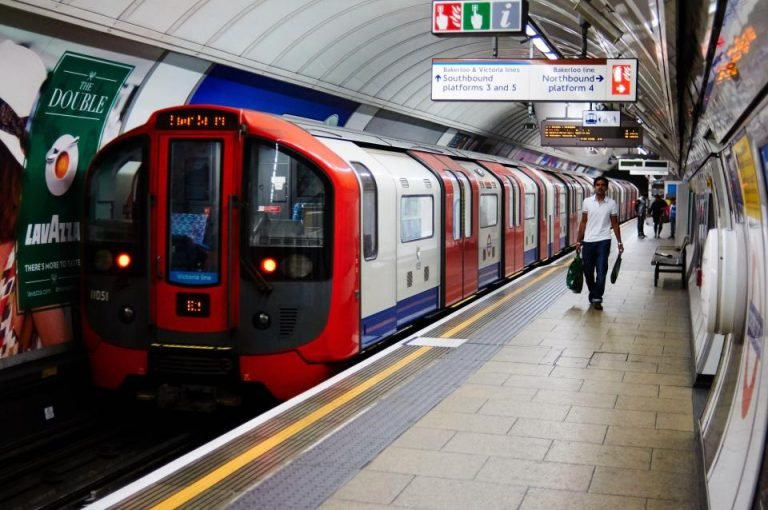
Earlier in the day, an improvised explosive device (IED) was used during an explosion at London’s Parsons Green metro station injuring 22 people. The Scotland Yard described the incident as a “terrorist incident”. The home-made bomb on a packed rush-hour commuter train in London engulfed a coach in flames, in what police said was Britain’s fifth terrorism incident this year. However, it failed to explode fully.
Passengers on board a train heading into the capital fled in panic as the fire erupted at Parsons Green underground station in West London at 8.20 am. (0720 GMT). Some suffered burns while others were injured in a stampede to escape. The National Health Service said 22 people had been taken to London hospitals, most believed to be suffering flash burns, however, none were thought to be in a serious condition, the ambulance service said. “We now assess that this was a detonation of an improvised explosive device,” Britain’s top counter-terrorism officer Mark Rowley told reporters.
London Underground Metro blast took place at Parsons Green station
In pictures taken at the spot, a slightly-charred white bucket with a supermarket freezer bag was seen on the floor of one train carriage. The bucket, still intact, was in flames and there appeared to be wires coming out of the top. “I was on second carriage from the back.
I just heard a kind of whoosh. I looked up and saw the whole carriage engulfed in flames making its way towards me,” Ola Fayankinnu, who was on the train, told Reuters.
“There were phones, hats, bags all over the place and when I looked back I saw a bag with flames.” Charlie Craven said he had just got on the train when the device exploded. “Literally within three seconds of putting your bag down, the doors just closing, we hear a loud explosion,” he told Reuters. “I looked around and saw this massive fireball … coming down the carriage.”
Reacting to the incident Britain’s Prime Minister Theresa May said, “My thoughts are with those injured at Parsons Green and the emergency services who, once again, are responding swiftly and bravely to a suspected terrorist incident,” May said. Foreign Secretary Boris Johnson said people should “keep calm” and continue their lives as normal. Germany stands united with Britain in the fight against terrorism said Chancellor Angela Merkel.
Merkel said that since attacks had also struck other European countries, including France, Spain and Germany, “this is a challenge which we all face”. “That’s why we’re united with Britain, with the British government and, above all, with the people of Britain,” she said, adding that not all the circumstances of the latest attack were known yet. “Our thoughts are with the British people and (the attack) strengthens our resolve to continue and boost
international cooperation in the fight against Islamist terrorism,” said Merkel.
“Another attack in London by a loser terrorist,” US President Donald Trump said on Twitter. “These are sick and demented people who were in the sights of Scotland Yard. Must be proactive!” May said it was not helpful for anyone to speculate on investigations after US President Donald Trump tweeted that the culprits behind a train bombing had been “in the sights” of the police.
However, a US law enforcement official and a US intelligence source, speaking on condition of anonymity, said the attack might well have been carried out in response to recent Islamic State video messages urging would-be militants to attack trains and other public transport. The officials said the device “doesn’t look very professionally built” and said its rudimentary design suggested the attack was carried out by someone inspired by Islamic State propaganda rather than by a well-trained cell. UK security services believe those behind some of the militant incidents in Britain this year had probably been acting alone and likely radicalised by online material.
In 2005, 52 people were killed when four British Islamists carried out suicide bomb attacks on three London underground trains and a bus and this year Britain has suffered four attacks which killed a total of 36 people.
Are you at Parsons Green station? Did you witness the events? If it’s safe to share your experiences then please email to editor@metrorailnews.in with your stories.
New Delhi: Bharat Heavy Electrical Limited (BHEL) has moved higher by 10% to Rs 146 in intraday trade on the back of heavy volumes after Prime Minister Narendra Modi and his Japanese counterpart Shinzo Abe on Thursday laid foundation stone for India’s first bullet train between Ahmedabad and Mumbai.
The stock settled the trade 3.6% higher at Rs 137 on the BSE.
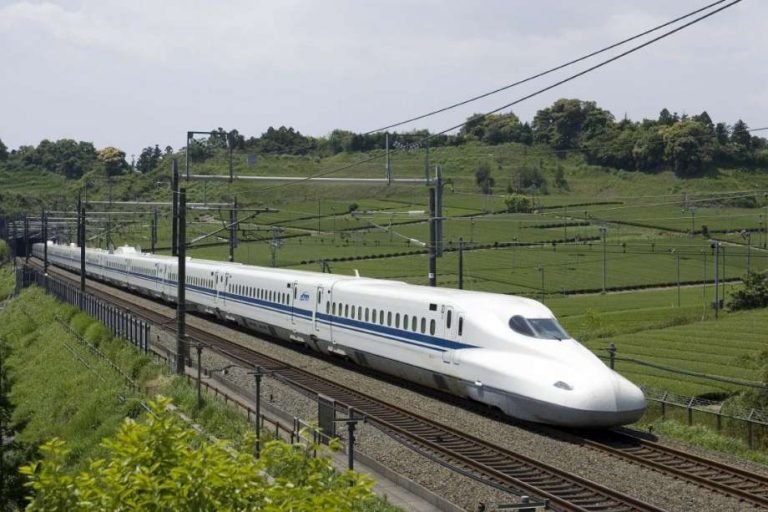
KHI is a manufacturer of heavy equipment and its rolling stock company has supplied EMU trainsets to various countries like the US, Singapore, Taiwan and Hong Kong, alongside Japan, the statement said. KHI is also the manufacturer and supplier of the Shinkansen High Speed Bullet Trains, proposed to be introduced in India on the Mumbai-Ahmedabad High Speed Rail Corridor. The pact will enable BHEL to produce stainless steel coaches indigenously, it added.
The Technology Collaboration Agreement covers establishing a state-of-the-art design, engineering and manufacturing facilities at BHEL, India using Japanese technology, a company statement said.
The pact will also entitle BHEL for all technology advances and upgrades. BHEL has been supplying the Indian Railways both electric and diesel locomotives, EMUs, and propulsion system sets and drives for the same. Kolkata Metro, the first metro project in India, is equipped with BHEL made propulsion system.
Meanwhile, in past four trading sessions, the stock rallied 14% after the BHEL has fixed September 30, 2017 as the record date for the purpose of issuance of bonus shares of the company in the ratio of 1 (One) new equity bonus share Rs 2 each for every 2 (Two) existing equity shares of Rs 2 each.
Ahmedabad: India’s creaking, colonial-era railway system is preparing to take a giant leap forward as the Indian prime minister breaks ground on the country’s first bullet train project.
Narendra Modi laid the foundation stone for the high-speed line on Thursday during a visit by his Japanese counterpart, Shinzō Abe, to the western state of Gujarat.
“This is the new India and the flight of its dreams is endless,” Modi said at the ceremony. “The bullet train project will bring speed and employment. It is human-friendly and eco-friendly.”
The high-speed line, which the government aims to launch by the 75th anniversary of Indian independence on 15 August 2022, will run from Ahmedabad, the Gujarat capital, to the financial hub of Mumbai.
PM Narendra Modi with Japanese PM Shinzo Abe (Photo: PTI)
Indian officials say the train will have a maximum speed of 217mph (350km/h), more than twice the speed of the country’s current fastest train, which runs from the capital, Delhi, to Agra at a comparably sluggish maximum of 100mph.
The Shinkansen model train will cut the 316-mile journey from Ahmedabad to Mumbai from eight hours to around three.
More than four-fifths of the project’s $19bn (£14.4bn) cost will be funded by a 0.1% interest-rate loan from Japan as part of a deepening economic relationship that both countries hope will act as a bulwark against Chinese influence in Asia. “Japan has shown that its a true friend of India,” Modi said on Thursday.
The fast rail is also significant for the Modi government, which made the bullet train a key part of the modernisation agenda on which it campaigned at the 2014 elections. It also claims the project will create about 36,000 jobs.
Narendra Modi and Japanese PM Shinzo Abe in Gujarat
India is reportedly considering another six potential high-speed rail corridors, including one connecting Mumbai and Delhi. But the former chairman of India’s railway board Vivek Sahai said that the financial investment required to build such fast rail meant it was unlikely to phase out traditional trains any time soon.
“India runs more than 10,000 trains each day, which carry the equivalent of the population of Australia – you can’t just discontinue them,” Sahai said.
The country might also find it cheaper to invest in medium-speed trains that could run on the existing system, he added, rather than paying for the special infrastructure required to run bullet trains.
The spread of super-fast trains would ultimately “depend on the finances”, he said. “High speed trains have to come to India … but how to get it and the financial viability of the projects is still to be questioned,” he said.
Trains are still the preferred choice of long-distance travel for most Indians but passenger numbers, particularly in the more expensive berths, have started to decline since 2014.
Growing incomes in the past three decades have seen a surge in car ownership, and India’s domestic flight market grew 14% last year, second only to China’s.
The industry is also marred by a horrendous safety record: a 2012 government report referred to the annual death toll from the country railway’s system as a “massacre”.
More than 33,700 people died in train-related accidents in 2015, the most recent year for which data is available, the majority by falling from overcrowded trains or being hit as they tried to cross tracks.
Modi replaced the country’s railway minister in August after a horror 12 months that included an accident last November that killed 150 people.
The government has committed to spending $137bn (£111bn) over its five-year term to upgrade India’s railways, including improving track structure and introducing long welded rails and track patrols to prevent railway infrastructure from falling into disrepair.
India’s train network, built during British colonial rule is Asia’s oldest and the fourth-longest in the world, covering more than 67,000km.
India’s first bullet train – a dream project for the country – is set to see the light of the day this week. Not just that, if Indian Railways has its way, you may get to travel on the Ahmedabad-Mumbai bullet train in less than 5 years time! The Narendra Modi government has set an ambitious deadline of starting the bullet train on August 15, 2022 – the day that India marks its 75th year of Independence. On September 14, Japanese PM Shinzo Abe along with PM Narendra Modi will lay the foundation stone for this historic and gigantic infrastructure project that is going to cost India approximately Rs 1,10,000 crore.
The bullet train or high-speed train project was originally scheduled to be completed in 2023, but Railway Minister Piyush Goyal has been quoted as saying that PM Modi is confident that Indian engineers will achieve the feat in lesser time. The bullet train project, which has been in works for some years now, was given the clearance by Modi government in 2015.
(Narendra Modi and Japanese PM Shinzo Abe in Gujarat)
The unprecedented scale of the infrastructure projects assumes special significance given the fact that it comes under ‘Make in India’. Not only that, Piyush Goyal is confident that once India absorbs the technology of making bullet trains, it will be able to export to the world as well! That’s just one amazing fact about the project, though! From a 7 kilometre long under-sea tunnel to a maximum speed of 350 kmph – we take a look at 10 mind-blowing facts about India’s first bullet train project:
1. Cheaper than flights? The government, in its own words, aims to keep the bullet train ride “affordable for all”. Railways officials, quoted by PTI, have said that the fare would be comparable to that of Rajdhani Express AC-2 tier.
2. Seating capacity and frequency: Japan’s Shinkansen E5 series of bullet trains have been identified for the project. The bullet train – with executive and economy-class seats – will have 10 coaches that will be able to seat as many as 750 passengers. Later, Indian Railways proposes to add 6 more coaches to take the seating capacity to 1,250 passengers. Initially, 35 bullet trains will be operated. By 2053 this number is likely to go up to 105. The bullet trains are expected to do 70 Ahmedabad-Mumbai sorties in a day. While 24 bullet trains will be imported from Japan, the rest will be manufactured in India, reported IANS.
3. Train features: Earlier in the year, PTI had reported that Shinkansen bullet train for India will have two extra-spacious toilets for wheelchair-bound passengers, multi- purpose room for breast feeding and sick passengers, wall-mounted type urinals, baby toilet seats and western style toilets.
4. Stations: Covering a distance of 508 kilometres, the bullet train between the two business hubs of Ahmedabad and Mumbai will cover a total of 12 stations; Mumbai, Thane, Virar, Boisar, Vapi, Bilimora, Surat, Bharuch, Vadodara, Anand, Ahmedabad and Sabarmati.
5. Travel duration and speed: Two trip options will be offered by Indian Railways. With stops at limited stations – Surat and Vadodara – the train will take 2 hours 7 minutes to travel between Mumbai and Ahmedabad. However, the train that will stop at all stations will take 2 hours and 58 minutes. The bullet train will run at an operating speed of 320 kmph and a maximum speed of 350 kmph!
6. Under-sea tunnel: Passengers will get to travel in a 21-km long tunnel while riding the bullet train – 7km of which would be under the sea!
7. Peter not paying for Paul? That’s what Indian Railways claims. The bullet train project is being made at a cost of Rs 1,10,000 crore. Out of this, the Japanese government is providing a loan of Rs 88,000 crore at a “miniscule” interest rate of 0.1%. The loan can be repaid over a time span of 50 years, with the repayment beginning 15 years after disbursement. The loan interest ranges between Rs 7-8 crore a month and the government claims it will not put any strain on existing financial resources. “Clearly Peter is not paying for Paul,” the government claims.
8. Make in India & Transfer of Technology objectives: One of the biggest benefits of the bullet train project will come from the fact that Indian engineers and labour will gain knowledge and skills to ‘Make in India’ the parts and rolling stock. This, in turn, would be beneficial for future high-speed rail projects that are being planned for other routes in the country – and as Railway Minister Piyush Goyal said – we may even start exporting!
9. Jobs and Skill India: According to the Modi government, the project is likely to generate employment for about 20,000 workers during the construction phase. These workers will be trained specially to take up construction of such projects in India. “Some of the new areas where construction skills would be developed are ballast-less track, under sea tunnel etc,” says the government, adding that a dedicated High-Speed Rail Training Institute is being developed at Vadodara.
10. Safety: The train delay record of Shinkansen is less than a minute with zero fatality, says Japan. Not only that, the technology for disaster predictions and preventions will also be acquired. This would make sure safety is maintained in case of any natural calamity such as an earthquake etc. Modi government hopes that with this technology, India will leapfrog to the cutting edge of latest train developments.
The Metro Rail News editorial team is proud to announce its worldwide project of connecting working and non-working professionals, journalists, railway & public transport engineers, research associates, freelance writers and engineering / management students on an intellectual platform. This platform also encourage youngsters to improve their editorial / writing skills and learn about benefits of green metro systems, smart public transport, their role in global climate change, smart cities, chronicle development in technology and involved strategies & policies.
Smart Cities: How smart public transportation will make citizens smart?
Driverless (UTO) Metro Train: Advantage and disadvantage in context of increasing commuters in metropolitan cities.
Article length: Article should be greater than 2000 words in English only.
Last date of submission: 30th day September 2017
Result Announcement: 5th day of October 2017 at metrorailnews.in
Mode of submission: In MS-Word format via e-mail to editor@metrorailnews.in
Who can participate: Open to all. (Participant should not be an active member of editorial team of any print magazine/newspaper)
Prize / Cash Award for best entries: Once the article is submitted our editorial team will review it thoroughly. 5 best entries will be selected by our Editorial Board for publication in our Metro Rail News (Monthly) Magazine as well as on our news portal metrorailnews.in
The writers of first 3 selected entries will be honored with Cash award + Appreciation certificate by the Symbroj Media Pvt. Ltd. and its associates (including sponsors):-
1st Rank: ₹2500.00 (or equivalent currency)
2nd Rank: ₹1500.00 (or equivalent currency)
3rd Rank: ₹1000.00 (or equivalent currency)
Besides the above, the article garnering maximum page previews / readership will be selected for our “Quarterly Award Programme”. A cash prize of ₹5000.00 or equivalent currency will be given to writer of highest readership earning article. Writers will get a period of one month to promote their articles on social media to get more readership.
Rules, terms & conditions:-
Articles should be accomplished with brief bio of writer, a passport size photograph along with link of his/her LinkedIn profile.
A person can send one article in each topic. Multiple article on same topic will not be allowed.
Only the original works will be published. Any attempt to publish copied content will be discarded, and the defaulter will be banned from participating in the next contest.
All communication will be made either through our news portal or e-mail to the winners.
Metro Rail News reserved it rights to publish selected articles on one or more websites. However, due credits will be given to author.
Decision of Metro Rail News Editorial Team will be final and binding.
In case of any query or clarification, please write to editor@metrorailnews.in
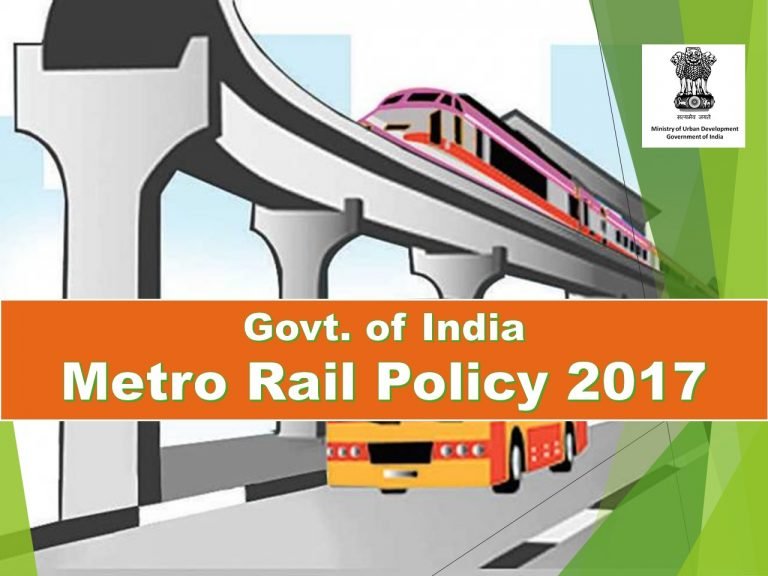
On 16th August 2017, the Union Cabinet chaired by Prime Minister Shri Narendra Modi has approved a new Metro Rail Policy that seeks to enable realization of growing metro rail aspirations of a large number of cities but in a responsible manner.
Indian cities are growing rapidly.
There is a need to direct growth in a planned manner with adequate attention to the transport system at early stages in their development. Cities are witnessing fast growth in the number of personal motor vehicles, with severe congestion and pollution being the most visible manifestation of the growth in the number of motor vehicles. Efforts at remedying the situation will need to focus on improving the public transport system. In several cities this would require implementation of Mass Transit systems such as metro rail, bus rapid transit, light rail, etc.
Urban Rail, popularly referred to as Metro Rail, has seen substantial growth in India in the recent years. More cities are experiencing the need for metro rail to meet their day-today mobility requirements. Most of the metro rail projects have been financed by the central government in partnership with the state governments, while some have been funded by the state governments either on their own or with private partnership. Metro rail projects provide high capacity public transit and are capital intensive. However, considering the rapid urbanization and the imminent need for enhancing mobility in cities through metro rail, it is imperative to explore alternative and innovative sources of funds to supplement the budgetary resources. At the same time, it is also important to ensure that the proposals are prepared and appraised in a comprehensive manner to enhance urban mobility as well as the speed and quality of implementation of metro projects. It is in this context that the need for a policy on metro rail has been felt necessary to ensure that such systems are decided upon and implemented in the most sustainable manner from the social, economic and environmental perspectives.
Now Metro Rail News providing you complete Metro Rail Policy 2017 approved by Government of India for standardization and expanding the metro network across various cities in India.
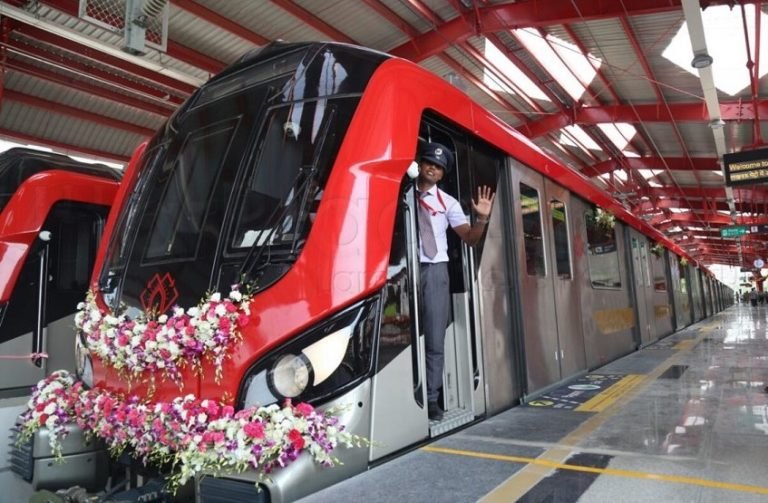
Lucknow: While all necessary arrangements have been done to ensure the safety of passengers on board the Lucknow Metro, the Lucknow Metro Rail Corporation (LMRC) on Tuesday announced that it had entered into an agreement with the United India Insurance Company for passenger accident and public liability insurance.
“For all passengers travelling on the Metro service, there would be a Rs 400,000.00 (four lakh) cover per person, for any accident that leads to death, permanent total disability, permanent partial disability, temporary disability and medical expenses and/or compensation awarded by any court of the land or tribunal,” Director (Operations) Mahendra Kumar said.
Against any similar accidents to people present in the Metro station premises other than paid area and trains, including unpaid areas, circulating area, parking area or any other areas under the jurisdiction of the LMRC, on any one accident, the insurance cover sum in total is Rs 10 lakh, Kumar added.
In a conversation with Economic Times, Sinha said, “I will be the interface between the two governments. This is a prestigious project but extremely complex.
Converting the political will into actual execution will take a lot of effort.”Sinha had earlier worked with Goldman Sachs, Mizuho Securities, UBS Investment Bank and as Chief Country Representative in Japan for Tata Asset Management and Tata Realty and Infrastructure, a private equity fund.
The ambitious Mumbai-Ahmedabad High Speed Rail Project said to be cost around Rs 1 crore and would be backed by Japan’s low cost financing.
The groundbreaking ceremony for the bullet train project, would be performed in Ahmedabad on September 14 by Prime Minister Narendra Modi and his Japanese counterpart Shinzo Abe.
Both the leaders are expected to stay here for three days, starting from September 13.
“Japanese PM Shinzo Abe and our PM would arrive in Gujarat on September 13 afternoon. The next morning, they would attend the groundbreaking ceremony of the high speed rail project at the Sabarmati railway station. Both of them are expected to leave on September 15 morning,” the official earlier told reporters.
Apart from this project, various MoUs related to investments and tie-ups would also be signed in the presence of these leaders, the official said, adding that bilateral talks will also be held between the two here. The high speed railway line between Ahmedabad and Mumbai is expected to cover 508 kilometers in about two hours with an operating speed of around 320 kmph. It is expected to become operational by 2023.
Sanjeev Sinha appointed as Advisor for Ahmedabad-Mumbai bullet train project
Sanjeev Sinha, hailing from Barmer Rajasthan in relative proximity to Ahmedabad, is a graduate of IIT Kanpur. He is a prominent Indian resident of Japan for 21 years. He has worked with Goldman Sachs, Mizuho Securities, UBS Investment Bank and as Chief Country Representative in Japan for Tata Asset Management and Tata Realty and Infrastructure, a private equity fund.