Home Blog Page 824

Lucknow Metro | LMRC celebrates World Environment Week with Shramdan by employees

Lucknow: With a motto to encourage mass awareness and self-initiated drive for protecting our environment and keeping Lucknow Metro a clean and green mode of Mass Rapid Transit System (MRTS) for the people of Lucknow, Lucknow Metro Rail Corporation (LMRC) today led by Shri Kumar Keshav, Managing Director started a mass ‘shramdan’ cum environmental drive to celebrate the World Environment Week.

On the occasion, Kumar Keshav the Managing Director said “We at Lucknow Metro must inculcate this habit of cleanliness in our daily affairs to ensure and retain world class cleanliness standards at our premises and surroundings.” “We must not hesitate to pick garbage with our hands and should try to maintain our cleanliness on our own. This is the only way to take forward the Clean India Mission of the Government”, he added.

All Metro officers and staff gathered at the Transport Nagar Metro Depot this morning and started contributing towards intensive cleanliness of the Depot and the Transport Nagar and Krishna Nagar Metro stations. They all participated in the ‘Mass Shramdan’ organised by the Corporation and were very happy to be a part of the drive.

Sharing his experience, Mr. Vishal Kumar Nath, a Customer Relation Assistant (CRA) said “cleaning and caring for our environment must be one of our prime responsibilities apart from the office work. We must take care of our surroundings just as we take care of our home and try to keep it clean, green and lively”.

Ms. Neha Kumari, Station Controller/Train Operator (SC/TO) said “as a Station Controller or as a Train Operator, the first and foremost duty of the individual should be to make sure that  his/her Metro station or the Train which he/she is driving is completely neat and clean. This reflects the good habits at Lucknow Metro as a whole and shows our positive concern for the environment”.

While Mr. Manoj Kumar who is working as a Junior Engineer (Safety/Environment) commented “LMRC has always encouraged us to take up activities related to the environment for its betterment. Our MD Sir always motivates us for taking an initiative for bringing a positive change in society”.

LMRC has decided to undertake an environmental campaign during the World Environment Week from 3rd June, 2017 to 9th June, 2017 wherein many environmental awareness activities such as sapling plantation drive, external training session on environment, quiz competition, slogan competition, poster/green selfie competition, training session by Confederation of Indian Industry-IGBC(CII-IGBC) Team etc. will be held to raise global awareness to take positive environmental action to protect nature and the mother earth.

Lucknow Metro observes the “World Environment Week” every year and these activities are the part of Lucknow Metro’s green initiatives for the city to make it green. LMRC has planned to provide an environmental friendly Mass Rapid Transport for the public from the first day of its inception. Lucknow Metro ensures that its every activity is an environmental friendly endeavour so as to keep the city clean, green and lively.

Kolkata Underwater Metro | Know how Kolkata is Building Tunnel Under Water

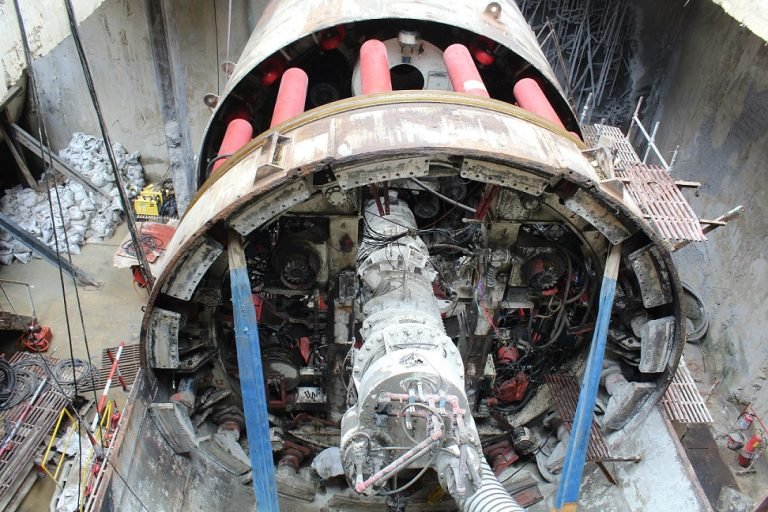
Kolkata: Two top-order tunnel boring machines, nicknamed Rachna and Prerna, are digging India’s first ever under-the-river Metro tunnels in Kolkata at full speed. If all goes through, then one could take a Metro ride under the Hooghly river in December 2019.

Tunneling for the project began at the Howrah end in April under the Hooghly river. The tunnels are 520 metres long and about 30 metres deep. The under-the-river Metro ride will be all of 60 seconds long.

The 90-metres-long tunnel borers ‘Rachna’ and ‘Prerna’, named after the daughters of a project officer who died in a road accident, were brought from Germany in parts and assembled underground. ‘Rachna’ took a little over a month to cross the Hooghly.

Tightest precautions are in place for workers and for commuters, once the Metro is ready. Special concrete sections are being used to line the tunnel. These sections have special gaskets that expand if contacted with water to rule out leakages.

“It is a huge challenge,” said Satish Kumar, managing director of the Kolkata Metro Rail Corporation Limited.

 “The soft soil was an issue. Cutting through rock is less complicated… There have been water leakages in projects abroad, which slowed them down. We don’t want any leakages,” he added.

However, the tunnels will pass less than 100 metres away from three heritage buildings, which needs the approval of the Archeological Survey of India.

“The work has slowed down because we cannot progress below heritage buildings without the permission of the Archeological Survey of India,” said KMRCL chairman Vishwesh Choubey.

“We hope it will come through soon,” he added.

This was echoed by Mr Kumar who also said that getting the Archeological Survey’s approval is just a matter of time.

“IIT-Kharagpur has done an independent study and certified that the methods we are using will ensure no damage to the heritage buildings,” the Kolkata Metro managing director said.

Scores of workers and officials are optimistic about the project.

“Kolkata had the honour of getting India’s first Metro. Now, it will get yet another honour of getting India’s first metro under the river,” said chief engineer Parshuram Singh.

Source: NDTV

India to introduce new Metro Rail Policy for metro projects in this month

New Delhi: After the intervention of the Prime Minister’s Office, a new Metro policy will be introduced in the Cabinet this month by making changes now. It is important that the PMO’s suggestion has been made the most important change in the policy, the Metro project will be launched only under Public Private Partnership (PPP) wherever the it is Vaibel. If it seems that the Metro project will not have enough revenue to run the private company, then the city should not include private players for the Metro project.

Apart from this, Metro project will be seen at the approval level only to see how much benefit will be by land development from Metro project. According to sources in the Urban Development Ministry, this is the first time that a separate Metro policy has been created in the country. Earlier, in 2007, the National Urban Transport Policy was created and the Metro was included in it.

Officials of the ministry say that although the draft of the policy had already been prepared, but on the occasion, the PMO has made some suggestions for the change in the policy. These suggestions are also being included in the policy draft. Urban Development Minister M. Venkaiah Naidu says that within the next one month, this policy will be presented for approval in the Cabinet.

According to the sources of the ministry, prior to PMO’s suggestion, it was emphasized that state governments should bring Metro projects on PPP in their cities i.e. money from private companies in the metro and that too later to operate the metro, but PMO Has suggested that the Metro project should not be brought on PPP, because it is a public transport for the cities. Not a great instrument.

According to sources, the PMO has also said that in the policy, it should be included in the matter that due to the formation of a Metro project the amount of land will be increased around the metro line and how it can be benefited.

In the same way how will the empty land of the surrounding land be used in the long term, it is also being included in the policy. The Government believes that the metro project will not be assessed only through cost and income, but it will also be seen that by how much it will reduce the losses due to pollution, roads maintenance, accidents, and after that Metro project will be approved. It is notable that at present, the Urban Development Ministry has come to the Detailed Project Report of Metro Project of several cities including Patna, Bhopal, Indore for approval.

Sonepat Metro | Haryana approves extension of Delhi Metro Rail from Narela to Kundli

Chandigarh: The Haryana Cabinet today approved the extension of Metro Rail from Narela in Delhi to Kundli in Sonepat district.

The project will be financed by the state and Central governments, with Haryana providing 80 per cent of the funds, and the Centre taking care of the rest.

This was the funding pattern adopted for the Delhi Metro Rail Corporation (DMRC) extension to Gurugram, Faridabad and Bahadurgarh in Haryana.

The state government will contribute Rs 968.20 crore as its share, an official spokesman said.

The 4.86-km long extension will have three stations – Narela Sector 5, Kundli and Nathupur. All the three stations will be elevated.

The construction for the Narela-Kundli extension is proposed to start in April 2018 and end by March 2022.

The Cabinet meeting, chaired by Chief Minister Manohar Lal Khattar, also approved the revised funding pattern of Metro projects in the state.

Under this, 50 per cent of funds for DMRC projects in Haryana will be contributed by the Haryana Infrastructure Development Board, 20 per cent by the Haryana Urban Development Authority, 18 per cent by state government and 12 per cent by the Haryana State Industrial and Infrastructure Development Corporation, the spokesman said.

The state government also notified a revised Transit Oriented Development (TOD) Policy, which prescribes parameters for creating TOD as a means of densification of corridors along Mass Rapid Transit System (MRTS) projects, and also as a source of generating revenue for financing the MRTS projects.

The fee or charges collected under this policy will be kept under a separate head in the Infrastructure Development Fund and will be exclusively utilised for implementation of MRTS projects.

The Cabinet also approved the proposal that bus fares beyond Rs 15 be charged in multiples of five. Tickets below Rs 15 will be of Rs 5, Rs 7, Rs 10 and Rs 12, depending on the distance.

Vijayawada Metro | DMRC suspends tendering process of metro rail project

New Delhi: The Vijayawada metro rail project appears to have hit a hurdle, as the Delhi Metro Rail Corporation (DMRC) has suspended the ongoing tendering process.

The DMRC is providing technical support for the project’s execution.

While the government was hoping to finalise a contractor within a week’s time, it could be deferred due to this development. Issues with the land acquisition process and delay in obtaining clearance from the Public Investment Board (PIB) which has said that the project is not viable, were cited as reasons for the DMRC to take this decision.

DMRC had earlier cleared the technical evaluation and studied the financial bids by L&T and Afcons Infrastructure.

“We have written to the DMRC seeking to know the reasons for cancellation of the tendering process.”, said  NP Ramakrishna Reddy, Managing Director of Amaravati Metro Rail Corporation (AMRC).

The high amount quoted by L&T and Afcons was the chief reason for suspending the tendering process, according to sources. However, AMRC has denied it.

Tenders which had been called for in December 2015 became void in June the following year, after the project failed to get the necessary clearance for execution.

The duration for completion of the project is going to be affected with this latest development. Andhra CM Chandrababu Naidu had in the past directed that at least one of the two corridors should be ready by the end of 2018 but this looks unlikely.

A senior AMRC official told the newspaper that the project will get delayed but they shall launch and finish the works as soon as the process gets completed.

Train Accident | One killed, more than 100 injured in South Africa train collision

At least one person was killed and more than 100 injured when a South African train slammed into the back of another at a station near Johannesburg, the state-owned train operator said on Thursday.

The collusion, which left several train carriages lying on their sides, occurred after the two trains were manually authorised to be on the same track after signalling power cables were stolen overnight, Metrorail said in a statement.

“Paramedics discovered that one of the drivers of the trains had sustained fatal injuries,” emergency medical service firm ER24 said in a statement.

Train collisions and derailments are not uncommon in South Africa, often caused by the theft of power cables, which are made out of highly sought-after copper.

(This article has not been edited by Metro Rail News’s editorial team and is auto-generated from an agency feed.)

Source: Reuters

Hyderabad Metro | Track and Infra are ready but train is not on track for June 2 start

Hyderabad: With no official communication from the state government to Hyderabad Metro Rail, it is not clear whether the service from Miyapur to SR Nagar will start on June 2, the State Formation Day.

While the rail infrastructure is ready, much work needs to be done on parking areas, cycle and scooter stations and other facilities.

At various forums in February and March, Hyderabad Metro Rail managing director N.V.S. Reddy had stated that the service would start mid-2017.

However, on May 19, minister K.T. Rama Rao said in a tweet: “Metro will run actively on 59 km by year-end. It will start in phases.”

A senior HMR officer on condition of anonymity said the stretch from Miyapur to SR Nagar was ready in terms of station and concourse area. The safety clearance certificate had been obtained and trial runs had been carried out, he said. Land for parking of vehicles had been handed over to L&T Metro Rail and work was being carried out for multi-level parking.

A senior officer said, “We will have to study the travel pattern and the number of places where there are large exits and entries to determine parking zones. Work on bus bays has started. The tie-ups with companies for bike and scooter stations have been initiated and will fall into place once the service starts.”

Street-scaping was undertaken at Metro Rail stations in April. Encroachments over 2 km of roads were removed between Miyapur and Hydernagar to make way for bus bays and bike stations. A children’s play area and exercise zone has been demarcated and are being developed. When contacted about the timeline, Mr Reddy said it was not possible to comment on the start of the Metro Rail and it was for the government to decide. Officials of L&T Metro Rail refused comment.

India Bullet Train | PM Modi to lay foundation stone of bullet train project in September

0

New Delhi: The long wait for construction of country’s first bullet train project will be over by September this year, when actual work on the Mumbai-Ahmedabad corridor will begin.

Prime Minister Narendra Modi and his Japanese counterpart will together lay the foundation of the project during the latter’s visit to India in September, said Mohd Jamshed, member traffic, Railway Board.

Speaking at the 3rd Mail Today Tourism Summit in the national Capital, Jamshed said the construction work would continue for another five years and mentioned that the government was committed to complete the project by the end of 2022.

He asserted that India’s bullet train, at the speed of 320 km per hour, will match the speed of the leading highspeed train systems across the world. This, he said, would prove to be a big leap for Indian Railways which is also the backbone of the tourism sector in India with its vast network of over 66,000 km, catering to 24 million passengers everyday. Jamshed noted that railways also catered to nearly 9 million foreign tourists per year.

He added that a 508-km stretch of the project will be entirely elevated that will save railways’ hassles of legal and environmental delays, owing to land acquisition.

Apart from the bullet, the average speed of trains will increase with railways opening sections of the eastern and western dedicated freight corridors. This will increase the speed of trains on Delhi-Mumbai and Delhi-Howrah route by up to 160 kmph.

Jamshed mentioned that for the first time after 2006, the Railway ministry is coming up with a dedicated and a liberalised tourism policy that will take care of the entire transportation and catering needs of tourists from every section of the society in India.

Kochi Water Metro | KMRL gives node for engaging GC for Water Metro Project

0

Kochi: The Board of Directors of Kochi Metro Rail Limited (KMRL) today approved a proposal for engaging a General Consultant for Water Metro with an estimated project cost of Rs 747 crore.

The project envisages creation of modern water transport infrastructure in Greater Kochi region by inducting 78 state-of-the-art modern boats along 16 routes and traversing 38 boat jetties.

The meeting approved extension of agreement with DMRC and payment of additional remuneration of Rs 42.71 crore to them for execution of Kochi Metro Rail Project Phase I, a KMRL release said here today.

The agreement with DMRC for executing the Kochi Metro Rail Project will expire tomorrow.

The agreed remuneration was Rs 241.8396 crore for a four year period at six per cent of the approved project cost (excluding land cost and DMRC remuneration).

DMRC had requested for an additional remuneration of Rs 42.71 crore, to execute the remaining work during the extended period of the contract.

The 26th meeting of the Board of Directors of Kochi Metro Rail Ltd was held in New Delhi under the chairmanship of Rajiv Gauba, Secretary, Urban Development.

Kochi Metro | PM Modi to flag off Kochi Metro train services on June 17

Thiruvananthapuram: Prime Minister Narendra Modi will inaugurate Kerala’s prestigious Kochi Metro project on June 17. The inaugural function of the 13-km Aluva-Palarivattom corridor will be held at Aluva in Ernakulam district.

“Modi will inaugurate the Metro services at a function to be held at Aluva,” the CM’s office told Media. Chief Minister’s Private Secretary M V Jayarajan confirmed Officer-on-Special Duty at the CM’s office M Sivasankaran had received a message in this regard from the PMO.

Kochi Metro, which secured the green signal from rail safety panel, had begun service trials recently on the corridor.

About Kochi Metro Rail Project:

  • In the first phase, seven trains with CBTC technology will run on the 14-km Aluva-Palarivattom corridor. A total of nine trains are equipped with the technology, provided by French company Alstom. The CBTC system will give the position of the train more accurately.
  • Over 600 trained women from the ‘Kudumbasree Mission’ have been employed to ensure the smooth run of the first phase of the metro. Of the total of 39 persons hired to operate the metro rakes, seven are women.
  • Twenty three persons from the transgender community have been employed for jobs ranging from handling the ticket counter to housekeeping work.
  • According to the Kochi Metro Rail Limited, Rs 10 is the minimum charge and a passenger traveling from Aluva to Pettah (the entire journey) will have to pay Rs 60. Rs 20 is the charge fixed for traveling a 5 km distance, Rs 30 for 10 kms and for traveling 15kms, a passenger will have to pay Rs 40. Rs 50 for traveling a distance of 20 kms and Rs 60 for traveling a distance of 25 kms.
  • The KMRL is planning to give concession for passengers using the Kochi One application, officials said.
  • A controversy had erupted over the inauguration after BJP Kerala leadership had alleged that the state government wanted to inaugurate the project by May end when the Prime Minister would be away on a European tour. The Chief Minister had put a lid on the controversy by saying that the government was in constant touch with PM’s office and only after getting his confirmation, a final date for the metro inauguration will be fixed.
  • The state government had recently given clearance for extension of phase II of Kochi Metro from Jawaharlal Nehru stadium to Infopark.