Home Blog Page 816

Lucknow Metro | LMRC gets technical clearance from CMRS

Lucknow: In a major development for the commuters of Lucknow, Commissioner Metro Railway Safety (CMRS), Government of India, on Monday gave the green signal for the Lucknow Metro Rail Corporation (LMRC) to start commercial operations.

CMRS Satish Kumar Pandey gave his approval to the LMRC after inspecting a trial run of a Metro train at the maximum operating speed of 80 kmph. He, along with senior LMRC officials, carried out the inspection on Monday. The train completed a to-and-fro trial run between Transport Nagar Metro station and Charbagh Metro station. LMRC in a statement said that the trial run was completed successfully on the 8.5 km priority corridor which covers eight stations.

LMRC Managing Director Kumar Keshav said, “Getting all the required technical clearances from the Ministry of Railway and finally certification from the CMRS today to commence revenue operations on the Priority Corridor of the Lucknow Metro Project from Transport Nagar to Charbagh has been a great achievement. Now, doors are ready to be opened to commence public operation of the world class Metro service in Lucknow at any convenient date.

LMRC senior PRO Amit Kumar Srivastava said that the Government of India and the state government would be intimated that all clearances have been obtained to operate the metro rail in Lucknow. Srivastava said a date will be sought from the government for inauguration.

Lucknow Metro | LMRC celebrates 71th Independence Day of India

Lucknow: The Lucknow Metro Rail Corporation (LMRC) today celebrated the 71st Independence Day with great fervour at its Administrative Building, Vipin Khand Office. The occasion was graced by Shri Kumar Keshav, Managing Director and other Directors of the organisation.

The Managing Director unfurled the national flag in the presence of officers and staff of the organisation. It was followed by the national anthem. On the occasion, the Managing Director said “It is a great and memorable day for LMRC as the organisation has received all the necessary technical and safety clearances from all the statutory body and the Metro trains are all ready for public inauguration.”

“This has been possible only because of extreme devotion and continued hard work by the whole team of LMRC and good wishes and support of the people of Lucknow. Now, doors are ready to be opened to commence public operation of the world class Metro service in Lucknow at any convenient date, he added”.

The Managing Director remembered the time when Country got freedom in 1947. “It was then a time for our nation when it made a tryst with destiny. Now, after 70 years it is Lucknow Metro’s time for making a tryst with destiny.

We all should, therefore, take a pledge on this 71stIndependence Day that we will re-dedicate ourselves in the service of this nation by doing our work with complete devotion and dedication”, he said.

Lucknow Metro Rail Corporation also initiated ‘Swachh Bharat Abhiyan’ on the eve of the Independence Day for maintaining cleanliness of offices, premises, workplaces etc. LMRC is committed to ‘Swachh Bharat Abhiyan’ and the efforts will continue during the year. On the occasion, LMRC decorated its Administrative Building in tricolour lighting to give a feel of the national day.

Delhi Metro | DMRC smart cards becomes common mobility card soon

New Delhi: After years of delay, common mobility cards are going to be a reality in Delhi as the first 500 buses having the facility will be rolled out in two weeks from now.

The Delhi government has begun procuring chips known as Secure Access Modules (SAMs) from South Korea to ensure cashless transportation in the city. These chips will be fitted in the electronic ticketing machines (ETMs) that have already been handed over to the bus conductors.

“The Delhi Integrated Multi-Modal Transit System (DIMTS) is procuring the first 100 SAM chips from South Korea as they are not available in India. These will be rolled out immediately. We need 2000 more such chips for cluster buses for which tenders have already been floated. The bidder is expected to import the same product for us,” said a transport official.

In the first phase, the government will introduce this system in 100 cluster buses and 400 Delhi Transport Corporation (DTC) buses. The DTC is outsourcing the project and procuring ETMs that would already be fitted with the SAM chips.

“SAM is a chip or card is installed permanently in the equipment interacting with the cards or tickets. It is used to enhance the security and cryptography performance in devices to perform secure transactions in paying terminals,” the official said.

The security of a contactless system is based on secret keys used to authenticate transactions and the SAM stores these secret keys.

By extending the DMRCs smart card for cluster buses, the commuter will be able to pay the fare using the Delhi Metro Rail Corporation’s smart card. The DTC runs over 3,900 buses in the city and another 1,600 buses are being run by the DIMTS under the Cluster scheme.

The government has planned to facilitate travel on all its buses with the use of the metro smart card by the end of this year.

One of the issues that had hampered the integration of the systems of DMRC and DTC was that of refund value which needed approval from the Reserve Bank of India.

“The statutory clearances have been obtained from RBI to make the common mobility card operational,” a DMRC official said.

Source: HT

Delhi Metro | DMRC cuts fares up to 50% on metro ride on Independence day

New Delhi: The Delhi Metro Rail Corporation (DMRC) on Monday announced that fares this independence day will be discounted to up to 50 per cent. As per the announcement, this is a special offer for all Metro users who can avail up to 50 per cent off on their metro fares, amid recent rise in metro fares.

In another notification, the DMRC announced that all Metro parking will remain close from 6am on August 14 till 2 pm on Tuesday.

The decision to offer fares at discounted prices on national holidays of Republic Day, Independence Day and Gandhi Jayanti was proposed by the committee which decides metro fares. This move also seems to be an attempt to boost public transportation on days when traffic routes around the city are diverted in several points.

The second notification by the DMRC states that parking at Metro stations will remain closed from 6 am on Monday to 2 pm on Tuesday owing to security measures adopted for the Independence Day celebrations.

The DMRC also directed its officials to inspect the parking facilities and asked its contractors to clean up the premises keeping in mind the spirit of Swachh Bharat Abhiyan.

Delhi Metro | DMRC to provide pick and drop points in underground stations of phase IV

New Delhi: The Delhi Metro Rail Corporation (DMRC) has proposed to to provide Multi Modal Integration underground because most of the Metro stations face problem of overcrowding at the gate. The pickup point in the underground Metro stations of phase IV will be one level below the ground, to avoid congestion on the road.

“In phase IV we are contemplating this. Since the space is not available on the street, all our underground stations will have one more level. Today we have two level stations, but in phase-IV we will try to have three levels so that one level can be used for traffic,” DMRC managing director Mangu Singh said.

Of the 103.9-km network proposed in phase-IV, about 35. 92 km will be underground. Seventy-nine stations are planned in phase IV of which 28 will be underground, where this facility will be available. By taking the Metro-bound traffic underground, the DMRC will reduce congestion on the road and commuters get dedicated space for public transport.

“We will provide ramps for taxis, two-wheelers and other vehicles. Today, you have to come out on the road to get the taxi but in phase IV, we will provide that facility inside the station.

This is at the planning stage as the city has got a space problem,” Singh said.

When it is completed in 2022, the length of the Metro network in Delhi will be 434 kilometres with 308 stations. The daily ridership on Delhi Metro trains is likely to go up to 63 lakh from the current 28 lakh.

“Underground is costly but since we are already constructing a station and will be digging for that, it will not cost that much. We will just need to go 15-20 metre deeper,” Singh said.

At the first level of the underground station, there will be a separate lane for pedestrians and cyclists, corridor for non-motorised vehicles and space for bus stops and a lane for drop-off vehicles. After that passenger will enter the Metro premises and after crossing the concourse level, the third level will have platforms.

Source: HT

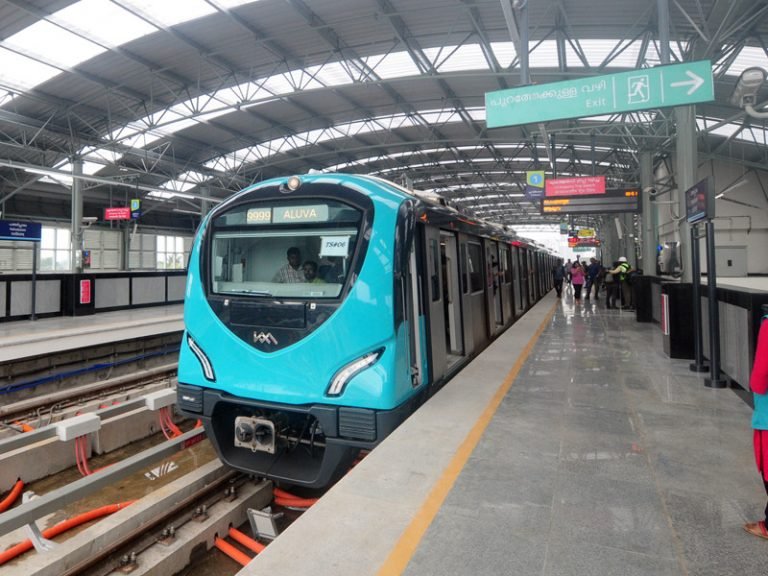
Kochi Metro | Pedestrians feel unsafe while crossing Kochi roads

Kochi: The city is just not pedestrian-friendly. A walkability study has revealed that 60% of pedestrians in the city are afraid to cross busy roads. The study on ‘safety of pedestrians in the city and development of basic facilities’ was carried out at 10 major junctions in the city over a period of seven months.

It found that 74% of the footpaths in the city is in a rundown state, and 50% of the people surveyed said the damaged footpaths have an adverse impact on their daily commute. The study conducted by ESAF for Kochi corporation pointed out that 86% of pedestrians have to get down from footpaths and walk along the road due to obstacles like cables, motor vehicles, construction materials and trees.

Handing over the study report to Kochi corporation, ESAF programme director Jacob Samuel said they conducted a sample survey of pedestrians from July, 2016 to January, 2017. According to the report the city has a high pedestrian volume irrespective of peak and non-peak hours, weekends and weekdays, and this volume amounted to a minimum of 2,000 and above on a given segment of a busy junction. “It is found that the maximum number of people walk through the city from 8am to 10am and from 4pm to 6pm,” he said.

The report says that pedestrian walkways in the city are not disabled-friendly, and 51% people pointed out the need to put in place safety measures to help them cross busy roads.

The report highlights lack of political will and co-ordination as major deterrents in ensuring the right of pedestrians in the city. The assessment of police and initiatives by various agencies responsible for ensuring pedestrian rights proved that decision makers have not taken the matter seriously.

It is expected that formation of unified metropolitan transport authority (UMTA) is expected to cover these gaps in the near future. Deputy mayor T J Vinod said that local body would go through the study and take measures to plug the holes in pedestrian safety measures. He also said that views from stakeholders including public, government departments and NGOs would be taken into consideration.

The deputy mayor pointed out the efforts taken by Kochi Metro Rail Ltd (KMRL) to develop the junctions at Edappally and Aluva would help address the issue to a certain extent. Meanwhile, KMRL officials said that they have already started junction development works at these two locations. The metro agency will carry out similar works in other junctions once they are completed.

At the same time Samuel said they will continue to associate with Kochi corporation, and would do a follow up on whether the suggestions were getting implemented. “We need to create awareness regarding pedestrian discipline. These awareness programmes will be held for school and college students,” he said.

Source: TNN

Mumbai Metro | HC asks MMRCL not to carry out Metro construction at night

Mumbai: The Bombay High Court today directed the Mumbai Metro Rail Corporation Limited (MMRCL) not to carry out any construction or ancillary activity of Metro-3 project at night for a period of two weeks, after a resident complained of inconvenience.

“We direct the MMRCL not to carry out any construction activity or ancillary work pertaining to the Metro-3 project from 10 pm to 6 am for a period of two weeks,” a division bench of Chief Justice Manjula Chellur and Justice N M Jamdar said.

The direction came on a petition filed by lawyer Robin Jaisinghani, a resident of south Mumbai, claiming that the authorities carried out construction activities through the night, causing inconvenience to all residents.

MMRCL’s advocate Kiran Bagalia told the court that its request to the authority concerned for permission to carry out construction at night had not yet been granted and that only concrete filling work was being done during the night.

To this, Jaishingani claimed the concrete filling was being done by trucks which was causing noise.

“The Noise Pollution Rules and judgements of the high court clearly state that no noise emitting activity should be carried out between 10 pm and 6 am,” Jaisinghani said.

The court said it would also want to hear the side of Maharashtra Pollution Control Board on the issue.

Jaisinghani, in his petition, sought a compensation of Rs 10,000 per day for him, his wife and two daughters for their hardships and sufferings owing to the continuous construction activity in their vicinity.

The construction for the 33-km Colaba-Bandra-SEEPZ Metro line-3 project is currently going on in Mumbai.

The project is a part of the Metro system which will connect the Cuffe Parade business district in south Mumbai to SEEPZ in the city’s north-central suburb.

(This article has not been edited by Metro Rail News’s editorial team and is auto-generated from an agency feed.)

Hyderabad Metro | HMRL to open metro train services in January 2018

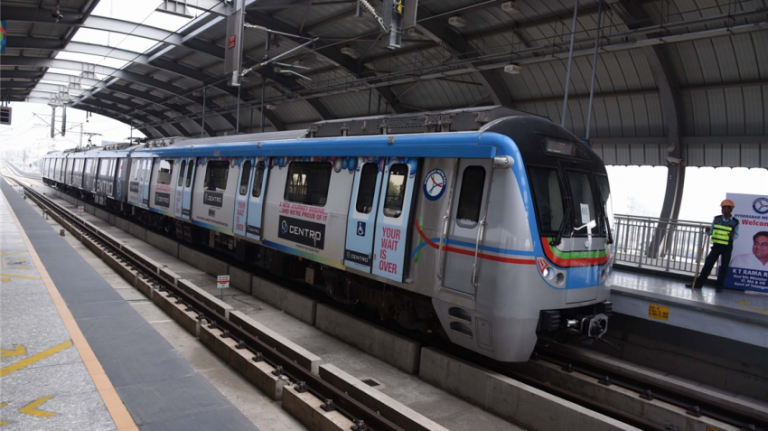
Hyderabad: The Telangana Government has decided to speed-up the Hyderabad Metro Rail project works and the services will become operational from January 3rd 2018 onwards.

The project will be inaugurated by Prime Minister Narendra Modi. The first phase metro will be between Nagole and Begumpet with Miyapur – SR Nagar and Nagole – Mettuguda routes likely to be operational.

Both the routes have been ready for more than a year ago and 58 metro rails are already brought to Hyderabad.

The Hyderabad Metro Rail project should have been completed by July 4, 2017 but due to the constant delays from the Telangana Government over handing the necessary land and the route alignment issues, the project deadline has been pushed.

Source: The Hans India

Kolkata Metro | Railway to open New Garia Airport Metro corridor in June 2018

Kolkata: The New Garia Airport Metro corridor, which has come a long way by crossing multiple hurdles, is poised to start operations on the 5km stretch — between Kavi Subhas and Ruby Hospital — by June 2018. With Metro general manager Vishwesh Chaubey closely monitoring the progress of the project, the latest problem, where 11 shopowners have encroached upon vested land near Baghajatin rail bridge, is likely to resolved within a week.

“The project has been progressing quite well. Majority of the hurdles have been crossed. In case of any new hurdle, general manager Vishwesh Chaubey will personally take steps to solve them,” said Metro Railway chief public relations officer Indrani Banerjee.


A Metro assessment shows the project, which is being carried out executing agency Rail Vikash Nigam Limited (RVNL), is progressing on war-footing. The alignment, which will be moving through the city’s newest healthcare district, is expected to take away the load off the road and provi de faster means of transportation to and from the airport.

The project has, however, suffered many stumbling blocks in the past. Its terminal station at New Garia was uncertain after local squatters chased away pro ject engineers and staged an agitation. Finally, the state government intervened and mayor Sovon Chatterjee made it clear to the squatters that they have to move out.The move cleared a very crucial hurdle, blocking the completion of the stretch.

Lucknow Metro | LMRC achieves Breakthrough of TBM Gomti

Lucknow: The Lucknow Metro Rail Corporation (LMRC) today successfully achieved the breakthrough of TBM-Gomti near Sahu Cinema in Hazratganj in 6 1/2 months due to the hardwork and commitment of Lucknow Metro Project team.With this ‘breakthrough’, Lucknow Metro Rail Corporation has achieved one of the biggest milestones in form of completion of first TBM drive in the construction of underground Metro in the state of Uttar Pradesh. The state of the art onboard computerized tunnel guidance system have been provided in TBMs to ensure that the tunnelling is done as per the designed alignment to the highest level of accuracy. Extensive instrumentation has been done throughout the underground stretch and continuous online and real time monitoring is done by a team of dedicated experts to ensure safety during TBM operation.

The underground stretch of 3.67 km length of Lucknow Metro Project starts immediately after Charbagh and covers 3 underground stations at Hussainganj, Sachivalaya and Hazratganj . Work of tunneling in this section was started from the Sachivalaya underground Metro Station using two Tunnel Boring Machines (TBMs) named –‘Gomti’ and‘Ganga’ for Up and Down lines respectively.

Tunneling work for the UP line started on 23.01.2017 with TBM-Gomti, towards Hazratganj underground Metro station. The tunneling in this stretch posed an enormous technical challenge as the route passes beneath highly congested areas and basements of commercial establishmentsto lay the tracks at the depth of 12-15m below ground
level.LMRC has accomplished the difficult mission of not affecting the working of commercial establishments even for a day while tunneling beneath them.

TBM-Gomti having a length of 75m, has taken about 6 1/2 months to complete tunneling of 812m length from Sachivalaya to Hazratganj metro station, where it will be taken out and shifted to other end of Sachivalaya station for starting tunneling towards Hussainganj metro station. Preparatory arrangements are being made in the meantime for the breakthrough after completion of tunnel drive.

Second TBM-Ganga which is working in parallel on Down Line between Sachivalaya and Hazratganj has completed 782 m tunneling and its breakthrough is also expected shortly.