Home Blog Page 810

Agra Metro | No groundwork after DPR, project seems to be on a slow track

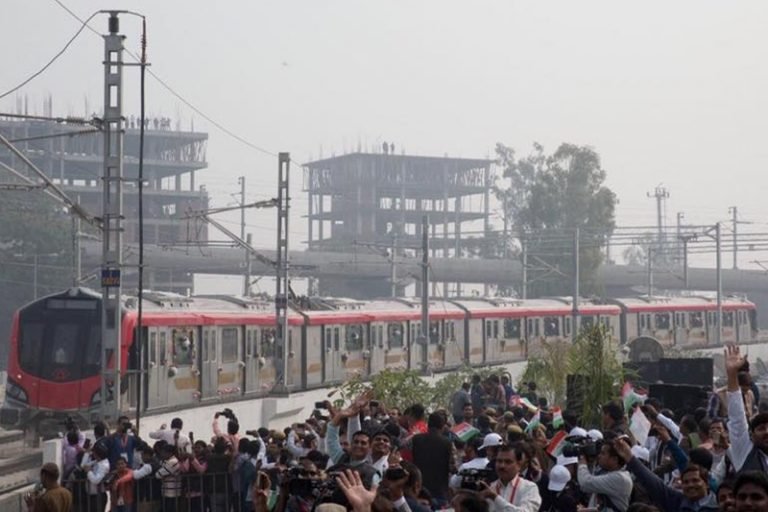
AGRA: While Uttar Pradesh chief minister Yogi Adityanath and Union home minister Rajnath Singh, on Tuesday, jointly flagged off an 8.5 km stretch of the first Metro train in Lucknow, work on the much-awaited Agra Metro seems to be on a slow track. No groundwork has been done after a detailed project report (DRP) was submitted to the Agra Development Authority (ADA) last year by the engineering consultancy firm Rail India Technical and Economic Service (RITES). The DPR had subsequently underwent technical changes and approved by the state government.

The 30-km long Metro rail project, proposed during the Samajwadi Party (SP) regime, was to be developed in two phases. The former UP government had planned Metro infrastructure in Lucknow, Agra, Varanasi and Kanpur.

According to the DPR, three-coach trains will make 136 trips per day (in a single direction) on Corridor One, from Sikandra (Akbar’s tomb) to Taj Mahal via Agra Fort, and 160 trips on Corridor Two, Agra Cantt to Kalindi Vihar. Both corridors will have 15 stations each. The development of the first corridor was slated to be completed by June 2022. The report had also stated that altogether 210 acres of land would be required for building stations, depots and other facilities. Moreover, a total of 159 structures, mostly commercials, will be affected by the Metro construction.

According to an earlier statement given by the ADA, the project was estimated to be built at a cost of Rs 200 crore per kilometre for the elevated sections, and Rs 450 crore per kilometre for the underground stretch. Official sources said that an initial allocation of Rs 10 crore was made during the last budget but it is yet to be released.

Talking to Media, a senior ADA official said, “Budget allocated for Metro rail development project has not been released by the state government. We are ready with the DRP and can implement it once funds are given. The total cost of the project is estimated to be Rs 11,000 crore.”

Some of the major Metro stations of the first corridor are proposed to be built at the Taj Mahal East gate, Agra Fort, Jama Masjid, Heeng Ki Mandi, Raja Mandi, Guru Ka Taal and ISBT. The second corridor will be 16 km in length and will include stations in Sadar Bazaar, Pratapura, St John’s crossing, Subhas Park, Kamlanagar and Rambagh.

Guwahati Metro | State Govt. gives green signal for implementation of metro project

Guwahati: The Assam Government on Wednesday gave the green light for implementation of the state government’s ambitious Guwahati metro rail project.

Transport Minister Chandramohan Patowary said, “To ease the growing traffic congestion in Guwahati, the cabinet has approved the implementation of the metro rail project. The Detailed Project Report (DPR) prepared by the Guwahati Metropolitan Development Authority has been submitted.”

However, a group of activist opposed for expansion of metro rail project to Boko in Kamrup (rural) district). They raised slogans against the Guwahati metro expansion to Rabha Hasong area and also against State Transport Minister Chandra Mohan Patowary. Mantu Kumar Rabha, Kamrup district Rabha Students’ Union secretary took initiative of the rally. Kamrup district Rabha Students’ Union president Hiteswar Rabha, vice-president Ajit Rabha also took part in the protest rally.

The president of Kamrup district Rabha Students’ Union, Hiteswar Rabha said, “Minister Chandra Mohan Patowary wants to expand the Guwahati metro to Rabha Hasong area but we oppose this plan. Earlier on two occasions we had protested against the plan and today also we protest against the expansion plan. We will continue protesting till the plan is scraped.”

On 29 February 2016, former Assam Chief Minister Tarun Gogoi had laid the foundation stone of the project, which was proposed to be implemented by the Special Purpose Vehicle — Guwahati Metro Rail Corporation Limited.

The total cost of the project was estimated to be Rs 18,020 crore and it was supposed to be implemented in different phases across the city.

Join 2nd Annual Future Rail India Summit 2017 in New Delhi

With the announcement of National Rail Plan, a lot of reforms are being undertaken by
the Indian Railways to improve the stability of the railway sector and retain the image of
being one of the premier organizations in the country. The focus of the ambitious plan
will be on upgrading the tracks, signaling, implementing safety parameters, station
modernization and electrification systems on the railway tracks to improve punctuality,
speed and safety of the trains. Also with a different mode of approach, the ministry is
trying to reduce its dependency on the budget and fare revenue, by introducing
innovative funding methods and emphasizing on Non-Fare Revenue along with the
development of new projects on Public Private Partnerships (PPP) model.

Working on the Railway Ministry’s National Rail Plan, Nispana is organizing the 2nd
Annual Future Rail India Summit on the 7th and 8th of December, 2017 in New Delhi,
which will bring together the key stake holders from the Indian Railways who are
focusing on business and technical fronts.  Along with this, the conference also will
feature international experts to present best practices which has helped them develop
their railway sectors in their countries, and technology providers to feature the latest and
efficient technologies which will help Indian Railways make the next big leap.
2nd Annual Future Rail India Summit will provide the solution providers, policy makers
and decision makers an opportunity to come together to discuss, collaborate and
determine the best solution for the current challenges faced and pave paths for future
project engagements.

Event Highlights
  • Gain exclusive insights on investments from the Ministry of Railways through innovative funding policies
  • Analyze the paradigm shift towards sustainable energy
  • Identify the need for involvement of consulting firms areas such as operations and planning.
  • Understand the new railway FDI policy in setting up of production units for manufacturing rolling stocks
  • Determine India’s freight / cargo handling capacity.
  • Capitalize on “Make-in-India” scheme to attract foreign investors and manufacturers.

Confirmed Speakers

  • Deepak Tripathi, Chief Mechanical Engineer, Konkan Railway Corporation Ltd.
  • Ms. Akshima Tejas Ghate, Senior Fellow and Associate Director, Transport and Urban Governance Division, Sustainable Habitat Programme, The Energy and Resources Institute (TERI)
  • GK Gupta, Chief Mechanical Engineer, Indian Railways Institute of Alternative Fuel
  • Satish Kumar, ED Safety, Indian Railways
  • M.P. Singh, CEO, High Speed Corporation of India Ltd.
  • Bindu Muralidharan, Chief Manager (Information Technology), Konkan Railway Corporation Limited
  • S.K.Singh, Executive Director (Engine Development), RDSO

Metro Rail News is an official Media Partner for the event.

Kochi Metro | KMRL to deploy more 60 transgenders in next two years

Kochi: Kerala made headlines when it appointed 23 transgenders to work for the Kochi Metro. But it is a no secret that the employees started quitting when most turned a blind eye to the possible miseries the sexual minority would face.

While some faced difficulty in finding alternate accommodation, some found the new lifestyle too expensive to adjust.

Kochi Metro Rail Limited (KMRL) is now taking steps to increase the strength of the transgender staff from an existing 14 to 60 and impart soft skills too.

When 23 transgenders employees were deployed in June, the criteria for recruitment included their educational qualifications. While Kudumbasree trained them with soft skills, the Metro agency upskilled them in managing ticket counters and housekeeping.

“We decided to recruit TG people, a first in any metro system in the country as a social experiment and to ensure social inclusion. This, in a way, resulted in their problems being highlighted at the national level.” a KMRL spokesperson told the Media.

Several reports emerged citing the reasons for the nine employees to quit the job was a wage hike. Justifying their stand the KMRL spokesperson said that the pay scale of the TG employees was on par with the regular workforce.

“We aim to increase the number of TG people in the metro to 60 when the Pettah extension is completed, around two years down the line,” the spokesperson said.

Chennai Metro | CMRL to link IT parks in phase-II metro corridor

Chennai: For the thousands of techies in the city, commuting across busy stretches to reach the various IT parks could become easier. Chennai Metro Rail Limited will in Phase 2 link some of the major IT parks on Old Mahabalipuram Road and Manapakkam with the rest of the city through metro stations. The phase will cover a distance of 108.4km with 104 stations across three corridors. If everything goes as planned, construction for the phase will begin in 2018 and is expected to be ready in 10 years.

“The plan to build stations close to IT companies and parks is to encourage techies to use metro trains regularly. This will take many four-wheelers and two-wheelers off the roads and reduce the road traffic to a great extent,” a metro rail official said. “We are also planning to extend beyond Siruseri in the next phase.”

It will include 20km stretch of the IT corridor along Rajiv Gandhi Salai or Old Mahabalipuram Road, which will be connected through 22 elevated metro stations from Tidel Park all the way up to SIPCOT in Siruseri. The elevated line will be part of the 46.1-km corridor three of the phase which will connect the IT corridor with far-flung areas of North Chennai up to Madhavaram Milk Colony. The line is expected to be ready for operation in five years. There are close to 70 major IT parks in the city and many of them are located along OMR. Many other major IT/ITES companies, national research laboratories, technical and educational institutions are also located along the stretch.

In corridor 5, the underground stations at Sathya Nagar and Ramapuram bus stop are expected to connect the DLF IT Park that houses some of the biggest IT companies. The two stations are part of a 45.2-km-long corridor from Madhavaram Milk Colony to Sholinganallur. The stations will link several localities in the northwest of the city, including Kolathur, Anna Nagar, Maduravoyal and Valsarvakkam, and neighbourhoods such as Madipakkam, Kovilambakkam, Medavakkam and Perumbakkam in the southwest.

Metro rail officials said corridor 5 would be an orbital line, as it would connect all the arterial roads through phase 2 lines and the 45-km two-corridor Phase 1 through stations like Chennai Mofussil Bus Terminus (CMBT), Thirumangalam and St Thomas Mount, which is likely to be common to both the phases. Phase 1 of the project will link all major railway stations and bus terminuses in the city once it becomes fully operational.

Lucknow Metro | On first ride, over 100 passengers stuck for over an hour

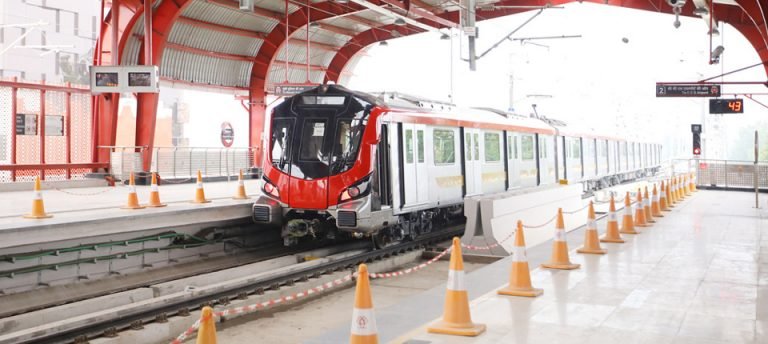
Lucknow: Over 100 passengers were rescued from the Lucknow Metro this morning as the first day of the new service turned hellish.

The new 8.5-kilometre city train was inaugurated yesterday by Uttar Pradesh Chief Minister Yogi Adityanath and Home Minister Rajnath Singh in presence of Governor Ram Naik and other officials of Lucknow Metro and State Government.

IMG 20170906 WA0020
Lucknow Metro Passenger rescued through Emergency Door

According to press release issued by LMRC, “Around 7.15 A.M. today, a Metro Train that was on way from Charbagh to Transport Nagar developed a technical snag. The Emergency Brakes (EB) were applied in the train when the train was travelling between Durgapuri and Mawaiya Metro stations.

All 101 passengers who were travelling inside the train were taken out through the emergency exit door of the train and were taken safely to Durgapuri Metro station. From Durgapuri Metro station, all 101 passengers were taken by a different train to the Transport Nagar Metro station. From the Transport Nagar Metro station all the passengers made in exit thereafter.

During this intervening time period, all passengers inside the train were taken proper care by the LMRC officials and were provided every care and support they needed. The Metro staff/officials at the Durgapuri Metro station ensured that the Metro commuters do not face any further inconvenience.”

Mumbai Metro 3 | Residents take MMRC to Bombay High court

Mumbai: A Cuffe Parade resident has moved the Bombay High Court against the Mumbai Metro Rail Corporation (MMRC) in connection with the construction of the Colaba-Bandra-Seepz Metro-3 underground corridor. He has alleged that barricades installed by the MMRC for construction have occupied maximum space on the access road leading to his society and the nearby societies making it difficult for the fire brigade to enter during an emergency.

Residents from Colaba Woods Sports Complex Marg in Cuffe Parade have said that the MMRC is putting lives of residents in danger due to the Metro work barricades. The writ petition by Robin Jaisinghani prayed that directions be given to the MMRC to restore the road width of the Colaba Woods to at least 12 metres —minimum road width prescribed in Regulation 22 of the Development Control Regulations. According to the petitioner, the MMRC has barricaded the entire road.

Now, vehicles heading further north towards Taj Vivanta President Hotel use the footpath.

The petitioner has further said that when he approached the fire brigade, he was told that they can do very little because it is chief minister’s pet project.

“The petitioner contacted Divisional Fire Officer Bangar and brought to his notice that the contractors were proposing to block the entire Complex Marg to carry out construction work and to take preventive action,” the petition reads. Meanwhile, the MMRC said, “Vehicular access necessary for the movement of fire vehicles is made available along the service road in front of Venus, Jupiter and Dalamal buildings and Hotel Taj Vivanta” said MMRC spokesperson.

Delhi Metro | DMRC’s latest project delayed over land acquisition issues

New Delhi: The Delhi Metro Rail Corporation‘s latest project which is said to connect North and West Delhi with South and East Delhi is stuck over land acquisition and rehabilitation of affected people in Trilokpuri.

The project is supposed to be Delhi’s longest Metro line 58.6 Km long and connect the Mukundpur-Shiv Vihar corridor, but it will now operate in two segments because of the land acquisition issues.

Delhi Metro Rail Corporation (DMRC) has to rehabilitate over 108 residents but it is falling short of land. Only 66 families can be accommodated on the allotted plot. DMRC has requested the Delhi government for more land but the process will take time, this delays the construction of the metro line and will now be complete only in 2018.

DMRC chief Mangu Singh in relation to the problem said “In Trilokpuri ,we are not able to accommodate all these people on the piece of land the government has given to us .This is because the available land for the dwellings has reduced as the width of the road had to be increased . We have asked for additional land from the Delhi Urban Shelter improvement Board (DUSIB).”

DMRC hopes to open the rest of the line by March 2018 .The passengers from east Delhi areas such as Shiv Vihar , Welcome and Krishna Nagar will use Anand Vihar as an interchange to go to south Delhi or Gurgaon and Faridabad .Once the entire line is complete passengers can commute to Lajpat Nagar and INA directly without going to Rajiv Chowk .

The entire line was scheduled to be launched by December 2016.

Mumbai Metro | Mumbai’s Colaba-Bandra-SEEPZ Metro-3 to be ready by 2021

Mumbai: The Mumbai Metro Rail Corporation (MMRC) is likely complete the Metro-3 corridor (Colaba-Bandra-SEEPZ) by December 2021 instead of early 2021. It has also reduced the length of the phase-1 corridor. MMRC officials have blamed the revision on protracted legal battles over the cutting of trees and a Bombay high court stay on construction at night.

The 33.5-km underground Metro is to be commissioned in two phases.

MMRC has reduced the length of the corridor under phase-1, which was originally planned between the Aarey Milk Colony car depot and Bandra-Kurla Complex. Now, the first phase will connect the car depot to the airport.

“The first phase, which is from the car depot to the airport, will be commissioned by March 2021. And the second phase, which is from the airport to Cuffe Parade, will be operational by December 2021,” said Ashwini Bhide, managing director, MMRC.

The project has faced numerous hurdles owing to opposition and petitions from environmental groups and citizens.

According to MMRC, the project has been facing delays after the Bombay high court’s order against the cutting of trees along the construction site earlier this year.

In addition, the recent stay by the high court disallowing construction work at night had slowed down the work, an official said.

“Our earlier deadline was in 2020, but we lost about six months due to a petition on cutting of trees and the high court stay. So obviously, we have now factored them in,” Bhide added.

MMRC has still not evaluated whether these delays will lead cost escalation.

“We haven’t calculated it because the project period is almost five years. So sometimes there are delays, sometimes we catch up,” Bhide said. The project cost is Rs23,136 crore.

The Metro-3 corridor chalked out by the state government will connect north to south and is expected to take load off the over-burdened suburban rail network.

MMRC claims that the line will reduce daily vehicle trips by 4.5 lakh or 35% and save 2.43 lakh litres of fuel daily in 2021.

Mumbai Metro | MMRC appoints architects for Kalbadevi-Girgaum rehabilitation

Mumbai: The Mumbai Metro Rail Corporation (MMRC) has appointed GD Sambhare & RH Mahimatura Architects to provide Architectural, Design and PMC services for Kalbadevi-Girgaum in-situ rehabilitation scheme. The tender for appointment of the architect was  invited in June 2017. The scope of contract includes Planning and Architectural designs, Structural design, Construction supervision and management (PMC) of buildings to be redeveloped.

Part of the lands of impacted buildings in Kalbadevi-Girgaum would be utilised by MMRC for construction of underground Metro stations, ancillary works, ventilation shafts, entry/exit structures and other related activities. The redevelopment of properties will be undertaken simultaneously in the remaining lands and after completion will be allotted to the project affected families by 2021.

“We are delighted to announce the appointment of Architects for the redevelopment of properties occupied by families affected by the proposed construction of Kalbadevi and Girgaum Metro stations. The rehabilitation plan has been finalized by keeping in mind the concerns raised by the project affected families. We, at MMRC, are committed to complete the rehabilitation of all families in a time-bound manner”, said Ms. Ashwini Bhide, Managing Director, MMRC.

As a part of the in-situ rehabilitation scheme under 33(7) DCR 1991, 19 buildings consisting of 293 Residential and 341 Commercial PAFs were identified. The PAFs will  be rehabilitated within the same area by following the MCGM DCR 33(7) of 1991 Sanctioned DP and treating all affected plots as part of one integrated scheme.