Home Blog Page 68

Bullet Train Project Progresses with Launch of 8th Steel Bridge in Gujarat

0

India’s first bullet train project (Mumbai-Ahmedabad High Speed Rail Corridor) has reached another milestone with the completion of the 8th steel bridge over DFCC tracks near Bharuch, Gujarat.

Screenshot 2025 06 16 180003

About Steel Bridge

This development marks the successful installation of the 8th  steel bridge for the Mumbai-Ahmedabad High Speed Rail (MAHSR) project. Out of the total 28 steel bridges planned along the entire corridor, 17 are located in Gujarat. The MAHSR corridor spans approximately 506 kilometres and will feature 12 stations, significantly enhancing high-speed connectivity between Mumbai and Ahmedabad.

Fabrication Process

This bridge was fabricated in the workshop of Trichy. Subsequently, it was brought to the location with the help of trailers. The bridge fabrication involved the use of approximately 55,300 Tor-Shear Type High Strength (TTHS) bolts for structural integrity. A C5 anti-corrosion painting system was applied to enhance durability in harsh environmental conditions. Additionally, elastomeric bearings were specially designed to support a lifespan of 100 years.

Characteristics of the Bridge
Length100 meter
Height14.6 meter
Width14.3 meter
Weight1400 metric tons

Launching Process

The engineering team utilised an 84-meter-long launching nose to execute the launching of the bridge. The weight of the launching nose was about 600 metric tons. The entire bridge structure was meticulously assembled at the project site at an elevation of 18 meters above ground level, supported on temporary trestles. For the launching process, a precision-controlled mechanism was deployed using two semi-automatic jacks. Each jack had a capacity of 250 tonnes. These jacks operated in coordination with Mac-Alloy bars to pull the superstructure into its final position.

Details of completed steel bridges in Gujarat for the Bullet Train Project

Sr. No.LocationLength of the steel bridge (in meters)Weight of the steel bridge (in MT)
1Across National Highway 53, Surat70673
2Over Vadodara-Ahmedabad main line of Indian Railways, near Nadiad1001486
3Over Delhi-Mumbai National Expressway, near Vadodara230 (130+100)4397
4Near Silvassa in Dadra & Nagar Haveli1001464
5Over Western Railways, Vadodara60645
6Over two DFCC Tracks and two Western Railways tracks, Surat100,602040
7Over two DFCC tracks, near Vadodara70 674
8Over DFCC tracks near Bharuch1001400
Advertisement1
InnoMetro_2026

Delhi Metro Phase 5: Bids Invited for Construction of YugeYugeen Bharat Station

0
Delhi Metro
Delhi Metro/ Representational Image

NEW DELHI (METRO RAIL NEWS): Following the 60% completion of Delhi Metro Phase 4, Delhi Metro Rail Corporation has initiated tendering for Phase 5 in order to expand the metro network in the NCR Region. Recently, DMRC invited bids for the construction of YugeYugeen Bharat underground metro station, which will come up on the 9.9km Indraprastha – RK Ashram Marg corridor under Delhi Metro Phase 5A. 

DMRC’s Scope of Work: Design and Construction of YugeYugeen Bharat underground station along with PD Area Ancillary Building, associated Entry Exits and Connecting subways under Phase V A of Delhi MRTS.

Tender Details

Estimated cost of work: ₹206.33 crore

Tender Reference Number: EC-01

Tender Id: 2025_DMRC_864634_1

Pre-Bid Meeting: 20 June 2025
Bid Submission Start Date: 30 June 2025
Bid Submission End Date: 7 July 2025
Bid Opening Date: 8 July 2025

Delhi Metro Phase 4 Map

Significance of Indraprastha – RK Ashram Metro Corridor.

The corridor will come up as an extension of the 12.3 kilometre-long Inderlok-Indraprastha corridor (Green Line), which is being developed under phase 4 of Delhi Metro.

The corridor will extend metro connectivity to important sites, including 10 big central government office buildings along the Kartavya Path, the proposed Yuge Yugeen Bharat Museum, Bharat Mandapam, India Gate, among others.

Stations Planned Along the New Corridor

This new metro line is likely to feature 9 strategically planned underground stations: 

  1. Indraprastha
  2. Bharat Mandapam, 
  3. Baroda House, 
  4. India Gate (adjacent to C-Hexagon), 
  5. New Common Central Secretariat (CCS) 
  6. Central Secretariat, 
  7. Yuge Yugeen Bharat Museum 
  8. Shivaji Stadium 
  9. R K Ashram Marg.

Delhi Metro Phase 5

As per the proposal submitted by DMRC to the Ministry of Housing and Urban Affairs, Phase 5 will cover a total distance of 206.5 km. Phase 5 will be implemented in 2 phases: Phase 5A and Phase 5B. Phase 5A will have 3 corridors, and Phase 5B will feature 15 corridors.

Corridors Planned Under Phase 5A

  1. Indraprastha – RK Ashram Marg (9.9km)
  2. Aerocity- Terminal 1 of IGI Airport (2.3 km)
  3. Tughlakabad – Kalindi Kunj (4km)

The Detailed Project Report (DPR) for all three corridors has been submitted to the Government of Delhi. Additionally, the National Planning Group (NPG) has recently assessed the plan, which amounts to Rs 11,150 crore, for these corridors. Furthermore, the proposal pertaining to this corridor is slated to be presented to the central government for approval.

Advertisement1
InnoMetro_2026

Kochi Metro Explores Non-Fare Box Revenue Stream by Leasing Out Land

0
Kochi Metro
Representational Image only

KOCHI (Metro Rail News): Kochi Metro Rail Ltd (KMRL) is gearing up to lease land that is presently utilised as a parking facility for the Metro, for a commercial establishment near the Kaloor Metro Station in Kochi. This initiative aims to capitalise on the prime location of the land. 

Tender issued by KMRL for leasing out the land 

KMRL has issued a tender for the commercial lease of 45 cents of land adjacent to the metro station. The tender notice indicates that KMRL seeks to engage with investors or developers capable of developing this land parcel. 

In discussing the strategic advantages of the location, the tender document suggests that the developer may explore options to establish a connection to the nearest metro station through suitable technical solutions, thereby facilitating direct access for metro commuters to the proposed complex.

Motive Behind leasing out the land 

This move to lease out the land follows previous efforts by Kochi Metro to initiate commercial activities on its property, but the effort to find land developers failed. KMRL managing director Loknath Behera mentioned that the move to lease out the land aligned with KMRL’s policy to increase revenue beyond ticket fares.

Official Statement from Kochi Metro, MD 

“We have already started the process to lease land parcels at many locations in the city. It is expected that the new policy will financially help the company implement various development projects,” he said.

About the Kochi Metro Rail Project 

Kochi Metro Rail Project is an urban Mass Rapid Transit System (MRTS) serving the city of Kochi. The Kochi Metro comprises 2 Phases, consisting of 1 metro corridor each. Currently,  Phase 1 of the Kochi Metro while Phase 2 is under construction. 

Phase Corridor Route Length Stations 
Phase 1 Line-1 (Blue Line): Aluva – Tripunithura27.96 km25
Phase 2 Line-2 (Pink Line)JLN Stadium – Infopark II11.2 km11 
Advertisement1
InnoMetro_2026

KERNEX-VRRC JV Receives LoA for Kavach Contracts worth Rs 311 Cr from Southern Railways 

0
Indian Railways
Representational Image

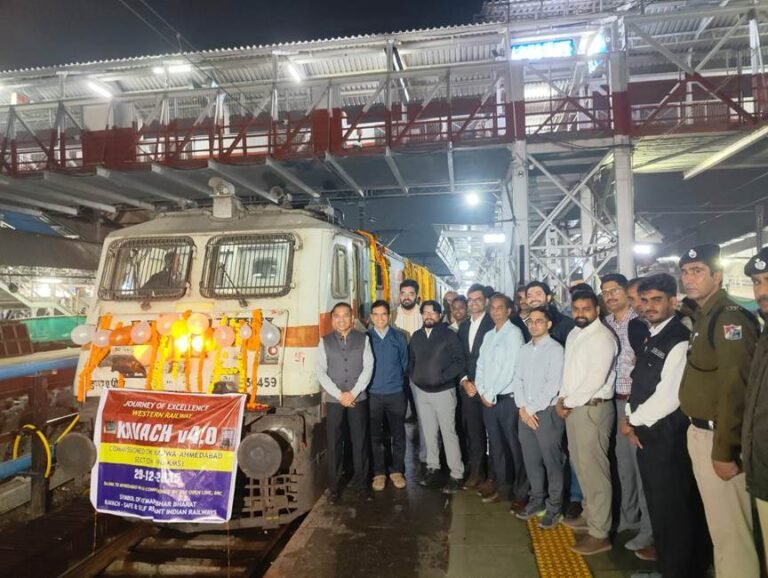
The KERNEX-VRRC Consortium has received a Letter of Acceptance (LoA) for two major Kavach contracts from Southern Railways. The contract includes the provision and installation of the Kavach (Train Collision Avoidance System) at the Chennai division.

The total combined value of the Kavach Contracts is Rs 311.03 crore. Kernex holds a 60% share in the joint venture.

Contract 1 Details 

MAS

Contract Value:  Rs 173.11 crore

Contract Duration:  730 days

Length: 271 Kilometers 

The contract includes the deployment of the Kavach system across the MAS-Gudur, MAS-Arakkonam, and Arakkonam, Renigunta sections within the Chennai Division. 

Contract 2 Details 

Artboard 1@4x 2 1

Contract Value:  Rs 137.92 crore

Contract Duration:  540 days

The awarded contractor will be responsible for implementing Kavach, along with the construction of tower infrastructure and laying 48 optical fibre cables as the backbone network between Arakkonam and Jolarpettai within the Chennai Division.

Implementation Of Kavach System Across India 

SNItemsProgress
iLaying of Optical Fibre Cable5743 Km
iiInstallation of Telecom Towers540 Nos.
iiiProvision of Kavach at Stations664 Nos.
ivProvision of Kavach in Loco795 Locos
vInstallation of trackside equipment3727 Rkm

Kavach Implementation Future Plan

The estimated cost for installing Kavach equipment along the trackside, including at station locations, stands at approximately ₹50 lakh per route kilometre. Additionally, the cost of installing Kavach systems on locomotives is about ₹80 lakh per locomotive.

So far, a total expenditure of ₹1,950 crore has been incurred on Kavach-related works. 

Next Phase

Under the next phase of implementation, Indian Railways has finalized a project to equip 10,000 locomotives with Kavach. To facilitate this, 69 locomotive sheds have been upgraded and prepared to carry out the installations.

Furthermore, tenders have been invited for the provision of trackside Kavach systems covering approximately 15,000 route kilometres (RKm), focusing on the Golden Quadrilateral (GQ), Golden Diagonal (GD), High-Density Network (HDN), and other strategically identified sections of the Indian Railways network. Out of this, contracts covering 1,865 RKm have already been awarded and are in various stages of execution.

Advertisement1
InnoMetro_2026

AIIB Delegation Visits Vizag Metro Rail Project

0
Metro
For Representational Purpose Only

VISHAKHAPATNAM (Metro Rail News): The Vizag Metro Rail Project progressed as 2 members of the Asian Infrastructure Investment Bank visited Phase 1 of the Vizag Metro. This visit is part of AIIB’s plan to provide funding for the project.

 AIIB will likely bear the 60% cost of the project, and the remaining 40% will be borne by the central and state governments, each contributing 20%.

About the AIIB Visit 

During their two-day visit, the delegation from the Asian Infrastructure Investment Bank (AIIB) inspected all 43 proposed metro stations planned under Phase 1 of the Visakhapatnam Metro project, covering a total length of 46.23 km. Shri Ramakrishna Reddy, Managing Director of Andhra Pradesh Metro Rail Corporation (APMRC), provided a detailed overview of the project’s scope and current progress.

Visakhapatnam Metro Phase 1: Project Overview

Total Length:

  • 46 km
  • Phase 1 is divided into two systems:
    20 km Double-Decker System
    26 km Standard Metro Rail System

Double-Decker Metro System

Total Length: 20 km
Unique Feature: Longest double-decker metro system in India

Segment Details:

  • 15 km stretch: From Carshed Junction (PM Palem) to Thatichetlapalem
  • 5 km stretch: From Visakhapatnam Steel Plant (entrance gate) to Gajuwaka.

Official Statement 

APMRC MD Mr. Ramakrishna Reddy said, “We want to begin civil works by October, 2025 and are expediting all aspects of the project. The AIIB team visited the city as part of the process of sanctioning a loan (60% of the total project cost). We will prioritise Phase-1 first and will follow with Phase-2 after the international airport at Bhogapuram becomes operational.” as reported by The Hindu

Advertisement1
InnoMetro_2026

Chief Secretary Inspects Patna Metro’s Priority Corridor 

0
Patna Metro's Priority Corridor inspection

PATNA (Metro Rail News): The Patna Metro Rail Project progressed as Chief Secretary Amrit Lal Meena, along with Abhay Kumar Singh, IAS (MD, PMRCL, Secretary, UDHD), and other senior officials, conducted a comprehensive inspection of the Patna Metro’s Priority Corridor on June 12. 

GtO8Bm aoAE1fJG

The priority corridor of the Patna metro is a 6.20 km elevated route of Line 2 connecting Malahi Pakri and Patliputra bus terminal. Originally, Line 2 spans 14.05 km between Patna Junction Railway Station and New ISBT, passing through 12 stations. 

GtO8BnLbMAAYNHs

About the Inspection  

The team thoroughly reviewed all four metro stations and the depot, evaluating the ongoing construction efforts and ensuring adherence to timelines. 

During the inspection, Shri Meena emphasised the necessity of accelerating construction activities to meet the deadlines. 

GtO8Bm3acAA6GSM

He instructed the officials to uphold the highest standards of safety and quality, highlighting the project’s critical role in enhancing public convenience and facilitating the state’s rapid urbanisation. 

Inspection of Malahi Pakri Metro Station

On 11 June, Chief Minister of Bihar, Nitish Kumar, also inspected the ongoing construction work of the Patna Metro at Malahi Pakri Metro Station. The Urban Development Minister of Bihar, Jivesh Kumar, was also present during the inspection.  

GtKes16bMAEYhnb

During the inspection, the CM mentioned, “We have been continuously inspecting its construction works and instructed the officials to ensure its completion on time so that people have convenience in commuting,” the CM said.

GtKes15bMAYUYLg

Further Updates 

Recently, the Delhi Metro Rail Corporation (DMRC) announced HCC as the lowest bidder for the underground tunnelling contracts, PC05 & PC06 of Patna Metro’s Line-1.

Advertisement1
InnoMetro_2026

Bangalore Suburban Rail Project: Bids Invited for track work contract C4 of Corridor 4

0
Bengaluru Suburban Rail’s
Image for representation.

BANGALORE (Metro Rail News): Rail Infrastructure Development Company Karnataka Limited (K-RIDE) has floated tender for track work contract C4 of the Bangalore Suburban Rail Project’s (BSRP) Corridor 4. Corridor 4, also known as Kanaka Line, spans 46.285 km between Heelalige and Rajankunte. 

Tender Details 

Opening Date10 Apr 2025
Closing Date9 Aug 2025
Tender Id2025_KRIDE_232476_1
Tender NoK-RIDE/BSRP/C4/Track Laying/2025
EMD₹ 1,47,00,000

Contract Details 

Contract Amount: INR 147.33 Cr ( Approx) 

Contract Duration: 24 Months 

Scope of Work 

The scope of work under Package C4 of the BSRP includes the Design, Supply, Installation, Testing, and Commissioning of Ballastless tracks between Heelalige and Rajanukunte in Corridor 4 of the BSRP. 

Brief Scope of Work: Design, Supply, Installation, Testing and Commissioning of Ballastless, Ballasted Track, Fastening System and Turnouts from Chainage (-) 635 to Chainage 46,985 m from Heelalige to Rajanukunte in Corridor 4 of BSRP.” 

Other Track Related Contract of the Bangalore Suburban Rail Project 

In April, K-RIDE announced Rahee Infratech Limited as the lowest Bidder for the track contract of Bangalore Suburban Railways’ Corridor 2, which connects Benniganahalli and Chikkabanavara. 

About the Bangalore Suburban Rail Project

The Bangalore Suburban Railway Project is an under-construction commuter rail network spanning 149.348 km and consisting of 4 Corridors. 

BengaluruSuburbanRailRouteMap
Corridor Line Route Length 
Corridor 1Sampige LineKSR Bengaluru – Yelahanka – Devanahalli41.478 km
Corridor 2 Mallige LineBaiyyappanahalli Terminal – Chikkabanavara24.866 km
Corridor 3 Parijaata LineKengeri – Whitefield35.52 km
Corridor 4 Kanaka LineHeelalige – Rajankunte46.285 km
Advertisement1
InnoMetro_2026

Maharashtra CM Launches NCM Card for Mumbai Metro Line 3

0
Mumbai metro
Mumbai metro line 3 (Representational image)

MUMBAI (Metro Rail News): In a step towards integrating Mumbai’s public transport system,  Maharashtra Chief Minister Devendra Fadnavis launched the National Common Mobility Card (NCMC) for Mumbai Metro Line 3 on 10 June 2025.

The initiative undertaken by the Mumbai Metro Rail Corporation Ltd (MMRC) is being executed in collaboration with the National Payments Corporation of India (NPCI) and the State Bank of India (SBI). 

The launch of the event was attended by Deputy Chief Ministers Eknath Shinde and Ajit Pawar, Revenue Minister Chandrashekhar Bawankule, Chief Secretary Sujata Saunik, as well as other senior officials. 

About the NCMC for Mumbai Metro Line 3

The contactless RuPay NCMC enables passengers to travel the Metro Line 3 stations, spanning from Aarey JVLR to Acharya Atre Chowk, without the necessity of queuing at ticketing counters. 

This card can also be used for travelling through different modes of transport, including Mumbai Metro Line 1, 2A, and 7, as well as chalo buses. These cards are in services on Line 3 from 11 June. 

Official Statement from MMRC, MD 

MMRC Managing Director Ashwini Bhide stated, “The NCMC card integration in Mumbai Metro Line 3 is a significant milestone in our path towards smart and commuter-centric urban transport. Being the city’s first underground Metro corridor, Line 3 is planned with future-proof infrastructure, and this contactless payment solution, with ease, is an integral part of that vision. We are excited to collaborate with NPCI and SBI to facilitate a seamless, hassle-free travel experience for Mumbaikars and enable the Government of India’s National Common Mobility Card programme.”

About Mumbai Metro Line 3 

The Mumbai Metro Line 3, also known as Aqua Line, partly operational metro corridor which spans 33.5 km between Cuffe Parade, Bandra Kurla Complex (BKC), and Aarey JVLR through 27 stations. 

Recently, Chief Minister Devendra Fadnavis and Deputy CM Eknath Shinde inaugurated the 2A Phase of Mumbai Metro Line 3. The Phase 2A of Line 3 spans 9.77km from BKC to Acharya Atre Chowk, featuring 6 stations

Stations 

  1. Dharavi
  2. Shitaladevi
  3. Dadar West
  4. Siddhivinayak
  5. Worli
  6. Acharya Atre Chowk
Advertisement1
InnoMetro_2026

Meerut Metro: Pioneering India’s Fastest Metro Transit System

0
Meerut Metri

Introduction

The Meerut City is located in the western region of Uttar Pradesh, India, approximately 80 kilometres northeast of New Delhi and 480 kilometres west of Lucknow. Commonly referred to as the “Sports City of India,” Meerut is one of the largest producers of sports equipment in the nation. Additionally, the city is recognised as the foremost producer of musical instruments in India and ranks among the largest gold markets in Asia. Meerut also serves as an educational hub within Western Uttar Pradesh, contributing to the region’s development and knowledge economy.

As of 2024, Meerut ranks as the 34th most populous city in India and holds the distinction of being the second most populous city within the National Capital Region (NCR), following Delhi. Meerut has seen immense development over the last several decades. With an ever-growing population and growing traffic, the transportation infrastructure of the city has become strained.

The Meerut Metro project aims to overcome these challenges by providing a new, secure, and green mode of transportation that suits the daily commuter and minimises the use of personal vehicles.

The metro network is planned to be integrated with the Regional Rapid Transit System (RRTS) between Delhi and Meerut. This integration will help improve regional connectivity, making Meerut a part of the National Capital Region (NCR) in economic and social development.

meerut metro route map download

Meerut Metro: From Vision to Reality 

Early 2020: The Government of India and the Uttar Pradesh State Government proposed the metro system for Meerut along with the Delhi-Meerut RRTS Project. 

2015: RITES conducted the feasibility study for the Meerut Metro Project. 

30 June 2016: RITES prepared the Detailed Project Report (DPR) of the Meerut Metro Phase 1 and submitted it to the state government of Uttar Pradesh for approval. 

2017: The Uttar Pradesh Metro Rail Corporation (then Lucknow Metro Rail Corporation) was assigned a ‘coordinator’ role to bring all stakeholders together for the implementation of the project. 

8 March 2019: Prime Minister Narendra Modi laid the foundation stone for the Meerut Metro Project along with the RRTS Project. 

June 2019: Construction finally began for the Meerut Metro Project and Delhi-Meerut RRTS Project. ‘

Meerut Metro 1 1

Meerut Metro: A New Era of Metro Connectivity

Overview 

  • Meerut Metro Project is an under-construction urban Mass Rapid Transit System (MRTS) for Meerut, Uttar Pradesh. 
  • The Meerut Metro project will be executed in 2 Phases. 
  • Phase 1 of the Meerut Project consists of one corridor spanning 20 km. The Meerut Metro Phase 1 will utilise the Delhi-Meerut RRTS Projects infrastructure and will be managed by the National Capital Region Transport Corporation (NCRTC). 
  • The Phase 2 of Meerut Metro Project is in the proposal stage currently and consists of one corridor.
  •  Phase 2 of Meerut Metro Project is expected to be built and operated by the Uttar Pradesh Metro Rail Corporation Limited (UPMRCL).
WhatsApp Image 2025 01 13 at 10.20.59 f20b3b22 1 1536x864 1

Rolling Stock

  • In mid-2021, Alstom bagged the Rs. 2577 crore Rolling stock contract. As per the Contract, Alstom was supposed to supply 10 trainsets, each consisting of 3 coaches, to NCRTC for the Meerut Metro Project. 
  • In February 2024, Alstom supplied the first 3 coach trainsets for the Meerut Metro Project.
  • Alstom has supplied all 10 train sets for the Meerut Metro Project to the NCRTC as per the contract. Currently, All the train sets supplied by Alstom are housed at Duhai Depot, as the Modipuram Depot is still under construction.

India’s Fastest Metro: Speed, Capacity, and Indigenous Manufacturing

What distinguishes the Meerut Metro from the rest of the urban transport networks in India is its high speed. It is going to be the fastest in the nation, with trains having a design speed of 135 kmph and an operating speed of up to 120 kmph. 

In keeping with the ‘Make in India’ policy, 100% of the Meerut Metro trainsets are being domestically produced, which strengthens the country’s vision to be self-reliant in infrastructure development.

WhatsApp Image 2024 09 07 at 14.54.14 f10afdc5
WhatsApp Image 2024 09 07 at 14.54.16 f500d4c2

Contractor List

Contract Contractor 
General Consultant (GC) for RRTS & Metro ProjectAyesa lngenieria Y Arquitectura – ITALFERR – Ayesa India (AIAI)
Rolling Stock: Supply of 30 coaches as part of 210 RRTS rolling stock contractAlstom Transport 
Part of Package-3: Partapur – Shatabdi Nagar (elevated viaduct and 3 stations at Partapur, Rithani, & Shatabdi Nagar)Larsen & Toubro (L&T)
Package-5B: Modipuram Depot & WorkshopKSM Bashir Mohammad & Sons
Package-7: Shatabdi Nagar – Brahampuri DN Ramp AND Begumpul Ramp – Modipuram (elevated viaduct and 5 stations at Brahmapuri, MES Colony, Daurli, Meerut North and Modipuram)Larsen & Toubro
Package-8: Brahampuri DN Ramp to Begumpul UP Ramp (underground twin tunnels and 3 stations at Meerut Central, Bhaisali and Begumpul)Afcons Infrastructure
WhatsApp Image 2025 01 13 at 10.20.59 98fff2d0 1024x576 1

Route Information 

Operational: 0 km 
Under Construction: 20 km 
Proposed: 15 km

Phase 1 

Line-1: Partapur – Modipuram

  • Length: 20 km
  • Status: Under Construction
  • Type: Elevated: 14.40 km & Underground: 5.6 km
  • Depot: Modipuram Depot
  • Number of Stations: 13
  • Station Names: Partapur, Rithani, Shatabdi Nagar, Brahmapuri, Meerut Central, Bhaisali, Begum Pul, MES Colony, Daurli, Meerut North, Meerut South, Modipuram and Modipuram Depot. 
Recent Update on Phase 1
Trial Runs 
In January 2025, NCRTC initiated trial runs on the  9.4 km route spanning from Meerut South Station to Meerut Central Station, featuring 6 stations. The  NCRTC team operated the 3-coach Alstom train on the 9.4 km stretch.

AD 4nXfzfEzx4saFgF5OaC4E IUJInk Fj0VSpw9ivHC7ttLNMHJ0CBG4kUMEIHKQb0K4ehnkpgwVcBEnryu2v4lZ2aeRoGUxQGxB GRsv4 ymglAKQ254 aztWzC oVkKTA y6Ox1hOk

Phase 2

Line-2: Shradhapuri Phase II – Jagriti Vihar

  • Length: 15 km
  • Owner: Uttar Pradesh Metro Rail Corporation Limited (UPMRCL
  • Status: Proposed
  • Type: Elevated (10.7 km) and Underground (4.3 km)
  • Number of Stations: 13
  • Station Names: Sharadhapuri Phase 2, Kanker Khera, Meerut Cantt. Railway Station, Rajban Bazar, Begumpul, Baccha Park, Shahpeer Gate, Hapur Adda Chauraha, Gandhi Ashram, Mangal Pandey Nagar, Tej Grahi, Medical College, Jagruti Extension
WhatsApp Image 2025 01 13 at 10.20.59 d5eb0870 1024x576 1

Integration With Delhi- Meerut RRTS Project

The Meerut Metro Project has been engineered to integrate with the Delhi-Meerut Regional Rapid Transit System (RRTS). 

Key Aspects of Integration:

Shared Infrastructure: A substantial portion of the Meerut Metro will function on the same infrastructure as the Delhi-Meerut RRTS corridor within the city of Meerut. This includes the tracks, elevated viaducts, and several stations. 

Common Stations: Four stations Meerut Metro Project will serve as interchange points between the Meerut Metro and the Delhi-Meerut RRTS:

  • Meerut South
  • Shatabdi Nagar  
  • Begumpul  
  • Modipuram 

The integration of the Meerut Metro Project along with the Delhi- Meerut RRTS aims to provide commuters with effective local transit options within Meerut, along with rapid regional connectivity to Delhi and other areas of the National Capital Region (NCR).

NEW MAP 1024x922 1 1

Recent Update on the Meerut Metro Project

Begumpul Station Near Completion 
The Begumpul station of Meerut Metro, which also serves as an interchange for the Delhi-Meerut RRTS project, is near completion. 
NCRTC CPRO Puneet Vats mentioned, “Tracks for both up and down lines are laid, and the station is in its final construction phase. Begumpul will be Meerut’s only underground station serving both Namo Bharat and Metro commuters. This is India’s first infrastructure project where two transit systems will share the same track, with two platforms and four railway tracks catering to the Rapid Rail Transit Corridor and the city’s intercity metro.” 
WhatsApp Image 2025 01 13 at 10.20.59 98fff2d0 1024x576 1 1

Impacts of the Meerut Metro Project 

1. Enhanced Connectivity: The Meerut Metro will improve urban mobility within the city by establishing seamless connections to the National Capital Region (NCR). As an integral part of the Regional Rapid Transit System (RRTS), it will link crucial areas such as Modipuram and Partapur, while also integrating with rapid transit lines extending into the core of Delhi. 

2. Reduction in Traffic Congestion: Meerut is currently facing severe traffic congestion, primarily due to the excessive number of private vehicles on its roads and the limited availability of reliable public transportation options. The introduction of the metro system will offer a streamlined and efficient alternative, alleviating the traffic on roads.

3. Economic Growth: The enhanced connectivity by Meerut Metro is anticipated to stimulate economic activity throughout the region. By facilitating improved access to employment opportunities, markets, and educational institutions, the metro will empower local residents and attract new investments.

4. Environmental Benefits: The transition toward a comprehensive public transport system represents a crucial step in reducing the dependence on private vehicles, which, in turn, is expected to lead to a substantial decline in carbon emissions. 

Conclusion

The Meerut Metro Project signifies a pivotal advancement in addressing the urban mobility challenges confronted by one of the rapidly developing cities in Uttar Pradesh. Strategically integrated with the Delhi-Meerut Regional Rapid Transit System (RRTS), this metro initiative aims to establish an efficient, and environmentally sustainable public transportation network. By enhancing connectivity, alleviating traffic congestion, fostering economic growth, and contributing to ecological sustainability, the project possesses substantial potential to transform Meerut’s urban framework. As construction advances and Phase 1 approaches operational readiness, the Meerut Metro is prepared to initiate a new era of mobility and sustainable urban development.

Advertisement1
InnoMetro_2026

Central Government Approves Railway Projects Worth ₹6,405 crore

0
Indian Railway
Indian Railways (Representational Image)

Under the PM-Gati Shakti infrastructure plan, the Cabinet has approved two railway multi-tracking projects with a combined investment of ₹6,405 crore on June 11, 2025. This is the fifth major announcement from the Cabinet Committee on Economic Affairs (CCEA) within the past year.

The two projects will extend the railway network by approximately 318 km, covering seven districts across Jharkhand, Karnataka, and Andhra Pradesh. 

The doubling of lines on the designated routes is projected to enable the railways to transport an additional freight volume of approximately 49 million tonnes (MT) annually. In the fiscal year 2025, Indian Railways recorded freight loading of 1,617.38 MT, reflecting an increase of 1.68% compared to the previous fiscal year. 

Overview of Project 1 

The first project encompasses 113 km between Koderma and Barkakana, traversing a major coal-producing region in Jharkhand. This project will also provide the shortest and most efficient rail connection between Patna and Ranchi. 

Overview of Project 2 

The second project will span 185 km between Ballari and Chikjajur. This project will pass through the Ballari and Chitradurga districts in Karnataka, as well as the Anantapur district in Andhra Pradesh. 

Additional Railway Projects Approved by CCEA 

In May, the CCEA approved two multi-tracking projects valued at ₹3,399 crore. Furthermore, in April, four railway initiatives amounting to ₹18,658 crore were launched, which will enhance the existing rail network by approximately 1,247 kilometres. 

Official Statement 

An official mentioned, “These multi-tracking proposals are poised to streamline operations and alleviate congestion. The projects are in line with PM’s vision of a new India, which will make people of the region “Atmanirbhar” by way of comprehensive development in the area, which will enhance their employment and self-employment opportunities.

Advertisement1
InnoMetro_2026