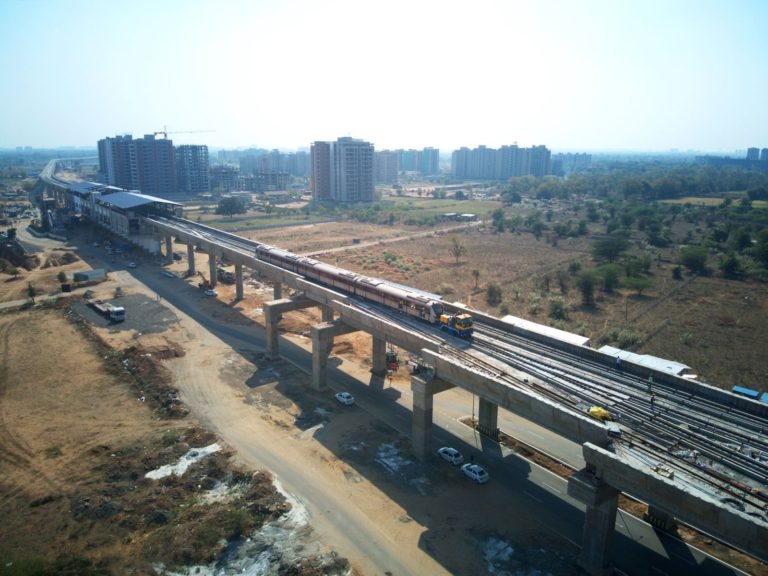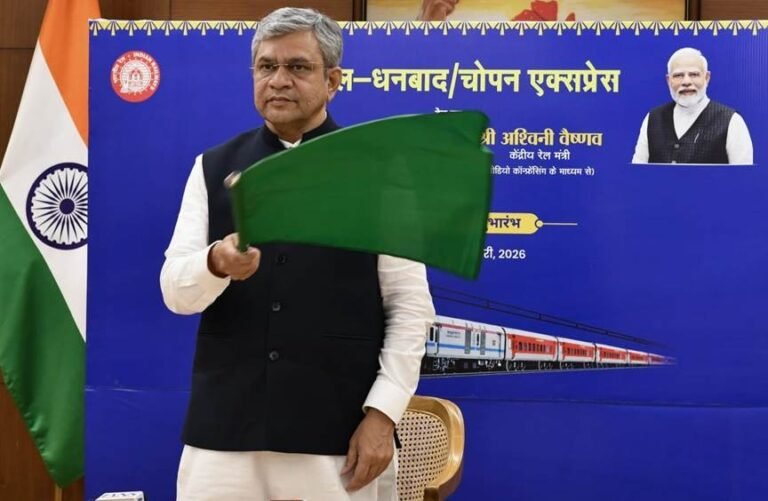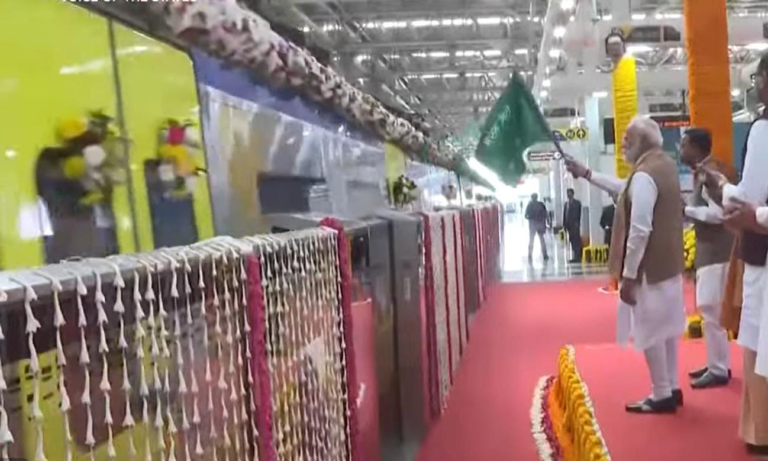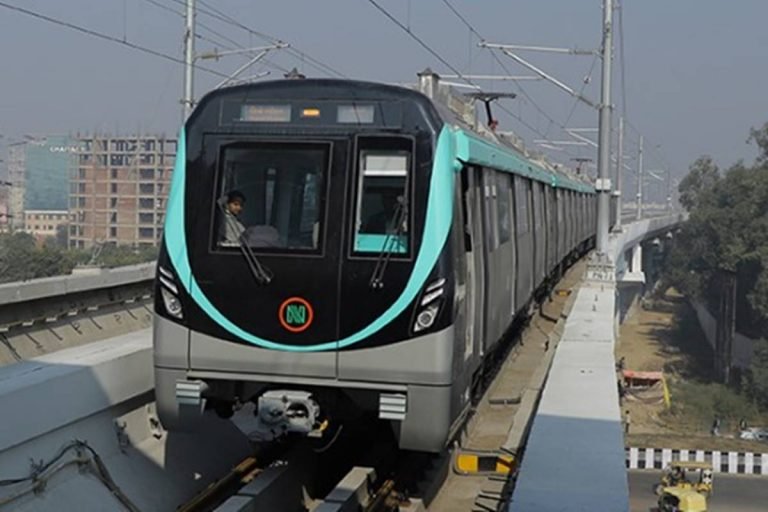
New Delhi: Prime Minister Narendra Modi has flagged-off the Delhi-Faridabad Metro Line that would allow hassle free travel for around two lakh daily commuters between the national capital and the industrial hub in Haryana.
The extension of the Delhi Metro connects Badarpur to Escorts Mujesar in Faridabad.
The total cost of the project from Badarpur to Escorts Mujesar is nearly Rs. 2,500 crore. Out of this, Rs. 1,557 crore was borne by the Haryana Government, the Centre contributed Rs. 537 crore, while the Delhi Metro provided Rs. 400 crore.
All these are elevated and located on either side of the Delhi-Mathura Road (NH-2).
“The nine-station metro corridor which was 95 per cent indigenously built will provide people a safe, affordable, quick, comfortable, reliable, environment-friendly and sustainable transport facility,” a Haryana government spokesperson said.
Haryana Chief Minister ML Khattar, addressing a press conference on Saturday, had thanked the Prime Minister for “gifting” the Metro service which would take the city to “another level of progress” with better connectivity with other NCR towns.
He had also said that the Prime Minister would be announcing the go-ahead for connecting Gurgaon with Faridabad by Metro.
ANDHRA PRADESH (Metro Rail News): The government of Andhra Pradesh has expedited the process of implementing metro projects in Vijayawada and Visakhapatnam (Vizag). The state government has decided to initiate the tendering process for both metro projects.
Tenders will initially be floated for works accounting for 40% of the total estimated project cost. The combined cost of the two metro projects stands at ₹21,616 crore. The estimated cost of the Visakhapatnam Metro project is ₹11,498 crore; meanwhile, the cost of the Vijayawada Metro stands at ₹10,118 crore. The projects will be implemented under a 50:50 cost-sharing model between the Central and State governments.
Funding Contributions for Metro Projects
Project
Implementing Authority
Contribution Amount
Visakhapatnam Metro Rail Project
Visakhapatnam Metropolitan Region Development Authority (VMRDA)
₹4,101 crore
Vijayawada Metro Rail Project
Capital Region Development Authority (CRDA)
₹3,497 crore
Project Overview: Visakhapatnam and Vijayawada Metro
The KERNEX-VRRC JV has received a Letter of Acceptance (LoA) for Kavach contracts worth ₹21.03 crore from South Central Railways. The contract includes upgrading the Kavach safety system from Version 3.2 to Version 4.0 in the Bidar – Parli Vaijnath section.
Contract Value: ₹21.03 crore
Contract Duration: 24 Months
The KERNEX-VRRC scope of work under this contract includes upgrading the Kavach system on the route between Sadashivpet Road and Parbhani station. However, the stations themselves will not be included in the contract. The contract only includes upgradation at Bidar and Parli Vaijnath stations along the route, which falls under the jurisdiction of South Central Railway.
Recently, KERNEX-VRRC also received a LoA for two major Kavach contracts from Southern Railways. The total combined value of both contracts stands at Rs 311.03 crore. To know more about this news: Click Here.
RAIPUR (Metro Rail News): To facilitate socio-economic development in the state capital, Raipur, the Chhattisgarh government has approved the Raipur-Durg metro rail project. This development is part of the border vision of creating a State Capital Region (SCR) modelled after Delhi’s National Capital Region (NCR).
The proposed SCR aims to integrate Raipur, Nava Raipur Atal Nagar, and the Durg–Bhilai corridor into a coordinated urban framework. The metro rail corridor is intended to facilitate more efficient movement of people, reduce road congestion, and contribute to the development of shared infrastructure across the region.
According to projections, the region is expected to have a population exceeding 50 lakh by 2031, and the metro system is being developed to meet the anticipated demand for reliable and accessible public transportation.
To initiate the Raipur–Durg Metro Rail Project, the Chhattisgarh government has allocated an initial sum of ₹5 crore in the 2024–25 state budget for conducting a comprehensive feasibility survey. This allocation is the first step towards assessing the technical, financial, and operational viability of the proposed metro corridor. Chhattisgarh may introduce a light metro system in its capital. The Raipur Municipal Corporation signed a Memorandum of Understanding (MoU) with the Ministry of Transport of the Russian Federation to explore the implementation of a light metro system in Raipur in August 2024.
The Capital Region Development Authority (CRDA) is being established to lead the planning and execution of the Raipur–Durg Metro Rail Project. The CRDA will function as the nodal agency responsible for coordinated development across the proposed State Capital Region (SCR).
Chaired by Chief Minister Vishnu Deo Sai, the CRDA will include cabinet ministers, senior bureaucrats, Members of the Legislative Assembly (MLAs), and representatives from urban local bodies. The CRDA will oversee key functions such as land use regulation, infrastructure development, investment facilitation, and environmental management within the SCR. It will play a central role in integrating regional planning with implementation to ensure cohesive urban growth.
To support the funding of capital-intensive infrastructure projects like the Raipur–Durg Metro, the CRDA will have the statutory authority to impose a dedicated infrastructure cess. Additionally, the authority will be responsible for preparing annual budgets and submitting progress reports to the state government.
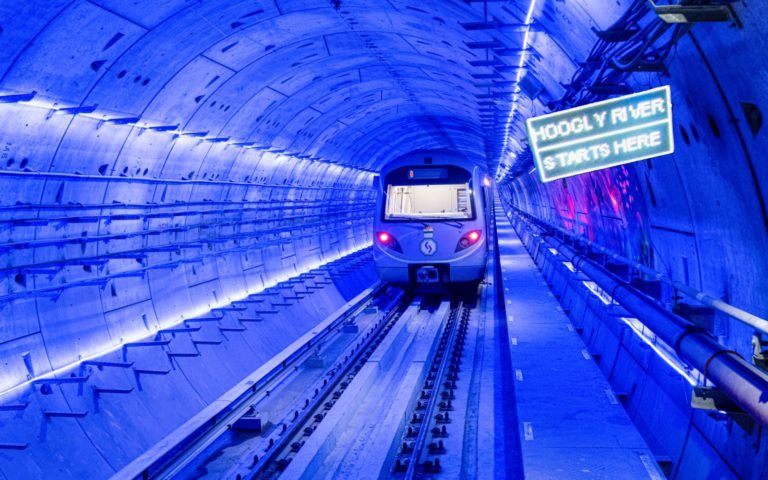
KOLKATA (Metro Rail News): The Kolkata Metro Rail Project advanced with the successful trial run on the under-construction Line 4 (Yellow Line) spanning 16.876 km between Noapara and Barasat, covering 10 stations.
The trials were conducted on a 7.03km stretch of Line 4, between Jai Hind Bimanbandar (Airport) and Noapara metro stations, covering 4 stations.
Stations
Noapara
Dum Dum Cantt
Jessore Road
Biman Bandar
The trial run on the Yellow Line between Jai Hind Bimanbandar and Noapara was conducted through Rake No. MR 413 in the presence of the General Manager and other senior officers.
The spokesperson said, Metro Railway General Manager P Uday Kumar Reddy was present during the trial run between Jai Hind Biman Bandar and Noapara metro station on Monday, and the trial run was smooth and successful, as reported by ET Infra.
Shri P. Uday Kumar Reddy, General Manager, said, “This stretch, once commissioned, would be a revolutionary step in providing a modern transport system to the people of Kolkata and suburbs to reach the airport,” as reported by ET Infra.
Shri P. Uday Kumar Reddy, Metro Railway, also inspected the stretch from Jai Hind Bimanbandar to Noapara stations of Yellow Line on 21.07.2025 with senior officials of Metro Railway.
The first successful trial run on this section was conducted in January 2025. To know more about this news: Click Here.
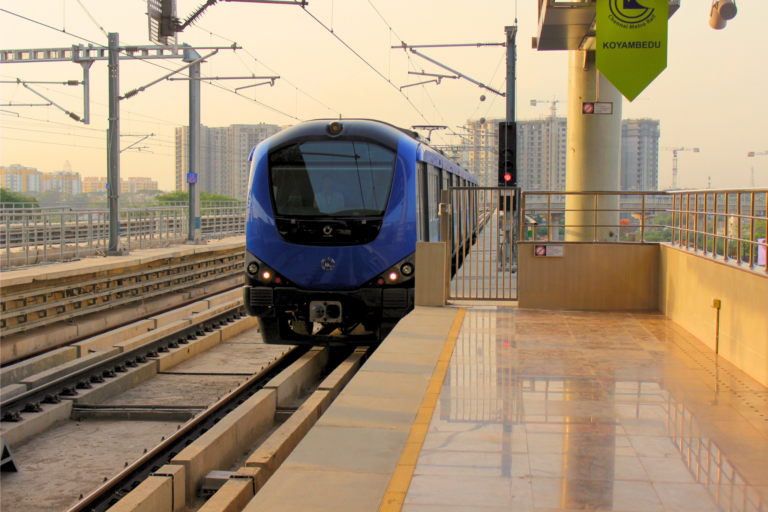
CHENNAI (Metro Rail News): Chennai Metro Phase 2 progressed as ITD Cementation’s TBM Peacock achieved Breakthrough on 23 July at Line 4’s Kodambakkam Ramp Retrieval shaft near Meenakshi College. This development was recorded under Package C4-UG02 of Line 4 of Chennai Metro Phase 2. The Line 4 spans 26.8km from Light House to Poonamallee Bypass and features 12 underground stations and 18 elevated stations.
TBM Peacock Breakthrough at Kodambakkam Ramp
Chennai Metro Rail Limited is in the process of implementing the much anticipated Phase 2 project across Chennai City in full swing with three corridors for a total length of 118.9 km.
For its first assignment, Tunnel Boring Machine (TBM) Peacock commenced tunnelling operations on May 2, 2024, from the Panagal Park Crossover towards the Kodambakkam Ramp Retrieval Shaft. The TBM completed a drive of 2,047 meters, which is the longest single tunnel drive executed in Chennai Phase 2 of the project.
In January 2022, ITD Cementation bagged Package C4-UG02 of Chennai Metro Phase 2 from Chennai Metro Rail Corporation (CMRL) at Rs 1846.86 crore.
CMRL’s Brief Scope: Construction of underground stations at Boat Club, Nandanam, Panagal Park, Kodambakkam, Kodambakkam Flyover, including underground crossover at Panagal Park Station and associated twin tunnel, cut & cover box, U section and ramp project start from chainage 5+150m to end chainage 10+0.27m (down line).
The 10.03 km underground section of Corridor 4 of the Chennai Metro, stretching from Light House Station to Kodambakkam Flyover, is being executed by ITD Cementation India Ltd. under two distinct contract packages: C4-UG-01 and C4-UG-02.
The primary challenge during this tunnel boring operation was navigating beneath a densely built-up urban environment. The alignment passed beneath 190 buildings, predominantly residential structures, including over 50 old buildings with potentially vulnerable foundations. Additionally, the TBM had to bore parallel to an operational railway line before crossing multiple active railway tracks, which posed geotechnical and logistical challenges.
The tunnel alignment also traversed below two churches and passed underneath the existing Kodambakkam flyover, which required precise control and monitoring to avoid any structural impact. Despite these complexities, the tunnelling operation was executed successfully, achieving the longest drive of Chennai Metro Phase 2, measuring 2.047 km without causing any disruption to public life or ongoing surface traffic.
MUMBAI (Metro Rail News): The Government of Maharashtra has approved a financial mechanism that will empower the Mumbai Metropolitan Region Development Authority (MMRDA) to secure loans from foreign financial institutions for six under-construction Metro corridors of the Mumbai Metro Rail Project.
The loan agreements will be executed for the following under-construction Mumbai Metro corridors:
Line
Route
Length
Line 5
Thane-Bhiwandi-Kalyan
24.9 km
Line 6
Swami Samarth Nagar-Vikhroli
14.5 km
Line 7A
Dahisar East to Mumbai Airport
3.17 km
Line 9
Dahisar East to Mira Bhayander
11.38 km
Line 10
Gaimukh to Shivaji Chowk
9.2 km
Line 12
Kalyan to Taloja
20.7 km
According to the government resolution issued last week, the Maharashtra state government has agreed to provide contingent liability support for loans that the Mumbai Metropolitan Region Development Authority (MMRDA) may obtain from bilateral or multilateral agencies or other financial institutions. This support implies that the state will act as a guarantor, assuming liability only if MMRDA is unable to meet its repayment obligations.
The resolution further states that these loans may be structured either on a back-to-back basis, where the terms of the loan are directly passed through to the borrowing agency or through other appropriate financial arrangements. The borrowing is expected to be carried out at concessional interest rates, potentially reducing the financing burden on MMRDA for the implementation of its metro infrastructure projects.
Under the terms of the resolution, MMRDA will be solely accountable for servicing the loans, including the repayment of principal, interest, and applicable charges. However, the state government has pledged to act as a guaranteeing authority which will fulfil the obligations only in the case of default or under specific exceptional conditions, as defined in the resolution.
This initiative by the state government is expected to play a major role in supporting MMRDA, as it will enable the authority to secure loans more effectively. Access to such funding is likely to facilitate the timely execution and completion of the under-construction metro corridors by ensuring adequate financial resources are available throughout the project lifecycle.
BANGALORE (Metro Rail News): The Bangalore Metro Rail Project progressed as the Commissioner of Metro Railway Safety (CMRS) Inspection began on the long-awaited Yellow Line of Bangalore Metro Phase 2. The Yellow Line spans 19.143 km from RV Road to Bommasandra through 16 stations.
On 22 July, the CMRS conducted an inspection of Reach 5 and completed one-fourth of the overall assessment.BMRCL Chief Public Relations Officer Yashwant Chavan said, “The inspection will be completed in the next 3-4 days,” adding that once the CMRS clears the line, final authorisation for passenger services will be granted. As reported by The New Indian Express.
Once the approvals from the CMRS are secured, the BMRCL is expected to finalise operational activities following consultations with both the Union and State governments of Karnataka.
Bengaluru Central MP PC Mohan commented, “CMRS inspection of the Yellow Line began on Tuesday, three years after BMRCL missed its 2021 deadline. With 16 stations from RV Road to Bommasandra, it is crucial for ORR commuters. But 10 MDs in 22 years slowed progress. Namma Metro deserves steady hands, not shifting chairs.”As reported by The New Indian Express.
BHOPAL (Metro Rail News): Bhopal Metro has achieved a major milestone with the Research Design and Standards Organisation successfully completing Oscillation and Emergency Braking Distance (EBD) trials for the Bhopal Metro’s rolling stock, which Alstom India is supplying.
The trials were conducted within the time frame of July 9, 2025, to July 21, 2025. The trials spearheaded by Sandeep Gupta, Director (Testing), RDSO, were carried out between Nagar metro station and AIIMS metro station.
The oscillatory behaviour and braking performance of the Bhopal Metro rolling stock were thoroughly evaluated under diverse operational scenarios to ensure compliance with safety and performance standards. Experts from the Research Designs and Standards Organisation (RDSO) conducted extensive trials to measure and analyse critical dynamic and braking parameters.
Key aspects assessed during the trials included:
Ride Quality and Passenger Comfort: Using onboard sensors and data acquisition systems, the ride index was evaluated in accordance with the standards defined in Indian Railways’ applicable codes. Measurements captured vertical and lateral accelerations, vibrations, and jerk levels to determine the ride comfort under various speeds and track conditions.
Stability and Oscillatory Behaviour: The dynamic stability of the trainset was examined through oscillation trials, which focused on lateral and vertical displacements, wheel unloading, and hunting behaviour, particularly at high speeds and curves.
Braking Performance: Emergency and service braking trials were conducted to evaluate the deceleration rates and braking distances under loaded and unloaded conditions.
Overall System Integration and Performance: The rolling stock’s response under acceleration, deceleration, coasting, and gradient conditions was monitored to ensure optimal traction-braking integration. Compatibility with track geometry, signalling, and platform interfaces was also assessed.
The data acquired from these comprehensive assessments is critical for the preparation of the Oscillation Trial Report and Braking Distance Certification Report. These documents form the basis for granting safety clearance and technical approval by RDSO, which is a prerequisite for the initiation of commercial operations of the Bhopal Metro.
DELHI (Metro Rail News): Delhi Metro Rail Corporation (DMRC) has received bids from 10 firms for the architectural finishing contract for Delhi Metro Phase 4’s Golden Line (Line 10), which spans 23.622 km from Aerocity to Tughlakabad through 15 stations.
Bidders
CP & Associates Pvt Ltd
Ghaziabad Mechfab Pvt. Ltd.
Godrej and Boyce Mfg. Co. Ltd
Lisha Engineers Private Limited
M I A Construction Pvt ltd
M/S Garg Builders
Quality Buildcon Private Limited
SS. SS. Constructions Pvt. Ltd
Vishnu Saran and Company
YFC Projects Pvt. Ltd.
Contract Value: Rs. 88 22 Crores
Contract Duration: 450 Days
The scope of work under this contract includes the Architectural Finishing Works, Including Design, Fabrication, Supply, Erection, & Roof sheeting of Pre-Engineered Building (PEB) Structures and Design & Construction of External facade, Water Supply, Sanitary Installation, Drainage, and Site development works at 4 elevated stations of Delhi Metro Phase 4’s Golden Line.
Stations
Sangam Vihar
Khanpur
Ambedkar Nagar
Saket-G block
In addition, the Delhi Metro phase 4 recently witnessed another milestone as Afcons Infrastructure’s TBM Disha (1264B) achieved a breakthrough at Tughlakabad Railway Colony station of Delhi Metro Phase 4’s Golden Line. This development was recorded under Package DC-07. To know more about this News: Click Here
HYDERABAD (Metro Rail News): Hyderabad Metro Rail Project is going to progress as Hyderabad Airport Metro Limited (HAML) will commence underground utility mapping for Phase 2’s Corridor 6, which extends the existing green line between MGBS and Chandrayangutta in the Old City. The corridor spans 7.5 km.
This utility survey will involve both road-cutting and non-destructive probing at the proposed station sites to identify existing underground infrastructure. The 7.5 km corridor traverses Mir Alam Mandi Road and will include station stops at key locations such as Salarjung Museum, Charminar, Shalibanda, Aliabad, Falaknuma, and Chandrayangutta.
HAML intends to engage a contractor to carry out the utility probing between Darulshifa and Chandrayangutta. Upon finalisation, the appointed contractor will be allotted 30 days to complete the task.
The survey will utilise ground-penetrating radar technology to map underground utilities at depths of 5 to 6 meters.This data is crucial for minimising disruptions to essential services, including water pipelines, drainage systems, electricity, and telecommunication cables during the construction phase.
According to HAML officials, the objective is to facilitate the smooth execution of metro work while ensuring minimal interference with existing infrastructure.