Home Blog Page 2

BEML-Medha consortium to supply 16 high-speed trains for Mumbai Ahmedabad High Speed Rail Corridor

0
BEML to Supply High Speed Train

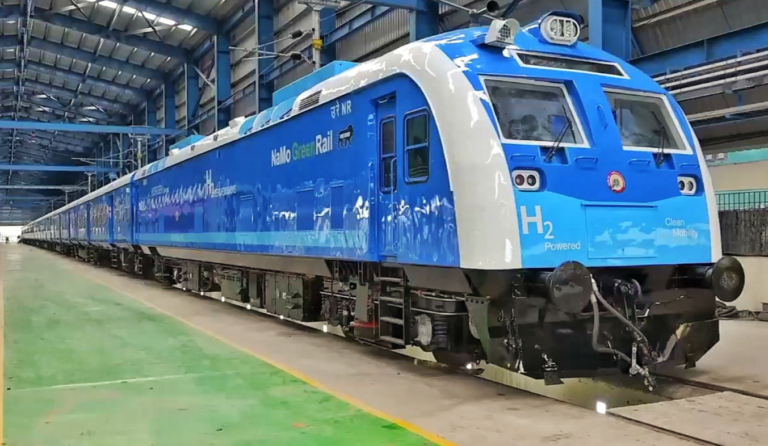
NEW DELHI (Metro Rail News): A consortium of BEML Limited and Medha Servo Drives has put forward its bid to the National High Speed Rail Corporation Limited (NHSRCL) for designing and manufacturing 16 high-speed trainsets for the Mumbai-Ahmedabad High-Speed Rail project, as per a Moneycontrol report.

This move comes after NHSRCL issued a single-vendor tender earlier in February, specifically inviting BEML to participate in the process. With this submission, the consortium has formally entered the race to supply rolling stock for India’s first bullet train corridor.

In 2024, the Integral Coach Factory granted a contract valued at ₹866 crore to the BEML–Medha consortium for the development of two eight-coach high-speed trainsets. These trains are being developed to achieve a top speed of 280 kmph, with a scheduled operating speed of 250 kmph.

The BEML–Medha consortium has quoted approximately ₹250 crore per train for the proposed 16 trainsets, which also includes a seven-year maintenance agreement. Out of this, BEML’s portion covers the carbody and interior works and is estimated at around ₹150 crore per train, while Medha Servo Drives is expected to account for nearly ₹100 crore per train for propulsion equipment, bogies, and the Train Control and Management System (TCMS). 

The first two prototype trainsets are projected to have about 50% indigenous content, with this share expected to rise gradually as the domestic supply ecosystem develops.

Delay in Shinkansen procurement

Talks with Japan regarding the supply of Shinkansen trainsets are still unresolved due to differences over pricing. As a result, the National High Speed Rail Corporation Limited (NHSRCL) has decided to move forward with the procurement of 16 domestically manufactured trainsets to ensure sufficient rolling stock is available when operations begin.

The timeline for the rollout of the first prototype has now been pushed to March 2027 from the earlier target of December 2026, as manufacturing activities have not yet started.

Phased commercial operations

The Surat–Bilimora section of the Mumbai Ahmedabad High Speed Rail Corridor will become the first to witness the high-speed train operations in August 2027.


Discover how AI is bringing the next phase of sustainable urban rail mobility for Viksit Bharat at InnoMetro 2026, India’s prime exhibition and conference for metro & railways, which is going to be held on 21-22 May 2026 at Bharat Mandapam, New Delhi.

Register Now: https://zma.page/ek9

Advertisement1
InnoMetro_2026

Bhopal Metro floats ₹123 Cr tender for escalator & lift procurement

0
Bhopal Metro

BHOPAL(Metro Rail News): The Madhya Pradesh Metro Rail Corporation Limited (MPMRCL) has floated a ₹123.14 crore tender for the supply and installation of heavy-duty lifts, escalators, and moving walks across stations of the Bhopal Metro project – the latest in a series of procurement drives as the city’s metro network moves closer to full operations.

Tender Information:

Package BH-12
Cost of work₹123.14 crore (Including 18% GST)
Pre-bid Meeting15-April-2026
Bid Submission Deadline13-May-2026
Work Completion Period695 Days (Excluding DLP and CAMC)

MPMRCL’s brief scope of work: “Design, Manufacture, Supply, Installation, Testing and Commissioning of Heavy-Duty Machine Room-Less & Gear-Less Lifts, Heavy-Duty Escalators and Moving Walks along with two-years DLP (Defects Liability Period) followed by three-years of CAMC (Comprehensive Annual Maintenance Contract) for Bhopal Metro Rail Project”

2024 04 30 BH Aln Map Distances

Key Dynamics of the Bhopal Metro Project

Phase 1 of Bhopal Metro spans about 30km and features 2 metro lines, including the Orange Line and the Blue Line. In December 2025, the first section of Bhopal Metro Phase 1 became operational from AIIMS to Subhash Nagar. This 7km stretch is part of the Orange Line. The upcoming sections of the project will be opened in a phased manner. Amidst these developments, there is another emerging aspect of Bhopal Metro, which is cost overruns. The Bhopal Metro Phase 1 was initially planned to be built at ₹6,941 crore; the delays have pushed this cost to 10,000 crore, which is a major concern for the long term financial sustainability of the project. 


Discover how AI is bringing the next phase of sustainable urban rail mobility for Viksit Bharat at InnoMetro 2026, India’s prime exhibition and conference for metro & railways, which is going to be held on 21-22 May 2026 at Bharat Mandapam, New Delhi.

Register Now: https://zma.page/ek9

Advertisement1
InnoMetro_2026

Indian Railways Clears ₹1,236 Crore for Kavach Expansion and Communication Upgrade

0
Railway

NEW DELHI (Metro Rail News): Indian Railways has approved 3 major infrastructure projects worth approximately ₹1,236 crore to modernise its communication backbone and extend the Kavach automatic train protection system across key zones. The approvals span Central Railway, Southern Railway, and Western Railway, and address two critical pillars of railway modernisation: fibre optic communication networks and collision-avoidance safety technology.

Central Railway to Get Dual Fibre Backbone: ₹623.63 Crore

Two complementary works have been sanctioned to build a robust, dual-path communication backbone across all five divisions of Central Railway, including Solapur, Nagpur, Pune, Bhusawal, and Mumbai.

The first component involves installing OPGW (Optical Ground Wire, 96-fibre) along the existing 25 KV electric traction lines over 2,250.68 route km, covering four divisions. This specialised composite overhead wire serves a dual purpose; it acts as an earth protection wire for the traction system while simultaneously carrying optical fibre for communication. Since it uses existing traction towers, no new civil infrastructure is required. This work is approved at ₹238.94 crore.

The second component involves laying underground optical fibre cables (2×48 fibre) on one side of the track over 2,673.21 route km across all five divisions, at a cost of ₹384.69 crore. Together, the OPGW above ground and the underground cable create two fully independent fibre paths on every route. The surplus dark fibre capacity will also be leased out commercially, generating additional revenue for Indian Railways.

Kavach 4.0 to be Extended to 548 km on Southern Railway: ₹310.18 Crore

Kavach, Indian Railways’ indigenously developed automatic train protection system, will be deployed on high-traffic routes across Tamil Nadu, Kerala, and Karnataka under this approval. The system automatically applies brakes to prevent collisions when two trains are on a conflicting course or when a signal is passed at danger.

The first section covers Jolarpettai-Erode (180 km, Salem Division) and Chennai Beach–Tambaram-Chengalpattu (60 km, Chennai Division), along with new optical fibre cabling, at a cost of ₹158.74 crore. The second section covers Shoranur-Mangalore (308 km, Palakkad Division) along with 4×48 fibre OFC cabling, at ₹151.44 crore. 

Fibre Network in Gujarat: ₹302.26 Crore

Optical fibre cables (2×48 fibre on each side of the track) will be laid on the remaining stretches of two Western Railway divisions in Gujarat: 1,064 km in the Rajkot Division and 589 km in the Bhavnagar Division, totalling 1,653 km at a cost of ₹302.26 crore.

Project-wise Breakdown

Project Route (km)CostScope
Central Railway – OPGW2,250.68 Rkm₹238.94 Cr96-fibre OPGW on traction lines (4 divisions)
Central Railway – UG OFC2,673.21 Rkm₹384.69 Cr2×48 underground fibre (all 5 divisions)
Southern Rly – Kavach 4.0 (Jolarpettai-Erode & Chennai Beach-Chengalpattu)240 km₹158.74 CrKavach + OFC, Salem & Chennai Divisions
Southern Rly – Kavach 4.0 (Shoranur-Mangalore)308 km₹151.44 CrKavach + 4×48 OFC, Palakkad Division
Western Railway-OFC (Rajkot + Bhavnagar)1,653 km₹302.26 Cr2×48 OFC on both sides of track

Overall Impact

These approvals are part of Indian Railways’ broader strategy to modernise infrastructure through the integration of advanced communication systems and safety technologies. 


Discover how AI is bringing the next phase of sustainable urban rail mobility for Viksit Bharat at InnoMetro 2026, India’s prime exhibition and conference for metro & railways, which is going to be held on 21-22 May 2026 at Bharat Mandapam, New Delhi.

Register Now: https://zma.page/ek9

Advertisement1
InnoMetro_2026

Kochi Metro Phase 2: Crescent Construction Wins Rs. 21.5Cr Civil Contract

0
Kochi-Metro
Kochi-Metro/ Representational Image

KOCHI (Metro Rail News): Kochi Metro Rail Limited (KMRL) has awarded a civil construction contract worth Rs. 21,49,69,334.50 to Crescent Construction Company for the construction of entry and exit buildings at two Phase II stations: Civil Station Junction and Cochin SEZ.

The contract covers balance civil works and excludes architectural and building services works, which are to be procured separately. 

Contract Details: 

Tender ReferenceKMRL/PROC/TENDER/2025-26/047
E-Tender ID2025_KMRL_787246_1
Stations CoveredCivil Station Junction & Cochin SEZ
Awarded ToCrescent Construction Company
Contract ValueRs. 21,49,69,334.50 (including GST)
ScopeCivil works (excluding Architectural & Building Service works)
Scope of WorkConstruction of Entry & Exit Buildings of Civil Station Junction and Cochin SEZ Metro Station for Phase II of Kochi Metro Rail Project (excluding Architectural and Building Service works)- (Balance Works)
Awarding AuthorityCompetent Authority, KMRL

Civil Station Junction is strategically positioned near Kochi’s civil services administrative hub, which makes it a high-footfall station for government employees and visitors.  On the other hand, Cochin SEZ station will directly serve the Special Economic Zones.

About Kochi Metro Phase II (Pink Line)

Kochi Metro Phase II, known as the Pink Line, is an 11.2 km elevated metro corridor connecting Jawaharlal Nehru Stadium in Kaloor to Infopark II in Kakkanad. The foundation stone was laid by Prime Minister Narendra Modi on 1 September 2022, and construction officially began on 3 July 2024. The Pink Line will feature 11 stations and is being developed in two sub-phases. The first five stations are targeted for launch by June 30, 2026, while the remaining stations including Civil Station Junction and Cochin SEZ (covered under this contract) are scheduled for completion by December 2026.

Despite a three-month delay caused by heavy monsoon rains and underground pipeline relocation challenges, KMRL remains committed to its June 2026 target for the first five stations and December 2026 for the full Pink Line.


Discover how AI is bringing the next phase of sustainable urban rail mobility for Viksit Bharat at InnoMetro 2026, India’s prime exhibition and conference for metro & railways, which is going to be held on 21-22 May 2026 at Bharat Mandapam, New Delhi.

Register Now: https://zma.page/ek9

Advertisement1
InnoMetro_2026

Indian Railways’ Kavach System Now Guards 190 km of Delhi-Howrah Corridor

0
Vande Bharat Express - Indian Railways
Vande Bharat Express

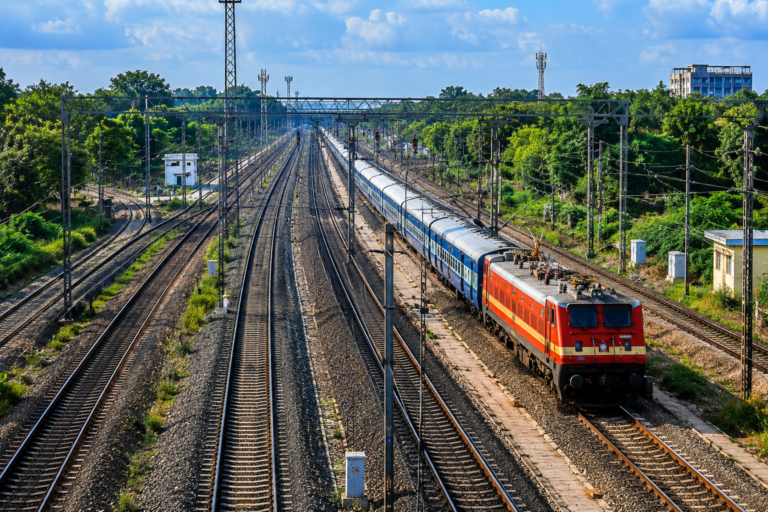
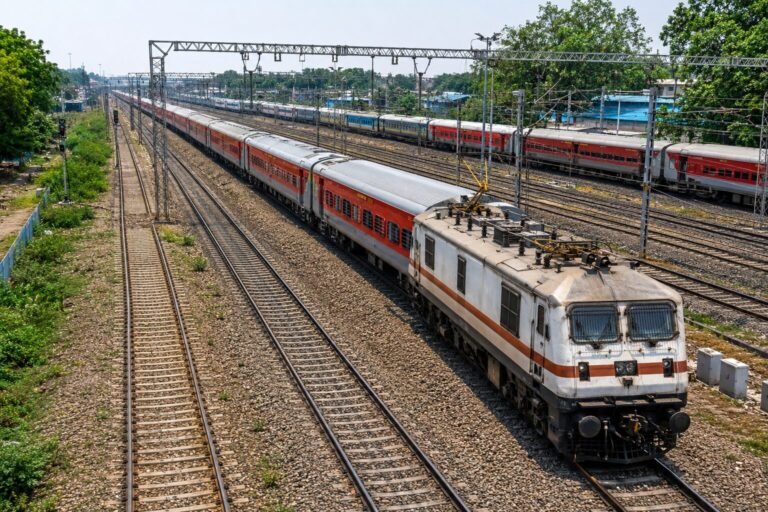
NEW DELHI (Metro Rail News): Indian Railways achieved a landmark safety milestone on 22 March 2026 when it formally commissioned the Kavach Automatic Train Protection (ATP) System on the Prayagraj (Excluding) to Kanpur (Excluding) section, a stretch of 190 route kilometres forming a critical part of the Delhi-Howrah high-density corridor.

The commissioning was conducted through Train No. 14163, with the General Manager personally conducting a footplate inspection from Subedarganj to Manauri station. Senior officers, including PHODs, the Divisional Railway Manager of Prayagraj, Headquarters officers, and Divisional officers, were present.

In the first phase, Kavach will be enabled on eight pairs of trains: 14113/14114, 14163/14164, 12307/12308, 12417/12418, 22437/22438, 15003/15004, 20433/20434, and 12403/12404. Additional trains and Vande Bharat services will be progressively included in subsequent phases.

Prior to commissioning, extensive and rigorous trials were successfully conducted. Trial runs included WAP-7 locomotives with 8, 16, and 22 LHB coach configurations, as well as a 20-coach Vande Bharat rake, ensuring system reliability under varied operational conditions. Passenger trials were also conducted using the Chauri Chaura Express (Train No. 15003/15004), which demonstrated consistent and reliable performance.

In the next phase, the Kavach system will be introduced on the Ghaziabad-Tundla section, another key segment targeted for 160 kmph operations under Mission Raftaar. Indian Railways remains committed to adopting modern safety technologies and strengthening its safety framework, ensuring safer, more reliable, and efficient train operations for passengers across the nation.


Discover how AI is bringing the next phase of sustainable urban rail mobility for Viksit Bharat at InnoMetro 2026, India’s prime exhibition and conference for metro & railways, which is going to be held on 21-22 May 2026 at Bharat Mandapam, New Delhi.

Register Now: https://zma.page/ek9

Advertisement1
InnoMetro_2026

Shri Vijay Pratap, former Additional Member(Traction), Railway Board, joins InnoMetro 2026 Advisory Board

0

NEW DELHI (Metro Rail News): Metro Rail News proudly welcomes Shri Vijay Pratap Singh, former Additional Member(Traction), Railway Board, as a key advisory board member of InnoMetro 2026 – Asia’s Leading Expo & Conference for Metro, Railway, RRTS, HSR, and allied sectors. The event is being presented by Metro Rail News and organised by Symbroj Media on 21-22 May 2026 at Bharat Mandapam, New Delhi.

Professional Background

Shri Vijay Pratap Singh is a distinguished officer of the Indian Railway Service of Electrical Engineers (IRSEE), with a career spanning over 37 years in some of the most technically demanding roles across Indian Railways. A postgraduate in Power Electronics from IIT Kanpur (1986-1988), his academic foundation in advanced electrical systems has consistently informed his approach to large-scale infrastructure challenges.

His career trajectory reflects steady progression through critical leadership positions. He served as Additional General Manager (AGM) at South East Central Railway (SECR), before being elevated to the Railway Board as Principal Executive Director (Traction). He subsequently rose to the position of Additional Member (Traction), Railway Board, one of the most senior technical roles in Indian Railways, with supplementary charge as Additional Member overseeing Production Units from March 2024.

In this capacity, he was instrumental in formulating national policies for electric traction systems, coordinating with zonal railways, locomotive factories, and RDSO, and steering India’s railway electrification agenda with a focus on reliability, energy efficiency, and integration of advanced technologies.

Among his many notable contributions, Shri Singh chaired the 64th Electrical Standards Committee meeting at NF Railway Headquarters, a landmark forum that reviewed and updated electrical standards critical to the safe and efficient functioning of Indian Railways.

Role at InnoMetro 2026

As a member of the Advisory Board of InnoMetro 2026, Shri Vijay Pratap Singh will play a pivotal role in shaping the intellectual and strategic direction of the conference. His responsibilities will include:

  • Identifying priority conference themes grounded in real-world sectoral challenges and emerging opportunities
  • Ensuring that technical sessions and panel discussions reflect the current operational realities of Indian Railways
  • Aligning conference outcomes with the long-term infrastructure goals of metro, RRTS, and high-speed rail development in India

About InnoMetro

This year, Metro Rail News is presenting the 6th edition of InnoMetro, which serves as the global platform for showcasing products and services for the rail transit sector. The expo is expected to attract participation from over 200 exhibitors from 27+ Countries. 

Recognising the growing integration of Artificial Intelligence across various layers of rail operations, ranging from predictive maintenance and signalling to passenger information systems and asset monitoring, InnoMetro 2026 will introduce a dedicated Bharat AI Pavilion. The pavilion is designed to provide a focused platform for innovators, technology developers, and solution providers who are integrating AI-driven applications into rail and urban mobility systems. 

In addition to the exhibition, the conference will see participation from 60+ renowned experts from the industry, including metro & railway officials, who will discuss the dynamics of rail transit in India. The sessions will focus on key developments, operational challenges, policy direction, and emerging technologies shaping rail transit in India.

The objective of the event is to bring together decision-makers, policymakers, and global as well as domestic manufacturers on a single platform. By enabling dialogue between government authorities and industry stakeholders, the event aims to facilitate collaboration at both policy and manufacturing levels, which can support the development of a stronger and more self-reliant rail mobility ecosystem that aligns with India’s growing transportation needs.


Discover how AI is bringing the next phase of sustainable urban rail mobility for Viksit Bharat at InnoMetro 2026, India’s prime exhibition and conference for metro & railways, which is going to be held on 21-22 May 2026 at Bharat Mandapam, New Delhi.

Register Now: https://zma.page/ek9

Advertisement1
InnoMetro_2026

HMRTC Plans 18 Metro Stations Along Gurugram-Faridabad RRTS Corridor

0
RRTS

GURUGRAM (Metro Rail News): The Haryana Mass Rapid Transport Corporation (HMRTC) has come up with a new proposal which includes the construction of 18 metro stations along the upcoming Namo Bharat corridor, which will connect Gurugram, Faridabad and Greater Noida.10 stations out of 18 are planned to be constructed in Faridabad, meanwhile, the remaining eight stations will come up in Gurugram.

The Gurugram – Faridabad RRTS line will stretch about 64 kilometres, and it will use the same model that has been used for Delhi Meerut RRTS and Meerut Metro, which means the metro and Namo Bharat trains will utilise the same infrastructure for operations. 

A large part of the RRTS route, about 52 km, will pass through Gurugram, while the remaining 12 km will be in Uttar Pradesh. This new semi-high-speed transit line will be well-connected with the existing Delhi Metro network, making travel easier for daily commuters. One of the key connections will be at the Millennium City Centre Metro station on the Yellow Line, allowing passengers to switch between the two systems conveniently.

Another important interchange is planned at Sector 61. Here, the Namo Bharat station will connect with a proposed metro line connecting Sector 56 and Pachgaon. This will create a smooth link between different parts of the city and nearby regions, helping people save time and travel more comfortably.


Discover how AI is bringing the next phase of sustainable urban rail mobility for Viksit Bharat at InnoMetro 2026, India’s prime exhibition and conference for metro & railways, which is going to be held on 21-22 May 2026 at Bharat Mandapam, New Delhi.

Register Now: https://zma.page/ek9

Advertisement1
InnoMetro_2026

RITES wins contract to maintain 67 km high-speed railway test track in Rajasthan

0
Railway high speed track

JODHPUR (Metro Rail News): RITES Limited, a PSU under the Ministry of Railways, has secured a Rs 105cr contract from RDSO for the maintenance of Indian Railways’ first high-speed test track in Rajasthan. This track has been developed by RDSO at a cost of Rs 967 cr. 

This test track facility comes under the jurisdiction of North Western Railway (NWR and is situated between Gudha and Thathana Mithri in the Nawa region of the Jodhpur Division. 

Scope of work: Comprehensive maintenance contract of the dedicated test track between Gudha and Thathana Mithri stations of the Jodhpur division of NWR.

RITES is responsible for executing this work within  60 months from the date of issuance of LOA.

About High Speed Test Track

RDSO has designed this 64 km high-speed test track for the testing of advanced trains that will be capable of reaching the speed of 220km/h. The test track includes multiple civil structures, including 7 major bridges, 129 smaller bridges, and four stations (Gudha, Jabdinagar, Nawan, and Mithadi). As per the projection, the work on the test track will be completed by December 2026. 


Discover how AI is bringing the next phase of sustainable urban rail mobility for Viksit Bharat at InnoMetro 2026, India’s prime exhibition and conference for metro & railways, which is going to be held on 21-22 May 2026 at Bharat Mandapam, New Delhi.

Register Now: https://zma.page/ek9

Advertisement1
InnoMetro_2026

Bangalore Metro’s Pink Line inches closer to launch; RDSO to start safety checks

0
Bangalore Metro
Bangalore Metro (representational Image)

BANGALORE (Metro Rail News): The Pink Line of Bangalore Metro is making move towards the launch, as the Research Designs and Standards Organisation (RDSO) gears up to start the safety inspection. The safety trials are planned to be conducted on the 7.53 km elevated section of the Pink Line, which connects Kalena Agrahara and Tavarekere.

Every metro system in India requires RDSO to commence operations. The primary objective of the safety trial is to scrutinise each and every critical aspect of rolling stock and infrastructure, which is required for passenger safety. During the testing, RDSO assesses the rolling stock interaction with civil structures, braking system, signalling integration, among others. After getting the safety clearance from RDSO, BMRCL can initiate the operations on the Pink Line.

Officially, the Pink Line is known as the Reach 6, and it forms a very crucial part of the Bangalore Metro Phase 2. It covers a 21.25 km distance from Kalena to Nagawara. The operations on the Pink Line will reduce congestion in the city by connecting residential and commercial zones

The Pink Line will become operational in a phased manner. Once the 7.5 km elevated stretch becomes operational, the remaining line will be commissioned by December 2026.


Discover how AI is bringing the next phase of sustainable urban rail mobility for Viksit Bharat at InnoMetro 2026, India’s prime exhibition and conference for metro & railways, which is going to be held on 21-22 May 2026 at Bharat Mandapam, New Delhi.

Register Now: https://zma.page/ek9

Advertisement1
InnoMetro_2026

Delhi Metro Phase 4: Bids Invited for UIC-60 turnouts, crossovers for Line-08 extension

0
Soon, enjoy uninterrupted internet on Delhi’s Pink and Magenta lines

DELHI (Metro Rail News): Delhi Metro Rail Corporation has floated a tender for the procurement of standard gauge UIC-60 turnouts and scissors crossovers for ballastless track of Magenta Line (Line-08) extension. Under Phase-4, the Line 8 is planned to be extended to a length of  29-km from Janakpuri West to RK Ashram Marg. 

Tender Information

Tender Id 2026_DMRC_902787_1
Tender NoDT-22
Cost of workINR 5.48 Crores
Completion period6 months
Pre-bid meeting24.03.2026
Bid submission deadline08.04.2026

Brief scope of work: Design, Manufacturing, and Supply of Standard Gauge UIC-60 Turnouts and Scissors Cross Overs for Ballastless Track of Line-08 Extension. Of Delhi Metro Phase-IV Corridors.

The Magenta Line of Delhi Metro holds great significance after the approval of its extension between Ramakrishna Ashram Marg and Indraprastha under Phase 5A. After this extension, the Magenta Line will become the longest corridor (approx. 89 km), which runs driverless. Recently, a 10 km section of the Magenta Line was inaugurated between Deepali Chowk and Majlis Park under phase 4.


Discover how AI is bringing the next phase of sustainable urban rail mobility for Viksit Bharat at InnoMetro 2026, India’s prime exhibition and conference for metro & railways, which is going to be held on 21-22 May 2026 at Bharat Mandapam, New Delhi.

Register Now: https://zma.page/ek9

Advertisement1
InnoMetro_2026