




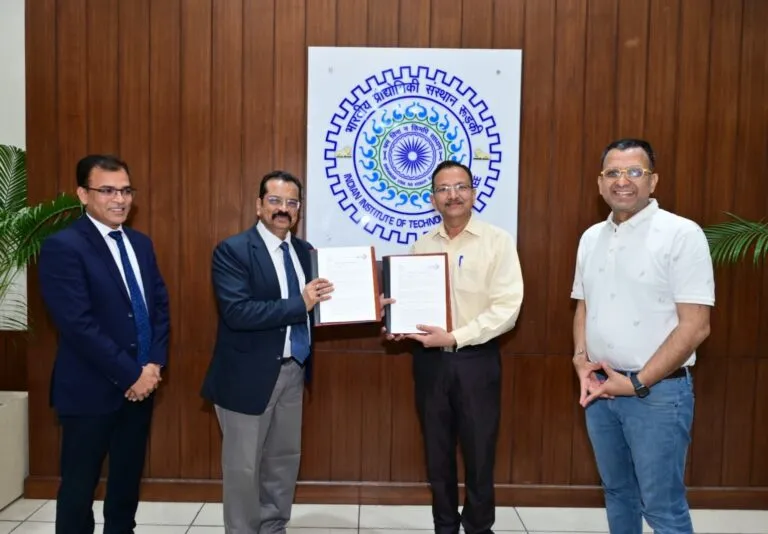
DELHI (Metro Rail News): The National Capital Region Transport Corporation (NCRTC) and the Indian Institute of Technology (IIT) Roorkee have signed a Memorandum of Understanding (MoU) to strengthen collaboration in research, innovation and capacity building in the urban transport sector. This MoU was exchanged on Saturday, 04th April in the presence of Managing Director, NCRTC, Shri Shalabh Goel and Dean of Resources and Alumni Affairs (DORA), IIT Roorkee, Prof. R. D. Garg. Senior officials of NCRTC and Associate Deans and Heads of Departments/Centres of IIT Roorkee were also present on the occasion. This MoU aims to leverage the academic and research expertise of IIT Roorkee with NCRTC’s experience in successfully implementing India’s first Namo Bharat, to address the challenges of the urban mobility sector, and pave the way for greener and sustainable future.
Speaking on the occasion, Shri Goel said, “This partnership between academia and industry will bring together the expertise of both worlds to address the complexities of the new-age mobility equation. The innovations and technology solutions from this collaboration will help pave the way for Viksit Bharat as envisioned by the Hon’ble Prime Minster, while strengthening indigenous capabilities in the sector.”
Director of IIT Roorkee, Prof. (Dr.) Kamal Kishore Pant added, “At IIT Roorkee, we are committed to advancing translational research that addresses real-world challenges. This collaboration with NCRTC provides a strong platform to integrate academic research with national infrastructure priorities, particularly in the domain of sustainable and efficient urban mobility systems.”
Under this collaboration, both organisations will work together on research projects of mutual interest, with a focus on developing practical and scalable solutions for the urban transport sector. NCRTC may share real-world problem statements to be explored by IIT Roorkee’s faculty and researchers, encouraging applied research aligned with industry needs. It also provides scope for technology demonstrations and potential transfer of innovations developed at IIT Roorkee, thereby bridging the gap between academic research and real-world implementation.
Get the Daily Metro & Rail Brief
Join 125,000+ metro and rail professionals. Project updates, new tenders and contract awards from across India, in your inbox every day.
The partnership will also facilitate internship opportunities for undergraduate, postgraduate, and doctoral students of IIT Roorkee, providing them with hands-on exposure to large-scale infrastructure projects and operational transit systems. In addition, this agreement envisages capacity building and upskilling initiatives for NCRTC personnel through specialized training programmes, certification courses, and workshops conducted by IIT Roorkee. This will enable continuous learning and adoption of emerging technologies in the sector.
Namo Bharat is India’s first Regional Rapid Transit System (RRTS) and an entirely first-of-its-kind project in the country. To implement this project, NCRTC has adopted several advanced technologies, some of which are being deployed for the first time in the world, such as ETCS Level 2 (Hybrid Level 3) signalling on an LTE backbone. The precast ballastless slab track technology used in the Namo Bharat corridor, suitable for a high design speed of 180 kmph, has also been deployed for the first time in the country. As track is a key component of any rail-based transit system, this technology marks a significant advancement in the high-speed rail sector.
These initiatives have enabled meaningful knowledge transfer and capacity building within India’s infrastructure sector. Local contractors and engineers have developed expertise across multiple domains, strengthening indigenous capabilities. This partnership will further contribute to building a future-ready workforce equipped to deliver large-scale, complex infrastructure projects.
Both institutions will also explore organizing joint conferences, workshops, and knowledge-sharing platforms to promote dialogue and exchange of ideas in areas of mutual interest.
This partnership underscores the shared focus of both organisations on strengthening institutional collaborations to drive innovation, enhance technical capabilities, and support the development of future-ready urban mobility solutions in the country.