




Introduction
Agra is one of India’s most visited cities, with over 6 million tourists each year visiting its UNESCO World Heritage Sites, including the Taj Mahal, Agra Fort, and Fatehpur Sikri. Due to this reason, the city also faces the pressures of urban growth. It has a population of about 2.6 million, and vehicle density has increased sharply over the past decade. Agra now deals with persistent traffic congestion, poor air quality, and a public transport system that depends largely on diesel buses, auto-rickshaws, and private vehicles.
The Agra Metro project emerged in response to these conditions. It serves not only as a transit system for daily commuters but also as an infrastructure investment that is linked to the city’s tourism economy. The project carries environmental significance as well. Air pollution in Agra has remained under the scrutiny of the Supreme Court of India because of its impact on the Taj Mahal.
This article reviews the development of the Agra Metro from the proposal stage to partial operations. It examines construction progress and financial structure, and it evaluates the business case for a metro system in a city with high historical sensitivity.
Agra Metro Project: From DPR to Delayed Start
The conceptualisation of the Agra Metro dates back to 2016, when RITES submitted the Detailed Project Report to the Uttar Pradesh state government. The path from that submission to construction commencement was anything but smooth. In September 2017, the central government rejected the DPR as it did not conform to the newly introduced Metro Rail Policy 2017. A revised DPR was prepared and resubmitted, and central government approval finally came in February 2019, followed by the foundation stone being laid by Prime Minister Narendra Modi in March of the same year.
Get the Daily Metro & Rail Brief
Join 125,000+ metro and rail professionals. Project updates, new tenders and contract awards from across India, in your inbox every day.
Even after approval, construction could not begin. Agra’s location within the Taj Trapezium Zone, which is a 10,400 sq km environmentally protected area around the Taj Mahal, meant that clearances from the Supreme Court, the Taj Trapezium Zone Authority, the Archaeological Survey of India, the Forest Department, and the National Monument Authority were all required before ground could be broken. These approvals were pending as late as January 2020. The Supreme Court’s Central Empowered Committee examined the project and recommended conditional clearance in July 2020, with 11 specific conditions that UPMRC was required to adhere to throughout construction.
After all the struggle, the construction formally commenced on 7 December 2020 when Prime Minister Modi inaugurated works virtually. The project was assigned to Uttar Pradesh Metro Rail Corporation Limited (UPMRCL), a joint venture between the Government of India and the Government of Uttar Pradesh, which also operates the Lucknow Metro and oversees the Kanpur Metro.

The Metro Network in Agra: Two Corridors, One Vision
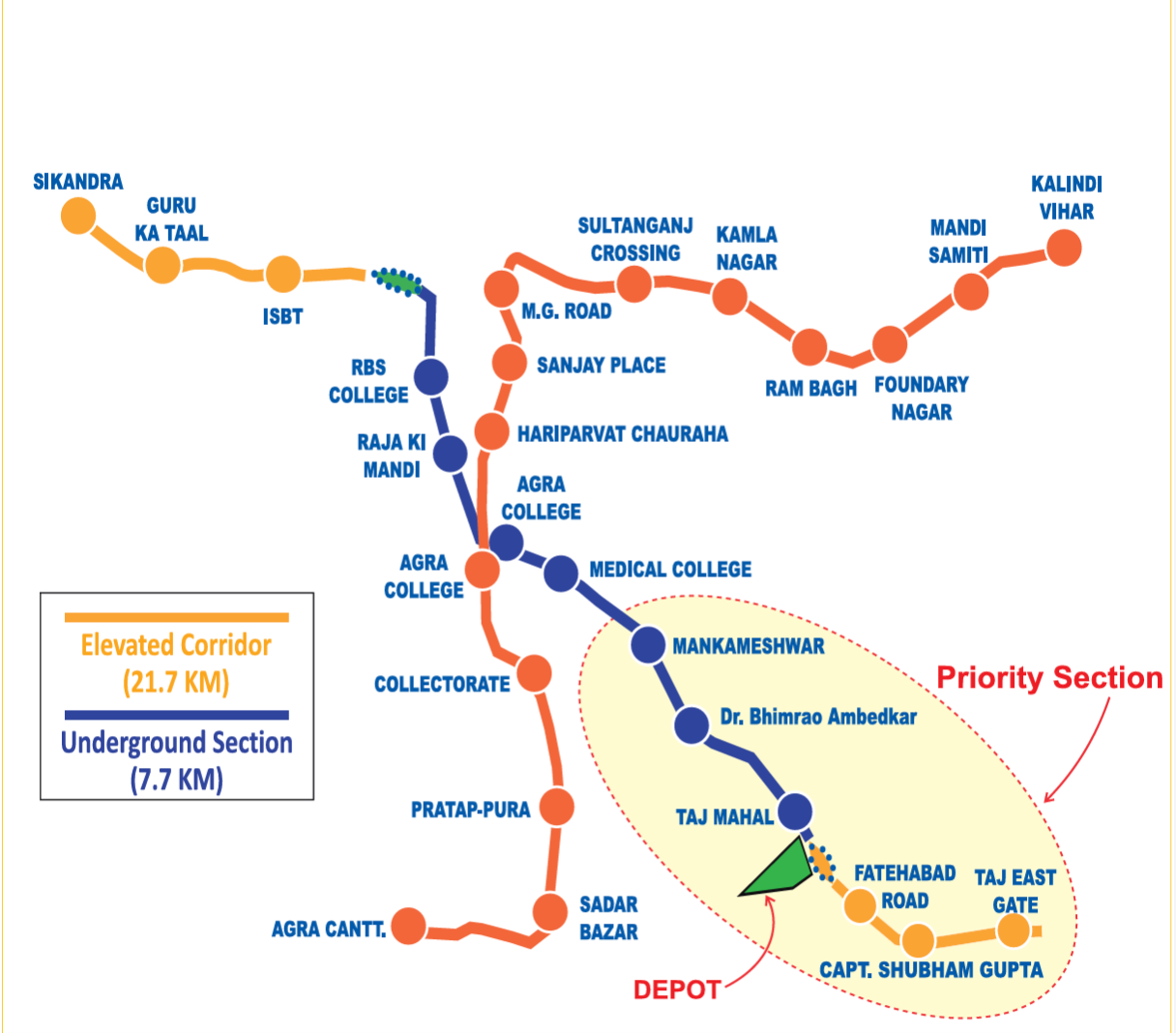
The Agra Metro Phase 1 comprises two corridors that cover a total of 29.4 kilometres with 27 stations, designed to connect the city’s key residential, commercial, and tourism nodes.
Corridor 1 – Yellow Line: Sikandra to Taj East Gate
| Detail | Information |
| Length | 14.25 km |
| Type | Partly elevated (6.569 km) and partly underground (7.681 km) |
| Stations | 14 (6 elevated, 7 underground, 1 interchange) |
| Station Names | Sikandra, Guru Ka Taal, ISBT, Shastri Nagar, RBS College, Raja Ki Mandi, St. John’s (Agra University), Medical College, Mankameshwar (Jama Masjid), Agra Fort, Taj Mahal (Purani Mandi), Fatehabad Road, Basai, Taj East Gate |
| Operational Section | Taj East Gate to Mankameshwar 6 km, 6 stations (inaugurated March 6, 2024) |
| Estimated Cost | Rs 8,379 crore |
| Full Completion Target | June 2026 |
Corridor 2 Blue Line: Agra Cantt to Kalindi Vihar
| Detail | Information |
| Length | 15.4 km |
| Type | Fully elevated |
| Stations | 15 |
| Station Names | Agra Cantt, Sultanpura, Sadar Bazaar, Pratap Pura, Collectorate, Subhash Park, St. John’s College, Hariparvat Chauraha, Sanjay Place, MG Road, Sultanganj Crossing, Kamla Nagar, Ram Bagh, Agra Mandi, Kalindi Vihar |
| Estimated Cost | Rs 4,520 crore |
| Status | Under construction |
| Priority Section Target | Agra Cantt to Agra College December 2026 |
| Full Completion Target | June 2027 |
Construction Progress: Where Things Stand
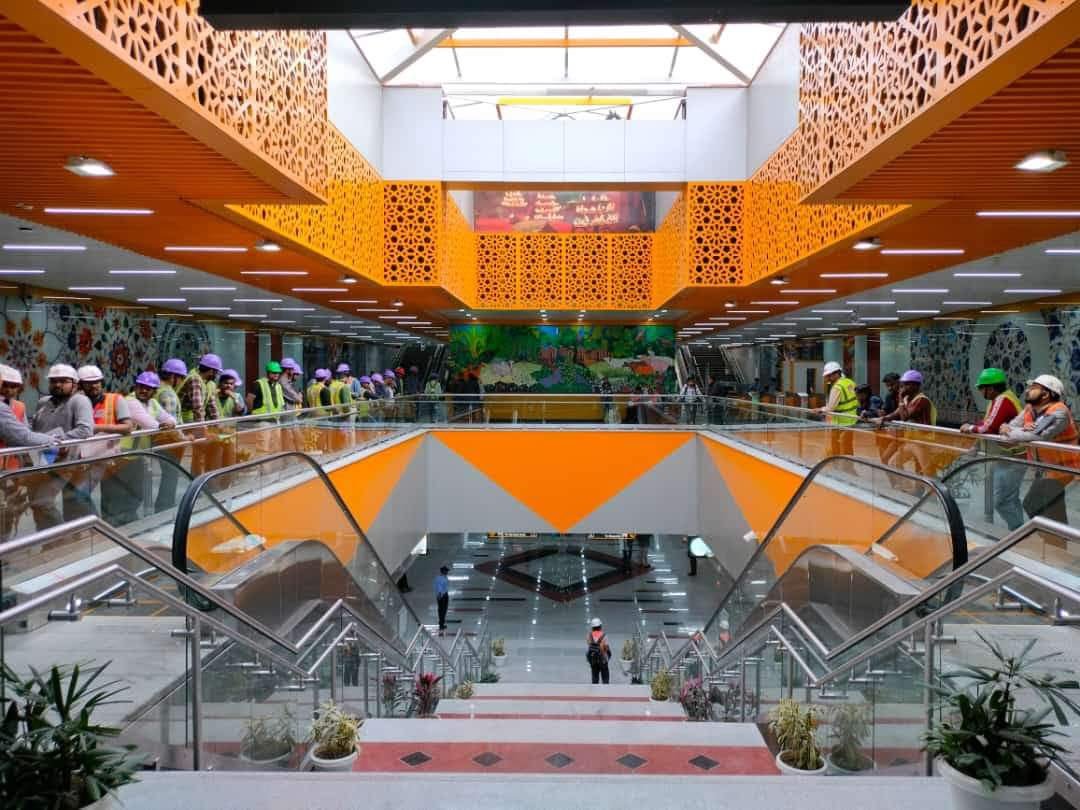
The priority corridor of the Yellow Line, a 6-kilometre stretch from Taj East Gate to Mankameshwar covering six stations, was inaugurated by Prime Minister Modi on March 6, 2024. What made this milestone historic was not just the opening itself but the speed of delivery. The underground section was completed in just 23 months, and tunnel construction was wrapped up in 11 months from the date of inauguration, six months ahead of schedule. In its first year of operations, the priority corridor ferried over 17 lakh passengers.
Progress on Line 1
- Trial Runs on ISBT-Mankameshwar Stretch
The progress on Corridor 1 has continued through 2025 and into 2026, with trial runs conducted on the upline between ISBT and Mankameshwar. The section covers stations including SN Medical College, Agra College, Raja Ki Mandi, and RBS College.
- Civil Works Completed up to Khandari Ramp
Construction between RBS College and the Khandari Ramp has been completed.
- Final Phase Targets June 2026 Completion
The remaining stretch of Corridor 1 has entered its final stage of construction, with overall completion expected by June 2026.
Progress on Line 2
- Pier and Station Construction Underway
On Corridor 2, work on piers and station structures is in progress across 14 elevated stations.
- Priority Section Scheduled for December 2026
The priority stretch between Agra Cantt and Agra College is planned for completion by December 2026.
- Trial Runs Planned Between August and November 2026
Testing and trial runs on the priority section are proposed between August and November 2026.
- Full Corridor Targeted for June 2027
Completion of the entire Corridor 2 is now targeted for June 2027.
Financial Architecture
The Agra Metro Phase 1 carries a total estimated project cost of Rs 12,899 crore, funded through a combination of central and state government equity and multilateral financing. The Government of India and the Government of Uttar Pradesh contribute in equal measure on the equity side, consistent with the Metro Rail Policy 2017 framework. A 450 million Euro loan from the European Investment Bank, approved in December 2021, forms a crucial component of the financing structure.
Agra Metro’s Regenerative Braking Yields ₹5 Million in Annual Cost Savings
Agra Metro has recorded measurable financial gains from the use of regenerative braking systems, which enable trains to recover energy during braking and feed it back into the network. The system deployed in Agra uses IGBT-based inverter technology, supplied by Sécheron SA, to capture and reuse this energy either within the metro network or through the wider grid.
Data from the first year of operations indicates that a single inverter unit helped Agra Metro save approximately Rs 5 million (USD 58,000) in electricity costs in its first year. The projected payback period for the inverter-transformer system is less than five years, and over its 30-year operational lifetime, the system is expected to generate a total net return of USD 1.4 million. For a project of this scale and one where long-term financial sustainability is a central concern, these figures signals a meaningful contribution to reducing the total cost of ownership of the fleet
Business and Economic Impact of the Agra Metro Project
Tourism Economy Integration
The Agra Metro’s most distinctive business proposition lies in its deliberate routing through the city’s tourism spine. No other metro project in India’s mid-sized cities can claim direct station connectivity to UNESCO World Heritage Sites on the scale of the Taj Mahal and Agra Fort. The Yellow Line’s underground stations at Taj Mahal and Agra Fort position the metro as a premium, pollution-free last-mile solution for tourists arriving at Agra Cantt railway station or the ISBT, both of which will be served by the full network once complete. The city receives over 6 million tourists annually, a figure that, even with modest conversion to metro ridership, can meaningfully supplement daily commuter numbers and increase fare-box revenue in manifold.
Real Estate and Urban Development
As with metro projects elsewhere in India, the Agra Metro is already generating a real estate premium along its corridors. Areas near planned and operational stations on Fatehabad Road, Sikandra, and the MG Road stretch of Corridor 2 have seen increased developer interest and rising property inquiries. The metro’s progression toward full network completion is expected to drive further appreciation, particularly in the Sikandra and Agra Cantt catchment areas.
Employment and Commercial Activity
Beyond construction employment, the metro’s operational phase is expected to generate sustained employment across operations, maintenance, station retail, and security. The network’s connectivity to key commercial nodes, such as Sanjay Place, MG Road, the Collectorate, and ISBT make it a viable commuter solution for Agra’s working population, not just its tourist visitors.
Environmental Sustainability
The metro’s environmental case is inseparable from Agra’s unique context. The city’s air quality has been under Supreme Court monitoring for decades, and the Taj Trapezium Zone restrictions that once delayed the project are also the reason the metro matters so much here. A shift of even a fraction of Agra’s private vehicle trips to metro transit would have a measurable impact on air quality, one that directly serves the long-term preservation of the Taj Mahal itself.
Operational and Financial Challenges That Remain Unresolved
Ridership and the Viability Question
The Agra Metro’s DPR projected daily ridership of 5.7 lakh passengers by 2024, rising to 8.7 lakh by 2041. The reality in the first year is comparatively more modest; the 6-km priority corridor carried approximately 17 lakh passengers in its first twelve months, an average of around 46,000 passengers per day. This must be contextualised: the operational section covers barely a 5th of the planned network and does not yet connect the major residential or commercial hubs that will drive commuter ridership.
The broader question of whether mid-sized Indian cities generate sufficient ridership to justify metro infrastructure has been raised repeatedly. A Parliamentary Standing Committee report in 2022 noted that almost all metro networks in India are running at a loss. The experience of Jaipur Metro, which despite years of operation, carries around 55,000-60,000 passengers daily on a comparable corridor, offers both a cautionary reference and a realistic near-term benchmark for Agra.
The Heritage Construction Constraint
Building a metro infrastructure in Agra is not like building one anywhere else. The route of Corridor 1 passes within proximity of 12 heritage monuments, with four falling within 100 metres of the alignment. Every phase of underground construction near Agra Fort and Jama Masjid required archaeological oversight, vibration monitoring, and compliance with Supreme Court-mandated conditions. These are not one-time clearances; they are ongoing obligations that add cost, time, and institutional complexity to every phase of the project.
Last-Mile Connectivity
The metro station at Taj East Gate offers no onward connection to hotels, markets, or the railway station, and for this reason, it will quickly lose its relevance. The same applies to daily commuters: Corridor 2’s MG Road alignment will struggle to attract passengers without a reliable feeder bus network. The DPR envisions multimodal integration with railway stations, BRT stops, and feeder networks of buses and intermediate public transport, but delivering this ecosystem requires coordination across multiple agencies and sustained investment well beyond the metro itself.
Financial Sustainability
Like most metro projects in India, the Agra Metro is not expected to achieve operational profitability from fare box revenue alone in its early years. With a total project cost of Rs 12,899 crore and an initial ridership base that is a fraction of projections, the financial gap will need to be bridged through non-fare box revenue streams, such as advertising, commercial space leasing, transit-oriented development, and value capture financing. UPMRCL has acknowledged this in the project’s DPR, which explicitly identifies transit-oriented development and transfer of development rights as part of the long-term revenue strategy.
Conclusion
The Agra Metro is a project carrying a weight of expectation for a city of tourists and residents alike, for the environmental protection of one of the world’s most iconic monuments, and for Uttar Pradesh’s ambition to build a metro ecosystem across its major cities. Its progress so far, against extraordinary regulatory and heritage constraints, is more than merely creditable.
Yet the distance between what has been built and what was promised remains substantial. The full 29.4-kilometre network is the minimum viable product that the Agra Metro needs to demonstrate its real worth both as a commuter solution and as a tourism infrastructure asset. Half a network, however well-engineered, cannot generate the ridership volumes or the economic multipliers that justify the investment.
The next two years are critical. If Corridor 1 reaches Sikandra by June 2026 and Corridor 2 opens fully by June 2027, the Agra Metro will cross the threshold from an interesting demonstration project to a genuinely city-scale transit network. If this transition materialises, the system will establish a viable rapid transit model in one of the world’s most regulated and historically sensitive urban environments. It will demonstrate the ability to balance heritage conservation requirements with modern infrastructure delivery, while serving both daily commuters and the city’s large tourist base in a reliable and sustainable manner.
Project Overview