Home Blog Page 832

Delhi Metro | Botanical Garden-Kalkaji corridor (Magenta line) to be open in June 2017

New Delhi: The Delhi Metro Rail Corporation (DMRC) is set to throw open the stretch between Botanical Garden and Kalkaji Mandir for public use by June this year. After the opening of the stretch, Botanical Garden metro station will become the first and only interchange station in the National Capital Region, outside Delhi.

The Botanical Garden station will provide interchange between the currently operational Line 3 (Noida City Centre – Dwarka Sector 21) and the upcoming Janakpuri West – Botanical Garden corridor. This station will also help in connecting Noida with important locations of south Delhi like Nehru Place, Kalkaji and Hauz Khas.

The Indira Gandhi International airport will also get direct connectivity to the Janakpuri West – Botanical Garden line, once it is fully operational.

“The projected interchange load at Botanical Garden station, as per the Detailed Project Report ,will be around 97,780. At present, nearly 14,000 passengers use the station every day. The station has a total parking area of about 1,420 sq metres, with a capacity to hold about 400 vehicles,” said a spokesperson of DMRC. He further added that with the new interchange station, travelling time between Noida and Gurgaon will come down by anything between 30 and 50 minutes, with interchange facility at Hauz Khas. Presently, a journey from HUDA City Centre in Gurgaon to Botanical Garden in Noida takes about 90 minutes, requiring an interchange at the busy Rajiv Chowk Metro station.

Noida will also get directly connected with the domestic terminals of the Indira Gandhi International Airport for the first time after the completion of the line. The journey from the Botanical Garden station to the domestic terminal will take about 40 minutes.

The new station building at Botanical Garden will be connected with the existing station with the help of a pathway that is 20 meters wide and 100 meters long. There will be platform to platform and concourse to concourse connectivity, a DMRC official said.

“To save time of passengers, we have provided them platform to platform connectivity. Passengers coming from Noida city centre can get down at Botanical garden and walk straight and take a train towards Kalkaji. They won’t have to get down and take any stairs,” the DMRC spokesperson said.

The construction work of the new station building is in its final stage, he added.

Suzhou Metro China | Suzhou opens fourth metro line for public

Suzhou, China: SUZHOU Metro added a second north-south line to its metro network on April 15 with the start of trial passenger operation on Line 4.

The line runs for 42km from Longdaobang in the north to Tongli in the south, with a 10.8km branch from Hongzhuang to Muli, which will ultimately become part of the future Line 7.

The Yuan 36bn ($US 5.2bn) line adds 37 stations to the network, including interchanges with metro Line 1 and the main line network at Suzhou Railway Station.

Peak services operate at six-and-a-half minute headways on the main line, with trains running every seven-and-a-half minutes on the branch to Muli.

Services are operated by a fleet of 40 six-car type B trains supplied by CRRC Nanjing Puzhen.

The completion of Line 4 takes the total length of the Suzhou metro network to 121km with 97 stations.

For detailed information on metro projects in India and around the world subscribe to Metro Rail News.

Source: Rail Journal

Centre to tighten norms for appraising metro rail projects in India

New Delhi: It will soon become tough for states to send proposal for building metro rail in its cities and get central approval.

Wary that many such metro projects, which are hugely capital intensive, may not be financially viable and can end up burning a big hole in the government exchequer, the Ministry of Urban Development (MoUD) is tightening the norms for appraising proposals sent by states.

Ministry of Urban Development is the nodal agency for sanctioning metro projects.

In the last few years, proposals to build metro rail in Tier I and Tier II cities such as Chandigarh, Patna, Kanpur, Varanasi and Kochi have landed in MoUD’s doorstep, for approval. They are yet to get the central nod.

Take for instance Delhi Metro Rail Project. It has the highest ridership in the country and making operational profits but is yet to achieve break-even. Almost all the other functional metro networks are currently running at loss including the Mumbai Metro Line-1 that suffers an estimated daily loss of Rs 1 crore, government sources said.

Government sources said the rigorous appraisal norms will ensure that metro rail gets constructed only if it is of utmost necessity and all other measures to de-congest a city such as increasing the public transport fleet has been explored.

The new norms being finalized will allow Centre to approve only those projects, which ensures a 14% return on investment. Currently, the Centre clears projects offering an 8 % financial internal rate of return (FIRR).

The ministry will not consider projects where the EIRR (Economic Internal Rate of Return) is less than 14%. “The EIRR, along with ridership will also capture long term economic gains accruing from a project such as job creation, environmental gains by reducing pollution, reducing road accident deaths, etc.,” said a government source.

Though a metro project has a life of 100 years but the current method of appraisal considers just a 30-40 year life span for assessing its net present value. “This is inadequate to capture the full economic and environmental outcomes of projects,” the source added.

MoUD secretary Rajiv Gauba has set a one month deadline for finalizing the new norms.

The ministry will also fix an appropriate ridership for considering metro projects, keeping in view the present and future traffic projections in the context of expansion of cities.

As of now, though the minimum ridership is fixed at 12000 PHPDT (Peak Hour Peak Direction Traffic), many cities do not adhere to it. For instance, Vijaywada that has sent a proposal to build metro has shown the current PHPDT of 6,000. “At this low ridership, it will take the project a long time to become financially viable,” said a finance ministry official.

Metro Man who changed the face of India’s public transport

One peculiar aspect of Indian bureaucrats and their projects is that most of them fail to get the work done within the stipulated deadline and budget. The offering at hand brings us face to face with one man who defeated the tangles that beset our bureaucracy and governance, allowing room for excellence and becoming part of railway engineering folklore.

Elattuvalapil Sreedharan, popularly known as the “Metro Man”, is largely credited for changing the face of public transport in India by his leadership in building Konkan Railway and the Delhi Metro, when he served as its managing director between 1995 and 2012.

A celebrity in his own right, there is ample information about this technological genius in the public domain. There are detailed works on his life that seem to cover his professional efforts, methodology, the problems he faced, and the unique solutions he offered while completing key projects on time and within budget, as well as his ensuing success and glory.

What new information about this man — known, revered and respected throughout the country — could be presented in this book? But as the biographer Rajendra B. Aklekar dug deeper, he came to realise that there was much that was unknown about Sreedharan.

“There were many hidden aspects of his life; aspects never discussed or documented in the public domain, though there are official records and notes regarding a few,” Aklekar mentions in the preface while reminding readers that this biography — mainly based on personal interactions with Sreedharan at his residence in Kerala — focuses on little-known stories that have made him what he is today.

Consider the national railway strike in 1974 for instance: The 20 day-strike by 1.7 million workers is perhaps the largest strike to hit Indian Railways till date but at that time, Sreedharan was busy designing a Metro rail network in Calcutta (now Kolkata) and therefore refused to halt his work.

Then, in the build-up to the first Gulf War, there was fuel shortage in several countries around the globe, including India. The only project that managed to stand up against all odds at that point of time was the construction of Konkan Railway, headed by Sreedharan.

“He had factored in all permutations and combinations, insulating the project from any hurdles by setting up petrol pumps with back-up supplies,” Aklekar writes.

One would assume that Sreedharan — a man so dedicated to his cause and service — must have had a tough family life. But surprisingly, the “Metro Man” maintained a cordial balance between his work and family.

In the biography, his daughter Shanthi Menon shares personal insights about her father, including how Sreedharan values family life and is involved in every small decision that is taken, paying attention to even the smallest needs of his grandchildren.

And then there are critics too. A chapter titled “Bouquets and Brickbats”, provides enough space to his critics too. The biographer points out that not even one of his critics was willing to speak on record, but there were enough cases in the public domain for him to put together their points of view. The fundamental argument of his critics revolves around the fact that Sreedharan was given an unduly free hand, violated all established norms and, despite all of this, has been glorified.

More than anything else, this biography holds significance particularly because Sreedharan himself sat patiently with the author to clear all his doubts and almost proof-read the draft of this book, giving it the status of an authorised biography.

Finally this book is not a guide to the process that marked the construction of Konkan Railway or Delhi Metro. While these aspects are touched upon in the offering at hand, it is primarily the amazing story of one man – his perseverance, beliefs and public and private battles.

Highly anecdotal and sufficiently endnoted, “India’s Railway Man” is an inspirational book that opens up a life well-lived, against all odds and at constant service to the cause Sreedharan was involved in.

Title: India’s Railway Man

Author: Rajendra B. Aklekar

Publisher: Rupa

Price: Rs 295

Pages: 253

Bombardier, Alstom turn to India as urban rail export centre

The French and Canadian multinationals set up manufacturing and engineering operations between 2008 and 2010 to tap into India’s rapidly growing urban transportation market and will now export to Australia, the Middle East and Asia from these facilities, company officials said. Price water house Coopers estimates total investments in subway projects will reach $230 billion in Asia over the next 15 years.

Alstom and Bombardier want to exploit India’s large pool of engineers and cheap skilled labour that have helped turn the nation into a key centre for auto companies including Ford Motor Co. and Hyundai Motor Co. New export avenues such as metro rail systems are critical to Prime Minister Narendra Modi’s promised economic rejuvenation. Shipments from Asia’s third-largest economy must grow about 15 per cent a year to ensure the pace of expansion needed to create sufficient jobs, according to Modi’s top economic adviser Arvind Subramanian.

Sydney is going to be Alstom India’s first project in Australia and it will supply railway coaches from the South Asian nation, said Bharat Salhotra, the company’s managing director for the region. “We will continue to look at India, not just for addressing the Indian market but for addressing markets beyond. Exports will continue to be on the radar.

Alstom will fill the Sydney metro orders from its manufacturing units in south India and is looking at the Middle East and Southeast Asia, he said.

India is a low-cost set up

Bombardier has invested about 33 million euros in its Indian manufacturing facility and has orders to export 450 metro rail coaches to Australia and components to Brazil, Australia and Saudi Arabia, Harsh Dhingra, chief country representative of Bombardier India said in a phone interview. The Montreal-based company has manufacturing capacities in Gujarat state in western India and a transportation engineering services center in Gurgaon, near New Delhi.

“We will look at opportunities to export from India to other countries in the region,” he said. “India is a low-cost set up. That is why our exports are going out of India.”

Bombardier’s India unit got its first export order in 2012 for supply of components for trains in Adelaide and has since supplied components and railway coaches for projects in Victoria, and Queensland in Australia, Sao Paulo in Brazil, and Riyadh in Saudi Arabia. It is also providing engineering services for its parent’s projects in Germany, Switzerland, China and U.K.

India has already emerged as a base from where the likes of Hyundai, Ford, Renault SA and Suzuki Motor Corp. export cars to Africa, South America and Europe. The South Asian nation shipped 3.5 million vehicles in the year ended March 31, just below a record in the previous year, according to the Society of Indian Automobile Manufacturers.

While the government has tried to spur the manufacturing sector via its “Make in India” push, the nation still ranks 130th in the World Bank’s ease of doing business ranking, slowing the pace of investment. It has fared better on the services side: The information technology industry is the nation’s largest private-sector employer, providing a livelihood to nearly 4 million.

10 Indian cities have metro projects

The domestic and regional opportunity for transportation companies only looks to be growing.

At least 10 Indian cities are working on metro railway projects and the government initiated a plan in 2012 to study the feasibility of such networks in all cities with a population of more than 2 million. Most cities with projects require companies that bid for supply contracts to manufacture in India, which led to the setting up of facilities in the country.

More than 500 billion rupees ($7.7 billion) worth of metro projects are underway in India and this pile will probably grow, according to Manish Agarwal, leader of infrastructure at PricewaterhouseCoopers.

“All of this implies sufficient scale for parts of manufacturing to be located in India,” he wrote in an emailed response to questions. “The manufacturing base can then also serve the growing market in other parts of Asia (Dhaka, Colombo, etc) as also Africa (Mauritius, among others).”

Source: Montreal Gazzette

Delhi Metro | Richa Industries bags DMRC order worth 35 crore to build metro stations

New Delhi: Richa Industries Limited, a leading Construction & Engineering company, has secured an order of Rs.35 crores from Delhi Metro Rail Corporation (DMRC) for constructing the Six Elevated Metro stations on Mukundpur-Shiv Vihar Corridor and Depot cum Workshop of Jahangirpuri-Badli Corridor Phase III of Delhi MRTS.

Richa Industries received this back to back projects from DMRC. The First Project involves the Construction of six elevated metro stations and Second project involves Construction of Workshop, Inspection Shed, Stabling Shed, Pit Wheel Lathe Shed and Parking Shed. The complete scope of work entails Engineering Design, Fabrication, Shipment and Erection of the Pre Engineered Buildings.

“We are glad to get this back to back project of DMRC and this will be our fifth achievement after associating with Metro Rail Sector. Our focus will remain to take up more challenging projects in future for Infrastructure development and enhancing Public services.”, Dr. Sandeep Gupta, Managing Director,Richa Industries Limited said.

Source: Press Release

Delhi Metro | DMRC plans to make all phase-III stations solar powered

Bhopal: Delhi Metro Rail Corporation (DMRC) today signed Three Power Purchase Agreements and unique Co-ordination Scheduling Agreement for 25 years period with Rewa Ultra Mega Solar Limited, (a joint venture of Solar Energy Corporation of India (SECI) and Government of Madhya Pradesh), Solar Power Developers (Mahindra, ACME Solar and Solenergi) and MPPMCL. DMRC has become the first metro to procure Solar Power on RESCO basis as Inter State Open Access Consumer.

The landmark event was graced by the presence of Shri M. Venkaiah Naidu, Hon’ble Minister of Urban Development, Shri Piyush Goyal, Hon’ble Minister of State (IC) for Power, Coal, New & Renewable Energy and Mines and Sh. Shivraj Singh Chauhan, Hon’ble Chief Minister of Madhya Pradesh.

DMRC team of senior officers, was led by Mr. Anoop Kumar Gupta, Director (E), who has been instrumental in spearheading DMRC’s efforts for enhancing use of solar power, to reduce impact of increasing energy tariff and mitigate environment depletion.

DMRC was involved in this mega solar project since April 2016 and played crucial role in drafting project documents. Team of officers from DMRC & RUMSL, through diligent detailing, robust project preparedness, keeping appropriate distribution of risks, have achieved a record low first year tariff of Rs. 2.97, for solar energy.

This 750 MW Solar Project being set up at Rewa, Madhya Pradesh, will be one of the largest Solar plant in the world and is likely to be operational from June 2018. DMRC will source 345 MUs annually from this project, effectively the entire energy requirement of Phase – 3 of Delhi Metro project and would mean substantial savings in energy cost for Delhi Metro.

DMRC also has a target of commissioning 20 MWp rooftop solar plants by end of 2017 on its premises and has successfully commissioned 16 MWp capacity till date and already signed Power Purchase Agreements for 31.50 MWp.

Source: DMRC Press Release.

Delhi Metro | Porn video reportedly played on advertisement display at Rajiv Chowk metro station

New Delhi: In a bizarre incident, a pornographic clip was reportedly played on a large advertisement screen at a Rajiv Chowk Metro station of Delhi Metro Rail Corporation (DMRC).

According to initial information, the incident took place on April 9, at Rajiv Chowk Metro Station in Connaught Place.

The video that was being played on a advertisement screen installed at Rajiv Chowk Metro station and the entire sequence was shot by a few commuters on mobile phone, after which the incident went viral on social media.

Central Industrial Security Force (CISF) and Delhi Police have claimed that they were unaware of the incident and no complaint has been filed yet.

Meanwhile, the DMRC said that it was not aware about any such clip. “The LED screen was under commissioning and testing by a private contractor and same is still under commissioning. The work is still not completed. We will check all the details of the testing and commissioning process of the contractor to check whether any such clip was played on the LED screen at Rajiv Chowk station, and take adequate safeguards/action,” said Anuj Dayal, Spokesperson of DMRC in a statement.

The porn clip has reportedly gone viral in Social Media.

Malaysia orders hybrid DMUs from chines firm CRRC Corporation

MALAYSIA’s Ministry of Communications signed two contracts with CRRC Zhuzhou Electric Locomotive for 22 metre-gauge multiple units at a ceremony in Changsha, China, on April 11.

The orders for Malayan Railways Corporation (KTM) have a total value of Yuan 1.32bn and comprise 13 regional hybrid DMUs and nine additional class 93 inter-city EMUs.

The 100km/h regional trains will be equipped with 60,000 Farad supercapacitors, which will store energy from the regenerative braking system for re-use during acceleration. Each four-car train will seat more than 500 passengers.

The 160km/h class 93s will supplement the fleet of 10 trains which entered service with KTM in September 2015. Each six-car train will seat 320 passengers.

Assembly will take place at CRRC Zhuzhou’s plant in Batu Gajah in the Malaysian state of Perak.

Source: RailJournal

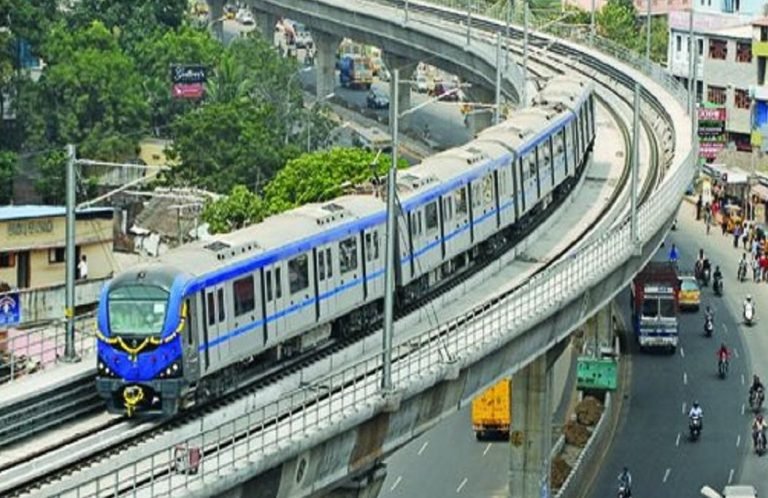
Chennai Metro | Chennai’s first underground metro rail line may open soon

Chennai: Chennai’s first underground metro rail line between Koyambedu and Nehru Park may soon be opened to the public, as a team led by commissioner of metro rail safety K A Manohar began final round of inspections in the stretch on Wednesday.

“Chennai Metro Rail Ltd (CMRL) has submitted documents related to the stretch. We will conduct inspections for two days,” said Manohar before heading for the inspections.

The team comprising the commissioner, three deputy commissioners and supporting staff will inspect around 7.63km downline between Nehru Park to Koyambedu and around 4.54km upline between Koyambedu and Shenoy Nagar.

They will inspect tracks, tunnels, air-conditioning systems, fire prevention mechanisms, knowledge of staff, ticketing and passenger amenities.

Trains will be run on the stretch and tested for its safety. They will also check functioning of the platform screen doors.

Once the underground line gets operational, residents from areas like Kilpauk, Shenoy Nagar, Aminjikarai, Anna Nagar, Thirumangalam and Koyambedu can take a ride in the train all the way up to the airport with a single ticket.