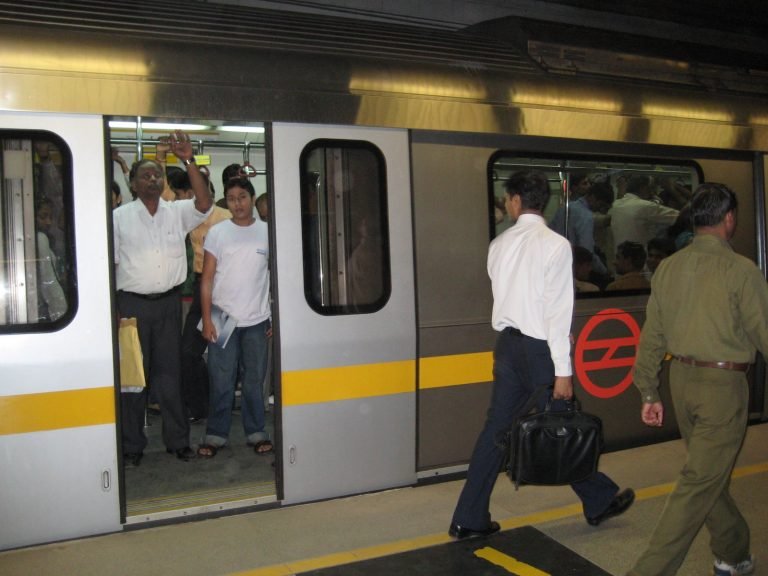
New Delhi: A Delhi Metro train, packed with commuters, made its way across two stations on Yellow Line on Monday, with one of its gates open.
The highly-unusual incident took place around 10 pm between Chawri Bazar and Kashmere Gate stations of Yellow Line, which connects north Delhi to Gurugram.
“The problem was only with one door. It was guarded by the DMRC staff. The train was taken to Vishwavidyalaya station to avoid any delay or bunching,” a metro spokesman said.
A similar incident had occurred back in July 2014 when a train had run with all its doors open between Ghitorni and Arjangarh stations on the same line.
Immediately after the incident, the train operator was suspended over “safety lapse”.
New Delhi: The Delhi Metro Rail Corporation (DMRC) has partnered with Google Maps to make commutes easier by sharing information on Metro routes, fares and connectivity. This partnership with Google has been done keeping in line with Delhi Metro’s vision for providing a better commuter friendly public transport system. This facility will provide the commuters complete information on Delhi Metro routes, line details, platform details, fares etc.
Delhi Metro’s integration with Google will be extremely beneficial to both new and existing commuters. Delhi Metro has launched several such initiatives in the recent past to help commuters to manage their travel time, and make more informed transport decisions. Transit details for Delhi Metro would also be available on mobile devices with Google Maps, so commuters can check available Metro schedules to make route changes on-the-go and plan their trips accordingly.
Know how would Google Maps benefit the commuters of Delhi Metro
As Delhi Metro is the preferred public transportation for millions of commuters every day, the integration of the Metro network with Google Maps would benefit new commuters and help existing commuters in discovering new routes and options.In the next stage of this collaboration, the Delhi Metro is further planning to integrate facilities available at the station such as parking, rest rooms etc.
The train timings and directions are for planning purposes only.
Gandhi Nagar: Japanese firm Mitsui Co. Ltd. has won the bid to supply 10,600 metric tonne of Head Hardened Rails (HH-Rail) for the track work of the 37-km-long Phase-1 of the Ahmedabad metro-rail project at the cost of Rs 59.32 crore.
“Mitsui has been selected from a group of five bidders which included Voestalpine, Jindal Steel, British Steel, East Metals,” said IP Gautam, managing director of Metro-Link Express for Gandhinagar and Ahmedabad (MEGA) Company Ltd which is constructing the Rs 10,700 crore Phase-I of the project.
Mitsui is the first Japanese firm to win a bid out of the 27 contracts that have been awarded.
The tender notice for procurement of the HH-rail was published on July 8, 2016 and the tender was awarded on June 15.
According to metro rail officials, the 1,080 grade HH-rail being procured for Ahmedabad metro has greater durability than the normal rail of 880 grade. The use of 1,080 grade HH-rail will dispense frequent rail checks on main lines.
“We will be using the HH-rail only for laying the metro tracks, while normal rail will be used in the depots,” an official added. Two depots — one at Apparel Park on the East West Corridor and the other at Gyaspur on the North-South Corridor is being built.
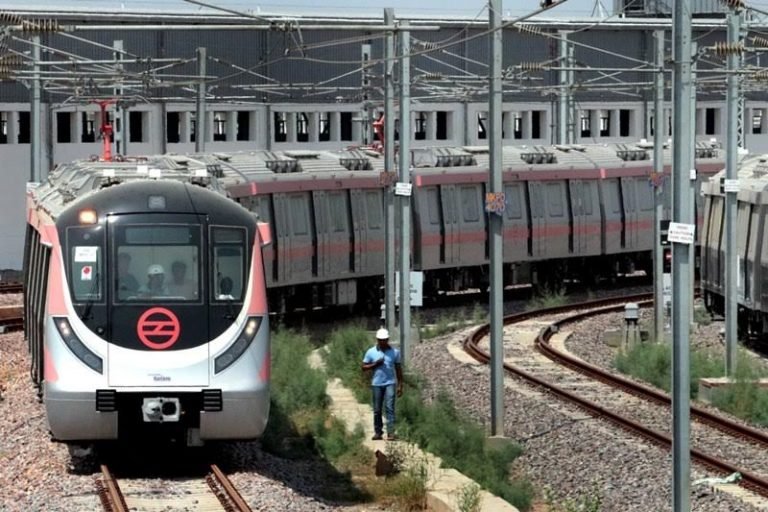
New Delhi: This December, Delhi Metro is going to open its first section of the Pink Line(Majlis Park-Shiv Vihar), a 20.6km-long corridor, which will function like an arc connecting north, northwest, west and south Delhi. The remaining stretch of 58.5km will be commissioned by March next year.
While the existing Metro corridors have been designed as radials spread across Delhi NCR, the Pink Line has been conceptualised as a large ring that will connect all these corridors. The Majlis Park to Durgabai Deshmukh South Campus section is one part of the ring, which will begin from north Delhi and on its way down to south Delhi, connect areas in northwest and west Delhi.
“The trial runs between Shakurpur and Mayapuri stations are in progress. It will be extended to Majlis Park from Shakurpur station to Durgabhai Deshmukh South Campus station from Mayapuri in the next two months,” said a DMRC spokesperson.
The number of interchange stations in the Metro network will go up to 27 once the Phase-III project is completed and both the Pink Line and Magenta Line (Janakpuri West-Botanical Garden) become operational.
Starting from Majlis Park, there will be an interchange at Azadpur, which will connect with the Yellow Line (Samaypur Badli-HUDA City Centre). The next interchange station at Netaji Subhash Place will connect the Red Line (Rithala-Dilshad Garden) and the Rajouri Garden stop will link the Blue Line (Dwarka Sector 21-Noida City Centre/ Vaishali).
The last interchange will be between Durgabai Deshmukh South Campus and Dhaula Kuan station of the Airport Express Line. The two stations are located 1km away, which will be connected with a walkway that will have walkators.
Currently, the Airport Express Line sees a daily ridership of 50,000 commuters, which DMRC believes will go up substantially after the Pink Line opens.
While the Pink Line was envisaged as a ring connecting all parts of the city, difficulties in acquiring land at Trilokpuri created a missing link of 1.52km. This would mean that the trains coming from Majlis Park will have to reverse from Mayur Vihar Pocket 1 station and trains coming from Shiv Vihar will have to reverse from Trilokpuri station.
“The sections from Durgabhai Deshmukh South Campus station to Mayur Vihar Pocket 1 and Shiv Vihar to Trilokpuri station are expected to be ready for trial runs by the end of this year,” the spokesperson said.
Ahmedabad: After Delhi, Mumbai, Kolkata and Bengaluru, Gujarat’s Ahmedabad is all set to get its own metro transport network. Called MEGA (Metro-Link Express for Gandhinagar and Ahmedabad) the construction work for the phase-I route is in full progress and operations are slated to begin by end of 2018. Not only that, Ahmedabad Metro plans to take a leaf out of Delhi Metro’s book, and adopt the technology of ‘driverless’ trains!
We take a look at some salient facts about this upcoming metro project:-
The Phase-I of Ahmedabad Metro was sanctioned by the Central government in 2014 and spans a length of over 39 kilometres. Of the 39.2 kilometres stretch, 6.335 km will be underground, while the rest will be elevated.
The Ahmedabad Metro aims to connect the four corners of the city with two corridors – North-South and East West. In all there will be 32 stations.
The 18.5 km long North-South Corridor will have 15 stations; APMC, Jivraj Park, Rajiv Nagar, Shreyas, Paldi, Gandhigram, Old High Court interchange, Usmanpura, Vijay Nagar, Vadaj, Ranip, Sabarmari Railway station, AEC, Sabarmati and Motera Stadium. This corridor will be completely elevated.
The 20.7 km East-West Corridor will have 17 stations; Vastral Gaam, Nirant Cross Road, Vastral, Rabari Colony, Amraiwadi, Apparel Park, Kankaria East, Kalupur Railway Station, Ghee Kanta, Shahpur, Old High Court interchange, Stadium, Commerce Six Road, Gujarat University, Gurukul Road, Doordarshan Kendra, Thaltej, Thaltej Gaam. Four stations out of 17 will be underground.
The project is being made by part funding from the Central government, state government and a soft loan from the Japan International Cooperation Agency (JICA). Incidentally, Ahmedabad Metro is said to be a pet project of Narendra Modi and was conceptualised when he was the Gujarat Chief Minister.
The 6.5 km stretch from Vastral to Apparel Park is being treated as a priority corridor and is likely to become operational first.
As for the technology of using driverless trains, an official of MEGA told Media that initially attendants would be employed to make sure that no untoward incident takes place. While most of the operation will be automated, this attendant would intervene manually as and when required, the official said.
The latest decision is a marked deviation from JICA’s earlier stand, when the agency had raised serious doubt over the viability of the project that got mired in realignment knot. With multiple government agencies working together to remove the stumbling blocks, Jica then carried out a study to ascertain the viability of the new route. It was very satisfied with the cost-benefit analysis that promised a much higher ridership than that of earlier alignment.
According to the previous alignment, the corridor was supposed run through Bowbazar. But now, the alignment will move via Esplanade. The change in route, along with delay in implementation, has pushed up the project cost to 8,996 crore from Rs 4,874 crore.
When the project had kicked off, JICA’s share — 46% of the total cost — came to around Rs 2,253 crore. But now, the agency will shell out around Rs 4,138 crore for the project.
In 2015, the state government had engaged RITES to carry out a study on the realignment. The Railways had approved the new route in 2016. The project gained momentum thereafter, with the Railways allocating handsomely to East-West Metro in the Union Budget.
Meanwhile, Kolkata Metro Rail Corporation (KMRC) has awarded the Rs 484-crore contract to Afcons for constructing the 700metre stretch between Makakaran and Esplanade. The TBMs, which are currently moving below Brabourne Road, will now go upto the Esplanade shaft.
Kochi: With the integrated trial run of the Kochi Metro using the signalling and communication system in the second reach up to Maharaja’s being successfully completed, the Kochi Metro Rail Limited (KMRL) authorities are waiting for the inspection by the Commissioner of Metro Railway Safety (CMRS). The CMRS will inspect the stretch by the third of week of this month, it is expected.
“The testing of the signalling and communication system which began on August 26 has been successfully completed on September 7. The remaining finishing works of the station construction are progressing at a fast pace,” said a top official with KMRL. As the integrated trial run has been completed, the normal time schedule of the Metro service along the Aluva – Palarivattom route has been restored. The timings of the service was changed to facilitate the trial run.
KMRL had started the trial run along the second reach with a focus on coaches, tracks and the third rail traction in July which was followed by signalling and communication testing. The Metro authorities are planning to open the stretch for traffic before the FIFA Under-17 World Cup matches scheduled from October 6. KMRL expects a significant increase in the number of regular passengers once the stretch is opened and the Metro agency has plans to introduce special packages and revisions in ticket fares.
Los Angeles: In a press release Hyperloop Transportation Technologies announced that they have signed a Memorandum of Understanding (MoU) with the Andhra Pradesh Economic Development Board (APEDB) on 6th September 2017, to facilitate the development of HTT’s Hyperloop Transportation System.
The proposed route for the Hyperloop is between the city centers of Vijaywada and Amaravati, potentially turning a trip of more than one hour into a 6 minute ride. The project will use a Public Private Partnership (PPP) model with funding primarily from private investors.hra
“We are extremely delighted to have entered into a MoU with the Government of Andhra Pradesh to bring the HTT Hyperloop to India,” said Mr. Bibop Gresta, Chairman & Co-founder, Hyperloop Transportation Technologies. “In partnering with Andhra Pradesh, HTT will work with local stakeholders to build the regulatory standards necessary for safe and efficient operation.”
During Phase 1 of the project, HTT will conduct a six-month feasibility study commencing in October. Working with partners in the public and private sector, HTT will analyze the surrounding cityscapes to create the best route between the two cities while identifying all pertinent stakeholders in the region. After conducting the initial six-month feasibility study, Phase 2 of the project will construct and build HTT’s first Hyperloop in India.
Mr. Krishna Kishore, Chief Executive Officer, APEDB said, “Amaravati is a state-of-the-art city being developed in Andhra Pradesh as its de facto capital. In order to boost its image and emerge as the frontier city in future technology, Amaravati is looking forward to collaborating with Hyperloop Transportation Technologies. Hyperloop is a cutting-edge technological disruption in the transportation industry.”
Discussing the added benefits of establishing an ultra-high speed connection between the cities, Mr. Kishore added, “Like most of the world-changing technological advancements, HTT aims at collaborating with Government of Andhra Pradesh to foster research and development, in order to bring affordable and low-cost technologies for the masses. This will eventually lead to improved standards of living in the region. The EDB along with Government of Andhra Pradesh will assist Hyperloop Transportation Technologies Inc. (HTT) with all regulatory requirements to develop and implement Hyperloop.”
The State of Andhra Pradesh is the seventh largest in India with a population of over 50 million people. Connecting these emerging development regions with ultra-high speed transportation will establish this region as a leader in technological innovation and sustainable development.
What is the hyperloop?
Hyperloop Technology
Hyperloop is a radical, yet untested means of travel proposed by maverick entrepreneur Elon Musk. It involves travelling in pods through a sealed pipe at speeds that could touch 1,200km/hr, making it faster than a jet aircraft. These speeds will be possible due to a largely frictionless environment, minus any physical contact or air resistance.
Tests are already underway in several parts of the world. Musk claims he has an approval to build a New York City–Washington DC hyperloop that will cut a five-hour drive to just 29 minutes!
In India, Musk’s HTT isn’t the only startup in the fray. Earlier this year, another company called Hyperloop One identified five routes for its India debut. On its list are:
Bengaluru-to-Chennai: 334km in 20 minutes
Bengaluru-to-Thiruvananthapuram: 736km in 41 minutes
Delhi-to-Mumbai via Jaipur and Indore: 1,317km in 55 minutes
Mumbai-to-Chennai via Bengaluru: 1,102km 50 minutes
Lucknow: In order to provide a push to government’s ‘Digital India’ campaign, Lucknow Metro has started providing free Wi-Fi facility to its ‘GoSmart’ card users at all its operational Metro stations. The facility will be available for the GoSmart card holders who register their card on Lucknow Metro’s website.
This free Wi-Fi service can be availed upon registering the GoSmart card at www.lmrcl.com. The passenger will have to provide basic information like Name, Mobile Number, Occupation and E-mail ID while registering the card.
After registering the card, the commuters will have to tap the GoSmart card on the marked card readers in the paid area of the Station. Upon tapping the card at the card readers, the passenger will receive a One-Time-Password (OTP) on their registered mobile number. This OTP can be used to sign in to the free Wi-Fi network.
The free internet facility (free Wi-Fi) can be used in the paid area of the stations i.e. at the concourse level and at the platform level of the station. This free service will be available for 30 minutes session initially. Free Wi-Fi means free internet usage through mobile, laptop, tablet etc. and implies saving money to the common people. Those who need internet connectivity but can’t afford will be at advantage in the Metro system by using the free Wi-Fi.
Students and youth can benefit largely from Free Wi-Fi. They can refer to e-books and online learning methods while travelling. With advent of several online shopping sites and a surge in online booking of trains, flights, movie tickets etc., this advantage can be used at maximum by the Metro travellers.
For providing this facility to all ‘GoSmart’ users, Lucknow Metro Rail Corporation (LMRC) has tied up with M/s Sikka Broadband Pvt Ltd. Sikka Broadband Pvt Ltd.(formerly known as Gomti Cables Network) is a Government of India licensed ISP (Internet Service Provider) and is already providing a host of Internet services to the citizen of Uttar Pradesh.
Lucknow Metro “GoSmart” Card
Shri Kumar Keshav, Managing Director/LMRC said “GoSmart cards provide an excellent facility of free W-Fi at Metro stations in addition to 10% discount on each journey.” He, therefore, requested Metro commuters to purchase and use GoSmart cards more and more for saving their time and ease in commuting frequently.
Shri Tony Sikka, Managing Director, M/s Sikka Broadband Pvt Ltd. also expressed his happiness and said “We are delighted to be associated with Lucknow Metro Rail Corporation (LMRC) in this digital campaign of the government”.
Mentioning his personal invitation to Modi made earlier in June in New Delhi, the Chief Minister requested the PM to inaugurate the Hyderabad metro rail project (Phase-I) in November 2017.
In the letter addressed to the Prime Minister, the Chief Minister tweeted that the first phase of the project will be ready in November, and that during Modi’s visit to Hyderabad during the Global Entrepreneurship Summit as Chief Guest, the phase one could be inaugurated.
Project in progress
The Chief Minister informed that the 72-km, ₹15,000-crore Hyderabad metro rail project is the biggest public private partnership venture to date. The 13-km Miyapur-Ameerpet line and 17-km Ameerpet Nagole line have conducted trial runs and obtained safety permissions. Meanwhile, work on the metro rail has gathered pace with round-the-clock activity in some segments. While most of the major links have been completed, including rail over bridges, some interconnection points and stations are at advanced stages.
The rail project, undertaken by construction major L&T, is being developed across three corridors.