Home Blog Page 818

Metro rail networks are rapidly spreading across India

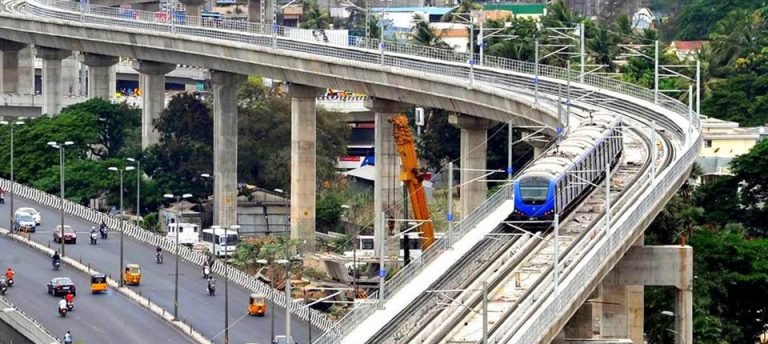
New Delhi: The metro rail network in the country is increasing with the mass rapid transit system emerging as one of the best solutions for urban transportation. Even as eight metro rail networks covering a length of 370 km are operational in the country, over two dozen more projects are lined up.

Out of the two dozen projects, around 15 are lined up with the urban development ministry. The cities that have lined up their plans include Pune, Nagpur, Ahmedabad, Chennai, Vijayawada, Kozhikode, Indore, Bhopal, Patna, Guwahati, Kanpur and Varanasi.

A senior urban ministry official, on the condition of anonymity, said, “Success of Delhi-NCR metro brought enthusiasm in the state governments and they want to replicate the same in the cities with population of over 1 million. We are getting a lot of proposals and many of the state governments are also looking at public-private partnership (PPP) since urban transportation is a state subject.” He added that Central assistance is given only to projects which are feasible.

In the last three years, from 2014-2017, the urban development ministry sanctioned Rs30,653.78 crore, out of which only Rs12,345.33 crore was released to various metro rail companies in the country. Similarly, in the current fiscal year, the ministry allocated around Rs17,960 crore for metro rail companies and till the first quarter ending June only Rs4,650 crore was spent. The figures are for Uttar Pradesh, Maharashtra, Gujarat, Rajasthan, Tamil Nadu, Kerala, Karnataka, Maharashtra and Delhi-NCR region.

However, officials from states like Punjab and Madhya Pradesh, which are yet to get approval for the first metro projects in their states, said that there has been a huge delay from the Centre for their projects. Some of these states are ready for the PPP route too.

A senior Punjab government official, who didn’t want to be identified, said, “We have submitted two metro proposals for Amritsar and Ludhiana, both high-density areas where such a mass rapid transit system would be a success. However, none of them has been approved. We will see for some more time and are also open to PPP route for development of metro system.

w railway2 U20573096666OjE

Metro rail projects are capital intensive and are generally undertaken through financial support of both the central and state governments in the form of equity and grants. The remaining funds are raised through multilateral agencies like Japan International Cooperation Agency (JICA) and European Investment Bank (EIB).

The urban development ministry official said, “States should learn to be open to use their own resources and reduce dependence on centre. In the recent months we have simplified provisions for state public sector undertakings to directly tap bilateral agencies for resources for infra development in their states.” He added that the new fund-raising route will allow for direct borrowing from official development assistance partners in countries like Japan, the US and Germany.

Interestingly, PPP for metro projects has been limited to five in India. Out of these five, one project (Mumbai Metro Phase 2) was terminated before it started, while another (Delhi Airport Line) was terminated after becoming operational. Currently, there are three operational PPP-based metro projects (one in Mumbai, and two in Gurugram) while one project is under implementation (Hyderabad Metro).

Shubham Jain, vice-president and sector head for corporate ratings agency ICRA, said, “The PPP participation in metro rail projects has been limited thus far, to encourage PPP would require adequate risk allocation in the concession agreements, availability of low cost debt funding, and the presence of a robust dispute resolution mechanism.”

ICRA in its report has estimated that in the next five years, metro rail projects worth Rs2 trillion are likely to come up for bidding.

Source: Live Mint

Rail firms eyes on business opportunities in Tier-II cities metro projects

New Delhi: As mass rapid transportation penetrates cities like Kochi, Jaipur and Lucknow, it throws open opportunities for companies like Alstom, Bombardier and Hyundai Rotem. Contracts for rolling stock, signalling and electric systems have helped these companies put up manufacturing units, too.

Now, the blue print for metro services in two cities in Madhya Pradesh — Indore and Bhopal — is also ready. In all, the government has identified nearly 50 Tier-II cities and towns for modern metro systems, herein, lies the next big wave of business for the companies.

The Indore metro project is expected to come up at a cost of Rs 7,522.63 crore, including financial cooperation from Asian Development Bank (ADB) and New Development Bank (NDB).

The expected expenditure in metro rail for India over the next three-five years is about Rs 2.3 lakh crore. Currently, 350 kilometres of route network is under operation. A critical mass has already been achieved and this is only expected to increase significantly in the coming years.

Rail coaches, rolling stock, signalling and other electrical components contribute close to 50-60 per cent of a metro project, hence, this offers a significant opportunity for the suppliers of these equipment, Jagannarayan Padmanabhan, practice leader and director, transport and logistics, CRISIL Infrastructure Advisory, said.

One of the recently unveiled metro services is the Kochi Metro that was inaugurated by Prime Minister Narendra Modi in June. The estimated cost of the metro project is Rs 5,181.79 crore, the total length of the rail line is 25.612 km with 22 stations.

Alstom is undertaking signalling, telecom and electrification solution for the Kochi Metro line. The company’s scope includes design, manufacture, supply, installation, testing and commissioning of Radio communication-based train control (CBTC) signalling solution and supply of onboard equipment for 25 trains. It would provide an integrated telecom solution comprising of radio, master clock, CCTV, passenger information display system, passenger announcement system and Giga bit network.

In a recent report, Icra said that the metro rail sector has seen strong traction in the last couple of years and is expected to provide sizeable opportunities for construction companies over the next three to five years due to a strong pipeline of projects which are in the approval and planning stage.

The Central government encourages cities with above 2 million in population to develop mass transit systems Bombardier is pursuing various metro projects such as Delhi Metro, Bengaluru Metro Phase II, Mumbai Metro Phase III, Vizag Metro and light rail for cities of Kerala.

“Roads and urban infrastructure, including metro rails are two key segments which have witnessed robust order inflows for the construction companies. Further, with a sizeable pipeline of projects in these segments, the construction sector is expected to have sufficient order inflows and companies with strong track record and healthy balance sheet are expected to exhibit strong growth going forward,” K Ravichandran, senior vice-president and group head, corporate ratings, ICRA, said in the report.

Canadian major Bombardier, for instance, has a supplier base and over 2,200 highly skilled employees in India. It operates a railway vehicle manufacturing site and bogie assembly hall at Savli near Vadodara, Gujarat. In addition, it has a propulsion system manufacturing facility at Maneja, near Vadodara.

Currently, Alstom, which employs close to 3,000 people, is executing metro-railway projects in Chennai, Kochi and Lucknow. The rolling stock for these has been manufactured at Sri City.

The company is also executing signalling and power supply systems for the 343-km section on the World Bank-funded Eastern Dedicated Freight Corridor.

“We are already playing an important role in several upcoming urban rail projects. Starting from designing and manufacturing completely out of India, to establishing local supply chains, we are well positioned to provide an end-to-end full systems turnkey solution from India and to emerge as the preferred partner for our customer,” Bharat Salhotra, managing director Alstom Transport said.

Cities like Kolkata, Chennai, Delhi, Bangalore, Gurgaon, Mumbai and Jaipur already have metro systems. But with nearly 50 cities and towns in line for modern metro systems, Tier-II cities are poised to witness the next big wave.

Source: Business Standard

Bangalore Metro | K’taka Govt. under pressure on usage of Hindi in Namma metro

Bengaluru: Amid the raging controversy over the usage of Hindi in Metro trains, the government has come under pressure to take a clear stand and formally ask Bangalore Metro Rail Corporation (BMRC) to use only Kannada and English in signages in trains and stations.

Pro-Kannada activists gearing up for a large-scale protest against the alleged imposition of Hindi have urged the government to come up with a clear-cut policy, without which confusion over the language issue will continue to disturb law and order. BMRC officials say they are caught in a bind and can not remove Hindi from signages without written instructions from the government.

“The government has to make up its mind and take a decision before the situation gets out of hand. With agitators disfiguring signages at Metro stations, the situation has become fluid. We are helpless as we are still awaiting the government’s instructions,” a BMRC official said on condition of anonymity.

Activists of Karnataka Rakshana Vedike (KRV), which is spearheading the anti-Hindi campaign, had recently blackened signboards at Metro stations and staged a demonstration in front of the BMRC office.

Kannada Development Authority (KDA), which has already shot off a missive to BMRC asking it to eliminate Hindi from its signages and public announcement system, is scheduled to visit the utility’s office on Tuesday. “We will assess the situation. Based on the findings, we will write to the government asking it to issue clear directions to BMRC to adopt a two-language policy and use only Kannada and English in all its communications,” said S G Siddaramaiah, chairman, KDA.

Interestingly, the government, which is said to be sympathetic towards the Kannada cause, is yet to issue any formal directive to BMRC on the issue. Chief minister Siddaramaiah is said to have orally instructed the utility to reduce the usage of Hindi, while Bangaluru development minister K J George has asserted that the government is for Kannada supremacy. This is in contract with the Centre, which had written to BMRC asking it to use Hindi in its public communications.

In a letter to BMRC dated December 9, 2016, under secretary to the Union ministry of urban development, had invoked the Official Languages Act 1976 and instructed the corporation to use three languages, Kannada, Hindi and English, in signboards, name boards, announcements and publication material.

The state government had written to the Centre earlier on July 2, 2016, seeking exemption for Namma Metro from the Official Languages Act. In the letter to the secretary, ministry of urban development, then chief secretary Arvind Jadav wrote: “Since BMRC is not a Government of India public sector unit, the mandate of using Hindi under the Official Languages Act should not be made applicable to Namma Metro.” However, there has been no reply from the Centre since then.

Source: TNN

RVNL submits final feasibility report of Delhi-Kolkata Bullet Train corridor

Kolkata: Rail Vikas Nigam Limited (RVNL) submitted its final feasibility report of a high-speed bullet train in the Delhi-Kolkata corridor earlier this month.

A bullet train — capable of covering the 1,474.48km distance between the two metropolises in 5.24 hours flat, at a speed of 250kmph to 270kmph — would cut down surface travel time between the two metropolises by around 12 hours. The current fastest train on this route, the Rajdhani Express, takes around 17 hours.

The project will be completed in phases, starting in 2021, said a railway source. The Delhi-Varanasi corridor will be covered in the first phase. Within that, the Delhi-Lucknow stretch will become operational by 2029, and the first phase will be completed by 2031. For “bullet-speed” travel to Kolkata, you’ll have to wait till 2039, a source added.

The terminal station will be Shalimar. “We had also thought of the Kolkata (Chitpore) station. But congestion is higher on the east bank of the Hooghly. Also, the project cost will shoot up for building an underground tunnel for the bullet train corridor. Shalimar is also the right option because it will eventually be connected with the East-West Metro,” said Rajesh Prasad, executive director of RVNL, who was part of the high-speed corridor project.

Land acquisition and the high cost of implementation, said sources, are the two biggest hurdles for the project that will require 368 overbridges, 65 underbridges and five tunnels. There will be four depots and workshops. The train requires a dedicated elevated track, completely sanitized as far as security is concerned.

The project report was commissioned by High Speed Rail Corporation of India (HSRC), a subsidiary of RVNL. HSRC, which has been conducting feasibility studies for several bullet train projects, has submitted a final feasibility report for the Delhi-Amritsar project and a draft report for the Delhi-Kolkata corridor to the ministry of railways.

Even though a high-speed bullet train is a costly proposition, it saves energy costs and reduces greenhouse emissions, argued railway officials. An aeroplane consumes 51.1g energy per passenger per kilometre, private cars 29.9, bus 18.3 classic train 17.6, a high-speed train uses only 12.

1. Similarly, journey time for air travel involves travel times to and from the airport, away from the city heart, and one also has to factor in waiting time at the airport. Taking all this into account, travel time by air betweeen Delhi and Chandigarh takes 3.5 hours, but would take only an hour in bullet trains.

Expert groups have predicted that by 2030, Indian’s urban population will swell to 590 million (40% of India’s total population). The rapid urbanization, HSRC officials argued, has triggered a growing demand for inter-city traffic between metropolitan cities and second- and third-tier cities. The train would touch upon some of the busiest urban hubs, which generate a huge number of passengers.

Source: TNN

Kerala to expedite land acquisition work for light metro projects

Thiruvananthapuram: A high-power committee headed by Chief Minister Pinarayi Vijayan today decided to expedite the process of land acquisition for Thiruvananthapuram and Kozhikode light metro projects.

The committee also entrusted Delhi Metro Rail Corporation (DMRC) Principal Advisor E Sreedharan to decide the technology to be used for the two projects, estimated to cost over Rs.

6,000 crore, a government press release said.

The Thiruvananthapuram light metro will cover 21.8 km from Karamana in the city to Technocity in Kazhakootam. It was also decided at the meeting to conduct a study with regard to extending the light metro from Karmana to Papanangode.

The light metro projects were approved in 2015.

The project was to be implemented through 20 per cent capital investment each from the Central and state governments and remaining 60 per cent was to be raised through loans.

The government has already given sanction to acquire 1.98 hectares land in the capital city and 1.44 hectares in Kozhikode, the release said.

The amount for the land would be sanctioned from Kerala Infrastructure Investment Fund Board (KIFB).

The state government is moving ahead with the project with the expectation that centre would participate and provide clearance.

DMRC has been engaged as interim consultants to identify and take up preliminary preparatory works for the two projects.

(This article has not been edited by Metro Rail News’s editorial team and is auto-generated from an agency feed.)

Kolkata Metro | GST to raise East West Metro construction cost

Kolkata: The Goods and Services Tax (GST), which subsumed all indirect taxes and was implemented from July one this year, is likely to raise the construction cost of East-West Metro being constructed by Kolkata Metro Rail Corporation (KMRC).

 “GST will definitely raise the construction cost. But the exact amount of the rise is yet to be ascertained.”, KMRC managing director, Satish Kumar said.

Briefing reporters here today, he said that tunneling work under Brabourne Road in the city has been completed and work on the Esplanade station already started.

There will be five levels at Esplanade station and function as a confluence of the three metro railways – the East-West Metro, North-South Metro and the Joka-BBD Bag Metro.

Work on the Mahakaran metro station will start soon, he said adding that the first phase of the project from Salt Lake to Phool Bagan have been targetted to go operational from June 2018.

Kumar said that entire stretch from Howrah Maidan to Salt Lake was expected to be operational from December 2020.

Efforts have been made to keep settlement of the soil within 30 mm, which according to him, would not do much damage to the buildings falling on the tunnelled route.

Once the construction was complete, the operations of the East-West metro would be transferred to the North-South Metro authorities.

Total cost of the 16.55-km project had been pegged at Rs 4874 crore so far, he added.

(This article has not been edited by Metro Rail News’s editorial team and is auto-generated from an agency feed.)

Mumbai Metro | Financial bids for Metro Line 3 rolling stock by August end

Mumbai: Having already received six pre- qualification bids for the rolling stocks, Mumbai Metro Rail Corporation (MMRC) is hopeful of opening financial bids for the same by the end of next month for the Line 3 that connects the city’s southern tip to the airport and beyond.

The Rs 23,136-crore, 33.5-km-long Line 3 connects Colaba in the southern tip of the island city with Bandra- Seepz in the north via the international airport and is the biggest infra project that the city has ever seen.

Also, on completion by 2022, the Line 3 will be the fifth largest underground metro in the world.

“We are hopeful of opening the financial bids for rolling stock for the Line 3 by the end of August. We’ve already received good pre-qualification bids from as many as six domestic and global consortia,” said MMRC managing director Ashwini Bhide.

The consortia are Alstom Transport India-Alstom Transport France; CRRC Nanjing-CRRC Changchun-CRRC International Corp of China, Kawasaki Heavy Industries of Japan; CAF of Spain, Hitachi from Japan, and a consortium of Bhel-Mitsubishi Corp, she said.

Of these, CAF, Hitachi and Mitsubishi are independent bids, Bhide.

After evaluating these bids, MMRC will invite financial tenders from shortlisted companies in consultation with the Japan International Cooperation Agency, which is funding 57.2 per cent of the project cost at a soft loan for 30 years.

Bhide said the winning consortium will have to manufacture 75 per cent of coaches locally though not necessarily in Maharashtra itself.

The state-of-the-art eight-coach cars will be driver- less trains, said MMRC director (projects) S K Gupta.

MMRC will procure 31 cars of eight coaches each, or 248 coaches in total, in the first phase. Each car will be 22.6-metre-long and 3.2-metre-wide with four gates per car.

The contract will include design, manufacture, supply, installation, testing and commissioning of the rolling stock.

Describing the Line 3 as the biggest infra project in the megapolis, Bhide said the thus far the biggest such venture here, the Bandra-Worli Sea Link – has cost only Rs 1,600 crore, while the Line 3 is 14 times larger.

The other key infra projects – the Eastern Freeway (Rs 1,200 crore) and monorail (Rs 2,600 crore) all pale in front of the Colaba-Seepz metro line. The 11.8-km Metro One (being operated by the Anil Ambani group) has cost only Rs 2,400 crore, she noted.

The Line 3, on completion by FY22, will reduce daily fuel demand by around 4 lakh liters, or close to 10,000 tonne of green house gas emissions per year, as it will take at least 4.5 lakh vehicles off road daily.

The city is building five more metro lines of which civil work on the Line 2A and Line 7 have already started.

These six line new metro lines will cost close to Rs 1 trillion and are being implemented by the nodal development agency MMRDA.

Executive director (planning) at MMRC R Ramana said the Line 3 will need 17 tunnel boring machines (TBMs) which will arrive by end-August and the tunnelling will start from October from the proposed Naya Nagar station in the Dharavi slum area in central Mumbai.

Gupta said the Line 3, which will have just one of the 27 stations on-ground, needs 78.67 hectares land, of which only 3.45 hectares are private land.

Of the total government land of 74.22 hectares, 64 hectares have already been acquired and of this 30 hectares are at the Arey Colony where the metro will have the casting yard and depot. Out of the 30, 5 hectares will be untouched and will remain a natural green cover, Bhide said.

She ruled out building commercial space at the stations, saying it isn’t commercially viable to build large space at the stations, though each of them may have some urgent utilities like ATM and snacks bars.

“Out of the total project cost of Rs 23,136 crore, over Rs 18,000 crore are only for tunnelling and stations.

Effectively, cost works out to be Rs 2 lakh per sq ft and we cannot charge so much from a tenant.

Each station will have a built up space of 240-250 sq meter space only,” she said.

Asked whether the project is on time despite many legal hassles it had to face, Bhide said, “very much”.

No there is no uncertainty over the project. The metro will be a reality on time, and that is by 2022, she concluded.

(This article has not been edited by Metro Rail News’s editorial team and is auto-generated from an agency feed.)

Delhi Metro | DMRC employees call off strike after series of meetings

New Delhi: Metro trains in the Capital will run as usual on Monday, with employees of the Delhi Metro Rail Corporation (DMRC) calling off their strike subject to implementation of their demands assured by the DMRC Management in a series of high level meetings on July 22 & July 23 till evening.

“The ongoing protest by DMRC’s non-executive employees was called off on Sunday evening after all the issues raised by the agitating employees were  assured to be settled amicably following many rounds of meetings and deliberations with DMRC’s managing director, Dr. Mangu Singh and other senior officials,” said Anuj Dayal, chief spokesperson at DMRC. “In light of the above, the Delhi Metro services will continue as per schedule tomorrow (Monday),” he added.

The announcement came after the corporation assured and agreed to the demands of its protesting non-executive employees that included reinstatement of Ex. RTI Supervisor Vinod Shah who was removed recently by the DMRC for raising voices against corruption and irregularities in recruitment in Delhi Metro Rail Corporation, revising their salary slabs, and cancelling charge sheet issued to its Staff Council members Anil Mahato and Ravi Bhardwaz for disciplinary actions. However, the demand for forming separate employees union were kept pending and the management assured the present Staff Council to give more powers in line with employees union. The DMRC has around 9,000 non-executive staff who perform important duties of train operators, station in-charge, traffic controllers, technicians, maintenance and so on.

These employees had been protesting by holding sit-ins at various platforms over the past three days. On Monday, they had threatened to shut all metro services by not reporting to work.

However, the crisis was averted after a series of meetings held over the weekend between the Metro’s staff council, DMRC’s top officials, Delhi government officials and the secretary at the ministry of urban development.

“The issue was also deliberated in detail yesterday (Saturday) in a high-level meeting chaired by secretary MoUD, Durga Shankar Mishra and Delhi chief secretary Dr MM Kutty with DMRC’s MD,” Dayal said. Ex. DMRC Chief Dr. E Sreedharan was also called from Kochi to resolve this serious issue.

However, the Delhi Metro employees are keeping close watch on prompt implementation on their demands as assured by the DMRC Management.

Ahmedabad Metro | NID bags contract for design signages of metro rail

Ahmedabad: Top-notch design institute, National Institute of Design (NID), has bagged Metro rail’s project to design signages on the entire stretch of the railway line, including stations which will connect Ahmedabad and Gandhinagar.

The project, led by professor Tridha Gajjar, coordinator, graphic design, will have two experts and a consultant working on the designs.

Confirming the development, NID director Pradyumna Vyas said, “It is a very proud moment for us to work for betterment of the city by contributing our designs to projects like metro rail, airport beautification etc.”

Professor Gajjar said they had been asked to create an identity for Metro rail and design signages. “We have been given a deadline of six months in which we have to give them designs of six prototypes for stations and roads. We have started work and are studying the metro route. The visual identity of Metro rail should be such that one can relate to it at once,” she said.

An expert, requesting anonymity said, “NID should take some cue from Delhi metro rail which has used tough material for signages ensuring they are vandalism and defilement-proof. The signages are made of aluminium extrusion with vinyl.”

Interestingly, an NID team led by professor Pravinsinh Solanki is also working on giving a facelift to Vaishno Devi shrine in Jammu. NID has designed signages and designed monkey-proof dustbins for Vaishno Devi Shrine Board, besides enabling better facilities.

The total length of the Ahmedabad Metro Rail Project Phase-I is about 39.259 km out of which approximately six km is underground, while the rest is elevated section.

The project will connect four corners of the city. There will be two corridors and 32 stations.

North-south corridor with a length of 18.522 km will connect Motera Stadium to APMC and Vasna and will pass through Sabarmati, AEC, Sabarmati railway station, Ranip, Vadaj, Vijaynagar, Usmanpura, Old high court, Gandhigram, Paldi, Shreyas, Rajivnagar and Jivraj stations. It will be completely elevated with 15 stations.

The length of the east-west corridor is about 20.737 km with 17 stations along the route. This corridor will connect Vastral Gaam to Thaltej Gaam and will passing through Nirant Crossroads, Vastral, Rabari Colony, Amraiwadi, Apparel Park, Kankaria east, Kalupur railway station, Gheekanta, Shahpur, old high court, Sardar Patel Stadium, Commerce six roads, Gujarat University, Gurukul Road, Doordarshan Kendra, Thaltej stations. About six km will have an underground section and four stations will fall within this section. The remaining stations will be on elevated section. Old high court station will be an interchange station for both corridors.

Wanted to quit, but Yogi Adityanath won’t allow: Sreedharan says

With the intention of reducing his work load, 85-year-old E Sreedharan visited Uttar Pradesh Chief Minister Yogi Adityanath last month to offer his resignation from the role of advisor to the Lucknow and Kanpur Metro projects. But he returned to Kochi with more work.

“He (Adityanath) said ‘I’m not allowing you to resign. In fact I’m also adding Varanasi, Agra and Meerut… and also Gorakhpur’,” said Sreedharan, seated in the conference room of the DMRC office in Kochi, on Thursday afternoon.

Sreedharan, known as Metro Man to many for his supervision of various Metro Rail projects, said that while surveys have begun in Gorakhpur, Agra and Meerut, “the first phase of the 10.5-km line of the Lucknow Metro is ready and waiting for inspection from the Commissioner of Metro Railway Safety”.

Giving an update on the Metro plan in UP, Sreedharan informed that the “depot is ready in Kanpur” and the “project report of the Varanasi Metro is ready but has to be revised”.

He said: “Yogi wasn’t happy with the report. He doesn’t want any kind of construction to come up near the temple. It’s going to be underground and should be a light metro — fewer coaches with less vibration and noise.”

While many cities are working on Metro projects, Sreedharan believes there is still a long way to go. “China is constructing 300 km every year, we are only doing 22 km. If cities have to survive, it is essential to have the Metro. We should do at least 200 km per year.” Sreedharan spoke about a variety of subjects, including the RInFra-DMRC arbitration, speculations around his Presidential nomination and the pace of Metro expansion in India.

Regarding rumours of his presidential nomination, he laughed it off with “I was never approached…it was all media speculation. You can’t be the president of a country at 85!”

Source: The Indian Express