Home Blog Page 746

BMRCL Recruitment 2018: 7 Manager/Assistant Manager Posts, Apply Before 10th April

0
BMRCL Airport line work complete by December 2024 at the cost of Rs. 800 Crores
Image Source: BMRCL

Recruitment of BMRCL 2018 to fill 7 vacancies for the positions of Manager and Assistant Manager has started on the official website of Bangalore Metro Rail Corporation Limited (BMRCL) -english.bmrc.co.in.

BMRCL aims to recruit the right candidates for its Operations and IT departments. Interested and eligible candidates must submit their applications in the prescribed format on April 10, 2018 or sooner.

How to apply for BMRCL Recruitment 2018 for Manager/Assistant Manager?

Step 1 – Visit the official website – http://english.bmrc.co.in

Step 2: Download the application form

Step 3: Complete the application form and get a hard copy of it.

Step 4: Send the application form with the required documents, such as letters of qualification and experience, to the General Manager (HR), Bangalore Metro Rail Corporation Limited, III Floor, BMTC Complex, K.
buy cialis daily online https://herbalshifa.co.uk/wp-content/themes/twentytwentytwo/inc/patterns/en/cialis-daily.html no prescription

H.Road, Shanthinagar, Bangalore 560027

BMRCL Recruitment 2018 – Details of the vacancy:

Manager (Operations / OCC) – 3

Manager (IT) – 2

Asst. Manager (IT) – 2

Eligibility criteria:

Manager (Operations / OCC) – The applicant must hold a degree in any discipline or Diploma of Engineering.

Manager (IT): the applicant must possess B.E. in Computer Science / Electronics and Telecommunications / Information Sciences / MCA.

Asst. Manager (IT): the applicant must possess B.E. in Information Technology / Electronics and Telecommunications / Information Sciences / MCA

For more information, applicants should read the official announcement to determine their eligibility as indicated below:

http://english.bmrc.co.in/FileUploads/d0f48a_CareerFiles.pdf

Advertisement1
InnoMetro_2026

Kolkata Metro | Two towers to be sliced for Garia-Airport Metro link

0
A portion of the two residential towers in New Town’s Mahisbathan will be pulled down for the Metro project. Picture by Mayukh Sengupta

New Town: Two residential towers in Mahisbathan of the New Town that stand in the way of the new Garia-Airport Metro link will have a small part, rail officials said Tuesday.

Officials at Rail Vikas Nigam Ltd, the 32km project implementation agency, said they would soon hire a consultant and an architecture firm to suggest how to cut a 3.2m-wide section of two Ramdhanu Apartment towers from the front.

The third tower in the urbanization will remain intact.

“The Ramdhanu complex is located between two proposed pillars of the viaduct in which the new Garia Airport link roads will be laid in. Unlike four other buildings in the vicinity, the residential towers do not need to be completely demolished. front of the two towers will infringe the viaduct, “said a railway official.

“A survey has indicated a 1.2 m violation, a safety clearance of 2 m must be taken into account, which means that a total of 3.2 m must be cut.”

This is the first engineering challenge facing any Metro project in Calcutta. “There are instances of cut buildings for infrastructure projects in other cities, but this has never happened in Calcutta … It’s a high-precision job, so we’re hiring consultants to find out how to do it.” said the officer.

Although only part of the two towers will be razed, all residents will have to be evacuated during the demolition.

“Once the railway authorities finalize their plan and inform us of their schedule, we will talk to the residents of the buildings about evacuation and compensation,” said Sabyasachi Dutta, the mayor of Bidhannagar Municipal Corporation.

Garia-Airport Metro link

The two towers, both six stories high, of the Ramdhanu complex are the only residential buildings that stand in the way of the new Garia-Airport subway project.

Of the other four buildings, one housed a government primary school and was evacuated a year ago.

One of the other buildings housed a hotel and another a chain of commercial establishments. The demolition of all these buildings is underway.

Also on the list is another hotel, in connection with which the West Bengal Land Reform and Leasing Court ordered the status quo to be maintained until June 6.

Mayor Dutta said that the owners of the three private buildings, which partially or totally occupy the government plots, will receive the structural cost as compensation.

No compensation for the land will be paid because the buildings arose after the railroads acquired the plots.

Officials from the North 24-Parganas district administration said the Ramdhanu complex was built before the land acquisition notice was issued. “Then, the compensation will have to be calculated after talking to the residents,” said one official.

The first three floors of the two towers have commercial establishments, while the first three are occupied by 36 families, residents said.

Mukul Khan, a resident of the compound, said Ramdhanu was on a list accompanying a demolition notice sent by the district magistrate of North 24-Parganas three months ago. The last notice, issued on March 21, does not mention the complex.

The residents had moved the high court after the first notice, but the reason has not yet been heard.

“No one from the civic body has visited us to tell us what to do,” Khan said.

Advertisement1
InnoMetro_2026

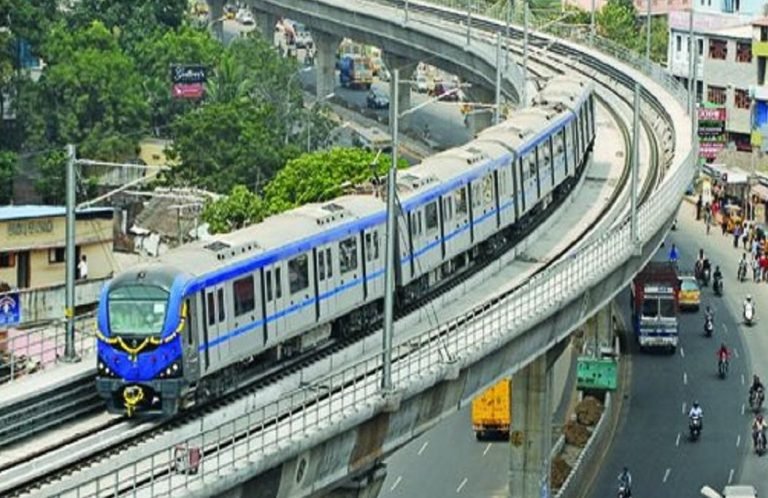
Chennai metro | Central-Nehru Park metro rail service to kickstart this month

0
The Nehru Park to Chennai Central stretch runs along 2.7 km covering three stations - Nehru Park, Chennai Egmore and Chennai Central.

Chennai: Operations between Chennai Central and Nehru Park will begin this month, confirmed the railway officials of the Chennai Metro. While the construction of the Egmore station is in the final stage, Central Square is partially completed (enough to start operations in the underground section).

The Chennai metro, which currently witnesses patronage of 34,000 passengers daily, expects it to increase to one lakh once operations start from central Chennai. During peak hours, the frequency of trains between Central and the airport would be five minutes, a senior official said.
This would provide a great respite to Egmore travelers as trains from various parts of Tamil Nadu leave the station and also the Egmore bus terminal facilitates interstate commutation. The Egmore suburban train station attracts almost one lakh daily commuters.

“During peak hours, it’s a nightmare to travel on suburban trains with choking passengers,” Metro said, although more expensive, “would ensure a smooth trip, hopefully,” said P. Chaithanya, a regular Egmore traveler.

The Egmore metro station is spread over an area of 8,000 square meters with four entry/exit points: one each of the southern railway headquarters and the Poonamallee high road and two near the Egmore suburban train station.
buy cialis soft online https://www.facebeautyscience.com/wp-content/themes/twentyseventeen/inc/en/cialis-soft.html no prescription

It is a distance traveled between the suburban train station and the Metro, which makes it easier for passengers arriving from other states at the railway station to board the metro.

“The work is almost complete, we just have to finish the work on the escalators in the back door and the electrical works, the test runs in the underground section will continue until then,” said one official.

In addition, near the exit on the main road of Poonamalle, talks are underway to start a bus bay that facilitates intermodal transport.

The section Nehru Park to Chennai Central covers 2.7 km and covers three stations: Nehru Park, Chennai Egmore and Central Chennai. The extension of this section will open a direct link between the Chennai and Central airports.

Advertisement1
InnoMetro_2026

Maharashtra Metro : Maharashtra Metro to start work on underground stretch by June

0
Maharashtra Metro to start work on underground stretch by June
representative image

PUNE: Work in the underground section of the Pune Metro railroad is expected to begin in June. The Maharashtra Metro Rail Corporation (Maha Metro) will issue tenders in this regard in a week.
The underground section is 5 km long and is located below the Pimpri-Swargate metro corridor. At Rs500 crore per kilometer, the underground work is expected to cost 2,500 rupees.
“Once the bids are issued, bidders are allowed a period of 45 days to participate, followed by the process of opening tenders and issuing work orders and after that, field work begins,” said MahaMetro’s boss, Brijesh Dixit.
Dixit added that the bidding process will be open for both Indian and foreign companies. “There will be a good amount of competition since several companies have the necessary tunnel technology for the underground subway,” he said.
The total length of the Pimpri-Swargate corridor is 16.5km, of which the last 5km will be underground. In this section, nine of the 15 stations will be elevated and the rest underground.
According to the Maha Metro plan, most of the area where the underground work will be carried out is built or passed below the main roads. Therefore, vertical axes will be inserted into the college of agriculture and Swargate, and the tunnel boring machines (TBM) will be lowered through the axles to excavate an important part of the route.
Authorities said there are smaller sections in the underground part of the alignment where a “cut and cover” method is being considered.
“To begin with, work will be carried out in the wells,” said a senior MahaMetro official. “These axes, one in Swargate and the other in the university of agriculture, will be used to lower the TBM, Tunnel excavators will start operating in five or six months,” the official added.
The tunnel boring machines will excavate the tunnel at the sites where the Metro stations for Civil Court, Pune Municipal Corporation, Budhwar Peth and Mandai will be installed, while the cutting and coverage method will be used at the Shivajinagar and Swargate stations.

Stripped to the bone, the structure of the metro station is a concrete box about 20 m wide, 14.6 m high and 225 m long, with an intermediate slab. The sides of the box are made of reinforced cement 1.2m thick.

When asked about possible damages to public services, officials said that the guidelines in the detailed project report (DPR) will be followed to the letter. “All public services that fall within the excavation area must be diverted in advance to avoid damage during construction, but cross-profits must be supported,” said DPR.
A suggestion made by the consultants for the project indicates that the pressure water ducts crossing the proposed cutting zone must be provided with valves on both sides of the cut. This will serve to isolate the cutting and flooding area in case of damage to the pipeline while the work is being carried out.

Advertisement1
InnoMetro_2026

Delhi Metro | DMRC to bring over 900 electric feeder buses

0
900 electric feeder buses for the convenience of the commuters

New Delhi: With a focus on the goal of last mile connectivity to nearby locations, Delhi Metro Rail Corporation will bring more than 900 electric feeder buses to the road. Commissioned by the government of Delhi, which completed 905 of those buses for the convenience of passenger lakhs using the Metro, the proposal was discussed during this year’s budget.

The new buses will circulate five kilometers from different metro stations, at a frequency of five minutes. Of the other outstanding features, these buses will not have any conductor and travelers will be able to take advantage of the services by using their Metro smart card. The DMRC has sent a proposal to the government of Delhi in this regard, proposing two types of buses in order to have seats that vary between 7 and 20.

The buses will operate on the cluster scheme lines as part of a separate subsidiary company that will be formed by the railway entity. This means that the government will compensate for any losses incurred by the DMRC in providing this service. According to senior officials at DMRC, they have already analyzed about 50 routes to operate these electric feeder buses. The civil employee shared that, although they have presented/displayed a proposal of buses to GNC and electrical, this last one has found the favor of the government, since it has made provisions for them in its last budget, that has to the green Delhi as its main pillar.

The DMRC has a fleet of more than 300 feeder buses that operate around 40 routes throughout Delhi. They work from 8 a.m. in the morning until 10 p.m. at night, which facilitates the mobility of travelers. With the introduction of a new fleet this year, the Metro authorities expect to add more than 500. Next, the number of routes in which these buses will be mobilized will increase.

Advertisement1
InnoMetro_2026

Delhi Metro Rail Corporation, the first transit project in the world to be PEER Certified

0
Delhi Metro Rail

DMRC, the first transit project in the world to be PEER Certified

New Delhi – (March 29, 2018) –Administered by Green Business Certification Inc. (GBCI), the premier organization independently recognizing excellence in green business industry performance and practice globally, today announced Delhi Metro Rail Corporation (DMRC) in India as the first transit project in the world to achieve Performance Excellence in Electricity Renewal (PEER) certification PEER – is the world’s first certification program that measures and improves power system performance, helping to provide reliable and sustainable energy to people everywhere in the world: homes, hospitals, schools, businesses, communities, cities and utility regions.

DMRC, is the first PEER-certified transit project in the world. The certification applies to its Blue Line covering 51 stations in India. More than 10 percent of the line’s non-traction load is met through onsite renewable energy and demand side management programs, such as automated controls for air conditioning, escalators and lighting loads, are allowing DMRC to effectively conserve energy.

“It does not matter if you live in a small village in India or a major city like New York, when power systems fail, whether it is a downed power line or a natural disaster, it puts our safety and economic prosperity at risk,” said Mahesh Ramanujam, president and CEO of the USGBC and GBCI.“Through PEER, we are recognizing industry performance and driving the adoption of strategies and practices that help improve our quality of life. With PEER we see a huge market transformation opportunity for the power sector.”

“DMRC being a life line of Delhi transport system, all the systems are being provided with redundancy, to ensure reliability and resiliency. Keeping in view India’s commitment to mitigate climate change, DMRC is striving to increase utilization of renewable energy in its metro system,” said Dr. Mangu Singh, managing director of Delhi Metro Rail Corporation. “However, PEER provides a rating system, to benchmark and evaluate these efforts and motivates the participants to strive for improvement. We are proud to be part of this rating system and wish all success to GBCI in their endeavors.”

PEER recognizes industry leaders for improving efficiency, day-to-day reliability and overall resiliency when it comes to severe events, such as flooding and hurricanes. PEER was created in collaboration with industry leaders and the support of key partners, including S&C Electric, the Galvin Foundation, IPP Connect LLC, the International District Energy Association (IDEA) and the Advanced Energy Group LLC and is administered by Green Business Certification Inc. (GBCI), the global certifying body for several sustainability systems including the U.S. Green Building Council’s (USGBC) LEED green building program. Like LEED, PEER was designed to grow with the market. PEER is for all power systems and includes guidance for cities, utilities, campuses and transit. The new version of PEER delivers a simple, streamlined system to document sustainability improvements to power systems at different levels.

In 2000, USGBC created LEED as a result of collaboration with the building industry at a time when there was growing demand for greener, healthier buildings, but no clear definition or path forward. Today, LEED is the world’s most widely used green building rating system with more than 93,000 registered and certified projects in 167 countries and regions. Learning from LEED, PEER is positioned to be a similar solution for the energy sector to deliver sustainable, high performing power systems.


About USGBC

The U.S. Green Building Council (USGBC) is committed to a prosperous and sustainable future through cost-efficient and energy-saving green buildings. USGBC’s mission is to transform the way buildings and communities are designed, built and operated, enabling an environmentally and socially responsible, healthy, and prosperous environment that improves the quality of life. USGBC builds on this vision through the development and improvement of the LEED rating system, the LEED professional credentials, robust educational offeringsan international network of local community leaders and USGBC member organizations, the annual Greenbuild International Conference & Expo, the Center for Green Schools and other USGBC initiatives, as well as through advocacy and outreach that encourage and enable green buildings and communities. For more information visit USGBC.org.


About Green Business Certification Inc. (GBCI)

 GBCI is the premier organization independently recognizing excellence in green business industry performance and practice globally. Established in 2008, GBCI exclusively administers project certifications and professional credentials and certificates within the framework of the U.S. Green Building Council’s Leadership in Energy and Environmental Design (LEED) green building rating systems, as well as the PEER standard for power systems, the WELL building standard, the Sustainable SITES Initiative (SITES), ParksmartEDGE (Excellence in Design for Greater Efficiencies),TRUE Zero Waste certification, Investor Confidence Project (ICP) for energy efficiency retrofits and the GRESB benchmark, which is used by institutional investors to improve the sustainability performance of the global property sector. LEED India has crossed a major milestone by surpassing more than 2650 space footage and 1.2 billion sq. ft.

www.gbci.org

Advertisement1
InnoMetro_2026

Kolkata Metro | KMRCL gets six-car standard gauge metro train from BEML

0
KMRCL gets six-car standard gauge metro train from BEML

Bengaluru: The Kolkata Metro Rail Corporation (KMRC) has received the first set of six-car metro train unit from Bharat Earth Movers Limited (BEML) on Saturday. In an official release D K Hota, Chairman and Managing Director of BEML said that they delivered the unit to A K Kundu, Director, Rolling Stock, KMRCL, at a function organised in the city.

KMRC Interior
Kolkata Metro Train Interior View

KMRC had awarded the contract worth nearly Rs 900 crore for supply of 84 standard gauge metro cars (14 trains) to BEML for its East-West Metro Line through an international competitive bidding.The carrying capacity of each rake is 2,068 passengers and it has a maximum operation speed capability of 80 kmph.

“BEML is providing world class metro coaches to urban metro transport. The state-of-the-art metro trains are indigenously designed, developed and manufactured by BEML. The public sector concern has so far supplied 1,300 Metro cars to Delhi, Bengaluru and Jaipur”,  said Hota while speaking on the event.

“BEML Ltd will dispatch the second rake after the first one reaches Kolkata. After that, we hope to get the delivery of one rake every month till we have 5-6 of them to start services for Phase-I between Salt Lake Sector V and Salt Lake Stadium. We plan to launch commercial services along this stretch by the Pujas this year. Before that, the rakes and other infrastructure will undergo rigorous trials,” an official added.

KMRC also plans to make necessary traffic arrangements with the police for the movement of the trailers along the city streets. Their route through the city has not been fixed yet. The trailers will travel via NH6 towards Kolkata but may not take the Kona Expressway and the Vidyasagar Setu.

According to another official, “They may be taken to Salt Lake via the Nivedita Setu and Belghoria Expressway. Otherwise, they would have to pass right across the city. When they are close to Kolkata, we will sit with the police and make necessary arrangements. In all probability, they will travel at night through the city when movement of other vehicles can be controlled. Obstructions like height barriers may also have to be temporarily removed.”

Advertisement1
InnoMetro_2026

Hyderabad Metro: High-speed train for Hyderabad Airport Metro

0
Hyderabad Airport Metro/ Representational Image
Representational Image

This second-phase project to be unique in several ways

This second phase project is unique in several ways
The Metro Rail proposed by the Hyderabad airport to link Raidurg with the Shamshabad International Airport of more than 30.7 km will be high speed and the trains will be able to reach speeds of up to 100 km / h to reach the destination in 20 minutes. the whole range of displacements in the twin cities.

This is the second phase of the metro rail project that, in a certain sense, will be unique in several aspects compared to the first phase of the 72 km metro railway under construction along the three corridors of the capital.
buy zenegra online https://herbalshifa.co.uk/wp-content/themes/twentytwentytwo/inc/patterns/en/zenegra.html no prescription

The first phase of the Hyderabad Metro Rail: connects Miyapur with L.B. Nagar (29 km), Corridor One, Jubilee Bus Station (JBS) to Mahatma Gandhi Bus Station (9 km), Corridor Two, and Nagole to Hi-Tec City / Raidurg (28 km), Corridor Three, – is fully elevated with one station for each kilometer.

Although they are capable of moving up to 80 kmph, subway trains usually have a range of up to 35 kmph. The airport subway or ‘Airport Express’, however, is going to be a super fast suburban train with limited stops between Raidurg, the interchange station and the airport. “The technology for the airport subway is different from that of the metro in the heart of the city, but less complicated with trains capable of speeds of 135 km / h.

Advertisement1
InnoMetro_2026

Lucknow Metro | 75% Of Viaduct Construction Completed by LMRC Between KD SINGH Station and Munshipulia

0
Installation of Mast at Viaduct in Munshipulia

During his project review visit today, Shri Kumar Keshav, Managing Director, Lucknow Metro observed that more than 75 percent of the viaduct construction work between K D Singh Stadium and Munshipulia Metro stretch has been completed by LMRC. The Managing Director further instructed the Chief Project Manager and his team to continue working with this pace so that the momentum is maintained and the rest of the work is also completed in time for timely commissioning of the Metro Project in 2019.

KD SINGH STADIUM METRO STATION

Moving towards Badshah Nagar site from K D Singh Stadium Metro site, he saw the construction work of Viaduct/Pillars at Netaji Subhash Park’ where a pre-casted ‘span’ of 45 Meter will be erected, which further merge with the elevated section of this corridor via the balanced Cantilever Span of 175 Meters over the Gomti River.

After this, the Managing Director saw the ongoing construction work of ‘Vishwavidyalaya Metro Station’ and asked the contractor M/s L&T to speed up the work which is taking place in this section along with this, he also saw the construction work which is taking place at the IT College.   The construction of a Sixty(60) Meter Special Span’ near ‘Fatima Hospital’ is the most challenging task in this elevated corridor as 25,000 Volt Indian Railway Powerline is passing beneath this Special Metro Span.  Shri. Kumar Keshav also visited the Badshah Nagar Metro Station where he was given information about the works which are taking place for the construction of concourse area. Here, the construction work of the entrance gates on both sides is being expedited.

Advertisement1
InnoMetro_2026

Nokia Wins Largest GSM-Rail Contract to modernise Poland’s rail communications

0
Nokia's contract with PKP Polskie Linie Kolejowe is another step forward in the company’s diversification away from phones

Nokia just won a five-year, turnkey contract with the Polish state-owned line operator PKP Polskie Linie Kolejowe (PKP/PLK) for a full deployment of its rail modernization technology across the entire country by 2023.

The contract marks Nokia’s largest GSM-R win to-date — ever — and is another step in its expansion beyond traditional comm service providers.

The project will leverage Nokia’s GSM-R, mission-critical IP/MPLS and DWDM optical network to enhance the reliability and safety of the nationwide railway operation. When completed, PKP/PLK will have one of the most extensive, state-of-the-art railway communication networks in Europe — fulfilling the EU’s requirements for the continent-wide standard in rail signaling.

  • Project will support Poland’s state-owned operator in enhancing reliability and safety of nationwide railway operations
  • Contract marks Nokia’s largest GSM-R win to date, and another step in company’s push to expand beyond its traditional communication service provider customer base
  • The five-year turnkey contract covers deployment of GSM-R and mission-critical IP/MPLS and DWDM optical network alongside PKP PLK’s nationwide railway infrastructure
  • Full GSM-R coverage of about 14 000 km of rail tracks expected to be achieved by 2023

On March 29, Nokia announced it had won a contract to revamp Poland’s state-owned railway communications network. The contract is another step forward in the company’s diversification away from phones.

The five-year contract with PKP Polskie Linie Kolejowe will see Nokia roll out GSM-Railway (GSM-R) technology to cover almost 14,000km of rail tracks across Poland. The project will bring the country’s rail system closer to complying with EU rail traffic management standards. Nokia will also install more than 11,000km of optical fibre for network connection.

Nokia expanded its reach into the telecommunications networks space in 2016 with its speedy acquisition of Alcatel-Lucent

“Nokia is proud and excited to be a trusted partner for Poland’s digitalization, and building the railway communications network is a key part of this,” said Nokia’s Senior Vice President for Global Enterprise and Public Sector, Matthieu Bourguignon, in the statement.

“Based on our expertise as the market leader in GSM-R and critical communications networks, our unparalleled experience in turnkey projects and our successful long-term history in large-scale network deployments in Poland, Nokia is a natural choice for this kind of ambitious rollout.”

This is not the first major contract landed by Nokia this month. On March 28, Nokia also announced it was chosen by China Mobile, a state-owned Chinese telecoms company, to develop advanced cloud services for both public and private use. The company also expanded its reach into the telecommunications industry in 2016 with its speedy acquisition of Alcatel-Lucent.

These moves mark the continuation a strategic shift away from what had been Nokia’s bread and butter business – smartphones – until the company sold its devices business in 2014 following the cratering of its share in the market.

In the last quarter of 2007, Nokia commanded just over half the smartphone market, but by the second quarter of 2013 it only had 3.1 percent.

Nokia is the global market leader in GSM-R with 20 customers worldwide, more than 75.000 km railway tracks covered and 20 years’ experience in turnkey projects

Advertisement1
InnoMetro_2026