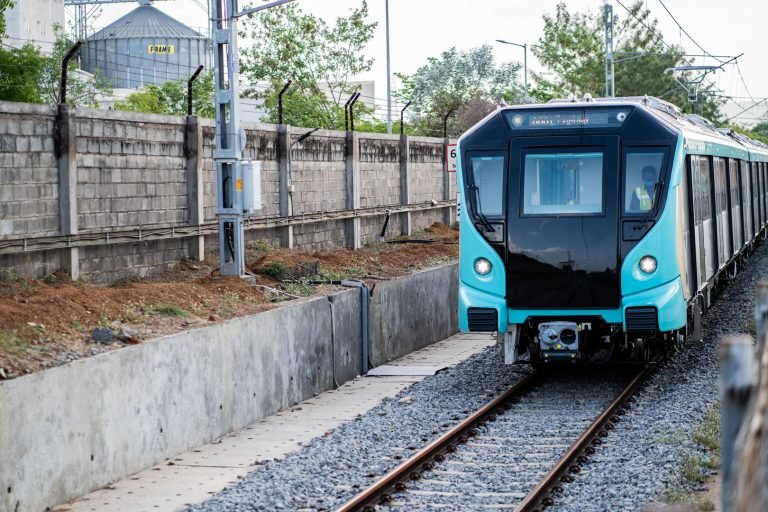
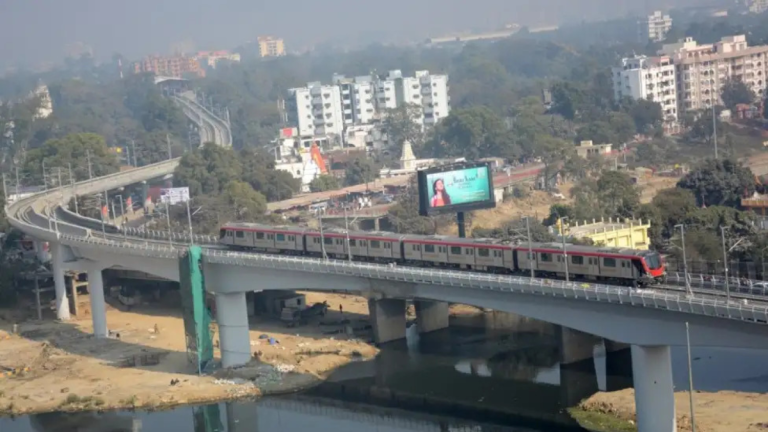
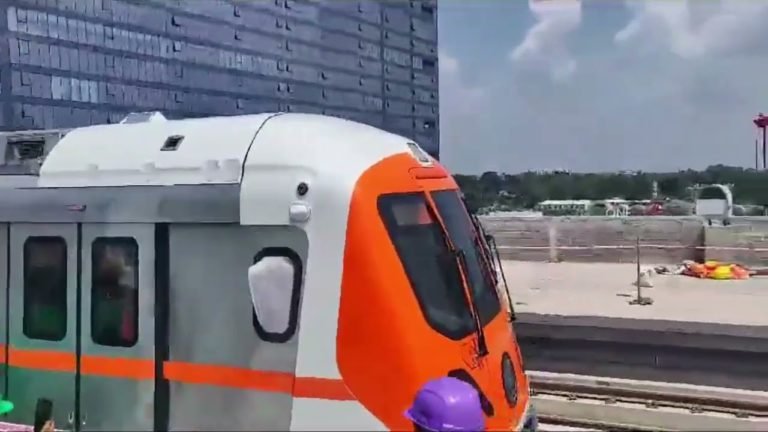
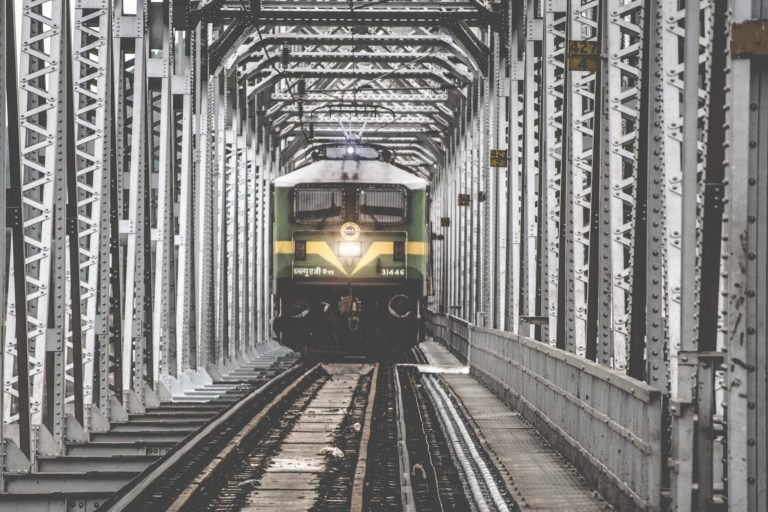
New Delhi: Prime Minister Narendra Modi has flagged-off the Delhi-Faridabad Metro Line that would allow hassle free travel for around two lakh daily commuters between the national capital and the industrial hub in Haryana.
The extension of the Delhi Metro connects Badarpur to Escorts Mujesar in Faridabad.
The total cost of the project from Badarpur to Escorts Mujesar is nearly Rs. 2,500 crore. Out of this, Rs. 1,557 crore was borne by the Haryana Government, the Centre contributed Rs. 537 crore, while the Delhi Metro provided Rs. 400 crore.
All these are elevated and located on either side of the Delhi-Mathura Road (NH-2).
“The nine-station metro corridor which was 95 per cent indigenously built will provide people a safe, affordable, quick, comfortable, reliable, environment-friendly and sustainable transport facility,” a Haryana government spokesperson said.
Haryana Chief Minister ML Khattar, addressing a press conference on Saturday, had thanked the Prime Minister for “gifting” the Metro service which would take the city to “another level of progress” with better connectivity with other NCR towns.
He had also said that the Prime Minister would be announcing the go-ahead for connecting Gurgaon with Faridabad by Metro.
MUMBAI (Metro Rail News): – Mumbai Metro Rail Corporation (MMRC) awarded a contract for In-Building Solutions to provide telecom infrastructure for Metro Line 3. ACES India Pvt Ltd, a subsidiary of Riyadh-based ACES Co., emerged as the winning bidder. It will now ensure uninterrupted mobile and internet connectivity to the commuters on Aqua Line.
Since Mumbai Metro Line 3 is entirely underground, with station concourses at 10-14 m below ground and platforms at 18-20 m below ground, mobile network and internet propagation is a significant challenge. MMRC planned to deploy cellular coverage from mobile service providers such as Jio, Vodafone, Airtel and MTNL to address this issue and ensure mobile and internet access to commuters during the journey. It will be achieved through In-Building Solutions by installing antennas and repeaters within underground stations and tunnels.
ACES India implemented In-Building Solutions at Bangalore Airport and Surat Diamond Bourse. The license fee realised per station is approximately 2.5 times of any other metro line in India.
Ms. Ashwini Bhide, Managing Director, MMRC, remarked, “The non-fare box revenue generated by Metro Line 3 through this initiative is highest in India. This In-Building Solutions initiative will ensure passengers enjoy uninterrupted mobile and internet connectivity while commuting on the underground Metro Line 3.”
Mr R. Ramana, Director (Planning & Real Estate Development/ NFBR), MMRC, expressed his delight at achieving the highest annual premium in the country to date for In-Building Solutions. He believes this endeavour will significantly support Metro Line-3 operations and enhance the commuter experience.
Intrigued by the future of Metro and its impact on our city? Join us at our upcoming InnoMetro event to delve deeper into this vital issue. Stay informed, get involved, and let’s ride the Metro towards a brighter, more sustainable future together.
MUMBAI (Metro rail News): MMRDA has proposed to build the car depot for line 5 at Kasheli. The project has been awarded to Ritwik Projects worth 589,56,02,078/-, the lowest bid received. The project will be built on 27 hectares of land. It will greatly help the maintenance and commissioning of metro lines.
The project includes implementing a ballastless track for the main line and a ballasted track for the depot. Metro Line 5 stretches 24.9 Km, covering Thane, Bhiwandi and Kalyan, which is being developed in 2 phases. The work on the 11.9 Km route between Thane & Bhiwandi is nearly 80% done.
The depot will serve the metro corridors for operations, train parking & repairs, heavy equipment handling & testing, cleaning & periodic inspections. It will have a capacity of parking 30- cars at a time & will be featured with facilities like a stabling yard, a hazard store, a workshop, a test track, etc.
The project is expected to be completed by March 2026.
Intrigued by the future of Metro and its impact on our city? Join us at our upcoming InnoMetro event to delve deeper into this vital issue. Stay informed, get involved, and let’s ride the Metro towards a brighter, more sustainable future together.
BHOPAL (Metro Rail News): In a significant development unfolding in the capital city of Madhya Pradesh, MPMRCL conducted the First Safety Trial Runs of the Bhopal Metro on Tuesday. The trial run was conducted from Subhash Nagar Depot to Rani Kamala Pati Station.
During the trial run, the metro was inhabited by technicians & engineers from MPMRCL & the French rolling stock manufacturer Alstom Transport India. These ultra-modern trains are renowned for their lightweight design and will be helping the commuters to commute from Karond Chauraha to AIIMS easily.
Currently, the priority corridor to be inaugurated by the Chief Minister of MP includes eight stations, namely AIIMS Hospital, Alkapuri, DRM Office, Rani Kamalapati Railway Station, Sargam Talkies, DB Mall, Kendriya School and Subhash Nagar Station.
The Bhopal Metro promises to offer efficient and eco-friendly commutation in the city. The trial run is a testament to the goals mentioned above of the Bhopal metro. Alstom Transport India has manufactured the 3-coach train running on the Bhopal Metro with a passenger seating capacity of 50 & room for 300 standing passengers.
It will transform how people commute in Bhopal and also facilitate the commuters an easy, efficient & eco-friendly commutation.
Intrigued by the future of Metro and its impact on our city? Join us at our upcoming InnoMetro event to delve deeper into this vital issue. Stay informed, get involved, and let’s ride the Metro towards a brighter, more sustainable future together.
MUMBAI (Metro Rail News): RVNL has emerged as the lowest bidder in the contract for the construction of Tunnels with ballastless track, bridges & track linking on the Dharakhoh-Maramjhiri section of the central railways worth 811 crores.
The construction will be executed from 831.8 to 841.9 Km in connection with the 3rd line of the Dharakhoh-Maramjhiri section. It involves:
4 Tunnels for a total length of 1.6 km (s)
Ballastless track
Earthwork formation
Track lining
Side Drain retaining wall
The time period for the execution of the order is 18 months, while the exact amount of the tender is Rs. 311,17,66,199.68/-.
Intrigued by the future of Metro and its impact on our city? Join us at our upcoming InnoMetro event to delve deeper into this vital issue. Stay informed, get involved, and let’s ride the Metro towards a brighter, more sustainable future together.
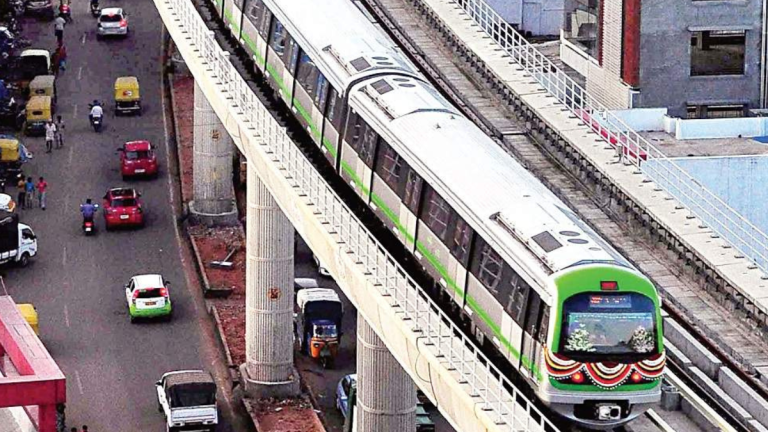
BANGALORE (Metro Rail News): The long-awaited Pink Line of the Bengaluru Metro has entered its final work phase, with nearly 85% of the tunnelling work already completed. Out of 20.991 Km of the Tunnelling target, 17.93 Kms have already been achieved.
The 21.26 Km-long Pink line of the Bengaluru metro has a 13.76 Km Underground section & a 7.5 Km elevated section. It has a total of 18 stations, including 12 underground. BMRCL hopes to complete all civil & track-laying works on the Pink Line by the second half of 2024.
Out of the Underground stations, the work is completed by more than 50% at stations like Langford Town, Shivaji Nagar, Cantonment & Pottery Town, Tannery Road, Venkateshpura, and Nagavara. In comparison, it still lies below 50% at Lakkasandra metro station.
Currently, 3 TBMs, namely Rudra, Tunga, and Bhadra, are active and have already tunnelled about 1,911 meters out of 3,090 meters. Approximately 40% of the tunnelling work remaining to be done by these TBMs, which will be completed by March next year.
Intrigued by the future of Metro and its impact on our city? Join us at our upcoming InnoMetro event to delve deeper into this vital issue. Stay informed, get involved, and let’s ride the Metro towards a brighter, more sustainable future together.
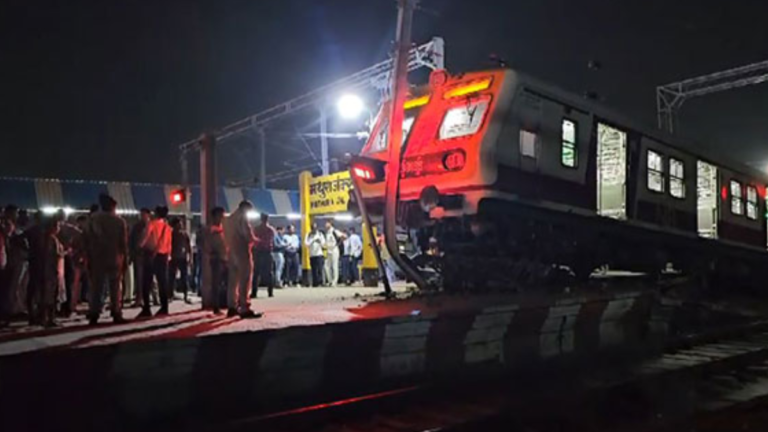
MATHURA (Metro Rail News): A train accident unfolded on Tuesday with an Electronic Multiple Unit (EMU) train suddenly climbing the platform at the Mathura Junction.
It created chaos at the Mathura Junction, leaving all the riders in tension & stress. The incident occurred after all the passengers had alighted the train, allowing for no casualty to be reported.
“This train comes from Shakur Basti. The train arrived at 10:49 p.m. All passengers had deboarded the train. Suddenly, the train climbed the platform. We are investigating the cause of this incident,” SK Srivastava, Director at Mathura Station, told ANI.
An investigation regarding the cause of the accident is underway. The incident also delayed a few trains, but no casualty has been reported.
Intrigued by the future of Metro and its impact on our city? Join us at our upcoming event, InnoMetro, to delve deeper into this vital issue. Stay informed, get involved, and let’s ride the Metro towards a brighter, more sustainable future together
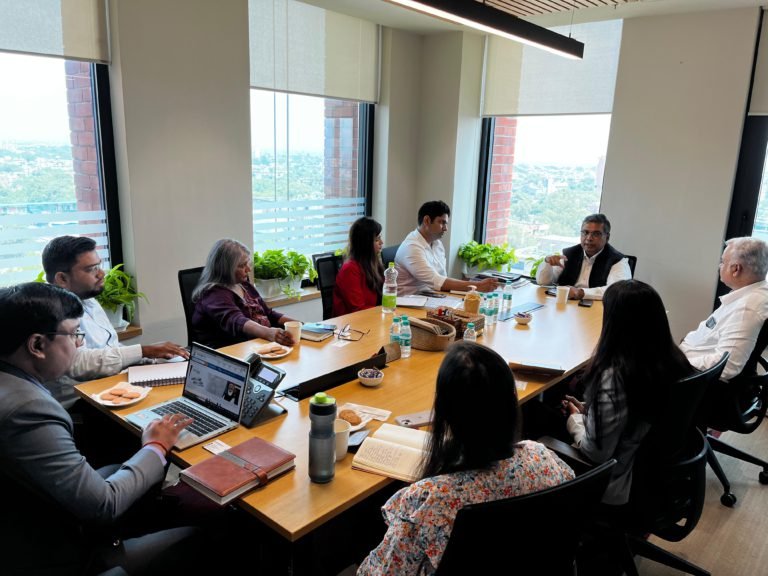
Metro Rail News Managing Editor Narendra Shah recently participated in a closed-door media round-table conference organised by Bentley Systems at their New Delhi office in Okhla Phase III on August 23, 2023. The event was organised by the renowned global infrastructure engineering software company and aimed at sharing critical information regarding its work in India, the various R&D and innovation activities being carried out, and insights regarding upscale and incorporation of the latest technologies in Indian engineering and construction space with an elaborative description on the different ways Bentley Systems has been supporting the government, private and public sector undertakings with their software applications.
The conference, which included Mr. Kaushik Chakraborty (Sr. VP, Bentley Systems, Asia-Pacific region) and Mr. Kamalakannan Thiruvadi (Regional Executive, South Asia, Bentley Systems) as key speakers along with other representatives of the company, also focused on deliverables as how the application by Bentley Systems supports various organisations across the areas of design, analysis, construction, handover, operations, maintenance of infrastructure, complex engineering solutions, 3D and live designing, etc. Several other media representatives and transport journalists also participated in the meeting.
Our Managing Editor Mr Narendra Shah felicitates Mr. Kaushik Chakraborty with the August issue of our monthly magazine
The following is a synthesis and quick overview of the considerate discussion, including specifics on answers to some of the critical issues raised and insights provided by Bentley officials.
Q. How would you better define the working principles of technologies like BIM, Digital Twin, and iTwin, which you have pioneered? What are the latest trends and developments in the used applications?
Ans: Engineers have been designing and building structures for thousands of years. Most of us know that no engineer does anything significantly different, but in what ways and how much the task differs is what matters the most and where the boundary lies. So, I would say that the real change is how things are executed today. We can appropriately say that we live in an era based on data. The engineering world and the age today are data-centric. Access to data today is easier than it was ever before. We have all the means to access data. So, data collection and, consequently, the research based on that data has become quite accessible in modern times. The data-centric – research-based approach, which is the foundation of most of the techniques and methodologies used in the engineering world in modern times, like BIM, Digital Twin, and iTwin, which used to be a relatively tricky task earlier, has become quite convenient these days. This is all because of data and easy access to data.
So, speaking about the latest trends and developments in technologies like BIM, iTwin, and Digital Twin, we can say that these technologies have revolutionised the construction, engineering, and infrastructure space and are evolving continuously. The data-centric technologies are helping engineers with an array of insights. It is not only helping to reduce costs and make constructions and accomplish projects in an efficient and timely manner, but it is also helping in problem-solving and fault detection in the best possible way, creating greater scope for optimum utilisation of resources. Applications like Digital Twin, therefore, are generally stated to be nothing but all engineering information contextually and collaboratively integrated with the IT information and operations information, which is a live model. It’s essentially a live model of a structure, a design, or a concept being worked upon to achieve a desired goal.
Digital Twin, iTwin, and BIM technologies bring a sense of consequence management through the perpetuation of digital information. Using the technology and the applications, everything is collaboratively looked at through the life cycle of a project. For instance, let us suppose that a live 3D model had been created for a project, but, for some reason, its 2D version is used on the ground. So, considering the project’s relevance, it is necessary that the information related to the project is updated and data is kept alive. So, no matter when the data is handed over to the operations team, they can know what the original design was. Accordingly, they can make the desired changes, keeping the project relevant if required. Therefore, the data initially remains the same, but its usage with the technology and application changes. This is what an updated model, the basic principle and working management of modern technologies, is all about.
Regarding the latest trends and development, I would say it is immense. There’s hardly any field today where these technologies are not used. Digital technologies are creating some of the most prominent impacts, including those in the water sector. Real good remodelling for the projects is being observed today. The most excellent things also seen today are not just the better design but better execution of the project in terms of cost and efficiency. The technologies are also helping reduce power and affecting health care in urban areas. So, in many cases, it is also making good societal impacts.
Q. How do you envisage the concept of Smart Societies? What, in your opinion, shall be the circumferential space of intelligent technologies like AI, Cloud Computing, Digital Twin, iTwin, etc. in Society 5.0? How would you rate the upcoming scenario for humanity and humankind?
Ans: I think technology can help make our lives better. What makes our life better is better housing, better transportation networks, lesser air pollution, more resilience as cities or wherever we live to climate change, lower noise pollution, continuous water and power supply, etc. So, these things are supposed to make our lives better. The quality of life, in my opinion, depends on all these essential things. If we notice the last few years in India, considerable changes and improvements in infrastructure across different sectors can be observed, which can be stated to have impacted our lives. Therefore, it goes beyond denial that with the improvement of the infrastructure, many parts of our lives also benefit in multiple ways.
With cities improving on various indicators that impact human life with the aid of technology, we can say that we are integrating and approaching a concept like Smart Society or Society 5.0. But the important to know is where to stop. Hence, one should know the borderline and where and when to stop. This is important because only a humanitarian point of view can prevent us from the harmful effects of technologies like all innovations in the testing or experimental stage in our consciousness. We can never ascertain or envisage the impact of technology. Going back dates and seeing the number of technologies being introduced, we’ll find that humankind depends or relies on its existence on some of the technologies or sciences invented centuries back. Yes, of course, there are several others which, although meant for our ease and comfort, are definitely on the premise of discussing their impact on human life. We can’t say that for these reasons, society would stop progressing.
Although we heavily rely on intelligent technologies like AI, Cloud Computing, Digital Twin, and iTwin today that will shape our future, it shall always be the humans who use this technology. Unless we allow technologies to overpower or invade us, technologies can do no harm to us. This should be very clear to each of us from a humanitarian perspective. For construction, for example, in Bentley Solutions, we firmly believe that the goal of technology is always to reduce the overall time, effort, and cost of construction. So, to make it more resilient in cities as Bentley technologies, our goal is to help our user base and customers design, build and operate better infrastructure. Everything we do is to help them accomplish the same.
Of course, technology like AI should never replace the insights of a human being. But it should, as we discussed, help us make better decisions. So I think that’s the impact on society, as how we can help create better and modern infrastructure which creates a better life for all of us so that we have better health facilities, greater prosperity, more happiness, and an environment where we can live which is safe, less polluted. We have good access to whatever transportation networks we need. This is how I would like to put my ideas for the question.
Q. Digital Twin and iTwin are modern technologies requiring enhanced skills to operate. How do you ensure the augmentation of skills and their availability to the stakeholders and those to whom you render your services to?
Ans: We would like to discuss this more from a Bentley perspective. Bentley has a program called the Bentley Academic Program. We provide access to Bentley tools, free of cost, to all the AICTE-approved engineering colleges or deemed universities. Many of our modules are taught in the colleges as part of the curriculum. That is where the students get trained with options for certifications, ET criteria, and everything else we sponsor. We also provide access to the software free of cost. We conduct training for famous programs to select universities and even work with some of the universities on selected projects. We also provide these universities with various types of support in different areas once a candidate graduates and joins an organisation. Tying up with our leading customers who look for Bentley-certified or trained professionals, we are also helping students when they join an organisation. This way, we help create a pool of trained professionals familiar with Bentley software and applications.
The second thing is about how we look at continuous enablement. For example, new and adjacent technologies may be added to the original set of applications. For example, there can be a new set of tools or applications that are required to be added to an existing project, etc. Hence, as a part of customer engagement, we offer these training programs. So, Bentley works in multiple facets. One, of course, is working with the universities and colleges and then providing interim training programs to the customers with a project-led initiative being accomplished, a continuous activity that continues with corporations and government organisations.
Regarding the requirement of licenses for these activities to be carried out, we would like to convey that as long as it is being used for education and training purposes, it will be free. Likewise, for students who are trained on our software, we help and place them for internships. In this context, we work with our customers. For example, if there is a project that aims at a particular set of tasks with plans for new recruits and freshers, we would like to state that we work with these interns as a bridge between the industry-academia collaboration. In this way, we also facilitate augmenting the skills required by our stakeholders to whom we render our services. The Bentley academic team is helping them identify the correct set of people.
Q. What is Bentley doing to create more affordable licensing models of software? What is the approach to developing technologies? Is it as per R&D specifics and structure or the client’s requirements?
Ans: We have not made a conscious decision like most of our competitors have done regarding moving from perpetual licensing to pure subscription. Bentley believes in giving customers choices. We have CapEx-based acquisition models because many governments worldwide still prefer that. Bentley has extensive subscription models. We have our subscription models for small, single users. We have an enterprise-based subscription model, which is purely usage-based. Users need to pay charges for the number of days they use the product and don’t need to pay the amount for full-year subscription charges or fees. Today, in India, many engineering companies use our subscription models.
We have seen a significant shift towards e-commerce and our e-store in recent years. We would say that the success of our e-store, a virtuosity store, in India is amongst the three most successful markets in the world today. Therefore, what we can do is make it affordable and easily accessible to many customers who don’t want the pain of interacting with so many companies and products. As we have accomplished that, we have also extended and reinforced our reseller network and given them the tools.
India has a robust digital economy willing to make online purchases and buy online. Home shopping has also evolved significantly in the nation. Therefore, we see a much higher move, especially in India, where the rate of change from perpetual subscription has been phenomenal. Many customers still prefer to buy products based on online surveying, providing options for the best possible capital expenditure. It is well known that the advantage of having a web-based mechanism is that one can create excellent control over the cost. One can have offers, season benefits, or options for mixed packages with multiple choices. We have recently moved towards a different digital model where we plan to bring facilities and features like what Amazon has. For instance, if somebody is looking to buy a structural analysis package, there would be choices and recommendations for real-time bundling capabilities or other features related to road-to-highway design software, bridge design applications, etc.
Another thing to mention is that Bentley has kept and perpetuated the same data model that we had more than thirty years back. We have not changed our data format for 35-plus years. So, users associated with Bentley can go back to designs created twenty-five years ago. Further, we don’t force upgrades of product versions based on changing the file format. And our file format is an open-file standard. In engineering, nobody uses one product. GIS is locked to one vendor. But in engineering, we usually find at least ten plus projects and several software being used on that project. So, we can’t avoid being interoperable. Otherwise, the project will not be accomplished; it will be carried out in a multi-discipline approach.
Regarding spending on and building a technology per client’s need or our R&D structure, we want to say that it’s both. One is user-based. The other is driving technology forward from an innovation. Many of our advances on the Digital Twin and iTwin platforms have not been driven by any parent or source organisation. It had been a vision developed by the Bentley management team to create a platform that is vendor agnostic, open, scalable, and everything that helps to use any Bentley offering. So, regarding the applicability of the tools, we would like to convey that we try to be a very open, user-friendly, and supportive engineering software company.
So, whether one designs any component or a product using Bentley software or does it using any of our competitor’s applications, it hardly matters to us. We are vendor-agnostic in that respect. Any platform that connects disciplines, companies, and projects cannot be tied to one vendor, and multiple options are open. Bentley does this, and this is how we are developing technologies.
The second thing we have done is fully embrace the cloud technology because we want to create an auto-scale computing facility. That means if somebody creates a system today where three people want to use something versus three thousand, One doesn’t need to rely on hardware. The cloud technology should be able to give it in all. Therefore, we are also making sure that we are very local in our cloud-enabled technologies, which gives us an edge.
Q. What message would you share with Metro Rail News readers and your comments on our publication?
Ans: For the readers of Metro Rail News, I would like to say that the metro revolution, which started a few years back in India, is helping its citizens in many ways. What I think is encouraging is how innovations are being done today, how fast metro projects are being designed and executed and how construction of these projects is being done using technology and various applications. It is undoubtedly to learn something and feel proud.
So, as a reader, I would like to get all this information on the metro and rail industry today, which is very inspiring. I acknowledge your efforts for being development-oriented and helping people know the latest technologies, helping the metro and rail industry. Today, we see a very active usage of digital information and data-centric decision-making in India’s metro and rail industry, which is also one of the core principles of Bentley’s future thinking and product development strategy. Through your esteemed publication and your readers, I would like to convey that we hope that as the industry matures and progresses, we can support the metro revolution in India more effectively with tools that are very relevant to the Indian market. We are excited to look forward to many enhancements in the metro network in the coming years.
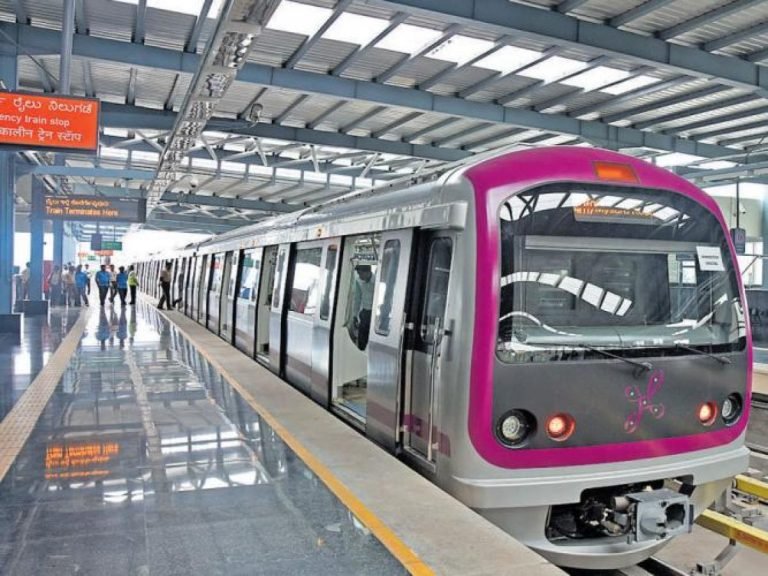
BANGALORE (Metro Rail News): TheKR Pura-Byappanhahalli stretch of the Bangalore metro got clearance from CMRS, this Monday. It’s gonna provide seamless connectivity to the people, especially to Whitefield.
As per BMRCL estimates, this would increase the footfall from 50,00-60,000 as the line becomes operational. Once both the sections, namely, KR Pura-Baiyappanhali & Kengri-Challaghatta, are opened, the 44Km-long Purple Line will become fully operational, providing easy & efficient commutation between Whitefield & Challaghatta.
Intrigued by the future of Metro and its impact on our city? Join us at our upcoming event, InnoMetro, to delve deeper into this vital issue. Stay informed, get involved, and let’s ride the Metro towards a brighter, more sustainable future together.
BANGALORE (Metro Rail News): A panel comprising members from FICCI as well as the state government of Karnataka has proposed three new corridors in the Bengaluru Metro, namely:
Old Airport Road: MG Road to Hope Farm
Old Madras Road: KR Puram to Hoskote
Inner Ring Road loop (Yeshwantpur, Cantonment, Indiranagar, Koramangala, Ashoka Pillar and Mahalakshmi Layout).
It aims to provide metro connectivity & accessibility to all the people residing in Bangalore by a fixed time.
The proposal also includes increased connectivity of the railway networks in the nearby cities & locations of Bangalore. The total extension of the railway line adds up to 452 Kms for cities nearby Bangalore.
Intrigued by the future of Metro and its impact on our city? Join us at our upcoming InnoMetro event to delve deeper into this vital issue. Stay informed, get involved, and let’s ride the Metro towards a brighter, more sustainable future together.
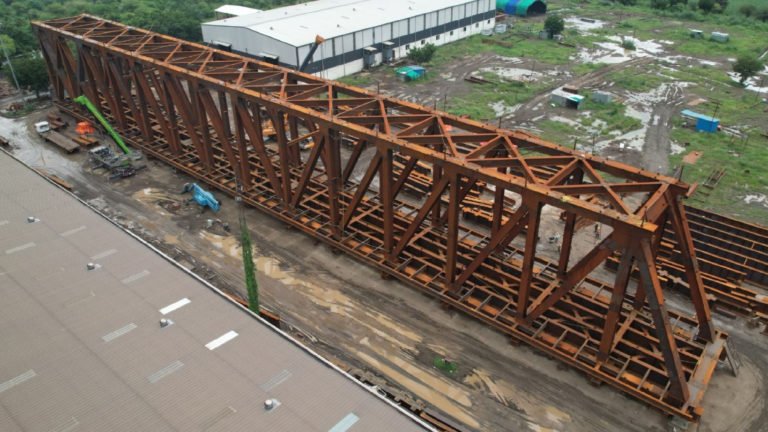
MUMBAI (Metro Rail News): A 130-m long, India’s longest indigenously-built, open web girder completes its trial installation at the Zetwerk’s facility in Narayanapur, just south of Wardha in Maharastra.
Zetwerk is the subcontracting company of L&-IHI Infrastructure Systems that has built the 130-m Long gorder for the MAHSR Project. The girder stands 21 metres tall & 13 meters wide. It is the longest girder to be fabricated in India, with a dedicated team of 250 people.
NHSRCL has awarded L&T-IHI Infrastructure Systems the MAHSR Bullet Trian Project Package P4X & Y. The contract includes transporting 28 steel Truss amounting to an estimated 70865 MT of Steel.
L&T-IHI Infrastructure Systems subcontracted Zetwerk for 10,000 MT of fabricated Girders with a contract value of 126.5 crore. The exact launch location of the girder remains unknown.
Intrigued by the future of Metro and its impact on our city? Join us at our upcoming InnoMetro event to delve deeper into this vital issue. Stay informed, get involved, and let’s ride the Metro towards a brighter, more sustainable future together.