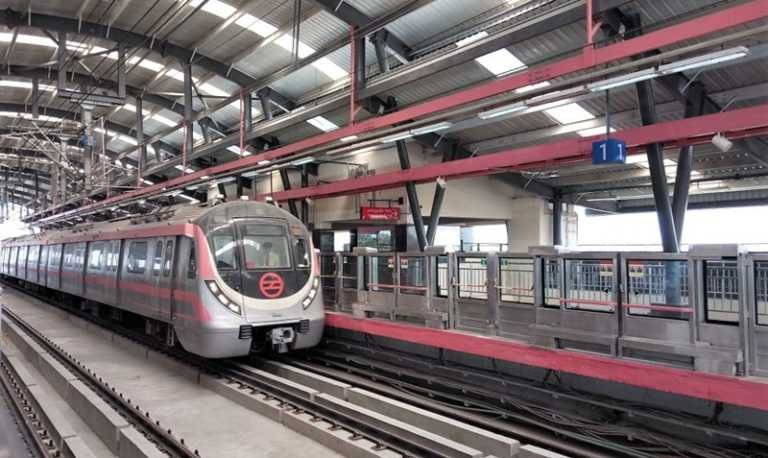
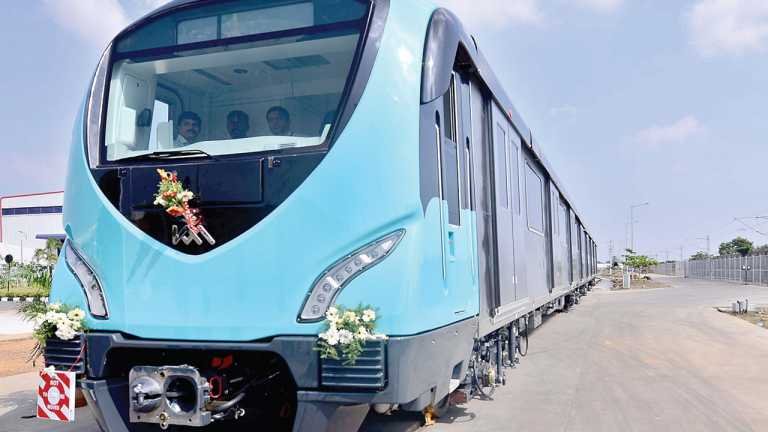
New Delhi: Prime Minister Narendra Modi has flagged-off the Delhi-Faridabad Metro Line that would allow hassle free travel for around two lakh daily commuters between the national capital and the industrial hub in Haryana.
The extension of the Delhi Metro connects Badarpur to Escorts Mujesar in Faridabad.
The total cost of the project from Badarpur to Escorts Mujesar is nearly Rs. 2,500 crore. Out of this, Rs. 1,557 crore was borne by the Haryana Government, the Centre contributed Rs. 537 crore, while the Delhi Metro provided Rs. 400 crore.
All these are elevated and located on either side of the Delhi-Mathura Road (NH-2).
“The nine-station metro corridor which was 95 per cent indigenously built will provide people a safe, affordable, quick, comfortable, reliable, environment-friendly and sustainable transport facility,” a Haryana government spokesperson said.
Haryana Chief Minister ML Khattar, addressing a press conference on Saturday, had thanked the Prime Minister for “gifting” the Metro service which would take the city to “another level of progress” with better connectivity with other NCR towns.
He had also said that the Prime Minister would be announcing the go-ahead for connecting Gurgaon with Faridabad by Metro.
New six coach metro train in Salt Lake depot of Kolkata Metro (Photo: KMRC)
Kolkata: In Kolkata Metro two stretches i.e., from Monipore to Esplanade in the Jocka Esplanade alignment and from the airport to new Barrackpore of the Noapara-Barasat route are in the limbo and this is because the material modification is still not approved by the railway board.
A chief wrote to the board that the state has cleared all the roadblock so they expedite the process.
In railways Jagron “material modification” mainly refers to the project in which without the planning commission’s approval the railway ministers through an executive order sanctioned through rail budget.
In the letter addressed to the chairman of the railway board the chief secretary has urged him to improve the changes that has been agreed upon by both the executing agency and the board, saying no construction could be undertake because the modification had not been approved.
On Airport- Barasat stretch they planned to have an elevated track from Nopara to Barasat. But the safety norms of the Airport Authority of India (AAI) do not allow for constructing any high structure along with flight path, so now the tracks will be underground.
But this plan change requires a railway board sanction for the cost escalation.
5 km stretch from the airport. No encroachment is there on this stretch. A senior state government officer said that the metro railway has estimated the cost after some alterations to the plan and sent it to the railway board for approval.
In the original plan, there had been two stations on the stretch i.e., Birati and New Barrackope. But now an additional station is also being planned. And in the revived project Michael Nagar is a station that has been proposed.
Chennai Metro/ Image for representation purpose only
Chennai: Commuters in Chennai will soon travel with ease if they are using public transport facilities. A single card travel system is likely to be introduced by the end of 2018. Using this card, commuters can hitch a ride in Chennai Metro and then take the MTC bus to reach their destination and vice-versa. If things go well this single smart card can be used for commuting via any public transport in the city.
Common Mobility Card: One card for many benefits (Photo: NPCI)
All that commuters have to do is tap the card and travel hassle-free. According to Chennai Metro officials, the testing of single smart card is on for two modes of transport. The common mobility card or smart card will be introduced by the end of the year post the testing phase.
A Chennai Metro Rail Limited (CMRL) official has confirmed that they have tested the smart card at MTC’s electronic ticketing machines as well as metro rail stations in the city. If all goes well during the testing phase, the officials would be introducing this facility for the public by the end of this year.
In order to test the card’s usability, CMRL have upgraded their software and hardware IT infrastructure to check the compatibility of card.
Pankaj Kumar Bansal, managing director of CMRL had communicated in November 2017 that the smart card trials have been initiated and they were working along with MTC to launch them soon.
MTC conductors already have hardware at the electronic ticketing machines. All that is needed at their end is to upgrade the software to make the system compatible with that used by CMRL at various metro stations.
PWC Davidar, the state transport secretary has said that this is the just phase of one – connecting one smart card with metro and MTC. In future single smart card will be used across all state-transport facilities. Davidar also added that a lot needs to be done to set up a secured technology interface before the ambitious plan is put to action.
How will smart card make travel seamless?
The smart card will have a magnetic strip containing all data regarding station codes as well as amount recharged or added. When the card will be swiped or placed at automatic fare collection (AFC) fate while entering the station, the code will be encrypted in the card itself. When one will exit and swipe the card at AFC gate, the machine will automatically calculate the fare based on the distance travelled. The amount will be deducted from the money deposited in the card. Same process will be followed at MTC Bus station as well as metro station parking lots.
DMRC planned to procure electric buses to provide last mile connectivity to metro users
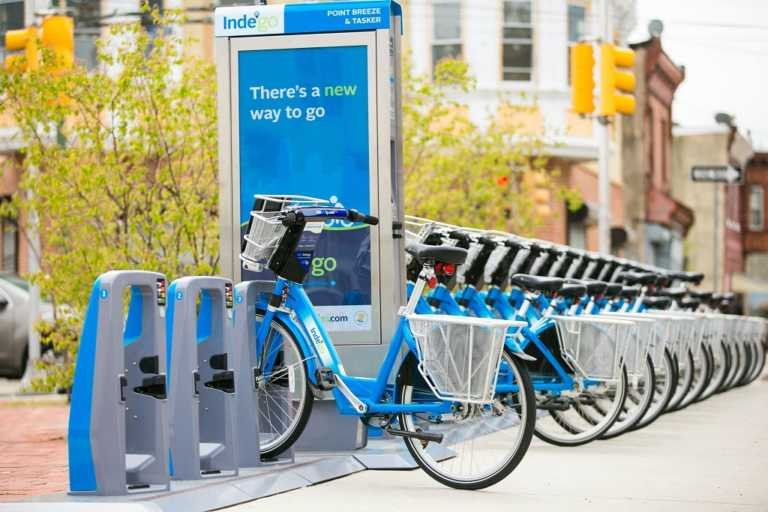
New Delhi: The Delhi Metro Rail Corporation Ltd. (DMRC) has a metro route network of 288 kms with 208 metro stations. Last mile connectivity is a critical component for provision of an effective integrated public transport. It is essentially required to promote the use of public transport and to provide speedy & easy access to metro stations and to transit point / destination. With this objective, Delhi Metro Rail Corporation Ltd (DMRC), at the behest of STA, GNCTD, has been providing feeder services to & fro metro stations. Various last mile connectivity modes includes feeder buses, e-rickshaws, cycle sharing services, etc. In order to provide further comfort to the passengers and to simultaneously contribute to the environment, DMRC is planning to introduce Air Conditioned CNG and Electric bus services on feeder routes.
In order to facilitate the passenger for last mile connectivity, DMRC intends to provide feeder services under West cluster by way of Air Conditioned Electric buses. In this regard bids are solicited from interested Applicants who shall be responsible to procure 99 (Ninety Nine) Battery Operated Electric,7-8 Meters length, 16-22 seaters, low floor, Air Conditioned buses to Operate & Maintain the same.
For the purpose, Delhi Metro Rail Corporation Ltd. (DMRC) floats this open e-Tender to select a bidder, who would be entrusted with the following tasks: –
To procure, operate & maintain 198 (One Hundred Ninety Eight), low floor, Air-Conditioned Electric Buses.
To procure, install, commission, operate & maintain battery charging Infrastructure for these 198 Air-Conditioned Battery Operated Buses in the depot
To develop bus depot infrastructure for repair and maintenance of buses on land/plot
provided by DMRC at Nangloi, Shadipur, Punjabi Bagh East, Mohan Estate and INA.
To procure, install, commission, operate & maintain auto bus washing/ cleaning plant and requisite tools, equipment, machinery for repair and maintenance of buses in depot provided by DMRC at Nangloi, Shadipur, Punjabi Bagh East, Mohan Estate and INA.
Key points of the Tender Notice No. DMRC/Operations/FBS-02/2018
Schedule of work: Provision of Feeder Services under West Cluster for last mile connectivity with procurement, operation and maintenance of 16-22 seater low floor AC Electric (Battery Operated) Buses.
Tender Notice No. DMRC/Operations/FBS-02/2018: NIT, for the work: Provision
of Feeder Services under West Cluster for last mile connectivity with procurement, operation and maintenance of 16-22 seater low floor AC Electric(Battery Operated) Buses.
Approximate Cost of work: Rs.588.65 Crores
Amount of Tender Security: Rs.5.88 Crores
Period of work: 10 Years from commencement date of services
Tender Document on sale: From 15.06.2018 to 23.07.2018 (upto 15:00 hrs) on e-tendering website https://eprocure.gov.in/eprocure/app.
Cost of Tender Documents: Rs.23600.00 (Non-refundable)
Pre-bid Meeting: 05.07.2018 at 11:00 hrs
Date and time of submission of Tender online: Between 13.07.2018 from 11:00 hrs
and 23.07.2018 up to 15:00 hrs
Date & Time of opening of Tender (Technical Bid): 24.07.2018 at 15:00 hrs. Financial Bid will be opened later.
Key points of the Tender Notice No. DMRC/Operations/FBS-06/2018
Schedule of work: Provision of Feeder Services under South Cluster for last mile connectivity with procurement, operation and maintenance of 16-22 seater low floor AC Electric (Battery Operated) Buses.
Tender Notice No. DMRC/Operations/FBS-06/2018: NIT, for the work: Provision
of Feeder Services under South Cluster for last mile connectivity with procurement, operation and maintenance of 16-22 seater low floor AC Electric(Battery Operated) Buses.
Approximate Cost of work: Rs.569.90 Crores
Amount of Tender Security: Rs.5.69 Crores
Period of work: 10 Years from commencement date of services
Tender Document on sale: From 15.06.2018 to 24.07.2018 (upto 15:00 hrs) on e-tendering website https://eprocure.gov.in/eprocure/app.
Cost of Tender Documents: Rs.23600.00 (Non-refundable)
Pre-bid Meeting: 05.07.2018 at 11:00 hrs
Date and time of submission of Tender online: Between 13.07.2018 from 11:00 hrs
and 24.07.2018 up to 15:00 hrs
Date & Time of opening of Tender (Technical Bid): 25.07.2018 at 15:00 hrs. Financial Bid will be opened later.
Authority and place for submission of tender cost & Tender Security (EMD), seeking clarifications on tender documents and pre-bid meeting is CGM/Contracts, Delhi Metro Rail Corporation Ltd., 5th Floor, A-Wing, Metro Bhawan, Fire Brigade Lane, Barakhamba Road, New Delhi –110001 (Tel : 011-23415838)
Delhi Metro becomes the world’s seventh busiest metro rail network
New Delhi: The Delhi Metro Rail Corporation (DMRC) added new features to it’s app in tandem with new corridor. The app serves an all-encompassing guide on your fingertips, information about routes, tourist place in Delhi.
DMRC app in anroid mobile phone.(Source: techotv)
The app will be beneficial for those who are visiting Delhi for the first time as the app have all the details about all six lines that are currently functional, 250 stations and interchanging points. Commuters will be able to plan their travels using the app with the trip planner feature that will show which Metro to board, where to change and time to reach a station. It also facilitates smart card users who can recharge their metro cards using the app.
“The Metro now runs through 390 kilometers, having 250 stations on its route. It is difficult to remember all the routes with so much of expansion going. Hence, we have updated the app, bringing everything on fingertips,” said a senior Metro official.
The best feature added to the app is providing information to the commuters about the nearest metro station, with this people can easily find nearest metro station closest to their location within 4.5kms. The app also has details of historical places, famous tourist destinations, shopping centers in Delhi, acting as a tourist guide for the user.
The DMRC is planning to bring in a list of restaurants, hotels etc in it’s next update. The app is available on the website of the rail corporation and Google Play and Apple store.
The DMRC, recently, introduced the Janakpuri West to Kalkaji Mandir section of the Magenta line, which is the longest stretch opened so far in Metro’s Phase 3. The 24.82 km long section has 16 stations, including interchange point at Hauz Khas (with Yellow Line) and Janakpuri West (with Blue Line) and is part of the Magenta Line from Janakpuri West to Botanical Garden. buy clomiphene online https://www.parkviewortho.com/wp-content/languages/new/prescription/clomiphene.html no prescription
MUMBAI: Getting worse for the country’s monorail. Monorail services are suspended since the November last year. Operation of the 19.5 km corridor has been decided to pull out from the operations says Malaysian- based firm Scomi engineering. However the Mumbai metropolitan region development authority (MMRDA) said that the company cannot take any decision unilaterally. After the rake got fire in November last year the two were suspended on the 8.9 km stretch from Chembur to Wadala (Phase 1).The Phase 2 (from Wadala- Jacob circle) is not in operation yet. The 15 deadlines are missed by the 10.6 km.
The pulling out from the operations was conveyed by the consortium but they cannot do so unilaterally.
The additional metropolitan commissioner of Mumbai metropolitan region development authority (MMRDA) Sanjay Khandore says that “first they have to commission the entire corridor and acquire spare parts required for rakes”
A tussle between Scomi and MMRDA has been going on for sometime now says the senior MMRDA official. He also says that Scomi argued that it could withdrawn from operations as it had completed three years after comisioning of monorail.
Officials also says that “It is a matter of interpretation. In February 2014 the phase 1 was commissioned. But the entire project is still not commissioned. It is still responsible for commissioning the phase 2 project they cannot leave work mid-way.”
“It is a matter of interpretation. In February 2014 the phase 1 was commissioned. But the entire project is still not commissioned. It is still responsible for commissioning the phase 2 project they cannot leave work mid-way” says the Mumbai metro senior officer.
In this time the Mumbai metropolitan region development authority (MMRDA) has started the process to appoint an agency for the operation and management (O&M) of the monorail once the phase 2 becomes operational the agency is expected to take over. The Mumbai rail vikas corporation on (MRVC) has been asked to check if the latter can operate the monorail corridor.
Mumbai: The protest over building metro car shed at Aarey colony is slowing down Mumbai metro work. Residents and activists continue to protest construction of metro car shed in the locality. In what seems like some relief, Bombay High Court has reserved orders. Maharashtra government has communicated to the court that it has followed all statutory and environmental rules before starting construction work. buy tadasiva online https://nouvita.co.uk/wp-content/themes/twentynineteen/fonts/en/tadasiva.html no prescription
All due consonance was taken prior to the work.
The land under dispute is the part of the green belt of suburban Goregaon. Metro car shed is proposed at Aarey colony, the shed is part of the Mumbai Metro rail project.
Ashutosh Kumbhakoni , the advocate general representing Maharashtra government told the communicated to the bench of justices S C Dharmadhikari and P D Naik that contrary to the allegations, the site of the proposed car-shed was not part of any Ecologically Sensitive Zone (ESZ) or reserved forest area.
The state government law officer also stated that the project was vetted by the state assembly. Car shed is not a bus stop that can be relocated or shifted as an when required, stated the legal team of government.
The law officer also added that the car shed project is well researched and thought about plan and it needs to be aligned with the metro rail tracks. The location has been fixed after several considerations. The advocate general shared that the construction work was approved with all statutory and environmental rules.
The petition is filed by Zoru Bhatena and others alleging that the Maharashtra government had illegally tailored the draft Development Plan 2034 for Mumbai to show what was formerly a green zone as that reserved for a car shed for the metro rail development. Kumbhakoni was responding to the petition filed by the social activist.
In what is seem like a relief the bench has reserved its judgement on the plea.
The 25 hectares land allocated for metro car shed under controversy is located the Aarey Milk Colony. This land has been allocated for setting up car shed and other allied services – part of the Mumbai Metro III (Colaba-Bandra-SEEPZ) line.
The petitioners have claimed that previously, the said plot was reserved as a ‘no development zone’ and that any construction in the area is likely to demolish extensive green cover and lead to an ecological dent.
Both Kumbhakoni, and senior advocate Aspi Chinoy, who appeared for the Mumbai Metro Rail Corp (MMRC), told the HC that while Aarey is in the neighbourhood of the Sanjay Gandhi National Park and is ecologically rich, it has certainly not been officially marked as no development zone or an ESZ.
The bench has said that the metro project is meant for public welfare but it is causing problem to commuters commuting in that area. The judges said that this bench will decide whether or not any ecological rules were flouted while allotting the said land for the car shed project.
India celebrate 86th Birthday of Metro Man on 12 june
Apart from Delhi, in some other cities of the country, Metro is also making people’s life easier at their own pace. The speed of the metro has not only reduced the distances but also provided a very comfortable way of transportation to the people. E. Sreedharan, who is known as Metro Man, played a key role in bringing this revolution in the country as a metro. He was born on June 12, 1932. Let’s know today we find some interesting things related to them …
Biography | Early Life
E. Sreedharan was born on 12 June 1932 Kerala in Palakkad district.His early education took place from Palakkad’s Basel Evangelical Mission Higher Secondary School. He studied college from the Victoria College in Palghat. Education of Civil Engineering from Government Engineering College Kakinada district of Andhra Pradesh.
After completing engineering studies, Metro Man taught at ‘Government Polytechnic’ in Kozhikode. There he used to teach civil engineering subjects. After this he worked as a trainee in the Bombay Port Trust. In 1953, he passed the Indian Engineering Service (IES) examination and in December 1954 he was appointed as the Probationary Assistant Engineer in South Railway.
Contribution In Metro And Railway Industries
Kolkata Metro: The responsibility of planning, design and implementation of the country’s first Metro Kolkata Metro was entrusted to them. In 1970, he laid the foundations of the country’s first metro in Kolkata. He was removed from the Kolkata metro rail project in 1975.
Cochin Shipyard: In October 1979, Sreedharan joined the Cochin Shipyard. The performance of the Cochin Shipyard was quite bad at that time which got the benefit of Metro Man’s experience, efficiency and discipline. E. Shridharan rejuvenated the Cochin Shipyard. In 1981, the first ship of the Cochin Shipyard was ‘MV Rani Padmini’ in which he had a big role. It is worth mentioning that the construction project of MV Rani Padmini was hanging in the Cochin Shipyard for a long time, which got momentum when E. Shridharan joined the Cochin Shipyard.
Konkan Railway: In July 1987, he was made General Manager in Western Railway and in July 1989 a member of the Railway Board. He was about to retire in 1990 but he was appointed on contract for the post of Chief Managing Director of Konkan Railway. The Konkan Railway project created several records under his leadership.
Other Metro:
In 1997, he was made the Managing Director of Delhi Metro Rail Corporation (DMRC). His age was 64 years at that time. The then Chief Minister of Delhi Sahib Singh Verma had appointed him.After retiring from the Delhi Metro, he was appointed Chief Advisor to the Kochi Metro Rail and Lucknow Metro Rail. He has worked to advise the Jaipur Metro and he is also associated with other Metro Rail projects being created in the country. These include two proposed Metro projects of Andhra Pradesh-Visakhapatnam and Vijayawada.
Metro Man Title
After the success of the Delhi Metro and the work that was developed by Sreedharan, there was a lot of discussion of his name and achievements in the media and he was given the informal title of ‘Metro Man’.
Achievement
E.Shridharan has been honored with many awards and honors for his achievements, in which some are important.
The Vice President, Shri Mohammad Hamid Ansari presenting the ICSI Corporate Governance Award to the Chairman of Metro, Mr. E. Sreedharan, organized by the Institute of Company Secretaries of India, in New Delhi on December 20, 2008. The Union Minister of Company Affairs, Shri Prem Chand Gupta is also seen in the picture.
In 2001, the Indian government awarded him Padma Shri and
In 2018 Padma Pibhushan
In 2005 the French government honored him with the Night of the Legion of Honor.
In 2013, he got TKM 60 Plus Award for Lifetime Achievement, 2013.
It’s a matter of year 1964. Due to a storm in Taminladu, the Pamban bridge that connects Rameshwaram with Tamil Nadu broke. Railway gave 6 months to repair and repair the bridge, but Sreedharan’s boss asked to complete this work in just three months and Sreedharan was assigned the task. Sreedharan surprised everyone by completing this work in just 46 days. He was given the ‘Railway Minister Award’ for this achievement.
Books on his professional life
There are two books written on his biography, the first book titled as “India’s Railway Man – A Biography of E. Sreedharan” is written by Rajendra B. Akhlekar has worked with most of the news paper like Mumbai, Hindustan times, Mid-Day, The Sunday observer, and The Daily with having 21 year of experience.
India’s Railway Man is inspirational book on E Sreedharan, known as ‘Metro Man’
And the second book titled as “Karmyogi – A biography of E. Sreedharan”, written by M.S. Ashokan and published it on 24th December 2015 by portfolio. who is one of the known journalist of India having more than 20 years of experience who lived in Kochi.
Karmyogi : A Biography of E. Sreedharan written by M.S Ashokan
On 15 June Haryana government agree on High speed rail transit project which will connect the transportation facility of people residing area between Sarai Kale Khan in Delhi to the Rajasthan –Haryana border area near Shahjahanpur –Neemrana –Behrrod.This was one of the result of discussion held in recently meeting Chaired by Minister Manhor Lal Khattar.In this meeting they were discussion on done on several issues .In which Haryana government gave its nod for High –speed rail transit through which they will get most beniffited.
This project covers 100km from Delhi to Haryana-Rajasthan border, project cost for phase 1 is approximately Rs 25,000 crore at which will connect the line till Shahjahanpur-Behrod.The project will start from an elevated section Delhi region which will run from Gurgaon to Lt Atul Katarya chowk by enhancing the route to signature tower chowk and proceeding to NH-48 upto Rajiv Chowk an official data says .
Further it would emerge the above the ground even up to IMT Manesar and moves underground beyond Kherki Daula and alignment would move along the highway before entering to Rajasthan through Dharuhera, Rewari and Bewal.
The Project is carrying out by NCR Transport Corporation (NCRTC), with a joint venture of the government of India and government u.p, Haryana, Rajasthan and Delhi.the project work will start from by March 31, 2019 and complete project report will be detail project report (DPR) by NCRTC.
“This project will help in economic development, transport facility for people, increase investment through Regional Rapid Transit System, said Mr Khattar.
This project will also work along Dwarka Expressway till sector 2. All techno feasibility study will be done by Haryana Mass Rapid Transport Corporation Limited (HMRTC). Gurugram Metropolitan Development (GMD) Authority will construct two line which will connect along new road from Basai Chowk till dividing road of sector 101/104.
Nagpur: Making commuting easy for public, the authorities in Nagpur have chalked out a plan to connect the Foot Overbidges (FOBs) of Ajni and Nagpur Railway Stations with Nagpur metro stations. This is a significant move as it will extend more facilities to commuters. With FOBs connected to metro stations, riders will be able to move freely and reach the railway and metro stations without any hurdle or transport.
This will also save time of passengers who have to get down from railway to reach metro or vice-versa. Taking steps in setting up the FOBs connectivity, Rail India Technical & Economic Service (RITES) had given Detail Project Report (DPR) of proposed second phase of ‘Majhi Metro’ project in Nagpur. The aim is to boost public transport facilities in rural part of Nagpur district.
As per details Phase II will be covering rural areas of Nagpur district and will be act as an addition to the ongoing first phase work. RITES have worked as expert consultant for designing and drafting of the DPR. The report has been submitted to the authorities after studying all facets concerning the second phase. The proposed Phase will be covering a stretch of 48.3 km length with 35 stations planned.
The work on Maha Metro Nagpur is going well and is as per the schedule. The first phase of work is meeting all its timelines and authorities expect to roll out the operation soon. In Phase I there are 40 stations that will cover a stretch of 41.7 Km and has four corridors.
Once Phase I and II are completed, Nagpur city will have a Nagpur metro network spread across 89 Km with 73 stations. With this development commuters will be able to travel easily from one part of Nagpur to another within short period of time. Common public will have access to comfortable and swift transport.
Taking connectivity to another step, the Ajni and Nagpur Railway Stations will be connected with metro stations via FOBs. This will make commuting easy and faster for commuters in Nagpur and those coming from outside.
Bentley recognized for helping MRTC for rail project.
MRTC will complete its project on time within budget by 2022 in collaboration with Bentley system and Microsoft. Kuala Lumpur is one of the highest population densities city of Malaysia. Malaysian living in Kalang Valley have faced 280 million hours stuck in jams, public transport will be increase up to 40% by 2018.Which is one of the challenging task for MRTC but completing the project by using Bentley System emphasis MRTC to complete project on time and emphasis the life of people living in Klang valley region by connecting citizen, RM 20 billion potentially saved per year, transform Kuala Lumpar into green city, 130,000 employment opportunity created, economic impact, digitalization, new skill job. This is the first metro project in Asia Pacific which will help in ensuring greater collaboration including efficiency with the help of building information modelling (BIM) methodologies.2 million people will be benefitted by new Sungai Bulah-Serdang-Putrajuya (SSP).
There are some other projects which has got successful result by using Bentley system .some of them are Design in counter current decantation, Blackfairs complex in London, Klang valley etc.
Bentley’s software solution has been used around the all over the world to improve performance of asset in infrastructure in order to enhance infrastructure which will help in sustaining economy as well as environment
It is based on past year contribution in field of Microsoft based solution given by Microsoft partner. This year Microsoft recognizes Bentley system to work with MRTC on Malaysia based rail project as Microsoft city Next partner of the year. This year winner were chosen from 115 countries worldwide entrants were more than 2,600, it was announced in 39 countries.
Reaction of Bentley system CEO
He said that it was great honored to have such a prestigious award. Which works mainly for infrastructure development the best project is ever done in Asia is going to maintain by Mass Rapid Transit corporation (MRTC) is using Bentley system.