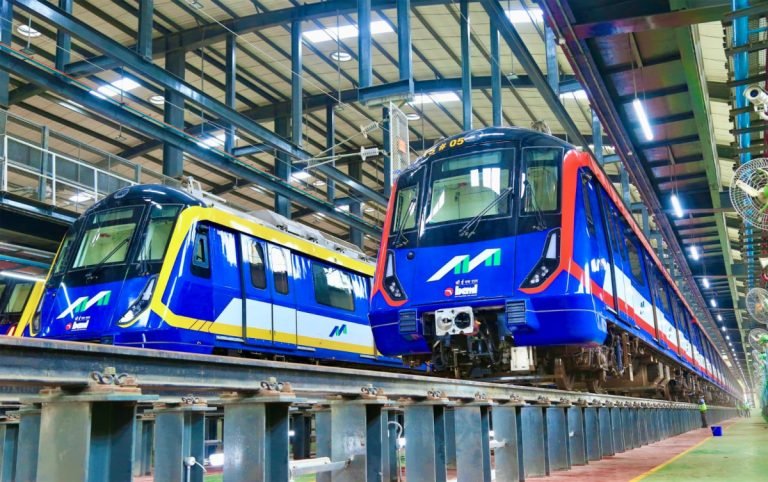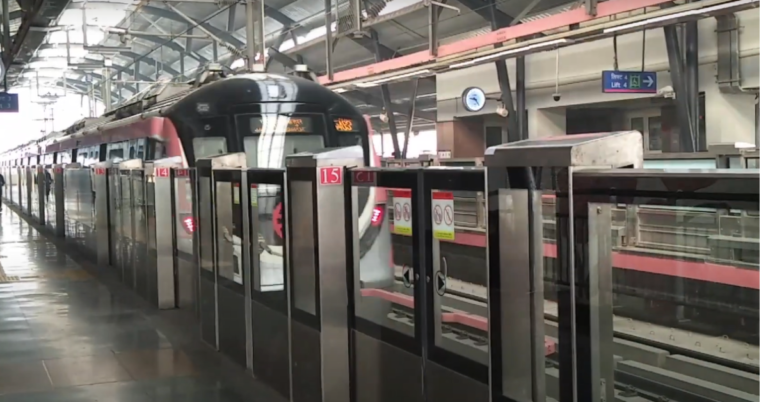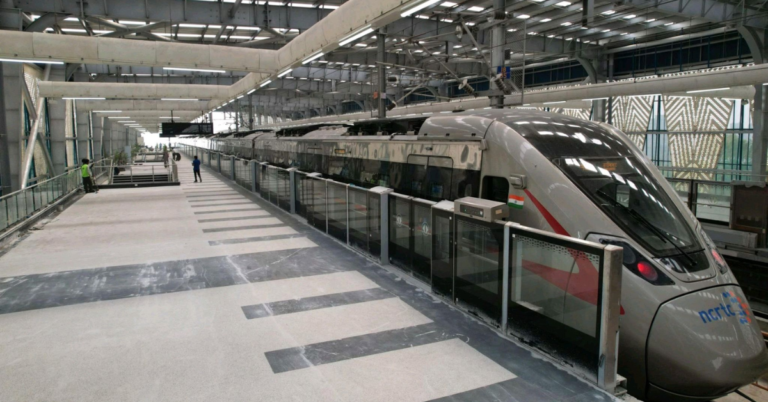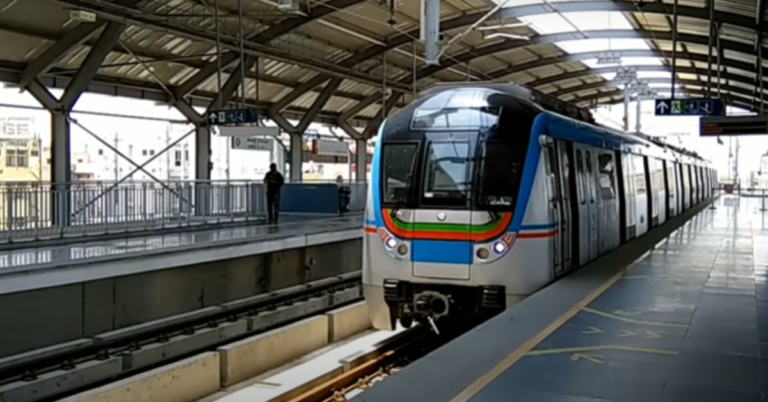
New Delhi: Prime Minister Narendra Modi has flagged-off the Delhi-Faridabad Metro Line that would allow hassle free travel for around two lakh daily commuters between the national capital and the industrial hub in Haryana.
The extension of the Delhi Metro connects Badarpur to Escorts Mujesar in Faridabad.
The total cost of the project from Badarpur to Escorts Mujesar is nearly Rs. 2,500 crore. Out of this, Rs. 1,557 crore was borne by the Haryana Government, the Centre contributed Rs. 537 crore, while the Delhi Metro provided Rs. 400 crore.
All these are elevated and located on either side of the Delhi-Mathura Road (NH-2).
“The nine-station metro corridor which was 95 per cent indigenously built will provide people a safe, affordable, quick, comfortable, reliable, environment-friendly and sustainable transport facility,” a Haryana government spokesperson said.
Haryana Chief Minister ML Khattar, addressing a press conference on Saturday, had thanked the Prime Minister for “gifting” the Metro service which would take the city to “another level of progress” with better connectivity with other NCR towns.
He had also said that the Prime Minister would be announcing the go-ahead for connecting Gurgaon with Faridabad by Metro.
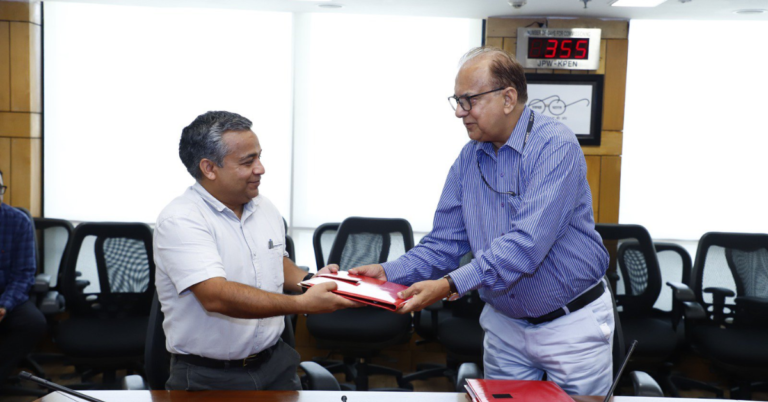
CMRL MD, M.A Siddique submits DPR for the Madurai and Coimbatore Metro Project to Ramesh Chand Meena, the Additional Chief Secretary of Govt. of TN.
MADURAI (Metro Rail News): The managing director of Chennai Metro Rail Limited (CMRL), M.A. Siddique, along with Madurai metro project director T. Archunan and other senior officials, submitted the detailed project reports (DPRs) for the Madurai and Coimbatore metro projects to Ramesh Chand Meena, the additional chief secretary of special initiatives, Government of Tamil Nadu.
The final detailed project reports for the Madurai metro have outlined plans for 27 metro stations along a 32 km rail track that will connect Thirumangalam and Othakadai.
The event was attended by Thiru T. Archunan, Director (Projects), Thiru. T. Livingstone Eliazer, Chief General Manager (PP&D), Tmt. Rekha Prakash, CGM (PD), and senior officials of CMRL.
EIB Vice President, Mr. Kris Peeters, along with delegation visits Agra Metro Project
AGRA (Metro Rail News): Mr. Kris Peeters, Vice-President, European Investment Bank (EIB), along with 4 team members, visited the Agra Metro Project on 14 July 2023 to inspect and assess Agra Metro Rail Project. The project is being executed under the leadership of Mr. Sushil Kumar, Managing Director, UPMRCL.
Mr. Kris Peeters meets with Shri Sushil Kumar, MD, UPMRC
Last year, a team of investment officers from the EIB also visited the ongoing Metro projects of UPMRC, where they were immensely impressed with the pace of the Agra Metro Project work and the way it is moving ahead with a strict timeline.
Mr. Kris Peeters, along with team members, visited and inspected the Taj East Gate Metro Station, Agra Metro Depot and Agra Fort Metro Station (Underground).
Vice President European Investment Bank, Kris Peeters, said, “The European Investment Bank (EIB), as the Bank of the European Union, is proud of its contribution to this project because it will improve the quality of life for the citizens and visitors of the historic city of Agra, and will help India in achieving its climate goals.
UPMRC will always have our cooperation; always ready to partner on other metro projects”, said Vice President Peeters.
EIB VP along with UPMRC MD on Agra Metro
“Once completed, the EIB-backed Agra metro rail will facilitate travel by more than 2 million people living in the city of Agra. This sustainable transport investment that will be supported by a total €450 million loan enables more accessible and affordable access to workplaces, healthcare, education and markets while protecting the environment and improving the quality of air in the city.
This is a good example of how international cooperation and local know-how can make tangible improvements for people and businesses alike and, at the same time, contribute to climate action and the protection of the environment. I am very proud to see cooperation between Europe and India growing through projects like this,” said Vice President Peeters.
Speaking on the same, Managing Director UP Metro Shri Sushil Kumar said, “I am very happy and thankful to European Investment bank for their continued support to the development of Metro rail projects being implemented in the state of Uttar Pradesh. After funding the Lucknow & Kanpur Metro projects, EIB is providing full support for Agra Metro project also. “
“A timely disbursement of funds from EIB accelerates the speed of work and helps in re-emergence of the local economy,” he added.
“EIB our most trusted financial partner; committed to give Agra world class metro by March 2024”, said MD, UPMRC Shri Sushil Kumar.
Advantages of a metro system in Agra city :
Metro projects provide an effective, efficient and quality transport that improves the overall health of the city.
Metro services are accessible to groups such as women and those with reduced mobility.
Metro projects shorten travel time, create an affordable and accessible transport for all.
Metro projects improve the quality of life and reduce greenhouse gas emissions in the city.
Agra is the sixth urban metro rail project that EIB supports in India. It brings EIB’s total approved commitments to the sector to over 3 billion euros, of which over 2 billion euros have been signed. These investments translate the India-EU Connectivity Partnership into tangible improvements for India’s people and accelerate green, sustainable and inclusive growth.
The European Investment Bank (EIB) shall be funding EURO 450 Million for the Agra Metro Project, which is made available to UPMRC through gross budgetary resources in the form of Pass-Through Assistance (PTA) from the Government of India.
Broader context — other metro projects in India (6 in total including Agra, the last one)
In Uttar Pradesh the EIB is financing 3 metro projects in Agra, Kanpur and Lucknow, with Uttar Pradesh Metro Rail Corporation Limited (UPMRCL) as promoter.
– The EIB is financing 3 other metro projects in other states:
Bhopal: 400m (state of Madhya Pradesh)
Bangalore: 500m (state of Karnataka)
Pune: 600m (state of Maharastra)
India is the largest beneficiary of EIB transport financing outside Europe.
Figures about metro projects in India
The total amount approved by the Board for metro projects in India is EUR 3,050m
– Lucknow: 450m – project completed one year ahead of schedule
Contract signed between officials of CMRL and DINESHCHANDRA-SOMA Joint Venture for construction of Metro Stations in Corridor 3 of CMRL Phase-II Project
CHENNAI (Metro Rail News): Chennai Metro Rail Limited (CMRL) has signed a contract agreement for the construction of metro stations in Corridor 3 of the CMRL Phase-II Project. The contract, labeled as Contract No. C3-CP01-UG-01, was signed with M/s DINESHCHANDRA-SOMA Joint Venture on July 13, 2023. This contract is part of Japan International Cooperation Agency (JICA) funding for Phase-II of the Chennai Metro.
On June 2, 2023, the Letter of Acceptance (LOA) for Tender No. CMRL/CON/PHASE-II/CORR-3/CP01/UG01-RT01/2021 was issued to the joint venture of M/s DINESHCHANDRA-SOMA. The total value of the contract amounts to INR 1063.37 Cr, which includes Provisional Sum and GST.
The scope of work under this contract involves the construction of four underground stations at Moolakadai, Perambur Market, Sembiyam, and Perambur Metro Crossover at Sembiyam. Additionally, it includes works other than the diaphragm wall for two underground stations at Madhavaram Milk Colony and Murari Hospital (Madhavaram High Road Metro) in Corridor-03 of the CMRL Phase-II Project.
The signing ceremony took place in the presence of Thiru. M.A. Siddique I.A.S., Managing Director of CMRL. The contract was signed by Thiru. T. Archunan, Director (Projects) of CMRL, and Thiru. Pranav Kumar, Vice President (Technical) of DINESHCHANDRA-SOMA Joint Venture. Several officials from CMRL, GC, and the contracting company were present during the occasion, including Thiru. T. Livingstone Eliazer, Chief General Manager (PP&D), Thiru. D. Gurunath Reddy, Additional General Manager (CP), and Thiru. Reepu Daman Dube, Joint General Manager (UG).
The signing of the contract agreement is a step forward in the development of Chennai’s metro infrastructure. The construction of these metro stations will contribute to the expansion and enhancement of public transportation in the city, providing efficient and convenient connectivity to residents and commuters.
AGRA (Metro Rail News): On Tuesday, Agra witnessed a significant milestone as the Agra Metro project successfully conducted its first trial run from the Ramp Area of Agra Metro Depot to Taj East Gate Station. This came as a pleasant surprise to the residents who witnessed the maiden test run. This trial took place on a ballastless track spanning approximately 3 km. Previously, trials were conducted on the ballasted track in the metro depot.
One unique feature of the Agra Metro trains is that they won’t have any overhead equipment for movement. Instead, they will be powered by a charged third rail running parallel to the track.
Agra Metro
Shri Sushil Kumar, MD, UPMRC, expressed his excitement and labeled this run as a victory for Agra Metro officials. He stated that all train systems and equipment were tested successfully during the 3 km long viaduct run. Mr. Kumar also assured that the officials are committed to commencing metro operations in Agra very soon.
The Agra Metro project aims to ensure timely commissioning, and Mr. Kumar emphasized their determination to achieve this goal. It is indeed a historic day for the people of Agra, bringing them one step closer to experiencing the benefits of metro transportation.
GURGAON (Metro Rail News): The Ministry of Railways has given the green light to the 129km South Haryana Economic Rail Corridor, linking Haryana with four ports in Gujarat via Rajasthan. The ministry will conduct a survey for the semi-high-speed rail corridor. Once constructed, trains on the corridor will run at speeds of 130-160kmph.
The project received approval from the Haryana government in 2022 and is estimated to cost Rs 1,225 crore. The aim of the project is to reduce travel time and improve connectivity to industrial hubs.
The proposed rail corridor will stretch from Farrukhnagar in Gurgaon to Loharu in Bhiwani, passing through Jhajjar and Charkhi Dadri. The corridor will eventually connect with Bahadurgarh and Sonipat through the under-construction Orbital Rail Corridor. This project will be executed by the Haryana Rail Infrastructure Development Corporation (HRIDC), a joint venture between the Indian Railways and the Haryana government.
According to officials, upon its completion, the project will significantly reduce the travel distance between Delhi-NCR and Gujarat, making the route to Gujarat shorter and more convenient for commuters.
The implementation of this project will result in reduced travel time between Delhi and various cities in Rajasthan, including Sikar, Jhunjhunu, Bikaner, Jaisalmer, Jodhpur, Barmer, Hanumangarh, and Sri Ganganagar. Additionally, it will also shorten the travel duration between Delhi and destinations in Gujarat, such as Gandhidham, Bhuj, and Dwarka. Currently, trains from Delhi follow a route via Rewari to reach Rajasthan.
At present, HRIDC is working on the Haryana Orbital Rail Corridor (HORC), which will connect Palwal to Sonipat, through Sohna, Manesar and Kharkhoda, benefiting both passenger and goods transportation. The railway ministry has also approved a survey for a double line between Gadi Harsuru and Loharu via Sultanpur Farrukhnagar, Jhajjar, and Charkhi Dadri. Once completed, the project will significantly reduce travel time between Delhi and various destinations in Rajasthan and Gujarat.
HYDERABAD (Metro Rail News): The Hyderabad Airport Metro Rail project has attracted the interest of two prominent firms, Larsen & Toubro and NCC Ltd (formerly Nagarjuna Construction Company), who are now in competition to secure the project. Both companies have submitted their bids for the 5,688 crore tender.
On Thursday, the engineering, procurement, and construction (EPC) contract for the Raidurg-Airport stretch was opened by Hyderabad Airport Metro Ltd (HAML). The project invited global tenders for the Airport Metro project, and a pre-bid meeting was held on 14th June. Although representatives from 13 national and global firms, including Alstom, Siemens, Tata Projects, IRCON, RVNL, BEML, PANDROL Rahee Technologies, and L&T, displayed their interest, only Larsen & Toubro and NCC Ltd participated in the bidding process.
Larsen & Toubro, a company with experience in developing Metro rail through public-private partnerships and that sought government aid to overcome losses, took part in the bidding. It is important to note that the Hyderabad Airport Metro project is fully funded by the Telangana government. Recently, the state government has also entrusted Larsen & Toubro with the responsibility of completing the remaining Metro connectivity between MGBS and Falaknuma.
Both Larsen & Toubro and NCC Ltd have submitted the required documents, including their project execution experience, technical and financial strengths, audited financial statements, and a security deposit of 29 crore each in bank guarantees.
According to NVS Reddy, the Managing Director of HAML, the bid documents will undergo a thorough evaluation by experts from GC (Systra-led General Consultants) and senior technical officers from HAML. This evaluation process will take approximately 10 days, after which the recommendations will be presented to the government.
NEW DELHI (Metro Rail News): The Delhi Metro Rail Corporation (DMRC) is planning to extend the proposed Rithala-Narela corridor of the Delhi Metro up to Kundli in Haryana to enhance connectivity to the neighbouring state. If approved, it will be the fourth expansion of Delhi Metro into Haryana, after the Yellow Line (Gurugram), Green Line (Bahadurgarh), and Violet Line (Faridabad) expansions.
The proposed extension involves extending the operational Shaheed Sthal-Rithala Red Line corridor. This corridor may become the first-ever connection between Haryana and Uttar Pradesh through Delhi within the Delhi Metro network. Initially, the plan included smaller stations designed to accommodate four coach trains, with the flexibility for future expansion to accommodate eight coach trains as the traffic demand grows.
Index plan of Rithala-Narela-Nathupur (Kundli ) corridor /Image by DMRC
Post approval, the total length of the corridor would be 27.31 kilometres, comprising 22 stations. The majority of the corridor, approximately 26.339 kilometres, will be elevated, with only about 0.89 kilometres at ground level. Of the 22 stations, 21 will be elevated, and one will be at grade (ground level).
The stations on this proposed corridor include Rithala, Rohini Sector 25, Rohini Sector 26, Rohini Sector 31, Rohini Sector 32, Rohini Sector 36, Barwala, Rohini Sector 35, Rohini Sector 34, Bawana Industrial Area – 1 Sector 3, 4, Bawana Industrial Area – 1 Sector 1, 2, Bawana JJ Colony, New Sanoth, Sanoth, Depot Station, Bhorgarh Village, Narela DDA Sports Complex, Anaj Mandi Narela, Narela, Narela Sector 5, Kundli, and Nathpur.
A press release states, “The route alignment and station planning for all stations have been revised. Currently, the topographical survey, traffic survey, and environment impact assessment study are underway for the extended section between Narela and Kundli, covering a distance of 5 kilometres. The DPR for the Rithala-Narela-Kundli corridor is expected to be submitted by the end of this month. Once finalized, the DPR will be presented to the government for consideration and approval.
The proposed extension will provide enhanced connectivity to Narela and other areas, benefiting residents of the new residential colonies. The extension will also link this region to the currently operational Red Line, which extends up to Ghaziabad and covers important locations in central and east Delhi.
BHUBANESWAR (Metro Rail News): The Delhi Metro Rail Corporation (DMRC) has initiated soil testing for the Bhubaneswar metro rail project in Odisha. The purpose of this investigation is to gather information about the physical properties of the soil to determine its suitability and strength for supporting the metro rail structure.
Soil sampling is underway by DMRC between Trisulia to Nandankanan. Additionally, samples will be collected between Nandankanan and the city airport. Once the soil testing is complete, the Delhi Metro Rail Corporation will prepare a detailed project report based on the findings.
The Detailed project report will play a crucial role in deciding the routes, alignment, and other related aspects of the metro rail project. The announcement of the metro rail project was made by Chief Minister Naveen Patnaik on Utkal Diwas. The first phase of the metro will cover a distance of approximately 30 km, connecting Trisulia in Cuttack to Biju Patnaik International Airport. It will also include connections to Jatni and Khurda, with a future extension planned to Puri.
The Government of India has set a target of 33% reduction in emissions intensity as part of its Nationally Determined Contributions (NDCs), with transport being one of the main sectors with significant mitigation potential. One of the most important transport emissions mitigation plans agreed to by the Government of India has been to raise Indian Railways’ share of freight traffic from 35-36% to 45% by 2030. The Railways plays a significant role in contributing to India’s NDC to address climate change through a variety of approaches, including:
To increase the railways’ share of total land-based freight movement and transportation from thirty-six per cent at present to nearly forty five per cent by 2030. Dedicated Freight Corridors (DFCs) are currently being developed across India by Indian Railways. The first phase of the project alone is expected to reduce emissions by 457 million tonnes of CO2 over a 30-year tie period.
Increase the proportion of renewable energy in the country’s energy mix. Railways to increase and enhance the energy efficiency for both diesel and electric propulsion, allowing the country to reduce GHG emissions.
The PAT scheme has been planned to be implemented in the railway sector. Use of 5% biofuel blend in traction diesel fuel. Increase water efficiency by 20% by 2030 and planting trees to boost carbon sink. Pollution control and waste management.
Adopting best practices for green buildings, industrial units, and other establishments for resource and infrastructure management in order to promote environmental sustainability in the growth of IR. Participation in the ‘Swachh Bharat Mission’ IR has established a goal of becoming a ‘Net Zero’ organisation by 2030 through the electrification of all railway tracks.
Indian Railways has taken a number of initiatives to streamline its environmental management operations, with prominent programmes including Energy Efficiency Management, Renewable and Alternative Energy Sources, Water Conservation, Afforestation, Water Management, and Green Certifications.
Some of the major steps taken can be broadly categorised in the following areas:
Net-Zero Carbon Emission: IR has plans to gradually reduce its carbon footprint and achieve Net Zero Carbon Emissions by 2030. IR will try to lower its carbon footprint primarily by procuring its energy needs from renewable sources. The projected requirement for renewable capacity installation by 2029-30 is around 30 GW. IR has installed 142 MW of rooftop solar capacity and 103.4 MW of wind energy capacity till August 2022.
Other efforts for becoming a Net Zero emitter include electrification of its lines, switching from diesel to electric traction, promotion of energy conservation, construction and development of Dedicated Freight Corridors, green certification of railway establishments and so on.
IR electrified 851 Route Kilometres (RKMs) during the fiscal year 2022-23 compared to 562 RKMs during the equivalent period of FY 2021-22. It is 51.4% higher than the previous year’s outcomes for the same period. According to the Ministry of Railways, the electrification target for the current financial year is 6500 RKMs.
It is worth noting that the Indian Railways accomplished a record electrification of 6,366 RKMs during 2021-22. Previously, the highest level of electrification was 6,015 RKM (during 2020-21). As of 30 September 2022, 53,098 BG RKM of the IR BG network (including KRCL) had been electrified, accounting for 81.51% of the total BG network.
Issuance of Water Policy 2017 for effective water management: Water Policy 2017 has been disseminated to all Zonal Railways and Production Units for implementation in Railway Stations, Trains, and Railway Colonies, among other places. This is part of the Government of India’s broader aim to reduce water consumption by approx twenty per cent by 2020 as part of its Nationally Determined Contribution. The main goal of this strategy is to promote water use efficiency through better demand and supply management, the installation of water-efficient devices, and the establishment of Water Recycling Plants on railway territory and land.
Creation of Additional Carbon Sinks by Afforestation: Railways, through its various departments, carries out and performs the afforestation work on vacant and unoccupied railway land and between sections. As part of the railways’ commitment to environmental betterment and sustainable development, state forest departments are involved in the plantation of the trees, their maintenance, and disposal. Since 2017, IR has been planting approximately 1 crore trees every year. During the years 2021-22, 72 lakh seedlings had been planted.
Waste Management: Waste to energy/compost/biogas plants/material recovery facilities have been installed at more than two-hundred fifty stations as waste management centres for managing waste. Separate containers for dry and wet waste have been installed for waste categorisation at the sources.
Green certification/Consent: Around 700 railway stations have been accredited for ISO:14001 environmental management system implementation. Over 545 stations have received consent to operate (CTO) from their respective State Pollution Control Boards. Green accreditation has been granted to 31 railway buildings (including offices, training institutes, hospitals, and schools), 32 stations, and 55 workshops/PUs.
Allocating cost for executing environment-related works: To reduce the environmental impact of activities and to protect the environment, a policy has been announced in May 2016 that provided for a 1% cost allocation in all sanctioned Works for executing environment-related activity.
Cleanliness of Trains & Railway Stations: Cleanliness of trains and railway stations has gained prominence in the last few years, as the number of mechanised cleaning contracts at stations and coaches in trains, rag picking and garbage disposal contracts at stations, and On Board Housekeeping Service (OBHS) contracts has increased substantially.
Environment-friendly Bio–Toilets for Passenger Coaches: Indian Railways (IR), along with the Defence Research and Development Organisation (DRDO), collaborated to create environment-friendly bio-toilets for passenger trains. The job of installing bio-toilets in all passenger-carrying coaches on Indian Railways has been finished with the installation of 2,58,990 bio-toilets in about 73,110 coaches up to March 2021. In accordance with the ‘Swachh Bharat Mission,’ direct disposal of human waste from trains has thus been eliminated.
Bio Toilet Tank
Third-party Audit/Survey including Passenger feedback on Cleanliness: Third-party audit cum survey on major station cleanliness began in 2016 and was repeated in 2017, 2018, and 2019. In 2018, the first-ever third-party audit cum survey on the hygiene of major trains was conducted. Such surveys enable independent evaluation while also instilling an encouraging sense of competition in improving cleanliness in passenger interaction areas.
Standard Bid Document for Housekeeping of Stations and Trains: To increase the effectiveness of housekeeping/cleaning contracts, the Standard Bid Document (SBD) (Aug 2017) and General Conditions of Contract for Services (GCCS) (Feb 2018) have been developed, with a special focus on passenger contact areas.
Conclusion
In the next seven years, Indian Railways, the world’s fourth-largest railway network, intends to become a net zero carbon emitter. The Railways plans to attain this ambitious objective in two stages: Complete transition to electric trains by December 2023, with trains and stations powered mostly by non-renewable sources by that time.
If successful, the move shall assist the country in meeting its nationally determined contribution of cutting carbon emissions by thirty-three per cent by 2030, with transport being an important sector with significant mitigation potential. Simply put, net zero implies reducing greenhouse gas (GHG) emissions to as close to zero as possible. Most firms attempting to achieve this rely on carbon offsets, in which they compensate for their emissions by engaging in green initiatives such as reforestation or land restoration drives.
The Indian Railways, on the other hand, is primarily concerned with lowering its emissions. The Union Ministry of Railways announced its ambition to go green in July 2020 and has subsequently iterated and restated the objective multiple times. The most recent announcement was made in September last year, which stated that the goal will be met through an ‘integrated approach’. On the one hand, it is expected to increase railways’ share in freight movement to 45 per cent by 2030, up from 35 per cent now. While on the other hand, it is envisioned to help the railways in expanding their renewable energy generating capabilities.
The agency is also implementing novel ideas, such as investing in battery and EV projects to assure continuous renewable supply and placing solar panels along rail tracks for long-term generation of power.
HYDERABAD (Metro Rail News):K Chandrasekhar Rao, Chief Minister of Telangana, has directed the municipal administration department to move forward with the Metro project in the Old City. The decision was announced by MAUD Minister KT Rama Rao in a tweet. The Old City stretch of the Metro, known as MGBS-Falaknuma on Corridor-II (Green Line), had faced a roadblock due to incomplete property acquisition. However, the Hyderabad Metro Rail Limited had already completed the underground utilities survey and mapping by December 2022.
The delay in the project’s progress raised questions, considering the completion of the preliminary survey. In this year’s budget, the state government had allocated 500 crore specifically for the Old City Metro project.
“CM KCR also spoke to the Chairman of L&T which is the agency executing the Metro Rail Project to expeditiously take up the project and promised all needed support”, said KT Rama Rao in a tweet.
The Metro stretch joining MGBS to Falaknuma will cover a distance of 5.5 km and have five stations along the way, including Salarjung Museum, Charminar, Shahalibanda, Shamshergunj, and finally, terminating at Falaknuma. The aim is to bring convenient and efficient Metro connectivity to the Old City region of Hyderabad, benefiting residents and enhancing transportation options in the area.