GMRC invites tender for general civil maintenance work of Ahmedabad Metro Rail project, phase-1

GUJARAT(Metro Rail News): Gujarat Metro Rail Corporation (GMRC) Ltd. invites Open Tenders from eligible applicants, who fulfil qualification criteria as stipulated in Clause 1.1.3 of NIT, for the work,  General civil maintenance work of western Reach from transition span (Viaduct) of Old High Court towards stadium station upto Thaltej Gam Dead end (7 Stations And Viaduct) of Ahmedabad Metro Rail project, phase-1.

Tender Reference No: GMRC/CIVIL MAINTENANCE/EW/PH-1/2022

Name of Work: General civil maintenance work of western Reach from transition span (Viaduct) of Old High Court towards stadium station upto Thaltej Gam Dead end (7 Stations And Viaduct) of Ahmedabad Metro Rail project, phase-1.

Estimated cost of Work: INR 2.42 Crore

EMD: INR 2.42 Lakh

Completion period of Work: 01 Year

Document Download Start Date: 28th July, 2022

Document Download End Date: 12th August, 2022

Bid Submission Start Date: 28th July, 2022

Bid Submission End Date: 12th August, 2022

Tender Opening Date: 12th August, 2022

for more details kindly visit https://www.gujaratmetrorail.com/tenders/

Railway commissions a new skywalk at Andheri station

MUMBAI (Metro Rail News): Western Railways successfully undertaken various infrastructural upgradation and augmentation works for the convenience of passengers. With an estimated 3.15 lakh daily passengers, Andheri is one of the busiest stations on the WR’s suburban line.

“The new south-end foot over bridge (FoB) is connected to the existing south FoB by the skywalk,” the Western Railway (WR) said on Monday 1st August. WR official stated, installing a second walkway will assist ease congestion on the old south FoB for traffic going from Andheri’s west to east side. With this, a total eight FOBs & Skywalks have been commissioned in the Mumbai suburban section of Western Railway in the financial year 2022 – 23, taking the total to 141.  

WR has successfully undertaken various infrastructural upgradation and augmentation works for the convenience of passengers. The new Skywalk at Andheri is 6 metre wide & 98 metre long. The total cost of the Skywalk is approx. 4.50 Crores.

Further, five more FOBs at Dadar, Khar, Naigaon, Vasai Road & Nalasopara stations are targeted to be completed by the end of this financial year.

Western Railway urges its valued customers to care for their precious life and not to trespass railway tracks. Always use FOB, Subway, Escalators & Lifts to crossover and change platforms.


CMRL introduces a new system ‘No more Q – Only QR’

CHENNAI (Metro Rail News): Chennai Metro Rail Ltd. (CMRL) introduces the opportunity for commuters to purchase a QR code ticket right in the station. This will be anticipated to reduce the crowd at the ticket counters during peak hours.

To purchase a ticket with a QR code in the past, users had to download the Chennai Metro Rail mobile app. QR code boards will be installed at strategic locations inside the stations as part of the new system. A commuter can scan the code and purchase a ticket from Chennai Metro Rail’s ticketing page.

In the stations, the QR code will be visible in several places, including the parking lot and concourse.

“We’ve made this available because there might be some people who haven’t downloaded the app. The ability to generate tickets by simply scanning a code will be convenient for many. This will greatly save time for commuters as they do not have to stand in the queue during peak hours. We are offering 20% discount for QR code tickets,” stated a CMRL official.

Commuters can choose from UPI, net banking, or credit/debit cards to make the payment.

The first tunneling drive of Kanpur metro completes

KANPUR (Metro Rail News): The Tube Boring Machine (TBM) ‘Nana’ reaches its first milestone in building the tunnel for the 4 km long underground stretch between Chunniganj and Nayaganj under the 23 km long Corridor-1 of the Kanpur Metro Rail Project (IIT to Naubasta).
Its initial drive was finished on Monday after the 84-meter tunneling procedure.

The TBM Backup System Unit will now be lowered into a rectangular launching shaft 17.5 metres deep to attach to the TBM’s shield for automatic excavation work.

The tunnelling work on the Nana TBM, which began on July 4, has so far resulted in the installation of 60 rings. As a result, the machine can now advance at 12 to 15 metres per day.

First, the Reaction frame, a steel frame on which the first eight rings were mounted, will need to be removed to lower the Backup System Unit into the shaft. At first, pushing them through the thrust jack Cylinders allowed the machine to advance.
The Backup System Unit is a moving structure behind the shield and contains all the auxiliary systems needed to keep the TBM machine moving forward.
As the machine moves forward, rail tracks are placed in the tunnel to transfer the ring section to the Backup System. An automated cart transports the ring segments to the backup system unit.

Siemens announces the result of Q3 FY 2022, 51% increase in Revenue and 85% increase in Profit 

NEW DELHI (Metro Rail News): For the third quarter of Financial Year 2022 ended June 30, 2022, Siemens Limited registered a Revenue from continuing operations of Rs. 3,865 crore, a 51% increase over the same quarter in the preceding year. New Orders from continuing operations stood at Rs. 4,992 crore, registering a 20% increase over the same period last year. The Company’s Order Backlog from continuing operations stands at an all-time high at Rs. 17,856 crore.

Profit after Tax from continuing operations of Rs. 296 crore, increased by 85% over the same period last year.


Sunil Mathur, Managing Director and Chief Executive Officer, Siemens Limited, said, “The strong performance was across all our businesses and included a significant order in our Mobility business. While we are currently not experiencing a slowing down in Public and Private Capex spending, we are concerned about global headwinds impacting demand which could result in a slowdown in Capex spending.”

Railways among top three sectors in the nation with most delayed projects

NEW DELHI (Metro Rail News): Indian Railways is one of the top three sectors with the most delayed projects. Infrastructure-related projects totaling more than 100 that have been accepted for implementation across the nation are running late. The railways also has the most projects among the top 20 programmes in the country with the most delays. These railways projects are five to fifteen years behind schedule for completion.
According to the Ministry of Statistics and Programme Implementation’s Infrastructure and Project Monitoring Division (IPMD), 127 of 211 railway projects are running behind schedule (by three to 15 years) for various technical reasons and problems with law and order and land acquisition.
According to a senior official, the Ministry of Road Transport and Highways, with 301 out of 843 projects delayed, and the Ministry of Petroleum, with 91 out of 139 projects delayed, make up the Indian Railways top three sectors in the nation with the most delayed projects.
The IPMD recently revealed in a written reply in the Rajya Sabha that the initial completion date for the new train line between Bengaluru and Satyamangalam has initially budgeted at Rs 1,383 crore, was March 2002,now its expected completion date has been moved up to 2028.
The 272 km long Udhampur-Srinagar-Baramulla new railway line was planned to be finished in 2002. Still, it was delayed and is expected to be finished in 2023 at a new estimated cost of Rs 37,061 crore rather than its original cost of Rs 2,500 crore.

First four coaches of prototype train for Mumbai Metro Line 3 arrive in the city

MUMBAI (Metro Rail News): The arrival of the first batch of four coaches of the prototype train in the city on 2nd August 2022 in the early morning gave the Metro Line-3 project a significant boost, which is facing opposition from environmentalists.

Four trailers, each hauling a coach, travelled 1,400 kilometres in 13 days from Sri City, Andhra Pradesh, to the city. This project was postponed due to COVID-19 and opposition from environmentalists to the car shed at Aarey Milk Colony.

Chief Minister Eknath Shinde lifted the ban on the construction of the car shed. Devendra Fadnavis, the deputy chief minister, has requested Bhushan Gagrani, the additional chief secretary of the urban development department, to put together a proposal to resume the work at the first Cabinet meeting after his oath in office.


A 500-meter elevated road to connect Ring Road with Jangpura RRTS station

NEW DELHI (Metro Rail News): An elevated route of 500 metres in length between the National Capital Region Transport Corporation’s (NCRTC) proposed transit hub at Jangpura and Ring Road bids invited, NCRTC spokesperson stated.

NCRTC is building an elevated route along the Delhi-Ghaziabad-Meerut Regional Rapid Transit System (RRTS) corridor from Mahatma Gandhi Road (Ring Road) to the NCRTC Complex in Jangpura. According to a spokeswoman for NCRTC, this elevated route would provide connectivity to the Jangpura RRTS station.

Even though it is only a small elevated section, it will facilitate traffic flow for nearby communities like Nehru Nagar.

The station complex [Jangpura RRTS] will be connected to the Ring Road near Nehru Nagar by an elevated portion of roughly 500 metres that will be built on 24 pillars (along the internal road). The Ring Road doesn’t need to be closed during construction.

The elevated segment, which is expected to cost close to 150 crores, will be finished within 19 months after the date of commencement of work, official stated.

The elevated part will begin from the plot where the station is envisaged and link to the Ring Road on the carriageway leading to the Delhi-Noida-Direct Flyway just before the Ashram flyover begins, per the plan. “AIIMS bound vehicles can take a U-turn beneath the Ashram flyover for going on the elevated length, therefore it will not link to the other lane (towards AIIMS) on the Ring Road” stated representative.

The NCRTC would be building its stabling yard, an operation control centre to monitor and control the time-bound operation of trains on all three RRTS tracks, office spaces, and residential facilities on around 12 hectares of land at Jangpura. The NCRTC decided to develop Jangpura as a significant transit hub earlier this year and is currently working on the influence zone plan to allow for the development of the station area using a transit-oriented development strategy.

The elevated corridor has been recommended because the Jangpura site is encircled by railroad tracks and has a weak connection to the arterial road network, stated NCRTC official.

“The RRTS station should have a good parking facility. The region where the station is located already has a lot of traffic. Therefore, doing a site impact evaluation is crucial. According to the principles of transit-oriented development policy, the station should be built, S Velmurugan, chief scientist for traffic engineering and safety at the Central Road Research Institute (CSIR-CRRI), said.

NCRTC representatives stated, the influence zone area design for the station will take the site’s surrounding traffic into consideration.

On the Delhi-Meerut RRTS route, Jangpura, like Sarai Kale Khan and Anand Vihar, will grow into a significant transport hub. A 17-km segment between Sahibabad and Duhai will be ready by March 2023, while the entire 82-km RRTS corridor is anticipated to be operational by March 2025.

BMRCL is in discussion with 3 firms to raise funds for its projects

BANGALORE (Metro Rail News): In order to raise money for its projects, the Bangalore Metro Rail Corporation Limited (BMRCL) is currently actively courting corporates in the city.

Sources stated, that they are in discussions with the real estate company Century Group and are considering building a new station at the Jakkur plantation that will be a part of the Airport Metro (KR Puram-Kempegowda International Airport).

The completion date for the Kempegowda International Airport is 2025, and construction has already begun. However, some experts believe that having too many stations may cause Metro trains to run more slowly and lengthen travel times. Between KR Puram and Yelahanka, the proposed average speed is 36 kph, and between Yelahanka and the airport terminal, it is 60 kph. The current average speed of the Namma MetroNamma metro trial runs of purple line extension will start in September is 32 kmph.

Commuter rail advocate Sanjeev Dyamannavar said: “BMRCL should evaluate the demand and anticipated footfall before finalising stations. VIPs who reside in that vicinity will mostly benefit from the proposed station at Jakkur Plantation. The number of stations between Hebbal and KIA should be restricted. However, while BMRCL is designing the Airport Metro like its regular services, the benefits of coaches and travel speed are not intended for airport users.

Between KR Puram and KIA, which is 57 kilometres apart, there are 17 stations, including Kasturinagar, Horamavu, HRBR Layout, Kalyan Nagar, HBR Layout, Nagawara, Veerannapalya, Kempapura, Hebbal, Kodigehalli, Jakkur Cross, Yelahanka, Bagalur Cross, Bettahalasuru, Doddajala, Airport City, and the KI, For instance, the Airport Express Line: New Delhi-Dwarka (22.7 km, 6 stations) in Delhi travel the distance in 19 minutes at an average speed of 70 to 80 km/h.

BMRCL is also in talks with Indian Oil Corporation (KR Puram/Mahadevapura station on Byappanahalll-Whitefield Metro) and Bagmane Tech Park (DRDO and ISRO stations on Outer Ring Road Metro). In order to connect its campus at CV Raman Nagar, Bagmane Tech Park has also proposed a monorail service from the SV Road Metro station on the Purple Line to the DRDC Metro station on the ORR.

According to a BMRCL spokesperson, “BMRCL is gathering funds by utilising creative financing solutions where corporates have been involved to augment funds.”

For 30 years, BMRCL grants the corporates a fundamental set of rights. This includes naming rights (of Rs 65 crore), 1,000 sq ft of advertising space inside the station, 3,000 sq ft of space inside the station for business use (worth Rs 25 crore), and direct access to the walkway (Rs 10 crore).

BMRCL has so far signed agreements or memorandums of understanding with businesses like Embassy Property Developments Pvt Ltd (Kadubeesanahalli station, Rs 100 crore), Intel Technology India Pvt Ltd (Bellandur station, Rs 100 crore), Prestige Exora Business Park (Kedibeesanahalli station, Rs 100 crore), and Embassy Property Developments Pvt Ltd Bettanalasuru stations, Rs 40 crore.

KMRL to begin Kochi Water Metro services soon

KOCHI (Metro Rail News): The Kochi Metro Rail Limited (KMRL) is preparing to begin offering Water Metro services in September after the Cochin Shipyard delivered two more boats on July 30, 2022. A KMRL spokesman stated that although four electric hybrid boats have already been delivered, another one is most likely to follow soon.

“Now that we have the two boats we previously acquired, we can start the trial runs. We anticipate receiving all five of the boats needed to start operations before September, the KMRL representative stated.

Experts in public transportation have urged for affordable tariffs, stressing that, unlike metro trains, islanders will be relying on the Water Metro rather than metro trains. However, conversations regarding the fares are ongoing, a source stated. In addition, 14 terminals should be finished building by December.

“The terminals at Vypeen, Bolgatty, and High Court are almost finished with construction. If all goes according to plan, we will begin operations on the High Court-Bolgatty-Vypeen segment, stated KMRL official. 23 boats are being constructed at the Kakkanad terminals of the Cochin Shipyard for the Water Metro project.

DMRC to conduct Online Customer Satisfaction Survey from August

NEW DELHI (Metro Rail News): Customers of Delhi Metro Rail Corporation (DMRC) have the chance to provide feedback on several aspects of metro services and facilities. From Monday, August 1 to Sunday, August 28, the DMRC will be collecting feedback via an online survey. Beginning on Monday, August 1, riders of the Delhi Metro can take part in an online poll being undertaken by the urban transporter.

The eighth edition of the Online Customer Satisfaction Survey – 2022 would include thorough questionnaires and detailed input from commuters on many themes. Additionally, recommendations for enhancements will be sought.

One can take part in the survey by moving to the DMRC’s official website, delhimetrorail.com.

“The primary goal of the survey is to get commuter input on various aspects of metro services and facilities. A thorough questionnaire will be used to get in-depth responses on certain themes from participating commuters. Additionally, the survey will look for any suggestions for changes “DMRC made a statement about this.

The DMRC survey will cover seven themes and be available in both Hindi and English. The questionnaire will focus on crucial Metro operations, including:

Accessibility and Availability

Services provided to passengers

Information

The standard of services

Consumer Assistance

Beyond the Metro Area

Security, comfort, and safety

“On the DMRC website, participants will have four days to complete the survey links for one topic. The next topic will be made available for feedback after four days. The survey will be completed in 28 days due to the seven themes it covers “DRMC stated.

This survey is being carried out by the Delhi Metro to learn what passengers of its services think of it. The outcomes would help evaluate and implement necessary improvements in a variety of Delhi Metro systems and services, officials stated.

DMRC now manages the operations and upkeep of a network with a length of about 390 kilometres and 286 stations, including the Rapid Metro in Gurugram and the Aqua Line in Greater Noida. It is one of the biggest metro networks worldwide.

Indigenous Vande Bharat train to become faster by 2025

NEW DELHI (Metro Rail News): In order to match the speed of trains operating in European countries, Indian Railways is gradually boosting the speed of the locally produced Vande Bharat Express.

The Vande Bharat Express train’s new version will accelerate from 160 kilometres per hour (kmph) to 180 kilometres per hour (kmph) this year. By 2025, the train is anticipated to travel at 220 kph, then accelerate to 260 kmph, matching the average speed of high-speed trains in Europe.

The development of the Vande Bharat trains took a leaf out of Japan’s book, where bullet trains continuously increased their speed since their introduction in 1959. Currently, they travel at a speed of about 320 kmph, Railways minister Ashwani Vaishnaw stated.

Additionally, Vande Bharat would gradually raise its pace while also enhancing the security and safety of all passengers.

The Vande Bharat trains’ first version, which can travel at 160 kmph, was introduced in 2019 as part of the Make in India project. The second version, which will begin running this month, has increased this to 180kmph. By the 15th of August of next year, 75 of these trains will be deployed as part of the nation’s 75th-anniversary festivities.

Vaishnaw stated, Vande Bharat versions 3 and 4 will travel at speeds of around 220 and 260 kilometres per hour, respectively.

By December, the Vande Bharat 3 tender is anticipated to be completed, and the high-speed train is anticipated to join the Indian Railways fleet by 2025.

“Since train began operating in the nation in 2019, the India Vande Bharat trains have travelled 1.8 million kilometres. The trains will become the main source of high-speed transit in the nation because the technology is now proven, Vaishnaw stated.

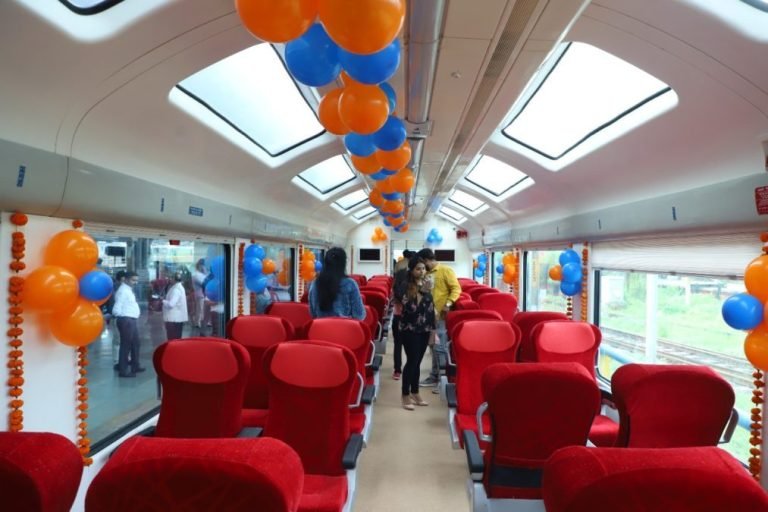
The Vande Bharat 2 is an enhanced model of the original, offering a smoother ride thanks to the usage of air springs. Additionally, the train will have superior interiors and seating as well as an integrated anti-collision system. With the substantial usage of aluminium and better wheels for quick acceleration, Vande Bharat 3 would also be lighter.

The 163kmph-capable bullet train project in Japan began construction in 1959. Prior to attaining the present speed of 320kmph in 2013, this increased from 210kmph in 1964 to 270kmph in 1992 and 300kmph in 1997.

Over the next three years, Indian Railways has set a goal of producing 300 Vande Bharat train sets (2025). By 2028, this will rise to 500 trains. By August 2023—75 years after India gained independence—the Railways must have built at least 75 of these trains, added Prime Minister Narendra Modi. The idea is to use these trains to connect 75 significant Indian cities.

To fulfil the goal of 500 trains, the Integral Coach Factory in Chennai, Indian Railways, intends to produce approximately 10 Vande Bharat trains per month. Eventually, the Rail Coach Factory in Kapurthala and the Modern Coach Factory in Raebareli are also anticipated to begin producing these coaches.

On the Delhi-Katra and Delhi-Varanasi routes, there are two separate sets of Vande Bharat trains operating. By August, two more Vande Bharat semi-high-speed trains are anticipated to start running.

The new trains would be an improvement over the first version since they would be equipped with Kavach, the most recent train accident prevention system used by the railways. The coaches will also have contemporary fire alarms, emergency light systems, exits, and a seating arrangement similar to that of an aeroplane with a reinforced exterior to reduce damage.

A 16-coach Vande Bharat train costs around 130 crores to manufacture, making the Vande Bharat trains cost-competitive as well.

MoHUA to consider many MRTS project in Delhi-NCR

NEW DELHI (Metro Rail News): The housing and urban affairs ministry informs the Center has received bids for Metro and Rapid rail projects totalling over 329 km in length across the National Capital Region (NCR) that are expected to cost approximately Rs 91,700 crore to complete.

This week, the ministry informed the Lok Sabha that these ideas are through various phases of “appraisal/approval.” According to the project information given to the Lower House, the ministry has been contacted about the proposal for the final three corridors of Delhi Metro Phase-IV, having a total of 47 kilometres in length. These corridors are expected to cost Rs 12.587 crore.

Similar to this, the government of Uttar Pradesh submitted its proposal for extending the Noida-Greater Noida Metro Link by around 15 km, at an estimated cost of about Rs 2,456 crore. The Haryana government has also requested authorisation for a spur to the proposed Dwarka Expressway and a 285 km Metro route from Huda City Center to Cyber City. This would require investments of approximately Rs 5,960 crore.

The RRTS projects make up the largest portion of the mass rapid rail proposals from the NCR constituent states, and they would demand the largest investment. According to the initial estimate, merely the 106.5 km Delhi-Gurgaon-SNB (Shahjahanpur-Neemrana Behror urban complex corridor will cost about Rs 35 216 crores. A proposal for a 33 km RRTS link from the SNB Complex to the Rajasthani industrial sector of Sotanala RIICO has also been submitted to the ministry. This 33-kilometre link is expected to cost around Rs. 6,188 crores.

Officials stated the expenses are currently being revised before being submitted for evaluation and approval.

Similar to that, the anticipated cost of the 103-kilometre Delhi Sonipat RRTS corridor is about Rs 29.300 crore.

These two and the Delhi-Meerut RRTS corridor were identified as the UPA government’s priority stretches for the years 2012–2013.

MPMRCL floats tender for the supplying and laying of metro tracks

INDORE (Metro Rail News): The Madhya Pradesh Metro Rail Corporation Limited float two separate tenders that will be release within a fortnight for supplying metro rail tracks as well as their laying in both Indore and Bhopal.

For phase 1 of the Indore and Bhopal Metro, the MPMRCL need 18 m long head solidified rails for the metro track’s construction. Additionally, they require a committed company to lay these rails.

Both Jindal Steel and Power Ltd. (JSPL) and Mitsui & Co. Ltd. have submitted bids for the delivery of the tracks, department officials stated.

In February, the Madhya Pradesh Metro Rail Corporation Ltd. issued tenders for this contract with an unspecified price and a 1022-day (3-year) timeframe.
Four businesses are competing for the contract to install the rails. Rail Vikas Nigam Limited, Texmaco Rail & Engineering Limited, Larsen & Toubro, and Vijay Nirman Company Pvt. have all engaged in this contract, which is worth approximately Rs 240 crore.


Work on the Metro trains is done in two shifts around the clock, with maintenance after 11 p.m. increasing as the amount of traffic in the area decreases where work is being done.