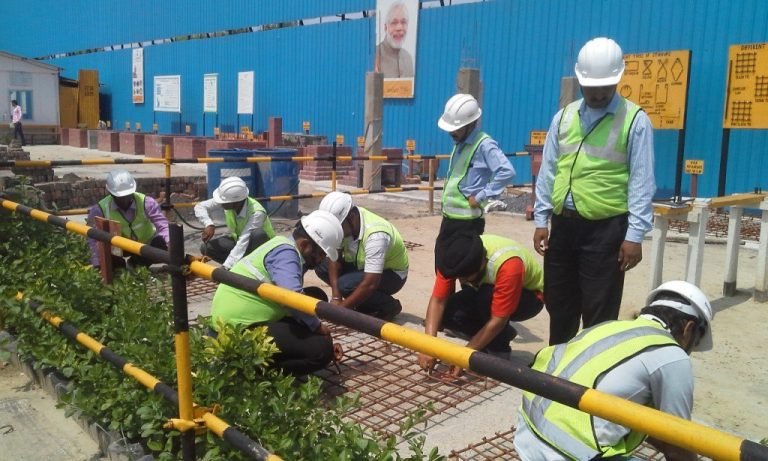
Kochi: The Kochi Metro Rail Ltd. (KMRL) started construction of the 18-meter high viaduct of its one of the highest points of the entire metro railway network, has begun and the installation of the substructure will be completed in April 2018.
“There will only be one pillar in the center of the crossing, while two others will arrive at both ends (near the police watchtower and the Hub Street entrance point). We have already started the work and we have imposed traffic restrictions in the far north. A 12-meter barricade has been erected there, which we hope to eliminate in two months, “said a high-ranking metro official.
“The pillar and other works of the substructure will be completed in four months, while the superstructure will work longer, but they will be performed only at night so as not to affect the flow of traffic,” the official said. The work in the section is being carried out by the contractor Era Constructions.
The Public Works Department also began the construction of two separate three lane crossings. “Both works will be implemented simultaneously so that the traffic is affected at least The subway viaduct will pass over the overpass and will have a separation of six meters,” said the official. Meanwhile, the metro viaduct will have a curve just before reaching the junction, starting from before the Welcare hospital.
Lucknow: The government of Uttar Pradesh hopes to operationalize the north-south corridor of the Lucknow Metro by April next year, amid accusations of delays in operations.
About 58 percent of the project (22,878 km) is complete and the government will begin to operate even ahead of time, Dinesh Sharma, deputy chief minister of the UP, told the Legislative Council during question time, while responding to Anand Bhadauria from Samajwadi party on reasons behind the delay.
Sharma said that the construction work for the Rs 6,928-crore project is progressing according to schedule and would be in operation by April 2019.
The Leader of the Opposition in the House, Ahmed Hasan, said the Lucknow Metro was a gift from the Samajwadi Party and accused the BJP of snatching the credit by delaying the project for almost nine months.
However, the deputy prime minister argued that the execution of the test in December 2016 violated the established norms.
“It can not be assumed that the test is inauguration, Metro Rail has its own safety parameters, which must be completed and fulfilled, and after that, the subway train will run,” Sharma said.
The Lucknow Metro test run took place on December 1 last year when the state was in election mode to elect a new assembly.
It was marked by the then prime minister Akhilesh Yadav and his father Mulayam Singh Yadav at a function at the Nagar Transport depot for the trial period to the Charbagh train station, a stretch of 8.5 km.
Gurugram (Gurgaon): After collecting comments on the two routes suggested by the Delhi Metro Rail Corporation (DMRC) for a new Metro line in Gurgaon, the Gurugram Metropolitan Development Authority (GMDA) has sent its report to the Haryana Mass Rapid Transit Corporation (HMRTC), recommending the longest route connecting the yellow line metro station HUDA City Centre with blue line metro station Dwarka Sec-21. The route, conceptualized by the DMRC, was chosen in place of the shorter one connecting the center of the city of HUDA and the Gurgaon train station.
“We received many comments, as well as some good suggestions from residents and travelers in Gurgaon, we have compiled them and have forwarded our report to HMRTC, recommending that it be considered the longest route to the new line.”, V Umashankar, Addl. GMDA CEO said,
Despite hosting several multinational companies, Gurgaon continues to be plagued by a weak public transport system. Now, the possibility of a new Metro line has brought hope to residents and travelers. Although the Yellow Line of the DMRC and the Rapid Metro connect parts of the city, most are not connected, except for a scarce bus network.
While only five DMRC stations fall in Gurgaon, the fast Metro, which will be expanded, runs only through Cyber City and Golf Course Road.
Several residents and travelers told The Indian Express that they approved the GMDA recommendation. Karan Duggal, who lives in Dwarka and travels to Gurgaon to work, said: “I spend about four hours driving to and from work, if you really start a Metro line between the two areas, you could get to work much faster.” The longer Metro route would also provide better connectivity with the IGI Airport.
Hyderabad: L&T, the concessionaire of the first phase of the Hyderabad Metro Rail project, is not interested in starting the second phase of the project in which the Metro Rail will be linked to the Shamshabad airport. The concessionaire experience several problems with the government during the execution of the first phase.
The another reason for not taking interest on further metro project could be lot of political interference in execution of this project as this project is being executed on PPP model.
And now, there are even doubts about the viability of the project and, therefore, L&T is not interested in participating in the project. If L&T is not interested, the government will look for others to develop the link, probably through open tenders.
A feasibility study of the 30.3 km Metro Metro link, which connects the Raidurg Metro station in Hyderabad with the Shamshabad airport, had been completed. The report is before the Chief Minister, who will make a final decision very soon.
New Delhi: The Delhi Metro Rail Corporation (DMRC) has finally announced inauguration of long awaited section between Botanical Garden and Kalkaji Mandir (line-8) of Phase-III project. The people who travel daily between Noida and South part of Delhi will now feel happy to find new route of Metro.
The stretch of 12.64 km is part of the Botanical Garden-Janakpuri West corridor of 38.23 km under the Phase III of the Metro expansion plans, and will be inaugurated by Prime Minister Narendra Modi on the eve of this Christmas Day i.e. December 25.
Union Urban Development Minister M Venkaiah Naidu with Delhi Chief Minister Arvind Kejriwal flags off the trial run of India’s first Unattended Train Operation (UTO). [Photo Credit: PTI]December 25 has been a significant date for the Delhi Metro Rail Corporation (DMRC) as its first line, the Red Line from Dilshad Garden to Rithala, was started for the public on Christmas day of 2002. The line was marked by then Shri Atal Bihari Vajpayee (then Prime Minister of India).
With the opening of the new line, Noida residents will save at least 45 minutes of daily travel when traveling to South Delhi.
The section that is opening on December 25 has nine stations namely: Botanical Garden, Okhla Bird Sanctuary, Kalindi Kunj, Jasola Vihar-Shaheen Bagh, Okhla Vihar, Jamia Milia Islamia, Sukhdev Vihar, Okhla NSIC and Kalkaji Mandir.
Kalkaji Mandir is underground and the others are elevated. The route will serve two important educational institutions: Jamia Millia Islamia and Amity University.
The Jardín Botánico subway station will be the first exchange station outside of Delhi and, since both the Botanical Garden and Kalkaji Mandir are exchange stations, there will be a significant reduction in travel time between the Blue and Violet Lines.
Once the entire corridor is opened, Noida passengers will be able to go to Gurgaon by changing the trains at Hauz Khas.
The trip from Noida and Faridabad will also be shortened. Passengers between Noida and Faridabad will change trains at Kalkaji Mandir.
Interesting things to know
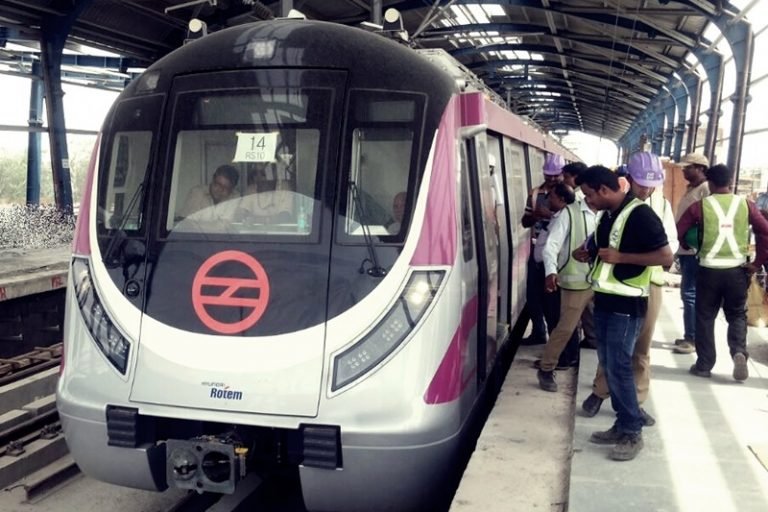
Very illuminated and with videos that will guide you on the routes, the Magenta line promises comfort and convenience for passengers. The trains will have Wi-Fi, USB ports along with charging points, LED and LCD screens and backrest near the wheelchair area. The seats on the new trains will be red, pink, orange and blue to give a sense of life.
Interior of new Driver-less Trains of DMRC to be operated in Line-7 and Line-8 of Phase-III corridors
This will be the first Metro line with trains without driver, the first in the country. Initially, trains on this route will run with drivers for 2-3 years.
The stretch will also be the first after the Airport Express line has screen doors on the Metro platforms. Post this, every new line launched in Phase III will have the same feature.
In fact, Delhi Metro Rail Corporation (DMRC) has decided to include platform screen doors in all stations that will be built in Phase IV as well.
Delay in opening
The sources said that the line was ready since the Commissioner for the Safety of the Metro Railroad (CMRS), after visiting the section of November 13-15, gave the green light for its opening with a list of some observations. DMRC took about one month to clear the objections listed by the CMRS.
A senior official of the Ministry of Housing and Urban Affairs of the Cabinet in condition of anonymity, said that the delay in opening the Magenta Line despite the approval of the CMRS was due to the fact that the authorities were solving logistical problems related to its inauguration. “It is absurd to link the opening of the line with the results of the Gujarat elections, once a line is declared ready to open, there are a number of logistical problems that must be addressed before they can be opened to the public”., added by the official.
This section was expected to be opened in last year.
Uttarakhand: In a significant move ahead of the Assembly polls, the Uttarakhand government on Tuesday evening signed an agreement with the Delhi Metro Rail Corporation (DMRC) to introduce the metro rail facility in the hill state.
The Memorandum of Understanding (MoU) was inked between the state Urban Housing Development Authority (UHDA) and DMRC in the presence of Chief Minister Harish Rawat. UHDA’s Secretary Meenakshi Sundram and Director (Business Development), DMRC, SD Sharma signed the pact for the project.
Briefing reporters after the meeting, CM Rawat said, “DMRC will submit the Details Project Report (DPR) to the state government after a month. After that the process for constructing the metro lines between Dehradun and Risihkesh will begin.”
A senior official in UHDA said that it will give an amount of about Rs 2 crore to the DMRC to draft the DPR for the purpose.
URHDA secretary Sundram said that in the second phase the metro lines will be laid on Dehradun-Haridwar and Dehradun-Kalsi route.
“DMRC will be later asked to prepare full proposal to extend the metro lines for the second phase,” he said.
The MoU between UHDA and DMRC was signed three days after the state Cabinet approved the proposal to construct metro rail lines.
“The state government will ask the DMRC to connect other towns with the metro lines in future,” Rawat said.
Officials said that total cost of the project will be estimated as per Rs 250 crores per km.
Mumbai: India’s first dedicated subway corridor between two international airports, the proposed 40-kilometer Metro in the Mumbai Metropolitan Region, will have trains running at three times the speed of a normal suburban Metro service. Mumbai Metropolitan Region Development Authority (MMRDA), which is responsible for constructing most of the Metro rail line in the region, has planned to operate rail services at an average speed of 30 kmph for other suburban railway routes in the region. Meter. While the MMRDA has been planning one station for every kilometer along other suburban Metro lines, the distance between two stations would be much greater for Airport Metro. The plan is to provide high-speed direct connectivity between the current Chatrapati Shivaji International Airport in Santacruz and the Navi Mumbai International Airport.
“It is ideal to plan high-speed direct connectivity between the two airports for better and faster connectivity with travelers,” said Madan.
The plan is to provide high-speed direct connectivity between the current Chatrapati Shivaji International Airport in Santacruz and the Navi Mumbai International Airport. The plan is to provide high-speed direct connectivity between the current Chatrapati Shivaji International Airport in Santacruz and the Navi Mumbai International Airport. (Photo by Amit Chakravarty) India’s first metropolitan corridor between two international airports – the proposed 40 km Metro in the Mumbai Metropolitan Region – will have trains running at three times the speed of a normal Suburban Metro service, according to what is reported by IE.
According to the newspaper, Mumbai’s metropolitan commissioner, U P S Madan, told The Indian Express that the plan was to provide services that would provide a maximum operating speed of up to 90 km per hour along the Airport Metro corridor. The Development Authority of the Metropolitan Region of Mumbai (MMRDA), which is responsible for constructing most of the Metro rail line in the region, has planned to operate rail services at an average speed of 30 kmph for other suburban railway routes in the region. Meter. The plan is to provide high-speed direct connectivity between the current Chatrapati Shivaji International Airport in Santacruz and the Navi Mumbai International Airport. While the detailed project report (DPR) of the high-speed corridor is still in the final stages of preparation, Madan said the plan was to build a Metro link, which would be partially underground. Starting at the Santacruz airport, the corridor will run underground for the first 8 km route before leaving near Mankhurd along Ghatkopar Mankhurd Link Road.
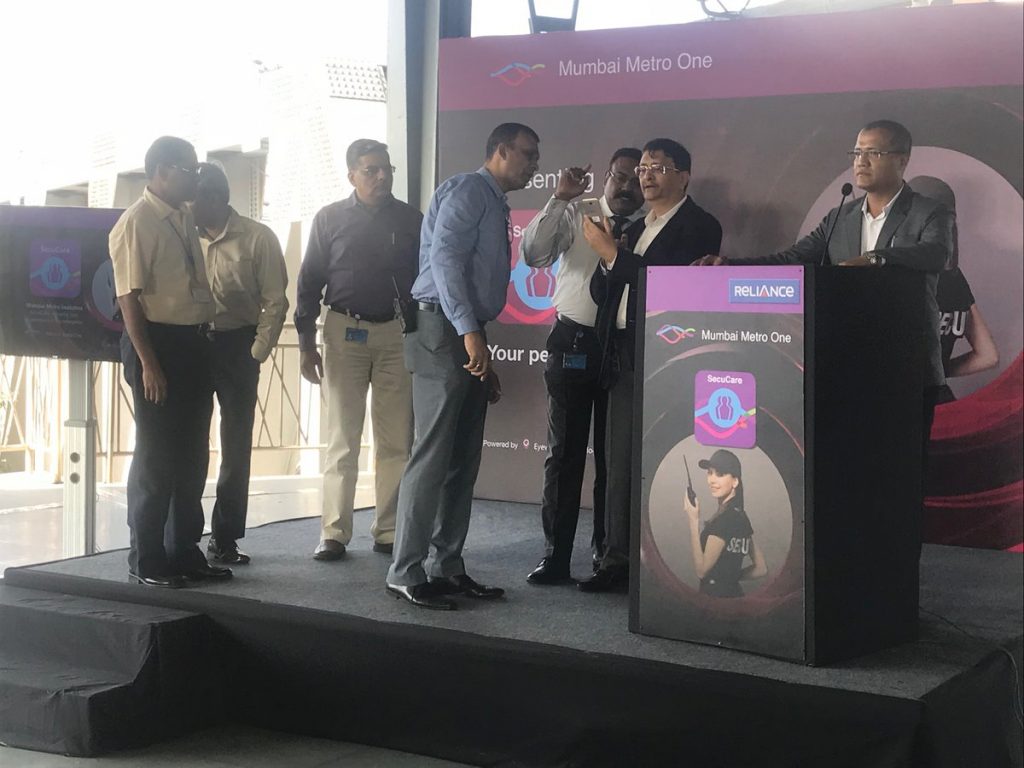
Mumbai: Three incidents of sexual harassment of women in the Mumbai Metro were reported in the last two months and they had to wait to reach their destinations and report them. Now, women who take the Versova-Ghatkopar Metro will not only be able to report such incidents immediately, but they will also receive help through the Mumbai Metro security application, called “Metro SecuCare”.
On Thursday, Mumbai Metro One became the first in the country to offer such an application to its passengers.
Abhay Kumar Mishra, CEO of Mumbai Metro One Private Limited (MMOPL) said, “Through the application, we can ensure immediate action at the time of an emergency and will also help prevent any misbehavior in the Metro corridor.”
The SecuCare App is developed by Eyewatch Technologies Pvt Ltd, and it allows a traveler to send an alert to the Central Security Control Room (CSCR) situated in DN Nagar and record a one-minute video. This “geosynchronized” application sends the exact location of the traveler to the control room from where a response team can be sent in five minutes. The traveler will also receive a call from the control room to confirm the location. While the main purpose of the application is to provide security for women, it will also ensure that help is given to anyone in case of emergency.
“The idea is to digitally train our passengers to seek help, it will be a great help for elderly people or patients who can ask for help in case of an emergency through the application, the focus is not only to provide security but also to give a sense of Take care of our passengers, “said a MMOPL official who works in security.
Due to the location characteristics, the application can be used only within the subway corridor and 20 m around it. The video recorded through the application can also be used as evidence during the investigation.
Sweta Nair, a traveler who had suffered harassment while traveling and had difficulty reporting the incident, said: “From a woman’s perspective, it’s a big metro initiative, but we’ll have to see how they act.
” When I reported it on Twitter, I received a quick response, this should be faster, after the incident, I think twice before taking the metro.”
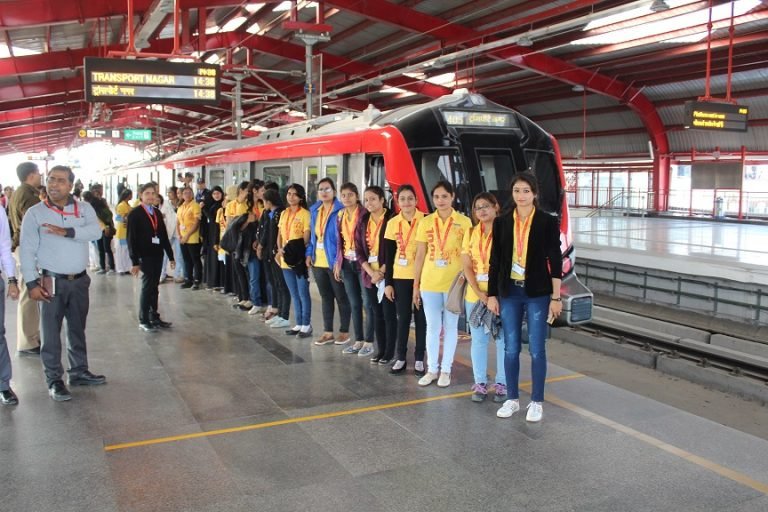
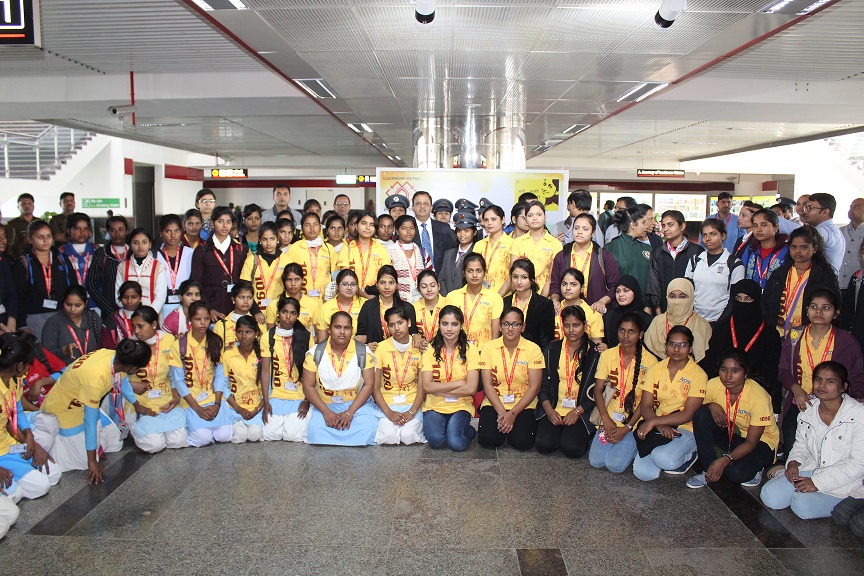
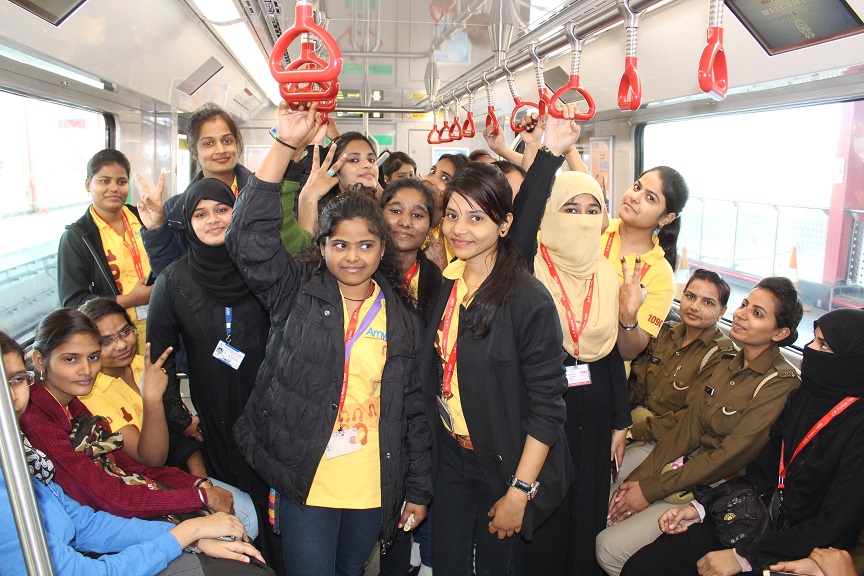
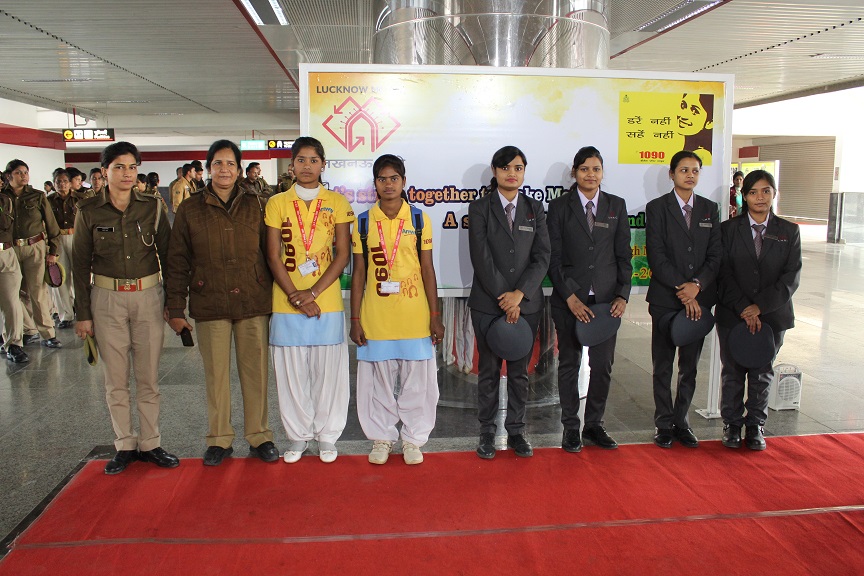
Lucknow: A group of 200 Supportive Power Angles from 1090 visited the Charbagh Metro Station under the supervision of Ms. Babita Singh (DSP, 1090) where they were welcomed by Shri Kumar Keshav, Managing Director, senior officials of the Lucknow Metro Rail Corporation.
The main objective of this program was to pay a tribute to the brave heart girl ‘NIRBHAYA’ by the association of LMRC and 1090.
During this visit, the officers of LMRC provided all important information related with safety and security of female commuters in metro. These include Talk back button, CCTV Camera, availability of female guard at every metro station.
On this occasion, Mr. Kumar Keshav, Managing Director, LMRC while relating to everyone, ensured that while traveling in the Lucknow Metro is completely safe and Lucknow Metro has used every new system for their commuters safety and he said, “Let’s Strive together to make metro-A safe travel for one and for all..”
Women Helpline Team in Lucknow Metro
Ms. Babita Singh and his team described this experience of the Lucknow Metro as very unique and impressed by the metro trains and the systems at the station. She also thanked LMRC to provide such a facility and asked women police to visit the metro system and sensitized female Metro commuters on the safety and security aspects.
Power Angels conveyed the message through the public drama and song that women are no longer weak or not to keep the misconceptions about them of being weak. They also took a ride from Charbagh Metro Station to Krishna Nagar and back.