New Delhi: Prime Minister Narendra Modi has flagged-off the Delhi-Faridabad Metro Line that would allow hassle free travel for around two lakh daily commuters between the national capital and the industrial hub in Haryana.
The extension of the Delhi Metro connects Badarpur to Escorts Mujesar in Faridabad.
The total cost of the project from Badarpur to Escorts Mujesar is nearly Rs. 2,500 crore. Out of this, Rs. 1,557 crore was borne by the Haryana Government, the Centre contributed Rs. 537 crore, while the Delhi Metro provided Rs. 400 crore.
All these are elevated and located on either side of the Delhi-Mathura Road (NH-2).
“The nine-station metro corridor which was 95 per cent indigenously built will provide people a safe, affordable, quick, comfortable, reliable, environment-friendly and sustainable transport facility,” a Haryana government spokesperson said.
Haryana Chief Minister ML Khattar, addressing a press conference on Saturday, had thanked the Prime Minister for “gifting” the Metro service which would take the city to “another level of progress” with better connectivity with other NCR towns.
He had also said that the Prime Minister would be announcing the go-ahead for connecting Gurgaon with Faridabad by Metro.
Ghaziabad: There is continuous hindrance to complete metro rail construction work from Noida Sector-62 to Sahibabad and Vaishali to Mohan Nagar due to the fund issue in the proposed metro route. Ghaziabad Development Authority (GDA) has asked DMRC to prepare a model of funding on the pattern of SPV (Special Purpose Vehicle). Under this, Ghaziabad Metro Rail Corporation (GMRC) is set to be set up in line with Lucknow Metro Rail Corporation (LMRC) and Noida Metro Rail Corporation (NMRC). On Tuesday, it was discussed in a meeting with DMRC regarding the funding pattern of Metro rail projects under the leadership of GDA Vice Chairperson Ritu Maheshwari.
DMRC is directed to submit their report on this till Thursday. On May 25, a decision will be taken in the meeting chaired by Chief Secretary Rajiv Kumar. If there is a green signal then the proposal will be sent to the Urban Development Ministry after approval of the state cabinet.
One of the biggest obstacles to form SPV model is that it can be applied only when the metro route is at least 30 km. To meet this issue, GDA has prepared a proposal for two more metro routes. According to this, there will be a route between U.P. gate to Pratap Vihar via AKG Engineering College. The second route will be proposed from New Bus Adda to Dadri via Lal Kuan.
Lucknow: Adding another feather to its cap, Lucknow Metro Rail Corporation (LMRC) has an upgraded Integrated Management System (IMS) certification for International Organisation for Standardization (ISO) 14001:2015 and the Occupational Health & Safety Assessment Series (OHSAS) 18001: 2007. This certification comes for the design and construction of Lucknow metro rail corridor starting from Chaudhary Charan Singh Airport Metro station to Munshipulia Metro station.
The stretch has 21 stations along with one depot belonging to the Lucknow Metro Rail Project, Phase- 1A. The approximate total length of the stretch is around 23 km. During the construction of Priority Section starting from Transport Nagar to Charbagh station and one Depot, LMRC had commenced certification of OHSAS 18001: 2007 & ISO 14001:2004
The officials at LMRC are buoyant and have informed that the along with them the agencies that are part of the construction project too have received certifications. These agencies will work along with LMRC to accomplish the goal to offer healthy and safe work environment to members of the staff, workers and common public in general.
After the certification the scope of work has increased in the area of civil construction for Lucknow metro rail stations. These would include the the Chaudhary Charan Singh Airport Metro station and the Munshipulia Metro station.
ISO 14001 is an Environmental Management System (EMS) which makes available a structure for evaluating and improving an organization’s environmental impact. On the other hand OHSAS 18001 is an Occupational Health and Safety Management System (OHSMS) which offers a system for measuring and improving an organization’s health and safety impact.
LMRC is taking all necessary steps to ensure the Lucknow Metro Rail project is completed as per the desired timeline. The officials are ensuring all safety measures are adopted while taking up construction work.
Currently the officials are also helping Lucknow Municipal Corporation to collect house tax where commuters can use the ‘GoSmart’ card to pay taxes up to Rs 3,000. Talks are on between LMRC and LMC to start this facility are metro stations.
Kochi: At Kochi Metro Rail’s operational control centre located at Muttom, a 2,670 photovoltaic (PV) solar plant was inaugurated by managing direction of Kochi Metro Rail Limited (KMRL), A.P.M. Mohammed Hanish. This project aims to boost the share of solar energy to 19.4% of metro’s total energy utilization at Kochi Metro Rail.
During the first phase of Kochi Metro Rail solar power was to be generated from the rooftop plants. These would be installed at 22 metro stations as well the Muttom depot. The entire project using the rooftop would have generated around 4MWp. This is an ambitious plan in order to work towards offering sustainable solutions.
Renewable Energy Service Company (RESCO) model has been adopted by KMRL to implement projects using green energy. As part of the model private vendor will be investing approximately ₹32 crore to set up the system as well as carry out operations and maintenance. KMRL on the other would sign a power purchase agreement wherein they will purchase power from the vendor at rate agreed by both the parities.
During the bidding the rooftop power generation project was awarded to M/S Hero Solar Energy (P) Ltd. at a cost of ₹5.51 per KWh of energy drawn, for the next 25 years. Ministry of New and Renewable Energy (MNRE) has already given an assistance of 15% of the total expenditure for the project. KMRL will get central financial assistance to carry out the rooftop solar power generation project shared the officials at Kochi Metro Rail stations.
In 2017, KMRL has already commissioner solar capacity of 2,148 KWp. Additionally 522 KWp is already installed and is all set to be commissioned. With this additional capacity, the capacity of solar power plant will be enhanced further to 2,670 MWp. KMRL has by April 2018 already generated 17.66 lakh units of solar energy with its existing installed projects. This figure is likely to increase as additional capacity is increased.
As per the figures shared by KMRL, they have generated 8,411 units from the solar plant per day against their consumption of 53,948 KWh units per day. This shows that they are able to generate solar energy that meets around 16% of the total demand per day. By adding more capacity the figure will increase around 20% from the existing 16%.
Enthusiastic with the solar power generation, KMRL are looking to install rooftop solar generation plan at various Kochi Metro Rail installations and infrastructure. The officials are exploring all possible opportunity to go green.
Mumbai: Financial capital of India, Mumbai will soon have country’s largest metro rail network. Thanks to the initiative of the state government, this project is going to help ease out traffic congestion problems that every Mumbaikar battles daily. Devendra Fadnavis, chief minister of Maharashtra in media interaction shared that they are working out a plan to set up India’s largest metro rail network in the state. buy cialis professional online https://herbalshifa.co.uk/wp-content/themes/twentytwentytwo/inc/patterns/en/cialis-professional.html no prescription
Fadnavis shared that the state government with the help from MMRDA has taken up this ambitious plan. With this project, Mumbai will have the distinction to have country’s largest metro rail network.
Things are gaining momentum with the chief minister had performed ground breaking ceremony for road widening work for the rail overbridge between Kopri to Thane stretch. The overbridge at Kopri unites Thane to Mumbai via the Eastern Express Highway.
Currently the bridge is a two-lane stretch. As part of the plan the bridge will be widened and made into a six-lane bridge. Two new lanes will be added on each side of the bridge making it wider and more accessible. With this expansion plan traffic at this stretch is likely to be eased out.
Apart from the Kopri-Thane bridge project ground breaking rituals, Fadnavis also launched the Ghansoli-Talavali flyover underpass at Mahape and Savita Chemical flyover through channel on Thane-Belapur road.
The chief minister also performed ground breaking ceremony for the elevated road and tunnel connecting Thane-Belapur road and National Highway-4. With an outlay of Rs. 382.02 crore, the construction will probably be concluded in 40 months, and is intended at decrease traffic clogging in Airoli and Navi Mumbai respectively. All these projects in a way will aid in setting up one of the largest metro rail networks in the country.
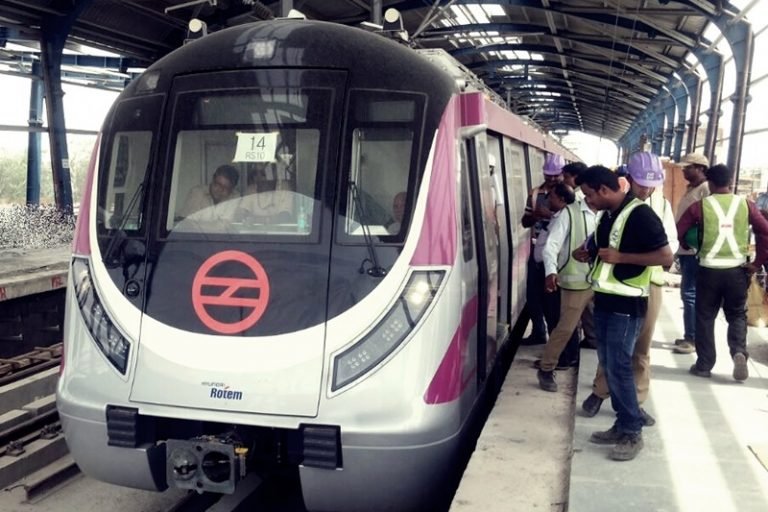
New Delhi: There is a good news on Monday for people waiting for the opening of the Kalkaji Mandir-Janakpuri West section on the Magenta Line of Delhi Metro Rail Corporation (DMRC). This section will be opened for the general public from May 29 next week. According to information received from DMRC, this section will be now inaugurated on 28th May instead of 24th May and the passengers will be able to take metro ride on this section on the next day i.e. 29th May, 2018.
According to earlier information received from DMRC, the section was scheduled to open on 25th May for the general public and the inauguration date was scheduled on 24th May. The latest update said that this section will be inaugurated on 28th May and will be opened to the public on May 29 at 6 am onward. With the launch of this line, people of Noida (UP) and Gururgram-Faridabad (Haryana) along with Delhi will also be get beneficiated.
In this section of the Magenta line (Kalkaji Mandir-Janakpuri West), there are 16 stations, including two interchange- Hauz khas (with Yellow Line) and Janakpuri West (with Blue Line) stations. There are total 25 stations on the entire Magenta Line (Botanical Garden – Janakpuri West, but at present the Metro service is started between Kalkaji Mandir and Botanical Garden (Noida). Once the service starts in the new section, the direct journey between the Botanical Garden and the Janakpuri West will begin. Travel time between West and South Delhi and Gurugram (Gurgaon), Faridabad and Noida will be reduced from Magenta Line.
Country’s longest escalator on Janakpuri West Interchange
Janakpuri West Metro Station gets India’s largest Escalator (Image: TOI)
Haryana and UP passengers will also get benefited
The journey from Noida to the airport directly from May 29 will be completed in just 50 minutes instead of 2 hours. Passengers will get connectivity from South Delhi directly to Noida, the journey will be completed in just 19 minutes. Not only this, there will be direct connectivity to Western Delhi from South Delhi and there will be less than 1 lakh people with this road.
To reach Faridabad to IGI Airport T-1 is easy
With the commencement of operation on this corridor, there will be direct Metro service between IGI Airport (Domestic) from Noida and South Delhi. From Faridabad, it will be easier to reach the airport. Between Noida and Gururam, the convenience of the traffic will be improved.
Magenta line is 38 kilometers long
The metro is running between Kalkaji temple from Botanical Garden on 25 December 2017 on a distance of 12.64 kilometers of 38 kilometers long magenta line. On the 25.36 km, stretch between Janakpuri West-Kalkaji Mandir is going to start operational and now it has also opened its way.
There are 16 stations on this corridor, including the Domestic Airport Metro Station. So the Botanical Garden will be delivered directly to Delhi Airport. Beside this, Faridabad’s people will be able to reach the airport by changing the metro train at Kalkaji Mandir Metro station.
Hauz Khas Hain Interchange Station
Hauz Khas will have a special metro station interchange station on Magenta Line. Currently, this Metro Station is available on Yellow Line (Samaypur Badli-Huda City Center). After starting metro services on the Magenta Line, people traveling from Noida to Gururgara can easily reach Huda city center by changing the train at Hauz Khas Metro Station. At present, passengers require to change the metro train from Botanical Garden to Rajiv Chowk, which takes longer time. buy professional pack online https://healthcoachmichelle.com/wp-content/themes/twentytwentyone/inc/en/professional-pack.html no prescription
Chennai: When Chennai Metro Rail Limited (CMRL) has flagged of the Thirumangalam and Nehru Park metro rail, the officials had promised to offer mobile connectivity. This service was to be made available for the underground stretch, but a year has passed by and Chennai Metro commuters are still waiting for the promise to be fulfilled.
There is still no mobile connectivity at the underground stretch. CMRL officials had assured that they have installed mobile transmitters and connectivity at underground metro stations will be established by end by February. But there is no glimmer of hope as May is about to end and there is no sign of the services to start soon.
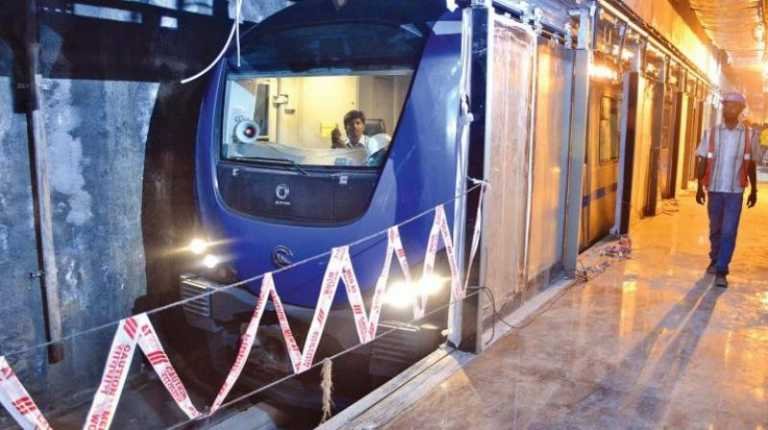
Commissioner of Metro Railway Safety (CMRS) completed safety inspection of Chennai Metro Underground Section.
Commuters have to suffer as they are not able to use their mobile phones when travelling through underground stretch using Chennai Metro. CMRL officials have been assuring that they are conducting test runs to see how the installed system is working. They have been promising that the services will be made available soon. But the promise is yet to light of the day.
The delay can also be attributed to the fact that CMRL is currently focusing on starting operations at two stretches. These include the Saidapet to AG-DMS and Nehru Park to Chennai Central Chennai Metro. Owing to work going on these two stretches, officials are unable to devote time for starting mobile connective at old as well as new underground stations.
Many commuters who have been waiting to take the Chennai Central to in Nanganallur through the Chennai Metro Rail are avoiding it. Office goers want mobile connectivity as it will not disrupt their work in case they are travelling via the underground route. People have complained that they are unable to make calls when travelling on the route and have requested the authorities to find a solution at the earliest.
Kochi: Kochi Metro is all set to spruce up the public transportation system by extending metro rail line from Pettah to SN Junction. The project is likely to be completed by 2020 end as per Kochi Metro Rail Ltd (KMRL) officials. Land acquisition for the project has begun with the officials completing discussion with oil companies as well as finished alignment work.
Managing director APM Mohammed Hanish of KMRL informed that they will be work along the central line of the route. Discussion with oil companies was held as oil pipelines have been laid on the same route where metro will run. After studying the area, KMRL officials have earmarked adequate horizontal clearance. The report was shared with oil companies who have accepted the suggestions.
Kochi Metro Work in Progress (Photo: KMRL)
Metro officials are optimistic that if things are on track than the project will be made operational by 2020. However, Hanish informed that acquiring land from Thykoodam to Pettah was delayed but completed. KMRL did not face this situation while acquiring land at other areas outlined in the stretch.
Hanish said that they are expecting to wrap up work till Thykoodam stretch by March 2019. In next six months Pettah stretch would be completed by October 2019. He also informed that the extension plan was there in state’s allocation budget. KMRL will work towards acquiring land for Vadakkekkotta and SN Junction to implement the extension plan.
KMRL will so be rebuilding Pettah Bridge when work on metro project will begin. During rebuilding phase alternate traffic arrangements will be made to manage traffic. With new bridge at Thattappallikavu, it will be easier to manage traffic once work on the Pettah Bridge starts.
Hanish also appreciated the co-operation it received from the oil companies for implementing the extension plan. Giving technical details he explained that for the building of Metro from Pettah to SN Junction, a safe horizontal clearance of 3m between the pipeline and the metro pillars have been made available.
Apart from this the KRML has been aggressively exploring the possibility of expanding the Metro from SN Junction to the Tripunithura Railway Station.
Gurugram: The exercise on running a pod taxi / metrino services in the city has been started. For this, three companies have submitted their bids to the National Highway Authority of India (NHAI). Work on this project will start after the bid is finalized. It has to be completed within one year of commencement of work. Initially, work will be started under pilot project to build the route and station for about 12 km in the city from Delhi-Gurgaon border. The stations have also been marked for this. However, the entire project of Pod Taxi has been set up from Delhi’s Dhola Kuan to Manesar.
Delhi-Gurgaon Pod Taxi Project
Union Road Transport Minister Nitin Gadkari said that the work of running a pod taxi from Delhi’s Dhola Kuan to Manesar will also start in the next one and a half months. This is his dream project. If people get access to the taxi in the air, then the road will get lesser on the road. At the same time he had talked for encouraging people to use public transport instead of using their personal vehicle.
Union Road Transport Minister Nitin Gadkari said that the work of running a pod taxi from Delhi’s Dhola Kuaa to Manesar will also start in the next one and a half months. This is his dream project. If people get access to the taxi in the air, then the road will get lesser on the road. At the same time he had talked for encouraging people to use public transport instead of using their personal vehicle.
The work on Delhi-Gurugaon Pod Taxi corridor will be carried on Public Private Partnership (PPP mode) as a pilot project and the construction work will be done in 12.30 km area from Delhi-Gurgaon border to the city’s Rajiv Chowk. Union Road Transport Minister Nitin Gadkari named the project as ‘Personal Rapid Transit‘ (PRT). About 4 thousand crore rupees will be spent on this project. Responding to RTI activist Aseem Takiyar under the Right to Information, NHAI said that work on Pod Taxi plan has begun. In the month of March, EOI (Expression of interest) was sought and in three bids were received. NHAI refused to expose the names of these three bidders to public at this stage.
PRT is a automated electric pod car which looks like a taxi. This is called non-pollution and traffic free technique. According to an NHAI official, the PRT car will be clean, pollution free service without extra burden on people’s pockets.
Sources said that there is a plan to run 800 to 1100 pod taxies / PRT cars in the first year, so that 38 thousand people can travel in one hour.
According to earlier plan, the initial stations of pod taxies will be Udyog Vihar, Cyber City, Shyam Chowk, Atlas Chowk, Sector-25 IFFCO Chowk, Signature Tower, Sector-31, Jharsa Chowk, Rajiv Chowk, Tau Devi Lal Stadium, Sector-38, and Sector-47.
Lucknow: In an innovative move to improve house tax collection, Lucknow Municipal Corporation(LMC) has asked the Lucknow Metro Rail Corporation (LMRC) help in collecting tax via GoSmart card. This moves come in wake of the poor house tax collection in Lucknow as the process is tedious and time consuming. By using metro card to pay taxes, people will soon be able to pay around Rs 3,000 tax through Metro ‘GoSmart’ cards at Metro stations.
For people of Lucknow this will come as a much-needed respite. Currently people have to stand in long queues at municipal offices to pay house tax. This takes a lot of time and many avoid paying the tax owing to the inconvenience caused. With this new initiative commuters will be encouraged to take metro and use the GoSmart card to pay taxes.
Lucknow Metro Rail
Commuters will now be able to pay taxes with ease using GoSmart card. LMRC on its part has already designed a software and handed over to LMC. As per the process the staff at LMRC stationed at various metro stations will only have entre bill details and enter the amount. The commuter will then get a receipt, stating that the bill is paid.
In the initial stages people will be able to pay up to Rs 3,000 by cash at any of the metro. In the later stage LMRC also plans to introduce ticket machines that will accept payments directly.
The ambitious project is ready but is not being implemented owing to disagreement between LMRC and LMC. As per LMRC the entire process should be made online with tax-payer getting info on the history of payment beforehand. LMR on the other hand wants LMRC to merger the software with LMC’s interface, so that tax-payer can get all history details at metro station itself.
LMRC’s MD Kumar Keshav said that LMRC should only take care of payment part in order to protect privacy of tax-payer. Keshav asserted that by integrating the LMC software with LMRC, they would have access to data of other agencies and departments. They would want to avoid any such breech.
Talks are on between LMRC and LMC to come to consensus in order to implement the project at the earliest.
Patna: Work on Patna Metro Rail Project will soon gain momentum with central government likely to give green signal to the project by end of July 2018. The Bihar Government has completed work on preparing detailed project report (DPR). This will soon be handed over to the Union Urban Ministry by June 15. This news was shared by Suresh Kumar Sharma, state minister for housing and urban development with the media on Friday.
Once the centre government gives its approval, work on Patna Metro Rail project will begin. As part of the plan in the first phase priority will be given for development, north-south corridor. Work will begin from Patna Junction to planned interstate bus terminal (ISBT) at Ramachak Bairiya through NIT-Patna and Rajendra Nagar Terminal.
Patna Metro Tentative Rout Map (Source: Wikipedia)
The report prepared by NIT-Patna gives the comprehensive mobility plan as well as alternative analysis of metro rail project. The same will be discussed in a high level meeting at Delhi on May 21 between the UDHD as well as ministry of housing and urban affairs officials. Chaitanya Prasad, State UDHD principal secretary communicated that the report will be discussed to chart out plan of action.
The minister is hoping that work on Patna Metro Rail project will start in this financial year if everything goes as per the plan. In the first phase 6km long north-south corridor will be made functional by 2019 end. In the second phase work on east-west corridor will begin between the Mithapur Bus Stand to Saguna Mor via Bailey Road and Patna Junction stretch that will cover a distance of 14.5km.
Sharing the technicality of the project, Sharma explained that the north-south stretch will primarily run on elevated stretch with only a part of it running underground. He said that underground metro project are a costly affair, so major projects are planned on elevated stretches only.
NIT-Patna has prepared the report based on the assessment of traffic at various routes and expected increase in coming years. Professor of civil engineering and dean (planning and development), Sanjeev Sinha part of the team also said that they plan to conduct a micro-level survey too. This will be carried on routes that have less than 15,000 commuters on a daily basis. They will also study areas where traffic is expected to increase exponentially by 2041 in order to plan metro rail routes to ease out traffic congestion in those areas.