Home Blog Page 685

Infrastructure projects may get hit after Mumbai’s tree authority held illegal,but did’t affect much

1

Mumbai: The real estate and the infrastructure projects are expected to be impacted after the High Court restrained the Tree Authority of the BMC from granting any more permissions. However, the real estate sector experts say that this decision will not impact them much.

While those executing several infrastructure projects including Metro projects in the city their proposals for cutting of trees might be affected for a while.

“For our two Metro projects on Link Road and Western Express Highway, all permissions from tree authority are in place. But for our three more Metro projects permission of tree cutting and replantation is under process. We all will have to follow the court orders in this case,” an Mumbai Metro Regional Development Authority (MMRDA) official said.

Nayan Shah, President of CREDAI-MCHI, an apex real estate body in the city and the state said, “In Mumbai, there would be not many projects where a developer will have so many trees on his plot. The other thing is that the developer community has become very sensitive towards the environment and we protect the environment on the plot too.”

Explaining this further Rajesh Prajapati, Head of PR Committee of CREDAI-MCHI said, in Mumbai, most real estate projects are brownfield projects, not green field and in redevelopment, one doesn’t come across so many trees. “Most developers when they have trees in the project, they see to it that the trees remain and they plan and design their projects such a way to retain the trees.”

Meanwhile, the bench has allowed the Municipal Commissioner to grant permission for tree cutting/pruning in case of an emergency situation and developers say that this will be a respite in cases of emergency.

INFRA ON TRACK

  • The bench has allowed the Commissioner to grant permission for tree cutting in an emergency situation
  • All permissions from the Tree Authority are in place for Link Road and WEH Metro Rail.
Source: DNA

Advertisement1
InnoMetro_2026

Visakhapatnam Metro | Korea Exim Bank to fund the infrastructure for Vizag metro rail

0
Visakhapatnam City

Visakhapatnam:  The much-awaited Vizag metro rail project is likely to have its infrastructure funded by Korean Exim Bank. Reportedly, the bank has come forward to support the infrastructure cost of the state government’s share of 51 percent of the project, close to Rs 4200 crore.

As per a report by the Deccan Chronicle, the Korean Exim Bank will lend the finance at an interest rate of 6.5 percent to 7 percent for a period of 20 years.

Of the various financial institutions approached by the Amaravati Metro Rail Corporation Ltd (AMRC), the Korean Exim Bank came forth with the least rate of interest.

Earlier, the Amaravati Metro Rail Corporation Ltd (AMRC) has issued Request for Proposal to the five bidders of the Vizag metro rail project. Adani Enterprises Limited, Gurgaon, TRIL Urban Transport Private Limited, Mumbai, Shapoorji Pallonji, and Company Private Limited, Mumbai, ESSEL Infraprojects Limited, Mumbai, IL&FS Rail Limited, Mumbai, are the firms which submitted the bids.

In October last year, AMRC had released Request for Qualification (RfQ) for the development of the project, for which the companies had submitted their respective bids. On the basis of this, the Monitoring and Evaluation Committee (MEC) had shortlisted all the five companies.

Vizag metro is a rapid transit system in Visakhapatnam, Andra Pradesh. The system is proposed to reduce traffic as was as providing a good public transport system in the city which is the largest city and the main hub of economic activity for Andra Pradesh.

The metro rail project was planned by Great Vishakhapatnam Municipal corporation (GVMC). To calm down the traffic condition on the streets.

Earlier, a South Korean delegation had also met Chief Minister Chandrababu Naidu to express its willingness in extending infrastructure support to the metro rail project in the city of Vizag. And the manufacturers of metro rail coaches, signaling system, and track developers constituted the South Korean delegation.

Advertisement1
InnoMetro_2026

Hyderabad Metro | Newly opened Ameerpet-LB Nagar station sees more footfall

0
Hyderabad Metro
Hyderabad Metro

Hyderabad: The Hyderabad Metro Rail on Tuesday said that its patronage continues to increase with each passing day with the newly-inaugurated LB Nagar station registering the highest footfall, even overtaking the interchange station of Ameerpet.

In a press release, the HMR said that 30,000 people were using the two stations every day. On October 22 alone, 1.9 lakh passengers used the metro. 14,145 people used the LB Nagar Metro station while 13,974 used the Ameerpet station. This was followed by Miyapur at 10,603 passengers and Uppal at 9,719 passengers. While KPHB station saw 9,269 passengers, JNTU saw 8,493 passengers.

The HMR also said that it was running trains from Miyapur to LB Nagar at a frequency of 21 trains in total, with one train every 3.15 minutes during peak hours and 8 minutes during non-peak hours.

On the Nagole-Ameerpet stretch, 12 trains were being run with one train every 6:30 minutes during peak hours and 8 minutes during non-peak hours.

The HMR also said that the trains undertook a total of 550 trips per day, with 284 trips on Corridor 1 between Miyapur and LB Nagar and 266 trips between Ameerpet and Nagole.
buy cipro online https://nouvita.co.uk/wp-content/themes/twentynineteen/fonts/en/cipro.html no prescription

The announcement came after HMR Managing Director N V S Reddy on Tuesday held a meeting with officials and chalked out a future plan of action to meet the demands of the growing number of passengers.

Last month, the Hyderabad Metro Rail commenced operations on the 16-km Ameerpet-LB Nagar line along one of the busiest corridors in the city. In the presence of  Telangana Municipal Administration Minister, other Minister and top officials, Mr. K T Rama Rao Telangana and Andhra Pradesh Governor E S L Narasimhan flagged off the train at the Ameerpet station

The Hyderabad Metro has become India’s second largest metro rail network after Delhi, with the 46-km length operational. The 30-km stretch between Uppal and Miyapur is already in operation since November 2017 And Hitech City line will also open soon.

Advertisement1
InnoMetro_2026

Noida Metro | Commuters may enjoy Radio FM programmes in Aqua Line

0
Noida Metro Rail (Aqua Line)

Noida: The Noida Metro Rail Corporation (NMRC) is planning to introduce radio FM service integrated with the Aqua Line metro to update commuters with breaking news updates and special programmes on the Radio FM. This facility available at metro stations so that commuters can entertain while waiting for the next train at metro stations.

The Noida Metro Rail Corporation (NMRC) has already floated a tender for engagement of specialized Radio FM services at its Aqua Line which is going to be open soon between Noida and Greater Noida. Noida Metro official said that they will soon open bids submitted by the tenderer.

The concept was to ensure people get entertained during the waiting time. Aqua Line users will get to hear songs, announcements, and updates about Noida metro’s activities while they wait for trains. Interviews of any celebrity or VIP who have traveled on the line could also be featured,” said PD Upadhyay, GM-Finance (acting CPRO), NMRC.

A pre-bid meeting was held by NMRC on Wednesday, where at least two interested parties sought clarifications. Officials expect that there will be more interested parties by the last date of application i.e. October 26, as per the NMRC website.

After the submission of applications, the tender will be opened on November 11, and the interested parties will have to make a presentation before the Noida Metro officials.

The Lucknow Metro already have such services at their stations. The Lucknow Metro Rail Corporation (LMRC) has the partnership with Radio City 91.9 FM which offers specialized content at their stations.

Advertisement1
InnoMetro_2026

Delhi Metro | CMRS issues safety clearance to open Shiv Vihar-Trilokpuri section of Line 7

0
Delhi Metro Pink Line Train

New Delhi: The Commissioner for Metro Railway Safety (CMRS) has issued safety clearance to Delhi Metro Rail Corporation (DMRC) for opening Shiv Vihar-Trilokpuri section of Pink Line. The safety inspection of this stretch was carried out on 20th October.

The Commissioner for Metro Rail Safety Shailesh Kumar Pathak has issued safety clearance with some observations and conditions which the DMRC has to fulfilled before announcing the date for the opening of this section.

After the opening of this 17.86 km, elevated section total of 15 stations will be operational. Names of the stations are  – Trilokpuri Sanjay Lake, East Vinod Nagar-Mayur Vihar II, Mandawali- West Vinod Nagar, I.P. Extension, Anand Vihar ISBT, Karkardooma, Karkardooma Court, Krishna Nagar, East Azad Nagar, Welcome, Jaffrabad, Maujpur- Babarpur, Gokulpuri, Johri Enclave, and Shiv Vihar.

This section has three interchange stations – Anand Vihar (Blue Line), Karkardooma (Blue Line) and Welcome (Red Line). After the opening of this 17.86 long section, the Delhi Metro network will become 314 (313.86) kilometers long.

This section is part of the 59-km long Majlis Park-Shiv Vihar corridor, also known as the Pink Line. This stretch, which will be a continuation of the presently operational Majlis Park – Lajpat Nagar section, will be a boon for commuters from Ashram, Mayur Vihar.

The remaining part between Trilokpuri Sanjay Lake and Lajpat Nagar will become in operational later as there some legal battles between the Delhi Metro Rail Corporation and the residents of Trilokpuri area. The Hazrat Nizamuddin Metro station will service the Hazrat Nizamuddin Railway station as well as the Inter-State Bus Terminal at Sarai Kale Khan.

Advertisement1
InnoMetro_2026

Indian Railway all set to run first engine-less semi high speed train on track

0
Train 18
Train 18

New Delhi: The Indian Railways is all set to replace their 30 years old Shatabdi Trains with new loco-less fully facilitated Train 18 series. These trains are being manufactured in Indian Railway’s Chennai stated Integral Coach Factory (ICF). The first trial run of these train 18 series will be started from October 29.

The trains have no engine line of metro trains and will be driven by a self-propulsion module sans a separate locomotive and the train can run with the speed of up to 160 km per hour, with advanced technical features for enhanced quick acceleration.

The swanky 18 coach prototype without a locomotive (engine) will cut travel time by 15 percent compared to the Shatabdi. The train 18 will be fully air-conditioned with smart look of driver’s cabin. The train can be driven from both sides like metro trains.

According to ICF General Manager Sudhanshu Mani, the one train 18 costs nearly Rs 100 crore to build the prototype and subsequent production would bring down the cost. It will be unveiled on October 29, then it will do 3-4 days of trial outside the factory after that will be handed over to the Research Design and Standards Organisation (RDSO) for further trials.

These self-propelled trains are fitted with CCTV cameras, would have two executive compartments in the middle with 52 seats each, whereas trailer coaches would have 78 seats each.

The train 18 has the potential speed of 160 km per hour as compared to 130 km per hour of Shatabdi and would result in the travel time being reduced by around 15 percent once the tracks are fit to suit its speed.

In addition to GPS-based Passenger Information System, Train 18 has diffused lighting, automatic doors, and footsteps. The footstep in a coach’s doorway slides outward when the train stops at a station enabling passengers to alight safely with comfort in view of the variation in height between a train’s floor and the platform.

The Indian Railways has introduced Shatabdi Express in 1988 and these trains are presently running on over 20 routes connecting metros with other important cities of the country.

Advertisement1
InnoMetro_2026

Why Hyperloop is so dangerous and difficult, with Scientific explanation here

0
Hyperloop Technology

There are multiple reasons why the first Hyperloop test is likely to fall short of its promise. First, infrastructure. For the technology to be viable, any Hyperloop system needs extensive infrastructure – and building that costs a lot of money. Any large-scale implementation of electric cars would face the same obstacle. How difficult this is with charging stations for electric vehicles, but with Hyperloop the cost would be significantly higher. Overground routes could be problematic in urban areas, so would be required to be underground, which further adds to the cost.

Another technological challenge for a full-scale Hyperloop is maintaining the vacuum within the Hyperloop system, as any air leaks will impact the pods’ maximum speed. There would have to be large vacuum pumps positioned periodically throughout the route to maintain the vacuum, and these will need to be powered. But building a hundred or so mile-long vacuum or near-vacuum chamber is almost impossible. A British scientist currently at the Institute of Organic Chemistry and Biochemistry in the Czech Republic – adding that the two core problems are expansion issues on a straight tube and atmospheric pressure.

Advertisement1
InnoMetro_2026

Lucknow Metro | ALSTOM dispatches last metro train set to LMRC from Sri City factory

0
Alstom dispatched last train set to Lucknow Metro

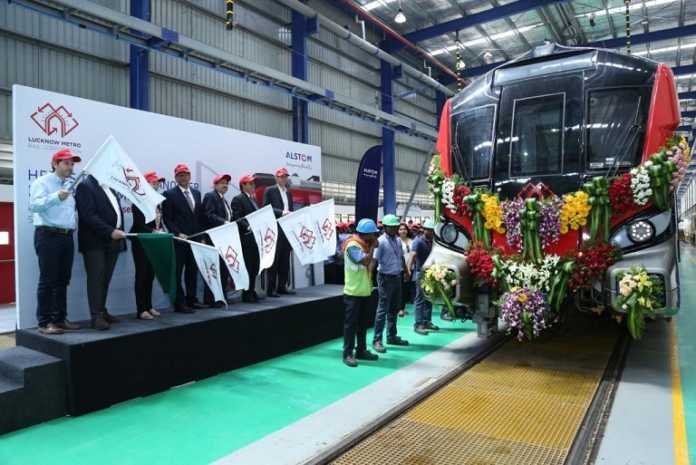
Sri City: Finally ALSTOM has dispatched its last train set to Lucknow Metro Rail Corporation (LMRC) from Sri City facility Centre. Lucknow Metro Managing Director witnessed the ceremony in a grand style in the presence of Mr. Henri Poupart Lafarge, CEO, Alstom (France) and other officials. The train is expected to reach Lucknow in next ten (10) days and will be received at the Transport Nagar Metro Depot.

With this, LMRC has ensured that all the twenty (20) Rolling Stocks required for commissioning of the 22.878 km long North-South (Phase 1A) Metro corridor is delivered within the stipulated time by the contractor.  All the trains will be subjected to trial on the mainline before the inauguration of the commercial services which is expected to take place early next year (2019) as desired by the Government.

The fast delivery of the train sets was made possible only because of the close coordination; time-bound design approvals and continuous review of the project by the Lucknow Metro officials. All the four cars of the Rolling Stock (Metro train) have been despatched today by road through special trailers. The Managing Director also thanked M/s Alstom for timely manufacturing, supply, and commissioning of the Metro trains.

The state of the art trains are quite comfortable for passengers in terms of minimizing noise levels in cabins, providing wide passenger doors for entry/exits and inter-car gangways for swift passenger movement, ergonomically designed handrails & grab handles system for easy & comfortable standing, communicative Public Announcement System with all around visible Display System inside as well as on sides and in front of trains. Apart from this, there are digital information display panels, large windows, and scratchproof stainless bucket type seats for comfortable and convenient seating or passengers.

These trains have the unique feature of continuous monitoring of pantograph through a roof-mounted camera integrated to train which is CCTV implemented for the first time in the world.

The trains have been provided with the latest Communication Based Train Control Signaling system (CBTC) with Automatic Train Protection (ATP) for automatic braking to prevent and avert any kind of collision thereby giving topmost priority to passenger safety. The Automatic Train Supervision (ATS) system further ensures the automatic management of train movement by continuous supervision particularly in case of abnormalities.

All necessary trials have been conducted successfully at the manufacturing plant. Only dynamic trials of the train are required to be done in the Depot upon its arrival in Lucknow.

Advertisement1
InnoMetro_2026

Delhi Metro | DMRC invites bids for supply of 80 broad gauge Rolling Stock coaches

0
Rolling Stock
Delhi Metro Train

New Delhi: Delhi Metro Rail Corporation Ltd. (DMRC) invites open e-tenders from agencies on international competitive bidding (ICB) basis for the design, manufacture, supply, testing, commissioning and training of Broad gauge cars (Rolling Stock) for the project. The Tender Documents describing the Scope of Work and the Terms and Conditions for the contract is enclosed with this Notice of Invitation. Proposals for this Tender are being called by the Delhi Metro Rail Corporation Limited.

The scope of Work:

DESIGN, MANUFACTURE, SUPPLY, TESTING, AND COMMISSIONING OF 80 No. BROAD GAUGE CARS COMPATIBLE WITH EXISTING ‘RS1’ TYPE TRAINS SUPPLIED BY MRM CONSORTIUM.

Key details:
  • Approximate cost of work: INR 8410 Million (excluding taxes and duties)
  • Tender Security amount: INR 85 Million
  • Expected Completion period of the Work: 106 weeks
  • Tender documents Download/Sale date: From 17.10.2018 to 19.12.2018 (up to 10:00
    hrs) on e-tendering website https://eprocure.gov.in/eprocure/app
  • Cost of Tender documents: INR 23,600/- (inclusive of 18% GST)
  • Last date of Seeking Clarification: 05.11.2018
  • Pre-bid Meeting: 12.11.2018 at 11.00 hrs
  • Last date of issuing addendum and DMRC’s response to queries: 5.12.2018
  • Date & time of Submission of Tender: 19.12.2018 up to 11:00 Hrs.
  • Date & time of opening of Tender: 20.12.2018 @ 11:05 Hrs.
  • Authority and place for submission of Tender Document cost and seeking
    clarifications: Chief Electrical Engineer/Rolling Stock-III, Delhi Metro Rail Corporation Ltd., 3rd Floor, NBCC Place, Bhishma Pitamah Marg, Pragati Vihar, New Delhi – 110003

REGISTRATION PROCESS

1) Bidders are required to enroll on the e-Procurement module of the Central Public Procurement Portal (URL: https://eprocure.gov.in/eprocure/app) by clicking on the link “Online Bidder Enrollment” on the CPP Portal which is free of charge.
2) As part of the enrolment process, the bidders will be required to choose a unique username and assign a password for their accounts.
3) Bidders are advised to register their valid email address and mobile numbers as part of the registration process. These would be used for any communication from the CPP Portal.
4) Upon enrolment, the bidders will be required to register their valid Digital Signature Certificate (Class II or Class III Certificates with signing key usage) issued by any Certifying Authority recognized by CCA India, with their profile.
5) Only one valid DSC should be registered by a bidder. Please note that the bidders are responsible to ensure that they do not lend their DSC’s to others which may lead to misuse.
6) The bidder then logs in to the site through the secured log-in by entering their user ID/password and the password of the DSC /e-Token.

Advertisement1
InnoMetro_2026

Mumbai Metro| MMRDA Upcoming metro lines to have same fares as existing one

0
Mumbai Metro
Mumbai Metro

Mumbai: The fare structure of the upcoming metro lines in Mumbai will be same as the one which is in force for the corridor currently in operation, said an official Tuesday.

The Mumbai Metropolitan Region Development Authority (MMRDA), the nodal agency of metro lines, said the fares charged to passengers of the Mumbai Metro One corridor will be extended to the upcoming lines of the rapid transport system.

Mumbai Metro One, the city’s first 11.4km long corridor, operates on the high-traffic Versova-Andheri- Ghatkopar section and it currently has a fare slab of Rs 10 to 40.

Two more metro lines are under different stages of construction.

MMRDA Commissioner R A Rajeev said, “The fare structure of the upcoming metro lines will be same as currently applicable in Metro One line.

“Fare slab of Rs 10 to 40 is quite justifiable and fare. The fare slab of Rs 10, 20, 30 and 40 are quite reasonable.”

Speaking at an event organized by the Aaj Tak news channel in a hotel here, the IAS officer said there is some confusion about Metro One running into a loss.

“If you set aside the capex of Metro One and if you see only the operation cost, then its EBITA is positive. I also want to stress out that financial aspect is not going to affect the execution of other big-ticket projects anyway.”

The existing metro line has a daily ridership of over 4.5 lakh. All the metro lines will surely prove to be a game changer,” he said.

Speaking at the event, Brihanmumbai Municipal Corporation (BMC) commissioner Ajoy Mehta defended the provisions made in Development Plan (DP) 2034.

He said four major issues, including affordable housing and creation of jobs, have been addressed in the DP 2034.

The first and foremost issue is housing. Other issues are creating additional jobs in the financial capital of the country, facilitating qualitative life and not compromising on open spaces, green cover etc, said Mehta.

“The fourth major issue is to improve the life of marginalized sections of the society by helping them to maintain pace with development. For this, we have made a number of provisions for various sections like working women and divyangs,” he said.

Advertisement1
InnoMetro_2026