Home Blog Page 684

Exclusive interview with Achal Khare, MD, NHSRCL: Bullet train to start in 2022

0
Achal Khare, Managing Director, National High Speed Rail Corporation

Prime Minister Narendra Modi ambitious Mumbai-Ahmedabad bullet train project corridor is going to be built for the first time in India, aimed at connecting the two cities in two hours and it is making headlines from the beginning. Earlier it was a matter of debate, but now it is in the headlines due to land acquisition. It is being said that the land is not getting acquired due to the opposition by farmers. In such a situation this project may lie down and its cost may increase. Mr. Achal Khare, Managing Director of National High-Speed Rail Corporation (NHSRCL) has shared his views on all such important aspects related to this project. Here are excerpts-

How much land is to be acquired for bullet train project?

The total land is over 1,400 hectares, with 353 hectares in Maharashtra and the rest in Gujarat. This is divided into 7,000 plots, in 195 villages in Gujarat and in 104 villages in Maharashtra. The project covers three districts in Maharashtra and eight in Guajarat, besides a small area in Dadra & Nagar Haveli.

Can a change of alignment be required due to the problem of land acquisition or can it be late in the project?

There should be no problem with the alignment. We have set the target for December 2018 to complete the land acquisition. If we get 80 % of the land till next May, then the project will run at its own pace. I do not think there will be any delay in the project.

What are you saying behind the scenes? But when will the public see the project speed?

There are many things going on. For instance, the work of training center in Vadodara is in progress. There is a depot to be constructed on 76 hectares of land in Sabarmati. The structures are being removed to clear the land. The tender is open for the Bullet Train terminal station in Sabarmati and it will be seen in January. Tenders for construction of two bridges are opened and new tender for construction of the tunnel in Mumbai will be floated in January 2019. I think the work of this project will be seen catching up at the speed of July next year.

Are you sure the bullet train will run on a fixed schedule?

MAlthough the Consultant of Japan has laid the target for this project on December 2023, it is our target that the bullet train should be run on 15th August 2022. In this case, we are promising that by 15th August 2022, the bullet train will start running, that means people will start traveling in it.

What about the first installment of the loan from Japanese agency JICA?

Japan has signed an agreement for the first installment of INR 5500 crores, but there is a special process of payment. Under this process, when the work is done for the first bullet train, the company will pay by the money of the Railways and then after Japan will transfer it to the NHSRCL.

Mumbai to Ahmedabad, 508 Km

Trains will be imported for the bullet train. Will tender for these trains be floated/will these trains be made in India?

rNo company in India yet makes bullet train, so we tend to tender for Japanese companies only. But according to the agreement, there is a term of transfer of technology. Indian companies will come forward in this direction, then they will have a firearm with Japan. After that these trains will start production in India. But there are many such devices, such as track fittings, electric poles, transformers, which are essential for bullet trains. Such devices will be produced here only. The steel structure will also be built here. Around 90 thousand tonnes of steel structure will be used. It will also be done under Make in India.

What is the nature of the tie-up with the East Railway Company in Japan? What is the percentage of resources, manpower, cost India would use of theirs and for how long?

We have a co-operation between the government of Japan which has asked the East Railway Company to give us the hand-holding. The company is working as the representative of the government of Japan. Coming to the component part, the Japanese share is 18.6 per cent of the total work. To clear it further, all civil construction will be with the Indian companies which will cost around Rs 45,000-50,000 crore.

We need the expertise of Japan on matters involving signalling and rolling stock (train equipment). They are going to train 350 of our people in due course and they will receive on-job training. They will prove ambassadors for us who on return will train the people at the upcoming Vadodara railway institute.

The institute will be an exclusive high-speed training institute. Five hectares of land has been carved out on the campus for National Academy of Indian Railway and we have already awarded some tenders. It will be completed by 2020 and people will be trained on the working of the train. We will have all those training facilities which are available at the high speed institute of Railway Technical Research Institute (RTRI) in Japan. The Japanese are helping us out with its profile and we are taking their advise on the same.

What is the total break-up of the cost of the project?

From the total project cost of Rs 1.08 lakh crores, the capital cost of the project is Rs 85-88,000 crores. Out of that, Rs 20,000 crores are coming from India and rest is from Japan. What India is funding involves land, utility relocation, PAP resettlement and taxes, the rest will be funded by Japan. As much as 81 per cent of the total cost will be borne by Japan.

What are the estimates for fare, footfall and speed of the train?

The final fares of the train will be decided only when the service starts. As of now, we are guided that the fare between Ahmedabad and Mumbai will be 1.5 times the fare of the first class AC of a premium train. The footfall of the train is expected to be around 40,000 people in the starting year, a lot of which will come from air and road travel. Till 2053, there will be 1 lakh, 66,000 passengers, using the bullet train.

This project is being financed at a very low cost. I am confident that we should be able to manage the project and recover our operating and maintenance costs.
Advertisement1
InnoMetro_2026

Lucknow Metro | Metro Services to be available from 6 am to 7 pm Only on “Diwali”

0
Lucknow Metro
Lucknow Metro renamed as Uttar Pradesh Metro Rail Corporation (UPMRC) Limited (http://www.lmrcl.com/media/all-images/project-pictures/)

Lucknow: On the festive day of ‘Diwali’ this year (i.e. 7th November, 2018), the Lucknow Metro services shall be available for passengers from 6:00 AM to 7:00 PM only. The Metro train services will commence at the daily usual time of 6 in the morning but will ply till 7 in the evening only instead of 10:00 PM.

The last Metro trains from the Transport Nagar Metro Station & the Charbagh Metro Station shall depart at 7 PM (i.e. 19:00 HRS) & 7.16 PM (i.e. 19:16 HRS) respectively.


Advertisement1
InnoMetro_2026

Bangalore Metro | Work on Metro Phase-II depots likely to begin

0
BMRCL Airport line work complete by December 2024 at the cost of Rs. 800 Crores
Image Source: BMRCL

Bangalore: While civil works pertaining to Metro lines had commenced along all routes, land acquisition issues ensured that work in all the six depots planned for the 72.1-km network remained a non-starter and Finally, work related to two depots in Phase-II of Namma Metro can commence.

At a high-level meeting held at Vidhana Soudha on Wednesday. The Commerce and Industries department, the parent body of the Karnataka Industrial Areas Development Board (KIADB) assured top Bangalore Metro Rail Corporation Limited (BMRCL) officials that the compensation amount pertaining to problematic patches of land at Kothanur and Hebbagoddi depots will be finalized in a fortnight.

Kothanur depot will be stabling and maintaining trains that will run on the R V Road-Bommasandra Line (Reach-5) while Hebbagodi depot will cater to the Gottigere to Nagavara Line (Reach-6).

M.S Channappa Goudar, General Manager, Land Acquisition Cell, BMRCL told that the work relating to tendering of these two depots can begin as the KIADB has assured us that the award will be announced in a fortnight. While some civil works have begun on both the lines, it is vital the depot is also in place when the line is ready.

Large parcels of land out of 30 acres required to put in place the Kothanur depot are stuck in High Court as there is a tussle between the government and the private parties over ownership of land. However, since we require the land for infrastructure work, we will deposit the compensation amount that needs to be paid in the HC and take over the land to carry out works, he said.

Advertisement1
InnoMetro_2026

Vijayawada Metro | Panel opts Light Metro Rail for Amaravati

0
Light metro to connect Vijayawada with Capital on cards

Vijayawada: On Thursday a committee led by municipal administration P Narayana recommended Light Metro Rail system and elevated corridor for all 77 km lines as part of Amaravati Metro Rail project after discussing various transport options.

The Vijayawada metro, which has been in a limbo, gained impetus with the Steering Committee, constituted for the project execution, finalising the preliminarily structure of the project.

The meeting recommended corridor from KC canal junction to Amaravati capital city with 27 km with both Elevated and Underground options.  The minister also suggested that to officials to study the advantages and disadvantages of both options of taking the corridor. The matter will be finalized after discussion with Chief Minister next week.

The four options proposed by the consultants preparing the Detailed Project Report (DPR) of the metro rail, the Steering Committee told the Amaravati Metro Rail Corporation (AMRC) to go ahead with an elevated light metro system.

The project has been proposed in three corridors in and around Vijayawada with a total length of 77 km. In the committee meeting held on Thursday, Municipal Minister P Narayana suggested that the consultant — Systra Consultants — examine the extension of one of the corridors to Amaravati.

According to the interim DPR submitted by Systra, four options – At-grade, elevated, underground, and combination of elevated and underground – were suggested. It also suggested that the State government could go with Light Rail Transit (LRT) or Light Metro. “The committee examined the phase-A of the DPR submitted on October 25 and suggested to go for Light Metro system and Elevated corridor for all 77.2 km of corridors,” a press release from Minister Narayana’s office said. Narayana is the chairman of the Steering Committee.

The three corridors proposed by the consultants include Amaravati – Pandit Nehru Bus Station (PNBS) – Nidamanuru-Gannavaram (52 km), PNBS – Penamaluru (12.5 km) and Railway Station – Jakkampudi (12.2 km). According to the press release, Minister Narayana, on the occasion, suggested the inclusion of cost estimates for the corridor from Krishna Canal (KC) junction to Amaravati Capital city – about 27 km – with both options of the elevated and underground metro.

Route map of Amaravati Light Metro Rail

“Minister Narayana also suggested that a study is conducted on the advantages and disadvantages of having an underground line near the airport while the remaining corridors would be elevated,” the press release said.

Advertisement1
InnoMetro_2026

Delhi Metro | DMRC plans 4831 trips in a day to control air pollution, Brings In 21 Additional Trains

0
KEC Awarded Delhi Metro Pink Line's DE-14 Electrification Contract
Image Source: DMRC

New Delhi: Good news for those who frequently use Delhi Metro service, take a note of this! In an effort to control severe air pollution in the national capital, the Delhi Metro Rail Corporation (DMRC) is taking a big step. Keeping in view the worsening air quality in Delhi-NCR, the DMRC has introduced 21 additional trains on its network. The services of additional metro trains started October 31 onwards, providing 812 additional trips. It includes 14 metro trains with 730 trips on newly introduced Shiv Vihar-Trilokpuri-Sanjay Lake section of Pink Line

The Shiv Vihar-Trilokpuri Sanjay Lake section of Delhi Metro Pink Line was flagged off on 31st October 2018 by Manish Sisodia, Deputy Chief Minister, National Capital Territory of Delhi along with Hardeep Singh Puri, Minister of State (Independent Charge), Housing and Urban Affairs, via remote from Metro Bhawan. The 17.8 km long Shiv Vihar-Trilokpuri Sanjay Lake section is entirely elevated and covers 15 metro stations, including 3 interchange stations- Welcome metro station for Red Line, while Karkarduma and Anand Vihar ISBT metro stations for Blue Line. With Shiv Vihar-Trilokpuri Sanjay Lake section, metro users will be connected to many northeast areas of the national capital such as Gokulpuri, Jaffrabad, Johri Enclave and Maujpur.

Meanwhile, another section of Delhi Metro’s Pink Line, linking Lajpat Nagar to Mayur Vihar I metro stations is likely to begin soon as well. The Lajpat Nagar-Mayur Vihar I section is 9.7 km long and it will cover five metro stations. With the commencement of this section, many locations across South Delhi such as Moti Bagh, Sarojini Nagar, Lajpat Nagar, South Extension, Vinoba Puri, Ashram etc. will get direct connectivity with the eastern part of the national capital.

With these additional train services, the Delhi Metro, for the first time in history, will be running 4831 trips in a day. This is the highest ever so far.

The move aims to ensure smooth public transport and reduce reliance on private vehicles. Vehicular pollution and number of vehicles on road has been a perennial cause of concern in Delhi.
buy soft pack online https://www.mydentalplace.com/wp-content/themes/twentytwelve/inc/en/soft-pack.html no prescription

Advertisement1
InnoMetro_2026

Lucknow Metro | Commuter’s Safety and Security: Lucknow Metro’s priority

0
LMRC Staff returning the belongings to their rightful owners

Lucknow: Lucknow Metro not only provides quick travel but also gives priority to the safety and security of its passengers. In last month only, Lucknow Metro has actively redressed various needs and problems of its passengers. Lucknow Metro’s readiness can be estimated from the fact that in this period, seven mobile phones, two laptops and other valuables from Lucknow Metro premises are safely returned to its rightful owners. Not only this, Lucknow Metro has also reached to help its passengers and addressed their grievances in best way possible.

Often, in the hurry or due to negligence, people forget their valuables like mobiles, laptops, purses etc. in the Metro. However, due to alert security arrangement of the Lucknow Metro these lost items revert to their proper place. In just last one month, seven mobile phones were recovered from Lucknow Metro premises. On Wednesday, 24th October, the train operator recovered a mobile from the platform number 01 of the Transport Nagar Lucknow Metro Station, which was returned to the owner Mr. Hans Narayan Singh of LDA Colony, after completing all formalities. Similarly, on 22 October, Mr. Amarjeet Chaurasia, resident of Mohammadpur Balia, who lost his mobile from Transport Nagar Metro Station got it back on the same day.In one other case on 11th October, a laptop was recovered from the Charbagh Metro Station, which was handed over to Shri Aman Sharma, resident of Gorakhpur after proper paperwork.
buy symbicort online blackmenheal.org/wp-content/languages/new/us/symbicort.html no prescription

In addition to lost and found cases, there are cases where families are separated from each other during journey. In such cases, Station Controller posted on Metro stations assist them responsibly. On October 16, a six-year-old girl was separated from her parents while boarding the Metro, but with the help of commuters and Metro staff, the family could get reunited in few minutes. In another incident, on October 17, a child who strayed into the Singar Nagar Metro area was helped by Metro staff to reach back to his family.

Lucknow Metro takes great pride in fulfilling its social obligations. On Monday, 29th October, at Charbagh Metro Station Gate No. 02, a passenger’s health suddenly deteriorated. As soon as the news was received, the Station Controller informed the ambulance at 108 number and the patient could get the necessary medical facility in time. The result of these efforts of  Lucknow Metro is that the confidence of the commuters towards Metro is increasing. The enthusiasm of the Metro staff is also increasing with the positive feedback of the passengers.

Advertisement1
InnoMetro_2026

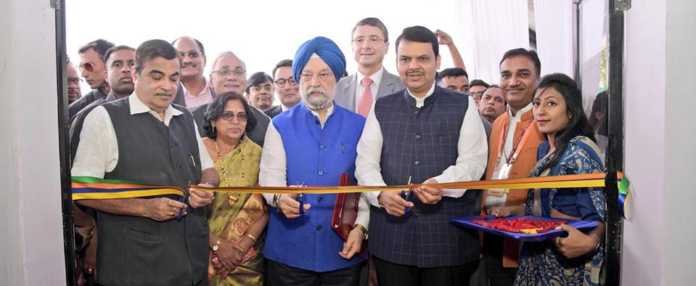
11th Urban Mobility India Conference & Expo inaugurates in Nagpur, Chief Minister Devendra Fadnavis

0

Nagpur: The Chief Minister Devendra Fadnavis and Union Ministers Nitin Gadkari, Hardeep Singh Puri inaugurate 11th Urban Mobility India 2018 conference and expo at Nagpur. Mr Alexandre Ziegler, Ambassador of France to India, Dr Martin Ney, Ambassador of Germany to India were present.
This 3 day Conference and Expo were organized by Urban Development dept, GoI, Housing Dept, and Maha Metro at Nagpur. Maharashtra Minister Chandrashekhar Bawankule was also present on this occasion. CM spoke on issues arising from growing population and urbanization.
Vehicles are giving the biggest contribution to increasing pollution levels and the solution is cheaper, easier public transport system with end to end integration; CM said

Our Government is working a lot in this direction.  In Mumbai, we are making available all means of transport and bringing everything on the single integrated ticketing system, on fingertips.
In the modern era we need to use technology to its fullest, he added.

Devendra Fadnavis, Chief Minister of Maharashtra, delivered the inaugural address. He pointed out that just like waterways were lifelines of ancient civilizations, mobility and urbanization are two factors on which urban habitation depends. Mobility is a prime concern that will define how Indian cities would be shaped and how living standards would be enhanced”.

“Mobility requires end-to-end solutions and it should be reliable”, stressed Fadnavis. He also added that transportation systems should be comprehensive but with the integration of different systems and with a special focus on sustainability.

Nitin Gadkari, Minister for Road Transportation, delivered the keynote address and discussed the undergoing Nagpur Metro project and the emphasis on electric bikes and scooters that can operate as taxis.

At the inaugural session, Alexander Ziegler, Ambassador of France, said that “Sustainable development is a key priority area as more than 80% of greenhouse gas emission is due to exploding population in cities. And transport is intrinsically linked to it”.

Undoubtedly, the need of the hour is safer, cleaner and greener transportation. India stands of great disruption in smart mobility. Smart cities mission of Indian government too would provide impetus to green urban mobility. French companies are looking to cooperate with India in the sector of urban mobility, added ambassador Ziegler.

With rapid urbanization, Indian cities would be the fulcrum of economic activities and drive changes.

Martin Nay, Ambassador of Germany, said that “Since the 1950s number of motor vehicles has increased by millions and it would increase further. This needs immediate attention as the increase in the number of cars on the roads would lead to many problems like congestion, cramped city spaces and increase in pollution”.

Investment in green mobility is about improving the living conditions of the citizens of a city as well as making the infrastructure environmentally sustainable.

“The battle for sustainability will be either won or lost in the cities,” said Ban Ki Moon last year. And this succinctly expresses the current predicament we face when it comes to urban mobility.

Hardeep Singh Puri said that Nagpur was the first city in India to launch e taxis and hydrogen-fueled buses, so it is the perfect location for Urban Mobility.

“By 2030, it is expected that 600 million Indians will reside in cities and preparing for that makes urban mobility an imperative”, he added.

There has been a growth of 400% in motor vehicle registration in 1991 and 2001. Looking at these figures, we have to figure out innovative ways and look at methods of mixing biofuels like ethanol in petrol, on the lines of Brazil.

The face of urban mobility is changing at a rapid pace and the world is noticing it, but we need to keep pace with the evolution of new technologies, develop new workflows and integrate the best methods keeping in mind the present generation as well as the aspirations of the posterity.

The conference is structured into three plenary sessions dealing with future of mobility, challenges in implementing electric mobility, innovations and challenges in metro rail system and nine technical sessions concentrating on broad theme of public transport, inclusive mobility, electric mobility, low carbon mobility, digital technology, and freight and environment will be discussed in the summit. Around 1,000 delegates, including 150 delegates from across the world, comprising senior officials from Central and State Governments will participate in the event.


Sinha said, the conference will provide an excellent opportunity to share and disseminate best transport technology and will be a platform for the exchange of ideas and knowledge for benefit of urban professionals.


Replying to a query, Sinha said, the share of public transport, as well as cycling and walking, are declining while the share of personalized vehicles, both cars and two-wheelers are increasing. This conference will help officials to keep up to date knowledge of best practices in urban transport. Anil Kokate, General Manager of Maha Metro also was present.

Advertisement1
InnoMetro_2026

Metro | Network to be extended 660-KM to 15 new cities: Union Minister

0
Hardeep Singh Puri, Union Urban Minister (Photo: PTI)

New Delhi: At an interaction organized on Monday (October 29) with the Consultative Committee of the Ministry of Housing and Urban Affairs, Minister Hardeep Singh Puri said that India will have an additional 660 km to 15 new cities, metro line apart from the existing network of 515 km across various cities in the country.

All the states and union territories have been asked to prepare their respective Detailed Project Reports (DPR) for the cities and submit them at the earliest to the Central government. These fall in line with the provisions mentioned in the Metro Rail Policy of 2017.

India already has a 515-kilometer functional network of metro tracks in various cities and 15 more will soon have over 660 kilometers of tracks for rapid urban transportation,

The statement issued to all states and UTs, which reads as: “Hardeep S Puri, Minister of State (I/C) for Housing and Urban Affairs has stated that more than 664 km of metro rail projects in 15 cities are presently under various stages of implementation, while more than 515 km of metro line is already operational in India, said an official sources.

He further stated that the 11th version of Urban Mobility India Conference will be held at Nagpur between 2 and 4 November bearing the theme ‘Green Mobility’. This is being organized to contemplate on the latest urban transport practices. This conference is aimed at bringing tech service providers, policymakers and officials together.

Advertisement1
InnoMetro_2026

Lucknow Metro | From Munshipulia to KD Singh Babu Stadium section on its final phase of completion

0
Lucknow Metro to Complete North-South Corridor by February

Lucknow: The construction work of the north-south corridor (phase 1-A) is going on the remarkable pace, metro stations from KD Singh Stadium to Munshipulia are in their final phase of completion. It is expected that Lucknow Metro Rail Corporation (LMRC) is likely to finish the civil works of all the eight elevated metro stations between KD Singh and Munshipulia by December 2018 which is an achievement in itself.

This was remarked by Shri Kumar Keshav, Managing Director/LMRC while reviewing the project progress activities of this metro stretch. He himself appreciated the entire team along with other Metro officials after seeing the satisfactory progress of the work.

He felt quite satisfied with the installation work of U-Girders (phase 1-A) being almost complete in such a short span of time. In addition to this, the structural framework of all the stations in this section is ready and its finishing is going on. On the other hand, the construction work of entry/exit gates of Munshipulia, Indira Nagar, RS Mishra, Badshah Nagar, IT and KD Singh Stadium Metro stations has been finished. The staircase work of concourse has been done while the installation of escalators and lifts is speeding up. The work of tiling and flooring of Station Control Room (SCR), UPS Room, Security Room, and PD (Property Development) area is 70% complete. The grill work at the platforms of IT, RS Mishra and KD Singh Stadium Metro station is also shaping up. The work of track laying is being carried out along with OHE (Overhead Electrification) between KD Singh & Munshipulia. He also emphasized the contractors to carry on the electrification (OHE) work with same speed and coordination.

The whitewashing of most of the Metro stations is also speeding up gradually. Expressing his satisfaction Shri Kumar Keshav instructed the executing agencies TATA and L&T to maintain their same speed and to wind up the civil construction work by December 2018. He also motivated and encouraged the entire team for this commendable quality of project work which is in its final stage of completion.

Advertisement1
InnoMetro_2026

Kochi Metro | First phase of Kochi Water Metro to be completed by October 2019

0
Kochi Metro Rail

KOCHI: By October 2019, The Kochi Metro Rail Ltd (KMRL) plans to complete and begin operations of the first phase of Kochi Water Metro. Tenders for vessels will be finalized and awarded by first or second week of December, which is part of the Kochi Water Metro project.

KMRL MD(Managing Director) APM Mohammed Hanish expressed faith that they would be able to start works without much delay. “Once the tender is awarded, construction activities will begin,” said hanish
According to KMRL, the companies that have been shortlisted in the request for qualification (RFQ) will be given tender forms. “We will give them 30 days to respond to RFQ,” added Hanish.
The Rs 819-crore integrated water transport system is being implemented in the Greater Kochi region. Aecom Consortium (a joint venture of Aecom India Pvt. Ltd., Urban Mass Transit Company Ltd, and Zebec Marine Consultants Service Pvt Ltd) has been appointed a general consultant for the project.

DDC, KITCO have prepared the detailed designs for Vytilla, Eroor, Kakkanad, Bolgatty, High court, Vypin, Mattanchery jetties.

Around 8.67 hectares will be acquired for the project, of which 5.3 hectares is owned by government departments and 3.37 hectares owned by private parties. The land acquisition, as well as land transfer, is progressing. The integrated water transport
project executed by KMRL is expected to cover 15 routes, 76-route km with 78 boats covering 45 terminals.

Advertisement1
InnoMetro_2026