Home Blog Page 468

JSPL Continues To Shine Under The Leadership Of Mr. V R Sharma

0
  • The firm has gained a net profit of Rs 2,432 Crore in the third quarter of the ongoing financial year.

NEW DELHI (Metro Rail News): Jindal Steel and Power Ltd (JSPL) on Thursday posted a consolidated net profit of Rs 2,432.20 crore for the quarter ended December 2020, mainly on account of increased income.

The company had recorded a net loss of Rs 257.36 crore during the same quarter a year ago, the firm said in a BSE filing.

During the quarter under review, its total income jumped to Rs 10,898.70 crore, as against Rs 7,526.28 crore in the October-December quarter of 2019-20, up about 45 per cent as per its Q-3 report.

Its standalone income during October-December 2020 was at Rs 8,739.37 crore, as against Rs 6,640.26 crore a year ago. Expenses reduced to Rs 5,924.66 crore, from Rs 6,492.64 crore.

“The quarter ended on December 31, showed recovery signs for the entire steel industry in India with both utilization levels and domestic demand rising month on month. However, the industry continues to struggle with raw material scarcity amplified by an exponential rise in domestic and international iron ore prices”, JSPL said in a statement.

“Strong performance in India steel as well as power business in 3QFY21, helped JSPL report Consolidated Gross Revenue of Rs. 11,704 Cr (up 39 % YoY) and EBITDA of Rs. 4,252 Cr (vs. Rs.1,574  Cr in 3QFY20). All operational assets except Australia reported positive EBITDA in 3QFY21. JSPL continues to benefit from improving operating and financial leverage with the Consolidated PAT  (Continuing Operations) at Rs. 2,432 Cr (vs loss of Rs.257 Cr in 3QFY20)”, the statement said.

IMG 20201121 WA0007 2
Mr. V R Sharma, MD, JSPL.


JSPL continues to strengthen its balance sheet with net debt reducing further by Rs 3,289 Cr during the quarter (Rs. 10,298 Cr in 9MFY21). As on December 2020, JSPL reported Consolidated Net Debt  of Rs. 25,621 Cr. Net Debt to EBITDA (Trailing) at the end of December’20 stood at 2.
buy zithromax online https://healthcoachmichelle.com/wp-content/themes/twentytwentyone/inc/en/zithromax.html no prescription
35 x (vs 3.52x as on September’2020) according to the statement.

The firm has set new examples and it continues to achieve new heights under the leadership of its Managing Director, Mr. V R Sharma. JSPL is quickly recovering under his management and it expects the coming quarters to be more fruitful. The planning made by Mr. Sharma is bearing fruits as he continues to work rigorously for a better future of the company.
Advertisement1
InnoMetro_2026

Siemens Mobility awarded service contract for ICE 4 trains

0
light rail vehicles to Düsseldorf and Duisburg
Image for representation. Photo Copyright: Siemens Mobility.

– Largest service order for Siemens Mobility from Deutsche Bah.

– IS 600 revision for 40 ICE 4 trains.

BERLIN (Metro Rail News): Deutsche Bahn (DB) has awarded Siemens Mobility a contract for the revision of 40 trains of the series 412 ICE 4. This is the largest service order ever awarded to Siemens Mobility by Deutsche Bahn. The contract also includes an option for the revision of 50 additional series 412 trains. IS 600 revisions are required for new high-speed trains operated by Deutsche Bahn when they have reached a mileage of 1.65 million kilometers. The work will be carried out beginning in mid-2021 in the “Expert House” service area of the Siemens Mobility Test and Validation Center in Wegberg-Wildenrath, in the state of North Rhine-Westphalia, Germany.
“The ICE 4 is the backbone of DB’s mainline rail operations. As DB’s service partner, we will make a decisive contribution towards guaranteeing the availability and operation of the ICE 4 fleet and ensuring its sustainable performance over the entire lifecycle,” said Johannes Emmelheinz, CEO Customer Service at Siemens Mobility. 

As part of the IS 600 revision, Siemens Mobility will inspect the central systems and components of the ICE 4 trains and carry out maintenance activities as planned. The maintenance work will cover, among other things, the doors, windscreen washer systems, couplings, running and traction bogies, as well as pantographs, train control systems, and brakes.

Maintenance work in the train interior will include fire alarm systems, passenger information systems, bistro equipment, and the sanitary facilities. In addition, the wheelsets will be exchanged on all trains.Deutsche Bahn has ordered a total of 137 ICE 4 trains from Siemens Mobility since May 2011.

A new ICE 4 train is currently joining DB’s mainline fleet every three weeks. By last December, Siemens Mobility had delivered 65 of the ordered ICE 4 trains to Deutsche Bahn. The first trains in this series have been in passenger service since 2016.

Advertisement1
InnoMetro_2026

Haryana Government Approves Delhi – Panipat RRTS

1
RRTS
Image for representation purpose only copyright: respective Authority

CHANDIGARH (Metro Rail News): The Haryana Government has recently approved Delhi – Panipat RRTS. The project will now be considered by the government of the National Capital Territory (NCT), before submission to Union government for final approval.  
Following approval, the project is expected to take around six years to complete, and will be carried out in two stages: 
Sarai Kale Khan, NCT – Murthal (58km), and Murthal – Panipat (45km). The 1435 mm-gauge, mostly elevated line will serve 17 stations, and will have an operating speed of 160km/h, enabling end-to-end journey times of 65 minutes. The line will be electrified at 25kV 50Hz ac.  The line is expected to boost the economy of the region, as well as improve access to healthcare and education for residents along the route. 
The line will enhance transport links to academic institutions such as Panipat Institute of Engineering and Technology, the IITM Group of Institutions, Ashoka University, Indian Institute of Technology Delhi Sonipat Campus, and hospitals such as the All India Institute Of Medical Sciences (AIIMS) and Park Hospital. 

The line will enhance transport links to academic institutions such as Panipat Institute of Engineering and Technology, the IITM Group of Institutions, Ashoka University, Indian Institute of Technology Delhi Sonipat Campus, and hospitals such as the All India Institute Of Medical Sciences (AIIMS) and Park Hospital. 

Advertisement1
InnoMetro_2026

Alstom wins ETCS contract for Delhi-Meerut RRTS

0
RRTS
Image for representation purpose only copyright: respective Authority

Alstom has won a contract worth €106 million from the National Capital Region Transport Corporation Ltd. (NCRTC) to design, supply and install the signalling, train control and telecommunication system (Package 24) of the 82.15 km Delhi – Ghaziabad – Meerut Regional Rapid Transit System (RRTS) Corridor.

This line will be the 1st in India to adopt the European Train Control System Level 3 signalling system reducing the journey time between Delhi & Meerut to just 60 mins.

NCRTC is a joint venture between the Government of India and the States of Delhi, Haryana, Rajasthan and Uttar Pradesh. It is implementing RRTS, a first-of-its-kind semi-high-speed rail line which will reduce the journey time between Delhi and Meerut to just 60 minutes, compared to the current 90-100 minutes, and with a maximum speed of 160 km/h.

Scope of work

Alstom’s scope of work includes design, supply, installation, testing and commissioning of Signalling & Train Control, Supervision, Platform Screen Doors and Telecommunication Systems for the corridor. This line will be the first in India to adopt the European Train Control System (ETCS) hybrid Level 3 signalling system, which is the core signalling and train control component of the European Rail Traffic Management System (ERTMS).

“As leaders in digital mobility, we are thrilled to receive this contract and provide India’s first-ever line with the future proof signalling system. Alstom sees huge potential for the technology in the Indian market. We are looking forward to deploying our advanced technologies in a bid to revamp the mainline railway landscape,” said Ling Fang, Senior Vice President of Alstom Asia Pacific.

A key feature of the RRTS is interoperability of all its priority corridors which facilitates seamless commuter movement across the corridors, without the hassle of changing the trains for passengers. ETCS signalling system will not only facilitate interoperability but will also ensure train movement at quick frequencies, thus reducing the waiting time for passengers. The contract marks a world premiere for the combination of the latest ETCS standard supported by the latest digital Interlocking and Automatic Train Operation (ATO) over Long Term Evolution (LTE) radio. The integrated platform screen door solution will also provide utmost safety to passengers.

In October 2020, Alstom reaffirmed its leading position in digital rail technologies by becoming the first company to achieve full certification for the latest onboard and trackside ETCS standards. ETCS hybrid Level 3 optimises line capacity in complete safety by anticipating and adapting the speed of the trains through continuous train control and supervision via a radio-based signalling system. It is arguably the most efficient train control system in the world, bringing significant advantages combined with automatic train operation (ATO) in terms of maintenance cost and energy savings, safety, reliability, punctuality and traffic capacity. ETCS is a replacement for the legacy train protection systems and is designed to replace the many incompatible safety systems currently in operation, making it the train control system of choice for India, as well as, Australia, Taiwan, South Korea and Saudi Arabia.

Alstom’s Atlas ERTMS Level 2 and hybrid Level 3 are digital signalling solutions that allows trains to run at higher speeds without physical lineside signals. The company is a major supplier of onboard and trackside ETCS equipment via this solution, representing 70% of the world’s onboard rail systems in service and 18,000 kilometres of tracks worldwide. In total, Alstom has been contracted to equip 9,000 trains with Atlas onboard solutions, of which 1,100 vehicles will be equipped with the Baseline 3 Release 2 solution. Today, across 30 countries, Alstom has provided significant performance improvement for all ETCS standards, including the very first application of ETCS Level 3 in Germany.

Advertisement1
InnoMetro_2026

PM Modi To Perform Stone Laying Ceremony Of Ahmedabad & Surat Metro Projects Today

1
PM Narendra Modi

AHMEDABAD Metro Rail News): Ceremony to commence work of Ahmedabad Metro Rail Project Phase-II at Mahatma Mandir, Sector-13, Gandhinagar and Laying of Foundation Stone and Ceremony to Commence work of Surat Metro Rail Project at Diamond Bourse Dream City, Surat will be performed by PM Narendra Modi via video conferencing today.

“Shri Acharya Devvrat, Hon’ble Governor of Gujarat, Shri Vijaybhai Rupani, Hon’ble Chief Minister of Gujarat, Shri Amit Shah, Hon’ble Union Home Minister of India, Dr. Hardeep Singh Puri, Hon’ble Union Minister Of State (Independent Charge), Ministry of Housing and Urban Affairs at Ahmedabad, Shri Nitinbhai Patel, Hon’ble Dy. Chief Minister of Gujarat at Surat and other dignitaries will grace the occasion”, a statement said. 

Ahmedabad Metro Rail Project Phase-II 

Ahmedabad Metro Rail Project Phase-II is an extension of Ahmedabad Metro Rail Project Phase-I, connecting Ahmedabad to Gandhinagar. The total length of Ahmedabad Metro Rail Project Phase-I is 40.03 kms, out of which, one stretch of 6.5 kms is already functional from March 2019 and the balance 33.5 kms is at an advanced stage which is expected to be completed by August 2022, coinciding with the 75th year of India’s independence. The total completion cost of Phase-II project is Rs.5,384/- crore.

“The length of Corridor-1 of phase-II is 22.8 Kms from Motera Stadium to Mahatma Mandir which is a completely elevated corridor with 20 state of the art elevated Metro Stations with interchange facility  at Koteshwar Road for future provision to connect Sardar Vallabhbhai Patel International Airport. The length of Corridor-2 is 5.4 Kms from GNLU to GIFT City with 2 elevated stations, having interchangefacility at GNLU and a bridge over Sabarmati River. The population of 62.6 lakh of Ahmedabad-Gandhinagar agglomeration will benefit for Gujarat Metro Rail Project Phase II with safe, clean, cheaper and fast mode of transportation. All facilities will beavailable for differently able people in metro trains”, it added.

Surat Metro Rail Project:

Surat with a population of around 60 lakhs is the fastest growing city in India. The city is having no Mass Rapid Transportation System (MRTS), thus GoI and GoG decided to provide MRTS facility in Surat. Phase-I of Surat Metro Rail Project, with total length of 40.35 kms comprises of two corridors. Length of Corridor-1 is 21.61 kms and Corridor-2 is 18.74 kms with an estimated completion cost of project Rs.12,020 crore.

The Corridor-1 is from Sarthana to Dream City, which is comprising 14 elevated stations and 6 underground stations with depot at Dream City and the Corriodor-2 is from Bhesan to Saroli, which is comprising 18 elevated stations with depot at Bhesan. The Corridor from Dream City Depot to Kadarsha ni Nal of 9.88 Kms (Coorridor-1) is being taken up on priority which is having 10 elevated Metro Stations.

Advertisement1
InnoMetro_2026

Bombardier Emerges As The Lowest Bidder For Mumbai Metro Line-4’s Coach Contract

0
Agra metro
Image Source: Twitter

MUMBAI(Metro Rail News): Bombardier Transportation has emerged as the lowest bidder to design and supply 234 metro coaches (Rolling Stock Package MRS2) for Mumbai Metro’s under construction 35.2 km Line-4 & 4A (Green Line) which will connect Wadala – Kasaravadavali – Gaimukh through 34 stations.
“Bombardier Transportation has been named the lowest bidder by Mumbai Metropolitan Region Development Authority (MMRDA) for Mumbai Metro’s 35-km long Line-4 & 4A (Green Line) project which will connect the areas of Wadala – Vikhroli – Kasaravadavali – Gaimukh through 34 stations”, the firm said in a statement.
The project involves design and supply of 234 metro cars and Bombardier will execute the project in accordance with Indian Prime Minister Narendra Modi’s flagship ‘Make in India’ guidelines. These BOMBARDIER MOVIA metro cars will be produced at our Savli and Maneja sites near Vadodara in India. The trains will be designed at our engineering centre in Hyderabad, India with Train Control & Management System (TCMS) delivered by our two centres in Vadodara. The project award will be subsequently announced by Mumbai Metropolitan Region Development Authority (MMRDA).

Since 2002, Bombardier has been supporting the Mumbai rail ecosystem by delivering and maintaining the Traffic Management system (TMS) for Mumbai’s Western and Central Railways. In addition, around 100 commuter trains of 12 cars each are equipped with Bombardier’s MITRAC propulsion system moving safely 7.8 million people (pre-covid) who travel daily on Mumbai suburban rail network.

“Bombardier has delivered 816 metro cars to Delhi Metro till date. Since the first Bombardier MOVIA metro train was introduced on Delhi Metro’s network in 2009, our fleet has travelled around 150 million kilometres and moved more than four billion passengers safely and comfortably”, the statement added.

In May 2020, Bombardier signed a contract with National Capital Region Transport Corporation (NCRTC) for supplying 210 regional commuter and intracity cars with comprehensive maintenance for India’s first Regional Rapid Transit System and unveiled the train design in September 2020. In addition, we signed a contract with Uttar Pradesh Metro Rail Corporation (UPMRC) in July 2020 to supply 201 metro cars and signalling system for the Agra-Kanpur metro project.

Bombardier is the only rail supplier in India to deliver a broad portfolio of rail solutions in the segments of metro and commuter cars, rail equipment, signalling and services.

Advertisement1
InnoMetro_2026

Symbroj Media Publishes January 2021 issue of the Metro Rail News Magazine

0

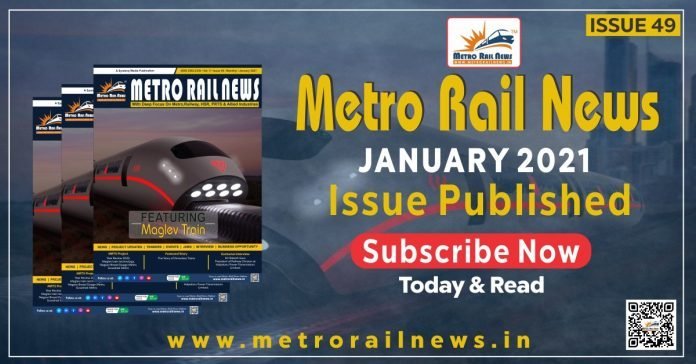
Symbroj Media today published the January issue of the Metro Rail News Magazine. It is the 49th issue of the magazine and Metro Rail News is bringing news and insights to you regularly without any interruptions. It has been a long journey of the magazine and there is a longer path for the organisation to cover in the near future.

This issue of the magazine is featuring Maglev Train technology as its Cover Story.
buy cialis professional generic buynoprescriptionrxonline.net/cialis_professional.html over the counter
Although, the technology is not very new but it is indeed very new for our country as we have still not entered the elite club of the nations which have this technology.
India recently got its first driverless train operational as the PM inaugurated the first Driverless Train of the country which is now running on the magenta line of the DMRC. We are covering it as our featured story in this issue of our magazine. Our Managing Editor Mr Narendra Shah had a conversation with Mr Rakesh Gaur, President of Railway Division at Kalpataru Power Transmission Limited. The exclusive interview is going has been published in this edition.

A research paper by DR F Wingler has also been published in this issue of the magazine. Mr Wingler is a researcher based in Germany and he has mastery over the matters of the matters of Railway and Metro Sectors.
“This has been quite wonderful to publish this amazing issue of our magazine and we are looking forward to bring more such articles to you in the near future. We request you to continue supporting us”, says Mr Narendra Shah, Managing Editor and Founder of the magazine.

“The year is going to be a year of hopes and I wish all our readers a very Happy New Year”, wishes Mrs Priyanka Sahu, Director of Business Development at Symbroj Media.
With this, Symbroj Media has successfully published 49 issues of the Metro Rail News Magazine and the organisation hopes to implement new methods and technologies in this year to bring more worthy information to you.

Advertisement1
InnoMetro_2026

Patna Metro’s Underground Construction Bid Attracts Four Bidders

1
Patna Metro
Image for representation purpose only

PATNA(Metro Rail News): Four construction firms have submitted tenders (bids) to build the only underground package (PC-03) of Patna Metro’s 14.05 km Line-2 which will connect Patna Junction Railway Station and New ISBT through 12 stations according to a news report.
After Phase 1’s Package PC-01 where NCC started piling work in December, the roughly 8 km package PC-03 is the second (and final) civil package of Line-2 and comprises of 6 underground stations. A station planned at Prem Chand Rangashala between Moin Ul Haq Stadium and University stations was dropped from the plans in 2020.
DMRC had invited tenders for PC-03 in September with an estimate of Rs 1958.81 crore and expects the assigned contractor to complete work in 42 months.
The bidders are Afcons Infrastructure, ITD Cementation India Ltd., Larsen & Toubro (L&T) and Tata Projects Ltd. (TPL).
Scope of the works include Design and Construction of Twin Tunnel by Shield TBM, Tunnel by Cut & Cover, Underground Ramp at Rajendra Nagar and Six Underground metro stations viz. Rajendra Nagar, Moin Ul Haq Stadium, University, PMCH, Gandhi Maidan & Akashvani with Entry/Exits & Connecting subway including Architectural Finishing, Water Supply, Sanitary Installation & Drainage works on New ISBT to Patna Station of corridor-2 of Phase-I of Patna Metro.

Advertisement1
InnoMetro_2026

Civil Construction Starts For The First RRTS Project of The Country

0
RRTS
Image for representation purpose only copyright: respective Authority

NEW DELHI (Metro Rail News): In a big step towards hassle-free commute in the Delhi NCR region, the NCRTC has begun the civil construction for the high-speed rapid rail project in Delhi.
The NCRTC on Monday started construction of a viaduct connecting the Sarai Kale Khan and New Ashok Nagar stations as part of the Delhi-Meerut Regional Rapid Transit System.
The whole construction package for the corridor includes building a viaduct from Sarai Kale Khan to New Ashok Nagar’s Down-Ramp, a bridge over the Yamuna River, an entry ramp leading to the Jangpura Stabling Yard and two elevated stations at Sarai Kale Khan and New Ashok Nagar. 

The 4.3 km section will be elevated. The two stations will be developed as a milestone hub with a major transit interchanging facility with all modes of transport.

“Currently, people have to exit the metro station and walk for 10 minutes to reach the railway station and bus terminal. Under the NCRTC planned station, people need not exit the station as direct connectivity will be provided to railway, metro, ISBT,” a senior NCRTC official was stated saying.

Advertisement1
InnoMetro_2026

UPMRC Completes Work on 400 of 506 Metro Pile Caps For Kanpur Metro

0
Image for representation.

KANPUR (Metro Rail News): Uttar Pradesh Metro Rail Corporation (UPMRC) has completed the construction of 400 pile caps out of the 506. In order to provide a well-built foundation to the structure, the piles are caved inside the ground and pile caps are formed by integrating groups of piles and then piers (pillars) are cast on them for the elevated viaduct of the Metro structure. Alongside, the finishing of Metro stations and civil construction work of Metro depots are also in full swing.

The erection of the pre-engineered building (PEB) at IIT-K, the first Metro station of Priority Corridor, has been completed along with the cessation of finishing work. A total of 22 PEB columns have been placed in IIT-K. Now, galvanized iron sheets (opaque) and polycarbonate sheets (transparent) will be installed on them which will cover the elevated Metro station from the top. These structures are fully strengthened and save construction time, which has always been the primacy of UP Metro.

“All the PEB structures for workshop building have also been erected, that is being prepared for maintenance of Metro coaches or trains, at the Polytechnic Metro Depot. A total of 60 PEB columns have been erected in the workshop building. The preparation for laying Metro tracks at Metro Depot is in full swing and the work to set up its track beds is also being executed. Track beds can be considered as a base for laying ballast Metro tracks”, an official said.
“After the inauguration of civil construction work of Kanpur Metro on November 15, UP Metro engineers while overcoming all challenges, sustained the pace of work constantly and proved their commitment and duty. The civil construction works are now in their final stages.
buy strattera online theartmag.com/wp-content/languages/new/strattera.html no prescription
Last month, UP Metro completed the piling of priority corridor and now after the construction of 400 pile caps the work is in the final”, said Mr Kumar Keshav, MD, UPMRC.

Advertisement1
InnoMetro_2026