Home Blog Page 255

JMC Projects erect 27.90m U-Girder for Kanpur Metro Phase 1 project

0
U-Girder erected at Kidwai Nagar for linking transport Nagar Ramp to Naubasta Station

KANPUR (Metro Rail News): JMC Projects put up the first 27.90m U-Girder in Kidwai Nagar for Kanpur Metro Phase 1 project’s Package KNPCC-07 linking Transport Nagar Ramp to Naubasta Station on 20th January.

The accomplishment of constructing the second and last 5.427 km elevated stretch of Line-1, spanning 23.785 km, was documented with a 164-tonne girder placed between Pier 56 and 57. The initial pier cap was set up at Pier 56 just before the end of 2021.

In June 2022, the Rs. 514.61 crore civil construction contract of this section was handed over to JMC Projects by Uttar Pradesh Metro Rail Corporation (UPMRC). The section is located on the eastern end of Line-1 and incorporates five elevated stations at Baradevi, Kidwai Nagar, Vasant Vihar, Baudh Nagar and Naubasta.

JMC achieved this remarkable feat of marking this milestone within seven months of the contract being awarded, setting a new benchmark for metro projects in India. By comparison, Afcons Infrastructure, given the contract in September 2019, completed the same feat in August 2020, requiring eleven months. Whilst the Covid-19 pandemic could have played a part, JMC’s success is still remarkable.

Advertisement1
InnoMetro_2026

Ministry of Railway Appoints Roop Narayan Sunkar as new Member (Infrastructure), Railway Board

0
Ministry of Railway Appoints Roop Narayan Sunkar as new Member (Infrastructure), Railway Board

NEW DELHI ( Metro Rail News ): Roop Narayan Sunkar, an officer of the Indian Railway Service of Engineering (IRSE) 1985 batch, has recently taken charge as Member Infrastructure of the Railway Board. He previously served as the General Manager of the East Coast Railway and has held various other roles such as Chief Project Director (CPD)/Bridge Work in West Central Railway, Divisional Railway Manager (DRM)/Ratlam, Chief Bridge Engineer in North Central Railway & West Central Railway, and Chief Engineer (Construction) at Bilaspur.
Shri Sunkar began his career in Indian Railways in 1985 after completing his Engineering Graduation from Barkatullah University, Bhopal. He has vast experience in construction and commissioning of projects, and has contributed significantly to the progress of Indian Railways. Under his leadership, 228 km of railway projects were commissioned during 2020-21, including new lines and doubling & 3rd Line – the highest progress amongst all zonal railways of Indian Railways. Shri Sunkar has been praised from all corners for his proactive approach to asset construction and maintenance, including Bridge Work and execution of other projects.
Shri Sunkar is a highly committed and devoted officer with brilliant knowledge and command on Bridge Works. He is always willing to shoulder extra responsibility and displays exceptional leadership skills, earning loyalty from those who work with him. He takes every task as a challenge and strives to move forward in fulfilling the mission of Indian Railways.
Apart from his degree in BTech, Shri Sunkar completed his LLB from Rani Durgavati Vishwavidyalaya, Jabalpur in 2005, and has also completed a Post Graduate Diploma in Environment and Sustainable Development and a Post Graduate Diploma in Disaster Management from Indira Gandhi National Open University, Delhi.


Advertisement1
InnoMetro_2026

ETA Engineering to Install Systems at 4 Subterranean Stops of Delhi Metro Silver line

0
(For representational purpose)

NEW DELHI (Metro Rail News): ETA Engineering Pvt. Ltd. was selected as the most cost-effective company to install the electrical and mechanical system, environment control system and tunnel ventilation system at four underground stops of the 23.622 km Silver Line (Line-10) of Delhi Metro.

Delhi Metro’s Phase 4 project in South Delhi, situated mainly beneath the surface, will join Aerocity to Tughalakabad via 16 stations, 12 of which will be built through civil packages DC-07 (Afcons Infrastructure), DC-08 (J Kumar Infraprojects) and DC-09 (Larsen & Toubro) below the ground.

In July 2022, DMRC called for tenders for contract DE-11, funded by Japan International Cooperation Agency (JICA). This contract had a 2.95-year deadline and an unknown estimate. When the technical bids were opened in October 2022, it was revealed that there were seven bidders.

Financial Bid Values

Firm Bid. (Rs. Crore)

ETA Engineering 183.61

Universal MEP Projects & Engineering Services 212.11

Efkon India 217.36

Sudhir Power 221.03

Blue Star 221.15

Larsen & Toubro (L&T). 240.07

Sterling And Wilson (SWPL). 259.18

DMRC’s Brief Scope includes Design verification, Detail engineering, SITC of Electrical and Mechanical system, DG set, Environment control system, Tunnel ventilation system and Building Management System for four underground stations of line-10 of Phase-IV of Delhi MRTS.

Since October 2022, an evaluation of the technical bid for a larger system package (DE-11) that includes seven underground and four elevated stations between Chhatarpur and Tughlakabad, similar to the existing line, has been underway.

Advertisement1
InnoMetro_2026

NCRTC Reduces Construction Time with Steam Curing Method for RRTS Precast Segments

0
NCRTC Reduces Construction Time with Steam Curing Method for RRTS Precast Segments

NEW DELHI (Metro Rail News): The northern part of India is experiencing an unprecedented cold wave, which has slowed down construction works in the region. However, the construction of the Delhi-Ghaziabad-Meerut RRTS corridor is still progressing at a rapid pace with the use of a particular technique. Pre-casted segments of the tunnel rings, used for constructing the underground section of the corridor, are being manufactured at a pace with the help of ‘Steam Curing Technology‘ at the casting yard of NCRTC.

Tunnel segments are being cast at the casting yard of NCRTC with assured quality control. However, with the onset of winter, precasting the segments faced a challenge. Due to low temperatures, the segments moulded by the machines do not get early strength in the stipulated time frame. As a result, the concrete, bars, and other construction materials used in the segment do not reach their actual solid state on time. The segments must be substantial and robust with the required strength to be used in tunnel construction. Therefore, NCRTC uses the steam curing technique to strengthen and solidify precast segments in low-temperature climates rapidly.

Under the steam curing technique, the newly formed segments are steamed for 5 to 7 hours with the help of a boiler. This allows the newly formed segments to solidify in their concrete structure and gain early strength almost three times faster.

Typically, when the temperature is below 10 degrees, it takes a regular precast segment about 40 to 45 hours to solidify. However, the steam curing technique completes the same work in about 10 hours. This way, with the help of this technology, the pace of construction of the tunnel rings continues despite the changing weather and construction of the RRTS corridor continues to progress at a pace. In addition, as the newly constructed segments automatically gain early strength in higher temperatures, this technique is not required in summer.

In the underground section in Delhi, the construction of two parallel tunnels of about 3 km in length from Anand Vihar station towards New Ashok Nagar and about 2 km towards Sahibabad is in full swing. For the construction of these two parallel tunnels, four Sudarshan are constructing about 10 km tunnel, out of which more than five and a half km tunnel construction has been completed. About 25,600 tunnel precast segments have been used so far in Delhi. In Meerut, a total of 11 km parallel tunnel is to be constructed, out of which about 5 km tunnel has already been constructed and about 21,000 tunnel precast segments have been used. These tunnel rings are manufactured at the casting yard of NCRTC with assured quality control.

NCRTC has been using precast segments for construction since the project’s inception. Precasting helps in the safe and speedy execution of construction work while ensuring better quality control and reducing air and noise pollution. Therefore, the decision to adopt precasting technology was an important strategic decision.

NCRTC aims to open the entire Delhi-Ghaziabad-Meerut corridor to the general public by 2025. Before this, the 17-km long Priority Section between Sahibabad to Duhai of the Ghaziabad region will be operationalised this year for the public.

Advertisement1
InnoMetro_2026

Work going in full swing for Metro in City of TajMahal

0
Work going in full swing for Metro in City of Taj Mahal

AGRA METRO (Metro Rail News): Agra Metro is a 29.40 km urban Mass Rapid Transit System (MRTS) under development in Agra, Uttar Pradesh, with two lines and 28 stations. RITES prepared the DPR (Detailed Project Report) for the Agra Metro Phase 1 project, which was submitted to the UP state government for clearance on June 30, 2016. The Uttar Pradesh Metro Rail Corporation (UPMRCL) was designated as the ‘coordinator’ in 2017 to bring all stakeholders together and get the project underway.

The project received approval from the union cabinet in February 2019, and the Supreme Court allowed the construction works in July 2020 with a set of 11 requirements that UPMRCL must meet. Construction on the first 4 kilometre segment of Phase 1 (Taj East Gate – Taj Mahal Ramp) began on December 7, 2020, with Prime Minister launching the project remotely. Its Priority Corridor is a 7-kilometer segment with six stations (3 underground and three elevated) connecting Jama Masjid and Taj East Gate.

The Agra Metro’s Priority Corridor is projected to be finished and open in June 2024, behind with its original March 2024 date. Phase 1 is scheduled to be finished in 2026. The project will be partially funded by the Government of India and the Government of Uttar Pradesh on an equal equity basis, as well as a 450 million Euro (approx. Rs. 4860 crore) loan granted by the European Investment Bank (EIB) in December 2021.

System Specifications

  • Top Speed : 80 kmph
  • Average Speed : 34 kmph
  • Track Gauge: Standard Gauge – 1435 mm
  • Electrification : 750V DC Third Rail
  • Signalling : Communications-based train control (CBTC)

Key Figures

  • Operational : 0 km
  • Under Construction : 11.9 km
  • Approved : 17.5 km
  • Estimated Cost : 8,379.62 cr (Line-1)
  • Estimated Ridership : 7.36 lakh/day (2031)
  • Estimated Coaches : 87

Agra Metro Phase 1 Route Information

  • Line-1 : Sikandra – Taj East Gate
  • Length : 14.25 km
  • Type : Elevated (6.569 km) and underground (7.681 km)
  • Depot : PAC Depot (16.3 hectares)

Number of Stations : 14

  • Station Names : Sikandra, Guru Ka Taal, ISBT, Shastri Nagar (future), RBS College, Raja Ki Mandi, St. John’s (Agra University), Medical College, Jama Masjid, Agra Fort, Taj Mahal (Purani Mandi), Fatehabad Road, Basai & Taj East Gate
  • Line-2 : Agra Cantt. – Kalindi Vihar
  • Length : 15.40 km
  • Type : Elevated
  • Depot : Kalindi Vihar Depot (11.9 hectares)
  • Number of Stations : 15
  • Station Names : Agra Cantt., Sultanpura, Sadar Bazaar, Pratap Pura (future), Collectorate, Subhash Park, St. John’s (Agra University), Hariparvat Chauraha, Sanjay Place, MG Road, Sultanganj Crossing, Kamla Nagar, Rambagh, Foundary Nagar, Mandi Samiti (Agra Mandi) & Kalindi Vihar

Latest Update

If everything goes as planned, the Agra Metro Rail will be operational before the 2024 Lok Sabha elections. Officials from the UP metro rail corporation are working hard to meet the deadline. The underground tunnelling machine recently received final testing before being used to excavate the subterranean tunnel from the Taj Mahal to Agra College and beyond.

The metro rail track will be around 30 kilometres long, with 14 kilometres first corridor running from Sikandra to the Taj Mahal and 16 Km second corridor running from Agra Cantt Railway Station to Kalindi Vihar. The UPMRC’s goal is to complete the first 6 km corridor from the Taj Mahal to Agra College, and issue the tender for the Sikandra, Guru Ka Tal, and ISBT stations soon. The lines will cross the highway and all three stations will be raised. As a result, the railings and lighting on the highway will be removed.

Due to the heavy machinery needed for the construction of the metro corridor, barricades are being built along the way, and the UPMRC will deploy two dozen marshals on NH-19 to monitor traffic during the corridor’s development. The UPMRC will also instal additional lights to help with traffic after streetlights are removed. There will also be warning signs placed 200 metres away from the building site.

Advertisement1
InnoMetro_2026

Maccaferri’s efforts aim at assisting India in building a green economy with sustainability at the core of its developmental infrastructure plan: Vikramjiet Roy

0
Mr Vikramjiet Roy, MD, Maccaferri India

NEW DELHI (Metro Rail News): Metro Rail News conducted an email interview with Mr Vikramjiet Roy, MD, Maccaferri India. In the interview, Mr Roy talked about various Rail projects in India.

Mr Vikramjiet Roy, the Managing Director of Maccaferri Environmental Solutions Pvt. Ltd (MESPL) in India and the Regional CEO of the ISEAP Region (India, South-East Asia & Pacific) of the Officine Maccaferri group, is a first-generation entrepreneur and has close to three decades of experience in businesses – ranging from Industrial Products & Civil Engineering Solutions to Core Infrastructure & Environment Solutions. Having graduated in commerce from St. Xavier’s College, Kolkata and an associate member of ICWA, Mr. Roy possesses an experience of over 27 years.

Here are the edited excerpts: –

Q1. Please tell us about the USBRL project you are collaborating on with SRM – Rajinder Project for railways. How important is this project for the company’s portfolio?

The USBRL project will connect Kashmir valley with the rest of the country through railways. This makes it a project of national importance as it will help boost tourism. However, due to the valley’s topography and harsh weather conditions, the project has many civil-engineering challenges. In addition to this, the need for sustainable infrastructure has become necessary. Considering this, Maccaferri provided solutions for a flexible hybrid reinforced soil (RS) structure out of tunnel muck that directly supports the railway track, offers increased resistance to earthquakes, and is entirely sustainable. This is a first-of-its-kind solution constructed at this height. Furthermore, by reducing traditional construction materials and replacing them with locally available ones, we could lower the overall carbon emissions of this project by up to 80%.

Being a part of this project has significantly added to our work portfolio. We are delighted to contribute our technical expertise in building this first-of-its-kind reinforced structure for a project of such national importance.

Q2. What other strategically important projects of Indian Railways that are you working on presently in single operations/collaborations? What is the status of various other projects on the order book?

For Surat Metro Line Project, we are working with ITD Cementation to provide an effective alternative solution to replace filter media behind the retaining wall. The product used for this project is MacDrain- drainage geo-composite. Another significant project is the Jafrabad-Akbarpur section ground improvement and slope protection work for Northern Railways. We have used solutions like MacGrid EG- polypropylene biaxial geogrid, MacTex N – nonwoven geotextile, and Paralink- monoaxial geogrid. In addition, we are providing Reno mattress solutions using Paramesh and Gabion for Eastern Dedicated Freight Corridor in collaboration with GMR & DFFCIL. We are also working with TATA on their Ambala project.

Q3. Maccaferri is known for designing and manufacturing innovative, long-lasting and environment-friendly solutions for civil engineering. What are your major contributions towards carbon-friendly construction solutions? How are you conforming towards UN SDG goals towards reducing carbon emissions?

Maccaferri serves as a solution provider for enterprises and governments adopting alternative construction materials that curb carbon emissions. Traditional construction materials such as concrete and steel significantly contribute to carbon footprints. With the government’s increased emphasis on infrastructure development, reducing the use of these materials and replacing them with more sustainable, climate-resilient solutions is critical. We understand the importance of the Indian infrastructure sector and are committed to designing & developing innovative solutions that focus on sustainability and environmental preservation. One of the most effective ways to reduce construction-related emissions is to use prefabricated components for construction and recyclable/reusable building materials. Gabion and geosynthetics are examples of green construction materials. Geosynthetic materials in infrastructure development enable the use of local materials with low overall transportation costs, further reducing the carbon footprint.

In line with UN Sustainable Development Goals and India’s commitment to becoming a net-zero emitter by 2070, Maccaferri’s efforts aim at assisting India in building a green economy with sustainability at the core of its developmental infrastructure plan.

Q4. What are the major challenges faced during project work in tough terrains of the Himalayas or other hilly areas in the country? How is construction in these areas different from other sites and locations?

Construction on hilly terrain comes with many challenges. In a restricted hilly area, climatic conditions, geological features and hydrological parameters vary considerably. In addition to this, construction works can have a significant impact on the landscape of a mountain region. If not done correctly, it can cause deforestation, erosion, water pollution, and damage to habitats. Considering all these factors, construction in hilly areas necessitates meticulous planning, careful selection of construction methods, and using climate-resilient materials for safe, economical and successful project completion. Furthermore, landslides, avalanches, debris flow, and high winds require special attention to prevent unwanted complications. 

Q5. What are the major innovations and recent R&D for Rockall protection, retaining structures, soil reinforcement, and railway erosion control systems?

Rockfall protection and erosion control are critical elements in infrastructure security and safety and people’s livelihoods. With over 60 years of experience in rockfall protection systems and natural hazard mitigation, we offer a wide range of products to stabilize rock faces, soil slopes and snow masses, reducing risks and costs. One of our innovations, HELLOMAC, is an alert system that detects rockfall events such as boulders, stresses, sagging, etc. An alert signal is sent immediately on computers and smartphones via email, SMS or app. The device also permits to activation of local sirens and traffic lights. It can be placed in the remotest of locations, as it requires no maintenance and can send information through data transmission modes like satellites.

Our other products, like MacArmour and MacMat HS, provide durable solutions for rockfall mitigation. MacArthur is a safe and effective drapery that combines a homogeneous steel wire rope structure with double-twist wire mesh. It maximizes the serviceability of the protected infrastructure and reduces installation time and other risks associated with on-site activities. 

Q6. In what ways Maccaferri is providing in-depth technical and Design support to provide real-world solutions for projects reducing project risks, cost and time for the clients? What is the strategy adopted for waste usage from tunnel construction, avalanche, erosion etc.?

Maccaferri offers environmental solutions for complex civil engineering works. Our products, services, and technology are appreciated and in demand by key infrastructure segments like the transport sector, water resource and water management arena, environmental sector and urban infrastructure development sector. Being an innovative solution provider, our services range from Design to execution, i.e. Design, supply, site supervision, technical support, installation, and consultancy. High quality, quick assembly, easy handling, cost-effectiveness, and the highest safety standards of our systems provide us with a competitive edge over conventional systems.

With expertise and a solid manufacturing base, we can tailor solutions to problems related to soil erosion. Selecting from a wide range of geomatics, fabrics and materials, the combinations of products are almost endless and are suggested basis the nature of the cause. Some products are Biomac® biodegradable biomass, MacMat® reinforced and unreinforced geomatics, MacWeb® cellular soil containment systems and the traditional double twist steel wire-based products; Gabions, Reno mattresses and wire mesh.

Q7. What are your business plans in India amidst the nation’s effort to restructure its rail infrastructure across all verticals by 2030? How are you contributing to a developing freight management system in the country? 

The government’s economic packages play a significant role in making India “self-sufficient.” Infrastructure is one of the pillars of ‘Atmanirbhar Bharat‘; various initiatives, such as the Bharatmala Project, the Paravatmala Project, and the Setu Bharatam Project, are on the go to improve road and rail connectivity. We are inevitably advocates of alternative construction materials and look forward to contributing techniques for sustainable development in ongoing and upcoming infrastructure projects. We enable the use of local materials with low overall and transportation costs, eventually reducing the carbon footprints and contributing to India’s commitment to meet Net-zero targets. We recognize the importance of the Indian infrastructure and are working to develop better, more cost-effective solutions and technologies tailored to the Indian climate. India’s infrastructure growth estimates are expected to rise year after year over the next decade. Our mission is to be a trusted partner to stakeholders, encouraging creativity, innovation, and the adoption of alternative solutions to complex civil engineering challenges with a focus on sustainability.

Q8. What would be your message to the youth willing to join the civil and construction industry, especially railways? What would be your message to our readers?

India has been at the receiving end of the growing climatic imbalance. The rising global temperatures in the country have led to severe heat waves, erratic monsoons, flash floods, tropical cyclones, and a compounding sea level rise. India needs to build a green economy with sustainability at the core of its developmental plans when 75% of infrastructure by 2050 is yet to be built. With the government committing to becoming carbon neutral by 2070, the responsibilities lie on the ‘young India’. The new generation of civil engineers must prioritize sustainability and climate-resilient infrastructure for all upcoming construction development projects. There is an immediate need to focus on value engineering and sustainable development to improve the quality, dependability, and durability of the infrastructure built in India. The youth joining the civil and construction industry should prioritize sustainable development and follow a systematic approach to develop structures that meet infrastructure needs without affecting the environment. 

Metro Rail News is a trusted platform dedicated to urban mobility solutions in India with vital and up-to-date information on infrastructure and growth. On behalf of Maccaferri, I want to encourage Metro Rail News readers to keep supporting the platform, which extensively writes about in-depth infrastructure topics, developments, and challenges.

Advertisement1
InnoMetro_2026

We are continuously working on the development and upgradation of new products: Shri Amit Banerjee

0
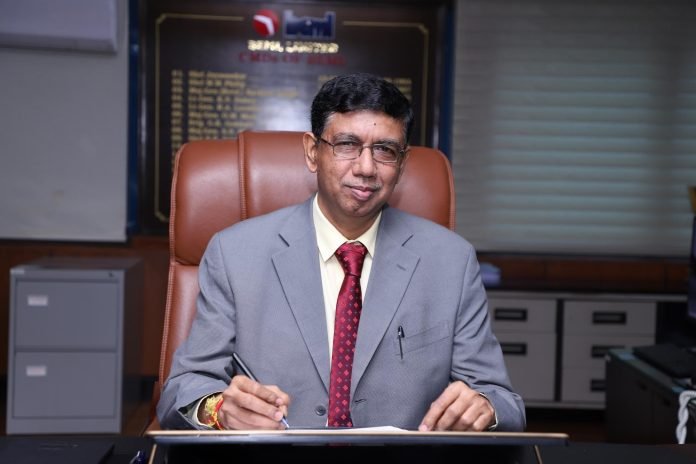
Shri Amit Banerjee, Chairman & Managing Director of BEML Limited

NEW DELHI (Metro Rail News): Metro Rail News conducted an email interview with Shri Amit Banerjee, Chairman & Managing Director of BEML Limited, a public sector undertaking under the Ministry of Defence. In the interview, he discussed about Rolling Stock.

Shri Banerjee is a graduate of Mechanical Engineering from IIT (BHU), Varanasi. He joined as Assistant Engineer and has vast experience of over 37 years in R&D and manufacturing functions.

He has worked for the indigenous development of Metro Cars for Delhi, Jaipur, Kolkata, Bangalore & Mumbai, Stainless-Steel EMU & Intermediate Metro Cars, Catenary Maintenance Vehicle, and PMS Bridge for the Indian Army, among others. Before assuming the present position, Shri Banerjee was Director (Rail & Metro) BEML.

Here are the edited excerpts:

As the leader of one of the most promising manufacturing units in the country, what are the significant challenges you face, and how are you responding to them? 

The most critical challenge is to keep our supply chain uninterrupted, control the increased input cost and maintain the margins. The current geopolitical situation and after-effects of COVID-19 have led to the increased price of input raw materials, viz. steel & aluminium and disruptions in logistics. As a result, we have taken advanced actions and have entered into long-term contracts with major suppliers to meet commitments. 

Also, stiff competition in all segments of business against global players is a significant challenge. More than 70% of BEML orders from customers are won in open tenders involving global MNCs and local players. With increased input and labour costs, margins often have to be compromised. 

Another critical challenge is the absorption and retention of talent as the Railway rolling stock business is growing. Some initiatives include forward-looking people practices, improving quality of life, open work culture, providing challenging roles, etc.

BEML is mandated towards indigenization and self-reliance of the country. What is the achievement percentage of the objectives? How do you rate yourself to the efforts of private players like Bombardier and Alstom in terms of quality & technology? 

BEML has achieved an indigenization level of 66% to 70% in the manufacture and supply of Metro cars. BEML is further targeting to improve indigenization and develop alternate sources to ensure cost competitiveness. 

BEML is on par with international players like Alstom and other Rolling stock suppliers in terms of Quality and Technology. BEML is the first Indian Rolling stock manufacturer to supply Rolling stock suitable for operation on CBTC Signaling system for Kolkata Metro. In addition, BEML is the first Indian Rolling stock manufacturer to Design, Manufacture and supply Driverless trains (UTO – Unattended Train Operation) to Mumbai Metro. After Delhi Metro, Mumbai is the second city in the country to have Driverless trains.

What are the major orders in the book? Which significant achievement of BEML in the last few years you shall quote to be one of the most influential for the country’s defence and non-defence sectors? 

At present, the order book position of the Company is over Rs. 8000 crores comprising all three business verticals, i.e. Mining & Construction, Defence & Aerospace and Rail & Metro. Out of this, some of the major orders are Metro cars for Mumbai Metro Line 2 & 7, Main Line Electric Multiple Unit, Rail Grinding Machines in Rail & Metro business, Armoured Recovery Vehicle, Pinaka Vehicles, Track Width Mine Ploughs, 1500 HP engines for Defence applications, 21 Cu.m. Rope Shovel & high-end dozer, dump trucks and excavators in the Mining & Constructions business.

The most significant achievement which was influential in the growth of defence and non-defence sectors is the success of our R&D. Our R&D teams across all three business verticals have indigenously designed and developed several new products for the country. This has also been possible due to our government’s thrust towards Atmanirbharta.

Further, as a manufacturing Company and to sustain the market, we are continuously working on developing and upgradation of new products. 

In Defence, keeping given emerging trends in technology and also in line with the unfolding business scenario, R&D has put in place a plan of action to develop a series of products/aggregates, such as the Development of a High Mobility Vehicle (HMV) 12×12, Self-propelled mine Burrier 8×8, Bar mine layer 8×8, Upgrading of Axles for higher load carrying capacity with ABS feature for use on chassis for special projects, Upgradation/Overhauling of Armoured Recovery Vehicle pilot project and Development of Trawl Roller & Track Width Mine Plough for demining operation.

Under Rail & Metro, the Rail Grinding Machine for maintenance of Rail Tracks is under production in addition to the driverless metro cars for the Mumbai metro.

Under Mining & Construction, we have taken up the design & development of 21 cu.m. Rope Shovel required for Mega Coal Projects. 

The Indian Urban Rail Transport is getting widely scattered, with many cities opting for LRTs / Trams/MetroNeo etc. As a dominant player in Indian metro rolling stock manufacturing, what are your plans to meet this new trend and requirement of Indian cities? – RJ

BEML, as an established Indian rail car manufacturer, intends to fulfil the various needs of the customers by expanding our product portfolio as and when they arise and are keen to adapt our expertise and capacities for the purpose. These different urban transport modes, viz. metrolite / metronome/trams, are still in nascent stages and need to be proven. However, BEML keenly observes the market trend, and we shall tie up with global players or design agencies to address the same. We are also investing in our human resources, in-house R&D and manufacturing set-up for Design & Development. 

The metros in the country are also looking for intermodal and last-mile connectivity. What are the ways through which you can contribute to this requirement of metro systems? Has there been any mentionable innovation or R&D? 

Currently, the vehicles required for intermodal and last-mile connectivity are predominantly road based and, as such, not part of our product portfolio. However, BEML is keen to address the requirement of monorails / PRT / Pods as and when they arise. 

What is the export status of the organizations? You have had several MoU and Tie-Ups with various organizations in the last few years. Please tell us about that. What have been the significant accomplishments? – MX.    

BEML exported Mining & Construction equipment worth Rs 48.36 Crs in Fy 2021-22, which includes 32 pieces of equipment valuing Rs 35 Crs to the Roads & Highway Department, Bangladesh. In the current financial year, exported worth Rs 81.24 Crs till Nov 2022, which includes 31 Mining & Construction equipment valuing Rs 72.58 Crs to the Ministry of Economy, Planning and Regional Development (MOEPRD), Cameroon and further export of 40 Mining & Construction equipment valuing Rs 75 Crs is under execution. 

The Important initiatives undertaken to cater to the requirement of the International Market are:

  • BEML has registered its branch office in Kenya to expand its African market network.
  • Widening Overseas market network through Representatives
  • Participating in International Export Promotion Exhibitions 
  • JVs in India/abroad – MoU signed with RITES and exploring participation in overseas Metro Project along with RITES.
  • BEML is exploring the possibility with DMRC to supply Rolling stock for metro projects globally.
  • BEML is also exploring the possibility with IRCON to supply Rolling stock for the Mauritius Metro phase-IV.

 What would be your message to youngsters and readers of our magazine especially?   

As I am a regular reader of Metro rail News magazine, the articles and updates published in this magazine about the Metro Rail Industry and Infrastructure are pretty informative.  

Also, readers, especially youngsters, must be aware that India has put its foot towards accelerating its growth and becoming a US$ 5 trillion economy by 2024-25. For achieving the same, know-why technology, indigenization of critical aggregates, increase in exports and entering into the service field by taking up equipment overhaul services and equipment as service is going to play a critical role. For us, lack of technology and know-why is a big challenge. Foreign OEMs are reluctant to invest in these fronts. A lot of things need to be evolved and worked out. We may look for an Industry-Academia interface to develop critical aggregates in India. We must gear up to adopt Atmanirbhar Bharat and make our country truly ‘Self Reliant’.

Advertisement1
InnoMetro_2026

Construction of water viaduct of Mumbai metro completes

0
Mumbai metro viaduct
Mumbai metro viaduct / Image Credit- Indian Express

MUMBAI (Metro Rail News): In the Mumbai Metropolitan Region (MMR), the first metro viaduct to cross a body of water has been finished. As part of Phase I of Mumbai Metro Line 5, which connects Thane to Kalyan through Bhiwandi, the last span of the 550-meter-long Kasheli Creek Metro bridge, was built on 22nd January. Metro Line 5’s project implementer is the Mumbai Metropolitan Region Development Authority (MMRDA).

The Kasheli Creek Bridge has 15 segments and 13 spans, nine of which are on the water, and is the first to reach 15 metres above a water body. Each span is 42.23 metres long. With the use of launching girders, the spans were constructed in 123 days or around four months.

Afcons, a Mumbai-based infrastructure company that built the Kasheli Creek bridge, is also building an 11-km viaduct for the same project that will connect Metro Line 4 (Wadala to Kasarvadavali) with Line 5. It will also connect six Metro stations, including Balkum, Kasheli, Kalher, Purna, Anjurphata, and Dhamankar Naka. Afcons claims that the 9.3 kilometres (km) superstructure of the 11.68 km viaduct is already complete and that 60% of the work in all six stations has been finished. For the bundle, more than 70% of the work has been finished (CA-28).

The Kasheli Creek bridge-building needed help. The entanglement of unwanted material caused the regular clogging of the rotary drill machine. Sukesh Singh, project manager for Afcons, stated, “We were forced by necessity to remove the drilling arrangement entirely and reinsert the same after cleaning. In addition, the team had to rely on barges and tugboats for the building work because a large amount of the bridge was over the water. Nevertheless, the manoeuvre was dangerous and difficult because of the high tide.

Only during high tide was the maritime equipment transported. As it was below high tide, casting the tie beam in nautical spans proved difficult. Every day, we had a window of four hours for construction. But with careful planning and great attention to machinery and procedures, we were able to build 22 tie-beams in just four months, Singh added.

Advertisement1
InnoMetro_2026

End Review 2022 – A year of significant accomplishments

0
Vande Bharat Express trains
Vande Bharat Express/Representational image

NEW DELHI (Metro Rail News): Railways has made significant investments in improving and expanding its network in recent years. This technique has aided railways in meeting rising transportation demands. Railways have demonstrated operational excellence while benefiting from high GDP growth. Railways’ capex increased from Rs 53,989 cr in FY14 to Rs 1,90,267 cr in FY22, with a provision of Rs 2,45,800 cr made for FY23. The current year’s expenditure trend has been positive, and the budgeted capex target is expected to be met.

Higher capital investments, frequent monitoring, and timely settlement of inter-ministerial issues will aid in linking the hinterland with the completion of important projects in J&K, Uttarakhand, and the North East States. The commissioning of Dedicated Freight Corridors (DFCs) and other key throughput augmentation projects will result in increased capacity. These initiatives, together with the acceleration of the Bullet Train project, will benefit the construction industry by creating jobs. Railway capital investments have a massive multiplier effect on the economy as a whole.

The downward trend in modal share has been reversed, and Railway has loaded an additional 184 MT in FY22 and 75 MT in FY23 till the end of November 2022. Railway receipts have entirely recovered from the negative impact of the pandemic experienced in the previous three years in the current fiscal, and until the end of November’2022, they have grown at a CAGR of 10.3% over the equivalent period of 2019-20. (i.e. pre-covid phase). In the post-covid context, the recovery is primarily supported by buoyancy in loading and a growing share of PRS passengers in total passengers.

Passenger Convenience

  • Induction of Semi-High Speed Vande Bharat Trains : Integral Coach Factory/Chennai produced semi-high speed self-propelled trains with indigenous efforts, which is known as the Vande Bharat Express. These trains have ultramodern features such as quick acceleration, significant reduction in travel time, a top speed of 160 kmph, on-board infotainment and GPS-based passenger information system, automatic sliding doors, retractable footsteps and Zero discharge vacuum bio toilets, CCTV cameras, and other modern features in accordance with global standards.
  • Six Vande Bharat trains are now in service on Indian Railways. Since 2019, two Vande Bharat trains have been travelling between New Delhi and Varanasi, and New Delhi and Shri Mata Vaishno Devi Katra. Three new and improved Vande Bharat trains with better safety measures and passenger amenities have recently been introduced between Mumbai Central and Gandhi Nagar Capital, New Delhi and Amb Andaura, Chennai and Mysore, and Nagpur and Bilaspur.
  • Introduction of Vistadome coaches : Vistadome coaches give panoramic views through bigger body side windows and transparent areas in the top, allowing passengers to experience the visual beauty of the locations they travel through.
  • Introduction of Tejas Rajdhani trains : Indian Railways has launched ultramodern Tejas trains with sleeper cars on the LHB platform. These ultramodern trains include the following notable features: Passenger Announcement / Passenger Information System, Fire and Smoke detection system, CCTV cameras, Improved lavatory – vacuum aided flushing with bio-toilets, and so on.
  • AC Economy Coaches : A new model of the LHB AC three-tier coach, the AC Economy coach, has also been introduced into service, with improved facilities and higher passenger capacity. IR intends to introduce AC Economy coaches to meet the demands of the general public and to meet their expectations of travelling in AC class. These coaches are planned to replace general sleeper class coaches. One prototype coach was produced in 2020-21, and 519 similar coaches were produced until 30.11.22.


  • Proliferation of LHB coaches : IR has opted to mass produce Linke Hofmann Busch (LHB) coaches, which are technologically superior with characteristics such as anti-climbing arrangement, secondary air suspension with failure notification system, and less corrosive shell. When compared to traditional Integral Coach Factory (ICF) coaches, these coaches ride and look better. To that purpose, IR Production Units have ceased production of ICF coaches beginning in 2018-19. Trains running with traditional ICF carriages are gradually being replaced with LHB coaches.


  • Record Freight Loading : On mission mode, Indian Railways’ freight loading for the first eight months of fiscal year 2022-23 surpassed the loading and earnings for the same period last year. On a cumulative basis from April to November 22, freight loading of 978.72 MT was accomplished, an improvement of 8% above previous year’s loading of 903.16 MT over the same period. Railways generated Rs 105905 crore as opposed to Rs 91127 crore last year, representing a 16% increase over the same period last year. Following the mantra ‘Hungry For Cargo,’ IR has made ongoing efforts to increase the convenience of doing business as well as service delivery at reasonable pricing, resulting in new traffic flowing to railways from both conventional and non-conventional commodity streams. The customer-centric strategy and activities of Business Development Units, backed up by agile policies, aided Railways in reaching this historic milestone.

 Safety
 

  • Provision of Electronic Interlocking (EI) to increase Safety and Flexibility – Electronic interlocking are being used to reap the benefits of digital technologies in railway operation and to improve safety. 480 stations have been provided electronic interlocking systems during 2022. Up to 30th Nov, 2022, 2837 stations have received Electronic Interlocking, covering 44% of IR. The largest electronic interlocking in Indian Railways, with 1002 routes, was commissioned on May 30, 2022, in Bandel yard of the Eastern Railway’s Howrah division.
  • Automatic Signalling (ABS) – Automatic Block Signaling is a cost-effective approach for increasing line capacity so that more trains may run on Indian Railways’ existing High Density Routes. ABS was deployed on 305 Rkm in 2022. Till 30th Nov 22,  ABS has been deployed on IR’s 3643 kilometres route. The rollout is planned to carry out in mission mode. Increased capacity is expected from the introduction of Automatic Signaling, allowing for more train services.
  • Kavach – Kavach has been adopted as the National Automatic Train Protection system in the spirit of the vision Atam Nirbhar Bharat. Indian Railways has begun the deployment of Kavach on the Delhi-Mumbai and Delhi-Howrah circuits (about 3000Rkm), for which tenders were awarded in 2022.
  • Interlocking of Level Crossing Gates – Level crossing gate safety has been a big concern. To improve safety at level crossings, Indian Railways installed interlocking with signals at 317 Level Crossing Gates during 2022.  Till Nov 30, 10986 LC gates have been provided with gate signals for interlocking.
  • Sliding Boom at LC Gate – When Level Crossing Gates are broken by road vehicles, especially in suburban areas, the use of Interlocked Sliding Booms has proven to be quite efficient in minimising disruption to train services. With installation of Sliding Boom Interlocking, the Signalling System can continue to operate regularly with minimal disruption to train operations. Enhancing Safety at Level Crossing Gates with Sliding Booms (in case of gate breakage) has been completed at 488 level crossing gates during 2022.
  • Intermediate Block Signalling – The usage of Intermediate Block Signaling (IBS) has been particularly effective in increasing line capacity without incurring additional recurring revenue expenditures in the form of running labour and amenities necessary when establishing and operating a block station. Indian Railways has installed intermediate block signalling in 67 block sections during 2022, for a total of 700 block sections as of 30.11.2022.
  • Signal Design Automation Tool for Electronic Interlocking (SigDATE) – To expedite infrastructure work, improve efficiency, and enable safe railway operations, an indigenously built automatic Route Control Chart generating system has been adopted. The standing committee approved standard typical circuits for Electronic Interlocking Version 2.0 on March 29, 22 for use in all future installations up to 100 routes to improve efficiency in signal design and circuit approvals.
  • Centre of Excellence for Modern Signalling – On May 24, 2022, the ‘Centre of Excellence’ for Modern Signalling was established in Secunderabad with the primary goal of providing knowledge and technical inputs through competence building, research, design, and standardisation. 

One Station One Product (OSOP) Scheme

Under this plan, Indian Railways provides specially designed retail outlets with distinct appearance, feel, and logo at stations based on the design developed by NID/Ahmedabad for showing, selling, and promoting indigenous/local items for a small registration cost of Rs 1000/- for a period of 15 days. By lot at stations, all applicants who satisfy the scheme’s objectives are allotted on a rotating basis. This concept has been put in place in 535 stations, with 572 outlets. Till  30th of November, 2022, a total of 13560 direct beneficiaries have been benefitted with the opportunities provided under this scheme. Assuming Five indirect beneficiaries each allotment, the total number of beneficiaries is 47,145.

The Union Budget 2022-23 announced the One Station One Product initiative. This project intends to provide opportunities for increased livelihood to local artisans, potters, weavers/handloom weavers, craftspeople, and others through the establishment of selling outlets at railway stations across the country. The 15-day trial project began on March 25, 2022, at 19 stations. OSOP policy was issued on May 20, 2022, based on pilot project experience.

Theme based Bharat Gaurav Tourist Circuit Trains

The Indian Railways introduced a new tour packages, a theme-based tourist circuit train called ‘Bharat Gaurav,’ to highlight India’s rich cultural heritage and magnificent historical sites. Under this initiative, service providers across the country will be able to demonstrate untapped yet historically and culturally significant rich resources of the country. The Service Providers need to provide comprehensive tour facilities such as meals, lodging, transportation, site seeing, tour guides, and so on. This initiative is also expected to have a multiplier effect, increasing the number of job opportunities.

Station Redevelopment

To enhance customer satisfaction, Indian Railway have emphasized station development. Three stations have been developed and commissioned: Rani Kamalapati station of West Central Railway, Gandhinagar Capital station of Western Railway, and Sir M. Visveswaraya Terminal Station of South Western Railway. Work on 48 railway stations is now underway, with 19 railway stations in various phases of tendering and planning. Redevelopment of railway stations across the country will have a multiplier effect on the economy, creating more jobs. This will also provide momentum to the country’s rapid economic growth.

The redevelopment of the stations will improve the passenger experience. The rebuilt stations will have a spacious Roof Plaza, food court, waiting lounge, children’s play area, allocated space for local products, and other amenities. The development would connect multiple forms of transportation with the Railway Station, such as Metro, Bus, and so on, as well as both sides of the city with the station. Green building technologies and facilities for Divyangjans have been planned in the development of station infrastructure. The stations have been designed to be built on the intelligent building idea, with cutting-edge passenger facilities. The station will be redeveloped to include a ‘City Centre’-style space for both railway commuters and the general public.

Significant Decisions for enhancing passenger comfort

  • Reduction/rationalisation of single journey fare structure of AC local services and first class over suburban section.
  • Provision have been made for issue of Quarterly, Half Yearly and Yearly season tickets for AC ordinary local train services.
  • The second class unreserved coaches, in long distance Mail/Express trains, which were withdrawn due to Covid -19 have been restored.
  • Military/Defence Forces book special trains/coaches on Full Tariff Rates (FTR) for transit from one area to another. There had been a number of situations of pending reimbursements due to late submission of required papers, such as original receipts/folders, or loss of original receipts/folders, for which no refund/part refund was permitted under Tariff rules. In light of this, General Managers of Zonal Railways have been assigned authority to decide all such refund situations, even those that go beyond tariff guidelines, for booking of special trains on Full Tariff Rates (FTR) by Para Military Forces/Defense Forces beginning in January 2022.
  • On a trial basis, the Station Ticket Booking Agent (STBA) method for issuing unreserved tickets at NSG-5 and NSG-6 category stations has been expanded to NSG-4 and SG-3 stations (pilot for one year).
  • DRMs have been authorised to accept the suggestions of the JAG level screening committee for YTSK engagement, to provide approval for YTSK location change, to reduce YTSK office facilities, and to extend the duration of YTSK licensee. These powers were previously available to CCM(PM)/CCM(PS) of Zonal Railways.
  • An application has been developed for digitalising the procedure for issue of photo ID cards to persons with disabilities. The application has been rolled out at Secunderabad (SCR), Chennai (SR) and Mumbai (CR) Divisions w.e.f. 01.10.2022.
  • CRIS has developed a utility for data-driven quota optimization for reserved classes of the train known as ‘Ideal Train Profile’ to assist zonal Railways in finalising distribution of reservation quota, which should result in optimal utilisation of available accommodation, maximise revenue, and meet public demand. The utility enables the customer to evaluate demand, choose the best remote sites, and divide current berth/seat capacity into an ideal quota mix. It is expected to assist zonal railways in undertaking periodic reviews of train quotas to reflect changing demand mix due to holidays, festivals, seasons, and so on.

Conclusion

Indian Railways, Asia’s largest rail network and the world’s fourth largest national railway system, has been able to achieve a number of significant accomplishments in the last year. Despite the COVID-19 challenges, the national transporter has made progress in a number of areas, including electrification, freight loading, a new line, and the integration of safety technology. While Indian Railways is the most preferred form of cargo and passenger travel, it also connects the nation’s economic life by carrying a variety of products such as mineral ores, fertilisers, petrochemicals, agricultural commodities, iron, and steel. A look at some of the notable achievements of Indian Railways in 2022.


  • Vande Bharat Express train : Prime Minister Narendra Modi inaugurated the sixth Vande Bharat Express between Nagpur in Maharashtra and Bilaspur in Chhattisgarh on December 11, 2022. The Vande Bharat Express, the Government of India’s ‘Make in India’ programme, has been a major accomplishment so far. The elite and premium train, formerly known as Train 18, is the country’s first of a new generation of trains. It is a semi-high-speed train that travels from one location to another in a shorter time. Despite the fact that the trains are moving, passengers have the impression that they are flying. ‘400 new generation Vande Bharat trains with improved efficiency to be brought in over the next three years,’ said Finance Minister Nirmala Sitharaman while presenting the Union Budget 2022-23. There are now seven Vande Bharat Express trains operating in the country.
  • Train coach with a baby berth :  On Mother’s Day this year, the Lucknow division of the Northern Railway zone made a special arrangement and added a lower berth, especially for the children in the lower berth, on May 8, 2022. The Indian Railways has introduced new ‘baby berths’ on the side of the lower main berth in the Lucknow Mail. This service has been introduced for the convenience of passengers (particularly mothers) travelling with their babies. To help mothers travelling with their babies, a baby berth has been introduced in Coach no 194129/ B4, berth no 12 & 60 in Lucknow Mail.
  • Azadi Ki Rail Gadi Aur Stations week : The Indian Railways observed ‘Azadi Ki Rail Gadi Aur Stations’ week (from July 18, 2022 to July 23, 2022) as part of the Azadi Ka Amrit Mahotsav celebrations, during which 75 stations were designated as ‘Freedom Stations’ around the country. Apart from that, 27 trains were identified for showcasing and flagged off by freedom fighters or family members. Some were associated with Mahatma Gandhi, such as the Ahimsa Express, which runs between Ahmedabad and Pune, and the Ashram Express (Ahmadabad-Delhi); others with famous poet Rabindranath Tagore, who wrote songs hailing the Indian independence movement and raising the spirits of freedom fighters, such as the Shantiniketan Express (Howrah-Bolpur), Gitanjali Express (Mumbai CST-Howrah), Gurudev Express (Nagercoil-Shalimar) and others like Netaji Express (Howrah-Kalka) and Azad Hind Express (Pune-Howrah) linked to Netaji Subhash Chandra Bose.
  • ‘Kavach’ : Kavach, an indigenously developed Automatic Train Protection (ATP) system, shall be installed across the entire rail network, starting with 2,000 kilometres in 2022-23. Every year, it will be extended by 4,000 to 5,000 kilometres. ‘Kavach,’ the world’s cheapest automatic train collision protection system, has been developed with the objective of ‘zero accidents’ in view. It is built to automatically stop a train when it detects another train on the same line within a specified distance. In a situation where Loco Pilot fails to manage the train’s speed, it applies automatic application brakes.
  • Bharat Gaurav Tourist train : Under the new policy of the Ministry of Railways, the Indian Railway Catering and Tourism Corporation, abbreviated as IRCTC, ran its first Bharat Gaurav Tourist train. On June 21, 2022, the train commenced its 18-day journey. It followed the Ramayana Circuit identified under the Swadesh Darshan system, visiting significant locations linked with Lord Rama’s life, including the Ram Janaki temple in Janakpur, Nepal. The Bharat Gaurav Tourist train made its first stop in Ayodhya, Lord Rama’s birthplace, where travellers viewed Shri Ram Janmabhumi temple and Hanuman temple, as well as Bharat Mandir in Nandigram, dedicated to Lord Rama’s younger brother Bharat. The Bharat Gaurav Tourist train, consisted of ten three-tier AC coaches, accommodating 600 tourists at a time. The 18-day tour cost was Rs 62,370 per person.

Railway capex increased to Rs 1,90,267cr in FY22. Railways’ key focus area for improving customer satisfaction during 2022 has been station reconstruction. During the fiscal year, 535 stations with 572 outlets used the One Station One Product system. Tenders for the deployment of Kavach on the Delhi-Mumbai and Delhi-Howrah corridors (about 3000Rkm) in 2022 have also been issued. During 2022, 21 Railway Recruitment Boards (RRBs) across India supplied panels of around 14000 individuals to the Indenting Railway(s)/ Production Unit(s). For the first time, an Aadhaar-based authentication method has been introduced in RRB Exams. With modern stations, trains, and technology, the Indian Railways ushers in a new era of modernity. Six contemporary Vande Bharat Trains have been introduced on various routes that are now in use on Indian Railways. PM Modi virtually launched the country’s 7th Vande Bharat Train from Howrah to NJP on December 30th, 2022 from Ahmedabad. The ‘Bharat Gaurav’ trains have been introduced to showcase India’s rich cultural history and magnificent historical sites.

Furthermore, significant advancements in HRMS (Human Resource Management System), Man Power Planning (MPP), Skill Development, and rationalisation of manpower across the country have been some of the major tasks and long-pending demands of railway employees, and decisions have been made for the benefit of passengers in terms of safety and comfort in rail travel. According to the Economic Survey 2021-22, the Indian railway sector would see a very high level of capital investment during the next decade, eventually becoming the engine of national growth. According to the assessment, the Indian Railways has also unveiled the National Rail Plan, which lays out a strategy for capacity expansion of the railway network by 2030 to meet growth up to 2050.

Advertisement1
InnoMetro_2026

Delhi-Meerut RRTS Rapid Rail Smashes India’s Speed Record with 160 kmph Trial Run

0
RRTS train/ Representational Image

NEW DELHI (Metro Rail News): The first rapid urban network in India will be the high-speed rail system connecting Delhi and Meerut is completed. The railway line is currently being built, and it will run from Delhi to Meerut in Uttar Pradesh through Ghaziabad, Modinagar, and Muzzafarnagar. Although the NCRTC will use new trainsets with a peak speed of 180 kmph on the RRTS line, the tracks still need to be ready to test the trains to their full potential. A video of India’s first fast regional rail traveling at 150 kph past an RRTS railway station still under construction has since appeared on Twitter.

This demonstrates that the RRTS trains will overtake the Vande Bharat Express as the fastest rail in India once fully operational. Although the Vande Bharat Express is also intended to reach a high speed of 180 kmph, the top speed of the Vande Bharat trains is only 130 kmph due to safety restrictions on the rails. The RRTS, on the other hand, will be an elevated railway line without any disturbance from the public and may easily reach speeds of more than 150 kmph.

In a split second, the RRTS train arrives at the station and departs. The reported speed is between 150 and 160 kmph. The RRTS trains will be India’s first regional rapid rail and the quickest metro trains. The parent organisation of Delhi-Meerut Rapid Rail, NCRTC, is now doing test runs at Duhai Depot.

Alstom, the company that makes rapid rail on this route, just delivered four new trainsets to the depot. By 2025, it is intended that the full Delhi-Ghaziabad-Meerut RRTS will be running. The NCRTC had said that the Duhai-Sahibabad priority segment in Ghaziabad, Uttar Pradesh, is anticipated to be operational by early 2023.

The first Alstom trainset arrived at National Capital Region Transport Corporation (NCRTC) on June 3, 2022, after travelling by road for ten days, having been despatched from Savli in Gujarat. Modi presented the NCRTC with the first train set of the RRTS during a ceremony held at the production facility in Savli, in the Vadodara district.

The Delhi-Ghaziabad Rapid Rail Transit System’s (RRTS) first rake recently passed a night experiment. The footage was tweeted, making internet users even more impatient for the train’s arrival.

Advertisement1
InnoMetro_2026