New Delhi: Prime Minister Narendra Modi has flagged-off the Delhi-Faridabad Metro Line that would allow hassle free travel for around two lakh daily commuters between the national capital and the industrial hub in Haryana.
The extension of the Delhi Metro connects Badarpur to Escorts Mujesar in Faridabad.
The total cost of the project from Badarpur to Escorts Mujesar is nearly Rs. 2,500 crore. Out of this, Rs. 1,557 crore was borne by the Haryana Government, the Centre contributed Rs. 537 crore, while the Delhi Metro provided Rs. 400 crore.
All these are elevated and located on either side of the Delhi-Mathura Road (NH-2).
“The nine-station metro corridor which was 95 per cent indigenously built will provide people a safe, affordable, quick, comfortable, reliable, environment-friendly and sustainable transport facility,” a Haryana government spokesperson said.
Haryana Chief Minister ML Khattar, addressing a press conference on Saturday, had thanked the Prime Minister for “gifting” the Metro service which would take the city to “another level of progress” with better connectivity with other NCR towns.
He had also said that the Prime Minister would be announcing the go-ahead for connecting Gurgaon with Faridabad by Metro.
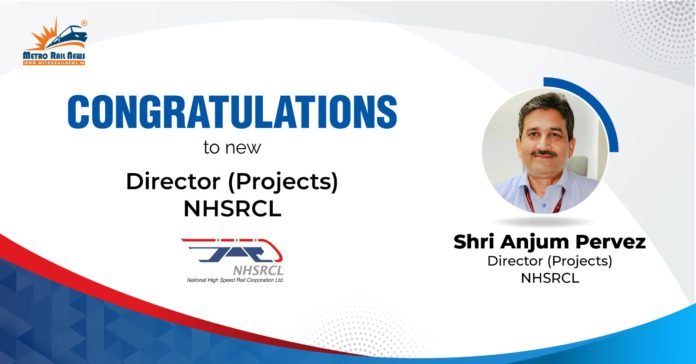
NEW DELHI (Metro Rail News): Shri Anjum Pervez has officially taken up the position of Director (Projects) at the National High-Speed Rail Corporation Limited (NHSRCL). Prior to this role, he served as the Principal Executive Director (Planning & Development) at NHSRCL. Notably, Shri Pervez has played a pivotal role in shaping India’s first high-speed rail project.
With a wealth of experience garnered through various capacities within the Indian Railways, Shri Anjum Pervez has showcased his expertise in multiple facets. His responsibilities have ranged from the maintenance and modernization of railway tracks to the meticulous planning, execution, and successful commissioning of new railway projects.
CMRL to display advertisements on its metro pillars to boost non fare revenue/ image by Stalin SP
CHENNAI (Metro Rail News): Chennai Metro Rail Ltd. (CMRL) is exploring new avenues for revenue generation by allowing advertisements on the pillars of its elevated stretches. The organization has initiated the bidding process, and a contractor is expected to be chosen within the coming months. These advertisements will be designed to reflect the cultural essence of the city and promote State tourism.
According to CMRL officials, the pillars along the Thirumangalam-CMBT, CMBT-Ashok Nagar, Ashok Nagar-Ekkatuthangal, Ekkatuthangal-Alandur, Saidapet-Guindy, and Guindy-Alandur stretches will be utilized for displaying these thematic advertisements. This strategic initiative aims to bolster non-fare box revenue.
While ticket sales contribute to revenue, CMRL acknowledges the need for diversification due to increasing operational costs. The growing ridership, with approximately 2.6 lakh daily commuters, leads to escalated expenditures. Therefore, generating substantial non-fare box revenue has become imperative. This will be achieved by leasing spaces within stations to commercial enterprises, allowing companies to prefix their names to station names, utilizing pillar space for advertisements, and implementing similar strategies, as stated by an official.
The inauguration of CMRL’s first elevated stretch from Koyambedu to Alandur took place in 2015. Subsequently, Phase I and its extension projects were successfully completed, resulting in the establishment of a functional 54-km network.
Aksahvani underground Metro station to be located at Frazer Road
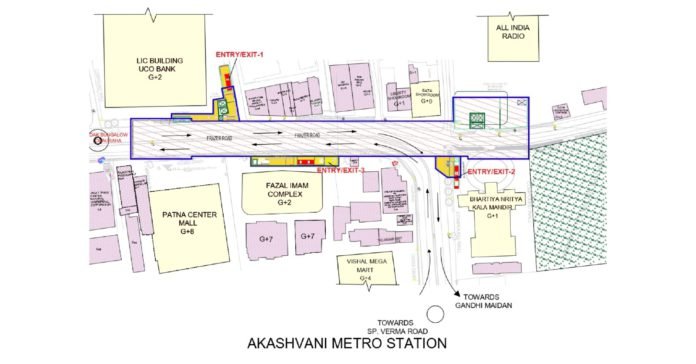
PATNA (Metro Rail News): The Aksahvani underground Metro station of the Patna Metro Rail Project will be located at Frazer Road, the heart and center of the city. The length of this station will be 235 meters, and the depth of the track from ground level will be 16 meters below. In this underground metro station of Corridor-II, pedestrians of Frazer Road area will be able to move easily from one side of the road to the other side of the proposed subway without entering the paid area of the metro.
The Akashvani underground metro station is proposed for seamless movement of people from areas like Frazer Road, S. P. Verma Road, Exhibition Road, Gandhi Maidan, Dak Bungalow, Patna Station, Station Road, Maurya Lok etc. It will also connect several important offices, commercial establishments/buildings, malls etc. in the vicinity of Frazer Road like LIC Building, BSEB Office, Hindi Bhawan, DM Office, All India Radio Station, Patna Central Mall, Fazal Imam Complex, Bhartiya Nritya Kala Mandir etc. The nearest stations to Akashvani metro station will be Patna station and Gandhi Maidan metro station.
The Akashvani station will have two levels:
The building is planned to have two levels. At minus one (-1) will be the concourse, and below that at minus two (-2) will be the platform.
Facilities for passengers: Passenger-centric facilities like ticket counters, public conveniences (toilets), security checks, etc. will be available at the concourse level. Since this metro station is a multi-modal integration point, there will also be additional facilities for passengers such as air-conditioned metro coaches and stations. The station will have five escalators, four elevators, and four staircases for the use of passengers.
There will be three entry/exit gates at the station: Entry/Exit Gate 1: Near LIC Building Entry/Exit Gate 2: Near the entrance of All India Radio Station and Bharatiya Nritya Kala Mandir Entry/Exit Gate3: Near Patna Central Mall and in front of Fazal Imam Complex
Facility of Subway for Pedestrians: This station is located in the Frazer Road and Dak Bungalows area, which is one of the busiest commercial/non-commercial centers in the city. Therefore, a pedestrian subway is proposed to facilitate the movement of pedestrians allowing them to easily traverse from one side of Frazer Road to the other side through this station.
For this purpose, the entry/exit gates of the station, Entry Gate 1 and Entry Gate 3, will be interconnected.
Emergency Arrangements:
Adequate arrangements will be in place to safely evacuate passengers from the platform in case of an emergency. In the event of such an emergency, five fire escapes are proposed to ensure the safe exit of passengers and firefighters.
Metro Rail News team conducted an exclusive interview with Mr. Rishi Aggarwal, MD, JCBL Group.
Mr. Rishi Aggarwal, a distinguished entrepreneur and visionary leader, is the Managing Director of JCBL Group, a prominent business conglomerate in India. With an MBA in Finance from FORE School of Management and a Harvard Business School fellowship, he exhibits exemplary leadership and business acumen. Joining the family business at 23 in 1996, he drove JCBL’s remarkable growth, achieving over 20% average growth rate and global expansion, transforming countless lives with innovative solutions.
The interview discusses Mobility Solutions Limited (MSL), part of JCBL Group, and its customized solutions for the metro and rail sector in India. It highlights MSL’s major projects, overseas ventures, and efforts towards carbon mitigation and EV developments.
Here are the excerpts from the interview:
1. What are the major customized solutions offered by Mobility Solutions Limited, of the JCBL Group for the metro and rail sector in India?
At MSL, we specialize in producing a diverse range of railway parts and components, including FRP/GRP composite solutions, sheet metal products, and interior solutions. Our expertise lies in crafting high-quality FRP/GRP composites, such as Nose cone/Front-end components, Interior panelling, and toilet modules. Additionally, we excel in manufacturing sheet metal products like Front Mask/Nose, Front and Rear-end components, Under Frame structures, Bogie Frames, Side Walls, Roofs, and Doors. To ensure efficiency and precision, we leverage advanced production and mass manufacturing technologies. Our commitment to delivering exceptional quality drives our position as a trusted provider in the industry.
2. Kindly specify the significant projects being undertaken with important orders on the book.
MSL works extensively with Indian Railways as well as for Metro Projects, nationally and internationally. Some of the projects we have contributed to are Vande Bharat Express, Chennai Metro, Delhi Metro, Mumbai Metro, etc. We continue to supply for the next phases of these projects presently. Apart from this, our collaboration with Indian Railways had been a massive success in the past, where we have worked with various Rail Coach Factories of Indian Railways. These Rail Coach Factories include ICF Chennai, MCF Raebareli, and RCF Kapurthala, where MSL manufactured many significant parts and components for the Indian Railways.
Please give a brief detail of your overseas ventures. How is the company performing in that segment? What have been the major business tie-ups and significant accomplishments w.r.t. high-end customized mobility solutions, especially for railways?
We have a very strong and enduring relationship with global companies, and we are doing very well on the global front. We have collaborations with global companies like Alstom and GE Transportation. With Alstom and its acquired company Bombardier, we have provided components and parts for various global projects that includes Sydney Metro, Mexican Metro, and more. Also, for GE Transportation, MSL has supplied FRP Parts for their locomotive business in the USA. The quality of our parts and components fulfil the requirements of international clients, which showcases the MSL’s worldwide success.
4. Indian Railways is going through a transformation spree and plans to aggressively boost its capacity in the next 5-10 years. How do you see the opportunity and enormous market ahead? Is there any specific plan by the company in this segment?
As the Indian Railways and the rail networks transform in terms of capacity and become more and more modernized, the need to supply optimum quality components made with the best quality material and technology will also increase. We are in talks with partners internationally to guide us when it comes to such niche areas of technological advancements. For example, high-speed trains require components different from the current components used. As far as specific plans are concerned, we are always aiming to improve processes and capabilities to cater to the ever-changing and ever-developing markets and demands.
5. Despite serious efforts by the government to augment rail networks and strengthen rail capacity for both passenger & freight transportation, there continues to be congestion in both trains and on roads. What, in your opinion, can be a customized solution to this? Do you think BRTS and LRT can be sustainable transport options for India?
India is an expansive country with a very high population. We cannot rely on any one single mode of transport to fulfil our requirements. Whether it is the LRT or BRTS, or metro lines or highways, we need to constantly expand reach and connectivity. The government is taking great measures when it comes to funding or infrastructure development. So, there is also no single answer to solve the congestion problem we face. The situation is slowly being eased as we develop more routes and means of transport.
6. JCBL Limited, a part of the JCBL Group, provides customized solutions in the luxury fleet. How is it placed amongst players like Eicher, Tata Motors, Ashok Leyland, etc? What have been the growth figures for the organization? Is there any significant development by the company in terms of luxury and customized rolling stock manufacture?
At JCBL Limited, we take pride in being a leading and preferred manufacturer of highly customized mobility solutions in the country. Our expertise spans across Passenger Transportation, Health Care Vehicles, and Special Application Vehicles, catering to diverse customer needs. With a strong focus on customer satisfaction, we provide end-to-end solutions, from selecting the right chassis from OEMs to designing, developing, and manufacturing the product after taking necessary approvals for Govt. compliance, homologation/CMVR and delivering the finished product that ensures customer satisfaction, and lastly followed by a Pan India service support. Our commitment to quality and innovation allows us to deliver around 50 highly customized mobility solutions each year, contributing to an approximate turnover of 25 crores per annum. We are grateful for the strong demand and business visibility in this segment, and we continue to strive for excellence in meeting our customers’ unique requirements.
7. What are your efforts towards carbon mitigation? Kindly specify the major developments in the EV segment. In what ways, with your R&D and innovation, are you helping reduce global carbon emissions in the coming years?
As a responsible corporate citizen, we are actively working on carbon mitigation and sustainability efforts. Our major developments in the EV segment are in progress, and though we can’t share specific details yet, we are committed to introducing environmentally friendly vehicles. Our R&D focuses on creating cleaner and more efficient technologies to reduce emissions throughout the vehicle lifecycle, from production to recycling. We are dedicated to achieving our carbon reduction goals through thoughtful strategies and milestones.
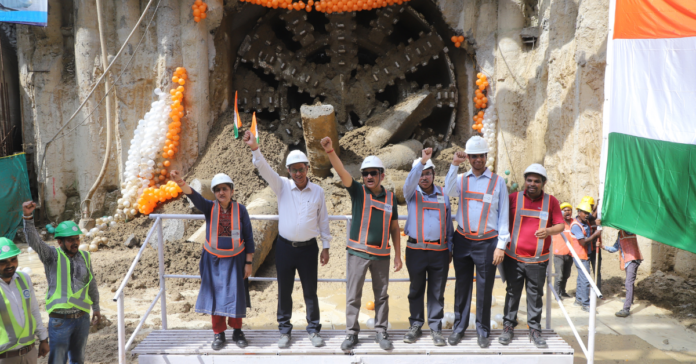
Shri Vinay Kumar Singh, MD, NCRTC along with other officials of NCRTC celebrating the breakthrough of TBM Sudarshan 4.4
VAISHALI (Metro Rail News): In a significant development towards providing a faster regional connectivity in NCR, the National Capital Region Transport Corporation (NCRTC) achieved today a major milestone with the TBM Breakthrough of Sudarshan 4.4 at Vaishali retrieving shaft, Ghaziabad. The tunnelling of the entire Delhi – Ghaziabad – Meerut RRTS corridor has now been completed with the completion of this 2 km long tunnel between Anand Vihar towards Sahibabad.
Shri Vinay Kumar Singh, MD, NCRTC initiating the TBM breakthrough by pressing the remote button
Mr Vinay Kumar Singh, MD, NCRTC, initiated the breakthrough by pressing a remote button in presence of the Directors and other senior officials of NCRTC. The Sudarshan 4.4 was lowered at the launching shaft constructed at Anand Vihar, which is now being retrieved from the Vaishali retrieving shaft.
Shri Vinay Kumar Singh, along with other officials of NCRTC, celebrates the breakthrough of TBM Sudarshan 4.4 at Vaishali retrieving shaft, Ghaziabad
The whole tunnelling has been completed in less than 18 months. Seven (7) state-of-the-art Sudarshan Tunnel Boring Machines (TBM) have been used to bore the 12 km long parallel tunnels of the underground section of the country’s first RRTS corridor. Rest 70 km long section of the corridor is elevated, where about 80% of the viaduct is completed.
To construct the tunnels, more than 80,000 pre-cast segments have been used. These high-precision pre-cast tunnel segments were cast at the state-of-the-art casting yards established at Kadkaddooma, New Delhi, and Shatabdi Nagar, Meerut. These segments, measuring 1.5 meters in length, joined together to form the tunnel rings. The diameter of the RRTS tunnels is 6.5 m which is highly optimised as compared to global benchmarks of tunnels for a similar design speed of 180 Kmph with wider and higher rolling stock.
TBM Sudarshan 4.4
A total of 4 tunnels have been constructed in Delhi from Anand Vihar underground RAPIDX station for to and fro movement of trains. Two parallel tunnels, each approximately 3 kilometres, are for connecting Anand Vihar station to New Ashok Nagar station, and approximately 2-kilometre-long parallel tunnels are for connecting Anand Vihar station to Sahibabad station.
Delhi section Tunnelling:
The tunnelling journey of NCRTC commenced in February 2022, when the tunnel boring machine (TBM) “Sudarshan 4.1” was lowered into the launching shaft at Anand Vihar, New Delhi to bore the tunnel between Anand Vihar towards New Ashok Nagar. Sudarshan 4.2 was launched soon after for tunnelling its parallel tunnel. These parallel tunnels are the longest tunnel in Delhi made by any Tunnel Boring Machine and are about 3 kilometres each. Sudarshan 4.1 made the breakthrough from the tunnel retrieval shaft constructed at Khichdipur, Delhi, in just over a year in April 2023. Sudarshan 4.2 also completed tunnelling for its parallel tunnel and made a breakthrough in June 2023.
Apart from these, two more Sudarshan, 4.3 and 4.4, were launched from Anand Vihar for tunnelling of 2-km long parallel tunnels towards Sahibabad RAPIDX Station for the Delhi-Ghaziabad Section in June and October 2022, respectively. One of these, Sudarshan 4.3, made a breakthrough from the retrieval shaft constructed near Vaishali Metro Station in May 2023. While the fourth and last TBM, Sudarshan 4.4 has achieved its breakthrough today.
Tunnelling in the Delhi Section was a complex and challenging task. Going towards Sahibabad from Anand Vihar, the underground tunnel was passing very close to the the industrial area buildings, passed below shallow over burden area ranging from 4m-6m and below the high-tension electric cables at an overburden of only 0.5m below the cables are few examples. Similar challenges were faced in the tunnelling towards, New Ashok Nagar when it navigated in close proximity to existing metro viaduct piling structures, crisscrossing expressways, and even non-engineered buildings in Patparganj and Khichdipur. All these challenges were tackled successfully by executing strategic planning and innovative methods.
Meerut Section Tunnelling:
Meerut, on the other hand, comprises three underground stations, namely Meerut Central, Bhainsali, and Begumpul. To connect these stations, six parallel tunnels have been constructed. The tunnelling activities started in Meerut with the launching of Sudarshan 8.1 in April 2022 and all tunnelling activities completed in July 2023.
In Meerut also, the tunnel’s path intersected densely populated urban zones, including its passage beneath the drain and foundations of the older buildings, Sharp bends etc., which was tackled with unwavering diligence and meticulous care.
After the completion of underground tunneling portions of the corridor, track laying and installation of OHE will pick up pace. The same has already been started from Anand Vihar underground station and Begumpul in Meerut.
NCRTC is targeting to open the entire 82-km long Delhi-Ghaziabad-Meerut for the public by 2025. Before that, it will operationalize a 17-km long Priority Section between Sahibabad and Duhai Depot shortly.
NEW DELHI (Metro Rail News): In a significant step forward, the ambitious Vande Bharat Trains project, equipped with sleeper facilities, has gained momentum as Russian rolling-stock giant TMH (Transmashholding) has submitted a performance bank guarantee (PBG) of Rs 200 Crore to the Indian Railways. This development paves the way for the railways to finalize a manufacturing cum maintenance agreement with TMH, which will serve as the technology partner responsible for producing 120 of these advanced trains.
The primary objective is to unveil the inaugural prototype of the Vande Bharat sleeper train by the upcoming March, strategically timed just months before the Lok Sabha Polls. The Russian major TMH, has established a joint venture in collaboration with the railway Public Sector Undertaking (PSU), RVNL (Rail Vikas Nigam Limited). Also, an alternative consortium comprising the central PSU, Bharat Heavy Electricals Ltd (BHEL), and Titagarh Wagons (TWL) has secured the contract for manufacturing 80 Vande Bharat trainsets. It is anticipated that this consortium will oversee the production of the initial train batch.
The newly designed trains are expected to cover long-distance and overnight journeys. It could possibly be deployed on Rajdhani routes. Meeting the terms stipulated in the tender, the special purpose vehicle (SPV) established by TMH and RVNL will oversee the production of 120 Vande Bharat sleeper trainsets within the prescribed timeline. Furthermore, the SPV will also be responsible for managing maintenance services for an extended period of 35 years.
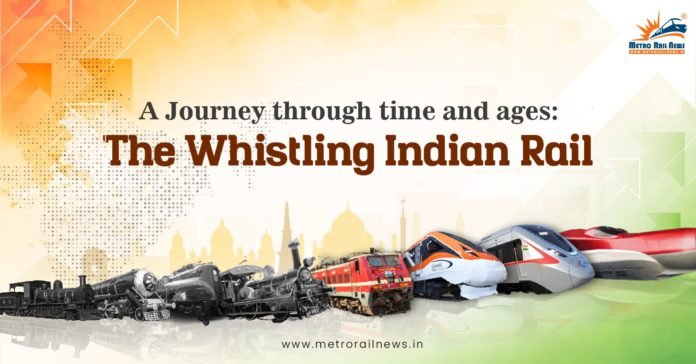
Indian Railways recently marked 170 years since the country’s first passenger trains entered service. It is worthwhile to investigate and analyse the extensive and complex history of one of the world’s greatest rail systems, from the British Raj to modern rail operations of a rising and developing economy. It may be noted that despite being started as an initiative to suffice the requirements of the colonial British East India Company to foster and strengthen their rule in the nation, over more than a century and a half, Indian Railways have come to define, shape and influence the country. The goals of the British plan to build railways were to reduce transportation costs and to provide English merchants with greater access to raw cotton from India. In addition, the railway would open the Indian market to British-made goods such as cotton textiles.
However, the self-driven motive of the Britishers to suffice their narrow needs on a fraudulently entered nation appeared to be a boon for the country and perhaps one of the most significant engines of its growth in due course of time. The networks and connections that were once laid to boost and help an authoritarian regime and fill the coffers of foreign investors evolved to transform the country itself, helping to establish a staggeringly large network that the world today refers to as a jewel in India’s crown.
First passenger train in India
On April 16, this year, exactly on this day 170 years ago, the first passenger train ran and headed from Bombay to Thane for around 34 km. On April 16, 1853, a 14-carriage train carrying 400 passengers set out from what is now called Chhatrapati Shivaji Terminal for a distance of thirty-four kilometres. Three engines, Sahib, Sindh, and Sultan, pulled the train. However, the first significant milestone for the nation was created when steam locomotives started to be manufactured in country workshops. The Rajputana Malwa Railway’s Ajmer workshop manufactured the first steam locomotive, No. F-734, in 1895.
The Great Indian Peninsula Railway (GIPR) built and operated the passenger line. It had been built in 1,676 mm (5 ft 6 in) broad gauge, which later became the standard gauge for the railway. In 1925, the first railway budget was proposed. The first electric passenger train in India travelled between Victoria Terminus (VT) and Kurla on February 3, 1925. Since then, Indian Railways have progressed and advanced in a significant way, and it has now become one of the most vital means of transportation in the nation, carrying over 30 million passengers and more than 3 million tonnes of freight across the country every day. Under one management, the Indian Railways network is the largest in Asia and the second largest in the world.
Indian Railways in Independent India
After independence, India inherited a rail network that needed significant modernisation. Many lines were rerouted, and new lines were constructed to connect important towns and cities. Later, Indian Railways was established through the merger of 42 railways held by former Indian princely states. The rail network in the country stood around nearly fifty-five thousand kilometres after independence in 1947.
For administrative purposes, the existing rail networks were divided into six Zones in 1952. With the growth of the economy, Indian Railway started making all railway productions indigenously. Steam locomotives were phased out beginning in 1985, and electric and diesel locomotives took their place. Today, Indian Railways is one of the world’s most prominent rail service providers. With nearly 1,30,000 Kms of total route length, it truly is a mammoth rail system of the world. Indian Railways operates the world’s second-biggest network under a single administration and Asia’s largest rail network. The railway operates around 7,500 cargo trains every day, carrying more than 3 million tonnes of freight. With approximately 1.4 million employees, Indian Railways is the world’s seventh-largest employer.
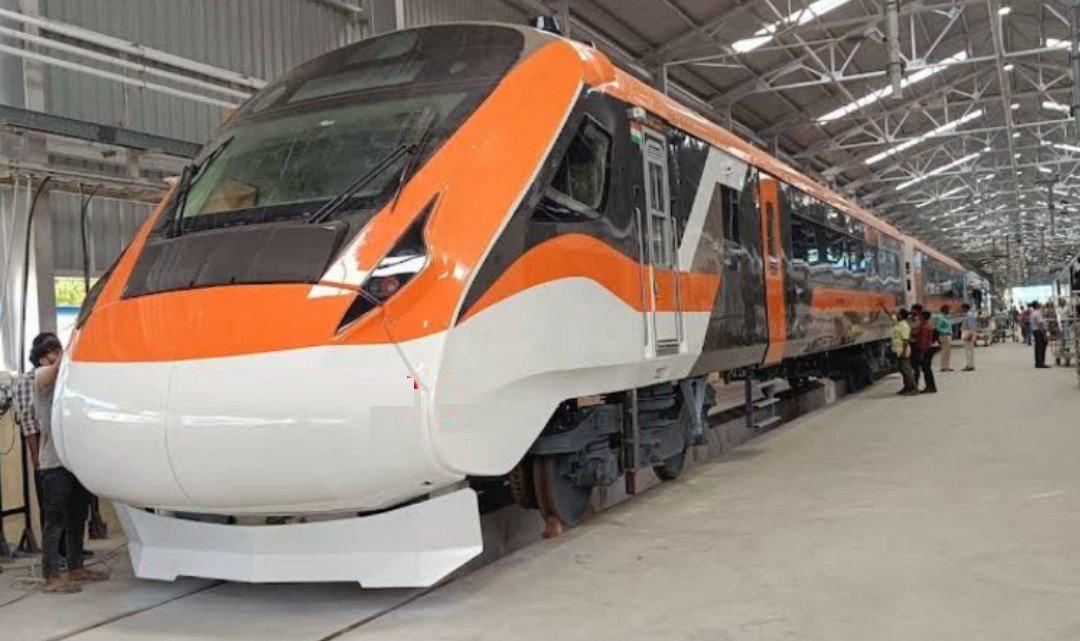
Soon after independence, Indian Railways was nationalised in 1951. It is currently Asia’s largest rail network. Millions of people in India rely on the Indian railway as a lifeline. It plays an extremely important role in nation-building, whether economic or social. It is a low-cost transportation system that not only carries people but also goods and cargo. Under the control and ownership of Railways, DFCCIL is also constructing dedicated goods and freight corridors to improve and smoothen the rail operations in the country. Additionally, the railway is also working on the development of a Diamond quadrilateral for a high-speed rail network. The railways in India employs the highest number of people. In addition, a large section of the society relies on the rail services to earn their bread and butter and living. Rail service companies such as RailRestro and e-catering apps are linked to the Indian railways. The Mettupalayam-Ooty Nilgiri passenger train is the slowest in India. It averages 10 kmph, while the Vande Bharat Express is the fastest train presently. This train, also known as Train 18, travels at a speed of 160 kilometres per hour on average. This train can reach to a top speed of 180 kmph.
India’s rail network is one of the world’s largest and busiest. Every day, about 10,000 trains connect twenty-eight states and two union territories. Rail connectivity to the main cities of the North East states of Sikkim, Meghalaya, and Arunachal Pradesh is improving, and one can expect full-fledged connectivity to every area of the country in the future years. The railway’s dense and complicated network is administered by dividing it into several zones, which are further subdivided into divisions.
Today, the railway comprises seventeen zones and sixty-eight divisions, which help in connecting the urban and rural areas of the country. The railways in the country operates on a multi-gauge system with broad, narrow, and metre gauges. With over 1.5 million employees, it is the world’s largest commercial employer. Other than long-distance trains, many cities have a suburban or local train network for its commuters.
There are several classes of travel available on the trains, including First Class AC, Air-conditioned coaches that are 2-tier or 3-tier, First Class, Sleeper Class, AC Chair car/Seater Class, and General or unreserved. The fare list varies based on the services offered. Trains are the most dependable and inexpensive mode of transportation. The Shatabdi Express, Rajdhani Express, and Duronto Express are some of India’s fastest trains, competing with the country’s low-cost airlines. Every year, railways tries to incorporate and adopt new safety measures and introduce new trains in various locations to accommodate and handle the increasing number of passengers.
The history and phase-wise development of Railways in India can be stated as under:
1853-1869: Launching passenger rail services
Although rail services were first proposed in India in the 1830s, historians attribute 16 April 1853 as the turning point for India’s passenger rail revolution. The country’s first passenger train began its 34-kilometre journey between Bombay’s Bori Bunder station and Thane on this date. It consisted of fourteen carriages pulled by three steam locomotives and carried four hundred passengers.
The railway was established through an alliance between the Great Indian Peninsular Railway (GIPR), founded in 1849, and the East India Company, which governed significant portions of the country at the time. The success of the alliance prompted the development of railways in Eastern India (1854) and South India (1856). Following the completion and opening of the Calcutta-Delhi line in 1864 and the Allahabad-Jabalpur line in 1867, these lines merged with the GIPR to form a 4,000-mile network that stretched across India. This initial phase of passenger transportation was predominantly financed and supported by private corporations under a British Parliament-created guarantee system that ensured they would earn an established and certain rate of interest on their capital investment. Between 1855 and 1860, eight railway companies were established, including the Eastern India Railway, Great India Peninsula Company, Madras Railway, Bombay Baroda Railway, and Central India Railway.
1869-1900: Famine and economic growth
The British Raj reigned dominant and supreme in India following the Indian revolt of 1857 and the subsequent liquidation of the East India Company. From 1869 to 1881, it took over railway building from external contractors and expanded to help areas hit by hunger and famine following the country’s severe droughts. By 1880, the network had grown to 9,000 miles long, with lines winding inward from the three major port towns of Bombay, Madras, and Calcutta. Toilets, gas lamps and electric lighting were among the new passenger facilities introduced in the 1890s. By this time, the railways’ popularity had soared, and overcrowding forced the introduction of a fourth class onboard. By 1895, India had begun to develop its own locomotives and was able to send its own experts and equipment to aid and assist in the construction of the Uganda Railway by 1896.
1901-1925: Moves towards centralisation
In 1901, the railways began to make a profit after years of construction and financial investment. Nonetheless, the scope of government interference rose considerably in the early years of this century. In 1900, GIPR was the first corporation to become state-owned. By 1907, the government had bought all major lines and began leasing and renting them back to private operators.
In 1901, the Railway Board was formed, consisting of a government official, an English railway manager, and an agent of one of the company railways. The government, then led by Viceroy Lord Curzon, formalised the board’s powers in 1905, and the board thereafter rose in size and influence ever since then. Both the GIPR and the East Indian Railways (EIR) were nationalised in 1923 as part of a move towards a more centralised management system.
Nonetheless, World War I had a negative impact on the growth of the railways, with production redirected to satisfy British needs outside of India. The network was in disrepair by the war’s end, with many services banned or reduced. In 1924, railway funds were separated from the general budget, and the railway received its first independent dividend in 1925.
1925-1946: Electrification and hard times
On 3 February 1925, the first electric train ran between Bombay and Kurla, laying the groundwork for future electrification. By 1929, the railway network had expanded to a total length of 66,000 kilometres, carrying approximately 620 million passengers and 90 million tonnes of goods every year. However, even in the final days of the British Raj, foreign events continued to influence rail operations in the country. The economic depression caused by the Wall Street Crash resulted in the withdrawal of INR 11m from the railway reserve funds. Meanwhile, World War II also hampered railway development and seized the construction works as waggons were largely appropriated and commandeered for military movements and transportation.
1947-1980: Partition and zonal creation
The departure of Britain in 1947 divided the country in two, producing a ripple effect on the railways as more than 40% of the network was lost to the newly formed Pakistan. The Bengal Assam and North Western Railways were divided and disconnected from the Indian rail system. During the post-partition uproar, rioters destroyed railway infrastructure and attacked refugee trains.
A few years later, Indian Railways began to shape its own future, gaining control of the majority of railway franchises in 1949-1950. It began reorganising the network into zones in 1951-1952. The Samjhauta Express, the first train between India and Pakistan, began service between Amritsar and Lahore in 1976. As the twentieth century progressed, the railways made more strides towards modernisation. Colonial-era locomotives were replaced with cutting-edge trains, while efforts to adopt 25kv AC traction in the 1950s spurred a new wave of electrification.
1980-2000: Technology and phasing out steam
As a result of energy challenges that occurred in the 1970s, steam locomotives were completely phased out in the 1980s. Between 1980 and 1990, approximately 4,500 km of track were electrified. Meanwhile, the first metro system in India debuted in Calcutta in 1984. Though economic stagnation and political unrest hampered network expansion in the 1980s, the Konkan Railway, a 738-kilometer behemoth connecting India’s western coast to the rest of the country, opened in the 1990s. The greatest transformation of the time, however, originated in the field of computing.
The Indian Railways, in particular was, benefitted by it, and subsequently, the Indian Railways online passenger reservation system was developed in 1985 and gradually launched at Delhi, Madras, Bombay, and Calcutta. This was designed to allow customers to reserve and cancel reserved accommodations (reservations) on any train from any terminal, which was expanded in 1995 with the introduction of the country-wide network of computerised enhanced reservation and ticketing (CONCERT).
2000-2017: Moving online
Metro stations have been sprouting up in India’s main cities since 2000, including Delhi (2002), Bangalore (2011), Gurgaon (2013), and Mumbai (2014). In 2002, the East Coast, South Western, South East Central, North Central, and West Central Railway zones were established on the network.
However, the launch of online train bookings and ticketing through its IRCTC system in 2002 was undoubtedly the most significant stride forward for IR. Passengers could now schedule their journeys online or buy tickets from thousands of agents across the country, which truly was an important convenience added considering that passengers had reportedly travelled more than 4.5 billion kilometres on the railways between 2000 and 2001. More recently, on 5 April 2016, the Gatimaan Express, India’s fastest train with a top speed of 160km/h, made its inaugural run from Delhi to Agra. On March 31, 2017, Indian Railways declared that the country’s entire train network would be electrified by Dec, 2022.
2018 to present and beyond: The future of Indian Railways
Today, Indian Railways manages the fourth-largest rail network in the world, with tracks spanning more than 120,000km of the country. The railway is preparing for the future with a number of initiatives like running freight and goods trains on a separate dedicated corridor across the nation called the Dedicated Freight Corridors (DFC). The first Regional Rapid Transit System (RRTS) called RapidX, which is also the country’s first indigenous semi-high speed train.
Rapidx Train
The priority section of 17 Kms from Shahibabad to Duhai Depot of the 83.14 Km corridor from Delhi to Meerut is complete, and the operations shall commence shortly. Apart from that, Indian Railways is already spearheading with its plans of launching Vande Bharat 3.0 Sleeper Version, Vande Bharat Trains, after successful implementation of Train-18 alias Vande Bharat Semi-High Speed Trains. The Railways, by the end of the year, may come up with the first prototype of the country’s first hydrogen-powered trains along with Vande Metro and other significant development in train operations. The nation is already on the verge of achieving a significant milestone of hundred percent electrification of its entire route length. The works on the nation’s first HSR Mumbai-Ahmedabad Bullet Train Project are also in full swing, and the priority corridor is expected to be completed by 2025. The Indian Railway also envisages the ambitious goal of going completely green by 2030.
Freight, Tourist & Luxury Trains
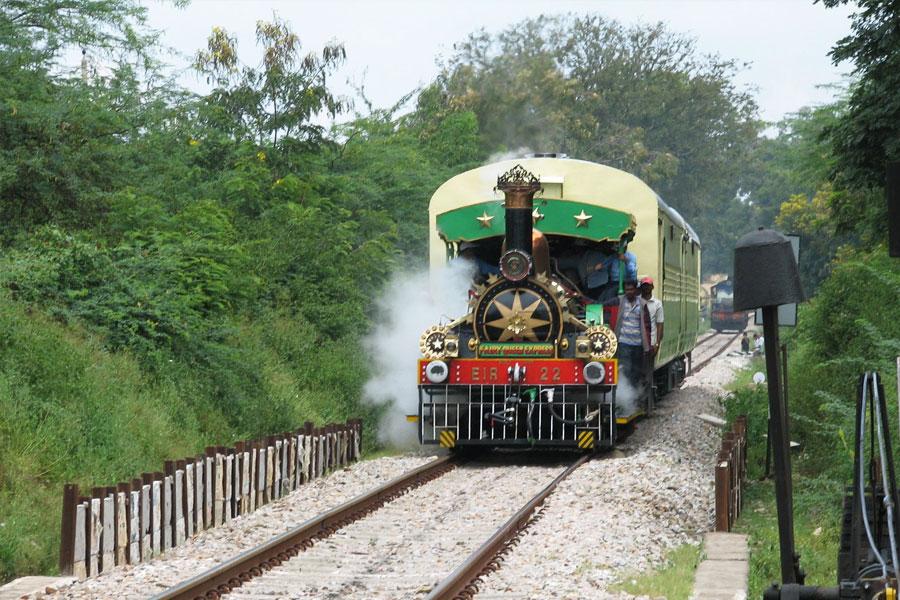
The rail journeys are always thrilling and provide a true taste of India’s rich tradition and culture. The goods and freight sector contributes over seventy per cent of the railway’s revenue. It delivers a wide range of commodities, including fertilisers, petrochemicals, agricultural produce, mineral ores, and many others. It also transports vehicles to and from long-distance locations. Indian Railways has been exceptionally successful in helping tourism growth. It has been an excellent host to all of the visitors. The most luxurious trains in the country include Deccan Odyssey, Maharaja Express, Palace on Wheels, The Golden Chariot, Royal Orient Train, Royal Rajasthan on Wheels, and the Fairy Queen. The Fairy Queen is also the nation’s pride and the world’s oldest functioning locomotive. On board, passengers can look forward to an unforgettable royal experience that combines Indian heritage and hospitality. The finest way to see the incredible India is through a train journey. Indian Railways is the nation’s lifeline, whether for passenger or freight transport. The railways contribute significantly to tourism, being the primary source of transportation for all types of tourists from both the domestic and international sectors. In addition to simple train excursions from point to point for visitors and the general public, the Indian Railways offers the following exclusive tourist trains:
Luxury Tourist Trains
Mahaparinirvan Express
Bharat Darshan Trains
Punj Takht Train Steam train |
Additionally, the Indian Railway Catering and Tourism Corporation, a Public Sector Undertaking under the Ministry of Railways, offers a wide range of specialised tourism products and packages as well as assistance with unique tourism needs.
12,000 HP most powerful locomotive
The Indian Railways’ most powerful 12000 HP Made in India locomotive made its commercial debut between the Deen Dayal Upadhaya and Shivpur stations of Uttar Pradesh. These engines, built at the Railways’ Madhepura factory in Bihar under the government’s Make in India programme, are the most powerful locomotives that are running on Indian rails. All 800 of these locomotives are being built in the country after being designed at the company’s engineering centre in Bengaluru. With the debut, India has joined a selected and elite group of countries that have 12,000 HP or higher capacity electric locomotives, including Russia, China, Germany, and Sweden.
India’s first bullet train project
The design of bridges and tunnels for the country’s first high-speed bullet train between Ahmedabad and Mumbai is well underway. The train would cover the over 500 km trip between the two cities in less than three hours, as compared to the current seven hours. The train shall stop at 12 stations, four of which are located in Maharashtra. The projected corridor will run from Mumbai’s Bandra-Kurla Complex (BKC) to Ahmedabad’s Sabarmati Railway Station. Three trains have been planned to run during peak hours and two trains to run during non-peak hours. Train operations have been slated to be divided into two categories. A few trains that would stop only at a few stoppages, while the others that shall stop at every station between Mumbai (BKC) and Sabarmati. There will be 70 trips each day (35 in each direction) connecting the two stations, with an estimated ridership of nearly forty thousand passengers per day.
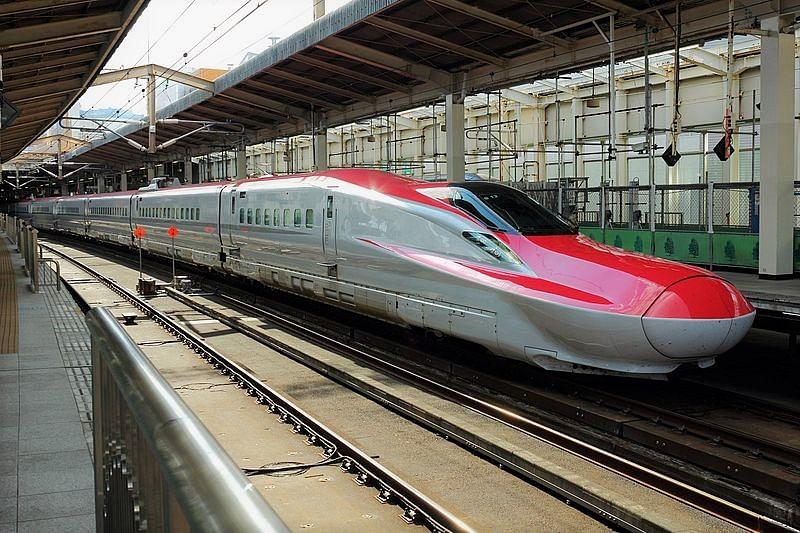
The soil testing, surveying and land acquisition works are underway. The route travels and passes through more than hundred villages of Maharashtra. The majority of these villages are located in the Palghar district. The National High-Speed Rail Corporation (NHSRC) issued a notice of intent to acquire land in 17 villages and notified the landowners. Those who donate their land will be reimbursed above and beyond the existing market values. Those who do not appear will have their lands taken under Section 19 of the Land Acquisition, Rehabilitation, and Resettlement Act of 2013. The train will reach a top speed of 320 km/hr in 320 seconds and will have travelled nearly eighteen kilometres by then. Passengers would go from BKC in Mumbai to Thane in 10 minutes and to Virar in Palghar district in 24 minutes.
Different Types of Trains in India
There are many types of trains which are operated by Indian Railways. These include:
Special Trains: Special trains are not permanent because they are put in place on a temporary basis to meet the high volume of traffic during the summer vacation and festival season. The numbers for Special Trains begin with zeros.
Covid-19 Special Trains: During the pandemic outbreak, Indian railways launched Covid-19 Special Trains to transport passengers trapped in cities to their homes. To reduce the possibility of spreading COVID 19, Indian Railways cancelled all regular trains, but began COVID 19 special trains to serve passengers. The tickets for these trains could be purchased 120 days in advance.
Train 18 Vande Bharat Express: Vande Bharat Express is a semi-high-speed, completely air-conditioned daytime train capable of reaching speeds of up to 180 km/h. Train 18, as it is often known, began operations on February 15, 2019. These trains include odour control systems, sensor-based water taps, bottle holders, on-board Wi-Fi, CCTV cameras, and bio-toilets.
Humsafar Express: The Humsafar Express is a premium train featuring three-tier AC and sleeper class accommodations. Humsafar trains are equipped with most of the latest features and conveniences, such as CCTV surveillance, charging connections, bio-toilets, an innovative GPS tracking system, reading lights, LED screens that indicate passing by stations, train speed display, and so on.
Rajdhani Express: The Rajdhani Express is one of the Indian Railway’s oldest trains, connecting the national capital with various other states. It is a completely air-conditioned, superfast long-distance train capable of reaching speeds of 130-140 km/h. There are currently 24 pairs of Rajdhani trains operating in the country.
Shatabdi Express: Shatabdi Express trains are superfast daytime trains that arrive and depart on the same day. The Shatabdi trains may reach speeds of up to 150 km/h. It travels short to medium distances with fewer stoppages. It only has an AC chair car sitting facility. Indian Railways is currently operating 25 pairs of Shatabdi trains.
Tejas Express: Tejas Express trains are air-conditioned chair car trains that travel at a semi-high speed. It only has two modes of accommodation: executive chair car (EC) and AC chair car (CC). It is India’s first private train, run by the IRCTC. It can reach a top speed of 180 km/h. Onboard modern amenities include tea and coffee vending machines, LED TVs for individual travellers, a celebrity chef menu, free Wi-Fi, CCTV cameras, charging plugs, and so on.
Duronto Express: The Duronto Express is one of our country’s fastest trains. It’s a nonstop premium long-distance train that doesn’t stop at any stations except for technical stoppages.
Antyodaya Express: Antyodaya Express began service on March 4, 2017. These trains are entirely unreserved and run on congested routes to alleviate congestion. Travellers do not need to reserve a ticket in advance; they can purchase one whenever they want to board the train.
Passenger Trains: Passenger trains in India provide railway passengers with cost-effective train travel. It links minor towns, villages, and cities to major cities. Passenger trains stop at nearly every station along the route and can travel at speeds ranging from 40 to 80 km/h.
Garib Rath Express: Garib Rath Express Trains are a series of low-cost, air-conditioned long-distance trains that provide rail travel at a low cost. These trains can reach speeds of up to 130 km/h.
Double Decker Express: Double Decker Express trains are superfast express trains that travel during the day and provide bi-level seating to passengers.
Uday Express: Uday Express trains are completely air-conditioned double-decker trains for business travellers, with 120 seats for each coach. Uday Express has a top speed of 110 km/h.
Jan Shatabdi Express: Jan Shatabdi Express trains are a cheaper variant of the Shatabdi Express. It has a top speed of 130 km/h and, like the Shatabdi, completes its route on the same day. AC and non-AC seating is available on Jan Shatabdi trains.
Sampark Kranti Express: Sampark Kranti Express trains are non-AC high-speed express trains that connect India’s capital to other major cities. It has a top speed of 130 km/h and only stops at major stations.
Suvidha Express: Suvidha Express is a fleet of premium express trains with dynamic fare pricing. Tickets for these trains can only be booked and purchased through IRCTC. Suvidha trains have a 15-day advance reservation period, and only confirmed tickets are booked. It is not possible to cancel e-tickets for these trains.
AC Express: AC Express trains are fully air-conditioned high-speed trains that connect the country’s major cities. It has limited stoppages and has a top speed of 130 km/h.
Mail Express Trains: Unlike passenger trains, express/mail trains only stop at key stoppages and do not stop at all stations along the route. Express trains can travel at speeds of up to 130 km/h.
Superfast Express: Superfast trains stop less frequently than regular passenger trains. Superfast trains can travel at the maximum permitted speed of 160 km/h. The superfast surcharge is added to tickets for these trains.
AC Superfast Trains: Superfast AC Trains are totally air-conditioned trains that the Indian railway operates. These trains have precedence over conventional passenger and mail trains on the tracks. It does not stop at smaller stations in order to shorten journey time.
Mountain Railways: Mountain Railways of India are train lines developed in India’s hilly regions that provide train services to mountain areas. Our country has seven mountain railways, three of which have been designated as UNESCO World Heritage sites.
Local Trains: Indian Railway also operates commuter or local train services to connect cities and metropolis with its peripheral and adjoining areas. Some of the popular local train services in India are- The Mumbai Suburban Railway or Mumbai, Chennai, Kolkata, Delhi, Pune, Hyderabad suburban, commuter or local train systems.
Demu Trains: DEMU trains are commonly used by passengers who travel on a regular basis in India’s semi-urban and rural areas.
Memu Trains: Memu Trains operate on railway tracks that have multiple electrical units and provide short and medium-distance routes.
Tourism Trains
The railways contribute significantly to tourism, being the primary means of transportation for all types of tourists from both the domestic and international sectors in the country. In addition to simple train journeys from point to point for visitors and the general public, the Indian Railways offers the following exclusive tourist trains:
Luxury Tourist Trains
Mahaparinirvan Express
Bharat Darshan Trains
Punj Takht Train
Steam train
Metro Rail Services
The first Metro Rail stretch in Kolkata city, between Esplanade and Bhowanipur, was commissioned in 1984, covering a distance of 3.40 kilometres with five stations under Metro Railway, Kolkata. At the moment, 27 cities have a network that is either active or under construction. There are currently sixteen operational or active rapid transit metro systems in fifteen cities across India, the largest of which is the Delhi Metro. India had 859 kilometres of operating metro lines and 16 systems as of March 2023. The metro rail services in the country have grown exponentially in the last one decade. The development is expected to surge further with more than 1,000 km of new metro lines projected to expand to nearly 30 cities by 2025. Recently, Kolkata Metro (the only metro system to be governed by Indian Railways) achieved a major feat by running the first under-water metro trial run successfully under the Hooghly River.
Conclusion
The Indian Railway network not only connects various regions but also touches the hearts of its citizens regardless of race, religion, caste, gender, or class. The tangled and twisted railway lines connect and unite the Indians in one thread. It precisely symbolises and embodies the vision of makers of our constitution, who stated that no one should be discriminated upon based on their origin and background. Railways carries us all, giving us space to learn more about others, nature, and explore different region and locations. The national carrier of people and goods in India is also packed with a number of amazing details and facts. It may be surprising to find that over 1.3 million IRCTC rail tickets are booked every day, and thousands of passengers check their PNR status every second. These statistics should make every Indian proud of their preferred means of transportation.
The Indian railway system was established on April 16, 1853. The inaugural passenger train travelled a distance of thirty-four kilometres from Mumbai’s Bori Bandar to Thane. Three locomotives, Sahib, Sultan, and Sindh, drove the train. The train consisted of thirty waggons. Some fascinating facts about Indian Railways are as follows:
The railway’s ‘Shubhankar’ is named Bholu. On the 150th anniversary of railways, the National Institute of Design developed Bholu, an elephant costumed as a railway guard. In 2003, the railways officially adopted this joyful, ethical, responsible, truthful, and steady elephant artwork as their emblem.
The British government’s first railway workshop was established in Jamalpur, near Munger, Bihar. It was established prior to Indian independence in 1862. With iron and steel foundries, rolling mills, and other facilities, the area rapidly evolved into one of India’s most important core industrial divisions.
With more than sixty-eight thousand km of track, Indian Railways is the world’s fourth largest railway network, trailing only the United States, China, and Russia. It currently has approximately 45 thousand kilometres of the electrified rail network. Besides that, the railway is the most important rail route in the world, operated by a single government.
Indian Railways has 34 active and three under-construction Rail Museums, Heritage Gallery, Art Gallery, and Heritage Park in various locations across India to highlight the sprawling history of the nation’s lifeline. These locations both protect and promote rail tourism. The Delhi Rail Museum, also known as the National Rail Museum of India, is India’s first railway museum.
The Hubballi railway station in Karnataka has been inducted into the Guinness Book of World Records for having the world’s longest railway platform. Prime Minister Narendra Modi inaugurated the 1,507-meter-long platform on March 12, 2023.
The Royal Rajasthan on Wheels, Palace on Wheels, The Golden Chariot, The Maharajas’ Express, and The Deccan Odyssey are the five royal luxury trains owned by Indian Railways. The Palaces on Wheels is the oldest luxury train of all.
Vivek Express covers the longest rail in India, travelling from Kanyakumari to Dibrugarh. It covers 4189 kilometres spanning over 82 hours and 30 minutes, including fifty-six stoppages. On the other hand, the shortest train ride in India is from Nagpur to Ajni, stretching over only 3 kms.
The Indian Railway is building the world’s highest steel and concrete rail arch bridge over the Chenab River. It is located at an elevation of 1178 feet above sea level. The bridge would connect the Bakkal and Kauri villages in Jammu and Kashmir’s Reasi district.
In India, railways employ over 1.4 million people. The Indian Railway is, without a doubt, one of the world’s major employers and institutions. Other than direct employment, some people make a living by selling goods and services at railway stations and trains. Job opportunities are created through e-catering and rail apps that supply rail services.
Another attempt to use the railway as a marketplace to improve people’s livelihoods is through One Station One Product.
Pir Pranjal, located in the Pir Pranjal range of the middle Himalayas in Jammu Kashmir, is India’s longest rail tunnel. It is 11.25 kilometres long. The tunnel is part of the railway line between Jammu and Baramulla.
Howrah Junction is the busiest railway station in India, with the most platforms. Its 23 platforms serve nearly one million passengers each day. Howrah is also India’s oldest railway station.
Household appliances in India work at 220 volts, although electric appliances such as lamps, fans, and outlets on railway coaches operate at 110 volts. It assists the railway in protecting its lamps and fans from robbery because it is challenging to convert 110-volt appliances to 220 volts.
When developing rail coaches, the resonance frequency of suspension is kept near 1.2 Hz or 72 bpm to match the frequency of the human body. It is the only reason one can sleep on a moving train.
Fairy Queen, India’s oldest functioning locomotive, is still used for rides. The locomotive is powered by a steam engine and operates as a tourist train between Delhi and Alwar. The train was built in 1885 and was decommissioned in 1909. The Fairy Queen has been relaunched in 1997. It is currently in operations and used as a premium tourist train.
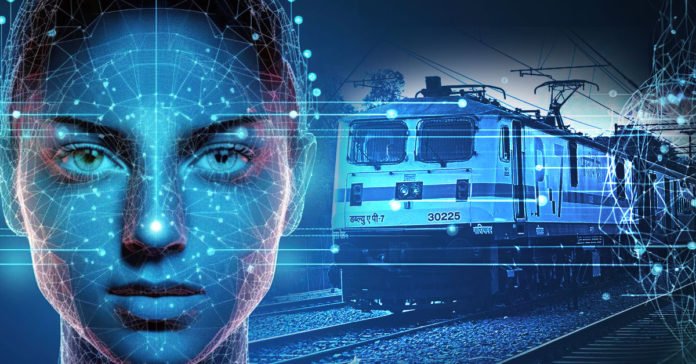
PATNA (Metro Rail News): Indian Railways is set to implement a cutting-edge security initiative by installing a Facial Recognition System (FRS) powered by artificial intelligence technology at major stations, including Patna Junction within the Danapur division of the ECR ( East Central Railway). The move aims to bolster security by linking the system to a database of crimes committed in and around the railway premises.
Birendra Kumar, the Chief Public Relation Officer (CPRO) of ECR, highlighted the railway’s commitment to ensuring comprehensive passenger safety during travel and at platforms. Patna Junction, known for its high passenger footfall of 3 to 4 lakh daily, is a focal point for passenger trains. Kumar emphasized that the railway plans to provide top-tier security similar to airport standards at major stations. The introduction of FRS is expected to serve as a deterrent against criminal activities on station premises.
After the successful installation of FRS technology at all major stations across the nation, it would be a significant security breakthrough for the railways, according to Railway Board sources. Even a team from the RPF had already developed a security plan following the Mumbai attacks on 26/11. However, the proposal was unable to be carried out for a variety of reasons.
Around 200 stations have been earmarked by the railway for a comprehensive security overhaul, with some falling within the ECR’s jurisdiction. In light of rising threats from various quarters like terrorists, Maoist groups, harassment of women passengers, and habitual offenders, there is an urgent need for enhanced security measures such as FRS, luggage scanners, sniffer dogs, and random luggage checks, particularly in Bihar and Jharkhand.
The implementation of FRS holds the potential to significantly enhance security at railway stations, contributing to safer journeys for passengers and curbing criminal activities within the station premises.
BENGALURU (Metro Rail News): The long-awaited moment is approaching for Bengaluru as the launch of the crucial two-kilometre Baiyappanahalli – KR Puram stretch on the purple line is eagerly anticipated. This particular addition to the metro system is expected to significantly enhance public transportation in Whitefield and its surrounding areas. The Bangalore Metro Rail Corporation Limited (BMRCL) has revealed that the inspection of this stretch by the Commissioner of Metro Railway Safety (CMRS) team is scheduled to take place after September 7. The launch of this stretch will be done upon the successful completion of the CMRS inspection.
Shri Anjum Parvez, Managing Director of BMRCL, shared, “The Baiyappanahalli – KR Puram line is currently undergoing signal testing and other trial runs. We anticipate that all trial-related activities will conclude by September 6. Subsequent to this, the CMRS is slated to assess the metro line after September 7. Once we secure CMRS approval, we will be all set to proceed, and the awaited stretch on the purple line will finally be open for operation.”
Initially projected to be operational by July or August, the metro line experienced a delay. Baiyappanahalli to KR Pura and Kengeri to Challaghatta are the two missing links in the Purple Line. Upon opening of these stretches, the complete 43 km line will be operational.
The significance of this launch is that it will bridge the gap between KR Puram and Baiyappanahalli, spanning around two kilometers. This connection is set to link the Whitefield region with Kengeri, Challaghatta, Majestic, and various other parts of Bengaluru.
In recent developments, trial runs were successfully conducted with a six-coach metro train. This was followed by a load test on the Open Web Grinder (OWG), which had been installed atop the Indian Railways track in Bennaganahalli. All these efforts are geared towards ensuring the seamless and safe operation of the newly added metro stretch.
BHOPAL (Metro Rail News): Bhopal, the capital of Madhya Pradesh, is on the brink of welcoming a new metro system. Chief Minister Shivraj Singh Chouhan unveiled the metro’s model coach at the Smart City Park in Shyamla Hills, an event coordinated by Madhya Pradesh Metro Rail Corporation Limited. CM Chouhan initiated the unveiling by pressing a button and subsequently entered the model coach. The metro train comprises three of these coaches, each spanning 22 meters in length and 2.9 meters in width.
During the initial phase of the Bhopal metro, a single train will be composed of three rail coaches. Each coach is designed to comfortably seat approximately 250 passengers. However, the train can accommodate many more passengers who are standing. The trial run for the metro is scheduled for September. The metro train is anticipated to operate along the route from Subash Nagar depot to Habibgang, covering a distance of approximately 4 km.
At least two metro rail stations, one of which is the Rani Kamlapati metro railway station, are anticipated to be finished and ready for trial runs in September. This trial run is a significant step toward enhancing urban transportation in Madhya Pradesh. The responsibility for executing the Bhopal and Indore metro projects lies with the Madhya Pradesh Metro Rail Corporation Limited (MPMRCL). The French mobility company has been awarded the contract, worth an estimated Rs 3,200 crore, to provide metro trains and various systems for the Bhopal and Indore metro rail initiatives. The manufacturing is underway at their Savli plant in Gujarat as part of the Make In India initiative.
The work in the contract involves designing, manufacturing, supplying, installing, testing, and commissioning of 52 standard gauge Movia metro passenger trainsets, each configured with three cars. Bhopal will receive 27 of these trainsets, while Indore will have 25. Each train car measures 22 meters in length and 2.9 meters in width. The Bhopal Metro Rail Project obtained approval from the Union government on November 30, 2018. It encompasses a network stretching 27.87 kilometers, divided into two corridors: one linking Karond Circle to AIIMS, and the other connecting Bhadbhada Square to Ratnagiri Intersection. The approved budget for completion in 2018 was Rs 6,941.40 crore.
CM Chouhan announced that the trial run will be conducted next month, with full-fledged operations expected to start in April. Despite delays during the 15-month Congress government, the project is now progressing rapidly. The metro train will eventually be extended to Mandideep and Sehore, passing through Bairagarh.