Home Blog Page 681

Rs 2,600 crore Aqua Line extension towards Greater Noida in 2 phases

0
Aqua Line extension towards Greater Noida in 2 phases

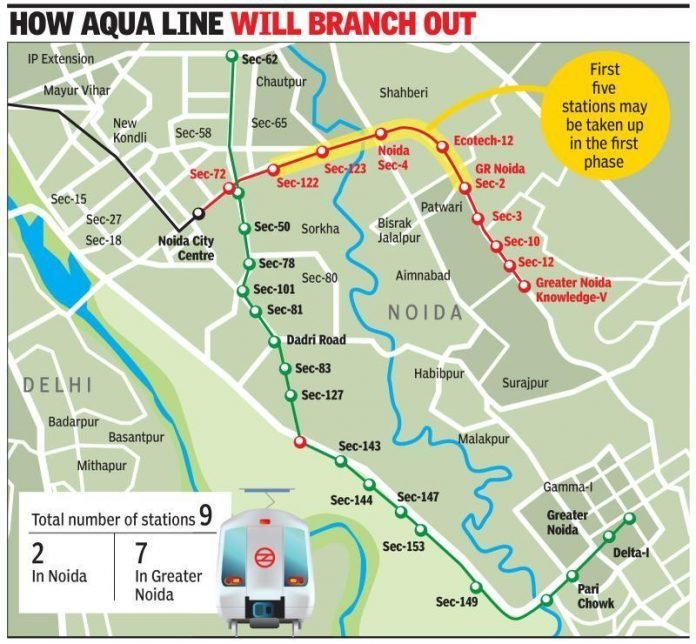
Noida, Metro Rail News: The Construction of the Rs 2,600-crore Aqua Line extension project towards Greater Noida to be taken up in 2 phase. With both the Noida and Greater Noida authorities citing funds crunch as a reason for being unable to contribute their share in the project, the construction of Aqua Line extension, expected to cost Rs 2,600 crore, is likely to be taken up in phases. At an upcoming board meeting in December, the Greater Noida Industrial Development Authority (GNIDA) officials are likely to suggest that the construction of five metro stations on the extended line (two in Noida and three in Greater Noida) to be taken up first, states a ToI report. However, it will need the backing of the Noida Authority as well as an approval from the Uttar Pradesh state government for any such construction work to start on the route.

For the entire project, Noida’s share is around Rs 130 crore, while Greater Noida’s share is around Rs 250 crore. The Centre, as well as the state government, will also contribute for the project by providing Rs 360 crore each. In addition to this, the government is also likely to take a loan of around Rs 1,200 crore for the project. As per the original DPR, the extended line of Noida Metro’s Aqua Line will have nine metro stations in total out of which two will be in Noida and seven will be in Greater Noida. The metro stations in Noida include sectors 122 and 123 and the metro stations in Greater Noida include sector 4, Ecotech 12, sectors 2, 3, 10, 12 and Knowledge Park V.

GNIDA CEO Narendra Bhooshan was quoted in the report saying that as the area was getting more and more populated by the day and needed a stable transport network, they had to start work on the metro project. For phase-wise construction of the route, GNIDA will make a proposal. Recently, a survey was conducted which suggested that work can be started on metro stations till sector 2 in Greater Noida. Bhooshan said that the Greater Noida Authority is ready to spend their Rs 250 crore share. He also said that he would write to his Noida counterpart and would request him to contribute as well. According to the initial DPR, the extension project is scheduled to take two years for completion, however, Bhooshan added that he would request Noida Metro Rail Corporation (NMRC) to expedite it.

The 29.7 km long corridor of Aqua Line, which is likely to be thrown open to the public by this year-end, will run from Greater Noida’s Theta to Noida’s Sector 71. Recently, it was reported that the metro fares for Aqua Line service will be lower than those in the Delhi Metro as it will depend on the number of stations traversed, similar to that of Lucknow Metro.

Advertisement1
InnoMetro_2026

Delhi Metro will soon be adding more coaches on busy routes

0
Delhi Metro to get more coaches, and hopefully less crowded

New Delhi, Metro Rail News: The Delhi Metro Rail Corporation (DMRC) will soon be adding more coaches on trains running on the main lines to ease travel woes. In a major relief for passengers traveling in crammed Metro coaches.  Another objective behind the move is to improve the frequency of services

The DMRC will be changing most of its  6 coach trains running on corridors Yellow (linking HUDA City center with Samaypur Badli), Blue (Line 3 and 4) that connects Dwarka with Vaishali/Noida, Red (Rithala with Dilshad Garden) and Airport Express Line, into 8 coaches to augment the carrying capacity on these corridors. Around 200 new coaches are likely to be added on these busy routes, of which approximately 50 will be commissioned for the Airport Express Line.
buy cymbalta online https://healthcoachmichelle.com/wp-content/themes/twentytwentyone/inc/en/cymbalta.html no prescription

This corridor will be extended further from Dwarka Sector 21 to the upcoming Exhibition cum Convention Centre at Dwarka. The new coaches will be added to maintain the frequency of trains on the extended corridor.

In August this year, the Delhi Metro had written to the National Capital Region Planning Board (NCRPB), seeking funds to the tune of Rs 2,000 crore, to procure additional coaches to address the issue of overcrowded coaches. Another objective is to improve the frequency of train services, especially when the government is promoting the use of public transport to combat constantly plunging pollution levels. Sources claim that the NCRPB is yet to take an action on the request. While the NCRPB usually does not extend such loans for purchasing train coaches, the DMRC is hopeful of striking lucky this time around. This is the reason why it has also started inviting tenders to procure coaches, sources claimed.

The expansion plan has already been delayed by two years for want of funds. According to reports, the DMRC knocked the doors of NCRPB after the  Japan International Cooperation Agency (JICA) refused to lend money to the rail body to purchase new coaches. The DMRC had planned to increase its fleet by over 580 coaches in a proposal sent to the Delhi government in 2017. The demand, however, was brought down to 200 in the revised proposal sent in June this year.

BEATING RUSH

  • DMRC will soon turn most of its six-coach trains to eight-coach ones to beat the rush
  • These trains will be running on corridors Yellow, Blue, Red and Airport Express Line
  • The Airport Express Line will be extended from Dwarka Sector 21 to the upcoming Exhibition cum Convention Centre.
Advertisement1
InnoMetro_2026

Chennai Metro has commissioned solar power panels in two more stations

0
Solar panels at Metro
Representational image only

Chennai, Metro Rail News: Chennai Metro installs solar panels at two more stations i.e Alandur, St Thomas Mount metro stations

“We have successfully installed and commissioned 1,120 kWp solar power plant on the roofs of Alandur and St. Thomas Mount Metro stations and on the ground level at Metro Rail Depot, Koyambedu. This project is expected to generate around 1,51,200 units per month, saving around ₹69 lakh per year,” said CMRL spokesperson.

The CMRL is executing this project under the Zero Capital Investment (ZCI) and is based on the RESCO Model under Solar Energy Corporation of India (SECI) scheme, on a monthly tariff based payment. Now, the installed capacity of rooftop solar panels by CMRL has a capacity of 3 MW in total. Another 4.6 MW rooftop solar panel installation is under progress and expected to be completed by end of this year.

Consultancy firm

Recently, the CMRL has appointed a consultancy firm for initiating processes to procure electricity from various renewable energy sources like solar, wind, etc., at competitive prices through open access, saving ₹ 1 crore anually.

In October, the CMRL commissioned another 410 kWp solar panel plant on the roof and ground of Metro Rail Depot, Koyambedu. This plant is currently generating around 55,350 units per month saving around ₹14.5 lakh per year.

All is not well with Chennai Metro Rail

The  `20,000-crore Chennai Metro Rail project has been ridden with technical glitches, internal problems, and incomplete works in underground and elevated stretches

The Rs 20,000-crore Chennai Metro Rail project has been ridden with technical glitches, internal problems, and incomplete works in underground and elevated stretches.The underground stretch, which was inaugurated in May 2017, has often been plagued by the train stopping in between, and commuters facing a harrowing time.

Even the construction has been questioned after a roof slate of Shenoy Nagar Metro station fell on a passenger a couple of months ago. On Friday, Chennai Metro was criticised, again, when a passenger took a picture of a leaking roof on the second platform of Anna Nagar Tower station which was inaugurated this year.

“Water was leaking from the a/c duct, but we have changed to a new duct. Only the board needs to be replaced,” said an official. It is reported to be repaired in a couple of days by the station controller.
However, this is not the only incident in the Metro. Sources say that many incidents have not been reported. “There was a fire at night at Pachayappas College station. It was hushed up and rectified,” the source alleged.

Meanwhile, most of the works on the Metro are yet to be completed. Sources say that works are still pending in both elevated and underground stations and many a time, these pose a threat to passengers. There have also been train disruptions. The trains have suffered a breakdown more than seven times.
While officials dismiss it as technical glitches, sources inside Metro Rail blame the lack of skilled and trained employees being used to run the trains. “They have been outsourcing manpower from MEMCO.

The previous managing director was particular that only housekeeping and ticketing should be outsourced. Now, Chennai Metro is outsourcing drivers and plans are to have station controllers also,” a source said.
Prior to outsourcing, the employees of Metro Rail had to undergo training at New Delhi Metro Rail Corporation and after that, one-year skill-based training at Chennai Metro after which they were pressed into service. “Now everything is outsourced mostly to Bengaluru-based companies,” said another source.

Meanwhile, there are internal issues including employees seeking pay rise on par with executives and as per Third Pay Revision Commission. The employees, mostly technicians, junior engineers, and station controllers, allege that the pay rise is not on par with the executives who got nearly 20 percent pay rise.
The employees also claim that Chennai Metro is the only one to have two shifts at most of the stations instead of three.

Chennai Metro has said that the demands of employees are unacceptable. “The junior engineer and technicians are already paid `39,000 and `23,000 respectively, which is high as per industry standards when taken into account the pay scale in government organizations and private establishments,” said a Metro Rail official.

Advertisement1
InnoMetro_2026

BMRCL seeks 500 million USD loan for airport Metro

0
BMRCL Airport line work complete by December 2024 at the cost of Rs. 800 Crores
Image Source: BMRCL

Bengaluru, Metro Rail News: The airport metro project is set to gain momentum with the Bangalore Metro Rail Corporation Limited, (BMRCL) seeking a loan worth 500 million USD. The BMRCL will also request Rs 500 crore as aid from the Centre. The move comes after a proposal to raise funds through the User Development Fee (UDF) has been put off.

Managing Director Ajay Seth said the corporation is looking for the $500 million, ideally in a long-term loan of up to 20 years with a moderate interest rate. The formal request for a loan has to go through the Union government. “We have held a discussion with the Asian Development Bank (ADB). The request is yet to be sent to the Union government,” he said.

The BMRCL is trying to shore up funds for the project aer the Airports Economic Regulatory Authority (AERA) in June blocked a proposal to raise Rs 1,000 crore through UDF. As per the AERA ruling, additional UDF can be levied aer the metro services begin.

The corporation will also seek Rs 500 crore from the Centre as per the new metro policy, where the Union government will provide 10% of the cost for a project, raising funds through innovative financing models.
buy flexeril online https://lasernailtherapy.com/wp-content/themes/twentytwentytwo/inc/patterns/en/flexeril.html no prescription

As per the financial plan approved by the cabinet, the state government is expected to pitch in Rs 1,250 crore, and the Centre, Rs 500 crore (8.40% of the project’s cost).

The alignment of the metro line to the airport is likely to be revised with the BMRCL planning to connect the line at Hebbal instead of Nagavara.

Advertisement1
InnoMetro_2026

More than 6000 Green Building Professionals Gathered for Greenbuild India 2018

0

MUMBAI, India – (20 November 2018) – The U.S. Green Building Council (USGBC)
concluded its second Greenbuild India conference & expo, which focused on the
intersection of humanity and the built environment. The two-day conference featured
the latest technological innovations, new products, 18 education tracks and was
attended by more than 6000 green building industry professionals. Greenbuild India is
presented by USGBC and ABEC Exhibitions & Conferences Pvt. Ltd.
The inspiring keynote speakers this year were Rick Fedrizzi, chairman and CEO of the
International WELL Building Institute (IWBI) and Elora Hardy, founder and creative
director at Ibuku. ‘Human x Nature’ was the core theme and represented how the green
building movement embraces all of humanity by making sustainable buildings and
environments accessible to everyone, and in doing so, benefits the natural
environment around us.

Gopalakrishnan Padmanabhan, Managing Director – APAC & Middle East, Green
Business Certificate Institute (GBCI) said, “Today I am inspired by what I’ve seen
and experienced at Greenbuild India 2018. It is clear, India’s green building community
is passionately pursuing a higher level of performance and shows no signs of slowing
down. I hope that this innovative spirit, combined with new technologies and ideas will
help define the path forward and the next generation of green building and business.”

Greenbuild India also hosted the Women in Green power luncheon, an all-female
congregation that celebrates pioneering women in the field of sustainability in
construction. This year, ‘Leading with Purpose’ as the theme, Women in Green
celebrated the power of purpose to shape our lives, our careers and our changing
world.

Mili Majumdar, Managing Director of GBCI India and Senior Vice President,
USGBC said, “Women in Green is one of my favourite events at Greenbuild and I
always look forward to this platform that is represented by women’s voices. Taking off
with the theme, ‘Leading With Purpose’ it is a journey that starts from within, it is about
self-expression and being true to ourselves, standing up for what we know is right and
helping others along the way. In times of uncertainty we turn to our inner sense of purpose to sustain our energy and commitment, to bolster our resilience and push us
forward.”

Discussions were primarily centred on the way women can lead with purpose to inspire
others and drive continued creativity and progress. The panel discussion was chaired
by Sonali Rastogi, Founder Partner of Morphogenesis; and included participants Mili
Majumdar, GBCI India; Ashwini Bhide, Managing Director, Metro Rail Corporation;
Teenaa Kaur Pasricha, Independent Director and Film Producer, Green Earth
Pictures; and Anita Arjundas, Business Leader.

A closed door Executive Luncheon, where C-level executives who are leading the
transformation of the green building industry discussed how one can assess the value
of green buildings with respect to Environmental, Social & Governance (ESG)
performance; tools & resources available to manage portfolio data and benchmarking;
preparing for increasingly rigorous sustainability issues at the forefront of business
decision making and engage with investors and IOT platforms. It was attended by top
100 thought leaders from India and saw an elite panel comprising of Gopalakrishnan
Padmanabhan, Managing Director, GBCI APAC & ME Markets; Sangeeta Prasad,
Managing Director & CEO, Mahindra Lifespace Developers Ltd; Hari Krishna V,
Director – Real Estate Investments, CPPIB India Investment Advisors Pvt Ltd.;
Chaitanya Kalia, Partner, EY Climate Change & Sustainability Services; Ragnar
Martens Director, GRESB. In addition, a Facilities Leaders Conclave deliberated on
the role played by the building performance in terms of resource efficiency.
Following the closing keynote, USGBC, recognised five organizations for their
outstanding leadership and achievement in the green building space.

Greenbuild Leadership awards:

  • Hemant Rathod, National Head Structural Glass Solutions, Saint- Gobain India Pvt Ltd
  • Dr. Padmakali Banerjee, Pro Vice Chancellor, Chancellor, Amity University

Certificate awardees:

  • Dr. Jagdish Patel, Mayor, Surat Municipal Corporation
  • Mr. Thirumal Govindraj, Managing Director – Executive Board, RMZ
    Corp
  • Girish Kapur, Vice President Operations – India, USP India

About Greenbuild

Greenbuild is the world’s largest conference and expo dedicated to green building. The
ideals and passion of the green building community come alive at Greenbuild.
Greenbuild brings together industry leaders, experts and frontline professionals
dedicated to sustainable building in their everyday work, and a unique energy is
sparked. Three days of extensive educational programming, workshops, a vast
exhibition floor and ample networking events provide unrivaled opportunities to learn
about the latest technological innovations, explore new products, and exchange ideas
with other professionals. Greenbuild is a multi-year recipient of IMEX Green Meetings
Award and the 2018 show will be held on Nov. 15-18, Mumbai, India. For more
information, visit http://greenbuild.usgbc.org/india and follow @GBCI_India and
@USGBC on Twitter and tweet hashtag #GreenbuildIndia to join the conversation

About U.S. Green Building Council (USGBC)

The U.S. Green Building Council (USGBC) is committed to a prosperous and
sustainable future through cost-efficient and energy-saving green buildings. USGBC’s
mission is “to transform the way buildings and communities are designed, built and
operated, enabling an environmentally and socially responsible, healthy, and
prosperous environment that improves the quality of life.”
USGBC builds on this vision through the development and improvement of the LEED
rating system, the LEED professional credentials, robust educational offerings, an
international network of local community leaders and USGBC member organizations,
the annual Greenbuild International Conference & Expo, the Center for Green
Schools and other USGBC initiatives, as well as through advocacy and outreach that
encourages and enables green buildings and communities. For more information:
USGBC.org.

About GBCI
GBCI is the premier organization independently recognizing excellence in green
business industry performance and practice globally. Established in 2008, GBCI
exclusively administers project certifications and professional credentials and
certificates within the framework of the U.S. Green Building Council’s Leadership in
Energy and Environmental Design (LEED) green building rating systems, as well as
the PEER standard for power systems, the WELL building standard, the Sustainable
SITES Initiative (SITES), Parksmart, EDGE (Excellence in Design for Greater
Efficiencies), TRUE Zero Waste certification, Investor Confidence Project (ICP) for
energy efficiency retrofits and the GRESB benchmark, which is used by institutional
investors to improve the sustainability performance of the global property sector. GBCI
was established as an on the ground arm to help provide local support and outreach.
For more information, please visit www.gbci.org/india and follow @GBCI_India on
Twitter and #GreenbuildIndia on social media.

Advertisement1
InnoMetro_2026

BEML bags Rs.3,015 Crore Contract for Mumbai Metro Corridor

0
Rs.3015 crore order bagged by BEML for Mumbai Metro Corridor

New Delhi, Metro Rail News: BEML, a public sector undertaking (PSU) of the Government has bagged a contract for Rs.3,015 crore for Mumbai Metro Corridor.

Ministry of Housing & Urban Affairs has contributed to this one of the biggest success stories under Make in India initiatives of the Government. The order includes manufacturing of 378 Metro cars (63 Metro trains of 6 cars each) for Mumbai Metro Corridor 2A, 2B & 7.

BEML was the lowest among seven bidders which included 6 internationally renowned bidders. The state of art, driverless trains shall be manufactured indigenously by M/S BEML.

Supply of trains will begin from October 2020 and completed by December 2022. BEML has earlier also supplied metro coaches in smaller numbers but along with an international player as a JV partner. It has now sub-contracted M/s Hitachi only for some designs. The coaches will be manufactured in the BEML factory at Bengaluru.

Some of the salient features are:

  • Total Trains: 63
  • Coaches per Train: 6
  • Fully Air Conditioned
  • Driverless train compatibility
  • Energy friendly with the regenerative braking system. Train to operate on 25 KV AC traction.
  • Equipped with CCTV surveillance for passenger security and real-time track monitoring.
  • Carrying capacity of 300 passengers in each coach.
  • Stainless steel body with 4 doors on each side.

Evolution of metro rail in India is indeed a breath-taking story. Today about 536 kms of metro lines are operational in 10 different cities namely, Delhi & NCR (317 km), Bangalore,Hyderabad, Kolkata, Chennai, Jaipur, Kochi, Lucknow, Mumbai and Gurugram. In addition, more than 650 kms of metro rail projects are under construction in Delhi & NCR, Mumbai, Kolkata, Bangalore, Chennai, Kochi, Jaipur, Hyderabad, Nagpur, Ahmedabad, Lucknow, Pune, Bhopal and Indore. Many more cities are also planning metro rail system.

The Ministry of Housing and Urban Affairs (MoHUA) has made concerted efforts for indigenisation of metro rail systems in the country. For this, it has standardized the specifications for metro rolling-stock, signalling, telecom, electrical and civil components. It has also adopted the Public Procurement Order, Make in India (PPO/MII) 2017, for metro rail systems. MoHUA has also stipulated that minimum 75% of the coaches procured against any tender have to be manufactured in India. Alstom, Bombardier, BEML, and Titagarh have setup manufacturing units in India. As a result of the “Make in India” initiatives, the last two big procurement orders for rolling stock in India, floated on international competitive bidding model, have gone to Indian companies. This has also resulted in substantial reduction in cost.

This is one of the largest orders of metro rail coaches in the recent times. BEML has bagged this contract purely on its own competence. The award price per coach which is less than Rs.8.00 Crs (including spares, design, installation, and commissioning) is record lowest in recent times. Seven International manufacturers of rolling stock viz. Alstom, Bombardier, CAF, CRRC, Titagarh, BEML, Hyundai Rotem, participated in the bid. The supply of coaches will start from end of 2020 and will be completed in about two years’ time. The project is being assisted by Asian Development Bank and the procurement has been done following their guidelines and concurrence.

Metro line 2A will connect Dahisar to DN Nagar in Mumbai. Metro line 2B will run further from DN Nagar to Mankhurd via Bandra, and Metro line 7 from Dahisar to Andheri (east).

Advertisement1
InnoMetro_2026

Centre Agree Metro Railway Plan for Patna – Metro Rail News

1
Center Approved Patna Metro Rail Project

Patna, Metro Rail News: The Centre has approved Patna Metro’s detailed project report (DPR) that the state government had submitted last month.

Urban development and housing department minister Suresh Sharma shared this information on Tuesday.

“I have been informed that the Centre has cleared the proposal and sent the file back to us,” Sharma said.

“After going through the details we will submit a proposal to the Centre in which the state government will provide information about funds it will invest from its kitty for this project,” He added and said that sanction for the state’s share will be procured through cabinet approval.

He also maintained that this process will be completed in November itself so that the central approval about financial details can be procured at the earliest and the project formally launched before year-end.

As far as the Patna Metro DPR is concerned, the ambitious project has a cost component of a little over Rs 17,800 crore out of which the Centre and the state had to bear 20 % each and the remaining fund has to be mobilised through loan.

The DPR talks of setting up 33.1-km-long tracks having two corridors — east-west and north-south. While the west-east corridor would run between Danapur area and Patna railway station via Dakbungalow Square, the south-north corridor would run between the inter-state bus terminal and Gandhi Maidan via Rajendra Nagar and Ashok Rajpath.

The document says a time of five years would be taken for project completion from the date of commencement.

Sources in the urban development said funds mobilisation for the project would not be a major hurdle for the state government as several international funding agencies have shown interest in the project.

“We first want central clearance as far as financial details are concerned. After that the process for procuring loan for this project would finally be initiated,” said a source.

The department has also initiated the process of setting up Patna Metro Rail Corporation Limited (PMRCL), which will be responsible for executing the project and the urban development and housing department principal secretary will be its ex-officio chairman.

This corporation will also have directors and a director each would be nominated by the urban development, finance, transport, energy and road construction departments.

Advertisement1
InnoMetro_2026

PM Modi inaugurates new section of Delhi Metro, Network Span Reaches 317 Km

0

New Delhi, Metro Rail News: As Prime Minister Narendra Modi today inaugurated the new Escorts Mujesar-Raja Nahar Singh (Ballabhgarh) section of the Violet Line, the entire span of the Delhi Metro network reached 317 km, officials said. Two more stations were added to the Violet Line of the Delhi Metro on Monday after Prime Minister Narendra Modi inaugurated the newly-built 3.2 km starch of the metro line that connects Escorts Mujesar with Raja Singh Nagar in Ballabhgarh. With the opening of this section, people travelling from Kashmiri Gate Metro station will have direct Metro connectivity to Ballabhgarh in Haryana.

Before this, three Haryana cities, including Gurugram, Faridabad, and Bahadurgarh, were connected with the Delhi Metro. Other NCR areas linked to the Delhi Metro are Noida and Ghaziabad in Uttar Pradesh. All trains, which till now were operating till Escorts Mujesar, will go up to Raja Nahar Singh. A total of 40 trains will be operational on the entire Kashmiri Gate Raja Nahar Singh corridor, the DMRC said.


Prime Minister flagged off the Metro from Escorts Mujesar to Raja Nagar Singh in Ballabhgarh with a remote control. The Metro train started functioning officially at 5pm on Monday.


With the opening of the stretch, the Delhi Metro’s network has expanded to 317km. The final nod to the passenger operation on this extended route of the Violet Line was given by SK Pathak, Commissioner of Metro Rail Safety, on Saturday. This elevated section include two stations Sant Surdas (Sihi) and Raja Nahar Singh. The Violet Line’s network that earlier ended at Escorts Mujesar has also increased to 46.6km.


All trains running on this section have been manufactured in India, according to the DMRC. The Escorts Mujesar-Raja Nahar Sigh (Ballabhgarh) section will be extremely crucial from the point of view of connectivity for the city of Ballabhgarh, Faridabad, South-East Delhi and Central Delhi areas.

Ballabhgarh is an upcoming urban settlement, which is an industrial city. Large numbers of people travel everyday for their professional requirements from Ballabhgarh to Delhi and vice-versa. The Raja Nahar Singh Metro station of this section will be integrated with the Ballabhgarh Railway station and the interstate bus terminal of Ballabhgarh directly with a foot over-bridge, which is currently under-construction, officials said. “A peak hour frequency of six minutes and 48 seconds will be maintained on this section between Badarpur and Raja Nahar Singh on weekdays,” the DMRC said

Advertisement1
InnoMetro_2026

Escorts Mujezar-Ballabhgarh ready for passenger Operation, PM Modi will inaugurate on Tomorrow

0

New Delhi, Metro Rail News: The 3.2 km-long Escorts Mujesar-Ballabgarh section of Delhi Metro’s Violet Line is now ready for passenger operations, the DMRC said Todaylg.php?bannerid=0&campaignid=0&zoneid=3310&loc=https%3A%2F%2Findianexpress.com%2Farticle%2Fcities%2Fdelhi%2Fescorts mujesar ballabgarh section ready for passenger operations dmrc 5452211%2F&referer=https%3A%2F%2Fwww.google.co

The section will be flagged off by Prime Minister Narendra Modi on Monday through remote control.

Ballabhgarh will become the fourth city in Haryana to get metro connectivity after Gurgaon, Faridabad and Bahadurgarh.

After the opening of this extension, the entire Kashmere Gate – Raja Nahar Singh Metro corridor will become 46.6 km-long.

“Currently, 25.8 km of metro lines are operational across Haryana. After the opening of this section, the total length of metro kilometres in Haryana will become 29 km. All trains running on this section are manufactured in India,” the Delhi Metro Rail Corporation (DMRC) said in a statement.

“The Escorts Mujesar–Raja Nahar Sigh (Ballabhgarh) section will be extremely crucial from the point of view of connectivity for the city of Ballabhgarh, Faridabad, South-East Delhi and Central Delhi areas.

“Ballabhgarh is an upcoming urban settlement which is an industrial city. Large numbers of people travel everyday for their professional requirements from Ballabhgarh to Delhi and vice-versa,” the DMRC added.

The Raja Nahar Singh Metro station of this section will be integrated with the Ballabhgarh Railway station and the interstate bus terminal of Ballabhgarh directly with a foot over-bridge, which is currently under construction.

“A peak hour frequency of six minutes and 48 seconds will be maintained on this section between Badarpur and Raja Nahar Singh on weekdays,” the DMRC said.

All trains, which till now were operating till Escorts Mujesar, will go up to Raja Nahar Singh. A total of 40 trains will be operational on the entire Kashmere Gate – Raja Nahar Singh corridor, it said.

The metro took passengers to Gururgram, Faridabad and Bahadurgarh

It has been stated in the statement issued by DMRC that it will be connected to Delhi for the fourth time by running the Metro till Ballabhgarh. So far, Metro used to take passengers from Gururgram, Faridabad and Bahadurgarh. Balbaghadhar, coming from Haryana on Monday, will also be connected to the metro. After the inauguration of this Metro Corridor, the section from Kashmiri Gate to Raja Nahar Singh Metro Station will be up to 46.6 kilometers.

Ballabhgarh is a big industrial town

The King Nahar Singh (Ballabgarh) rail section from Escorts Mujezar will be connected to Faridabad, South East Delhi and Central Delhi. Due to this route, connectivity will be improved here. Ballabhgarh is a big industrial town. It is developing very rapidly. An increasing number of people travel between Ballabhgarh and Delhi and they will get a lot of comfort from this metro. King Nahar Singh Metro Station of this section will be connected via Ballabhgarh Railway Station and Ballabhgarh Inter State Bus Station through Foot Over Bridge

Also Read: 

Delhi Metro all set to open three new routes before the end of 2018


Advertisement1
InnoMetro_2026

Surat to be world class facility ‘multi modal transport hub’ soon

0

Surat, Metro Rail News: With the uniqueness of Surat railway station will be developed into a world-class facility ‘multi modal transport hub’ (MMTH). The Surat multi-modal transport hub will have a swanky railway station, a modular passenger friendly concourse, a bus terminal, wide station lobby, big ticketing hall, retail and offices space in the commercial towers, seamless boarding facilities and connecting bridges among a host of other facilities. In other words, the railway station will have an airport like facilities for passengers.

According to officials, the Surat multi-modal transport hub will aim at enabling seamless transit – with simple connectivity between the railway station, bus terminal and other transport modes in the city.   As per plan, the transport hub will also be linked with the city metro rail network, Bus Rapid Transit System as well as suburban network. Interestingly, the Surat city railway station will be the third one in the country to get an international-standard revamp, the first two being Habib Ganj and Gandhi Nagar railway stations.

” A special purpose vehicle (SPV) ‘Surat Integrated Transport Development Corporation (SITCO)’, has been formed by the Centre (Railways), Surat Muncipal Corporation and Road Transport Corporation of the state. The bid opening date has now been extended to December 7, .2018 based on the request of bidders by the Indian Railway Stations Development Corporation (IRSDC),” officials said.

Sources in the Railways said that the project once completed, will transform the face of Surat.  The total land area of the station will be 3,19,700 sqm and the built-up area 57,739 sqm with the size of the concourse at 9,825 sqm. The area under commercial development would be around 5,07,054 sqm. The station would be a multi-modal transport hub with a bus terminal having a built-up area of 40,724 sqm.

“The built up area (BUA) of the proposed commercial development has been increased from 5.06 lakh square meter to 8.40 lakh square meter. The built up area will exclude basements or any upper floors for satisfying the parking/ fire requirements as per local byelaws. The hub will be built at a cost of around Rs 5,000 crore.

“For the first time in the history of the country the central government, state government and the urban local body are coming together to make a multi-modal transport hub by pooling their lands.
buy azithromycin online https://www.parkviewortho.com/wp-content/languages/new/prescription/azithromycin.html no prescription

  It will also have five road under-bridges and a parking space for 900 vehicles. It is expected to cater to around 3,49,684 passengers every day”,officials said.   The commercial area at ground level increased from 3,54,864 sq.m. to 7,84,596 sq.m. considering the local demand at Surat.

While the Habib Ganj railway station work is expected to be complete by December-end this year, the Gandhi Nagar station will open in time for the Vibrant Gujarat Summit in January 2019.

Advertisement1
InnoMetro_2026