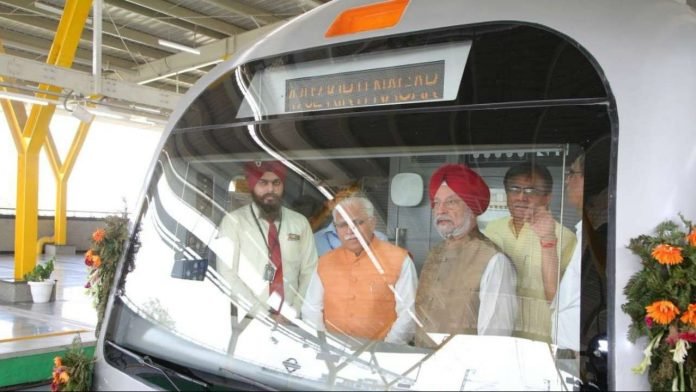
New Delhi: Prime Minister Narendra Modi has flagged-off the Delhi-Faridabad Metro Line that would allow hassle free travel for around two lakh daily commuters between the national capital and the industrial hub in Haryana.
The extension of the Delhi Metro connects Badarpur to Escorts Mujesar in Faridabad.
The total cost of the project from Badarpur to Escorts Mujesar is nearly Rs. 2,500 crore. Out of this, Rs. 1,557 crore was borne by the Haryana Government, the Centre contributed Rs. 537 crore, while the Delhi Metro provided Rs. 400 crore.
All these are elevated and located on either side of the Delhi-Mathura Road (NH-2).
“The nine-station metro corridor which was 95 per cent indigenously built will provide people a safe, affordable, quick, comfortable, reliable, environment-friendly and sustainable transport facility,” a Haryana government spokesperson said.
Haryana Chief Minister ML Khattar, addressing a press conference on Saturday, had thanked the Prime Minister for “gifting” the Metro service which would take the city to “another level of progress” with better connectivity with other NCR towns.
He had also said that the Prime Minister would be announcing the go-ahead for connecting Gurgaon with Faridabad by Metro.
Shri Ajay Kumar Singh, IRSME takes charge as General Manager of ICF
Chennai, Metro Rail News: Shri Ajay Kumar Singh, IRSME, has taken over as General Manager, ICF, 01.01.2019, after the retirement of Sri S. Mani, GM, ICF, who demit his office on superannuation on 31.12.2018. Shri Ajay Kumar Singh is at present the General Manager of South Western Railway, Hubbali, charge of GM, ICF, till further orders.
An Officer of 1981 batch of Indian Railways Service of Mechanical Engineering (IRSME), Shri A.K. Singh has held various important posts on Indian Railways, such as Principal Chief Mechanical Engineer in North Eastern Railwa Workshops Engineer and Chief Motive Power Engineer in North Eastern Railway/Gorakhpur. Divisional Railway Manager of Jabalpur Division of West Central Railway, Chief Mechanical Engineer/Planning in North Frontier Railway/Guwahati, Chief at Jhansi, and also as a Officer on Special Duty at Southern Railway, Chennai.
Shri Ajay Kumar Singh has undergone training for Senior Managers at Carnegie Mellon University in USA and Computerized Measuring Machines in Germany.
Union Minister of Housing and Urban Affairs Hardeep Singh Puri and Deputy Chief Minister flag off Delhi Metro's Pink Line
New Delhi, Metro Rail News: The new section of the Delhi Metro’s Pink Line Lajpat Nagar-Mayur Vihar Pocket 1 was flagged off by Union Minister of Housing and Urban Affairs Hardeep Singh Puri and Deputy Chief Minister of Delhi Manish Sisodia at the Metro Bhawan Auditorium today (December 31). The line will officially start at 4 pm today.
This 9.7 km stretch on the Pink Line will link seven stations, including Lajpat Nagar, Vinobapuri, Ashram, Hazrat Nizamuddin, Mayur Vihar Phase 1 and Mayur Vihar Pocket 1. with the opning of the new corridor, all stations, except 1.4 km stretch between Mayur Vihar Pocket 1 and Trilokpur Sanjay Lake, will open for public on the Delhi Metro Pink Line.
The new Metro line was flagged off by Union Minister of State (Independent Charge) Hardeep Puri and Delhi Deputy Chief Minister Manish Sisodia from Metro Bhawan at Barakhamba.
The Metro service at this new stretch from Lajpat Nagar to Mayur Vihar Pocket 1 will officially start from 4 pm on Monday.
Two stations, Mayur Vihar Ph-I and Mayur Vihar Pocket-1, on this corridor are elevated, while the rest of the Metro stations have been constructed underground.
There’s only one interchange station at the new corridor at Mayur Vihar Phase-1, connecting Delhi Metro’s Pink Line with Blue Line, which stretches from Dwarka Sector 21 to Noida City Centre.
As per the DMRC, the new Mayur Vihar Phase-1 station is an engineering marvel as it has been constructed on a narrow road with only 13 metres of width. The viaduct adjacent to the station passes at a height of 23 metre and goes above the Dwarka-Noida Blue Line viaduct as well as a road flyover.
The Mayur Vihar Phase-1 station is just 140 metre long and has 11 escalators and six lifts.
Trains will operate between Majlis Park and Mayur Vihar Pocket 1 at a peak hour frequency of 5 minutes and 12 seconds. During the non-peak hours, the frequency will be five minutes and 45 seconds.
A total of 29 trains will be operational on the Delhi Metro Pink line. The Hazrat Nizamuddin Metro station on the Majlis Park-Shiv Vihar Pink Corridor of Delhi Metro’s Phase-3 will become one of the Metro network’s major transit hubs as the station would provide direct connectivity with the Hazrat Nizamuddin Railway Station as well as the Sarai Kale Khan Inter State Bus Terminus.
As per the DMRC, the Hazrat Nizamuddin Metro station will have dedicated entry/exit points connecting to the Hazrat Nizamuddin Railway Station and the ISBT at Sarai Kale Khan.
Pic 1: Minister Housing & Urban Affairs Hardeep Singh Puri , Delhi Deputy CM Mansih Sisodia at the inauguration of the Lajpat Nagar to Mayur Vihar Pocket-1 section of the Pink Line in the august presence of Shri Durga Shanker Mishra
Pic 3: In inauguration of the Lajpat Nagar to Mayur Vihar Pocket-1 section @Metro Bhawan
Pic 3: Hardeep Singh Puri, Manish Sisodia flag off Delhi Metro’s Pink Line
The DMRC started its first ever operations in 2002 and currently, its network spans 317 km with 231 stations.
Dehradun, Metro Rail News: After the construction of a Metro Rail Project based on Light Rail Transit System (LRTS), more than 1.69 lakh passengers will travel daily on the two corridors of Doon. This has been mentioned in the Comprehensive Mobility Plan (CMP). Also, according to the plan, the conductor from ISBT and the FRI from Raipur in Doon is considered to be more favorable.
Uttarakhand Metro Rail Corporation’s Managing Director Jitendra Tyagi said that CMP has given two different options for the two corridors of Doon. In both options the first corridor was kept from ISBT to Kandoli, while two corridors were given two options. In this one, the FRI was given the option to connect the RSPNA bridge and the other with the FRI in Raipur area. In both options, the passenger number is almost identical, while the length of the respasement bridge is reduced by two kilometers. In this way, the total cost will be reduced by about Rs 280 crore, but in this area, a suitable place for the maintenance depot is not available.
At the same time, the place for making a maintenance depot in the Raipur region will be easily available. Technically, getting a place for a depot is more important. In this way, the project will be carried forward only on the second corridor (from FRI to Raipur). In the extension of the corridor, Mussoorie is also mentioning the future of extension of Condolee Corridor from ISBT in future Mobility Plan. In this sense, two options for this corridor were given from Kandoli to Canal Road and Kandoli to Mussoorie Road. In both, the length of the extension portion is 3.51 km, but in the number of passengers, on the part of the Mussoorie road, the number of passengers is reported to be around 10 thousand
However, the technical glare is also stuck here. There is a shortage of place for the mentin depot in the canal road, while this place will be available on Mussoorie Road. However, this deficiency can be completed after the creation of the Mussoorie Ropeway project.
Minimum fares for Metro will be 13 rupees
Uttarakhand Metro Rail Corporation’s Managing Director Jitendra Tyagi said that the rent has been fixed for the year 2023 for Doon Corridor. The minimum fare will be 13 rupees.
The rent will decide like
Kilometers
Rent (in Rs.)
0-02
13
2-06
27
while the maximum fare will be 40 rupees.
672 crores earnings as soon as the Metro starts
According to Manager Director Tyagi, revenue of about 672 crore rupees will be made annually as soon as the operation of the metro begins. While the total expenditure will be around Rs 524 crore. In this way, the LRTS-based project will run in benefits from the beginning and the cost of construction (around Rs 4 thousand crore in Doon Corridor) will not require any financial support from the government in the future.
Our December edition has special sections for the readers which cover interesting developments such as Regional Rapid Transit System (RRTS), Chennai Metro Project, Train 18, Talgo Trains, Safety on Railways. An Exclusive interview with Achal Khare, MD, NHSRCL. It also includes upcoming tenders, events, latest technologies, section on Women in Metro Rail, new development and business opportunities, our trademark “Industry Watch” section and so more…
Highlight of Metro Rail News December 2018
Honorable PM Shri Modi inaugurates Escorts MujesarBallabhgarh section of the Delhi Metro Violet line (Editor’s Desk)
News Highlights of November 2018 (Round Up-Catch up with the Industry’s to top stories)
Most highlighted stories of the month (Editor’s Picks)
Interview with Mr. Achal Khare, MD, NHSRCL (Interview)
Railway Safety & Disaster (Articel on Railway Safety)
Leaders Series – Mr. N. V. S. Reddy, MD, HMRL
Cover Story – RRTS Project
Technology Update – AFC System & MAHA CARD
Project Of The Month – Chennai Metro
New Development – Metro Railway Project
InnoRail 2018 and CILT India Post Event Coverage
Meet With Ms. Nimisha Singh: Women In Metro Rail Project
Train 18 Exclusive; Route and news update
Industry Watch: Egis Group Appoints Sandeep Gulati as the Managing Director, Egis India
Talgo high-speed trains update
Latest status of Metro Rail projects in India (Progress Report as on 15.12.2018)
Live tender notices in Metro and Railways industry. (Live Tender)
A round-up of upcoming Industry Events. (Event Diary)
Mumbai, Metro Rail News: The Mumbai Metropolitan Region Development Authority (MMRDA) has released its year-end review report for the year 2018 recently. According to the report, the MMRDA in the year 2018, has once again showcased its commitment and intent to undertake many mega infrastructure projects and paved the way forward towards completing them on a war footing. A cursory look at the progress it has achieved in the year 2018 is proof enough of its credibility –
The two Metro corridors – 18.5-km Dahisar-W to DN Nagar Metro-2A (Rs.6,410 crore) and 16.5-km Andheri-E to Dahisar-E Metro-7 Corridor (Rs.6,208 crore) – are being implemented on a war footing. Both projects are looking at completion of civil construction in 2019.
The Authority has also begun the construction of the 23.5-km DN Nagar to Mankhurd Metro2B (Rs.10,986 crore) and 32-km Wadala-Ghatkopar-Mulund-Thane-Kasarvadavali Metro-4 Corridor (Rs.14,549 crore). The work on 14.5-km Swami Samarth Nagar-JogeshwariKanjurmarg-Vikhroli Metro-6 corridor (Rs.6,672 crore) has also started this year.
The Authority approved Detail Project Reports (DPRs) for Gaimukh to Shivaji Chowk (Mira Road) Metro-10 (Rs.4,476/- crore), Wadala to Chhatrapati Shivaji Maharaj Terminus Metro-11 (Rs.8,739 crore) and Kalyan-Taloja Metro-12 (Rs.4,132/- crore) corridors. All the three DPRs will now be recommended to the State Government for approval.
The establishment of Mumbai Metro Operation Corporation Ltd. is another step forward as the State expects to throw open Andheri (East) to Dahisar (East) Metro-7 and Dahisar to DN Nagar Metro-2A corridors next year. The Corporation will be an autonomous body and will deal with operation and maintenance of Metro Lines as also Monorail. In addition, the decision to create more than 1,000 posts has also been taken.
The crucial decision of establishing Project Implementation Unit (PIU) to implement the Multi-Modal Navghar to Belavli corridor was taken in view of the various daunting tasks, such as land acquisition, resettlement and rehabilitation of the project affected families, appointment of contractors, handling legal hassles, coordination with different state and central government entities for various permissions, security arrangement etc.
The Authority also appointed MMRDA as the Special Planning Authority for the Mumbai University’s Kalina Campus. MMRDA is constructing two roads, A 2-km long elevated road connecting BKC and Hans Bhugra marg and the other 690-meter road to facilitate entry/exit from and to Bandra-Kurla Complex, which construction will require some land owned by the University.
The Chief Minister Devendra Fadanvis also released a series of heritage circuit maps covering heritage properties (built/natural) within the Mumbai Metropolitan Region (MMR). The task was commissioned by the MMR-Heritage Conservation Society. These maps represent perhaps the first such attempt to record and make accessible to the public heritage properties and natural sites in the MMR, several of them relatively unknown and neglected.
The Authority further widened its region by including the entire Palghar Taluka, the remaining region of Vasai Taluka, Alibaug, Pen, Panvel, and Khalapur in Raigad District in the MMRDA’s jurisdiction. This decision will help develop these regions in a planned way. “These areas have tremendous development potential and prone to fast unplanned growth if left as it is. This decision will now see these regions not only develop in a planned manner but also sustain the development on its own”, said the Chief Minister. There will be an emphasis on the development of “Growth Centers”, which will work as a catalyst for the development of the region.
Chief Minister also inaugurated the “War-Room and Innovation Center” at MMRDA much on the guidelines of a war-room that is set up in Mantralaya by himself. War Room’s need was felt by the Metropolitan Commissioner keeping in mind the large number of projects undertaken by MMRDA. The War-Room will be busy not only to streamline mega projects, discuss and take quick decisions with regard to any and all emergencies, it will also undertake critical research activities to pave the way towards “total development” of the city and its metropolitan region.
MMRDA, in the month of September 2018, successfully restarted the first phase of Monorail from Chembur to Wadala and will start operations of the second phase in the next year.
MMRDA successfully conducted the bid process and received lowest quotes for coaches, lifts, escalators and auto fare collection machines. This year the Authority inaugurated 1.4-km Ghansoli-Talavli flyover and a 575-m long flyover from Savita Chemicals towards Belapur. The Bhoomipujan for the 796-m ROB at Kopri, Thane; and 3.5-km Road connecting Thane-Belapur Road was also performed.
The New MMRDA Logo was launched by the Chief Minister which is indicative of the nature of varied projects the Authority has been implementing in the recent past. “The change in Logo was pertinent in the wake of the changed and enhanced scope of work undertaken by MMRDA over a period of time. It conveys the diverse development activities MMRDA undertakes today and the way forward the Authority has planned”, expressed Mr.Fadnavis.
Besides Metro-2A & 7 MMRDA is looking at completing many other projects in 2019 –
After taking over the operations of the Monorail, MMRDA has been running it quite successfully and is now aiming completion of phase-2 of Monorail. MMRDA, in the larger public interest, has terminated the contract with M/s. LTSE for their failure to perform and fulfill contractual obligations, in turn, causing great inconvenience to the Monorail commuters. The Monorail is expected to carry a number of commuters daily once the second phase from Wadala to Sant Gadge Maharaj Chowk is commissioned.
Nearer home, MMRDA is keen to introduce smart parking in the Bandra-Kurla Complex with the help of RTO and Traffic Police. There will be parking patrolling vans operating within the complex to deter illegal parking which invariably causes traffic chaos in the peak hours.
There are three more projects that MMRDA has vowed to complete in 2019. The first is 1.6- km long Bandra-Kurla-Chunabhatti (EEH connector) of which the estimated cost is Rs.156 crore. This Connector crosses Mithi, LBS Road, Central and Harbour Rail tracks to help motorists save 30 minutes and 3-km drive. Motorists will be able to avoid traffic congestion and pollution in the Sion-Dharavi area.
Then there are two flyovers (Estimated cost Rs.163 crore) and a road coming up to clear BKC Junction. The total length of the two flyovers – one from BKC to the Sea Link and two Sea Link to BKC is 1,888 meters. Also planned is a 300-meter long and 12 feet wide road running through the government land to streamline traffic from Dharavi to Sea Link.
MMRDA is also working on a war footing to de-congest BKC and SCLR junctions by constructing two roads at an estimated cost of Rs.449 crore. The 1.3-km elevated road running from MTNL junction to LBS Flyover will clear Bandra-Kurla Complex and another 3.89-km elevated road from Kurla (Kapadia Nagar) to Vakola near Western Express Highway will help decongest SCLR junction.
Yet another project that MMRDA intends to undertake is an improvement of signages on Western and Eastern Express Highway as also in the Bandra-Kurla Complex. While implementing this project MMRDA will pay special attention to the positioning, placement, and information on the signages.
Two other projects that are at the final stage are – The 650-meter long Mankoli bridge and 655- meter long Rajnoli bridge (Rs.121 crore). These two bridges will prove crucial to clearing congestion and road rages at Mankoli and Rajnoli junction on the Mumbai-Nasik National Highway and provide faster connectivity. After terminating the contracts with the contractors for their failure to perform and fulfill contractual obligations, the new contractors are in the process of being appointed and these two much-awaited bridges will be thrown open to the public by the end of 2019.
In the year 2019, MMRDA also is looking at undertaking the “Access Control System” to achieve signal-free WEH for which MMRDA will be interacting with consultants in the field. There are suggestions to break down a flyover or two to make the WEH congestion free. The consultants may also suggest a few elevated roads and or underpasses at particular junction. MMRDA is keen to undertake this project.
Year-end review reports on Urban Transport for 2018 by MoHUA
New Delhi , Metro Rail News: The Ministry of Housing & Urban Affairs (MoHUA), Govt. of India has today shared year-end review report for 2018 and summarized the development activities carried out in Urban Transport sector in the year.
Metro Lines Commissioned/Operational
At present, about 536 kms of Metro Rail lines are operational in 10 cities i.e. Delhi & NCR, Bangalore, Hyderabad, Kolkata, Chennai, Jaipur, Kochi, Lucknow, Mumbai and Gurugram. Since May, 2014 to till date, about 287 Kms of metro rail lines have been commissioned in Delhi & NCR, Bangalore, Chennai, Kochi, Lucknow, Mumbai, Jaipur, Hyderabad and Gurugram. In 2018 (from January, 2018 to till date), about 110 Kms of metro rail lines have been commissioned in Delhi & NCR, Hyderabad and Chennai.
Metro Projects approved
Since May, 2014, 13 new metro projects with a total length of about 248 Kms at a total cost of Rs. 68,021 crore have been approved for Nagpur, Ahmedabad, Gurugram, Lucknow, Chennai Extension, Pune, Delhi Metro Extensions, Noida – Greater Noida, Bhopal and Indore. In 2018 itself, 3 new projects with a length of about 66 Kms at a total cost of Rs. 16,408 crore have been approved for Bhopal, Indore and Delhi Metro Extn from Noida City Centre to Noida Sector 62.
Metro Inauguration
Foundation of 6 metro projects has been laid since May, 2014, for Nagpur, Pune, and 4 lines in Mumbai. Several new metro lines have been inaugurated since May, 2014 in Delhi, Hyderabad and Kochi. Delhi Metro extension from Mundka to Brigadier Hoshiyar Singh (11.18 Km) and Delhi Metro extension from Escort Mujesar to Raja Nahar Singh Ballabgarh (3.205 km) was inaugurated during 2018. Around 650 kms of metro rail projects are at various stages of implementation in Delhi & NCR, Kolkata, Bangalore, Chennai, Kochi, Jaipur, Mumbai (including State initiatives by MMRDA), Hyderabad, Nagpur, Ahmedabad, Lucknow, Pune, Noida, Bhopal and Indore. About 750 kms of metro rail systems and 373 km of Rapid Rail Transit Systems (RRTS) are under planning in various cities.
In order to promote “Make in India” and indigenization of various metro rail system, standard specification of rolling stock, signalling system, electrical & electromechanical metro rail components and civil engineering structures have been issued. Further, eligibility criteria for procurement of rolling stocks has also been issued. I-Metros (Indian Metro Rail Organisations’ Society) – a platform to exchange ideas, pooling of knowledge and sharing of experience, best practices, innovations etc. among the Indian metro rail companies to nurture excellence in performance was launched in March 2018.
Uber partners with Delhi Metro to make last mile connectivity easier
New Delhi, Metro Rail News: On-demand ride-sharing company Uber announced the second phase of partnership with Delhi Metro Rail Corporation (DMRC). Under this partnership, the company will install kiosks on 50 more metro stations till the first half of 2019. In the first phaseof this partnership, Kiosks have been installed at Sikandarpur, Dwarka Sector-21 and Rajiv Chowk to facilitate the passengers. This partnership will facilitate the last-mile connectivity.
As part of this partnership, Uber will appoint Uber Rider Assistant on the proposed Metro Stations for the convenience of its riders, who will be able to book Uber Ride without any app. Dr. Mangu Singh, Managing Director of Delhi Metro Rail Corporation (DMRC) said, “DMRC has always kept the interest of its passengers in the center of their work. Facilitate our agenda mobility and make feeder transport accessible to the passengers in a convenient way.
He said, ” With this partnership with Cab aggregators like Uber and Ola , we will encourage more and more people to travel from the metro so that they can get convenient connectivity to the corner.” Madhu Kanan, Chief Commercial Officer (Asia Pacific) of Uber, said, “By simplifying the journey of various places from the metro stations, we can reduce the need of parking and make corner connectivity easier.”
He said, “We are excited to work with DMRC and expand the reach of public transport in Delhi-NCR.” This will define the future urban mobility. It is the first participation of Uber with one of the world’s largest transit networks. ‘
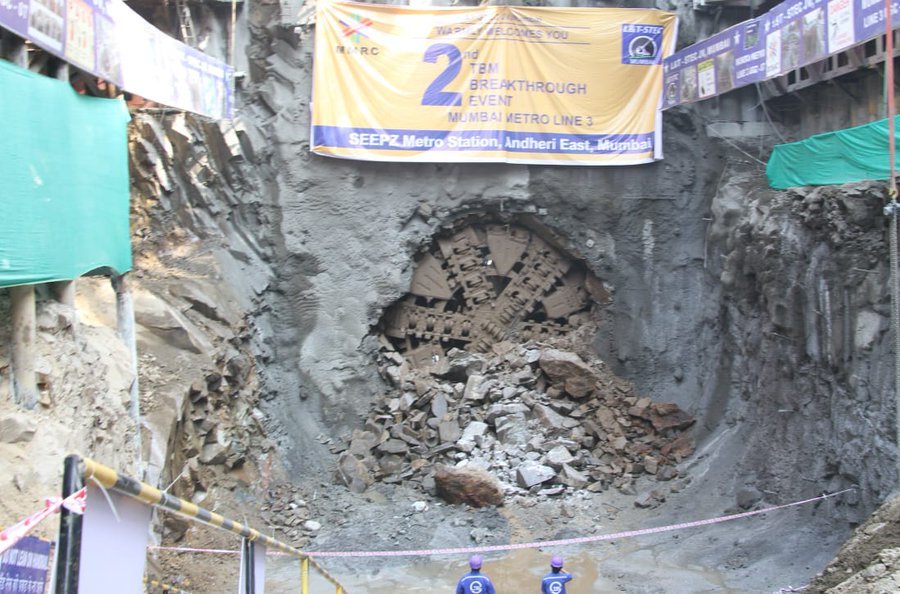
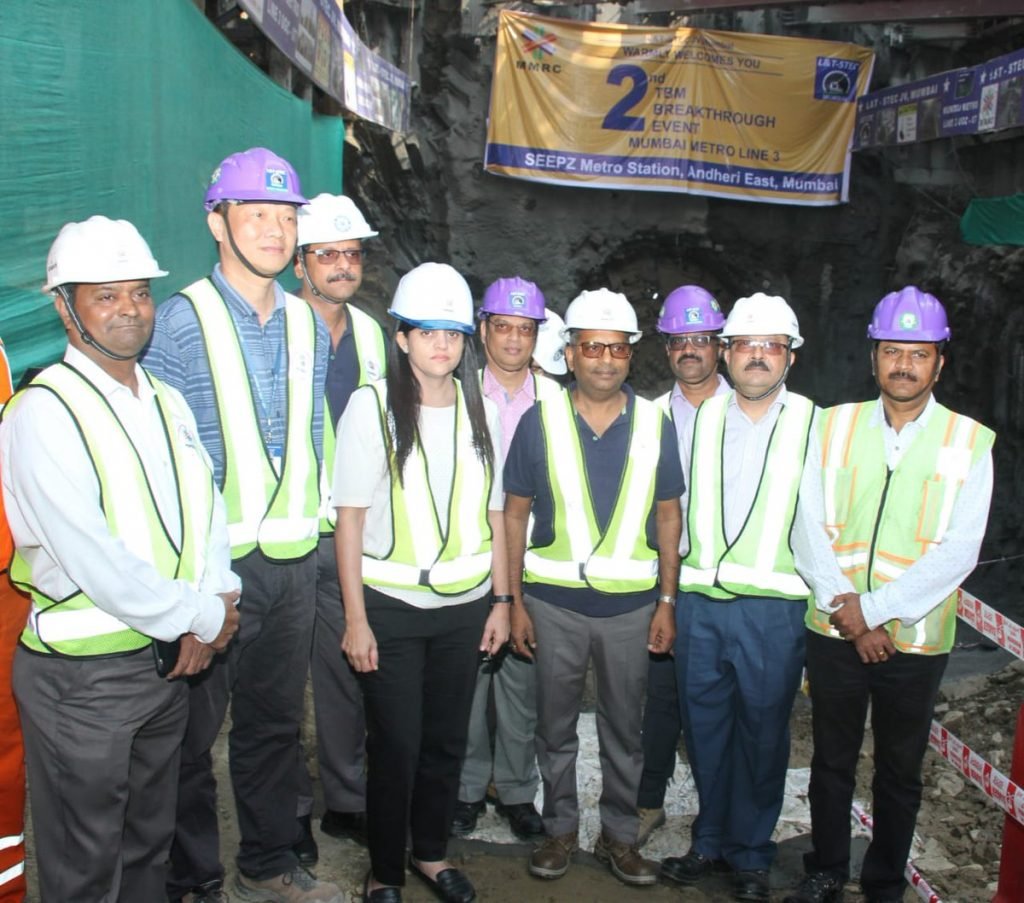
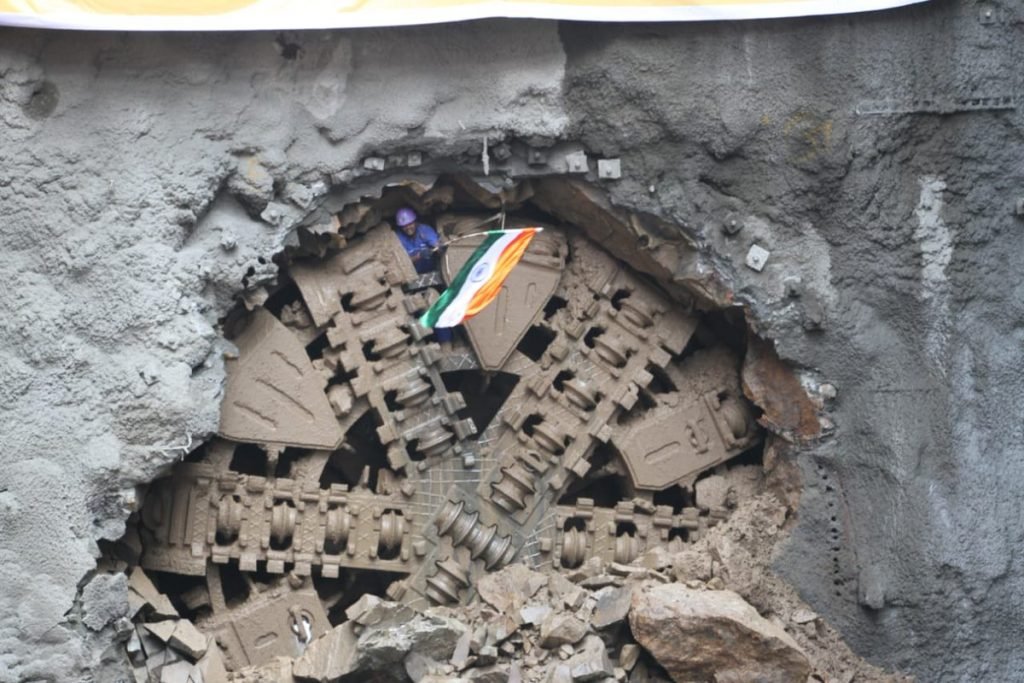
Mumbai. Metro Rail News:TheMumbai Metro Rail Corporation (MMRC) today achieve the breakthrough of the second TBM of Colaba-Bandra-SEEPZ Metro-3 corridor at SEEPZ station. The first breakthrough was achieved on September 24 at the Chhatrapati Shivaji Maharaj International Airport (CSMIA) Terminal 2 station.
The Tunnel Boring Machine (TBM), named Wainganga 2, tunneled from the launching shaft at Sariput Nagar, near Aarey Colony to SEEPZ station. It was was commissioned on 23rd August 2018 from Sariput Nagar launching shaft completed its tunnel drive of 568 metres in package 7 to see the light at its end at SEEPZ station. One more time it marks the achievement of an important milestone towards the steady completion of the 33.5-km long Metro-3 corridor. It is the result of consistent and continuous effort by a team of nearly 250 engineers, technicians and workers together to make this reach of tunneling successful.
“This is a second big milestone for the MMRC. We are delighted on completing another challenging achievement. The credit equally goes to the engineers and other stakeholders involved in the project.” said, Ashwini Bhide, managing director of the Mumbai Metro Rail Corporation (MMRC)
Wainganga 2, made its way through the rocky strata made of Basalt drilling relentlessly for exactly 125 days to attain the breakthrough. It has charted its course from under Jogeshwari – Vikhroli link road. The 92-meter long Wainganga-2 bored, on an average, 4.5 meters daily, with a peak rate of 10-12m per day, shaping the tunnel with 405 RCC cement rings.
The first two breakthroughs are part of the Package 7 of the project, which runs from Marol Naka to SEEPZ via MIDC. The first breakthrough was also achieved by Wainganga 1, which was launched for Marol Naka. The package will provide crucial linkages to the other Metro corridors, the existing Mumbai Metro One at Marol Naka station and the upcoming Swami Samarth Nagar-Vikhroli Metro 6 at Aarey station.
It will also provide rail connectivity to commercial hubs of SEEPZ and MIDC. The 4.16-km-long package is being executed by the consortium of Larsen & Toubro and the Shanghai Tunnel Engineering Company.
All 17 TBMs have been commissioned at 10 TBM shafts and tunneling for around 15 km of the 52.21 km has been completed. The first TBMs were lowered at Naya Nagar in Mahim, which are expected to achieve breakthrough in the first quarter of 2019 in Dadar.
Metro-3 corridor in its reach between CSMIA T 2 station to the ramp at Aarey colony will provide access to Versova-Andheri-Ghatkopar Metro-1 at Marol Naka and Swami Samarth Nagar-JogeshwariKanjurmarg-Vikhroli Metro-6 corridor at Aarey Station and also to business hubs like MIDC and SEEPZ which today are not connected by suburban rail.
PIC 1: Second TBM breakthrough at SEEPZ station
PIC 2: Second TBM breakthrough at SEEPZ station
PIC 3: Second TBM breakthrough at SEEPZ station
MMRC, as of today, has completed about 15-km of tunnelling. For the purpose, 17 Tunnel Boring Machines have been commissioned at ten TBM shafts.
On the occasion Ashwini Bhide, Managing Director, MMRC said “This is a second big milestone for Mumbai Metro Rail Corporation (MMRC). We are extremely delightful for completing another challenging achievement and the credit equally goes to the engineers and other stakeholders involved in this Project. Without their hard work and continuous efforts reaching this milestone is unimaginable”
M/s Larsen & Toubro and Shanghai Tunnel Engineering Co. Ltd. are consortia partners for the construction of Package-7 which runs from Marol Naka to SEEPZ via MIDC. The total length of the tunnel is 7.07-km and the contractors expect about eleven lakh cubic meters of muck to be generated. The generated muck will be disposed of at Talawali-Pise, a government land spared for dumping the muck. As of today the contractors have disposed of 4.2 lakhs cubic meters of muck.
New Delhi, Metro Rail News: A New year gift from Delhi Metro to Delhi – NCR People. Finally, Delhi Metro Rail Corporation (DMRC) has announced the opening date of 9.7 km long stretch between Lajpat Nagar-Mayur Vihar Pocket 1 of Pink Line. This section is all set to start the 9.7-km Lajpat Nagar-Mayur Vihar Pocket 1 corridor of the Pink Line on 31st December 2018. The train services for the public will start from the same day at 4 pm onwards. “The route underwent safety inspection on 24 Decmebr 2018 paving way for its opening” Said Metro officials.
The DMRC has shared this information through its newly opened official Twitter handle.
Mark your calendars!
Pink Line extension from Lajpat Nagar to Mayur Vihar Pocket 1 will begin operations from 4 PM on 31st December 2018.
The section will connect Lajpat Nagar and Mayur Vihar Pocket 1 through Vinoba Puri, Ashram, Hazrat Nizamuddin and Mayur Vihar 1. #DelhiMetropic.twitter.com/edCEwjBZZI
The inauguration of the train service between Lajpat Nagar – Mayur Vihar Pocket 1 will be done through the video conferencing from the DMRC Headquarters Metro Bhawan on 31st December 2018 at 11 am by the Hon’ble Minister of State for Housing & Urban Affairs Shri Hardeep Singh Puriand Delhi Deputy Chief Minister Manish Sisodiya. The train services for the public will start from the same day at 4 pm onwards.
The new stretch of the 59-km-long Delhi Metro Pink Line, which spans from Majlis Park to Shiv Vihar, is part of the Phase-III of the DMRC network. ‘
“The Commissioner of Metro Railway Safety (CMRS) inspected the Lajpat Nagar-Mayur Vihar Pocket 1 corridor of the Pink Line. The 9.7-km segment has five stations, three underground and two elevated,” a senior DMRC official said.
The 6 stations are — Lajpat Nagar, Vinobapuri, Ashram, Hazrat Nizamuddin, Mayur Vihar Phase-I and Mayur Vihar Pocket-1. Mayur Vihar Phase-I and Mayur Vihar Pocket-1 are elevated stations, the official said.
The Lajpat Nagar-Mayur Vihar Pocket 1 corridor will boost connectivity between south Delhi shopping hubs such as Lajpat Nagar, Sarojini Nagar, INA and South Extension and east Delhi. It will also make Hazrat Nizamuddin railway station more accessible, besides offering an interchange at Mayur Vihar I, connecting Pink and Blue lines. With completion of this route, the entire Pink Line will be 59 km long. Meanwhile, the Delhi Metro completed 16 years of its operations on Monday.
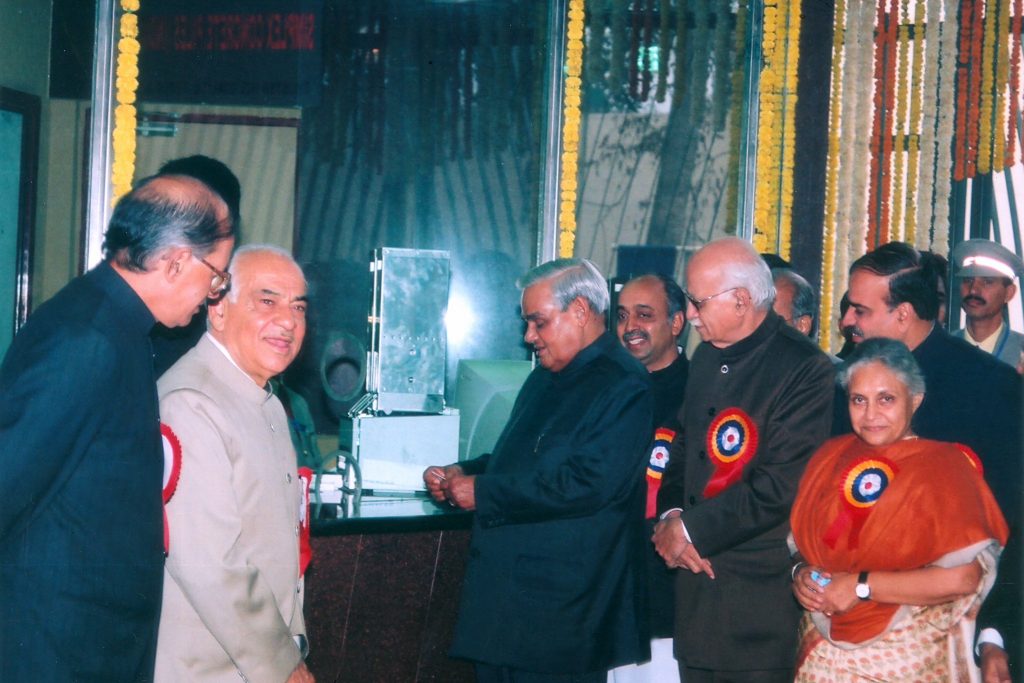
Former prime minister late Atal Bihari Vajpayee had inaugurated the DMRC’s first-ever corridor — an 8.2-km stretch between Tis Hazari and Shahdara stations of the Red Line — on December 24, 2002, fulfilling a long-cherished dream of the capital city. The 3.2 km-long Escorts Mujesar-Raja Nahar Singh (Ballabhgarh) section of the Violet Line was opened to public in November, taking the entire span of the Delhi Metro network to 317 km. While the Shahdara-Tis Hazari section had six stations, DMRC now boasts of 231 stations, with an average daily ridership of about 28 lakh.
The official said, as part of Ph-IV of the DMRC, a 103 km-long project has been proposed and Delhi Metro will continue to serve people with greater amenities and efficiency. On December 20, the DMRC had also launched its Twitter account, which now has over 3,200 followers.
Better Inter-City Connection
The Lajpat Nagar-Mayur Vihar Pocket 1 corridor increase connectivity between shopping hubs in south Delhi like Lajpat Nagar, Sarojini Nagar, INA and South Extension and east Delhi. It will also make Hazrat Nizamuddin railway station more accessible, besides offering an interchange at Mayur Vihar I.
On December 25, 2002, when the Delhi Metro was inaugurated by Atal Bihari Vajpayee, the then prime minister, along with the then Delhi Chief Minister Sheila Dikshit.
New Delhi, Metro Rail News: The Delhi Metro has changed the public mode of transport for the ordinary man in Delhi over the years and continues to expand its reach, having added nearly 100 km of network this year.
It was on December 24, 2002, when the Delhi Metro was inaugurated by Atal Bihari Vajpayee, the then prime minister, along with the then Delhi Chief Minister Sheila Dikshit. Now Delhi Metro is a massive metro network of 314 kms and 229 metro stations across Delhi and national capital region.
The Delhi Metro ferries approximately 26-27 lakh riders every day
It has eight colour-coded lines: Red, Yellow, Blue, Violet, Orange, Green, Magenta and Pink
The Delhi Metro, which began its journey with a mere 8-km-long Red Line connecting Shahdra and Tis Hazari, has turned 16 on Monday.
The metro has gone strength to strength since then and will soon boast of being one of the largest metro networks in the world, after Shanghai and Beijing, and is expected to even overshadow the London Underground.
During its construction in three phases, the metro has spread its network across 317 km of the city and its suburbs.
By the time the Phase-III winds up next year, it will have expanded to 349 km, and with Phase-IV, which has just been given the green signal and is expected to be completed by 2022, the Delhi Metro will cross the 400-km mark.
In words of the Delhi Metro Rail Corporation, the current year was “historic” in terms of construction of several new stretches, totalling a length of a “record” 87 km.
The expansion of the metro has not been a cakewalk along the years, with the transport system facing all kinds of roadblocks, from acquiring land– as in the case of Shakurbasti and Trilok Puri– to tunnelling around the Old Delhi area, known for its historical monuments.
At present, it has eight colour-coded lines: Red, Yellow, Blue, Violet, Orange, Green, Magenta and Pink, with the last two being the latest addition to the fleet.
The phase-IV, still to go on floor, is no less ambitious and aims to touch some of the harder to reach outskirts of the city, like Bawana and Narela in northwest Delhi.
With 231 stations over and below ground across the network, the Delhi Metro ferries approximately 26-27 lakh riders every day.
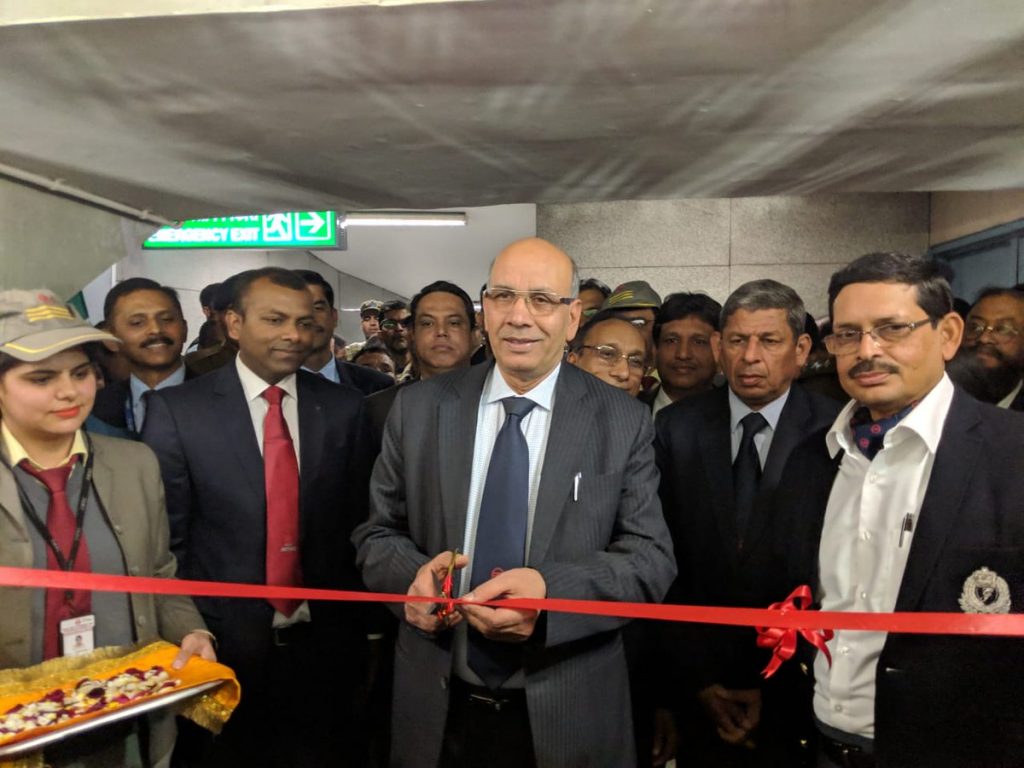
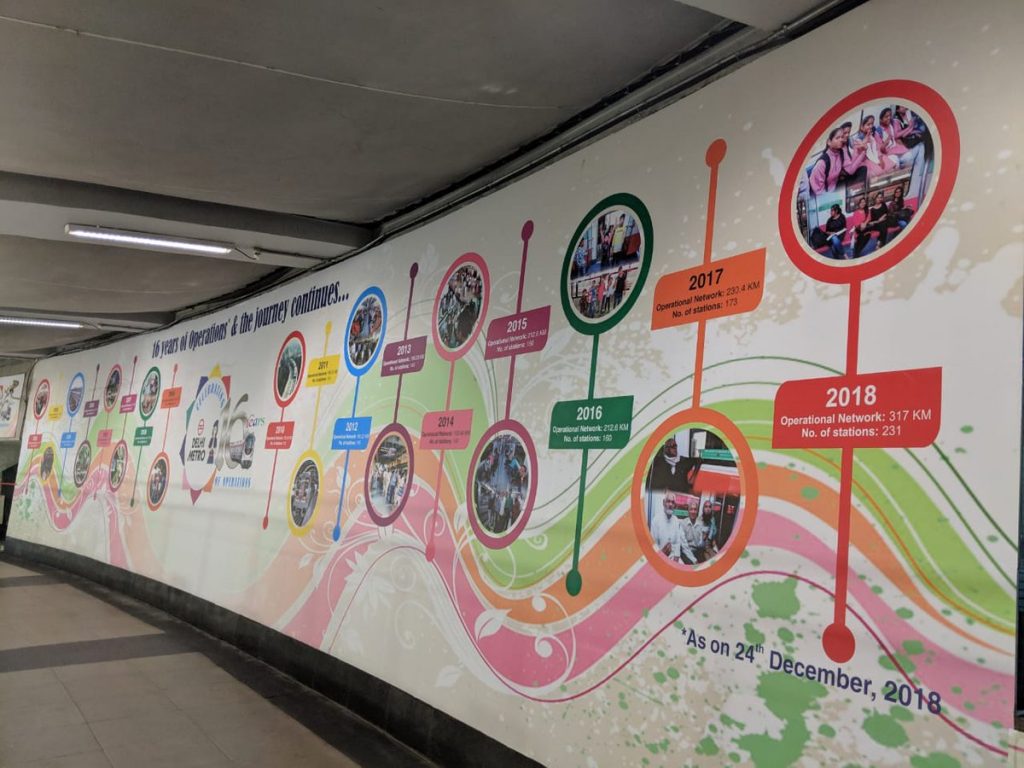
To commemorate the 16th anniversary of Delhi Metro’s operations on December 24, 2018, the Delhi Metro Rail Corporation (DMRC) has put together an exhibition showcasing metro’s journey so far since the commencement of operations in 2002. The exhibition was inaugurated by DMRC’s managing director Mangu Singh at the Rajiv Chowk Metro station on Monday.
Pic 1
Pic 2
Pic 3
Pic 3: An exhibition documenting the 16 years of Delhi Metro was inaugurated by MD DMRC, Dr. Mangu Singh at Rajiv Chowk Metro Station on Monday
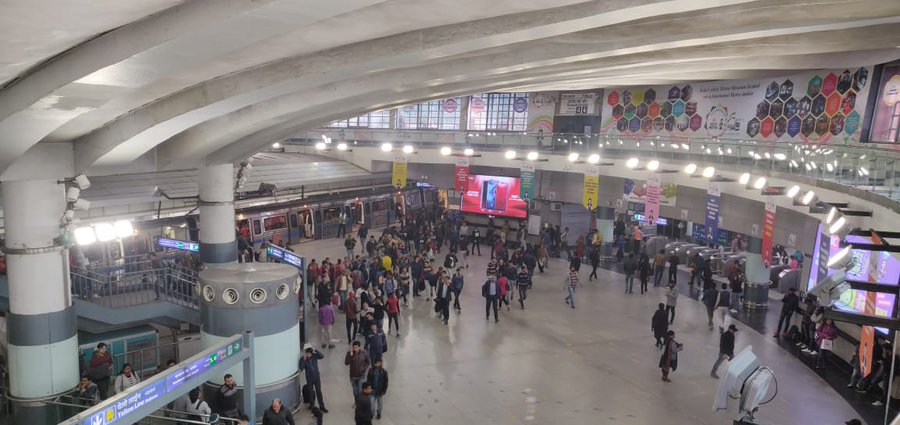
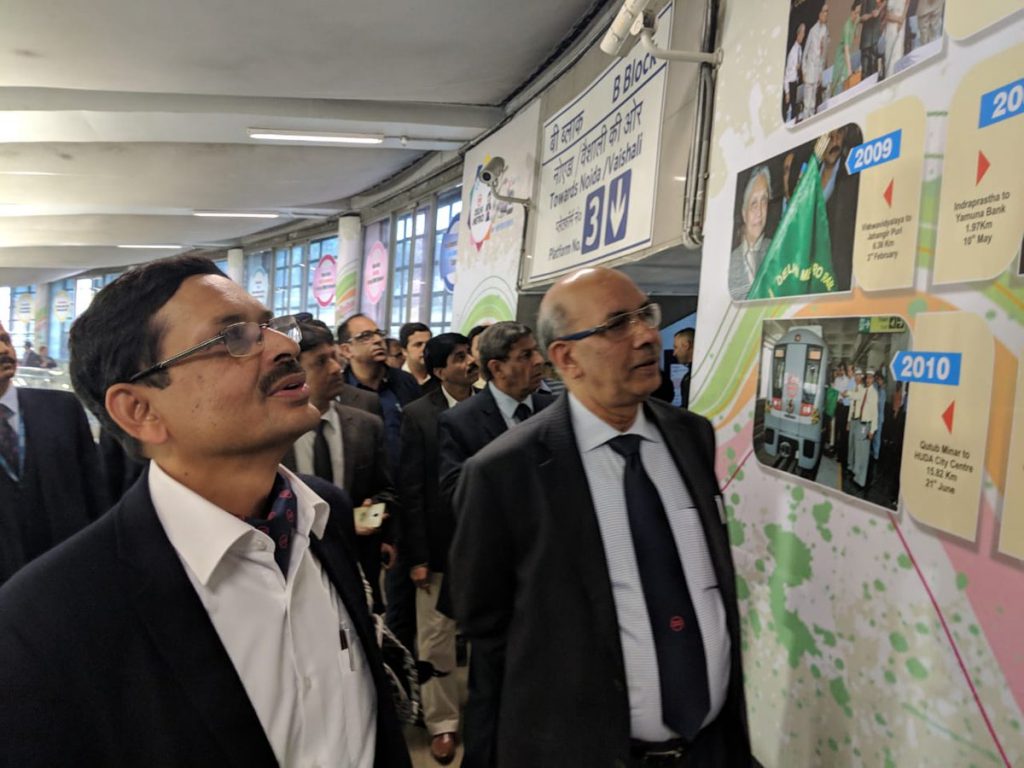
The exhibition is in the form of colourful panels that showcase the journey and year-by-year growth of Delhi Metro. The panels have been installed at the viewer’s gallery at the metro station, which is usually accessed by commuters to cross from one side of the platform on Blue Line (Dwarka-Vaishali/Noida City Centre) to another. Apart from panels, banners have also been put up by DMRC at the station. While the panels showcase metro’s journey, interesting facts and trivia about Delhi Metro have also been displayed as part of the exhibition, including major landmarks such as the beginning of reserved coach for women, first eight-coach trains etc.