New Delhi: Prime Minister Narendra Modi has flagged-off the Delhi-Faridabad Metro Line that would allow hassle free travel for around two lakh daily commuters between the national capital and the industrial hub in Haryana.
The extension of the Delhi Metro connects Badarpur to Escorts Mujesar in Faridabad.
The total cost of the project from Badarpur to Escorts Mujesar is nearly Rs. 2,500 crore. Out of this, Rs. 1,557 crore was borne by the Haryana Government, the Centre contributed Rs. 537 crore, while the Delhi Metro provided Rs. 400 crore.
All these are elevated and located on either side of the Delhi-Mathura Road (NH-2).
“The nine-station metro corridor which was 95 per cent indigenously built will provide people a safe, affordable, quick, comfortable, reliable, environment-friendly and sustainable transport facility,” a Haryana government spokesperson said.
Haryana Chief Minister ML Khattar, addressing a press conference on Saturday, had thanked the Prime Minister for “gifting” the Metro service which would take the city to “another level of progress” with better connectivity with other NCR towns.
He had also said that the Prime Minister would be announcing the go-ahead for connecting Gurgaon with Faridabad by Metro.
Ahmedabad, Metro Rail News: The Gujarat Metro Rail Corporation (GMRC) Thursday terminated the contract awarded to IL&FS Engineering & Construction citing project delays and awarded the same to J Kumar Infrastructure. The Rs 374.64-crore contract was to build four stations and lay a 4.6-km viaduct for the metro project in the city.
Due to financial constrains at the parent group, the company had stopped the work since September 2018. The corporation has also decided to en-cash the bank guarantee given by the IL&FS group company. The IL&FS Group is being run by a government-appointed board after it began defaulting on debt payments from late August last. The group and its 348 subsidiaries owe over Rs 94,000 crore to the lenders. The corporation said it had given a number of notices to the company to finish the work by the March 2018 deadline, but due to the cash crunch, they were not able to complete the work as per the schedule. “We have terminated the contract of IL&FS Engineering & Construction.
Alignment of Ahmedabad Metro Rail Project Phase -1
They were to build four stations and a 4.6-km viaduct for the Ahmedabad Metro at a cost of Rs 374.64 crore,” corporation said in a statement. The company was served numerous notices since October 2017 for not meeting the deadlines and by end-September 2018 the contractor stopped the work unilaterally, it said. “A final show cause notice was given in November 2018 and today (Thursday) we decided to terminate the contract,” the statement said, adding the company had neither performed satisfactorily in accordance with the terms and conditions of the contract and nor was in a position to continue the work, therefore contract termination.
The statement further said the corporation has awarded the balance work to J Kumar Infrastructure and has also started to encash the bank guarantee of IL&FS.
Exclusive Interview with Mr. Kumar Keshav, Managing Director,LMRC
Mr. Kumar Keshav, an IRSE (Indian Railway Service of Engineers) officer and a gold-medallist engineer from IIT- Kanpur (M.Tech) and IIT-Roorkee (B.E.), took over as Managing Director of the company on 18th August 2014. As Director (Projects & Planning) at Delhi Metro Rail Corporation (DMRC), he is credited with successfully completing and commissioning various projects in Delhi Metro.
He held the prestige of the nation high during the XIXth Commonwealth Games, 2010 when he commissioned the Central Secretariat -Badarpur Metro project on 3rd October 2010 – just on the day of the start of the Commonwealth Games – when approximately 70,000 public traveled by Delhi Metro to reach the main venue of the global sporting extravaganza – the Jawaharlal Nehru Stadium.
As regards the Lucknow Metro Project, it is a dream which is being realized by him. Lucknow Metro is a dream project of the people of Uttar Pradesh which is being executed by Metro engineers under the leadership of Shri Kumar Keshav. Work for this project is going on day and night without any break with the Managing Director leaving no stone unturned to see that the 8.5 km priority Metro corridor is commissioned for trial runs on 1st December, 2016 in just two years and two month period which is a record in itself, thereby achieving the distinction of being the fastest ever Metro project execution that has ever happened in the Country as stated by ‘Metro Man’ Dr. E. Sreedharan.
Lucknow Metro is a rapid transit system serving the city of Lucknow in the northern Indian state of Uttar Pradesh. Construction of the line began on 27 September 2014 with the 8.5 km (5.3 mi) stretch from Transport Nagar to Charbagh Railway Station which began its commercial operation on 5 September 2017, making it the fastest built metro rail system in the country. Lucknow Metro recently completed the successful load testing of the remaining section of the North-South corridor. Metro Rail News has conducted an interview with Mr. Kumar Keshav,Managing Director of Lucknow Metro Rail Corporation. Here are the excerpt from the interview:
What are the key concerns you faced while making the Metro what it is today?
Lucknow Metro, City’s pride. It feels just like yesterday when we commenced the Commercial Operations for Lucknow Metro for the first time on 5th September, 2017. From the dream of a Metro plying through the city of Nawabs to opening the entire stretch of the North-South Corridor for the public, this journey has been a roller coaster ride of challenges, accomplishments and a storm of emotions and hard work of the entire team behind the Lucknow Metro project and since then there has been no looking back. Lucknow, being the capital city, metro construction was a difficult subject. Fortunately, we were able to garner favorable public opinion through consistent interaction with the public. Lucknow Metro has achieved the distinction of being the fastest Metro Project execution that has ever happened in the country so far. Racing against time to complete the project was in itself a big challenge for us. The other challenges we faced were related to engineering construction. Lucknow being an old heritage city, construction at populated areas was the most challenging.
Please brief us on the current status of the metro rail project?
Lucknow Metro recently completed the successful load testing of the remaining section of the North-South corridor. We have also started the trial run on this stretch. This is being seen by many technical experts here and elsewhere in the country as yet another milestone for the 22.878 km long corridor from the Chowdhary Charan Singh International Airport to Munshipulia. The Metro work is likely to be completed by February, much ahead of the initial deadline of April 2019.
Kumar Keshav, MD- LMRC with the team during the trial runs of the remaining section of North South Corridor.
The journey hasn’t been easy but it’s definitely worth the outcome. We faced uncountable challenges throughout the construction phase but as is rightly said ‘Determination gives you the resolve to keep going in spite of the roadblocks that lay before you’, we kept going and the rest is history. With a team made of steel Lucknow Metro has emerged as a fine example of excellence in the field of Mass Rapid Transit System.
What is the step LMRCL has taken for environment safety and utilization of solar energy?
To conserve energy and use renewable sources of energy, Lucknow Metro
has taken many initiatives such as regenerative braking in the trains which
will result in saving 30-35% traction energy, use of 1% criteria for
underground stations in the air conditioning system, using Variable Voltage
Variable Frequency (VVVF) drive for all lifts and escalators, provision of LED
lights at stations, use of energy efficient equipment for Environmental Control
System (ECS) and Tunnel Ventilation System (TVS) system for the underground stations
etc. Currently, Lucknow Metro has planned 1.5- 2MW solar energy under the RESCO
model from the roof mounted photo voltaic cells on stabling and inspection
sheds in Transport Nagar Car Maintenance Depot. Because of all these novel
measures, society will be able to recover the entire investment cost on the
project in just 5 years, Economic Rate of Return (EIRR) of the Project being
19.46%. To create sustainable environment LMRC’s Metro stations and Depot have
been designed and built as ‘Green’ buildings in accordance with the standards
of the Indian Green Building Council (IGBC). Apart from this, on the occasion
of the World Environment Day on 5th June, 2017, LMRC has been awarded
International Organization for Standardization (ISO) 14001:2004 &
Occupational Health & Safety Assessment Series (OHSAS) 18001:2007
certifications in recognition of the organization’s compliances with
international standards.
Lucknow Metro has so far relocated 410 trees and a total of 537 trees have been saved through changes in design. LED Lights are used in all stations and trains of LMRC. 1.0 MWp capacity solar-roof plant has been installed in the Transport Nagar Depot. Along with it, a Waste Composting Machine has been installed in the depot
The work of the North-South corridor is likely to be completed by February 2019 please elaborate about this corridor.
The 23-km stretch from the Chaudhary Charan Singh airport to Munshipullia will have 21 stations. For this long route, the maximum fare will be Rs 60.Currently, it takes around 90 minutes to reach from Munshipulia to the airport, but once the route is operational, this distance will be covered in 40 minutes, and no one has to face the problems of a traffic jam.
What are the challenges specific to this corridor and how has it been overcome?
The most difficult work on this stretch was the construction of a 177-metre-long cantilever bridge on the Gomti River. By using high skill technology, tools and most important the continuous day and night effort of our team has made the challenge to overcome.
What are the unique features of this corridor and do you expect that this corridor will help boost the overall ridership of Lucknow Metro?
The operation of this corridor will definitely
boost the overall ridership of Lucknow Metro.
We have also taken some unique initiatives keeping in mind the commuters. Lucknow Metro is the first Metro in the country which has tied up with Radio City 91.1 FM and launched its very own FM Radio. It is now providing specialized content, public announcements, jingles and melodious music at all Metro stations for the commuters of Lucknow Metro. In order to provide a push to government’s ‘Digital India’ campaign and an extended benefit for the Metro commuters, Lucknow Metro started providing free Wi-Fi facility to its ‘Go Smart’ card users at all its operational Metro stations.
Transport Nagar to Charbagh Railway Station was built in record time making Lucknow metro as the fastest built metro rail system in the country. A similar feat is being achieved for the second corridor as it is two months ahead of its deadline. How this has been made possible?
Construction of Metro ina city like Lucknow has been a challenge in itself. In a period of just less than three years, Lucknow Metro has created a world record and has earned the distinction of being the fastest Metro which has ever been implemented so far. The 8.5 km “Priority Corridor” of the North – South Metro Corridor (Phase 1A) between Transport Nagar & Charbagh consisting of eight elevated Metro stations has been completed in a very stiff time-frame. It’s been a landmark achievement in the history of Metro Rail Project execution which has set a new benchmark in Metro construction in the Country. Similarly we recently completed the successful load testing of the remaining section of the North-South corridor. This is being seen by many technical experts here and elsewhere in the country as yet another milestone for the 22.878 km long corridor from the Chowdhary Charan Singh International Airport to Munshipulia. The Metro work is likely to be completed by February, much ahead of the initial deadline of April 2019. All this has been achieved purely because of team work and a dream that we all started off with of giving Lucknow a world class transit system. I would also attribute this achievement to the people of Lucknow, who have been immensely supportive for this project ever since its inception. It is because of their patience and cooperation that we have been able to realize this dream of a Metro in the ‘City of Nawabs’.
Any other information, you want to share with us with respect to technology development in metro rail industries.
Ticketing has been amongst the most innovative areas within rail and metro, perhaps most visible in smart-card systems overtaking paper tickets in a growing number of the world’s transport networks. The next development could well be Virtual Agents, essentially at station computer offering a combination of ticket office, vending machine and call centre. A passenger using the Virtual Agent is able to talk to a ‘real person’ in ‘real time’ offering a similar experience to being at the ticket window except over a video link. The ticket agent you speak to would be likely at a central ticket office hub.
Apart from publishing daily news updates on Metro Rail News portal, Our Monthly Magazine covering chronicle development in urban transport in India. How do you thinkwe can partner with railway industries across the country to popularize their project developments?
The urban transport in India is undergoing a revolutionary upgrade; it would be wonderful if you capture this journey through your Magazine. You can take projects from the Railways, Rapid transit systems and the Highways and feature them in your magazine. These feature stories should cover the entire journey of conception, development and execution of the project.
(The interview appears in Metro Rail News February 2019 edition)
Subscribe Now to Discover magazine today and receive in-depth articles and more delivered directly to your door as well as all of these great online features.
Lucknow Metro to Complete North-South Corridor by February
Lucknow, Metro Rail News: Lucknow Metro Rail Corporation (LMRC)‘s remaining section of North-South corridor running from Munshipulia to Airport has finally completed all the trial runs on Wednesday and is expected to open soon!
“We today completed the successful trial run of the remaining section of the North-South corridor. The work is likely to be completed by February, much ahead of the initial deadline of April 2019,” said Kumar Keshav, the MD, LMRC
This 23 kilometer long line was supposed to be finished by April, but all the work is now expected to be completed two months earlier, by February.
This 23-km stretch has 21 stations and the maximum fare will be Rs 60. Currently, it takes around 90 minutes to reach from Munshipulia to the airport, but after the route is operational, the distance will be covered in 40 minutes and people would get a respite from traffic congestion.
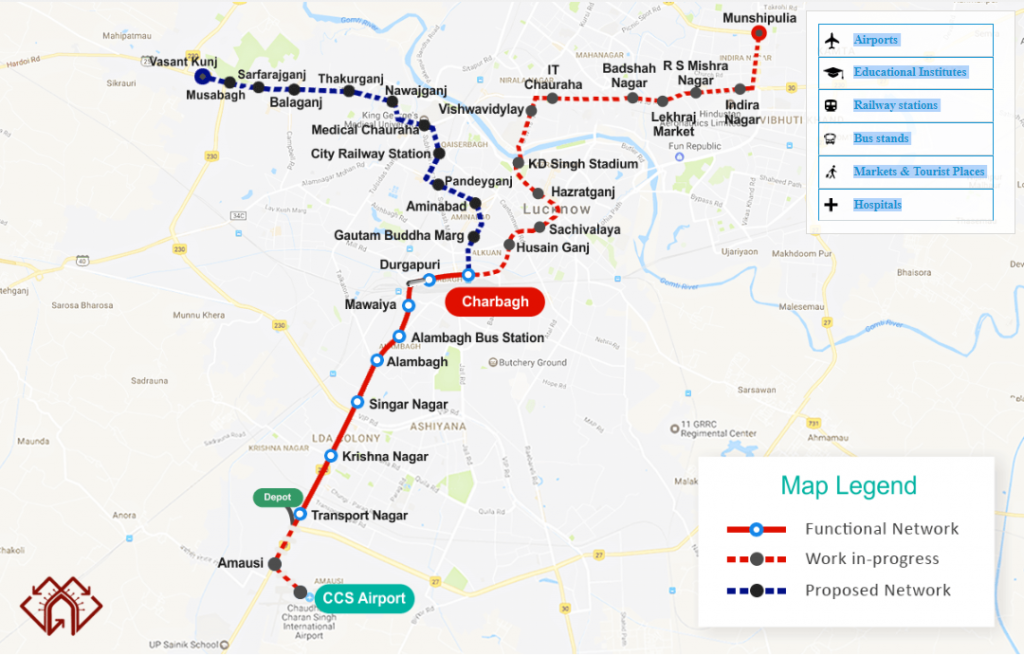
Lucknow Metro Map
Starting from Munshipulia the stations would be, Indira Nagar, R S Mishra Nagar, Lekhraj Market, Badshah Nagar, IT Chauraha, Vishvavidyalay, K D Singh Stadium, Hazratganj, Sachivalaya, Husain Ganj, Charbagh, Durgapuri, Mawaiya, Alambagh Bus Station, Alambagh, Singar Nagar, Krishna Nagar, Transport Nagar, Amausi and would finally terminate at Chaudhary Charan Singh Airport.
The priority route from Charbagh to Transport Nagar which has eight stations is already operational since 2017. The rest of 13 stations are expected to be operational soon, after which commuters would have to spend hardly 40 minutes to reach from Munshipulia to CCS Airport. The metro route will not only save time of the commuters but would also provide a respite from heavy traffic congestion.
And the best part is that the maximum fare on this route would be ₹60.
LMRC has proposed an East-West Corridor that would run from Charbagh to Vasant Kunj and would have 12 stations, bringing the total stretch of Lucknow Metro to 34 kilometers.
“Construction of Metro in a city like Lucknow has been a challenge in itself. In a period of less than three years, the LMRC has created a world record and has earned the distinction of being the fastest Metro (project) which has ever been implemented so far,” said Mr. Kumar Kesav, MD LMRC
“The early operations of the metro corridor will be our New Year gift to the city of Lucknow,” he added
Chennai Metro Rail Limited to launch electric auto feeder service today
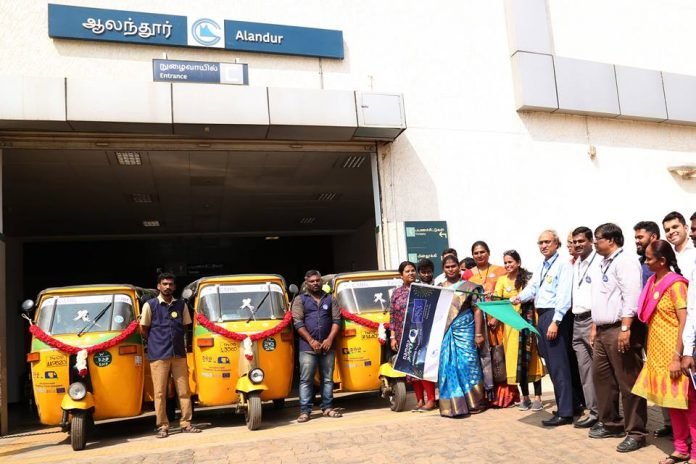
Chennai, Metro Rail News: Chennai Metro Rail Limited (CMRL) in association with the Namma Auto project has launched electric autos as a feeder service to the metro as a pilot project. This novel initiative by CMRL is another step towards the promise to build a more sustainable and convenient transport for the people of Chennai. The launch of operations for electric auto-rickshaws in Chennai is further proof to the narrative of how sustainable and green public transport is the need of the present as well as the future.
CMRL has provided free charging and parking facilities for these autos for the duration of the pilot while the launch of operations will be from Alandur metro station and will cover other stations in the coming months. The auto-rickshaws are meant to be noise free with zero tail-pipe emission and will provide commuters with a clean and green option to reach their respective locations.
The event was inaugurated at Alandur Metro Station by Thiru Narasim Prasad, Director (Systems & Operations), CMRL, Manju Menon, Project Manager, Namma Auto project along with Senior Officials and staff of CMRL and Namma Metro were present during the occasion.
Speaking on the occasion of the launch, Thiru Narasim Prasad, Director (Systems & Operations), CMRL appreciated the European Union funded Namma Auto Project for taking the initiative and supporting Chennai metro with an electric alternative as a feeder. He was quoted saying “CMRL has always worked towards the betterment of public transport in Chennai and while we are running feeder services from various metro stations, the launch of an electric feeder system is an extension of CMRL’s mandate to offer our customers an effective means of transport for a sustainable future”.
Speaking during the launch, Manju Menon, Project Manager, Namma Auto project said “This pilot project has been initiated to establish electric auto-rickshaws as a convenient, customer friendly and viable option of first and last mile metro connectivity for the people of Chennai, asserting a strong step towards sustainable urban transport.
This project also provides backing to our focus on implementing the sustainable development goals (SDG’s) which includes building a sustainable community and promotes action to improve climate change. We are thankful to CMRL for giving us the opportunity to run this feeder and spread the word of sustainability among the residents of Chennai.”
The Namma Auto project is implemented by four consortium partners, Fondazione ACRA (Italy), Enviu Foundation(Netherlands), Women Health and Development( WHAD) and The Energy and Resources Institute(TERI) from India.
As a pilot project, a total of 3 nos of electric autos at a flat rate of Rs.10/- will be shuttling between Alandur and DLF IT Park, Porur, Chennai.
• Meeting 13.12.2018 held at BEC with participating companies and the organisers.
The organisation, Terrapinn Holdings Limited, which has the backing of Mafex – the Spanish Railways Association, is putting together an intense agenda of talks and round tables in which the latest trends in rail transport and the main challenges of the future will be addressed over two days. Digitisation or mobility as a service are just two of the topics that will be covered in the 300 planned addresses. More than 3,000 attendees from 80 countries and 150 exhibiting companies will make Bilbao the world centre of the sector.
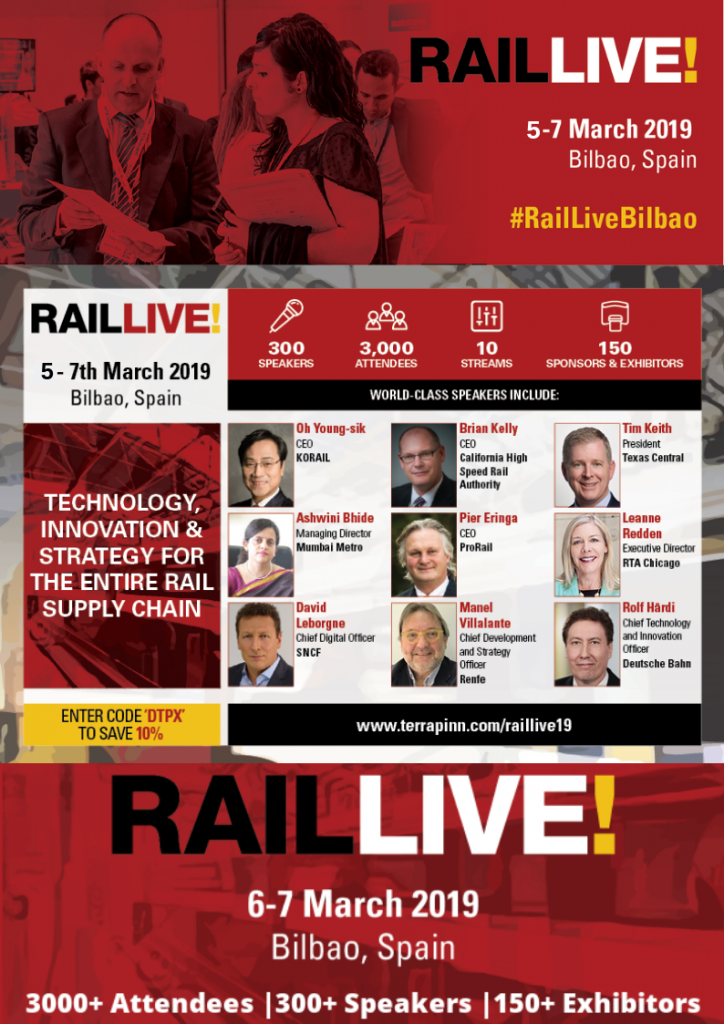
Bilbao, Metro Rail News: Bilbao will be the venue for the second consecutive year of the international fair and congress entitled “Rail Live!” running from March 6 to 7, 2019. This is one of the most pertinent professional platforms in the underground, light rail and commuter transport sector that will bring together experts from all over the world. In this edition, which will be held at the BEC (Bilbao Exhibition Center) once more, it is expected to surpass last year’s attendance figures. It is estimated that there will be 3,000 attendees from 80 countries, 300 speakers and 150 exhibiting companies.
In the words of Sean Willis, Terrapinn’s Managing Director “this year’s edition exceeded all our expectations in terms of industry attendance and participation. For the next one, our aim is to make it grow in all aspects “
Presently,
the organisation works in tandem with Mafex, on the drafting of a comprehensive
agenda in order to address for two days the latest trends in rail transport.
Amongst them, the challenges it faces in an environment of digital transformation,
new ways of travelling, as well as the future needs of users.
Pedro
Fortea, Managing Director of Mafex stresses the
“commitment” of the Spanish railway industry with
internationalisation as a way for its “competitive improvement” and
highlights that this event returns to place it “in a sectorial showcase of
great relevance” within the important pole of industrial reference that
the Basque Country represents.
Rail Live brings together speakers from Renfe, Central Japan Railways, California High Speed Rail Authority , Mumbai Metro Rail Cooperation and many others!
The
main international speakers have already been confirmed to date include, Executives
from the Korea Railway Corporation (Korea), California High Speed Rail
Authority and RTA Chicago (United States); SNCF and RATP Group (France); SBB
(Switzerland), Indian Railways (India), as well as NS Reizigers (Holland) and
Rail Baltica (Latvia), as well as the participation of ETS, Euskotren, Adif and
Renfe in the congress schedule.
Under the banner: “Technology, innovation and strategy for the entire railway supply chain”, the congress and the round tables of Rail Live!2019 will become the fulcrum of international debate on the many advances and their impact on the connection of the cities of the 21st century. A forum in which the viewpoint of national and international railway managers and operators will be known, as well as the role of industry and how R&D contributes to the mobility model in cities and their surroundings.
The
main topics on which this edition will focus are on metropolitan and light rail
networks, smart infrastructures, the digital revolution, Internet of Things
(IoT), telecommunications and control and the new concept of stations. These panels also include other key aspects
such as MaaS (Mobility as a service), financing models or advances in ticketing
processes. To the foregoing, the presentation of the “mega projects”
that are currently carried out around the world cannot be overlooked.
In
parallel, in the exhibition area, the exhibiting companies will present the
latest developments that are incorporated into the market to respond to these
new technological demands.
The
event also has the presence of the main companies in the sector such as Grupo
CAF, ArcelorMittal, Teltronic, Ingeteam, Amurrio, Danobat, Idom, Jez, Nem
Solutions and Stadler Rail Valencia, amongst others. It is expected the
participation of more than 150 companies, along with start-ups who will present
their latest innovations that will revolutionise the sector of the future.
Rail
Live! Boasts the backing of Mafex, the Spanish railway association, in the
organisation of the event, alongside that of the Basque Government. The SPRI
Group, ETS, Euskotren and Metro Bilbao collaborate in the event’s development.
The exhibition also has the support of Adif and Renfe.
More details about the fair and congress, the speakers and the companies taking part can be found on the following website: https://www.terrapinn.com/conference/rail-live/index.stm
Metro Rail News is Official Media Partner for all industry events being organized by the Terrapinn in the year 2019 including the Rail Live 2019.
CRCC Designed and Manufactured train for Nagpur Metro Phase 1 Project
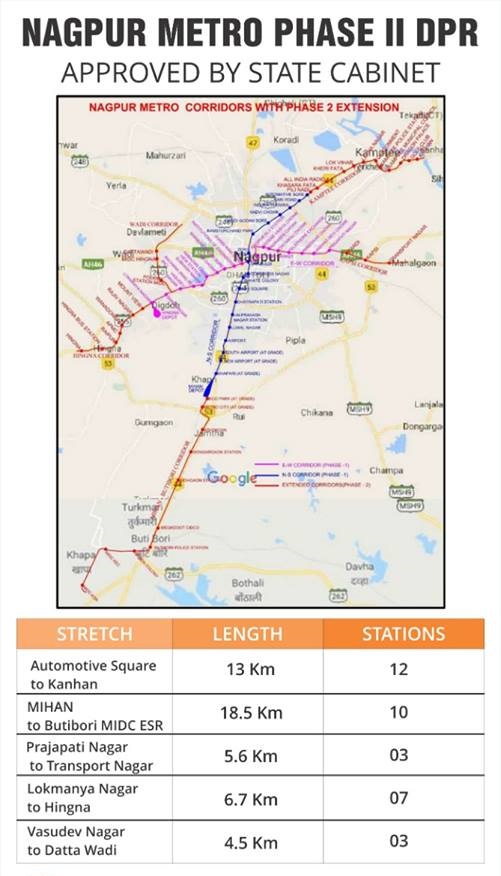
Nagpur, Metro Rail News: In a significant development which will boost connectivity in semi-urban areas of Nagpur, the state cabinet approved Phase-II of Nagpur Metro Project. This will particularly help those employed in industrial areas of Nagpur and have to commute long-distance daily.
The state cabinet on Tuesday cleared the Phase II of Nagpur Metro project worth Rs11,216 crore. The Phase I of Nagpur Metro worth Rs8,680 crore is being executed by MahaMetroand is about 75% complete.
The project worth Rs. 11,216 Crore will now be sent to Union Cabinet for its approval. This is a major milestone achieved and a new year gift by MahaMetro to residents of Nagpur, even as it gears up for the launch of its Phase-I operations.
Phase II covers rural parts of Nagpur district and will serve as an extension to the ongoing first phase. The proposed Phase will be spread over 48.3 km length with 35 stations. The collective population to be covered by two Phases is whopping 21.39 lakhs in 2019 (As per projections based on 2011 census). The projected population of Nagpur district in 2019 is 34.87 lakhs.
The population covered by Phase-I is 13.38 lakh and that by Phase-II is 8.01 lakh, in 2019.
Alstom has successfully delivered the last of the 30 additional Coradia Nordic regional trains ordered by Skånetrafiken, regional public transportation authority and operator in southern Sweden. The completion of the 2015 order, building on an existing fleet of 69 trains, has brought the Skånetrafiken fleet of Coradia Nordic trains, better known as “Pågatågen”, to a total of 99 units – one of the largest fleets in Sweden.
“With this delivery, Alstom has cemented its position as the leading supplier of regional trains in Sweden. The Coradia Nordic has proven itself over time to be safe and highly reliable, and with this large fleet, Skånetrafiken is now one of the largest operators in the country serving a growing region. We are very pleased to have been their trusted partner on this journey,” said Rob Whyte, Managing Director of Alstom in the Nordics.
“We are very pleased with this positive cooperation with Alstom as the vehicle supplier of the new Pågatågen. We now have 99 such trains and are thus well equipped to serve new customers and to expand our Pågatågen traffic,” added Linda Westman, Business Manager, Skånetrafiken.
Each Coradia Nordic train delivered to Skånetrafiken consists of four cars, is 74 meters long in total, and has a capacity of up to 510 passengers. The train runs at a maximum speed of 160 km/h. The Coradia family is characterized by modularity, safety and performance, as well as 98% recyclability. The trains were built at Alstom’s site in Salzgitter, Germany.
Coradia Nordic belongs to Alstom’s Coradia range of modular trains, which benefits from over 30 years of expertise and proven technical solutions. More than 2,800 Coradia trains have been sold so far and around 2,300 are currently in service.
Ircon chairman and managing director S.K. Chaudhary
New Delhi, Metro Rail News: The year 2018 was eventful for the Indian Railways’ public sector undertaking Ircon International Ltd (Ircon), which launched its initial public offering in September. It also figured in the list of top 250 international contractors as per the Engineering News-Record of the US. In an interview, Ircon chairman and managing director S.K. Chaudhary talks about the company’s focus areas in 2019. Edited excerpts:
Ircon will focus on global projects for better returns in 2019: S.K. Chaudhary
What are Ircon’s focus areas in 2019?
Ircon would like to expand its horizon in the infrastructure sector not only in India but in the overseas market as well, and improve its bottom line, although the existing canvas of Ircon is wide and colourful. Ircon has been entrusted with several strategic projects of national importance, too, and would like to expand its contribution in nation building and align with the priorities of the government. Our focus areas in 2019 would be railway line doubling and electrification, more EPC (engineering, procurement and construction) and HAM (hybrid annuity model) projects in highway sectors and winning some top international projects which give better returns.
Indian projects versus foreign projects, which is better?
Historically, Ircon had a 50:50 share of domestic and international projects. The margin from international projects are more than Indian projects because of various reasons. One of the primary reasons is that there is equitable distribution of risk and, thus, projects are not held up for want of issues such as land acquisition and approvals. Considering the speed of construction and project finance, definitely foreign projects are a better deal.
How is the progress of the Nepal projects, which Ircon is executing?
Ircon is currently executing two projects in Nepal: one, construction of a new broad gauge railway line between Jogbani (India) and Biratnagar (Nepal), which is likely to be commissioned by December, 2020. Two, between Jayanagar (India) and Bardibas (Nepal). In the first phase of work, tracks have been laid from Jayanagar to Kurtha, Nepal (34km). Apart from laying new lines, Ircon is also developing stations on this route. The remaining portion of the project is planned to be executed in two phases, that is, Kurtha-Bijalpura and Bijalpura-Bardibas, and is likely to be commissioned by February 2020 and March 2021, respectively. Both are strategic projects and will help strengthen Indo-Nepal ties.
What are the challenges for the Jammu and Kashmir railway project?
The Jammu and Kashmir rail project from Udhampur to Baramulla (272km), was envisaged to provide an alternative all-weather connectivity to the state of Jammu and Kashmir. Ircon is executing an 188km section, out of which 136km has been commissioned and train services from Baramulla to Banihal are in operation. In this section, Ircon has constructed the longest tunnel of 11.15km. Presently, Ircon is executing 113.75km tunnels out of which 70.60km is completed.
This project is perhaps the most challenging project ever undertaken in the history of Indian Railways. The alignment passes through thick forests, deep gorges, and criss-crosses numerous rivers and rivulets. Most of the length was inaccessible.
There are several reports that Ircon has completed various projects before time. Is it the case?
Yes. Ircon has completed a dozen projects before time in the last three years and it’s a big feat.
In fact, in the 42 year-history of Ircon, not a single project has been left incomplete, which is commendable considering the trend in the construction industry.
How many coal connectivity projects is Ircon implementing and when will be they be completed?
Coal connectivity projects are being developed by forming joint venture companies with the states governments, coal or mineral companies and Ircon. Ircon holds an equity of 26% in all these JVs and has secured 100% of construction works involved in these projects. At present we have five projects in Chattisgarh, one in Odisha and Jharkhand each. These connectivity projects are worth ₹15,800 crores and are expected to be completed by 2021-2022.
India Railways has an ambitious target of 100% railway electrification. Is Ircon eyeing it since it has expertise?
Ircon is the only Indian PSU which has executed works more than 6,000 track km of the railway electrification for the Indian Railways. Another 736 tkm of electrification work is in hand which is likely to be completed by 2020. There is only one company in the private sector which has the experience of more than Ircon. We are definitely keen and ready with men and machineries for availing this opportunity. Further, Ircon has wide experience of railway electrification work in foreign countries like Turkey, Algeria and South Africa.
Apply for DGM/Civil posts for DMRC phase-IV projects
New Delhi, Metro Rail News: The Delhi Metro Rail Corporation, Lifeline of Delhi, prides itself on its ability to nurture its employees through its unique work culture. Today, DMRC is empowered by about 13000 employees with MRTS activities spread over Delhi & NCR. To meet with the increased activities of DMRC, there is an urgent requirement of filling up of posts of DGM/Civil. Applications are invited from experienced, dynamic and motivated officers of Indian Railways/CPWD/MES/BSNL, having relevant work experience, for the posts mentioned below to be filled on deputation basis
No of Post: 10
Name of Post: Deputy General Manager/Civil (JAG-E4)
Scale of Pay: Rs. 15600-39100 (Grade pay Rs.7600/-)
Job Location: New Delhi
Tenure: 3-5 3 years as per GOI’s rule, extendable upto 5 years
Eligibility:
Eligible and interested Railway/CPWD/MES/BSNL Officers may apply as per the application format at Annexure-I. The candidates must enclose all relevant proof/documents in support of qualification, experience & pay scales/gross salary.
Age: Not more than 55 years
Service: IRSE/Group-A Officers/PSU-Executives
Selection Process
The candidate/s/will/would be screened by a Screening Committee consisting of three HoDs of DMRC. The candidate’s suitability will/would be decided, keeping in view the job requirement. The selection process would comprise of appraisal of different facets of knowledge, skills, comprehension, aptitude, physical fitness, etc. All related information shall be available only on website: http://www.delhimetrorail.com and candidates must remain in constant touch with it.
How to apply:
The interested person may submit his/her application in prescribed proforma by or before 18 January 2019 to the following address-
The Chief General Manager (CGM)/HR Delhi Metro Rail Corporation Ltd 3rd Floor, Metro Bhawan Fire Brigade Lane, Barakhamba Road, New Delhi-110001
Apply now for 13,000 jobs for Junior Engineers, DMS and CMA
New Delhi, Metro Rail News: For those who are looking to get a job with Indian Railways there is good news. The Railway Recruitment Board (RRB) has issued notifications for fresh recruitment to 13,487 vacant posts of Junior Engineer (JE), Junior Engineer (Information Technology), Depot Material Superintendent (DMS) and Chemical & Metallurgical Assistant (CMS). Candidates who wish to know more about the jobs on offer can visit the official website of Indian Railways at indianrailways.gov.in.
नये साल के अवसर पर मोदी सरकार का तोहफा : भारतीय रेल 1 लाख से अधिक नौकरियों के बाद युवाओं के लिए लेकर आ रही है 13,000 से अधिक और नौकरियों के अवसर, अधिक जानकारी के लिए नीचे दिए गए लिंक पर क्लिक करेंhttps://t.co/moGob8NwGMpic.twitter.com/AtG9jk2srA