Home Blog Page 670

Ahmedabad Metro’s Trail Run Conducted, Services Likely To Start From March

0

Ahmedabad, Metro Rail News: Gujarat Metro Rail Corporation (GMRC) conducted the first trial run of the Ahmedabad metro rail was conducted on January 31, 2019, Which announced that its commercial operations will start from March this year.

The government plans to start from March operations of the metro rail on 6.5-km route, which is a part of the first phase from Vastral in the city to Apparel Park.

“The first test of the train was successfully carried out today on the test track of 900 meters at Apparel Park,” a statement by GMRC said.

“The first train-set of Ahmedabad Metro had arrived at Apparel Park Depot on January 1, 2019 and was undergoing technical examination, safety checks and tests required for the regular run of the train,” the statement said.

“The second train-set is expected to arrive on February 9, 2019 and statutory inspection by the Research Designs and Standards Organisation of Railways and Commissioner of Railway Safety is expected to be completed by early March,” it added.

“Commercial operations of the metro will start after that,” the statement said

The metro rail will be implemented in two phases initially. While phase one is from Vastral to Theltej Gam, the second phase is from Gyaspur Depot to Motera stadium.

Advertisement1
InnoMetro_2026

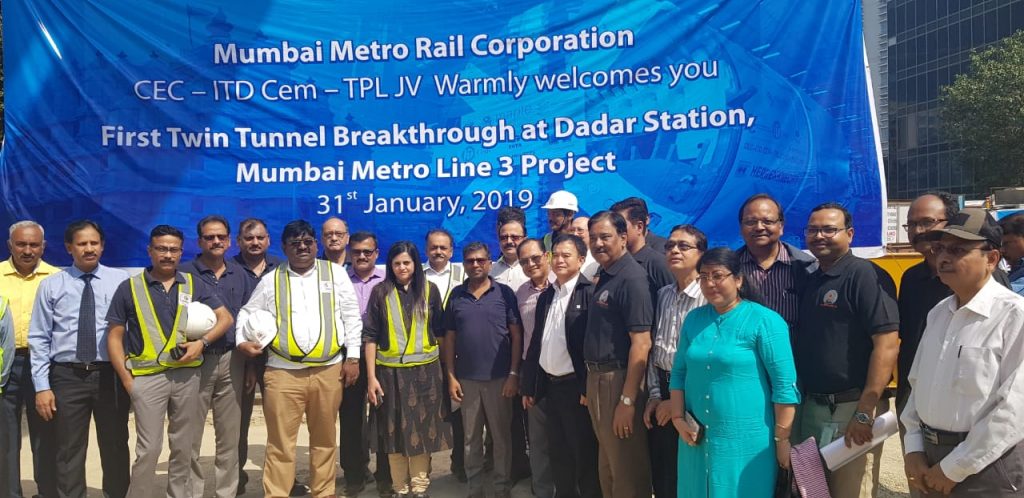
Mumbai Metro Line 3 successfully conducts its first twin tunnel breakthrough at Dadar Metro station.

0
TBM Krishna 1 and 2 have tunneled from Nayanagar to Dadar

Mumbai, Metro Rail News: Mumbai Metro Line 3 (Underground Metro) 18 km of tunnelling complete. Twin tunnel boring machines Krishna 1 &2, lowered in Sept & Oct 2017 respectively from Nayanagar, Dharavi, reached Dadar Metro station on January 31, 2019.

According to source “Krishna1 & 2 made their way through the rocky strata made of Basalt grade 3 & 2, breccia grade 4, 3 & 2 and tuff grade 4 & 3 drilling relentlessly for exactly 506 and 479days respectively. They charted their course from Nayanagar launching shaft.

Speaking on the occasion Ms Ashwini Bhide MD MMRC said Ths is the 3rd important tunneling milestone in Mumbai Metro Line 3 & the credit goes to our engineers, supervisors, workers & other stakeholders. We are working towards realising Mumbaikar’s dream of comfortable efficient commute at the earliest

The 108 meters long Krishna 1 bored, on an average, 10 to 12 meters daily shaping the tunnel with 1779 RCC cement rings, whereas The 108 meter long Krishna 2 bored, on an average, 10 to 12 meters daily, with shaping the tunnel with 1766 RCC cement rings. These TBM’s were equipped with Earth Pressure Balance Technology. Overall 35% work has been completed till now.

A Herrenknecht make TBMs Krishna 1 & 2 equipped with Earth Pressure Balance Tech tunneled their way through the rocky strata made of Basalt, Breccia & tuff for 506 & 479 days resp. Krishna 1&2 used 1779 & 1766 RCC rings while tunneling at 10 to 12 mtrs/day

Advertisement1
InnoMetro_2026

Jewar International Airport to have Delhi-Jewar Airport Metro Line for connectivity to NCR

1
Jewar International Airport to have Delhi-Jewar Airport Metro Line for connectivity

New Delhi, Metro Rail News: Delhi-Jewar Airport Metro Line will help Travelling to the new Jewar International Airport that is coming up in Greater Noida will become easier for passengers!

The Delhi Metro Rail Corporation (DMRC) will soon present the feasibility report of the Delhi-Jewar Airport Metro Line to the Yamuna authorities, according to a Dainik Jagran report. The authorities will then put forward the report in the upcoming board meeting. The airport metro line will take the passengers from Greater Noida to Jewar International Airport’s terminal. The airport metro line will be planned keeping in mind the need for punctuality to enable the passengers to reach the airport terminal in time for flights.

Two types of metro will be operated over the airport route. This airport metro line will have very few stoppages from the distance between Delhi and Jewar and hence, will take the passengers to the airport in a very short time. The other metro service on this route will be similar to other metro trains and will stop at all stations on the route. This particular metro train will be operated for the people residing in and around the Yamuna authority area. They will have separate lines on the stations.

The new airport metro line has been proposed for seamless connectivity between the Jewar International Airport to Delhi-NCR (National Capital Region). In the month of September last year, the Yamuna authorities had delegated the DMRC to present the metro feasibility report. The authorities want to get the report prepared as soon as possible and get all the formalities completed as well. They are eager for the timely completion so that the construction of the airport metro line starts simultaneously with the Jewar International Airport, the report said. In this way, both, the air services from the airport as well as the metro services for reaching the airport will be made available for passengers.

DMRC has promised to present the feasibility report to the authorities in the next 10-15 days. The feasibility report will be presented for acceptance in the upcoming board meeting of the authorities in February, the report added.

Advertisement1
InnoMetro_2026

Mumbai Metro One launches instant cashback for metro commuter’s from February 2019

0
Mumbai Metro
Mumbai Metro

Mumbai Metro One offers instant cashback to store value pass holders

Mumbai, Metro Rail News: Since its launch in June 2014, Mumbai Metro One has been following a base fare of Rs. 10 | 20 | 30 | 40. Apart from the base fare, Mumbai Metro offers 3 additional ticketing products: Store Value Pass (SVP), Return Journey Token (RJT) and Monthly Trip Pass (MTP), which have been designed keeping commuter needs in mind. The product pricing has been done in a manner to popularise Metro, promote regularity of usage and consequently increase ridership.

Of all the ticketing products, SVP has become the most preferred product by commuters because of the following reasons:

  1. Most flexible product; travel from any station to any station
  2. Balance available is refundable
  3. No need to go for ticketing daily
  4. Can be recharged across multiple platforms

Currently, around 1/3rd of Mumbai Metro commuters travel using SVP. Moreover, SVP has emerged as the highest growing product registering 51% growth YoY. To strike a win-win proposition, Mumbai Metro One wishes to go with popular commuters’ choice and encourage more and more commuters to take benefit of SVP.

Mumbai Metro intends to introduce an Instant Cashback on SVP w.e.f. 01.02.2019 and restructure the existing travel based incentive. This is to make SVP even more popular and encourage commuters to recharge with higher value. Commuters will now enjoy Cashback ranging from 2% to 10% for recharge ranging from Rs 200 to Rs 600 and above respectively. Of the many firsts to its credit, Mumbai Metro is the first Metro in the country to introduce Instant Cashback for the benefit of its commuters.

Earlier, SVP commuters enjoyed incentive piecemeal ranging from Rs.0 to Rs.5 as they commuted. Now, they will get Instant Cashback against recharge. Hence, it offers better time value of money. The new Cashback on SVP is aimed at encouraging regular commuters to migrate from daily queuing at ticketing counters to SVP. Use of card products on AFC gates improves Metro efficiency as card commuters take 40% lesser time to pass through AFC gates.

Benefits of new Cashback scheme:

  1. Earlier commuters who travelled shorter distances (0-2 km slab) didn’t get any incentive. Now all the commuters will be able to avail this scheme.
  2. Commuters will be able to easily identify amount of Cashback earned while travelling by metro.
  3. The Cashback offered by metro is equal to travel balance, which can be fully utilized while travelling.
  4. The Cashback will have long validity, which can be renewed by 6 months (180 days) with every recharge.

Mumbai Metro will offer one time 10% flat Cash-Back on entire remaining balance of 31st Jan’ 2019 (end of business day) so as to take care of incentive that a customer would have got while travelling with current balance.

With the base fare of Rs 10, 20, 30 and 40 for Single Journey Token remaining unchanged and introduction of Cashback on SVP, the price of MTP has been marginally increased by Rs.25 to Rs.50 for 45 trips, which effectively translates to a marginal increase from 55 paise to Rs 1.11 per trip. Despite this increase, MTP will still remain to be most economical product offering 14% to 24% incentive.

An MMOPL spokesperson said, “Over the last 4.5 years, Mumbai Metro’s loyal commuters have embraced metro culture. We believe it’s time our regular commuters move up the value chain. We are pleased to introduce an Instant Cashback on recharge of Store Value Pass to further popularize the product. We want commuters to use smart card and help us increase efficiency while ticketing and entry/exit.”

Advertisement1
InnoMetro_2026

Green Line of Namma Metro gets its first six-car train

0
green Line of Bengaluru’s Namma Metro gets its first six-car train

Bengaluru, Metro Rail News: Karnataka CM HD Kumaraswamy on January 28, 2019, flagged off the first six-car metro on the Green Line of the Namma Metro running between Nagasandra in the north and Yelachenahalli in the south of a Bengaluru. On the same day, two more six-car trains were added to the Purple Line which connects Mysore Road and Byapanahalli. 

Before January 28, 2019, three existing six-car trains were running on the Purple Line. Until June 2018, all the metros running in Bengaluru were of three coaches leading to extreme cramping in peak hours. The six-car trains have a capacity of 2,000 passengers and are currently deployed in peak office hours to prevent cramping. The capacity of three-car trains is 975 passengers at a given time.

the new six-car trains, when compared to the existing trains, are energy efficient by 15% and can automatically regulate temperature by sensing the ambient temperature, said BMRCL officials

The glimpse of Flag off ceremony

Other than this the new trains will also have remote isolation features for Variable Voltage & Variable Frequency (VVVF) Inverter through Train Management System along with Pendant Control Operation (Hostler mode) to move individual three units of six car train set on self-power (unique feature) in case of emergency. Other unique features of these trains include split screen in LCD panel in continuous advertisement display without disturbing the passenger information, remote downloading of train data for maintenance purpose.

With the additions of six-car trains, the Bangalore Metro Rail Corporation Limited expects the ridership to increase to five lakh from an average ridership of daily average ridership of four lakh passengers along its total 42-km network. 

While the first coach is reserved for women passengers for six-car trains in moving direction, the first two gates of three-car trains are for women-only. Top officials of the BMRCL expect that in future when all the metros in the city will be converted to six-car trains, such segregation won’t be required.

According to source By September, all 50 trains of Namma Metro will be converted to a six-car train.

Advertisement1
InnoMetro_2026

Train 18 renamed as Vande Bharat Express

0
Train 18 has been renamed Vande Bharat Express, says Piyush Goyal

New Delhi, Metro Rail News: Train 18 has been renamed Vande Bharat Express, as an acknowledgment of its made-in-India status. The announcement was made by Railways Minister Piyush Goyal on Sunday.

“It is completely made in India and various names were suggested by the general public but we have decided to name it Vande Bharat Express. A gift on the occasion of the Republic Day to people. Will request the prime minister to flag it off,” said Railway Minister Piyush Goyal on Sunday.

Indian Railways high-speed, engine-less train set named Train 18 (T18) will be rolled out soon. However, with all the world-class amenities, it’s being reported that the fares of train 18 might be costlier than Shatabdi Express. 

According to an IANS report, tickets of Train 18 might be 40-50% higher than the price of Shatabdi Express. 

Quoting officials close to the development, the report stated that the officials have approached Prime Minister’s Office (PMO) seeking time for the launch by Prime Minister Narendra Modi, which is likely after the presentation of the budget. The first train is slated to run between New Delhi and Varanasi, the Prime Minister’s Lok Sabha constituency. 

While the railways had been saying that it had proposed two routes for the train, Delhi to Bhopal and Delhi to Varanasi, this is the first time that the route has been officially confirmed.

“We have successfully tested the train and the suggestions are being incorporated. Very soon the train will be dedicated to the nation and we have requested that Prime Minister Narendra Modi flag it off. This train will run between Delhi and Varanasi in eight hours and the fastest train between the two cities takes 11.30 hours,” Goyal said.

“This train has amenities of international standards, is Wi-Fi enabled, CCTV cameras and it has no locomotive or engine. It is a trainset. It will cover the 750-km route at a maximum speed of 160kmph,” said Goyal, who inspected the rake at the New Delhi railway station.

Advertisement1
InnoMetro_2026

All you need to know: Noida-Greater Noida Aqua Line Metro open for public

0
The Aqua Line of the Noida Metro Rail Corporation (NMRC), connecting the twin cities of Noida with Greater Noida, will be inaugurated by Uttar Pradesh chief minister Yogi Adityanath on Friday.

Noida, Metro Rail News: The Noida Metro Rail Corporation (NMRC)
The Aqua Line, connecting the twin cities of Noida and Greater Noida in Gautam Buddh Nagar was opened for the public on January 25, 2019, by Uttar Pradesh Chief Minister Yogi Adityanath.

“Today we dedicate the Noida Greater Noida metro rail to the people of the region. The Aqua Line, which has been completed in record time, will provide better connectivity to the region and prove to a milestone in the development of the region,” Adityanath said.

Here is all you need to know about the line:

  1. Constructed at the cost of Rs 5,503 crore, the 29.7- Km section with 21 stations will be the longest Metro line in the country to be inaugurated, The Hyderabad Metro held the earlier record at 29km.
  2. There will be 15 stations in Noida and six in Greater Noida. The Aqua Line will halt on the Sector 76, 101, 81, NSEZ, Noida Sector 83, 137, 142, 143, 144, 145, 146, 147, 148, and Greater Noida’s Knowledge Park II, Pari Chowk, Alpha 1, Delta 1, GNIDA Office and Depot Metro stations.
  3. Commuters can buy QR-coded paper tickets or use smart cards. The initial payment for a new mobility card will be Rs 300, as against Rs 200 for Delhi Metro. The Delhi Metro tokens and smart cards will not be valid on this line.
  4. Travelling one station would cost Rs 10 on an QR-coded ticket and Rs 9 via smart card; 2km would cost Rs 15 on ticket and Rs 13.50 on smart card; 3 to 6km would cost Rs 20 via ticket and Rs 18 on smart card; 7 to 9km would cost Rs 30 on ticket and Rs 27 on smart card. Travelling more than 10 stations but less than 16 stations would cost Rs 40 via ticket but Rs 36 via the smart card. Travelling beyond 16 stations would cost Rs 50 via ticket and Rs 45 via the smart card.
  5. The Aqua line from will have a frequency of 15 minutes.
  6. It will have 19 rakes with four cars each. Every train is designed to run at a maximum speed of 80 kmph, clocking an average speed of 37.5 kmph.
  7. The trains are equipped with a passenger information system, a public address system, and an emergency announcement system from the operation control centre. Besides, all the stations shall be equipped with platform screen doors.
  8. Seat reservation through different colours has been done in the coaches for women, senior citizens and disabled. Dedicated space has been provided for wheelchairs in driving trailer cars at both the ends of the trains.
  9. The 49th battalion of the Uttar Pradesh Provincial Armed Constabulary will be responsible for the security on the Aqua Line and some private security personnel will also be deployed.
  10. The line will generate solar energy, have women drivers, and free water and toilet facilities for commuters

It would run between Sector 71 station in Noida and the Depot Station in Greater Noida. There are a total of 21 stations on the corridor – 15 of them in Noida and six in Greater Noida — spread over a distance of 29.7-km. 

The work on the Aqua Line started in May 2015 and was completed in a record time of three-and-a-half years.

The Metro service is expected to benefit a large number of commuters in both the cities, where mass public transport has been mostly unavailable, and the NMRC expects a daily footfall of over one lakh passengers.

Advertisement1
InnoMetro_2026

Delhi Metro’s Grey Line likely to start by September 2019

0
Delhi Metro
Photo Copyrighted: DMRC

New Delhi, Metro Rail News: Taking another step to cover more areas under its ever-growing network, Tthe Delhi Metro Rail Corporation on January 24, 2019, started work on its last leg between Najafgarh and Dhansa Stand on the Dwarka – Najafgarh – Dhansa Stand corridor.

“The TBM (Tunnel Boring Machine) will bore a 700-meter long tunnel between Najafgarh and Dhansa Stand on the up line and the same machine will be subsequently used for tunnelling on the down line between the same stations. The entire tunnelling work on both the up and down lines will be completed by September 2019″ said a DMRC official

Once this section of the Grey Line is made operational, Dwarka, Najafgarh and other nearby rural areas in western Delhi will be more accessible for commuters. Currently, travelling to these areas take time as they are not that well connected with public transport.  

The total distance between Najafgarh and Dhansa Stand is 1.2 kilometres. The entire stretch is underground. While 700 metres will be constructed using TBM, the rest will be done by the Cut and Cover technology in which excavation is done for underground construction and then the area is covered again.   

This section is an extension of the 4.295 kilometre long Dwarka – Najafgarh Metro corridor. The work for this section was formally awarded in late 2017 and the target date for completion is December, 2020. On the Dwarka – Najafgarh section, over 90 percent of construction work is complete and passenger services are expected to start by September this year.  

As part of its third phase of expansion, DMRC has constructed close to 54 kilometres of underground sections, which is more than the under underground corridors constructed in its first and second phases. About 30 TBMs were put into use for carrying out such massive underground tunnelling work. It was a tremendous engineering challenge since Delhi is an extremely crowded city and tunnelling had to be done beneath centuries old buildings and congested localities.  

TBMs were introduced for the first time by DMRC during the first phase of Metro construction. In Phase 2 of the Delhi Metro, 14 TBMs were used while the Phase 3, the number of TBMs used was 30.  

Delhi Metro currently operates on a network of 327 kilometres with 236 Metro stations. This network includes over a hundred kilometres of underground lines spread across the national capital.

Advertisement1
InnoMetro_2026

Train 18 Special – Metro Rail News January 2019 issue Publish

0
Metro Rail News January 2019 issue
Cover page of Metro Rail News January 2019 issue

Dear Readers,

Metro Rail News Published its most awaited Train 18 Special Edition which has in it very interesting section for the readers which cover The year review 2018 of Metro, Railway & MoHU, Cover Story of Train 18, Exclusive Interview with former ICF, GM, Mr. Sudhanshu Mani and Mr Kumar Keshav, MD, LMRCL in addition to Project of the Month, New Development, Opinion, Technology Update, Metro & Railway Job Openings, Article on Metro Camera, Tracking Sensor & AFC Ticketing, Case study of Alignment Design for Delhi Metro Phase IV Expansion, Project Watch, Upcoming Event, Live Tender.

The highlight of Metro Rail News January 2019

S. No.IndexPage no
1Editor Note6
2Round Up10
3Editor Choice13
4Year Review 2018: Metro, Railway & MoHU18
5Cover Story: Train 1826
6Interview with former ICF, GM, Mr. Sudhanshu Mani30
7Interview with Mr Kumar Keshav, MD, LMRCL32
8Project of the Month: Noida Metro35
9New Development38
10Opinion41
11Technology Update: Zonda Rotary Train44
12Pre Event Coverage: Middle East Rail 201945
13Metro & Railway Job Openings46
14Article: Metro Camera, Tracking Sensor & AFC Ticketing47
15Case study: Alignment Design for Phase IV Expansion52
16Project Watch55
17Upcoming Event57
18Live Tender58
Advertisement1
InnoMetro_2026

Chennai Metro’s AG-DMS to Washermanpet stretch to be open in Feb 2019

0
Metro Rail’s last stretch to be opened in February first week

Final check by CMRS on Friday; CM, Union Minister to participate

Chennai, Metro Rail News: Chennai Metro Rail Limited (CMRL) last stretch from AG-DMS to Washermanpet is likely to be inaugurated in the first week of February 2019

According to our source, the inauguration was planned for January 30 but had to be pushed to the first week of February for the convenience of authorities in the Ministry of Urban Development (MoUD). They are now considering two dates, February 6 or 10.

The function will take place at the Chennai Central Metro Rail station, for which arrangements have already begun.

The Tamil Nadu government had extended the invitation to the Ministry of Urban Development two weeks ago. Union Minister of State (Independent Charge) Housing and Urban Affairs Hardeep Singh Puri and Chief Minister Edappadi K.

Palaniswami will inaugurate the new stretch that marks the end of phase I project of the Chennai Metro Rail.

“Since Parliament is in session, they [the authorities in MoUD] wanted the ceremony to be shifted to February,” a source said.

Though there were rumours that Prime Minister Narendra Modi might participate in the function, sources clarified that he will not be present.

One more check

Meanwhile, the Commissioner of Metro Rail Safety (CMRS), who inspected the stations and tunnels along 10-km stretch from AG-DMS to Washermanpet, will once again come to the city on Friday for more checks. The CMRS team had pointed out some infringements in structures and incomplete work such as installation of false ceiling at the LIC and Thousand Lights stations.

“The CMRS team is returning to check if the corrective actions that had been recommended have been carried out. If the CMRS is satisfied with the work, then we are likely to get the final mandatory approval certificate in a few days,” another source said. If Chennai Metro Rail gets this certificate, the stretch will be ready for operations and can be inaugurated. When this stretch opens, all 45 km of the phase I project will be operational. Chennai Metro Rail plans to increase the frequency of trains and timings too.

Advertisement1
InnoMetro_2026