Home Blog Page 667

CMRS Concludes the 3 Day Inspection of LMRC from CCS Airport to Munshipulia; Migration Testing Trials Conducted Successfully

0
CMRS Concludes the 3 Day Inspection of LMRC from CCS Airport to Munshipulia; Migration Testing Trials Conducted Successfully
CMRS Shri AK Jain and Shri Kumar Keshav, MD, LMRC

Lucknow, Metro Rail News: Shri AK Jain, Commissioner Metro Rail Safety (CMRS) along with his team today concluded the 3 day inspection of Lucknow Metro Rail Corporation (LMRC) before the commencement of commercial operations of its Metro services for public for the entire section of North-South corridor (phase 1-A). On account of rigorous speed trials, the commercial train services on the priority section were suspended for the entire day from Transport Nagar to Charbagh which were earlier suspended from 6am to 12pm only.

The 3 day inspection which began on 20th February, 2019 was today completed after thorough testing of all the systems like Signaling & Telecom, Electrical and Civil Structure in addition to safety and passenger centric systems, lifts, escalators and other fire emergency related equipments.

CMRS and his team along with others senior LMRC officials tested the speed efficiency today by running the train to and fro CCS Airport and Munshipulia multiple times. After testing the systems at the maximum operating speed of 87 km/h and conducting several braking tests, the migration testing was completed successfully in the presence of the CMRS and his team. The monitoring of trains at the curves and jerks during the train movement were also tracked during the intensive testing.

Earlier, the CMRS and his team checked the working of Station Control Rooms (SCR) from where the trains will be monitored apart from the Automatic Fare Collection (AFC) system, location of Ticket Operating Machine (TOM) and Ticket Vending Machines (TVM) meant for ticketing and recharging ‘Go Smart’ Metro Cards. The track measurement tests were also carried out along the entire section of the balance section of North-South corridor (phase 1-A). The ventilation system of the entire Underground section was also inspected and examined apart from other physical aspects pertaining to passenger’s safety, convenience and integrated functioning of different components.

The Public Announcement System (PAS) and Public Information System (PIDS) were also checked in view of their usability in providing information and important messages to commuters. The operation, installation, design and location of lifts, escalators, CCTV surveillance system, Fire detection and alarm system and other public amenities were carefully scrutinized which are not only vital for providing timely assistance to passengers but also strategically important from emergency evacuation point of view.

Shri Kumar Keshav, Managing Director, LMRC congratulated the entire LMRC team, General Consultants and other contractors for their sheer dedication, commitment, hard work and successfully arranging CMRS inspection that was today concluded. This difficult task wouldn’t have been accomplished in record time without the god’s blessings for giving such a unique gift to the Lucknowites in form of most modern metro. He also emphasized on the fact that nothing is impossible if we remain focused and determined to work towards our goals day and night.
Advertisement1
InnoMetro_2026

Alstom wins electrification contract for Phase II of Bangalore Metro

0
(For representation purpose only)

Bangalore, Metro Rail News: The Bangalore Metro Rail Corporation Limited (BMRCL) awarded Alstom a EUR 71 million contract to provide power supply and traction electrification for the 33-km extension to Bangalore Metro under Phase II. It is Alstom’s largest third-rail electrification contract in India.

The scope of contract includes engineering, supply, installation, testing and commissioning of 750V DC third-rail traction electrification, the construction of 30 33kV/415V auxiliary substations, 26 33kV/750V DC traction substations and a 33kV cable distribution network along the viaduct. Alstom will work on integrating this new infrastructure with the existing system on the Phase I lines including augmentation of SCADA system. The execution of this project will be completed in 5 phases with the commissioning of the first 6.5-km stretch expected by the end of 2019.

“Our significance of our relationship with BMRCL, going back to 2009, is underlined by the fact that Bangalore hosts one of Alstom’s most significant sites. Alstom’s footprint in systems and infrastructure is growing rapidly, and this project will give us an opportunity to extend our cutting-edge capabilities and solutions to our customer,” said Alain Spohr, Alstom Managing Director, India & South Asia.

“The new line, once commissioned, will bring in much needed flexibility in the network while significantly reducing vehicular traffic in the city. It will enable Bengalureans to traverse the length and breadth of the city hassle-free and also add positively to the environmental needs,” Ajay Seth, Managing Director of BMRCL, said.


Phase II encompasses extension of Bangalore Metro’s existing North-South and East-West corridors, translating to a substantial increase in the reach of the metro and reduction of road congestion.

This is the second major contract win for Alstom in the city of Bangalore. In 2009, Alstom won the contract to provide the U200 signalling and telecommunications solution for 42 km of track comprising Bangalore Metro Phase I, completed in 2017.

Advertisement1
InnoMetro_2026

Noapara-Dakshineswar Metro Rail Project To Be Operational By Feb 2020

0
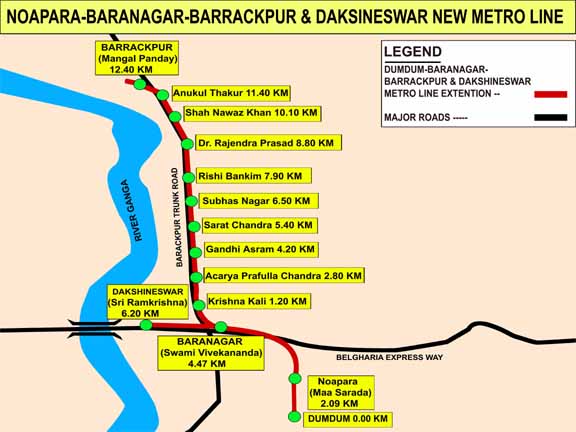
Noapara-Dakshineswar Metro Rail Project Map
Image for representation.

Kolkata, Metro Rail News: If things go according to plan,
Noapara-Dakshineswar Metro Rail project would be operational by February 2020. Commuting will be easier from the north to the south end and it would be done in a few minutes. from north and south ends reaching to the central business district of the city would be a lot easier.

Currently about 80 percent of the work of this project is complete. An amount of Rs 65 crore has been allocated in the interim budget of 2019-20. Chief Minister Mamata Banerjee, while she was the Rail Minister had announced several Metro Rail projects to connect the city with the suburbs. The Noapara-Dakshineswar project is one of those. The Dum Dum-Noapara Metro Rail route has been active for a few years now. Metro Railsources said that work along the 4 km route is near completion. The next station after Noapara would be Baranagar and the station after that is Dakshineswar.

Noapara Dakshineswar Metro Rail Project Map

According to sources, officials have the instruction to complete the work of the route by the end of this year. After completion, CMRS and other certification would be needed before the commencement of the train services on this route.

Also Read: Many Countries Express Interest to Import India’s Train 18 Set

Officials said that once this route is thrown open, citizens of North 24 Parganas, Howrah and Hooghly districts would be able to reach Kolkata with ease. Currently, Metro service is available till Noapara, Due to the lack of modes of transport at Noapara leads to fewer takers from this station. Instead, people opt for Sealdah Mainline trains or other buses along this route. Experts believe with the extended route till Dakshineswar, there will be more commuters which will lead to better and more means of transport at Noaparabecause right beside the under-construction Baranagar station there are buses available which shuttle between Baranagar and Sealdah.

Presently, owing to fewer commuters to Noapara, all Dum Dum bound trains are not run up to Noapara. Metro officials said that after every three trains which reach Dum Dum, one is run up to Noapara. Once the route is extended to Dakshineswar, at least alternate trains would be run up to there.

Metro officials further said that for trains to switch from Up line to Down line at Dakshineswar station, ‘V-Siding’ is has been used instead of the conventional ‘Y-siding’, chiefly because of lack of space at Dakshineswar station.

Advertisement1
InnoMetro_2026

PM Modi to inaugurate first phase of Ahmedabad metro on March 4.

0
Ahmadabad Metro
Ahmadabad Metro

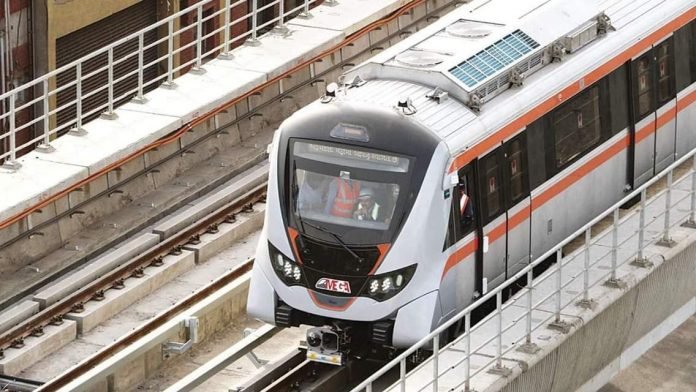
Ahmedabad, Metro Rail News: Good news for residents of Ahmedabad! Honorable Prime Minister Shri Narendra Modi is all set to inaugurate the first phase of the Ahmedabad Metro Rail Project on March 4. The trial for the 6.5-km long track has been completed recently. The 6.5 km-long section connects Vastral Gam to Apparel Park. Ahmedabad Metro project is
is implementing by Gujarat Metro Rail Corporation (GMRC).

Ahmedabad Metro Fare:
According to source, the minimum fare may start from Rs 15 for a ride of up to 2 km and the maximum fare may be around Rs 51 for a ride of up to 31 km

Ahmedabad Metro Phase I Route Map :

AhmedabadMetroMap1

Phase 1 Ahmedabad Metro Route Map

Ahmedabad Metro Phase II

Also, the Union Cabinet in a meeting chaired by PM Modi has approved the Ahmedabad Metro Rail Project Phase II on February 19, 2019. The Ahmedabad Metro Rail Project Phase-II comprises two corridors of total length 28.254 kilometres. It has two corridors – Corridor 1 from Motera
Stadium to Mahatma Mandir comprising for a length of 22.838 km and Corridor 2 from GNLU to GIFT City for a length of 5.416 km. The total completion cost of the project will be Rs 5384.17 crore.

The Cabinet has also approved the institutional arrangement and legal framework for the project.

Ahmedabad Metro Phase II Map:

Map of Pahse II 1 001

Ahmedabad Metro Phase II Map

Implementation of the Ahmedabad Metro Rail Project Phase II project will provide the much-needed additional public transport infrastructure to Ahmedabad and Gandhinagar.


Advertisement1
InnoMetro_2026

ABB wins Rs 270 crore order for train technologies from Indian Railways

0
ABB wins its largest order from Indian Railway

Varanasi, Metro Rail News: ABB won a 270 crore contract to supply converters for electric locomotives from Diesel Locomotive Works (DLW), in Varanasi. The converters are custom designed for Indian Railways and will be manufactured at one of ABB’s largest factories for locomotive applications in Nelamangala, near Bengaluru, in Southern India.

Traction e1550742254996

Traction equipment

ABB’s traction solution is based on the latest technology to bring more reliable trains to passengers, while increasing sustainable transport use by moving from diesel trains to electric. This helps rail operators to achieve significant operational improvements.

“We are delighted to be contributing to the electrification of India’s rail network with ABB’s locally manufactured solutions,” said ABB CEO Ulrich Spiesshofer. “By adopting advanced technologies, India is achieving rapid improvements in growth and productivity and shaping its economy for the era of digitalization.” He added.

“We are privileged to work with DLW and Indian Railways on the electrification of the domestic rail network in India – the fourth largest rail network in the world,” said Sanjeev Sharma, Managing Director, ABB India. “This order will help to improve rail efficiency so that passengers travelling in India will reach their destination on time and in comfort.” he added.

ABB factories for locomotive applications in Nelamangala, near Bengaluru, in Southern India.

ABB factories for locomotive applications in Nelamangala, near Bengaluru, in Southern India.

ABB has delivered traction equipmen more than 250 electric locomotives operated by Indian Railways for both passenger and freight services. In India, more than 20 percent of three-phase electric locomotives are equipped with traction converters from ABB. Last year, the Indian government approved plans to fully electrify the Indian Railways by 2022.

Advertisement1
InnoMetro_2026

Cabinet approves Rs 5,384.17 crore Ahmedabad Metro Rail Project Phase II

0
Cabinet approves Ahmedabad Metro Rail Project Phase II

New Delhi, Metro Rail News: The Union Cabinet chaired by Prime Minister Narendra Modi has approved implementation of Ahmedabad Metro Rail Project Phase-II on February 19, 2019.

The project comprises two corridors. One from Motera Stadium to Mahatma Mandir and second from GNLU to GIFT City. Total completion cost of Phase-II metro is estimated at Rs 5,384.17 crore.

The Union Cabinet approved the following proposals:

  1. Implementation of Ahmedabad Metro Rail Project Phase-II, which comprises two corridors of total length 28.254 i.e. Corridor 1 from Motera Stadioum to Mahatma mandir for a length of 22.838 km. and Corridor 2 from GNLU to GIFT City for a length of 5.416 km at a total completion cost of Rs. 5384.17 crores.
  2. The institutional arrangement and legal framework for the project.
  3. Conditions of sanction of the project.

The project will provide the much-needed additional public transport infrastructure to Ahmedabad and Gandhinagar.

The second phase of metro rail project is aimed at streamlining the urban transportation system in Ahmedabad and Gandhinagar. which is stressed due to intensive developments, increase in the number of private vehicles and heavy construction in the city putting stress on travel infrastructure and industrial activities, and by providing the people a safe, secure, reliable and comfortable public transport. 

The Metro Rail project itself is an innovation over the conventional system of urban transport. The project involves integration with other urban transport systems in an efficient and effective manner which is possible only by adopting innovative methods of designing, technology and institutional management.

Advertisement1
InnoMetro_2026

Union Cabinet Approves India’s first Regional Rail along with Metro in Meerut

0

New Delhi, Metro Rail News: Union Cabinet today approved India’s first Regional Rail between Delhi-Ghaziabad-Meerut with Metro in Meerut. This 82km stretch will be covered in less than 60 mins by high-speed, high-frequency, safe, reliable, comfortable & green public transit.

Joining city centre to city centre, RRTS trains will reduce pollution and road congestion taking more than one lakh private vehicles off-road. High speed mobility will also drive balanced socio-economic growth with increased economic activities and will improve quality of life of citizens.

Metro services with 12 stations on 18 kms. stretch between Modipuram and Meerut South stations on RRTS infrastructure will meet the local mobility needs of Citizens of Meerut besides providing efficient regional connectivity.

RRTS Trains will be equipped with modern features like CCTV surveillance, Mobile/Laptop Charging points, Luggage space etc. All station and trains will have universal accessibility for specially-abled. Each train will have a Business Class and a Ladies coach.

RRTS stations will be seamlessly integrated with other transport modes like Airport, Railway, Metro, ISBTs etc. and will be inter-operable ensuring that change of train is not required for moving from one RRTS corridor to another.

Delhi-Ghaziabad-Meerut RRTS corridor is first of the three prioritized corridors planned for implementation in Phase-1. The other two are Delhi-Gurugram-Alwar and Delhi-Panipat Corridors.

Geotechnical investigation


Pre-construction activities such as Geo-Technical investigations, Pile Load Tests, Road Widening and Detailed Engineering are already in advance stage and NCRTC, the implementing agency for the project is ready to begin construction of the corridor. Tenders for the civil construction have already been invited.

Total project cost is Rs 30,274 Crores.

NCRTC is mandated to design, construct, finance, operate and maintain RRTS in NCR and works under the administrative control of Ministry of Housing and Urban Affairs, Government of India.

Delhi-Ghaziabad-Meerut Corridor Map

elhi-Ghaziabad-Meerut Corridor Map and Station List

Delhi-Ghaziabad-Meerut Corridor Map and Station List

Work in progress

Advertisement1
InnoMetro_2026

STEC wins Tunnel ventilation, Environmental Control System Works contract for Mumbai Metro-3

0
STEC win Tunnel ventilation, Environ Control System Works contract for Mumbai Metro-3

Mumbai, Metro Rail News: The Mumbai Metro Rail Corporation (MMRC) has awarded Contract for the ‘Tunnel Ventilation system and Environmental control system’ Phase 1 works for the section Aarey to BKC for its Colaba-Bandra-Seepz Corridor of Mumbai Metro Line-3 (MML-3) project after obtaining clearance from JICA (Japan International Co-operation Agency) as per procurement norms.

‘Shanghai Tunnel Engineering Corp Ltd. (STEC)’ has been awarded the Tunnel Ventilation system and Environmental control system” works for Package 15 (Phase 1) being the most competitive amongst the respective bidders.

The works consist of design, manufacture, supply, installation, testing and commissioning along with other associated works for the section Aarey to BKC.

Tunnel Ventilation System (TVS) is critical life safety system that will protect passengers during fire and smoke emergencies in the stations/tunnels.
Tunnel Ventilation System (TVS) lowers tunnel air temperature during normal and congested conditions and provides smoke management in tunnel during train fire emergency.  Environmental Control System (ECS) Supplying fresh air for the physiological needs of passengers, removing body heat, obnoxious odours and harmful gases like carbon dioxide exhaled during breathing, 24×7 cooling system for critical operating rooms, smoke extraction at station during emergency conditions.

“Tunnel Ventilation and Environmental Control System” is a critical component of Metro Line 3 implementation for Passenger comfort and safety. We aim to implement robust and technologically advanced system and complete the works in time so that Metro Line-3 project can be completed in stipulated timelines. Said Ashwini Bhide, MD, MMRC

Advertisement1
InnoMetro_2026

Patna Metro Become operational by 2024: Suresh Kumar Sharma

0
Patna Metro Would be become operational by 2024

Patna, Metro Rail News: “The 31.39-km long Patna metro rail, the foundation stone for which was laid by Prime Minister Narendra Modi in Begusarai, would become operational by 2024” Said Sate Urban Development and housing department (UDHD) minister Shri Suresh Kumar Sharma on February 17, 2019.

“We will start the process of site investigation and selection of agency for loan this year. The bidding process will also start soon and the tenders will be awarded to the selected firms by mid-2020,” Sharma said. While laying the foundation for the project at a parallel function at gate number 1 of Patna zoo “work on the Rs 13,365.77- crore project would begin in six months” He Added.

Patna Metro Rail Corporation Limited, has been approved by the cabinet as a company and UDHD special secretary Sanjay Dayal has been nominated as its director.

On this occasion, Mr. Sany Dayal, Director PMRCL, Said “The construction of viaduct and tunnels will start from next year and complete by the end of 2022. Similarly, construction of stations and depots will also be done. Work related to coaches and their running on the track has been targeted to be completed by 2023 and commercial operations will begin in the next five years”.

As per the detailed project report (DPR), revenues will be generated through an automated fare collection system, advertisement and parking. The target for revenue collection is Rs 1,228 crore by 2024. The metro trains will run at a speed of 85km/hour. Its average speed limit will be 35km/hour.

The metro rail will run in two corridors — the 16.94km-long-east-west corridor covering Danapur, Patna Junction, Bailey Road and Mithapur bus stand. The 14.45km-long-north-south corridor will connect Patna Junction with the proposed bus stand at Bairiya via Gandhi Maidan, Patna Medical College and Hospital and Rajendra Nagar Terminal railway station.

Around 5.43 lakh passengers are expected to travel from the east-west corridor on a daily basis by 2024. The number is expected to touch 12.32 lakh by 2051. Similarly, in north-south corridor, around 3.31 lakh passengers are likely to travel per day.

Union housing and urban affairs minister Hardeep Singh Puri said the urban population is expected to reach 60 crore by 2030. “Metro will be an important mode of communication in the city,”

Advertisement1
InnoMetro_2026

Nagpur Metro Start first trial with three-coach train covers 11.5 Kms

0
Nagpur Metro Trial Run
Nagpur Metro First Trial Run

Nagpur, Metro Rail News: The The MahaMetro conducted its first trial run on February 18, 2019, with the three-coach train that covered 11.5 km distance between Khapri and Ajni stations, at a speed of 45 km per hour.

The trial run took place under the supervision of an 11-member team of Research Design and Standards Organisation, functioning under the Ministry of Railways.

“The team checked compliance markers, such as safety, braking system, acceleration and deceleration, among others. It will submit a report, following which a team of the Commissioner of Metro Rail Safety (CMRS) will undertake a visit for the final certification of safety to pave the way for the commercial run,” said Akhilesh Halve, DGM Corporate Communication

Stretching 39 km over the two corridors, the work for the project began in 2014.

“The Nagpur Metro will have the distinction of being the fastest completed Metro project in the country, the deadline for which is December 2019.”
said Brijesh Dixit, MD of MahaMetro,

Advertisement1
InnoMetro_2026