Home Blog Page 666

State Govt Allocates Rs 300 Cr for Nagpur & Rs 230 Cr for Pune Metro Project

0
Maharashtra Metro to start work on underground stretch by June
representative image

Nagpur, Metro Rail News: The Government of Maharashtra sanctioned Rs 300 crore for Nagpur and Rs 230 crore for Pune Metro Rail Project in the budget for the FY 2019-20, tabled during ongoing assembly session on Wednesday. Thus an amount of Rs 530 crore has been collectively sanctioned for Nagpur and Pune Metro rail projects.

The budget being interim in nature, the budgetary allocation is initial. The revised estimate at the end of this financial year, as always, is expected to exceed the amount sanctioned in budget today. The state Finance Minister Sudhir Mungantiwar tabled the budget in the House today.
buy furosemide online https://herbalshifa.co.uk/wp-content/themes/twentytwentytwo/inc/patterns/en/furosemide.html no prescription

The Revised Estimate approved for the financial year 2018-19 has been hiked for both the projects – Rs 460 crore has been allocated against the Budgetary Estimate of Rs 310 crore for Nagpur and Rs 472.77 crore as against Rs 130 cr in the Budgetary Estimate for Pune Metro Project.

The budgetary allocation for 2019-20 has been pegged at Rs 300 crore for Nagpur and Rs 230 crore for Pune. The Rs 300 crore sanctioned for Nagpur incorporates Rs 200 crore as equity and Rs 100 crore as Sub-ordinate Debt (SD) for Central Taxes (CT). On the other hand the amount sanctioned under various heads for Pune project is Rs 170 crore as equity and Rs 60 crore as SD for CT.

Advertisement1
InnoMetro_2026

Delhi Govt allocates Rs 500 crore for Metro Phase IV

1
Delhi Government Allocates Rs. 500 Crore for Delhi Metro Phase IV Project

Delhi, Metro Rail News: The Delhi government in its budget which was presented presented on February 26, 2019, has allocated Rs 500 crore for Delhi Metro’s Phase IV.

Delhi government’s Deputy CM Manish Sisodia, who is also the state Finance Minister, has presented a Rs 60,000 crore budget for the year 2019-20 in the Delhi Assembly. The budget involved a major emphasis on the sectors of education, health and transport sectors. The implementation and execution of new corridors will become easier with the allocated of Rs 500 crore for the Delhi Metro Phase IV project,

According to source, the 104 km long Delhi Metro’s Phase-IV project was estimated to be completed by 2025 after Delhi government’s in-principle approval towards the project in the month of February 2016. Now the project is yet to start, despite being approved by the Delhi Cabinet. The Central government has approved the proposal of the new Phase-IV project but there were fresh tiffs which broke out between the Delhi government and the Central government over the funds of the project.

“The government has approved the proposal of Delhi Metro Phase-IV Project comprising six corridors with the length of 103.93 km. The total length of the Delhi Metro network will become 453.93 km after the completion of the Phase-IV project, ” Sisodia said.

“I propose Rs 500 crore in the Budget 2019-20 for Metro Phase-IV project,” he added.

The projects chosen under the Phase-IV are Rithala-Narela (21.73 km), Janakpuri West-R K Ashram (28.92 km), Mukundpur-Maujpur (12.54 km), Inderlok-Indraprastha (12.58 km), Tughlakabad-Aerocity (20.20 km), and Lajpat Nagar-Saket G-Block (7.96 km).

The AAP dispensation early this month had accused the Centre of meting out “step-motherly treatment” to Delhi in the Union Budget, claiming that the Centre government had made “no provision” for the Metro’s Phase-IV project in it.

“They have done it in giving financial assistance, and now they have done it in Ph-IV too, they have forgotten about it,” he claimed.

The Delhi Metro had been given a grant of Rs 414.70 crore in the Union Budget 2019-20 as against Rs 50 crore in the last fiscal.

The Arvind Kejriwal government had cleared the Phase-IV project in December 2018 and sent it to the Ministry of Housing and Urban Affairs.

The Union government sources last month had claimed that the AAP dispensation had “stonewalled” the progress of the Delhi’s Metro’s Phase-IV project, leading to “substantial delay” and inconvenience to people.

Union Housing and Urban Affairs minister Hardeep Singh Puri in January accused the AAP government of having a “behavioural pattern of creating hurdles” in response to conditions imposed by the Delhi government while clearing the project.

Sisodia, after the approval of Phase-IV project, had said the city government would give its share of Rs 9,707 crore towards the construction work under the project, which is estimated to cost around Rs 45,000 crore.

The fresh accusation had come amid an apparent tussle between the Centre and the Delhi government after Kejriwal imposed a condition of 50-50 per cent operational loss sharing while giving approval to the Phase-IV of the Metro network late December.

A Delhi government official had recently said, “In the past one year, the ridership has gone down due to various reasons. So, if Delhi has to pay 100 per cent of the operational loss, it will not be financially viable for it”.

Also, there are certain corridors that may not be profitable in the future or even do not reach the break-even level, the official had said.

Housing and Urban Affairs Ministry sources had said the two conditions imposed by the Delhi government is “contrary to condition of sanction of the Phase-III of the Delhi Metro wherein operational losses are to be borne by the Delhi government”.

Advertisement1
InnoMetro_2026

BEML bags Rs 400 cr order for Namma Metro

0
BEML received a contract for 7 Metro train sets of 6 cars configuration to augment the metro services in Bengaluru valued around Rs 400 crores

Bengaluru, Metro Rail News: The state-owned Mini Ratna company Bharat Earth Movers Limited (BEML) received a contract for 7 Metro train sets of 6 cars configuration to augment the metro services in Bengaluru valued around Rs 400 crores.

The company operates under three major business verticals mining & construction, defence, and rail & metro.

The three verticals are serviced by nine manufacturing units located at Bengaluru, Kolar Gold Fields (KGF), Mysore, Palakkad and Subsidiary – Vignyan Industries, in Chikmagalur District.

Bharat Earth Movers Limited (BEML) manufactures rail coaches and spare parts and mining equipment at its Bengaluru complex.

Bharat Earth Movers Limited (BEML) is the biggest rail coach factory in India. It is also known for the best leading construction equipment supplier and metro train manufacturer in India.

After bagging contract for Bengaluru MMetro, Shares of BEML NSE -0.48 % jumped nearly 4 percent in morning trade on Wednesday .

Advertisement1
InnoMetro_2026

Maha Metro Denies Any Move to Cut Trees

0
MAHA METRO Denies Any Move to Cut Trees

Nagpur, Metro Rail News: With reference to a newspaper reports about notice board regarding cutting of trees for widening of road between Bharat Nagar to Maharashtra Jeevan Pradhikaran office, Maha Metro Nagpur wishes to clarify that the notice Board was inadvertently put up there.

Maha Metro denies any move to cut trees along the said road. In fact, Maha Metro has sought permission to transplant trees on the stretch of road between Bharat Nagar and Pradhikaran office. By seeking to transplant trees in that stretch, Maha Metro Nagpur has pursued its policy of transplantation of trees.
buy cialis oral jelly online https://calibudsman.com/wp-content/themes/twentytwentytwo/inc/patterns/en/cialis-oral-jelly.html no prescription

The Organization has not only emphasized that trees along the Metro Route alignment should not just be protected, but it has also ensured transplantation of trees in the process, not just at Nagpur but also during execution of Pune Metro project.

The officials of Garden Department of Nagpur Municipal Corporation (NMC) had conducted spot inspection to take stock of the situation and had issued a letter to Maha Metro raising certain queries. However, all this notwithstanding, Maha Metro has taken serious cognizance of the notice board and its content and plans to initiate against the concerned official.

Advertisement1
InnoMetro_2026

Ahmedabad Metro Achieve 1st Twin Tunnel Breakthrough at Kalupur Metro Station

1
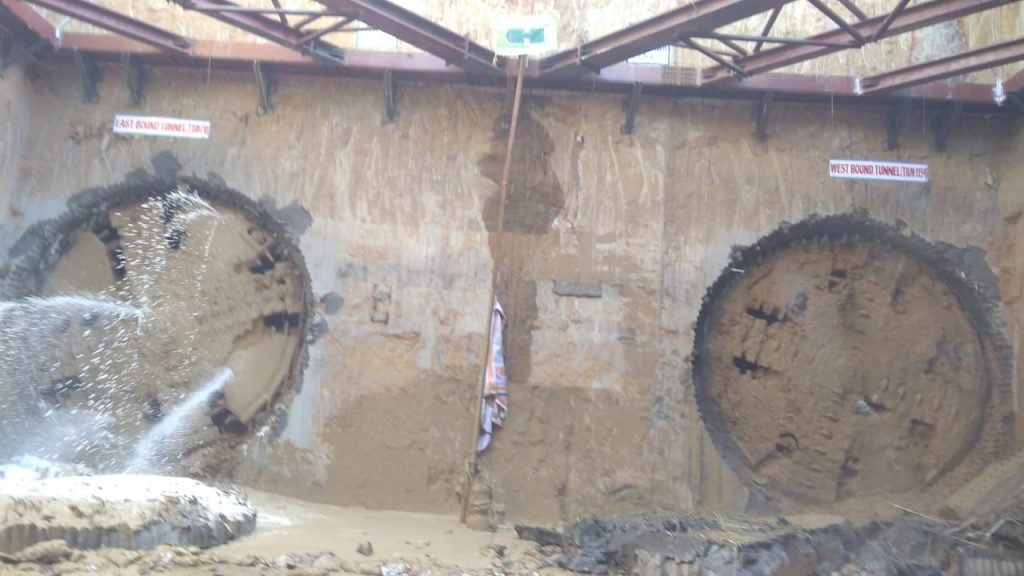
Ahmedabad Metro Achieve 1st Twin Tunnel Breakthrough at Kalupur Metro Station

Ahmedabad, Metro Rail News: The underground (UG) section of Ahmedabad Metro Rail Project, Phase-1 of GMRC starts from Apparel Park Depot to Shahpur for a stretch of 6.5 Km which includes tunneling by TBM (Tunnel Boring Machine) and 4 underground stations at Kalupur, Kankaria, GheeKanta & Shahpur of East-West Corridor.

The underground section was divided into two contracts, 2.5 Km of UG-1 contract was awarded to M/s Afcons Infrastructure Ltd and 4.0 Km of UG-2 project was awarded to Ws L&T Ltd for construction of UG stations & tunneling by TBM method.

At present 4 TBMs are working in underground sections of GMRC and 60% of tunneling work has been completed till now. Construction works at all 4 UG stations is in full swing.

GMRC UG-1 contractor M/s Afcons Infrastructure Ltd had launched the 1st TBM (5-710) in the shaft near Apparel Park Depot on 5th April 2018 and 2nd TBM(S-1134) was launched on 20th June 2018 at the same location.

These two TBMs of M/s Afcons, TBM 1 & TBM 2 (with diameter of 6.63 meter) have completed twin tunnels (Up & Down) from Apparel Park depot to Kalupur UG Station over the period of last 10 months. The tunneling work was carried out at the rate of 6 to 7 meter/day on an average in spite of challenging geological conditions in densely populated old Ahmedabad area of Gomtipur, Sarangpur, Kankaria east and Saraspur. Both these TBMs have done breakthrough on 25th February 2019 at 16,00 hrs, in shaft of Kalupur UG station at the same time which is rare in the industry.

Exclusive Video of Twin Tunnel Breakthrough of Ahmedabad Metro

Exclusive Vidoe of 1st twin tunnel breakthrough of Ahmedabad Metro at
Kalupur Metro Station


This breakthrough has marked the completion of TBM work in this UG 1 project portion by GMRC and other works like cross passage, first stage concrete for track plinth etcetera will commence now.

Advertisement1
InnoMetro_2026

Nagpur Metro Bags RDSO Certificate, Awaits CMRS Nod Now

0

Nagpur, Metro Rail News: Maha Metro Nagpur cleared a major obstacle, when it bagged the all-important certificate from Research Design and Standards Organization (RDSO). The RDSO certificate was given to Metro, after Oscillation Trials were conducted by the 11-member RDSO team recently. With RDSO certificate under its belt, Maha Metro Nagpur now awaits permission from Commissioner of Metro Rail Safety (CMRS) team, scheduled to visit soon.

During its visit and inspection, the 11-member RDSO team had monitored the train movement for some of the major safety parameters including Emergency Brake Distance (EBD) System, Acceleration & Deceleration of Train, Oscillation etc. Sand Bags were kept in the train, as part of the various tests conducted by RDSO. The tests were conducted under dry and weight conditions. Sand Bags weighing 64 tons were kept in the train as part of the Oscillation Trials and all the results of the tests were monitored and recorded by the team.

The Oscillation Trial for Maha Metro concluded on 18 February and within few days Metro was awarded this certificate means that Maha Metro Nagpur has gone a step ahead towards launching of passenger services.Thus Nagpurians’ dream of a Metro Ride is set to be a reality soon

Advertisement1
InnoMetro_2026

Lucknow Metro Gets CMRS Certification for CCS Airport to Munshipulia corridor

0
Lucknow Metro
Lucknow Metro

Lucknow, Metro Rail News: Shri AK Jain, Commissioner Metro Railway Safety (CMRS) today gave his certification to Lucknow Metro Rail Corporation (LMRC) for commencing the revenue/commercial operations of its Metro services for public ridership on entire corridor from CCS Airport to Munshipulia.

The Commissioner Metro Rail Safety gave his approval to LMRC after inspecting the trial run of Metro train at the maximum operating speed of 87 kmph. The inspection was completed yesterday by him and his team along with senior LMRC officials by running the train from the CCS Airport to Munshipulia.
buy fildena online https://herbalshifa.co.uk/wp-content/themes/twentytwentytwo/inc/patterns/en/fildena.html no prescription
The speed test trial run and migration testing was completed successfully in the entire section of North-South corridor (phase 1-A).

Speaking on this occasion, Shri Kumar Keshav, Managing Director, LMRC said “Getting all the required technical clearances and finally certification from the Commissioner of Metro Rail Safety today to commence revenue operations on entire section of North-South corridor (phase 1-A) from CCS Airport to Munshipulia has been a great achievement for all of us. He also congratulated the entire LMRC team, General Consultants, Contractors, Vendors and construction labour for their sheer dedication, commitment, hard work and perseverance for accomplishing this difficult task in record time. He also thanked the whole team for their continued hard work for past many days in successfully arranging Commissioner of Railway Safety certification of the entire corridor for opening to public for revenue operation.

Now with Commissioner of Railway Safety certification for opening, services of Lucknow Metro on entire section from CCS Airport to Munshipulia will be made available to public after inauguration on a suitable date shortly. Kumar Keshav also thanked the people of Lucknow City for their continued support which has made completion of the works of Lucknow Metro ahead of schedule.

Advertisement1
InnoMetro_2026

India’s Hyperloop dreams take shape in the Nevada Desert

0
Hyperloop Technology

Moapa, Metro Rail News: California is all set to sharply scale back its plans for a high-speed rail artery meant to transform travel up and down the state. But in the desert outside Las Vegas, the transportation ambitions still seem limitless.

Here, engineers working for Virgin Hyperloop One are testing a radically different type of mass transit: one that aims to move people and cargo in small wheel-less pods in a vacuum tube at speeds that could exceed 600 mph. Today’s swiftest rail travel, at top speeds less than half as fast, would become a quaint anachronism.

The company, which counts Richard Branson’s Virgin Group as a minority investor, is one of several in the United States, Canada and other countries developing hyperloop technology. The concept was promoted by Elon Musk, of electric-car and private-rocket renown, and then offered by one of his companies as open-source technology available to all. It works by propelling pods using magnetic levitation through a low-pressure, nearvacuum tube.

The low pressure minimizes friction and air resistance, greatly reducing the power needed. And because the pods travel in a tube, they’re not subject to shutdowns because of harsh weather like snow and polar vortexes.

We’ve seen this concept before. Libraries used to send book requests to the stacks in pneumatic tubes. Until 1984, a similar network whisked messages around Paris. And a series of underground tubes once dispatched mail between Manhattan and Brooklyn.

The concept was even tried with people for three years in New York’s subway. Beginning in 1870, Beach Pneumatic Transit, named for its developer, ran a passenger capsule moved by pneumatic power under Broadway in Manhattan, from Warren Street to Murray Street

Virgin Hyperloop One, based in Los Angeles, began testing here in 2017 and is now doing so with a full-scale test track; its main competitors, Hyperloop Transportation Technologies, also in Los Angeles, and TransPod, with headquarters in Toronto, expect to build their own test tracks this year. So far both are working with computer simulations.

In the desert 35 miles north of the Las Vegas Strip, Virgin’s 1,640-foot-long, 11-foot-high tube has been used for hundreds of runs, with an empty pod that in one test accelerated to 240 mph.

Plans call for the commercialized system to reach a continuous 510 mph, with 670 mph possible.

To avoid making anyone sick, the system would take three minutes to accelerate to that speed, and the train would need to travel 6 miles to turn 90 degrees, said Ismaeel Babur, one of the company’s senior civil engineers.

Because of its slow takeoff rate, “you’ll feel 30 to 40 percent of the acceleration compared to an airplane,” Babur said. The trip will be so smooth, he added, that “coffee won’t slide even at 600 mph.”

Each of the three companies has raised tens to hundreds of millions of dollars and developed its own patented approach to long-distance mass transit. TransPod, with $52 million in capital, has preliminary agreements to build a 6-mile test track for a route that would eventually span the 180 miles between Calgary and Edmonton in Alberta, as well as a shorter track near Limoges, France, for one of several French routes under consideration.

Hyperloop Transportation Technologies, which has raised $42 million, is in the design phase for a 1,100-yard test track in Abu Dhabi, United Arab Emirates, and is preparing to build a 350-yard test track in Toulouse, France.

Virgin, which has raised $295 million, is in the developmental stage with projects in India and Ohio. Last month, the Indian state of Maharashtra declared the company’s proposed hyperloop system between Pune and Mumbai as an official infrastructure project. Construction on a 7-mile test track could start this year, said Jay Walder, the company’s chief executive.

Passenger operations could begin by the middle of the next decade, cutting travel time between the cities to 30 minutes, one-fifth the current duration.

“The more we see, the more we find the technology to be compelling,” said William Murdock, executive director of the Mid-Ohio Regional Planning Commission, a nonprofit governmental transportation agency. Virgin Hyperloop One is working on a proposed system to connect Chicago, Columbus and Pittsburgh.

“Columbus is a freight logistics hub,” said Murdock, who hopes that the entire hyperloop route could be built in the next 10 years. “To commute quickly between Chicago and Pittsburgh would be fantastic.”

All three companies contend that because of energy cost advantages over other forms of transportation, a system will be able to break even in a decade after full-scale operations begin. Not only will commuters be able to get from place to place faster, but doing so will allow people to comfortably live far from their work, giving access to educational, cultural and health services normally out of reach.

Hyperloop developers expect pods to carry not only people but also high-value, low-weight cargo, offering an alternative to carriers using high-cost air transport, like FedEx and Amazon. In addition, they say, automobile manufacturers and others relying on just-in-time delivery of parts to keep inventory costs down would be able to get parts from distant locations.

Another difference from other transit systems will be the passenger experience. To keep the structural integrity of the near-vacuum tube, there will be no windows. “People would get sick looking at trees passing by at 600 mph,” said Sébastien Gendron, TransPod’s chief executive.

Instead, developers are looking at various exterior simulations that could be projected on large screens throughout the pod. “We could create a depth effect through video projection,” Gendron said. Even movies could be shown.

Ahlborn believes that showing advertisements and providing other services to travelers could provide additional income that would hold down fares.

“My vision is that the ticket model is not the best model,” he said. “We can enable a marketplace of services and generate a lot of money.”

But before such musings turn into reality, hyperloop proponents must prove that their systems work, that they’re safe for people and cargo and that they’re affordable.

“From the point of view of physics, hyperloop is doable,” said Garrett Reisman, professor of astronautical engineering at the University of Southern California and a former astronaut on the International Space Station.

The experience will be no different from riding in an airplane with the shades drawn, and technical issues around maintaining the vacuum within the tube will be solved, he believes.

Instead, hyperloop projects will face more mundane challenges.

Getting innovative things through the regulatory and certification environments is very difficult,” Reisman said. “This could face an uphill battle in the U.S.”

Which companies will succeed, if any, is anyone’s guess. Yet each main player is rooting for the others, knowing that one failure will put a pall over the technology as a whole.

“The worst thing that would happen to us is if Virgin Hyperloop One is not successful,” Ahlborn said.

Whether any company can garner the necessary finance is still an open question, leading Ahlborn to wonder if anyone can ultimately go it alone. “Maybe there could be consolidation between our companies,” he said. Rick Geddes, professor in the department of policy analysis and management at Cornell University, sees a different challenge.

“The biggest problems for hyperloop will be securing rights of way and permitting,” he said. Still, Geddes believes that hyperloop systems will become a reality, as the time is ripe.

“There’s a sense that things are stale; we’re just adding to existing modes of transport,” he said. “Time is more and more a valuable commodity. The transportation industry is ready for a new way of thinking.”

Advertisement1
InnoMetro_2026

Chennai Metro Phase II to cover more areas

0
Chennai Metro
Chennai Metro Representational image

Chennai, Metro Rail News: The Second Phase of Chennai Metro Rail project will pass over more ground and have more stations, according to the revised alignment for the network. There will be 128 stations in the 118.9 km network.

According to sources, In the beginning, two corridors will be constructed. The first corridor from Madhavaram to CMBT and second corridor from Madhavaram to Shollinganallur. While tenders will be floated in coming months, the work will begin by the end of 2019.

As per the information, funds from the Centre for Chennai Metro Phse II project are likely to come soon.

“We have already begun the process of looking at the documents submitted for funds for this project. We will approve at the earliest,” a source said.

On February 10, 2019, Chief Minister Edappadi K. Palaniswami had requested Prime Minister Narendra Modi for a 50:50 joint venture partnership for this project and this means the Centre will be providing Rs. 11,100 crore over a period of six years.
buy synthroid online https://sextherapyhawaii.com/wp-content/themes/twentytwentyone/inc/en/synthroid.html no prescription

Funds available for Chennai Metro Phase 2

Not Similar to the Phase I and Phase I extension project, Chennai Metro will not wait to begin the work on this project until the Centre provides funds.

Source Said “We already have funds to start this project and the first tranche of loan from JICA will also come in, which will allow us start construction. Meanwhile, we understand the funds from the Centre too will be granted very soon,”.

Prior to this, the proposed chennai metro phase II network of the Metro was 108 km long with 108 stations but that has now been extended to 118.9 km with 128 stations.

The New 118.9 km long Chennai Metro Phase II project includes 4 new stations are Alapakkam Junction, Kamaraj Garden Street near Medavakkam, DLF IT SEZ and Chennai Bypass Crossing near Sri Ramachandra Hospital, Porur.

Elevated Metro stations

Chennai Metro Phase 2 Project out of 128, 80 will be elevated stations and 48 stations will be underground. As the number of stations has gone up, in some areas, now the stations will be less than a km apart.

For the time being, the detailed design for some of the stretches is in progress. The source said that “The detailed design documents will only show all the finer details of this project. After the detailed design is over, we may know of the minor changes in the project, if any,”.

Advertisement1
InnoMetro_2026

Maha Metro Announces Inaugural Fare Structure for Nagpur Metro

0
Nagpur Metro Rail Project
Nagpur Metro Rail Coach

Nagpur, Metro Rail News: While countdown has begun for the much-awaited operational launch of Nagpur Metro Project, Maha Metro has proposed major discounted inaugural fares for the commuters of city. In fact, a citizen wanting to travel from Sitabuldi Interchange to Khapri metro Station would have a pay a meagre amount of Rs 20 as Metro Fare!!

Maha Metro Nagpur is all set to launch operations from Khapri Metro Station to Sitabuldi Interchange and from Lokmanya Nagar to Subhash Nagar Metro Station. While Nagpurians await launch of passenger services, Maha Metro has gone a step ahead to ensure that its commuters get rewarding initial benefits.

The discounted fare would prove to be all the more rewarding, as summer sets in and a cool Metro journey would give citizens the much needed relief from the scorching Sun and the rising temperatures. The journey with Metro Train would not just help fight the heat, but also ensure shorter journey time.

So, as mentioned above, a journey between Sitabuldi Interchange and Khapri Metro Station – which covers a distance of 13 km – would cost a passenger just Rs 20 instead of regular fare of Rs 34. Similarly, short distance journey spanning upto 3 metro stations would be extremely cheap as the passenger would have to pay just Rs 10. The comparative fare for the similar distance as decided is Rs 23.

The Inaugural Fares have been planned to ensure that Nagpurians get a feel of Metro travel. Maha Metro had launched Joy Ride services about a year back. Many a citizens have already availed of `Joy Ride’ services launched by Metro earlier. In fact, the concept of Joy Ride proved to be extremely hit, as close to 10,000 Nagpurians have availed and enjoyed this fun ride in a span of six months.

For all those who availed of this Ride, the experience of travelling by Metro Train has been extremely fascinating. So, taking this association with citizens to a new level, Maha Metro has planned this special discounted fare structure for initial days, after its formal launch.

Advertisement1
InnoMetro_2026