Home Blog Page 532

Matrix Wins ‘National Telecom Make in India Awards 2020’ by CMAI Association of India

0
Matrix Wins ‘National Telecom Make in India Awards 2020’ by CMAI Association of India

The award of “Excellence in Manufacturing Telecom Equipment’s” was conferred on Matrix at the  virtual National Telecom Make in India Awards & Summit ceremony held on 21st July 2020 from New Delhi, organized by TEMA and CMAI Association of India. The Award has been instituted to promote manufacturing of world-class telecom products in India.

On winning this prestigious award, Ganesh Jivani, Chief Executive of Matrix said, “We are happy to win this award for “Excellence in Manufacturing Telecom Equipment”.  We thank TEMA and CMAI for recognizing Matrix for our technologies, products and solutions. Matrix offers cutting-edge telecom and physical security solutions in more than 50 countries including many first-world technologically advanced nations. With 250+ R&D engineers,  world-class processes and infrastructure, Matrix is committed to designing and manufacturing cutting-edge solutions. This award is a validation of Matrix’s innovation, design and manufacturing capabilities and will go a long way in motivating us towards building world-class technology solutions.”

About Matrix

Established in 1991, Matrix is a leader in Security and Telecom solutions for modern businesses and enterprises. As an innovative, technology driven and customer focused organization, the company is committed to keep pace with the revolutions in the Security and Telecom industries. With around 40% of its human resources dedicated to the development of new products, Matrix has launched cutting-edge products like Video Surveillance Systems – Video Management System, Network Video Recorder and IP Camera, Access Control and Time-Attendance Systems as well as Telecom Solutions such as Unified Communications, IP-PBX, Universal Gateways, VoIP and GSM Gateways and Communication Endpoints. These solutions are feature-rich, reliable and conform to the international standards. Having global footprints in Asia, Europe, North America, South America and Africa through an extensive network of more than 2,500 channel partners, Matrix ensures that the products serve the needs of its customers faster and longer. Matrix has gained trust and admiration of customers representing the entire spectrum of industries. Matrix has won many international awards for its innovative products.

For further information, please contact:
394-GIDC, Makarpura, Vadodara-390010, India
Toll Free – 1800-258-7747
E-Mail: inquiry@matrixcomsec.com
Website: www.MatrixComSec.com

Advertisement1
InnoMetro_2026

Siemens Mobility awarded one billion-euro order for 30 new high-speed trains

0
ICE high-speed trains. Photocopy Right: Siemens Mobility

BERLIN, GERMANY (Metro Rail News): Deutsche Bahn has awarded the one billion-euro contract to Siemens Mobility for the supply of 30 new high-speed trains. DB has planned to extend its mainline fleet with 30 new high-speed trains at the start of 2022.

DB had requested bids for the supply of new High-Speed trains at the end of 2019 when the federal government announced it would be reducing the value-added tax on mainline rail tickets as of the beginning of 2020.

The trains will initially run on routes between the state of North Rhine-Westphalia and Munich via the high-speed Cologne-Rhine-Main line. The new trains will increase DB’s daily passenger capacity on these mainline routes by 13,000 seats.

Dr. Richard Lutz, CEO of Deutsche Bahn AG said:

Today marks a big step for a strong and environmentally friendly rail system: DB is investing one billion euros in new trains at a record level. Our fleet will be getting state-of-the-art additions with the new ICE trains, and our passengers will benefit from more seats, greater comfort and higher speeds by the end of 2022. The entire DB fleet will grow by 20 percent over the coming years. Even though demand has sharply declined due to the corona pandemic, everything speaks in favor of climate-friendly rail transport for the longer term. That’s why we’re committed to growth!

Andreas Scheuer, Germany’s Federal Minister for Transportation and Digital Infrastructure commented:

The new, ultra-modern ICE trains make rail travel even more attractive – also because high-performance high-speed trains, along with modern rail infrastructure, are a key prerequisite for increasing the frequency of nation-wide rail service. With this move, rail is increasingly becoming a climate-friendly alternative for long-distance travel. The order is also a strong economic stimulus and therefore a positive signal for many employees in the rail industry and their families. With an order of this size, we are securing thousands of jobs and strengthening innovations made in Germany.

Roland Busch, Deputy CEO and Member of the Managing Board of Siemens AG, said:

We are helping Deutsche Bahn implement its master plan for transforming Germany’s transport sector. The goal is to massively reduce CO2 emissions while at the same time attracting more people to public transport. Siemens and DB have long enjoyed a highly successful partnership. The most important requirement for the ICE order was to get the new trains on the rails very quickly. We can do exactly that by relying on our proven Velaro platform.
buy singulair online medstaff.englewoodhealth.org/wp-content/languages/new/purchase/singulair.html no prescription

By 2026, 421 ICE trains with 220,000 seats will be operating on Germany’s rail system. In addition to the 30 new ICE trains just ordered, there is an option for an additional 60 trains. The total value of the order is estimated at one-billion euros.

The new ICE trains will be manufactured at Siemens locations in North Rhine-Westphalia, Bavaria, and Austria. Technically, the train is based on the proven platform of the ICE 3. The new trains will have 440 seats and a top speed of 320 km/h. They will offer passengers greater comfort and convenience with features like frequency transparent windows for stable mobile phone reception and space for transporting bicycles.

Advertisement1
InnoMetro_2026

DMRC begin work on UG section of Janakpuri West – RK Ashram corridor of Phase IV project

0
Construction of a D Wall and casting of tunnel segments of the Janakpuri West – RK Ashram corridor

NEW DELHI (Metro Rail News): Delhi Metro Rail Corporation (DMRC) began work on the Janakpuri West – RK Ashram corridor’s underground section of Phase IV project on July 17, 2020.

The 28.92 km long Janakpuri West – RK Ashram corridor to have 22 stations will be an extension of the magenta line that connects Botanical Garden and Janakpuri West. 

According to the DMRC official, the Construction of a D Wall and casting of tunnel segments of the corridor has formally started.

Janakpuri West – RK Ashram corridor of Delhi Metro Phase 4 Project

Mr. Anuj Dayal, DMRC spokesperson, said that the construction D Wall starts at Krishna Park Extension Metro station, and the tunnel segments would be used for tunnelling with tunnel boring machines on a 1.4 kilometre stretch between Janakpuri West and Keshopur.

“The approximately two-kilometre stretch will also have the Krishna Park Extension station in between as well as a 365-metre cut and cover ramp near Keshopur leading to the elevated section,” He added further.

Around 7.74 kilometres of the Janakpuri West – RK Ashram corridor will contain of underground lines, officials said.

“The work was awarded in December last year. In spite of all constraints like the shortage of labourers and materials due to the lockdown, the milestone could achieve on time. The tunnel segments are being cast at the casting yard in Mundka,” said Mr Dayal. The casting work of U-girders for the corridor had begun on June 24.

Two more corridors

Apart from this, Maujpur to Majlis Park and Aerocity to Tughlakabad are the two other corridors which have been approved.

Under the Phase IV project, approximately 62 kilometres of new metro lines are projected to be added to the already operational network of 389 kilometres. Additionally, 45 stations will be added to the DMRC’s 285 existing stations.

Advertisement1
InnoMetro_2026

Chinese company to lose Rs. 1500 cr tender for 44 Vande Bharat trains

0
Vande Bharat Express
Vande Bharat Train/ Representational image only

NEW DELHI (Metro Rail News): CRRC Corporation, the Chinese state-owned company to lose the bid as Indian Railways might not consider the alone foreign player in the tender for the semi-high speed indigenous (Vande Bharat Express) Train 18 project.

The bid opened in last week and the CRRC has emerged the only foreign company. The bid for the global tender worth around Rs 1,500 crore for manufacturing 44 of the trains called ‘Vande Bharat Express’ was floated in December last year by the Integral Coach Factory (ICF), Chennai.

The other Indian bidders are Bharat Heavy Electricals, Hyderabad-based Medha Group, Electrowaves Electronics Pvt Ltd and Mumbai-based Powernetics Equipments Pvt Ltd.

According to the highly placed source said that the of the CRRC may not be considered or even be eliminated due to the Make in India and Vocal for Local policies of the government.

“Under the principle of reciprocity, India can restrict investment by foreign companies if Indian companies face restrictions in applying for contracts there,” the official said, 

Usually, after the Indian government has said they will promote the Atmanirbhar mission, the Railways will also comply with that.

Train 18 is the country’s first engine-less train and has been manufactured by Integral Coach Factory. At one point, it was touted as India’s fastest train when it hit speeds of over 180 kmph during a trial run. The first Train 18 was flagged off by Prime Minister Narendra Modi in February 2019.

However, the ambitious project has been embroiled in controversy for months now, with a turf war breaking out between the mechanical and electrical engineering departments over ownership of the train.

Push for self-reliance

In the aftermath of border tensions with China, India has been considering a series of measures to restrict Chinese investments in Indian projects and promote domestic companies instead.

Earlier this week, Railways Board Chairman V.K. Yadav said the railways would follow the guidelines set out under ‘Make in India’.

“As far as the question on Chinese companies arises, there are guidelines under the Make in India Policy by the Department for Promotion of Industry and Internal Trade (DPIIT) and we will follow them,” he said at a press conference.

A clause in the ‘Make in India’ policy under DPIIT states:

If a nodal ministry is satisfied that Indian suppliers of an item are not allowed to participate and/or compete in procurement by any foreign government, it may, if it deems appropriate, restrict or exclude bidders from that country from eligibility for procurement of that item and/or other items relating to the nodal ministry.

In the Train 18 project, which includes 44 train sets, six companies — including CRRC — sent their bids last week.

Earlier, international coach manufacturing companies, including Alstom, Bombardier, Talgo, Mitsubishi, or Siemens, had participated in the bidding process for the Train 18 project. However, none of them participated in the latest bid that was opened, making CRRC the only foreign company to participate in the bid.

Opposition to a Chinese company

The bid of the Chinese company has already led to some protest — the apex traders’ body Confederation of All India Traders (CAIT) has written to Railways Minister Piyush Goyal opposing the participation by CRRC.

“We appreciate several steps taken by the Union Government and your Ministry as well to block Chinese Companies for their participation in Railways, Highways, and other infrastructure-related projects.

“As a part of our “boycott Chinese campaign” which began on June 10, 2020, under our mission statement Bhartiya Saamaan-Hamara Abhimaan, we request you to please not allow Chinese state-owned CRRC Corporation to participate in global tenders for semi-high speed indigenous Train 18 project of Indian Railways. The total worth of the project is more than Rs 1500 crore for 44 Vande Bharat Express Trains,” CAIT said in its letter.

Last month, amid tensions between India and China at the Line of Actual Control (LAC) in Ladakh, the Indian Railways had terminated a signalling contract worth Rs 471 crore awarded to a Chinese company in 2016.

The Railways, reportedly, also scrapped a tender for thermal cameras meant for Covid-19 surveillance amid allegations that the tender specifications favoured a Chinese company.

Controversy over Train 18

The earlier proposal to import the complete train sets from foreign manufacturers had led to opposition from political parties, senior officials, and other stakeholders, who criticized the Railways for going global when there was indigenous technology in-house.

The turf war between the Mechanical and the Electrical Engineering departments had resulted in allegations of favouritism, safety compromises, and other flaws, which, in turn, led to the transfer of top officials from the team.

As a result, there have been several delays in the project, with the latest being the third tender floated by the government in December 2019 with changes meant to create a level-playing field to bring down prices.

In a letter addressed to Railway Board Chairman Yadav on 13 January, an official even alleged “sabotage”, pointing out a number of alleged anomalies in the bid documents, arguing, “It is surprising how a small clique of officers can hold the country to ransom.”

Advertisement1
InnoMetro_2026

Train Travel is the Perfect Way to See India’s Iconic Cricket Grounds

0
Train Travel
TraveTrain

Travelling on India’s extensive railway system is a great way to explore the country’s iconic cricket stadiums.

Using trains to get from one ground to the next is also worth looking into ahead of the next instalment of the Indian Premier League (IPL). Fans could soon be watching and betting on the IPL as the tournament works towards a restart.

Here we take a look at some of the trains that can whisk you across India and the iconic stadiums that await you at the end of each journey.

Visit the Feroz Shah Kotla in New Delhi

We’re starting our route in the capital New Delhi. However, before heading for the station be sure to make a stop at the Feroz Shah Kotla ground.

The stadium, which also goes by the name Arun Jaitley Stadium in honour of the former finance minister, is second oldest functioning cricket stadium in India after Eden Gardens in Kolkata.

The ground plays host to the Delhi Capitals in the IPL and has hosted international Test cricket since the 1948/49 season.

New Delhi to Ahmedabad

There are regular trains between New Delhi and Ahmedabad Junction, the quickest being the NDLS RAJ SPL(02957).

While a direct journey is around 14 hours, the reward for cricket fans will be the sight of the largest cricket ground in the world.

The Motera Stadium, also known as the Sardar Patel Stadium, can hold 110,000 spectators, which also makes it the second-largest sports stadium on the planet.

It has a Test, ODI and T20I venue since it first opened in 1983 but was completely reconstructed by 2020 to reach its current capacity.

Check out Mumbai’s famous Wankhede Stadium

The IPL’s most successful team, the Mumbai Indians, play their games at Wankhede.

The ground was opened in 1975 and staged its first Test match that same year when the West Indies visited India.

Memorable cricketing moments at the stadium include India’s World Cup final win in 2011, Sunil Gavaskar’s brilliant 205 against the West Indies and Sachin Tendulkar’s final international appearance.

Travelling from Ahmedabad to Mumbai can take around 8-9 hours and is covered by trains including the Ahimsa Express, Lok Shakti Express and Ranakpur Express. The fastest, however, is the Shatabdi Express.

Next stop Bangalore

There is a huge choice of trains from Mumbai to Bangalore, with around 26 regularly running between the two cities.

Puducherry Express, Jaipur Yesvantpur Weekly Special, TPJ Humsafar Superfast, BME YPR Ac Express and the Coimbatore Express are just some of the top choices. The fastest is the Coimbatore Express at 20 hours and 35 minutes.

Here you can find the home of Indian Premier League side Royal Challengers Bangalore, led by superstar Virat Kohli.

The M Chinnaswamy Stadium saw West Indies great Viv Richards make his Test debut and was also the sight of Sunil Gavaskar’s final Test.

Trains between Bangalore and Chennai

Visit the historic Chidambaram Stadium by making the short train journey from Bangalore to Chennai.

The Shatabdi Express is the fastest option. It departs Bangalore Central Railway Station at 6am and arrives at Chennai Central Railway Station at 11am.

Anyone wanting an early morning train between the two cities could look at the SMET MAS Express, which leaves at 5.25am and takes just over 6 hours.

Cricket fans travelling for the IPL will get to see the Chidambaram Stadium. It is the third oldest cricket stadium in India and held its first Test in 1934.

It is now the home of the famous Chennai Super Kings in the Indian Premier League and was also the site where Rahul Dravid passed 10,000 Test runs.

Don’t miss the brilliant Eden Gardens in Kolkata

It’s a journey that will take just over a day to make, but Eden Gardens is worth the wait.

There are eight trains that run between Chennai and Kolkata each week – the Aronai Express (12507), Howrah Express (12664), Cape Howrah Express (12666), MAS SRC AC Express (22808) and the MAS SHM Express (22826).

The 66,000 capacity Eden Gardens is the oldest cricket ground in India and is considered to be the home of cricket in India and one of the most iconic grounds in the world.

The ground held its first Test match in 1934 when England visited.

Eden Gardens has seen some memorable cricketing moments over the years. The ground hosted the 1987 World Cup Final between Australia and England. It was the first final ever to be held outside England and the first time Australia won the World Cup.

It now also plays host to the Kolkata Knight Riders in the IPL as well as the India national team.

Advertisement1
InnoMetro_2026

Metro Rail News July 2020 Issue Published

0
Metro Rail News July 2020 Issue Published

In the 167-year history of Indian Railway, this is possibly the first time Railways has come this far on the route to privatization. Railways has invited ‘Request for Qualifications’ from private entities to operate train services on existing rail infrastructure. Train operations are for 109 origin-destination (OD) pairs of routes using 151 modern trains in 12 clusters and 5% of the Railway’s Mail and Express services.
Undoubtedly, privatisation will be a structural change for Railways. With a route length of 67,415 kilometers, one ofthe world’s four largest rail networks, it is now facing keen competition, with passengers and freight shifting to other modes of travel. Private sector investment is indeed welcome.

From a passenger perspective, there is a need for more train services, particularly between big cities, with the Railway Board claiming that 50 million passengers could not be accommodated during 2019-20 for want of capacity, with a 13.3% travel demand oversupply during summer and festival seasons. Privatisation will create class divisions among passengers. Just like the private and government hospitals,
the Railways-run train will become the poor man’s train and the private trains — with better seating, cleanliness, more facilities fora higher fare — will become the rich man’s train.

Ultimately, Railways should build tracks and infrastructure and let private operators run trains to promote competition, efficiency and to protect consumer interest. Despite the concern over two classes of trains, while private operators take care of the premium segment, Railways can provide more services to the common man.


Our July issue focuses on exciting topics such as CBTC, Electric Traction Systems, Third Rail, Pantograph and also provides a cover story on Privatisation of Railway. Ahmedabad, Surat Metro, Dholera Metro Project cover under the project of the month and exclusive Interviews of Mr. S N Subrahmanyan, CEO and MD of L&T and Dr. Mangu Singh, MD, DMRC along with other regular columns such as new development in metro the project, pre/post-event coverage, technology updates, News analysis, Article, opinions, Awards, appointments, News around the world, live tenders, Industry contract, upcoming events and current job openings.

I would also like to express my most profound appreciation to all our readers for your constant support, and our valuable authors, reviewers, for their contributions, service, and interest.

I highly appreciate your support and hope to continue our collaboration further. Please feel free to provide
your valuable feedback and suggestions on this issue to my email address mentioned below. We encourage everyone to take extra precautions necessary to safeguard their health and that of others.

Stay informed about the situation in your local community by consulting and following the advice of your local authorities.


To read the Metro Rail News July 2020 issue, kindly subscribe

Know about the Latest Innovation Strategy of Metro Rail News to promote your sales, branding, increase market share in Metro & Railway Industry of India.

Advertisement1
InnoMetro_2026

Uttar Pradesh First Metro Rail Coach Factory to Built-in Greater Noida

3
1st Metro Rail Coach Factory to

Greater Noida, India (Metro Rail News): After the Jewar airport announcement, there is a boost in Yamuna Authority area for the investment. PPS International has asked to Yamuna Expressway Industrial Development Authority (YEIDA) for 20 acres land.

In this Regards, The company made a proposal and sent to YEIDA. The final decision on the proposal yet to come from authorities but it is believed that this proposal is going to get the green signal.  Although, Yamuna Authority has agreed on the allocation of land for the factory in Sector-32.

Once the company successfully begin to manufacture the metro coach factory in the Authority area. It will create job opportunities for the youth, along with investment from the big companies.

The  Company will manufacture stainless steel coaches based on German Technology. Most of the industrial plots in the authority area have been allocated for electronics or light industries. The establishment of the heavy industry will open new doors of possibilities.

“A decision to be taken on the allotment of land on completion of the application process,” Said officials

Formed in 2013, the company manufactures overhead electricity cables, cantilever, electric plugs etc. for Indian Railway and Metro Rail. The company to invest about 1200 crores.

Advertisement1
InnoMetro_2026

UP Govt releases Rs 100 cr for Delhi-Meerut RRTS

1

GHAZIABAD (Metro Rail News): Government of Uttar Pradesh has released Rs 100 crore to the National Capital Region Transport Corporation (NCRTC) for Delhi-Ghaziabad-Meerut Regional Rapid Transit System (RRTS) project.

This amount is part of the Rs 900 crore package which govt has allocated in its state budget 2020-21 in February. The Centre had allocated Rs Rs 2,487 crore for all RRTS projects in the union budget, including the Delhi-Ghaziabad-Meerut RRTS project that is currently being undertaken on a priority basis.“The project cost has been pegged at Rs 30,724 crore, of which Rs 6,500 crore has to be borne by the state government,” said an NCRTC official.

“The Delhi-Ghaziabad-Meerut RRTS — the country’s first rapid rail project — is being executed by the NCRTC from Sarai Kale Khan to Meerut,” added the official.
buy lasix online https://www.mydentalplace.com/wp-content/themes/twentytwelve/inc/en/lasix.html no prescription

Currently, the NCRTC launched the first precast segment between Guldhar and Duhai on Monday. This is the first out of 12 segments that have been launched on the 17-km-long priority section from Sahibabad to Duhai, the NCRTC has set March, 2023 as the deadline for priority corridor.

“Launching of girders under the prevailing circumstances marks an important phase of work. Soon, a superstructure will be visible on the RRTS alignment, and we are hopeful that by March 2023, we will open up the priority section between Sahibabad and Duhai,” said the official.

“The 12 segments that would be launched and connected to create the RRTS viaduct. It will take around six days to join and complete the span, following which the launcher will be moved towards Ghaziabad side from the present location,” said the official.

Advertisement1
InnoMetro_2026

Railways to introduce 20 Made in India innovations soon

0
Indian Railways/Representational Image
Representational Image only

NEW DELHI (Metro Rail News): The Railway Board has decided to execute 20 new ‘Made in India‘ innovations by its workers to make passenger train journeys safer and improve comfort. 

These innovations would add advanced passenger facilities like a warning bell to alert passengers minutes before a train departs, real-time CCTV monitoring inside coaches, the printing of unreserved tickets through mobile applications – on a mass scale.

Railway Board has issued the order to all zonal general managers and production units to gear up for the implementation of these ideas in next three months. All most all the innovations are aimed at technical improvements to boost safety and passenger comfort.

Here are some of the innovations indigenously developed by various zones and divisions of Indian railways:

Ultrasonic detection of rails: The North Central Railway (NCR), Prayagraj has developed a vehicular system for ultrasonic flaw detection of rails, which is currently done manually. The carriage and wagon department of Prayagraj division of NCR has developed a detector for hot axle box in running trains much before a possible derailment due to seizure.

Pyrometers: The Malda division of Eastern Railway has used pyrometers to monitor the speed and temperature of tracks.

Natural water coolers: The Western Railway (WR) has developed natural water coolers, with zero electric consumption, each at a cost of Rs 1.25 lakh with a lifespan of ten years. The system works on the principle of heat transfer where water is passed through copper coils which are covered with cooling fabric active through a water dripping system. These coolers have been installed at Borivali, Dahanu Road, Nandurbar, Udhana, and Bandra railway stations.

A bell system: This system is developed by the Prayagraj division which alerts passengers at platforms that the train is ready to depart within two minutes and they should occupy their seats. This is already in use on platform number one of the Prayagraj junction railway station.

Real-time CCTV footage: On the list is also a system to monitor real-time CCTV footage on-board trains. While the coaches in Humsafar trains have CCTV surveillance, the footage is not monitored in real-time. The NCR has developed a system for real-time monitoring inside trains and has installed it in all 18 coaches of Humsafar trains.

The CCTV display unit is provided in the guard’s compartment and the videos can be recorded and viewed later; it is aimed at quick resolution of crimes on-board trains.

Air quality monitoring: Another innovation the Indian Railways is looking at is air quality monitoring equipment developed by NCR and installed at Prayagraj Junction railway station.

Unreserved tickets through apps: With the coronavirus pandemic (COVID-19) encouraging people to go contact-less, the Northern Railway (NR) developed a system through which they issued unreserved tickets through mobile apps and Bluetooth printers.

This Mobile App helped Railways to open online UTS ticketing counters at stations, platforms, tent cities and passenger holding areas without UTS connectivity and uninterrupted power supply as these devices work on lithium-ion batteries and SIM cards.

In addition to the above, Indian Railways has developed the first ‘Post-COVID Coach’ to ensure a COVID free journey. The coach would have amenities like Handsfree, Copper-coated handrails & latches, Plasmdioxide, Titanium di-oxide coating etc.

Advertisement1
InnoMetro_2026

First precast segment launched on Delhi –Ghaziabad- Meerut RRTS corridor

1
NCRTC launched the first precast segment on Delhi –Ghaziabad-Meerut RRTS corridor
Representative Image

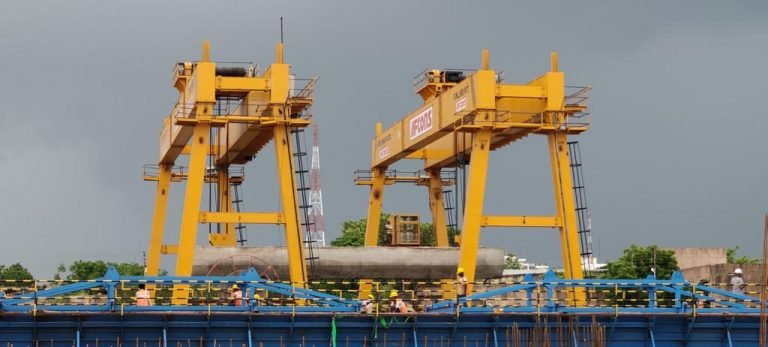
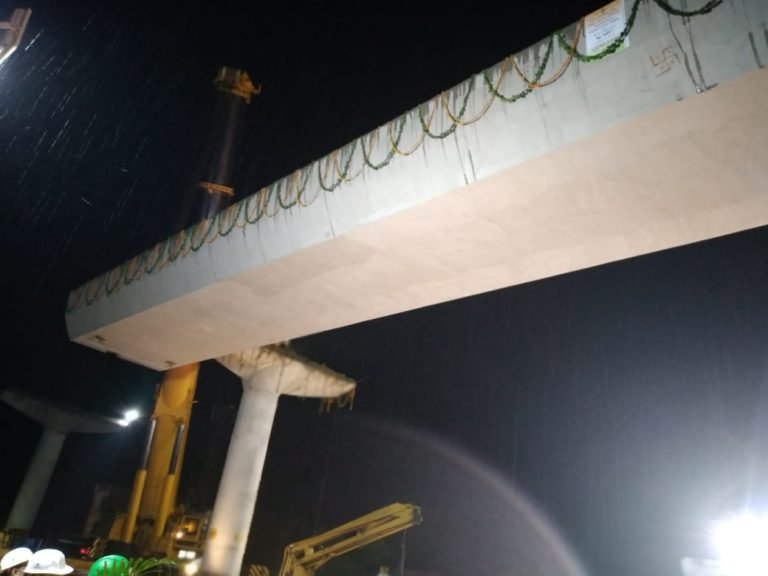
NEW DELHI (Metro Rail News): National Capital Region Transport Corporation (NCRTC) launched the first precast segment on Delhi –Ghaziabad-Meerut RRTS corridor at P382 between Guldhar and Duhai on July 13, 2020. Launching Girder which is also known as launching gantry is assembled on piers (pillars) through various stages on temporary supports (which are later on removed before segment lifting).
The various segments lifted are joined together to make viaduct.

There will be 12 segments in the first span of 34 meters. It will take around 6 days to launch join and complete this span and afterwards launcher will move towards Ghaziabad side., At present the launcher is between Guldhar and Duhai.

The segments of this corridor are being casted at the Vasundhara casting yard. RRTS viaduct will have the design speed capability of 180 kmph. This achievement is very significant for country’s first RRTS network considering the recent outbreak of Covid19 and the lockdown conditions in the country. This has been possible only due to the relaxation provided by the government and all support by different stakeholders.

NCRTC is taking all the safety measures to ensure that the launching work does not affect the public or the moving traffic. The area below is duly gated and barricaded, for the movement of workers to the launching girder manlifts and temporary staircases are being used.

The work for the 17 km long priority section between Sahibabad and Duhai is in progress and soon superstructures will be visible.

Launching of the first girder during the current scenario signifies NCRTC’s efforts to complete the project on time.

Advertisement1
InnoMetro_2026