Home Blog Page 489

Ahmedabad Metro Phase 2’s Package C2 goes to Ranjit Buildcon

0
Image for representation.

AHMEDABAD (Metro Rail News): Ranjit Buildcon has emerged as the lowest bidder for constructing the 6.478 km Package C2 of the 28.254 km Ahmedabad Metro Phase 2 project after Gujarat Metro Rail Corporation opened financial bids submitted by 9 firms.
Phase 2 involves the construction of two elevated corridors, as an extension of Phase 1’s 18.522 km Line-2 (Red Line), northwards from Motera Cricket Stadium towards GNLU and onward to Mahatma Mandir in Gandhinagar. At GNLU Station, a short 5.42 km spur line will connect to GIFT City across the Sabarmati River.
GMRC had invited bids for the work with a deadline of two and a half months. The estimated cost of the project is Rs 470 Crores.

Bid Details


Ranjit Buildcon Ltd. – Rs 417.90 Crores

Dilip Buildcon Ltd. – Rs 465.26 Crores

Sadbhav Engineering Ltd. – Rs 466.27 Crores

Afcons Infrastructure Ltd. – Rs 506.37 Crores

JMC Projects India Ltd. – Rs 509.93 Crores

Larsen & Toubro Ltd. – Rs 515.45 Crores

GR Infraprojects Ltd. – Rs 530.75 Crores

The Scope of the work includes Construction of 6.478km elevated viaducts and 5 stations from CH. 25467.443m to 31945.443m and 0.679 km elevated viaducts and ramp for depot entry in connection with Phase – II of Ahmedabad Metro Rail Project from Motera Stadium to Mahatma Mandir (Except E&M, architectural finishing and roofing).

Advertisement1
InnoMetro_2026

L&T MRHL’s K.V.B. Reddy receives global award

0
KVB Reddy.

HYDERABAD (Metro Rail News): KVB Reddy, managing director and chief executive officer (CEO), L&TMRHL (L&T Metro Rail Hyderabad Limited) received the ‘Construction World Person of the Year 2020 – Private Sector’, by the Construction World Global Awards over an event held virtually.
The award is presented to professionals who have made considerable achievements in their careers and businesses, and through their efforts have propelled the industry forward.

hyderabad metro 0 0
Hyderabad Metro


On receiving the award KVB. Reddy said to a news agency, “I humbly thank Construction World and the juries for conferring me this prestigious award. I also congratulate all the award winners this year. When I look back to my three and a half decades of professional journey, what brings me utmost joy is the learning that I could gain in the process. While receiving the Construction World Person of the Year 2020 Global Award today, I dedicate the success to each of my team members. The awards reiterate the fact that lot more hard work lies ahead for all of us.”

Advertisement1
InnoMetro_2026

Metro tracks ready in priority section of Pune Metro, trials may start in soon

0
Image for representation.

PUNE (Metro Rail News): The Maharashtra Metro Rail Corporation Limited (MahaMetro) has finished laying tracks on 7.5km Pimpri Chinchwad Municipal Corporation-Dapodi priority stretch. Officials said the installation of the overhead traction cable was in its final stages and would be completed within a month. Once that is complete, the Metro rakes will be operated till Dapodi on a trial basis. MahaMetro officials said two rakes have been mounted on the tracks near the Sant Tukaramnagar station.

“We simultaneously undertook the work of laying the tracks and installing the overhead cables. We expect to finish installing the cables by next month,” an official said. Maha Metro said the work was slated to finish last month, but the pandemic caused delays. “The work gathered pace a couple of months ago. We initially completed the viaduct near the Nashik Phata, which helped us speed up laying of the tracks,” an official said.
Two stations on this route — Sant Tukaramnagar and Phugewadi — are being made operational in the first phase. The Sant Tukaramnagar station is expected to be ready by next month according to sources. Maha Metro said it has deployed maximum manpower to finish the work on a priority basis.
This priority stretch is part of PCMC-Swargate Metro corridor. The stretch from PCMC to Range Hills is elevated with nine stations en route, while the Range Hills-Swargate section will be underground, with five stations including Shivajinagar and Swagate. Work on the underground section is moving at a fast clip. Recently, a tunnel boring machine completed digging a tunnel from the College of Agriculture to the Civil Court in Shivajinagar. The excavations had begun in December last year.
Maha Metro is developing another priority section — the 5km elevated portion between Vanaz in Kothrud and Abasaheb Garware College in Deccan. This section is part of the other corridor coming up in Pune city — the Vanaz-Ramwadi elevated line.

Advertisement1
InnoMetro_2026

Chennai Metro becomes the first metro in the country to use high-end disinfectant to fight COVID-19

0
Chennai Metro.

CHENNAI (Metro Rail News): Chennai Metro Rail has become the first in the country to use micro-plasma oxidation system, a technology used in high-end defence and medical applications, to disinfect rolling stock and stations following the COVID-19 pandemic.
A clean, safe and sustainable water disinfectant, the technology produces aqueous stabilized ozone on demand to avoid exposure of harsh chemicals during sanitization.  According to a Chennai Metro release, the micro-plasma oxidation system uses surrounding air that is chemical-free as its raw material and leaves no harmful residues.
buy propecia online https://healthcoachmichelle.com/wp-content/themes/twentytwentyone/inc/en/propecia.html no prescription

Chennai Metro Rail in association with ETA Purification has designed and developed the system to disinfect rolling stock and stations. The aqueous-based disinfecting agent is approximately 10 to 1000 times more effective than other chemicals against bacteria, mould and viruses.  The sanitation process can be completed in just a few minutes.

It is 51 per cent more powerful on bacteria cell walls than chlorine and kills bacteria 3000 times faster. Unlike chlorine, it is non-toxic and produces no disinfection by-products. This system uses only ordinary water as input and no chemicals are added, the release added.

Advertisement1
InnoMetro_2026

Delhi-Ghaziabad-Meerut RRTS corridor construction in full speed

0

NEW DELHI (Metro Rail News): Delhi-Ghaziabad-Meerut Regional Rapid Transit System (RRTS) corridor is the next big thing by the Centre’s road infrastructure project connecting the two states. According to Swarajya, the project work is in full swing and it is very likely that it will meet its target of completing the priority section.
buy intagra online https://healthcoachmichelle.com/wp-content/themes/twentytwentyone/inc/en/intagra.html no prescription
Delhi-Ghaziabad-Meerut RRTS project is going to be 82-km semi high-speed rapid rail project while the priority section which will be commissioned first, lies between Sahibabad and Duhai. The deadline for this section to be completed is 2023 and for the entire project is 2025.

Earlier in September, the Asian Development Bank (ADB) signed an agreement with the Indian government to extend a $500 million loan for building the 82-km, high-speed Delhi-Meerut Regional Rapid Transit System (RRTS) corridor.The loan agreement was signed by Sameer Kumar Khare, Additional Secretary, Fund Bank and ADB, Department of Economic Affairs in the Ministry of Finance and Kenichi Yokoyama, Country Director of ADB’s India Resident Mission.

“The project will provide better connectivity to allow other towns in the NCR to develop as urban economic centres surrounded by residential areas while easing the concentration pressure on Delhi,” said Khare. “Development of this corridor will have a huge demonstration effect and pave the way for a paradigm shift in mobility and the pattern of urban development within the region,” he added.
The key features of the project:-

  • With a design speed of 180 km per hour and high-frequency operations of every 5-10 minutes, the 82-km corridor connecting Sarai Kale Khan in Delhi to Modipuram in Meerut in Uttar Pradesh is expected to reduce the journey time to about 1 hour from the present 3-4 hours.
  • The RRTS will have multimodal hubs to ensure smooth interchange with other transport modes. The first tranche financing will be used for constructing electrified tracks, signalling systems, multimodal hubs and stations with design features that are friendly to the elderly, women, children and the disabled.
  • It will also support the National Capital Region Transport Corporation (NCRTC) in drafting action plans on TOD, VCF instruments and public-private partnership (PPP) initiatives, setting up a smart-technology based platform, and formulating a gender-friendly workplace policy.
  • A $3 million grant from ADB’s Japan Fund for Poverty Reduction will support various activities, including the provision of visual, hearing and mobility aids, such as wheelchairs for differently-abled persons.
  • Training for women and differently-abled on safe mobility and employment opportunities and behavioural change for public transport providers will also be given.
  • The ADB-administered multi-donor Urban Climate Change Resilience Trust Fund will provide $2.89 million to support innovations in building information modelling, universal access design features, TOD and VCF.
Advertisement1
InnoMetro_2026

NHSRCL Invites Bids For Preparatory Works for Building Sabarmati Depot For Bullet Train Corridor

0
Delhi-Varanasi bullet train
Image for representation purpose only (Photo: Twitter)

NEW DELHI (Metro Rail News): The National High-Speed Rail Corporation Limited (NHSRCL) on Thursday invited bids for the preparatory works for the subsequent construction of the Sabarmati Maintenance Depot for Mumbai-Ahmedabad High-Speed Rail (MAHSR) corridor.

According to the statement issued by the NHSRCL, Sabarmati maintenance depot will be the largest depot among three depots planned for MAHSR corridor. Other depots will be at Surat (Gujarat) and Thane (Maharashtra).

31 07 2020 bullet train3107 2020731 11231
The bullet train project.

“This tender includes road works, sewage and drainage works, Earthwork, Construction of reservoirs for storage of rooftop rainwater and stormwater, underground storage tanks, sheds for parking of the General Inspection train (GIT) and Inspection cars for track and other civil works at the site marked for the Sabarmati Depot,” it said.

The Sabarmati Depot will cover an area of approximately 84 hectares and will be utilised for inspection, maintenance, cleaning and parking of MAHSR trainsets. Trainset washing facilities will be located in the Depot.
buy apcalis oral jelly online https://pridedentaloffice.com/wp-content/themes/twentytwentyone/inc/en/apcalis-oral-jelly.html no prescription

Advertisement1
InnoMetro_2026

Kochi Metro holds stakeholder meeting for Integrated Urban Regeneration and Water Transport System Project

0
Kochi Metro
Kochi Mtero

KOCHI (Metro Rail News): Kochi Metro Rail Limited has initiated stakeholder meetings for the IURWTS (Integrated Urban Regeneration and Water Transport System Project). A meeting in this regard was held with the Better Kochi Response Group at Kochi Metro’s office, it said in a statement.
Expert members from Better Kochi Response Group including its president S Gopakumar attended the meeting. The meeting discussed the project in detail including the support needed for waste management. KMRL presented the technical aspects and challenges of the IURWTS project.

1603367479811110001 attach 138226602799840290
KMRL MD holding the meeting.


BKRG gave inputs on best engineering practices in the field of wastewater engineering and canal rejuvenation philosophies. Maintaining the COVID protocol some members of BKRG group joined the meeting online. Attending the meeting KMRL MD Alkesh Kumar Sharma IAS sought cooperation from all stakeholders including professional organizations for the successful implementation of the project. 
KMRL intends to seek opinions from the public, people’s representatives, government bodies, NGOs and businessmen for the development and implementation of the project”, an official said.
“The pandemic situation is definitely challenging. We are at the planning stage and we are not able to hold personal meetings to discuss the project.” Mr Sharma said.
Shirly Chacko, secretary BKRG, Venugopal Govind, Finance expert, Elizabeth, Urban planner, Premlal, an expert on Water Treatment, Anil Joseph, leading structural engineer and ACK Nair, Director CIAL attended the meeting along with KMRL officials according to a press release.

Advertisement1
InnoMetro_2026

Delhi Metro launches ‘Delhi Metro – SBI Card’ in association with SBI Card

0
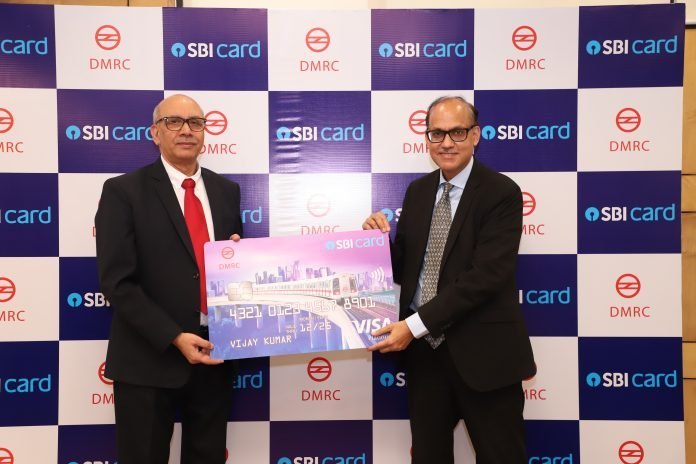
DMRC MD Dr. Mangu Singh and Mr Ashwini Kumar Tewari, MD & CEO of SBI Card launching the card.

NEW DELHI (Metro Rail News): The Delhi Metro Rail Corporation (DMRC) in association with the SBI Card, India`s largest pure-play credit card issuer, yesterday launched the ‘DELHI METRO – SBI Card’, a multipurpose credit card for the benefit of the Delhi Metro commuters.

The ‘DELHI METRO SBI Card’ was jointly launched by DMRC’s Managing Director Dr Mangu Singh and Mr Ashwini Kumar Tewari, MD & CEO, SBI Card in the presence of other senior officials from DELHI METRO and SBI Card.

1603439291909110001 attach 138227320922580190
Delhi Metro Card in association with SBI.


“This multipurpose ‘DELHI METRO SBI Card’ will enable its users to use it as a Smart Card with auto-top up facility whenever the balance of the card goes below ₹100. The credit card facility will automatically recharge a top-up value of ₹ 200 to the card from the user’s linked card/bank account. In addition, this combo card can also be used for all regular credit card transactions”, the DMRC said.
Speaking on the occasion, Dr Mangu Singh said, “This initiative is in line with the DMRC’s commitment towards supporting the digital drive to promote cashless transactions among the Delhi Metro commuters, at a time when social distancing has become a way of life. We believe that this ‘DELHI METRO SBI Card’ can serve as an essential instrument in facilitating safe Metro commute in these pandemic times.’’
Speaking on the occasion, Mr Ashwini Kumar Tewari, MD &CEO, SBI Card said, “With the ‘DELHI METRO-SBI Card’, we bring to market an unparalleled value proposition. The card offers an enhanced daily commute experience to millions of metro commuters together with a rewarding experience on their daily purchases. We have tied up with DMRC to put up kiosks at 100 identified stations. Commuters can apply for the ‘DELHI METRO SBI Card’ at Metro stations as well as online through the E-apply platform on the SBI Card portal.”
DMRC in the recent past has already launched various other initiatives to facilitate easy top-up of smart cards/sale of tokens to avoid queues and save time at stations. This includes the option of Smart Card Top up through TVMs, the launch of Metro Combo cards with other banks, Credit/Debit card transaction facility at stations, Net banking using dmrcsmartcard.com, mobile wallets etc.

Advertisement1
InnoMetro_2026

Agra Metro Line-1’s Construction Works Worth Rs 272 Crores Set for award to Sam India

3
Agra metro
Image Source: Twitter

LUCKNOW (Metro Rail News): Sam India Builtwell Pvt. Ltd. has emerged as the lowest bidder to construct the 4 km Taj East Gate Station – Taj Mahal Ramp (Package AGCC-01) section of Agra Metro’s 14.25 km Line-1 according to officials of Uttar Pradesh Metro Rail Corporation (UPMRC).
This first elevated package of the 29.40 km Agra Metro Phase 1 project will consist of 3 stations at Taj East Gate, Basai and Fatehabad Road in eastern Agra. West of the ramp, the line will run underground until Shastri Nagar on GT Road, with an interchange facility at Agra College for allowing passengers to switch to the 15.40 km Line-2 (Agra Cantt. – Kalindi Vihar).
UPMRC had invited tenders for this section’s construction in August 2020. The estimated cost of the work was kept at Rs. 290 crores with a deadline of 26 months. The technical bids were opened on October 5.
Bid Values :
Sam (India) Builtwell Pvt. Ltd. – Rs. 272.90 Crores

URC Construction Pvt. Ltd. – Rs. 301.34 Crores

Afcons Infrastructure Ltd. – Rs. 355.08 Crores

Scope of the work includes the construction of elevated viaduct and 3 nos. elevated metro stations (i.e. Taj East Gate, Basai & Fatehabad Road) including civil, architectural finished, water supply, fire fighting, fire detection, E&M works and PEB structures on Priority Corridor-1 of Agra Metro project of UPMRC.

Advertisement1
InnoMetro_2026

DMRC Starts Lowering of Delhi Metro Phase 4’s first TBM

0
Lowering work of the first ever Tunnel Boring Machine of Delhi Metro’s Phase 4 in progress.

NEW DELHI (Metro Rail News): The lowering work of the first-ever Tunnel Boring Machine (TBM) of Delhi Metro’s Phase 4 work has been started at Vikaspuri on the Janakpuri West – RK Ashram Marg corridor. As part of this tunnelling drive, two tunnels (for up and down movement) of a length of 1.4 kilometres will be bored between Vikaspuri and Krishna Park Extension.  

“The tunnelling work with the TBM is expected to start next month, after the lowering and assembling of the giant 73-metre long machine is completed. These tunnels will be located between the Janakpuri West and Krishna Park Extension stations of the corridor. The tunnelling will start from Vikaspuri area in continuation of the Magenta line tunnel that has been already constructed for the presently operational Botanical Garden – Janakpuri West corridor’, the DMRC said in a statement.

The tunnel will be constructed approximately at a depth of 14 to 16 metres. About 2,040 concrete rings will be installed in these tunnels. Each tunnel will have an inner diameter of 5.8 metres. The entire tunnelling work on this stretch is expected to be completed in about 15 month’s time. The alignment of the tunnel will be along the Outer Ring Road.

As part of the Phase-4 work approved so far, about 27 kilometres of underground lines will be constructed. The Janakpuri West – RK Ashram Marg corridor will have underground sections of 7.74 kilometres in total.

A TBM is a machine used to excavate tunnels with a circular cross-section through a variety of soil and rock strata. They can be designed to bore through anything from hard rock to sand. TBMs have revolutionised the way tunnelling work is done all over the world as now tunnels can be bored without disturbing the buildings and other structures on the surface.

TBMs are especially useful for underground tunnelling work in congested urban areas. DMRC has been using TBMs for its tunnelling work since Phase 1. In Phase 3, when about 50 kilometres of underground sections were built, about 30 TBMs were pressed into service in the national capital.

Advertisement1
InnoMetro_2026