Home Blog Page 326

5 firms bid for Chennai Metro Line-4’s contract

0
Chennai Metro/ Representational image

CHENNAI (Metro Rail News): 5 Bidders for Chennai Metro Line-4’s E&M Contract5 firms have submitted bids for electrical & mechanical works at Chennai Metro’s 26.09 km Line-4 which will connect Light House – Poonamallee Bypass through 30 stations after Chennai Metro Rail Ltd (CMRL) opened technical bids last week.

The 5 bidders who have come forward are Blue Star Ltd., Bridge and Roof Co India Ltd., Jakson Ltd., VK building Services Pvt. Ltd. and Voltas Ltd.

The scope of this contract includes Supply, installation, testing, commissioning and training of Electrical, Fire protection and VAC works for 18 Elevated stations from Power House Station to Poonamallee Bypass station including Viaduct between the stations (Ch 10027.102 to Ch 25928.186), approach ramp, including Poonamallee Depot for Corridor 4 of Chennai Metro Rail Project Phase-II

This contract is being financed by AIIB and ADB and CMRL had invited the tenders for this contract in January 2022 with a 4.6-year deadline whereas the estimate was not disclosed for tender CMRL/PHASE-2/SYS/C4-EM-05/2022.

Advertisement1
InnoMetro_2026

3 firms bid for Chennai Metro Line 3’s Package CP18A-ATW-09

0
Chennai Metro
Representational image only.

CHENNAI (Metro Rail News): Three bidders have come forward for the Chennai Metro’s Line-3’s Package CP18A-ATW-09 which is the supply and installation of standard gauge tracks work. Chennai Metro Rail Ltd (CMRL) had opened technical bids for this package on Tuesday, 21st June.

This new corridor under the CMRL’s phase-2 is a 45.813 km stretch which will primarily be underground and it will connect Madhavaram – SIPCOT passing through 49 stations.

The 3 bidders who have come forward are Larsen & Toubro Ltd. (L&T), Rail Vikas Nigam Ltd. (RVNL) and Texmaco Rail and Engineering Ltd.

The scope of this tender includes Supply, Installation, Testing and Commissioning of Ballastless track of Standard Gauge Including All Associated Works in Underground and Elevated Section from Madhavaram Milk Colony to Sholinganallur of Corridor 3’.

This contract is being financed by JICA and CMRL had invited tenders for this contract in January 2022 with a Rs. 267 crore estimate and 1290 day deadline and also a 730 day (DLP).

Advertisement1
InnoMetro_2026

Third Sudarshan TBM starts tunnel construction from Anand Vihar towards Sahibabad on RRTS corridor

0
TBM Sudarshan on RRTS Corridor

DELHI (Metro Rail News): A Sudarshan (Tunnel Boring Machine) has started tunnelling work in the direction of Sahibabad from Anand Vihar station on the Delhi-Ghaziabad-Meerut RRTS corridor. Two Sudarshan (TBM) are already working on tunnel construction from Anand Vihar RRTS station towards New Ashok Nagar RRTS station. This is the third Sudarshan (TBM), which has started the construction of a tunnel from Anand Vihar towards Sahibabad.

The total length of this RRTS corridor is 82 km, out of which 14 km is in Delhi and 68 km is in Uttar Pradesh. This corridor has four stations in Delhi, Jangpura, Sarai Kale Khan, New Ashok Nagar and Anand Vihar, of which only Anand Vihar station is underground. From this station, New Ashok Nagar towards Delhi and Sahibabad towards Ghaziabad are being built as elevated RRTS stations.

Two Sudarshan (TBMs) are already working to construct two parallel tunnels of three km length from Anand Vihar RRTS Station towards New Ashok Nagar. About a 2 km long tunnel will be built from Anand Vihar towards Sahibabad, which will end in front of Vaishali metro station. The launching shaft for the third Sudarshan (TBM) has been made at the north of Anand Vihar RRTS Station, from where the construction of the tunnel has commenced.

8 2 1

At the same time, at the end of the tunnel, a retrieving shaft is being built in front of Vaishali Metro Station, from where Sudarshan (TBM) will be retrieved. There will also be two parallel tunnels from Anand Vihar towards Sahibabad for the arrival and departure of trains.

The 17-km priority section between Sahibabad to Duhai will be commissioned by March 2023 and the trial run is expected to commence this year. At present, the civil construction work of the priority section has reached the final stage.

Tunnel rings are made underground by TBM with the help of tunnel segments. Seven (7) tunnel segments are generally used to form a tunnel ring. The Tunnel Segments are being manufactured at NCRTC‘s Casting Yard with assured quality control. Due to the large rolling stock and a high design speed of 180 mph, the width of RRTS tunnels is being constructed as 6.5 m. diameter. Compared to the metro systems, this is for the first time that a tunnel of such a large size is being constructed in the country.

There is a provision for two parallel tunnels for the movement of trains in the underground sections of RRTS. Along with this, various security measures have also been made to ensure the safety of the passengers. Emergency exits will be made in the underground sections for the safety of the passengers in case of any emergency. A cross-passage would be provided at approximately every 250 metres. The RRTS tunnel will also have ventilation ducts to ensure air movement and a 60 cm-90 cm wide side walkway which will assist in maintenance activities and also act as an additional emergency exit.

For the construction of the tunnels, about 90 meters long Sudarshan (TBM) is being used. This TBM consists of Cutter Head, Front Shield, Middle Shield, Tail Shield, Erector, Screw Conveyor and many other important parts.

Some of the important reasons behind the implementation of this project are to decongest the national capital, reduce vehicular traffic and air pollution, and ensure balanced regional development. NCRTC is using state-of-the-art technologies to ensure safe and timely completion of works while minimizing inconvenience to the commuters, business owners and residents of the entire segment. One of the techniques being widely used for the project is pre-casting of various civil structures and minimizing the construction work on site.

Advertisement1
InnoMetro_2026

Work on Indore Metro stations going on smoothly

0
Indore Metro
Image for representational purpose only

INDORE (Metro Rail News): The foundation work of piers at the ISBT Metro station in Indore has started and according to the officials construction of metro stations on the route will be complete soon.

The metro construction in Indore is going on an accelerated pace on the route from MR 10 to Robot Square for which 100 piers and more than 10 girders have already been set up. The construction is also going on through two segment launchers, one near the Chandragupta Maurya Square and the other near Radisson Square.

The metro has also set up segments on pebble sand near the MR 10 so that they could be easily picked and put in another place. Whereas the construction work of metro depot is comparatively going on slowly.

All the track slabs from MR 10 to Radisson are expected to be put in place and ready for installation of tracks and electrification work within a few months, the officials said. The officials have also informed that the construction will not be disrupted by the monsoons.

Advertisement1
InnoMetro_2026

BMRCL to launch FOBs at three metro stations

2
Foot over bridge
Representational Image/ Image copyrights: construction catalysers

BANGALORE (Metro Rail News): Bangalore Metro Rail Corporation (BMRCL) is soon going to construct foot overbridges (FOB) at three different Metro stations that are Yeshwanthpur Metro station and Nagasandra which are on the Green line, and Jnanabharathi station on the Purple line.

According to an official, the FOB at Yeshwanthpur will be made functional by the end of January 2023 which will connect Platform 6 at the South Western Railway line at Yeshwanthpur. Its length will be 87.7m.

The construction work at Jnanabharathi station is also under progress and the FOB is expected to be functional by the end of February 2023. It will connect the metro station to the Jnanabharathi railway station.

Recently an IKEA store was opened in Bengaluru which is also constructing a FOB from its store to the station located on Tumakutu Road. It is expected to get ready by December 2022. The Nagasandra Metro station has a functional overbridge across NH-48, to facilitate people to cross the jam-packed NH-48.

BMRCL had signed a contract of Rs. 12.45 crore in February 2022 to construct FOBs across 6 stations that are Yeshwanthpur, Dasarahalli, Nagasandra, Mailasandra, Jnanabharathi, and Chikkabidarakallu.
buy viagra oral jelly online no prescription
The construction at other locations is likely to start soon.

Advertisement1
InnoMetro_2026

DMRC begins trial runs between Dwarka Sector 21-IICC section at Airport Express line

0
Airport Express
Airport Express

NEW DELHI (Metro Rail News): The Delhi Metro Rail Corporation (DMRC) has begun trial runs on the two-kilometre long Dwarka Sector-21 to Dwarka Sector-25 (IICC) Metro section on the Airport Express Line.

Dwarka Sector 25 (IICC) is an underground station and an extension of the presently operational Airport Express Line connecting the New Delhi Railway station with Dwarka Sector 21 via terminal 3 of the Indira Gandhi International Airport. With the completion of this section, the New Delhi to Dwarka Sector-25 (IICC) Airport Express Line corridor will become 24.70 kilometres long.

During the trial runs, the signalling systems are tested. The completion of the trial runs will be followed by the mandatory inspections by various approving authorities including the Commissioner of Metro Rail Safety (CMRS). The section will be opened for passenger traffic after these mandatory approvals.

https://twitter.com/OfficialDMRC/status/1540946373465747456

The India International Convention Centre (IICC) is being developed as India’s largest exhibition and convention centre. This facility, currently under construction, will be equipped with state-of-the-art facilities such as convention centres, auditoriums, hotels, office spaces etc. The Metro station at IICC shall cater to this new centre.

The station is coming up at a depth of about 17 metres from the surface. The station will have five entry/ exit points which will be facilitated by 14 escalators, five lifts along with staircases for smooth passenger movement. Like the other stations of the Airport Express Line, the new station will also have full-height platform screen doors.

Apart from catering to the upcoming convention centre in the vicinity, this new station will also provide Metro connectivity to the residents of sectors 25 and 26 of Dwarka, along with the new sectors along the Dwarka Expressway in neighbouring Gurugram. Residents of these areas will be able to reach central Delhi in about half an hour.

Advertisement1
InnoMetro_2026

Transport Minister demands investigation report from DMRC on recurring breakdowns

0
Delhi Metro
Representative Image

NEW DELHI (Metro Rail News): Transport Minister Kailash Gahlot has asked DMRC to submit an investigation report in seven days on the recurring breakdown of metros. This decision has come a day after there was a delay in services between Samaypur Badli and Vishwavidyalaya on the Yellow Line of the Delhi Metro.

“There have been recurring incidences of breakdowns on various lines of Delhi Metro this month causing inconvenience to passengers. Have directed @OfficialDMRC to submit investigation report in next 7 days on the breakdowns and remedial action taken to ensure seamless operations,” Gahlot tweeted.

Previously the services have been delayed on the Blue Line on several occasions in June. Blue Line connects Dwarka Sector-21 in Delhi with Electronic City in Noida. Services were briefly delayed on the Blue Line on Sunday due to a fault in a train at the Mandi House Metro Station, officials had said.

The Blue Line had suffered a major technical snag on June 9, when commuters were stranded for over two hours. On June 6, commuters on the same line suffered an hour-and-a-half-long delay as services came down with a technical snag caused by a bird hit.

Advertisement1
InnoMetro_2026

NCRTC installs modern signalling system for RRTS, trial runs to commence soon

0
Modern Signalling system for RRTS
Modern signalling system for RRTS

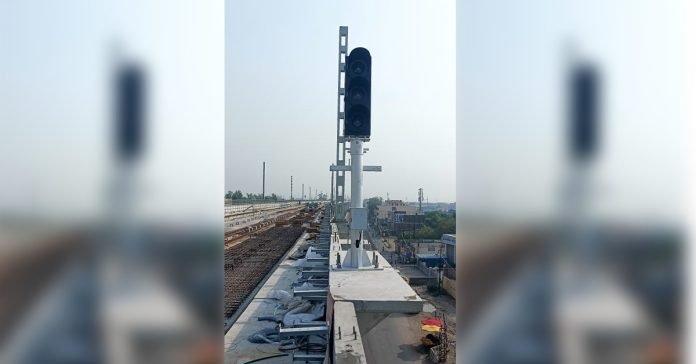
Ghaziabad (Metro Rail News): The installation of signalling equipment for operations of RRTS trains has picked up pace in the Priority Section of India’s 1st RRTS corridor (Delhi-Ghaziabad-Meerut).

The National Capital Region Transport Corporation Ltd. (NCRTC) is implementing hybrid Level 3 technology of the European Train Control System, one of the most advanced signalling & train control systems in the world.

This will be for 1st time in the world that a combination of latest ETCS Standard, latest Interlocking & Automatic Train Operation (ATO) over Long-Term Evolution (LTE) radio will be deployed. It will enable higher frequency of trains, better headways & thus increasing throughput.

The 17 km Priority Section, between Sahibabad to Duhai, is targeted to be commissioned by 2023 and the full corridor by 2025. The civil work on the Priority Section, having a total of 5 stations, is nearing completion.

Advertisement1
InnoMetro_2026

CRML holds meeting on feasibility of MRTS in Trichy

0
CMRL meeting
CMRL meeting

CHENNAI (Metro Rail News): Chennai Metro Rail Limited (CMRL) on Thursday held a meeting with officials to assess the feasibility of introducing a Mass Rapid Transit System Project in Tiruchirapalli.

The meeting was chaired by M.A. Siddique, Managing Director and Principal Secretary, Chennai Metro Rail Corporation Limited, in the presence of District Collector M. Pradeep Kumar and Corporation Commissioner R. Vaithinathan.

In the meeting, CMRL, MD M.A. Siddique said, “At present, the Chennai Metro Rail is providing rapid transport services to the people. Similarly, in Tiruchirapalli, a feasibility study will be carried out for high-speed transport in order to facilitate and speed up the movement of people. This is the first suggestion for that. Through this feasibility study, a suitable fast transport system for Tiruchirapalli and routes suitable for high-speed transport will be identified. Further, further steps will be taken to implement the Mass Rapid Transit System if there is any possibility of this.

WhatsApp Image 2022 06 24 at 11.57.54 AM

The “Comprehensive Mobility Plan” is being prepared by The Tamil Nadu Urban Infrastructure Finance Services Limited (TNUIFSS) to carry out a feasibility study for the Tiruchirappalli Mass Rapid Transit System. This report will be available soon. Only after a Detailed Feasibility Report is prepared based on the integrated mobility plan can a suitable fast transport system be selected for Tiruchirappalli city. M.A. Siddique, Managing Director and Principal Secretary, Chennai Metro Rail Corporation, said.

Chennai Metro Rail Corporation officials R.
buy valif online https://blackmenheal.org/wp-content/themes/twentytwentytwo/inc/patterns/en/valif.html no prescription
M. Krishnan, T. Livingston, Divisional Engineer (N.K.M.P.) of Highways Department, M.Kesavan, Divisional Engineer (N.K.M.P.) of Highways Department, Corporation Executive Engineers Sivapatham and Kumaresan, Tamil Nadu Water Supply and Drainage Board Superintending Engineer A.Muthiah, etc. were present in the meeting.

Advertisement1
InnoMetro_2026

Exclusive Interview with Mr. U.J.M. Rao, MD, Andhra Pradesh Metro

0
Mr. U.J.M. Rao, MD, AP Metro

Metro Rail News recently had a virtual interaction with U.J.M. Rao, IRAS, Managing Director Andhra Pradesh Metro Rail Corporation Ltd. In the interview Mr. Rao talked about the metro projects that are being carried out in Visakhapatnam and Vijayawada as well as talked about the importance of the Light Metro System.

UJM Rao is presently working as the Managing Director of Andhra Pradesh Metro Rail Corporation Limited (APMRC) a State-owned SPV of – Andhra Pradesh since January 2016, almost since its inception of the Corporation. Initially, he joined APMRC as the General Manager (Coordination & Finance) and got elevated to the position of Managing Director. Rao is a 1988 batch IRAS Officer belonging to Indian Railways and prior to his current assignment, he worked in various higher managerial positions in the Railways. His long and rich experience in Railways in various streams like Logistics, Railway Operations, Major Construction Projects including Railway Electrification etc. at decision-making levels has given him enough confidence in handling the Metro Rail Projects under implementation by APMRC. 

Here are the edited excerpts: –

In what ways the Light Metro project for Visakhapatnam would be different from other Metro projects of the country?

In Visakhapatnam, being a tier-2 City with moderate ridership, we considered that a cost saving Light Metro Rail System would be sufficient to meet the traffic needs in the next 40-50 years. With the smaller and smarter version of Metro Rail System which can meet up to 25000 PHPDT and carry 14 lakh people daily with increase in the number of metro cars from 2,3,4,5 and so on. The cost of construction is presently assessed to be INR 185 Cr/Km while other Metro Systems in India costs INR 250 Cr/Km for the elevated system. The Light Metro System would save sizable O&M expenses too.

In fact, this system is not new to the World. The At-Grade LRT in Europe and other Countries has been by and large adopted with the latest technology here in Visakhapatnam on an Elevated track. In my opinion, all the tier -2 Cities in India can adopt this Light Metro System, which provides the same facilities and comforts for the people that are available on Medium Metro System at a reduced Capex and Opex.     

As per new DPR what is the present status of the Vizag Metro Project?

The new DPR for 76.90 km with an estimated project completion cost of Rs.14,309 Cr has been submitted by the Consultants and is in the process of Government approvals. The financial model for implementation of this project is on VGF-PPP Model.

What new modifications and feasibility improvements have been quoted by Urban Mass Transit Company Limited (UMTC) in the new/revised DPR prepared for Vizag metro which earlier was prepared by DMRC 5-6 years back?

In 2015, DMRC prepared a DPR for 42.55 Km length of Metro Rail Alignment for Visakhapatnam covering the crowded parts of the core city only. Later, it was decided to expand the Metro Rail System upto the new International Airport at Bhogapuram and thus the total length became 76.90 km for which the UMTC Consultants have prepared the new DPR in 2021 considering the cost escalation in the last 6 years, changed financial model and improved designs specifications and the drawings suitable to Light Metro Rail System.

The previous DPR was the Metro Rail System similar to that established in Delhi and other places whereas the new DPR now prepared for Visakhapatnam is for the Light Metro System.

The Visakhapatnam Metro after completion is expected to become the world’s largest metro system developed on a PPP model which will have a combination of both Metro and Tram. What is the official statement of APMRC in this regard? Is the government ready to achieve the milestone?

As you said the 76.90 km Light Metro Rail Project will perhaps be the largest Metro Rail System in the World on PPP Model. The Visakhapatnam Light Metro Rail System is the first of its kind in the Country.

The said Light Metro Rail System in the main steam and the 61.10 km Catenary Free Modern Tram System are entirely two different MRTS Systems.

Visakhapatnam City is gifted with a 42 km long sea coast. Leaving 10 km towards the Southern side of the City where the two major sea ports viz. Visakhapatnam Port and Gangavaram Port and other Industrial belt are situated, in the remaining 32 km from Old Post Office to Bheemili beach, the Modern Tram System has been proposed on the beach front as a tourist attraction and also providing transportation to the colonies en-route. Two more Corridors in the busy city outskirts of a length of 18.10 and 11 km respectively have also been planned. The entire tram system is At-Grade with segregated ROW. This project is at DPR stage.

What is the status of the Vijayawada Light Metro Project? Is there any development for the project after DMRC cancelled the procurement in the first phase?

Similar to the Visakhapatnam Project, for Vijayawada also a revised DPR for 38KM length of Light Metro Rail System, in place of 26 KM earlier recommended by DMRC, has been prepared by M/S SYSTRA Consortium. The project will be taken up soon after implementation of the priority Visakhapatnam Metro Rail Project.

Is Light Rapid Transit / Light Metro or a Medium Capacity System (MCS) the future of a modern urban transport system to be developed in the country?

The unique advantage of the Light Metro System is that it can be upgraded to a higher version metro if there is a demand and need for such a big system.

Except in the Metropolitan and Tier-1 cities, the PHPDT would not be more than 25,000 per hour in Tier-2 cities for about 40-45 years, the cost saving Light Metro Rail System is the most suitable one because the system gives the same comforts to the public while the CAPEX and OPEX lesser by more than 20%.

When a City like Visakhapatnam with 41 lakhs of Population together with the Urban agglomeration can be managed with the Light Metro System for the next 40-45 years similar cities which will have the same traffic pattern can also adopt this system. As the Civil Infrastructure, p way and the 3rd Rail technology established is suitable to the conventional higher version of Metro’s, the up-gradation can take place after 35 years, if the traffic demands because the fleet of Light Metro have to be changed after a period of 35 years.       

Depending on the vast diversities and specificity this country possesses for each region, do you advocate a replacement of the traditional MRTS based transport system with a Light Metro, Metrolite or Metro Neo transport system across all future metro projects in the country?

The popular MRTS systems in public transport are the Conventional Metro, Light Metro (LRT on elevated/UG/At-grade), MetroLite and Metro Neo.  Each system has its own advantages and hence the cities are adopting them as suitable to their future needs. 

However, it is my strong opinion that in Tier-2 cities the Light Metro System is the most appropriate system for the next 40-45 years considering the population growth and other factors in the city development and is upgradable to a higher Metro System to run beyond that period. Up-gradation is possible even after 35 years.  The MetroLite and Metro Neo are no doubt are cheaper in comparison to other two systems but they have certain limitations like passenger carrying capacity (PHPDT), Speed, comforts, etc.,  

Kindly share your views about Metro Rail News. Is there any message you would like to give to our readers?

Frankly speaking, I came to know more about Metro Rail News magazine and the activities of SYMBROJ media a couple of months back, even though the media is in existence for the last 6 years.  When I have gone through the latest issues of the Metro Rail News, I find they have covered in the monthly, the latest activities & progress of all Metros in the Country and also it contains valuable information about RRTS and India Railways. Besides it has a strong editorial advisory board composed of veterans in the fields of Railways, Metro Railways, Urban Transportation and the Industry. Really this is a treasure for the magazine to receive highly technical developments happening around the world.

Mr. Narendra Shah, Managing Director and his editorial team are doing an excellent job in bringing out the Monthly Journal with varied subjects that are useful for the Management, Industries and Executing Agencies.

I Sincerely wish them all the best.    

Advertisement1
InnoMetro_2026