New Delhi: Prime Minister Narendra Modi has flagged-off the Delhi-Faridabad Metro Line that would allow hassle free travel for around two lakh daily commuters between the national capital and the industrial hub in Haryana.
The extension of the Delhi Metro connects Badarpur to Escorts Mujesar in Faridabad.
The total cost of the project from Badarpur to Escorts Mujesar is nearly Rs. 2,500 crore. Out of this, Rs. 1,557 crore was borne by the Haryana Government, the Centre contributed Rs. 537 crore, while the Delhi Metro provided Rs. 400 crore.
All these are elevated and located on either side of the Delhi-Mathura Road (NH-2).
“The nine-station metro corridor which was 95 per cent indigenously built will provide people a safe, affordable, quick, comfortable, reliable, environment-friendly and sustainable transport facility,” a Haryana government spokesperson said.
Haryana Chief Minister ML Khattar, addressing a press conference on Saturday, had thanked the Prime Minister for “gifting” the Metro service which would take the city to “another level of progress” with better connectivity with other NCR towns.
He had also said that the Prime Minister would be announcing the go-ahead for connecting Gurgaon with Faridabad by Metro.
MEERUT (Metro Rail News): Uttar Pradesh Government allocates Rs. 1306 crore for Delhi-Ghaziabad-Meerut RRTS Corridor in the state budget 2023, presented today. Earlier this month, the Government of India allocated Rs 3596 crores to the RRTS project in the Union Budget 2023.
The 17 km long Priority Section of the Delhi-Ghaziabad- Meerut corridor is going to be operationalized this year and NCRTC aims to open the entire corridor by 2025.
At present, NCRTC is carrying out train testing in the Priority Section to test various components of the RRTS. The 17 km long priority section of the corridor has five stations, Sahibabad, Ghaziabad, Guldhar, Duhai and Duhai Depot. The construction of these stations is in the advanced stages and soon they will be ready for operations.
NASIK (Metro Rail News): In order to facilitate the proposed Pune-Nasik semi-high-speed railway project, the Ahmednagar district administration has employed the direct purchase scheme to acquire approximately 19 hectares of land from local farmers.
The proposed Pune-Nashik Semi High-Speed Rail corridor project spans a distance of 234.60 kilometres and aims to connect Pune and Nashik in Maharashtra via 24 stations. The estimated cost of the project is Rs. 16,039 crore, with a target completion date of 2027. Upon completion, passenger trains on the greenfield line will travel at a top speed of 200 kmph, with a travel time of two hours between Pune and Nashik. The project will pass through the districts of Pune, Ahmednagar, and Nashik.
Ashok Garud, chief advisor of Maharail (a joint venture of the Ministry of Railways and Maharastra Government), revealed that 293 hectares of land is necessary for the 69-kilometre railway track, with 19 hectares already acquired for Rs 30 crore. Garud mentioned that an additional 242 hectares of land need to be obtained, and the valuation for eight villages has been concluded.
Shashikant Mangrule, the Sub-Divisional Officer for Sangamner Tehsil, confirmed that the proposed project requires 46 hectares of land from the forest department and five hectares of land from the government.
KOCHI ( Metro Rail News ): After Kochi Metro Rail Ltd (KMRL) opened the technical bids, eight companies have submitted their proposals for the General Consultant (GC) contract of Kochi Metro Phase 2.
This pre-construction contract is significant for Phase 2, which includes the
construction of a new 11.2 km elevated corridor, named the Pink Line,
consisting of 11 stations that will connect JLN Stadium, Kakkanad, and Infopark
(Smart City).
KMRL had issued tenders for the GC contract in November 2022, and the selected consultant is expected to work for 1095 days (3 years). Earlier, in 2021, KMRL had attempted to appoint a Project Management Consultant (PMC) but had to cancel the bidding process due to administrative reasons.
Bengaluru (Metro Rail News): According to recent announcements by the Karnataka government, the city’s Metro Rail network is set to expand by 40.15 kilometres in the current financial year. The BJP government led by Basavaraj Bommai has announced a sum of Rs 2500 crore in the latest state budget towards the ongoing projects of Namma Metro for the fiscal year 2023-2024. As per the chief minister’s statement to the Assembly, the Bangalore Metro Rail Corporation (BMRC) is set to launch over 40 km of the new Metro route during this period.
Currently, the Bengaluru Metro Rail Scheme is operational in a network spanning 56 kilometres. Work on the Metro rail scheme that will connect Central Silk Board Junction to Kempegowda International Airport, spanning 58.19 kilometres and featuring 30 stations, is progressing rapidly. As per the budget document, plans are underway to launch a new Metro route covering a length of 40.15 kilometres in the current year. BMRCL has stated that the Baiyappanahalli to Whitefield line, Kengeri to Challaghatta, RV Road to Bommasandra, and Nagasandra to BIEC sections are scheduled to be inaugurated this year.
The KR Puram to Whitefield line is in the final stages of trial runs and is anticipated to be open to the public by the end of March. Additionally, the Purple Line extension from Kengeri to Challaghatta, which has been pending for a long time, is expected to be operational by mid-2023.
Another significant stretch of the Bangalore Metro Rail Scheme’s phase II is the line running from RV Road station to Bommasandra via Jayadeva, Central Silk Board, and Electronics City. Moreover, the Metro route to BIEC is on the verge of completion.
As per the previous budget, the third phase of the Metro network project has been proposed, with a Detailed Project Report submitted to the Central Government for two corridors spanning a total length of 44.65 km and featuring 31 stations. The expected cost for this project is Rs.16,328 crore. The budget document indicates that work on the project will commence once it receives approval from the Government of India.
New Delhi (Metro Rail News): The Mumbai-Ahmedabad high-speed rail corridor, which is India’s first bullet train project, is moving forward rapidly. As of the end of January 2023, the work execution has reached 25% completion, which is slightly behind the 30% target. The total cost incurred for the project so far is Rs 36,722.60 crore, as per the reports. The government has established a goal of commencing trial runs on the Surat-Billimora section in Gujarat by August 2026, with the aim of having the entire stretch between Ahmedabad and Mumbai fully operational by 2027.
According to sources, the construction companies involved in the project, along with the National High-Speed Rail Corporation Ltd (NHSRCL), are working to shorten the project timeline.
The railway minister, Ashwini Vaishnaw, is keeping a close eye on the project and monitoring its progress closely, according to officials. The Japanese side is also regularly checking in on the project’s development. In fact, a high-level delegation led by the special advisor to the Japanese Prime Minister recently visited the sites to assess the progress made so far.
BIHAR (Metro Rail News):Indian Railways has received the 500th Evolution Series locomotive from Wabtec Corporation, which is a significant achievement in the $2.5 billion deal made in 2015. The agreement was established under the ‘Make in India’ initiative by the Government of India, as a Public Private Partnership, to design and distribute 1,000 diesel-electric Evolution Series locomotives that are fuel-efficient and comply with emission standards.
According to Dr. Sujatha Narayan, who is the Senior Vice President and India Region Leader of Wabtec Corporation, this accomplishment marks a significant milestone in Wabtec’s growth as a major supplier in India’s rail industry. It also emphasizes the company’s commitment to the ‘Make in India’ initiative. She further adds that this achievement is a testament to the hard work and commitment of Wabtec’s team in India, as well as the support from the community, government, suppliers, and other Wabtec sites worldwide. All of these efforts have placed the company and its customers in an advantageous position for continued success in the region for years to come.
The Wabtec India Team posing with Indian Railways and Saran District Administration at the factory in Marhowra, Birhar/photo by Aman Gupta
This 500th locomotive is a dual-cab design and a powerful 4,500-horsepower engine. So far, Wabtec has delivered 438 of these locomotives and 62 single-cab locomotives with a remarkable 6,000-horsepower engine to Indian Railways. These locomotives have cutting-edge digital capabilities and use advanced technology to ensure compliance with UIC1 international emission standards and deliver optimal fuel efficiency. The locomotives’ cabs have been thoughtfully designed to provide ergonomic comfort to the pilots with features such as air conditioning, seats, noise reduction, urinals, digital displays and heated windscreens,
Wabtec’s manufacturing plant is located in Marhowra, Bihar. This state-of-the-art plant commenced operations in 2018 and utilizes cutting-edge global lean manufacturing processes to produce locomotives. With a capacity to deliver 120 locomotives per year, this plant has set a new industry standard. Moreover, the plant takes pride in having a diverse and skilled workforce from Bihar and Jharkhand, setting a positive example for the region.
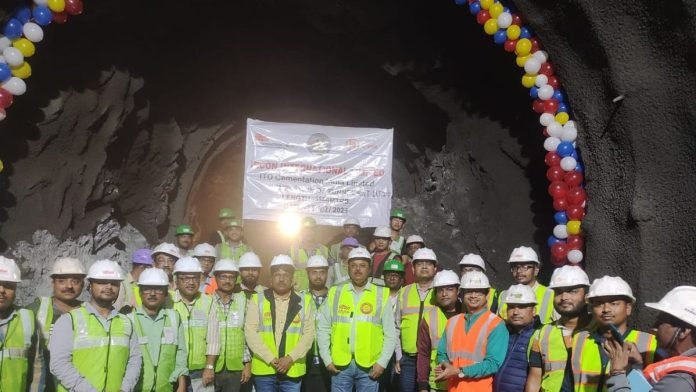
Escape Tunnel No. 1 (1144 m) of Main Tunnel T-10 (5300m) gets completed/Image from Ministry of Railways
GANGTOK ( Metro Rail News): On 19th February, another breakthrough was achieved on the longest excavation tunnel of the main T-10 tunnel of the Sivok-Rangpo Rail line Project.
T-10 is the main tunnel with a length of 5300 m, and the evacuation tunnel has a length of 1144m. This tunnel is the longest tunnel in the Sivok-Rangpo Rail project, which is situated between Bhalukhola and Tarkhola in Kalimpong district. The evacuation tunnel joins the central tunnel with the NH-10. In addition, this tunnel passes through challenging and of the lesser Himalayas.
According to the sources, in June 2021, tunnel excavation began. Surprisingly, it was completed in only 1.5 years despite the vulnerable geological conditions, making it one of the project’s significant achievements. Under the project, the new Austrian Tunnelling method was used to counter the vulnerability of the groundmass.
In main tunnel of T-10, around 3320 m of tunnelling has been completed, and 1980 m is yet to be completed. It is likely to be finished by the end of the year.
As per the release, around 70% of project work has been completed, and other activities of the projects ( constructing tunnels, bridges, station yards etc.) are likely to be completed by the end of the year 2024.
BEML signs MoU with DMRC-led SPV for Bahrain Metro/Representational image
DELHI (Metro Rail News): Recently, BEML signed the MoU with DMRC-led SPV to construct the Bahrain Metro Rail Project Phase-1. BEML Limited ( earlier known as Bharat Earth Movers Limited) functions in the production of rail coaches, mining equipment, and spare parts for infrastructure, defence, and power rail industries. It is also one of the prominent producers of domestic rolling stock in India.
BEML has been selected to produce and supply Metro Rolling Stock in collaboration with DMRC. Under this partnership, DMRC will provide its expertise in project development, budgeting, and contractual requirements. Meanwhile, BEML will leverage its manufacturing expertise and technological resources to enhance its global presence and streamline the production processes for Metro Rolling Stock used in urban transportation.
BEML Limited operates in three primary business verticals: Defence & Aerospace, Mining & Construction, and Rail & Metro. The company has nine production facilities located in Kolar Gold Fields (KGF), Mysore, Bangalore and Palakkad to support these verticals. Currently, over 87% of the company’s business faces stiff competition from multinational corporations (MNCs), while more than 68% of its products are the result of in-house research and development (R&D).
KOLKATA (Metro Rail News): This weekend, Afcons Infrastructure commenced construction on the diaphragm wall (D-wall) for Kolkata Metro Line-6 (Orange Line)’s underground airport tunnel as a component of Package ANVS-RVNL-1682. The northern terminal of Kolkata Metro’s 29.87 km Line-6 ( which connects Kavi Subhash New Garia to Biman Bandar) will be the Airport Station, which will also serve as a stop on the 6.87 km Line-4 (Noapara – Airport). Line-4 will be extended northward to New Barrackpore.
ITD Cementation is currently constructing the station’s box with four lines and a train stabling facility. Afcons has been tasked with constructing an underground cut-and-cover tunnel spanning approximately 950m through the land of the Airports Authority of India.
In January 2021, Afcons was granted the Rs. 532.65 crore civil construction contract for Package ANVS-RVNL-1682, which must be completed within 36 months. This 3.519 km civil package, which is mainly elevated, will connect the Sub CBD-2 Station to Biman Bandar. Under this, two new stations at Chinar Park (formerly Rabindra Tirtha) and VIP Road (Haldiram), as well as underground sections and viaduct, are to be constructed.
CHENNAI (Metro Rail News): On February 18th, 2023, Chennai Metro Rail Limited announced the unveiling of technical bids for the supply contract of platform screen doors (Package ASA12) for Corridor 3 and 5 of Chennai Metro Phase 2.
According to CMRL, only one bid has been submitted by ST Engineering Electronics Ltd, based in Singapore, for the supply and installation of half-height platform screen doors at all elevated stations along Corridor 3 (Madhavaram – SIPCOT,45.813 km) and Corridor 5 (Madhavaram – Sholinganallur, 47 km), both of which are currently under construction in Phase 2.
For Corridor 3 and Corridor 5 of CMRL phase 2, a notice was released in October 2022 for the manufacture, commissioning, supply, testing, design and installation of Platform Screen Door with a completion deadline of 1965 days.
Last year in October, CMRL received four bids for a comparable contract for Corridor 4 of Chennai Metro Phase 2. ST Engineering Electronics Ltd specializes in advanced electronics, infocomm technologies, satellite communications, remote sensing satellites, modelling, simulation, edutainment, cyber security, electro-optics, and telematics sensors.