Home Blog Page 217

Train Technology: Cloud Computing

0
Representational image only

Preface

Railway signalling is a system that is used to properly control railway traffic, primarily to avoid trains from colliding. Trains are unusually vulnerable to collision because they are guided by fixed rails; also, trains cannot stop fast and generally operate at speeds that do not allow them to stop within sight of the driver. Most of the types of train control entail the transfer of movement authority from those who are in charge of each part of a rail network to the train crew. Not all solutions necessitate the use of physical signals, and some are limited to single-track railways.

Signalling is an essential component of the railway system. It is essential for train movement safety, as well as train control and management. Many signalling and train control systems have evolved over the years, resulting in a highly technical and complex industry. Signalling is becoming increasingly important in train operation and maintenance. Through proper signalling, a good, safe, and secure operation is envisaged. Moreover, goods or passengers now need to be transported through several countries without changing trains. Given the number of new demands, the development and implementation of signalling systems remain difficult. It may be noted that a number of problems yet remain to be optimally solved.

With fewer resources and limited budgets, it is important to have a robust maintenance management system in place to aid managers and engineers in getting the most out of their existing infrastructure assets. To analyse the status, maintenance, capital spending, and inspection of a linear asset, such as a railway, a large amount of data and information needs to be recorded and examined. Railway signalling systems enable rail operators for the control, supervision, and protection of railway traffic. These systems are crucial to the railway’s capacity and availability. Their dependability and upkeep can have an impact on both the infrastructure and the trains. In addition to it, safety is an important concern.

Railway operators and managers are extracting an increased amount of data from trackside and handheld readers, onboard locomotive devices, and integrated systems for a number of objectives to be accomplished. The challenge with the users is to analyse this data, evaluate it, and use & apply it to help achieve improved movement of goods and freight. The challenge for tech providers is to keep up with the needs of an increasingly varied customer base. 

Railroads, for example, are essential infrastructures and linear assets used to carry commodities and people. The upkeep and enhancement of these linear assets are vital to a country’s economy and security. Any improvement in linear asset maintenance management and the technology implemented for maintenance tasks can have a significant impact on the revenue, safety, and reliability of the linear asset. Customers and owners are putting growing pressure on railways to increase safety, capacity, and reliability while lowering expenses and tightening the budget. Signalling systems are crucial and play an important role in achieving these increased demands.

Introduction

Traditional railway signalling systems tend to be usually based on copper wires and cables, making the signalling equipment upkeep both costly and complicated. Railway signalling system maintenance in modern times has become one of the most essential development works in railway transport. Railway signalling equipment has been unable to attain the envisioned outcomes in modern cloud computing technologies due to its unique characteristics and complex working environment. The issues that must be considered include energy consumption, quality of service (Quality of Service), data security and privacy, and others, making cloud computing challenging to be adopted in railway signalling systems.

Maintenance of Railway Signalling through cloud computing

To ensure safe and dependable operations, modern railway networks, including high-speed trains and urban mass rapid systems, rely on cutting-edge signalling and communication technologies.

  • Tracking Train Position: It is crucial to track the position of trains at all the times in order to effectively maintain a railway signalling system. This can be done by using cloud computing, helping to store and manage data. Using the technology, it can be verified that signals are properly flipped and trains are running on time by tracking their whereabouts. Further, if there are any issues with the system, it can be quickly identified and resolved. Cloud computing also allows consumers to view their train information from any location with an internet connection. Workers can now monitor train movement during inclement weather or when they are out in the field due to enhanced mobility, which has improved safety.
  • Asset Management: Locomotives, passenger coaches, wagons, bridges, buildings, and signals are among the various assets used by the Indian Railways. The upkeep of these assets is vital for the safety and efficiency of railways. Historically, the Indian Railways used a range of asset management methods, including manual record-keeping and paper-based systems. However, due to the large number of assets and data that must be managed, these methods are no longer viable.

The Indian Railways has started using cloud computing for asset management to address this issue. All asset-related data is stored in a centralised repository using cloud computing. Authorised people can access this information from any location. Maintaining railway signalling systems is vital to keep trains running on schedule. Physical assets such as buildings, vehicles, and equipment are monitored and handled via asset management. Organisations can keep a track of their assets in real-time through the use of cloud-based asset management software, lowering the risk of lost or stolen goods.

  • Automatic Signal Control: Cloud-based solutions can aid in the automatic management and monitoring of railway signalling systems. One can track the status of each signal using sensors and automatically change and modify settings as needed. It can assist in enhancing productivity and prevent problems before they occur. A sensor, for example, will notice an issue with a particular signal instantly. And on the cloud, changes will be made in real-time that affect only that signal. Trains can thus avoid those signals without being delayed or disrupted. The complete railway signalling system is thus kept fully operational.
  • Predictive Analytics: Predictive analytics may assist in the smooth operation of railway signalling systems by offering insights into potential problems before they occur. Through the use of technology, one can spot difficulties early and take steps to avoid them before developing into concerning and major issues by monitoring data and trends. Further, predictive analytics can help in system optimisation by identifying areas requiring improvement. It will be able to make sound decisions about how to effectively deploy resources to accomplish the intended goal using this information.
  • Speed Up Information Flow: The speed with which information can flow between different sectors of the organisation is one of the key benefits that cloud computing can bring and provide to the rail industry. To make choices and manage day-to-day operations, railway operators and suppliers rely on near-real-time data. Given the ever-increasing volumes of data generated by new equipment, trains, and trackside monitoring systems, the challenge for this sector has always been how to best deliver it. In addition, existing sources, including railroad signals, level crossings, and station automation systems, are also used. Historically, this has been managed by costly localised IT infrastructure expenditures, such as in railway control centres or customer service centres. With frequent on-site support requirements. Cloud solutions can assist in providing a cost-effective solution for managing access to this data over large geographic locations. Through centralised management functions and economies of scale, organisations can maintain their integrity and availability without jeopardising their integrity or availability.

Indian Rail Economy growing with Cloud Hosting

The Indian Railway network is the world’s third largest and one of the busiest, carrying approximately 13 million passengers daily. With around 1.3 million employees, Indian Railway is also one of the largest employers. The railways are undertaking a significant modernisation programme aimed at enhancing efficiency and passenger safety.

The Indian Railways is considering using technological advancements to improve its customer service. In recent years, there has been a strong emphasis on the adoption of advanced technology solutions, with a particular emphasis on cloud and big data analytics solutions. RailCloud, a strategic IT initiative initiated by India’s railway ministry, aims to provide solutions to the current issues. RailCloud is expected to cost over 53 million rupees to implement in order to provide a unified digital platform for Indian railways.

Cloud hosting has taken the digital world by storm, prompting the Indian railway government to recognise it as an ideal match for increasing income, improving passenger satisfaction, and ensuring safe operations. In addition to providing enormous data storage within a single server area and significantly faster on-demand resource deployment, Cloud hosting has given wings to digitized railway networks.

Conclusion

The use of cloud computing in the railway signalling sector is very simple. Cloud computing not only can help cut expenses, but it can also enhance efficiency and allow for real-time monitoring of systems. Signalling systems must be able to keep up with the ever-increasing demand for train travel. Cloud computing can assist in making this achievable.

The railway signalling system is one area that is benefiting from this upgrade and modernisation process. The signalling system guarantees that trains arrive on time and in good condition. Previously, it used to be a manual process prone to human error. However, by migrating to a cloud-based system, railways can improve performance by leveraging automation and real-time data. The advantages of employing cloud computing for railway signalling are numerous.

Signalling and communications for railways

Train Technology Cloud Computing 2

The Railway signalling and communications systems generally include: 

  • Systems and services for train control and signalling 
  • Data and telecommunications solutions for railway communications 
  • Cabinets and enclosures for communications, customer information systems (CIS), station information and security systems (SISS), and signals that have been certified by the Parts and Drawings System (PADS).
  • Radio frequency systems 
  • Railway network communications solutions 
  • Onboard electronic devices and communication solutions 
  • Fibre-optic systems and wireless communication in railways 
  • Train collision avoidance and track personnel protection systems 
  • 5G connection and future railway mobile communication system (FRMCS)/internet of things (IoT)/analytics solutions for automated railway operations

Automatic signalling systems, such as computer and relay-based interlocking solutions, automatic train protection and operation systems, rolling stock diagnostics, and speed control technologies, improve railway asset safety and efficiency. CBTC systems boost capacity and minimise headways by providing smooth operations in driver, driverless, or entirely unattended train operation modes. Automated systems combine human-machine interface and bidirectional radio communication capabilities for autonomous rolling stock monitoring and control, as well as high system availability for railways. 

Railway signalling systems monitor, supervise, and protect railway traffic. These systems have an importance to railway’s capacity and availability. Hence, their dependability and upkeep pose significant challenges. There are several signalling systems in the market today that seek to ensure network safety while achieving network capacity requirements. To keep the railway network running smoothly, the signalling systems must have tools that make data mining and analysis easier and faster. 

The different methods pointed out enable data mining and subsequent analysis without relying on the components that generate the data. Because of the complexity and constant evolution the signalling systems goes through, this can be considered to be an important factor. To collect data or information relevant to the assets of railway signalling systems, a data collection and distribution system based on the notion of cloud computing is proposed for integration purposes. A benefit from the standpoint of maintenance is the ability to acquire information or data relative to the health, variability, performance, or utilisation of an asset.

 

Advertisement1
InnoMetro_2026

Railway Allocation for Northeast Increased to Rs 10,200 Crore Under Modi Government

0
Vande Bharat
Representational image only

GUWAHATI( Metro Rail News): The Union Minister for Railways, Ashwini Vaishnaw, announced that the allocation for the railways in the Northeast region has been increased to Rs 10,200 crore by the Modi government. Previously, it was set at Rs 2,000 crore before 2014. This boost in funding will help accelerate railway projects in the region. Shri Ashwini Vaishnaw highlighted that Prime Minister Narendra Modi played a crucial role in multiplying the allocation, resulting in the significant increase.

Union Minister Shri Ashwini Vaishnaw shared that all states that have undergone route electrification will have Vande Bharat trains. This statement was made ahead of the inauguration of the semi-high-speed Guwahati-New Jalpaiguri Vande Bharat Express.

The introduction of Vande Bharat trains will enhance connectivity and save approximately one hour of travel time compared to the current fastest trains connecting Guwahati in Assam with New Jalpaiguri in West Bengal. According to the Prime Minister’s Office, while the existing fastest trains take around six and a half hours, the Vande Bharat will cover the journey in five and a half hours.

The Integral Coach Factory (ICF) in Chennai produces the domestic Vande Bharat trains. These trains are intended to take the place of Shatabdis, Rajdhanis, and local trains, offering passengers a better travelling experience. Vande Metro, Vande Chair Car, and Vande Sleepers trains are anticipated to be launched by the end of next year, according to Shri Ashiwini Vaishnaw, who spoke at the May 25 opening of the Dehradun-Delhi Vande Bharat Express.

Advertisement1
InnoMetro_2026

Wi-Fi on Trains

1
Representational image

Introduction

Wi-Fi is fairly common all around the world. It enables us to wirelessly link our smart devices to the internet. It employs electromagnetic radio waves at various frequencies, namely 2.4 GHz, 5 GHz, and 6 GHz, depending on the supporting WLAN chips. Various WLAN standards have been developed to provide higher data speeds and better coverage. The WLAN adheres to IEEE standards such as 802.11b, 11a, 11g, 11n, 11ac, 11ax, and 802.11be. Wi-Fi networks are generally used for larger data rates with restricted coverage and have been developed to support devices inside buildings, offices, railway stations, airports, and trains, among other places.

WLAN (Wireless Local Area Network) standards were created to accommodate smart devices with limited mobility initially. The IEEE 802.11ax version allows for greater mobility, allowing internet connection in automobile-confined devices via Wi-Fi hotspots. Cellular technologies adhere to 3GPP or ETSI standards and are primarily intended for usage in outside areas for fast-moving vehicles. Cellular standards include 2G (GSM), 3G (UMTS or CDMA), 4G (WiMAX, LTE), and 5G NR (New Radio). Wi-Fi service is offered by installing a Wi-Fi Router, which is an 802.11 AP (Access Point). Cellular service is delivered by erecting a cell tower and supporting equipments for PSTN/PSDN interface. Satellite networks provide connection in remote areas where cellular towers are either unavailable or impractical to deploy in rural and steep terrain. Due to placement in higher altitudes and at a greater height above the Earth, satellites provide a much broader coverage of the Earth.

Specific cellular standards for railways have been developed, including GSM-R and LTE-R, with the following specifications. The chart below summarises the key aspects of Wi-Fi and cellular standards (GSM-R, LTE-R, and 5G NR).

FeatureWiFi-6/6E (IEEE 802.11ax)Cellular (GSM-R)Cellular (LTE-R)Cellular (5G NR)
Frequency2.4 GHz, 5 GHz, 6GHz876 to 880 MHz, 912 to 925 MHz450, 800, 1400 MHz3.5, 28, 34, 66 GHz
Channel Bandwidth20 to 160 MHz0.2 MHz1.4 to 20 MHz1.25 to 400 MHz
Data rate i.e. throughput600 Mbps (80 MHz, 1 Spatial Stream-SS), 9.6 Gbps (160 MHz, 8 SS)172 Kbps per channel50/10 Mbps4 Gbps per channel
Mobility300 Km/Hr350 Km/Hr500 Km/Hr500 Km/Hr


(Comparison of Wi-Fi and Cellular Technologies)

L band (1-2 GHz), C band (3700-4200 MHz in downlink and 5925-6425 MHz in uplink), extended-C band, Ku band (11.7-12.7 GHz in downlink, 14-14.7 GHz in uplink), and Ka band (18.8-19.3 GHz in downlink, 28.6-29.10 GHz in uplink) are the bands used in satellite communication networks. The most common bandwidths for satellite transponders are 36 MHz and 72 MHz. Ground station users employ these whole bandwidths for a number of voice/data calls depending on various multiple access mechanisms.

Wi-Fi network architecture: Homes

wifi on train image 1

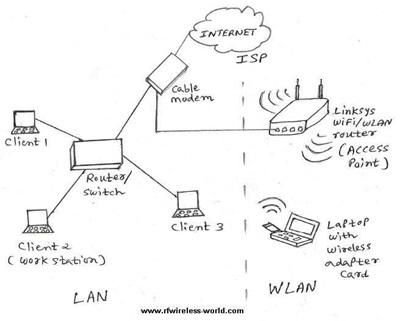
The basic Wi-Fi system consists of a single Wi-Fi router at home that is linked to an ISP (Internet Service Provider) on one side and Wi-Fi Clients (i.e. Stations) on the other. To interface with a Wi-Fi router, a cable modem or a compatible modem is usually required, depending on the technologies used by the ISP. ISPs have been using a variety of technologies to deliver internet access to users over the years, including dial-up internet, ADSL/SDSL, cable internet, ISDN, Ethernet, fibre optic, satellite, Wi-Fi, and cellular broadband.

Wi-Fi Network Architecture at Home

A Wi-Fi router enables several wifi-enabled smart devices to share a single internet connection. As a result, a number of individuals can use a single high-speed internet connection comfortably and economically. Connections to ethernet or ethernet ports are available on the Wi-Fi router. With the help of these, desktop PCs or laptops equipped with 10/100/1000 Mbps LAN devices can be readily connected to these ports using ethernet cables. Wi-Fi hotspots are deployed in shopping malls, airports, railway stations, and at business enterprises to provide internet access to customers or passengers using Wi-Fi routers. These Wi-Fi routers are linked to an ISP.

Wi-Fi network for moving trains: The Working

wifi on train image 2

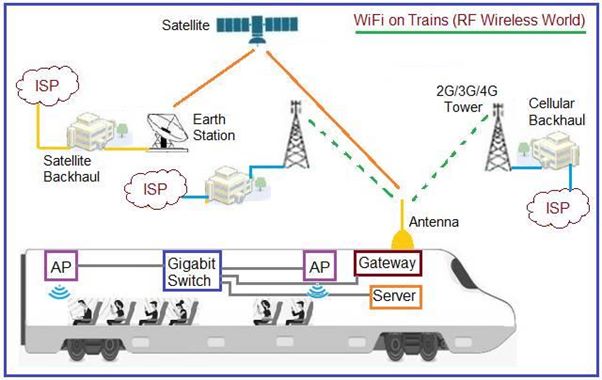
Internet access requires a connection to an ISP via various wired or wireless technologies. Wired technologies are generally ineffective and cannot be used when the train is moving at high or low speeds. As a result, cellular or satellite technologies are required to give internet connectivity to train passengers via EM (Electro-Magnetic) waves.

Wi-Fi architecture for onboard trains

Each train compartment has one or more Wi-Fi routers or access points (APs). Using Ethernet cables, all of these APs are linked to a multi-port gigabit switch. The Multimedia Server is linked to a gigabit switch through an Ethernet wire to aid in the configuration and monitoring of all APs and gateways. The WAN gateway is the equipment that connects APs inside the train to the outside network (cellular or satellite). Gateways accomplish this through the use of specifically designed rail antennas mounted on the train’s roof. Multiple WAN gateways are deployed in the trains based on user requirements.

Wi-Fi/Cellular architecture: Covered metro stations and rail tunnels

It is difficult to provide internet connectivity on trains when they are in underground stations, covered metro stations, or tunnels. There are numerous approaches that can be used in such situations. Repeater-based applications and solutions were used in tunnels initially. In the method, a series or ordered set of repeaters are placed between APs located on opposite ends of the rail tunnel. These WLAN APs are linked to a cellular tower on the track side.

Wi-Fi/Cellular architecture for covered metro stations and rail tunnels

wifi on train image 3

A different approach is being developed, which shall make use of the most recent 5G NR cellular infrastructure. 5G NR RRUs and BBUs are linked together in this system via Optical Fibre Cables (OFCs) and Optical to-RF and RF to Optical converters. In hyperloop technology, a number of WLAN APs are also installed inside the rail tunnels or capsules. OFC is used to connect these several WLAN APs.

Advantages of Wi-Fi on board trains

Railway operators are in a better position than other modes of transportation to provide a more comfortable and convenient passenger experience. The provision of on-board high-speed broadband connection is an important service available to the pasengers. While private passengers shall have the facility of fast internet access, video streaming, and online gaming, business travellers would be benefitted by the ability to work while travelling. Simultaneously, the availability of broadband on trains shall enable rail operators to roll out applications such as video monitoring for greater security, enhanced ticketing and seat reservation services, and other technologies that can access data online to help optimise procedures and decrease operational costs. Onboard broadband connectivity enhances the passenger experience while also contributing to increased railway operating efficiency.

On-board Wi-Fi facilities are helping rail operators, personnel and passengers in the following ways: 

(i) Connected passenger

  • Information and entertainment
  • Internet access

(ii) Connected staff

  • Handheld PC for ticketing
  • Passenger counting system
  • Train monitoring

(iii) Connected fleet

  • Train monitoring
  • Surveillance cameras
  • Driver decision support

The generic benefits or advantages of Wi-Fi on board trains can be stated as under:

  • The Wi-Fi service allows travellers to stay in touch with friends and family while travelling.
  • Business people can continue working while riding the trains.
  • Since the service being nearly free, passengers may spend their time by watching films or listening to their preferred music.
  • Train accidents or minor issues in trains can be easily reported from remote hilly regions to their controlling stations located kilometres away.
  • The system enables train control in real-time.
  • It facilitates the deployment of safety-related applications such as CCTV streaming, door clearance, mission essential voice, and passenger information systems.

 Disadvantages

Installing complete solutions on all trains is prohibitively expensive. The system’s benefits and downsides are largely determined by the precise technologies used to provide internet connection in the train. The same can be inferred based on various railway-bound technologies such as ethernet, Wi-Fi, cellphone, satellite, and so on.

RailTel

RailTel, a Central Public Sector Enterprise, a ‘Mini Ratna (Category-I)’ company, is an ICT provider as well as one of the country’s largest neutral telecom infrastructure providers, with ownership of a Pan-India optic fibre network availability. The OFC network covers country’s major towns and cities, as well as some rural areas. RailTel was founded on September 26, 2000, with the goal of modernising the existing telecom system for train control, operation, and safety, as well as generating additional revenue by establishing a nationwide broadband and multimedia network and laying optical fibre cable along railway tracks using the right of way. 

RailTel’s optic fibre network currently spans over 61000 route kilometres and 6108 railway stations across India. Its city-to-city access spans over 21000 kilometres across the country. 

RailTel’s various operations have been certified for Tier-III (Design & Facility), ISO 27001:2013 Certified for Information Security Management System, ISO 20000:2018 Certified for Service Management System, ISO 9001:2015 Certified for Quality Management System, ISO 27017:2015 Certified for Cloud Security, ISO 27018:2019 Certified for Data Privacy in Cloud Service, ISO 27033 Certified for Network Security, and CMMI Maturity Level-4 Certified for Process Improvement.

RailTel has a strategic relationship with the Indian Railways and works on a wide range of projects, including providing mission critical connectivity services such as IP-based video surveillance systems at stations, ‘e-Office’ services, and implementing short-haul connectivity between stations as well as long haul connectivity to support various organisations within the Indian Railways. RailTel additionally provides a number of passenger services, such as content on demand and Wi-Fi, across important railway terminals in the country.

RailTel believes that their experience and expertise in handling and undertaking telecom and ICT projects, has led themselves to be opted for implementation of various mission-mode projects for the Government of India, including rolling out the National Knowledge Network, Bharat Net (formerly, the National Optical Fiber Network) and USOF funded optical fiber based connectivity project in North East India.

RailWire

RailWire is a community-based broadband internet service provided by RailTel in collaboration with over 8000 communities in India. RailWire broadband, launched in 2008, is provided across India using a 61,000+ kilometre optic fibre network that runs through exclusive right of way along the train tracks.

RailWire Wi-Fi Experience

RailTel has supplied state-of-the-art public Wi-Fi under the brand name Railwire with the objective of transforming railway stations into platforms for digital inclusion. RailTel’s RailWire Wi-Fi is currently available at 6108+ stations. This is one of the world’s largest and fastest public Wi-Fi networks. RailTel wishes to provide Wi-Fi at all railway stations (excluding halts), and only just a few hundred stations remain to be covered and reach the milestone of all station coverage. Passengers can use this service to stream High Definition (HD) videos, download movies, songs and games, and carry out office work online within the station boundaries.

Every day, the first 30 minutes of Wi-Fi access at 1 Mbps speed is free. To use the Wi-Fi facility at a greater speed, the user must select a plan with a higher speed and pay a little cost. Excluding GST, the plans ranges from Rs. 10/day (for 5 GB at 34 MBPS) to Rs. 75/30 day (for 60 GB at 34 MBPS). To acquire a plan online, customers can use a variety of payment methods such as net banking, wallets, and credit cards. Advertisement-based monetisation has been planned to further monetise the infrastructure developed.

Using Wi-Fi at Stations :

  • Switch on the Wi-Fi mode on the smartphone
  • Select the RailWire Wi-Fi network
  • Enter Mobile and get one-time password (OTP) through SMS
  • Enter OTP and start accessing High-speed Wi-Fi

Railway Signalling

Safety, in addition to efficiency, is an important objective for Indian Railways. RailTel has been tasked with the project of replacing the existing mechanical signalling system with a modern electronic interlocking signalling system at 26 Northern Railway stations. Work at ten stations has been completed, and work on the remaining stations is underway and is in progress. This replacement shall improve the operational efficiency and safety. 

The new Electronic Interlocking signalling system shall allow for signal lowering and track switching with the click of a mouse. Previously, mechanical interlocking systems used standard 1 interlocking system with a maximum speed of 50 kmph. With a modern, sophisticated electronic interlocking system, the standard of interlocking has been updated to Std-II with a maximum speed of 110 kmph. Thus, the new electronic systems are not only improving the safety and efficiency of railway traffic, but also increasing its speed.

Summary & Conclusion

By making Internet access more widely available, cellular networks enable new services. Their rising coverage, dependability, and speed enable enterprises and end users alike to take advantage of new opportunities, while also increasing reliance on Internet availability for daily activities. Certain places, however, do not have consistent cellphone coverage. A common example is railway networks, which might span extensive runs along desolate areas where deploying a cellular network would be prohibitively expensive. Even in regions where coverage exists, passengers’ access to cellular networks is hampered by signal attenuation caused by the train’s own body. Some travellers may also encounter significant roaming fees when using the Internet. In addition to passengers, M2M units and train crews could benefit substantially from network connectivity, but they confront the same difficulties.

 In order to access the Internet aboard a moving train, different approaches can be followed.

  •  The first alternative is for the cellular network operator is to install more cellular capacity along the railway tracks. This technique is rarely cost-effective, and in any case, signal reception is still hindered by the train’s coachwork. Additionally, passengers must have a cellular contract with the particular operator in order to gain network connectivity.
  • Another possibility is to utilise signal repeaters (which may even be installed on the train). This is only possible in locations where there is some signal to begin with, and network capacity is severely impacted.
  • Establishing an independent network aboard the train is a preferable solution. M2M systems can be linked via Ethernet wiring, and Wi-Fi can be provided to reach every corner. An onboard router manages upstream connections and can integrate various network access technologies (such as cellular with external high-gain antennas, satellite, and Wi-Fi along the tracks) to provide failsafe and high-speed connectivity. Additional routers may also be placed to ensure greater redundancy.

Having a comprehensive network with high-speed Internet connectivity aboard the train offers up many new options for streamlining rail operations while also creating customer loyalty by providing an incentive to go by train rather than driving or travelling by air. Among the many new services that can be provided, some connected to train operation can be mentioned, such as:

  • For security purposes, real-time central access to on-board cameras.
  • Management and Remote monitoring of on-board systems. However, passenger-oriented services must not be overlooked.
  • Free or low cost internet access.
  • Maps, train schedules, and adverts displayed on inside screens.
  • Access to on-board restaurant or cafeteria for orders.

When implementing many services, the train’s routers must ensure that they all work independently and do not interfere with one another. The routers must also ensure that when there is minimal bandwidth available, the most vital services are prioritised. Further, it is also crucial to protect sensitive data using powerful encryption techniques, as well as facilitate flexible management and failsafe operations. Train operators must streamline their operations and develop new ways to secure consumer loyalty in order to remain competitive in an increasingly complex industry. Having full Internet connectivity on the trains is a low-cost solution to quickly improve both of these areas.

Advertisement1
InnoMetro_2026

Delhi-Meerut RRTS: Priority Stretch Ready for Public Services, DB RRTS Operations Takes Charge

0
Rapidx Train/Representational image
Representational image

DELHI (Metro Rail News): Delhi-Meerut RRTS Corridor’s 17 Km priority stretch is prepared for commissioning to the public services. The Ministry of Housing & Urban Affairs and the relevant state governments are working together to execute the RRTs corridor through a special purpose organisation called National Capital Region Transport Corporation Limited (NCRTC). Before the 17 km section between Ghaziabad and Duhai is put into service, the project is turned over to DB RRTS Operations India Private Limited (a subsidiary of Deutsche Bahn E.C.O Group) for operations and maintenance of Rapidx trains for a 12-year period.

There will be five RRTS stations along this line, located in Sahibabad, Guldhar, Ghaziabad, Duhai, and Duhai Depot.

According to an NCRTC official, “The system has undergone the necessary testing, and the trial runs of the RAPIDX trains have been successfully completed.” Deutsche Bahn India has also taken over the management & maintenance of the system.

A 12-year contract for Rs. 1493.08 crore was granted by the NCRTC to DB Engineering & Consulting (International Operations) way back in July 2022 for the operation and maintenance of the 82.15-kilometer Delhi-Ghaziabad-Meerut Regional Rapid Transit system (RRTS).

On the Delhi-Meerut RRTs route, DB IO will run 40 RRTS trains in addition to being in charge of maintaining the rail network. The network is anticipated to accommodate more than 800,000 passengers per day if fully operational. Beginning in 2023, operations will be introduced gradually, according to a statement from DB International Operations.

The Semi-high speed Rapidx trains are being provided to NCRTC by the French multinational enterprise Alstom Transport. As part of the Indian government’s “Make in India” initiative, Alstom’s Savli Coach Facility Centre in Vadodara, Gujarat, is producing the trains.

Between Delhi and Meerut, the proposed regional rapid transit system will reduce travel time by almost 70%, giving a big relief to the commuters.

Advertisement1
InnoMetro_2026

Alstom Emerges as the Lowest Bidder for ₹30,000 Crore Contract of 100 Aluminium Vande Bharat Trains

0
Vande Bharat Express
Vande Bharat Train/Representational image only

NEW DELHI (Metro Rail News): Alstom, a French railway company, has come up as the lowest bidder for the manufacturing & maintenance of 100 Vande Bharat trains with aluminium body. The contract is worth ₹30,000 crore. According to reports, Alstom bid ₹151 crore per trainset, which is 11% lower than the second lowest bid made by a consortium of Staddler and Medha with the bid of ₹169 crore per trainset.

A total of 13,000 crore would be paid to the successful bidder upon delivery of the trains, and an additional 17,000 crore will be paid over a 35-year period for maintenance.

On February 23, technical bids for the tender went live, with only two players getting selected.

By the first quarter of 2024, Indian Railways hopes to introduce the first Vande Bharat sleeper train. Up till this point, the Railways has given contracts for the production of 200 Vande Bharat sleeper trains and 102 Vande Bharat chair trains.

Railway experts believe that aluminium trains are more efficient at higher speeds and lighter compared to stainless steel trains.

Advertisement1
InnoMetro_2026

Safeguarding Delhi’s Heritage: DMRC Implements Real-Time Monitoring for Tunneling

0
DMRC
Delhi Metro/Representational Image

DELHI (Metro Rail News): Delhi Metro Rail Corporation (DMRC) is taking proactive steps to protect century-old structures in congested areas of central Delhi during the tunneling work for the RK Ashram Marg and Janakpuri West under Phase IV. To achieve this, DMRC will introduce a real-time web-based monitoring mechanism to supervise the condition of these buildings.

In the specified corridor, there will be three underground metro stations: Derawal Nagar, Ghanta Ghar, and Pulbangash. These areas are known for their congestion and numerous old and dilapidated buildings. The real-time monitoring of these areas will be carried out from eight different locations, which are spread across  Derawal Nagar, Pulbangash, Nabi Karim, Sadar Bazar and Ghanta Ghar.

According to an official, “DMRC will continuously monitor the condition of these structures once the tunneling work begins. They will utilize gadgets such as Automatic Total Stations (ATS), vibration sensors, tilt meters, and load cells to capture and transmit real-time data to a central system. This data will be processed and shared with stakeholders through text messages and email.”

The ATS will determine the position of monitoring points by measuring angles and distances. Additionally, for its tunnel boring machines, DMRC plans to implement the advanced Beam system (Bore Tunneling Electrical Ahead Monitoring). This system allows the TBM to predict geological structures up to 20 meters ahead, helping to prevent unexpected encounters with filled wells, cavities, and aquifers that may cause ground settlement.

Advertisement1
InnoMetro_2026

Mumbai Metro Ensures Commuter Safety with Comprehensive Insurance Coverage

0
Mumbai Metro Line 6
Representational Image

Mumbai (Metro Rail News): The Maha Mumbai Metro Operation Corporation Limited has taken crucial measures to ensure the safety of its customers by getting annual comprehensive insurance coverage for everyone who uses metro lines 7 and 2A (Gundavli-Dahisar-Andheri West).

Depending on the severity of the circumstance, the policy offers up to Rs. 5 lakh in compensation for death and up to Rs. 4 lakh for whole and partial disability.

Shri S V R Srinivas, Chairman and Managing Director of MMMOCL, emphasized the importance of securing passengers’ commutes for unforeseen circumstances. Alongside other safety and security measures, providing comprehensive insurance coverage to valued customers is a priority for MMMOCL.

With these measures, Mumbai Metro is committed to providing its passengers with a safe and seamless travel experience.

Advertisement1
InnoMetro_2026

TBM “Amrit” Commences the Longest Tunneling Drive for Delhi Metro Phase 4 Project

0
TBM Amrit commences tunneling of a 2.67 km long tunnel from Airforce Station, Tughlakabad to Maa Anandmayee Marg station

DELHI (Metro Rail News): The second tunnel boring machine (TBM) for the under-construction Silver Line in Delhi Metro’s Phase-IV project has commenced its work at Airforce Station, Tughlakabad. The tunnel boring machine, named ‘Amrit,’ will undertake the excavation of a 2.67 km long tunnel from Airforce Station, Tughlakabad to Maa Anandmayee Marg station. This remarkable tunneling effort will be the longest drive during Phase 4 of the project.

Dr. Vikas Kumar, MD, DMRC inaugurating tunneling work by TBM Amrit
Dr. Vikas Kumar, MD, DMRC, inaugurating tunneling work by TBM Amrit

Previously, on March 3, the first TBM initiated its drive, excavating a 1.27 km long tunnel connecting Chhatarpur and Kishangarh stations. The expansion work under Phase-4 involves the construction of 65.20 km of new lines across 3 different corridors in Delhi, featuring 45 metro stations.

TBM Amrit

The three corridors in Phase-4 include the extension of the Magenta Line, which connects Janakpuri West to RK Ashram Marg (28.92 km), the extension of the Pink Line connecting Majlis Park to Maujpur (12.55 km), and the upcoming Silver Line linking Tughalakabad to Aerocity (23.62 km). The Silver Line will link the operational Violet and Airport Lines.
There will be fifteen stations along the Aerocity–Tughlakabad corridor—four elevated and eleven subterranean. It will also include four interchange stations at Aerocity, Saket, Chattarpur and Tughlakabad.

The Silver Line’s alignment will make it simple for commuters from a variety of locations, including as terminal 3 at Indira Gandhi International Airport, south Delhi, Vasant Kunj, IGNOU, and Mahipalpur.

Advertisement1
InnoMetro_2026

Delhi Govt. Allocates Additional 500 Crore Rupees for Delhi-Meerut RRTS Corridor

0
Rapidx train
Rapidx train/ Representational image only

DELHI (Metro Rail News): The rapid rail transit system known as RAPIDX is now being built along the Delhi-Meerut corridor thanks to a second 500 crore contribution from the Delhi government. According to senior Delhi government officials, the money came from the environment compensation fee (ECC) that is collected from cargo vehicles entering the capital.

Out of the entire contribution of 1180 crore rupees for the first corridor of the Delhi-Meerut RRTS, the Delhi government has contributed 765 crore rupees.

To improve connectivity and reduce travel time and congestion, the government is also planning two more corridors: one connecting Delhi to Alwar and another connecting Delhi to Panipat. These corridors will benefit satellite towns and help decrease pollution on highways.

The Delhi Government was given permission by the supreme court to use the ECC budget to pay for its portion of the first corridor in April of this year. In response to the court’s ruling, the government made the first payment of 265 crore rupees in March 2019. Later, the remaining 415 crore rupee payment for the Meerut corridor would be made. 13 km of the 82.2 km long Delhi-Meerut project is inside Delhi’s administrative boundaries.

Advertisement1
InnoMetro_2026

Need for More Coordinated Efforts on Infra Development

0
Representational image only

With globalisation playing an increasingly important and influential role in societies and markets in the twenty-first century, the development of new transportation infrastructures that allow for the efficient movement of people and products is important. Transportation through railways has played an important role in this context, adding to the country’s long-term development in terms of both economic growth and social development. This mode of transportation has several advantages over others, the majority of which are related to lower transportation costs, reduced environmental impact, and better safety. Furthermore, the reduction in journey time due to increased speed and the improvement in passenger comfort add to rail transport’s enhanced competitiveness.

Significant investments have been made in recent years in the development of new railway infrastructure as well as the rehabilitation and upgrading of existing lines. Many of these lines contain a large number of essential infrastructure elements, such as bridges, viaducts, and embankments, whose operational and safety conditions must be maintained by infrastructure managers throughout their life cycle.

Recent advancements in science and technology have made it possible to evaluate the structural condition of railway infrastructures more efficiently, primarily through the implementation of intelligent inspection, monitoring, maintenance, and risk management strategies. Also, investment in the development of faster and lighter trains presents significant challenges in terms of the energy efficiency of this type of transport system. 

After China, India is one of the world’s fastest-growing economies, and it needs to continue its development momentum in order to improve its overall standard of living and reduce poverty. Investment climate surveys, such as doing business in India, consistently demonstrate that limited and poor-quality infrastructure facilities are a major barrier to business development in India. The main issues in India’s infrastructure sector include infrastructure funding, land acquisitions, environmental clearances, private sector involvement, a stable policy framework, institutional setup, tariff policy, and others. Amidst the government’s limited resources to finance the planned infrastructure projects and incur expenditure, the environment for infrastructure growth through both public and private investments needs to improve. This can only be accomplished by establishing a more stable and secure policy framework, protecting property and consumer rights, and implementing suitable pricing and subsidy policies.

In addition, the government may provide guarantees and other forms of assistance to ensure the trust and viability of infrastructure projects in order to attract private investment. The government can also entice foreign investors into the infrastructure industry by allowing up to a hundred per cent foreign equity in almost all infrastructure sectors. To address the issue of infrastructure funding, a number of studies suggest various methods to improve financing options to meet the massive infrastructure investment. Land acquisition laws must be revisited in order to facilitate appropriate rehabilitation and compensation packages.

The best option is decentralised negotiation between the necessary authorities and landowners. Proper institutional setup for each transport infrastructure sector is required, but efforts are required for a coordinated strategy among roads, trains, airports, and ports to ensure effective and efficient interlinking of infrastructure services. Since, the majority of infrastructure services are being built through contracts by private operators, project design, cost and time estimation, and others must be done in a scientific manner to prevent delays and cost overruns. 

Advertisement1
InnoMetro_2026